
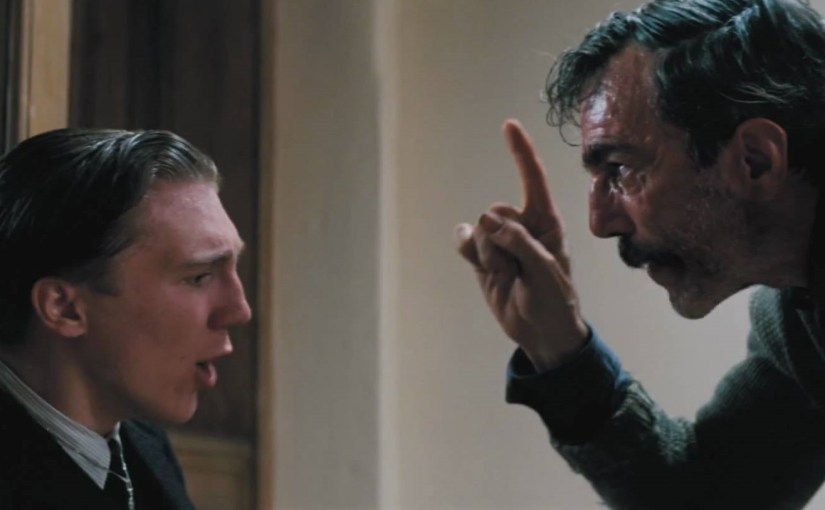
by Miguel E. Rodriguez
Director: Paul Thomas Anderson
Cast: Daniel Day-Lewis, Paul Dano, Ciarán Hinds
My Rating: 10/10
Rotten Tomatometer: 91% Certified Fresh
PLOT: A story of family, religion, hatred, oil, and madness, focusing on a turn-of-the-century prospector in the early days of the business.
My first draft of this review got up to nearly 1300 words before I realized I was just spinning my wheels. This is quite simply one of the most original, most daring, most engrossing films of the new millennium that I have ever seen. And after a while, my first draft became just a list, ticking off and describing scenes that I feel make it great, rather than a precise review.
So instead of giving a full film summary, which you can find elsewhere online, I’m going to try and instead give an actual review. I’m going to gush a little bit (no pun intended), because it’s a masterpiece, but I’m just going to have to live with that, I guess.
When I first saw this movie (with my good friend Marc Sanders, as it happens, at a free preview), I remember leaving the theater feeling inspired. Daniel Day-Lewis’s Oscar-winning performance in There Will Be Blood has, to this day, been in the back of my mind every time I’m on stage, whether it’s a drama, comedy, or whatever. It genuinely makes me want to be a better actor. Oh, I’ve seen great performances before from the likes of Nicholson, Hoffman, O’Toole, and the rest, but there’s something about the laser-like intensity of Day-Lewis’s performance as Daniel Plainview that had me gawping at the screen in awe as the film played out. I can’t fully explain it. It was, and remains, a religious experience to behold.
(For those of you unfamiliar with the story, Daniel Plainview is a turn-of-the-century prospector who thrives in the early days of the oil boom in America, but when his ambition crosses paths with a fire-and-brimstone preacher named Eli Sunday, things get a little testy.)
So, there you go, the acting is not just top-notch, it’s revelatory.
But then there’s the movie itself, exhibiting a level of craftsmanship I haven’t seen since the heyday of Stanley Kubrick. The plot itself reads like one of those summaries of films that great directors dreamed of making, but were unable to for various reasons, like Kubrick’s unrealized biography of Napoleon. I mean, who wants to see a 160-minute movie about oil drilling? Why would anyone care? Why should anyone care?
Director Paul Thomas Anderson’s ingenuity relies heavily on the acting and casting choices, and of course the ingenious screenplay, but any discussion of the film also has to mention the score. As much as any other element, the film’s musical score creates and sustains a mood of dread and suspense over such banal scenes as pipeline being laid, oil derricks being built, men surveying land, etcetera. The atonal and urgent score suggests that what we’re seeing is the prelude to some sort of apocalyptic event or incipient bloodshed. It keeps you on the edge of your seat, as if around the corner an earthquake or mass murder is waiting.
(Sometimes the ABSENCE of the score is just as disturbing, as in the scene in a church when Daniel Plainview is reluctantly baptized, or most of the scenes in the finale, taking place in 1927.)
But ticking off these technical details still feels lacking. This is the second draft of this review, and I still feel as if I’m not getting across how much this movie works on the viewer. Or, at least, how it worked on ME. This was only the third time I’ve watched the movie since first seeing it in 2007, and I was hooked all over again, right from the opening shot, with those dissonant strings playing over a panorama of sunbaked hills and scrub brush.
The movie just FEELS perfect. It’s anchored by Daniel Day-Lewis, who is in literally every scene except two that I can recall. But the artistry of everything else at play is just…I am at a loss for words. It is, as another review puts it, “wholly original.” There is just nothing else like it. Sure, it’s definitely inspired by Kubrick, but it takes things to another level.
It’s one of the best films I’ve ever seen.
 2 UNPAID MOVIE CRITICS!!!!