
CODE OF SILENCE

By Marc S. Sanders

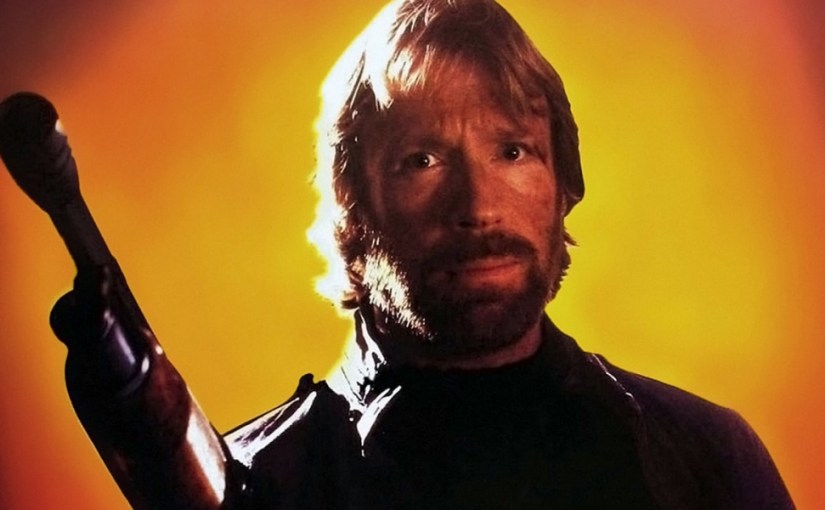
I must admit I have not watched many Chuck Norris movies. Just a handful here or there like The Delta Force, but on my radar to catch was always the cop thriller from 1985, Code Of Silence. I always intended to watch it someday as the film is highly endorsed by Siskel & Ebert. As well, it’s directed by Andrew Davis, the skilled filmmaker who would go on to direct The Fugitive and Under Siege.

Code Of Silence works in two ways; two stories that live up to the title. Norris is a Chicago cop named Eddie Cusack who heads a squad of under covers within the city. The film opens with what is supposed to be a well-planned drug bust that goes wrong when the one mob faction is overrun by another mob. Cusack’s informant as well as others turn up dead just before his band were to move in with arrests. Nearby, two of Cusack’s men come upon a young, unarmed man. The rookie officer witnesses the elder officer accidentally shoot the kid, and afterwards he plants a pistol in his hand to make it look like self-defense.

Now Cusack has to contend with a mob war in the streets where a boss’ daughter (Molly Kagan) is the only survivor of an attack and he must protect her. While at the same time he has to deal with his squad turning on him because he knows what the elder cop really did. The code of silence motif is expected to be honored in both camps. Personal vendettas and violations of police policy need to remain quieted.

The film belongs to Norris exclusively. Andrew Davis allows some of the action star’s kickboxing skills to work their way into the movie, and it all becomes a sidestep dance routine really. It always amuses me in these action pictures where the star will take on twenty guys at once yet he fights one or only two of them at a time. The other eighteen or nineteen thugs wait their turn. Why not just have all of them tackle Norris all together? No. Then we wouldn’t get his outstretched 360-degree roundhouse kicks in the air.

There’s also an unnecessary cop robot contraption that Norris pilots for the climactic action packed ending. This thing looks a rejected auditioner for the role of Johnny 5 in Short Circuit. The robot must have been too tall for the part and rather clunky. It has no relevance to either storyline and was obviously inserted for fun, campy violence of fireballs and explosions in the necessary old, abandoned warehouse where all of these actioners have to take place.

Fortunately, Code Of Silence has good story material to work with, and some thrilling stunt work including Chuck Norris pursuing a bad guy on top of a moving elevated train that makes its way with an eventual leap into the river. From what I could tell, that was really Mr. Norris himself in that whole scene. Good footage here.

Andrew Davis relies on what would become regular side characters that appear in many of his other films including Ron Dean and Joseph Kosala. They always make for good cop antagonists within the Chicago settings of his films. Norris is also good in a quiet Clint Eastwood kind of manner as he holds his own beliefs against the rest of his department who support the elder cop.

I like the conflicts that happen on both sides of the law in Code Of Silence. Sure, it’s got some silliness to it with the kickboxing and the gigantic, cop robot that shamelessly waddles along, but the two stories hold up by keeping me engaged of their outcomes.

Code Of Silence is a pretty effective thriller.
THE DELTA FORCE

By Marc S. Sanders

In the 1980s, a small production company named Cannon Films was started by an Israeli named Menachem Golan.  It churned out at least a dozen Charles Bronsan cheapy crime dramas and gave longevity to his Death Wish series of films.  Cannon also provided another franchise called American Ninja with action star Michael Dudikoff.  Dudikoff, nor any of his films won an Oscar, much less a Golden Globe or even an MTV Movie Award.  The poor guy with twenty bottles of mousse in his hair didn’t even get turned into an action figure. 

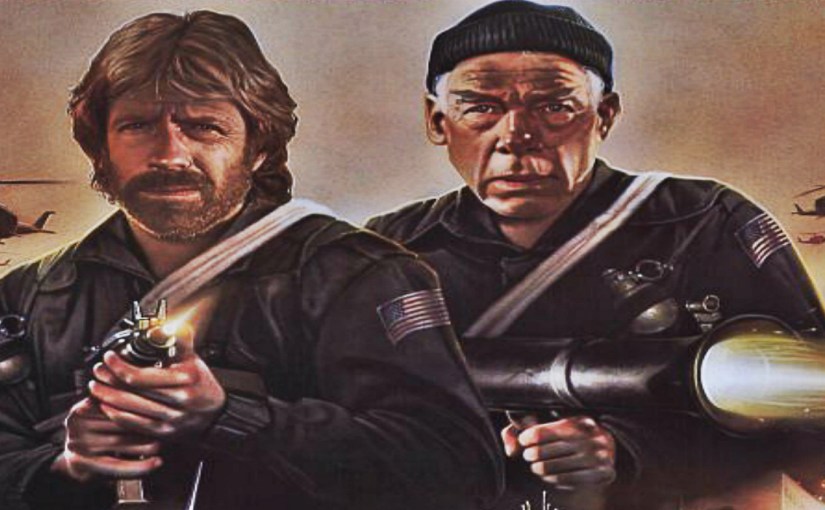
While I did see Death Wish 3, ahem…five times in the movie theatres (I mean there’s an outstanding final thirty minutes of a wall to wall shootout action in that film, and it was all a 13 year old boy yearned for at the time), Golan’s best product that I have at least seen to date is The Delta Force, featuring Chuck Norris, Lee Marvin and a host of stars most recently having been featured in every disaster film to crank out of the 1970s; Shelly Winters from The Poseidon Adventure, Robert Vaughn from The Towering Inferno and George Kennedy from every Airport movie under the sun.

Golan directed this film that was inspired by the 1985 hijacking of a TWA flight heading for Athens, Greece and he pretty much directed two different kinds of films in one.  The first hour focuses on the Libyan hijackers, led by an unrecognizable and terrifying Robert Forester, and their hostages.  A plane carrying mostly Americans is taken captive in midair and is diverted to Beirut.  Like the real-life event, a German born American stewardess is forced to select the Jewish passengers (Winters, Lanie Kazan, Joey Bishop and Martin Balsam) and separate them for an unknown fate.  An American Navy serviceman is also brutally tormented and later, an airline pilot (Bo Svenson) is interviewed by the media from the open window of the grounded plane’s cockpit, complete with a gun to his head.  All of this happened during that harrowing event.  Golan does a very good job of capturing these moments with heartbreak, fear and genuine terror.  The Jewish selection process is a scene that I take very personally, and it is not overdramatized as it glaringly hearkens back to the atrocities of the Nazis who sent millions of Jews to certain death, torture and concentration camps.  Remember, this film was released only 40 years after those terrible events.  Golan’s filmmaking makes certain the Holocaust is never forgotten.

Sprinkled throughout these first hour scenes are bits and pieces of the American strike team known as The Delta Force, led with gruff command by Lee Marvin and silent but deadly Chuck Norris.  These guys gear up, dress in black uniforms, load their aircraft carrier with motorcycles and armed dune buggies, listen to Marvin’s instructions and wait and wait and wait.  There’s something to appreciate in the wait of these skilled snipers and specialists.  Golan doesn’t rush the action.  Material is depicted showing Marvin, Norris and company exploring the options they have for taking out the terrorists and rescuing the hostages.  This is not a typical Rambo movie of destroying the village just to save it.  However, once the action starts, it doesn’t stop and Golan lets Norris do all the things he’s known for while arguably inspiring how POWERFUL Chuck Norris is compared to…well…anything else.  Don’t forget!  Inside Chuck Norris’ chin is ANOTHER FIST!  Also, Superman wears Chuck Norris underoos!  Chuck Norris can unscramble an egg!  Chuck Norris made a snowman out of rain!  It’s hard not to deny these claims when the film boasts a strike team consisting of 20-30 members, but Norris seems to do all the work and heavy lifting. 

It’s hard not to get caught up in The Delta Force.  You wanna see these terrorists get blown up real good.  You also wanna see Chuck Norris ride an agile moped equipped with an endless supply of missiles and ammunition ready to overturn enemy vehicles and bloody up a bad guy until he screams and turns on one foot before dropping dead with his eyes opened.  You also may get a jolt of energy from Alan Silvestri’s rah rah theme music that quickly stays embedded in your subconscious.  I read that his music was used for a time when the Indy 500 would air on TV.  That does not surprise me at all.  Its symphonic themes are as memorable as the Monday Night Football tune.

Unlike, other Norris films this crowd pleaser doesn’t just rely on him and his roundhouse kicks.  There’s a little bit of that schtick for the fans, but I gotta say I was truly touched by the cast as whole.  Lee Marvin (in his final film) echoes George C Scott’s portrayal of Patton.  The collective hostage cast are not overdramatized here.  Golan managed to capture a history to them.  While I thought Shelley Winters was a such joke for fodder in Poseidon, here she is truly sorrowful as she is separated from her husband played by Balsam.  Kazan and Bishop are equally touching.  Reader, this Jewish guy originally from New Jersey, who attended ten years of Yeshiva education, recognizes these folks when they are spirited vacationers early on, and then later tormented prisoners who’ve faced horrors like this before.

I know that Cannon Films also produced another favorite called Runaway Train with an Oscar nominated performance from Jon Voight.  As I write this column, I’ve yet to see that film.  It’s on my radar.  That being said, I have to wonder if Golan and company had stayed on this trajectory of genuine drama like he mustered in portions of The Delta Force, what powerfully impactful films might he also had up his sleeve.  Unfortunately, we were left with too much excess like American Ninja, I’m afraid.

Still, after watching The Delta Force you’ll absolutely believe that Chuck Norris can see things that don’t exist and that he counted to infinity…twice!