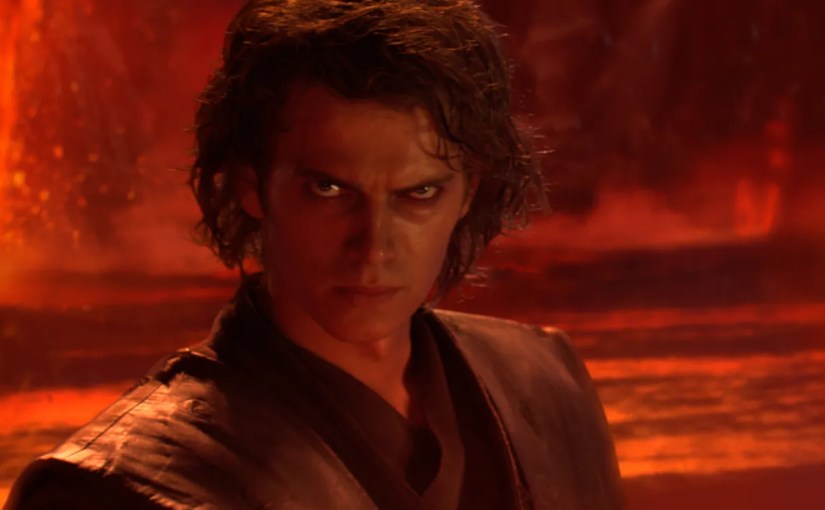
STAR WARS EPISODE III: REVENGE OF THE SITH

By Marc S. Sanders

Star Wars Episode III: Revenge Of The Sith is the best installment in George Lucas’ prequel trilogy of his epic space opera saga. However, that is where the line is drawn.

It carries a heightened drama thanks primarily to Ian McDiarmid as the eventual Emperor Palpatine. Shakespeare might have been proud of the character and performer. Much like Alec Guinness received an Oscar nomination for his portrayal of Ben Kenobi, so should McDiarmid have been honored playing an antithetical influence (of Kenobi) on the student and Jedi in Training, Anakin Skywalker (Hayden Christensen in a much more improved performance).

War within the galaxy is rampant and there’s no end in sight. The Jedi Order is overwhelmed. Anakin is used as a pawn to spy on his new mentor Palpatine who in turn insists that the young Jedi occupy a chair in the Jedi Council to spy on them. In addition, it’s hard for Anakin to come to grips with his secret wife Padme (Natalie Portman) dying from childbirth as his nightmares continue to remind him. A deal with the devil himself in Palpatine is offered as an option. Can a manipulation in the Force rescue Padme from death?

There’s a lot of weight on Anakin here. Sith departs from the politics discussed in the prior entries as it focuses primarily on Anakin’s personal struggles. The film really needed to take this direction. After all, it’s time to witness Anakin’s transformation into Darth Vader. Everyone has been dying to see that.

George Lucas’ scene set ups work on occasion. A great performance of dialogue occurs in an alien opera box between Palpatine and Anakin. This is where McDiarmid really comes through. He’s subtle and deliberate in his influence. Fortunately, Christensen just needs to listen mostly.

Later however, a scene works only so much when Samuel L Jackson as Jedi Master Mace Windu duels with Palpatine, having just revealed his secretly evil Sith side. Through all three of these films, Mace Windu has been one of Jackson’s least exciting roles. He’s bland and never doing much. Christensen comes upon this scene and doesn’t give me the genuine anguish I was hoping for. McDiarmid, again, is hitting home runs in surprise and development. This turning point scene is not as strong as it should have been thanks to Lucas’ stilted direction and writing, along with Jackson and Christensen lacking any true depth.

Episode III also has a handful of so what moments that continually frustrate me in this trilogy. We have to watch Yoda and Obi Wan watch a video of what Anakin has done. Why? We’ve seen this already. Bail Organa (Jimmy Smits; I wish he had a larger role) needs to be informed of an upcoming meeting. Honestly, I don’t need an update on a character’s calendar. Just make sure he arrives on time. Moments like these don’t drive towards anything.

Natalie Portman is not served well as a pregnant Padme. Her dialogue is worse than ever, and it hinders her performance. Padme is torn between her affection for Anakin and her passions for democracy. We see next to none of the latter. How does an intelligent woman like Padme suddenly become so unaware? Ironically, opportunity for her political nature was filmed but remains only as deleted DVD features. These scenes would have enhanced the movie as they imply the foreshadowing of the upcoming Rebellion, while a petition attempt is mounted to usurp the Emperor’s administration. Here, Padme is trying to be instrumental in Luke & Leia’s (her own children) future. Really good material here. Nevertheless, George Lucas opted to leave it all on the cutting room floor. Oh well! I’m still holding out hope for a “special edition” cut one day, inclusive of this storyline.

Lucas’ lava planet, Mustafar, is quite grand as the arena for the much-anticipated dual between evil Anakin and noble Obi Wan. Still, again, it could have been better. There’s too much CGI and flashing lightsabers that hide the acting among the swordsmen. Compare this to the duals in Empire and Jedi and you see what I mean.

I know my commentary on the prequels is quite pessimistic, but I do have an (maybe a biased diehard fan) appreciation for the films. The stories work. The execution falls short however in dialogue, performances and visual artificialness.

George Lucas had all the right make up for a trilogy as epic as his original films that began in 1977. Maybe because he didn’t have the monies and technology at that time, his imagination had to work overtime back then. In these later films, however, his hubris got in the way of his craft. So, we have to settle for his next great technological discovery in CGI efficiency. Therefore, we get cartoons with no depth like Jar Jar Binks, General Grievous, and lame, clicking battle droids.

Lucas always defended the position of his writing by insisting these films are aimed for kids. No. I don’t accept that. Star Wars was aimed for kids and the kids that remain in all of us as we continue to grow into adulthood. George Lucas needed to write with that in mind.

STAR WARS EPISODE II: ATTACK OF THE CLONES

By Marc S. Sanders

Star Wars Episode II: Attack Of The Clones is a vast improvement on the prior installment of George Lucas’ prequel trilogy from a galaxy far, far away. Lucas made an attempt to bring his characters out of their shell a little bit. I mean at least they laugh among each another. You need that if you are to believe that Jedi In Training Anakin Skywalker and Padme Amidala (Hayden Christensen and Natalie Portman) are to fall madly in love. So at least have them romp around in a Naboo meadow.

There’s some curious political intrigue in Clones; delving deeper than what Episode I only began to imply. As stilted as some of the dialogue may be, there are ingredients here that allow to me correlate with real life government powers and to date current events. That’s a compliment, but it’s also a shortcoming.

Ian McDiarmid remains the MVP of this trilogy as Chancellor Palpatine, the puppet master with a faux innocent exterior. Anytime he’s on screen you sit up in your chair with a little more focus. He’s brilliant as the manipulator who keeps a short distance on Anakin, the supposed chosen one, while also pushing Padme away from government interference, and yet still managing to prevent the Jedi Order from detecting his true nature. It takes a heck of an actor to pull this off.

At the same time though, the politics take up a large amount of the entire trilogy. While it holds my interest, I still question if this is what a Star Wars film should be comprised of. Where’s the force, and where’s a more defined explanation of what “the chosen one” is to offer, or what the “balance of the force” really means? Some heavy vocabulary in this terminology, maybe, but is there any dimension to any of this? Regrettably, the answer is no.

New characters and planets are introduced. Jango Fett (Temura Morrison), an armored bounty hunter, is the initial antagonist who is part of an assassination attempt on Padme, followed by a revelation that he is the source of a new discovered clone army on a secret water planet known as Kamino. (As a diehard franchise fan, I have a lot of issues with Jango and his pre-teen son Boba, but that is for another discussion.)

Eventually, the antagonism shifts to Christopher Lee as the former Jedi Count Dooku, found to be keeping conference on another secret planet known as Geonosis, where life size dragonflies reside. Lee was legendary by the time this film was released in 2002, but he’s not exactly aggressive enough for me. He was an old man with little convincing agility to be engaged in a lightsaber fight with a very bouncy Master Yoda. In Lord Of The Rings, he commanded from the perch of his tower. Here, Lee is in the mix of the action and he’s a far cry from Ray Park’s appearance as Darth Maul.

Yoda is another issue. Now friends will be quick to remind and tease me over how excited I got when I saw Yoda engage in a climactic lightsaber dual for the first time. My tune has changed though. As The Empire Strikes Back showed way back in 1980, Yoda was convincingly powerful without ever having to prove how powerful he ever was. Here, it comes off gimmicky to me as an excuse to draw a crowd or make a new kind of toy to sell. Just Yoda’s appearance alone should be enough. Now, he’s just like the rest of them. Yoda’s greatest feature was his philosophy, never his combat skills.

I don’t take much issue with the romantic dialogue between Anakin and Padmé. An actor like Leonardo DiCaprio or Billy Zane would sell the “sand monologue” into the stratosphere. Remember, those guys performed James Cameron’s hammy Titanic script. Hayden Christensen could not do that though. His temper, which Anakin is regarded for at this age, is never convincing. It’s terribly overacted. He screeches his dialogue. Darth Vader never had to yell or scream or screech. So why is Anakin? This is also partly Lucas’ fault. Where’s the misuse of the force with Anakin? At one moment, Anakin is upset and throws an object? Why throw an object? Why not “force throw” an object? Anakin demands answers from a captive bounty hunter by screaming at her? Why only scream? Why not “force choke her” or mentally torment her? Don’t you think these ideas, these familiarities we’ve seen with Vader would have held much more dramatic weight and depth?

Lucas stretched himself further than he did on The Phantom Menace. Still, he just didn’t take his second episode far enough. It’s as if he opted not to apply too much effort. There are no twists to Attack Of The Clones. No surprises. We easily have a general idea of where all of this is going long before the opening crawl even begins. So, like its predecessor, Episode II lacks a wow factor that placed the original three films into the greatness they still hold.

There still needed to be more in these films. I’m not gonna even talk about CGI. I’m talking about story, and what makes a saga a Saga. So… WHERE’S THE SAGA?????

THE LORD OF THE RINGS: THE RETURN OF THE KING

By Marc S. Sanders

I remember film critic Gene Siskel once said that to take issue with the length of a film is not entirely fair. After all, you are getting more movie for your buck. Would Siskel have felt that way about The Lord Of The Rings: The Return Of The King? Peter Jackson closes out the film adaptation of JRR Tolkien’s sweeping fantasy with an epic that allows you to marvel at everything you see, but does that mean we want to feel as overly exhausted as its main protagonist, Frodo Baggins, feels? Trust me. Poor Frodo looks wiped.

More battles are enacted in the third film. Jackson just changes the dynamics up a little bit. Now armies don elephants with a number of enormous, curved tusks. Another army has a different looking giant troll. Haven’t seen elephants before. Haven’t seen that kind of troll yet either. As well, there is another King who is apprehensive to cooperate in the fight against Sauran and his Orc minions. There’s also a green glowing ghost army. Meanwhile, Frodo and Sam (Elijah Wood and Sean Astin) continue their journey to Mount Doom where the almighty Ring must be destroyed. Gollum (Andy Serkis) remains as their untrustworthy guide.

Jackson seemingly covers every page written by Tolkien. I’m talking about depicting every dream each character has or line they utter or slow motion expression they offer, or walk that they take. Peter Jackson is a completist.

The Return Of The King won Best Picture along with a bevy of other Oscars. Seemingly it should have won anyway. The first two films were recognized with Best Picture nominations as well. For the third film to win was to honor the entire trilogy and its achievements in filmmaking. The Lord Of The Rings trilogy reinvented movie making as a whole. The bar was set so much higher following its release and huge reception of these films.

That being said, it takes endurance to stay with the picture. Most especially with The Return Of The King as the film has multiple endings. Just when you think it’s over, it’s not, and it’s tedious and a little frustrating. Jackson seemed to have too hard a time saying farewell to his digital Middle Earth with its endearing characters.

The length is a problem I have with the film, but none of it seems wasteful either. Every caption and scene carry an importance to it. At least that’s how Jackson wants you to feel. The question is, if a number of momentary scenes had not been woven into the final edit, would I miss it, and my answer would be likely not.

THE LORD OF THE RINGS: THE TWO TOWERS

By Marc S. Sanders

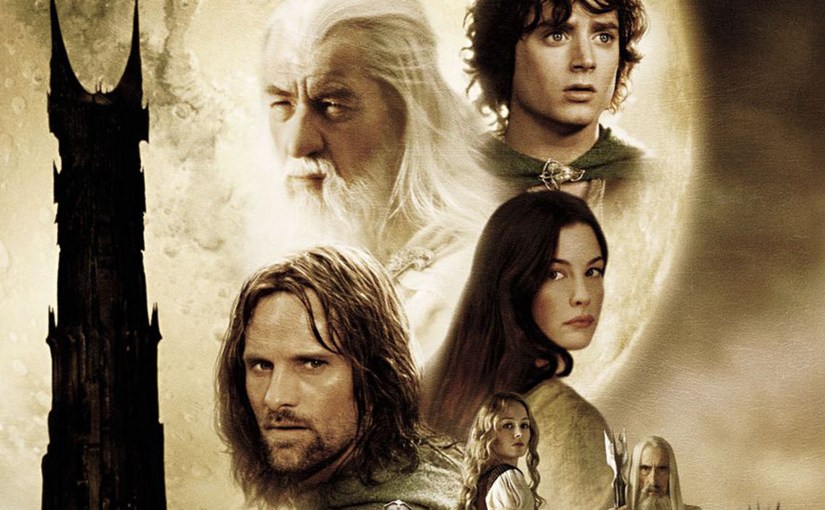
Peter Jackson’s second installment film adaptation of JRR Tolkien’s The Lord Of The Rings trilogy is The Two Towers. The captivating fantasy themes that audiences discovered in the first film continues.

Battle scenes with Orc armies are well edited and staged perfectly in digital settings. The film’s ending with a long, drawn-out battle located at the stone castle Helms Deep is stunning, full of heroic actions executed by favorite characters like Legolas the Elf (Orlando Bloom), Gimli the Dwarf (John Rhys-Davis) and especially Aragorn, destined to be King (Viggo Mortensen).

The Two Towers is almost marvelous with the exception of an overstayed welcome of the Ents – life size talking trees. Treebeard is the main Ent character, where the Hobbits Merry and Pippin take shelter by sitting on his branches. The effects of the Ents work. When the film returns to this storyline however, the narrative drags and the audience suffers. Treebeard converses in his own speak with the other Ents, the Hobbits ask “well?” and it’s supposed to be amusing that all they said was good morning. It’s not amusing. It’s boring.

The big centerpiece of the film belongs to Andy Serkis doing his full body animated effect to bring the untrustworthy, dual personality Gollum/Sméagol to life. Serkis should have received an Oscar nomination as he piggy backs on the continuous journey that Samwise Gamgee (Sean Astin) takes with the ring bearer Frodo (Elijah Wood). Gollum can’t resist what he once owned for himself-the “precious” Ring. Frodo’s good instincts insist upon not harming Gollum or Sméagol while Sam has strong reservations.

Jackson’s second film offers up a heightened urgency on all fronts. He’s good at showing the weight of the ring upon the psyche of Frodo and Gollum and he leaves time for other stories where Saruman’s (Christopher Lee) army conquers more lands-allegorical to the period of time when Tolkien wrote his novels following Nazi occupation within Europe.

Jackson is a completist and no stone is left unturned. A large portion of the film is appreciated even when you consider that you can take a bathroom break anytime Treebeard shows up.

THE LORD OF THE RINGS: THE FELLOWHSHIP OF THE RING

By Marc S. Sanders

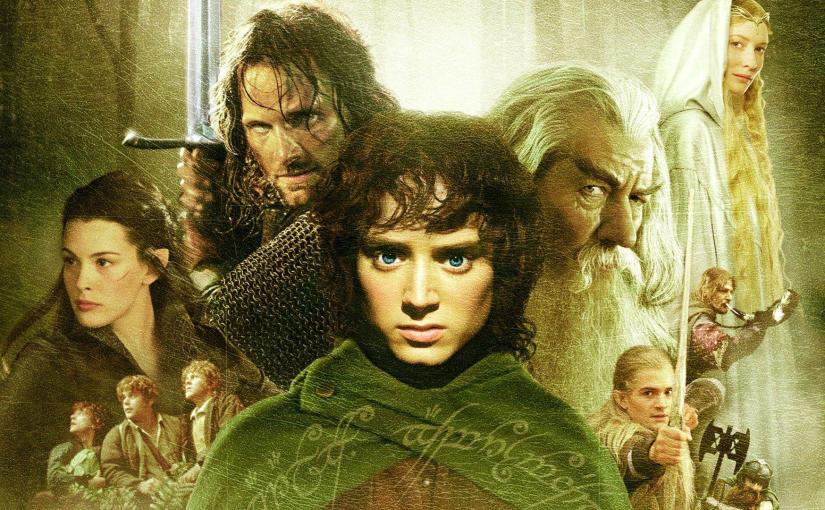
JRR Tolkien was one of the 20th Century’s greatest fantasy writers. The Lord Of The Rings series was a dense, sweeping epic inspired by the torn European climate during World War II and its conflict with the Axis nations, particularly Hitler and his organized Nazi Germany.

Peter Jackson found the opportunity to adapt Tolkien’s works. In 2001, The Fellowship Of The Ring amazed audiences with its epic landscape of Middle Earth, Isengard and Mordor where the fiery Mount Doom is located and the evil eye of Sauron waits for a resurgence of overthrow.

Much happens in each three hours plus Rings films. Tolkien’s story is not so much plot, but moreover a journey from one adventure to another. What’s special is that the main hero is a small, kind Hobbit named Frodo Baggins (Elijah Wood) who has been tasked with carrying the dangerously powerful “One Ring To Rule Them All” back to Mount Doom and destroy it. He is aided by eight fellows, three other Hobbits and four representatives of various nations and backgrounds to protect and escort him. The most significant member is the wise wizard Gandalf The Grey played by Ian McKellen in an Oscar nominated performance. The other characters’ significance become more established in later films.

This first installment is my favorite of the series because it is the most absorbing. I believe in the all but sinister and deadly value of Tolkien and Jackson’s MacGuffin, the Ring. Jackson does well of posing the threat of danger each time Frodo dons the Ring for the sake of invisibility while the Orc army of Saruman, Sauron’s Wizard henchman played by Christopher Lee, bears down on the Fellowship. The film shows one battle after another but the suspense is heightened each time as we become more familiar with Jackson’s digital world. It’s also quite dramatic to see Frodo become consumed in fear and a kind of sickness as the possession of the Ring weighs upon him. To precisely show that transition requires a three hour film, and Elijah Wood is up to the task, always appearing quite angelic and unsure of his assignment. Wood is quite the underrated actor.

There are a multitude of character descriptions in The Fellowship Of The Ring and a number of them come into play when centered around the viewpoint of the Ring. Backstories for others are really not necessary but Jackson attempts to cram as much of Tolkien’s narrative as possible. Beyond Frodo, and maybe Gandalf, the other most interesting character here is that of Boromir played by Sean Bean, often playing a variation of a hero in his films, but quite good at not being worthy of endless accolades. Boromir is a great character to show how the temptation of the Ring can cloud and poison the mind. Bean evokes that of one who might be a weak addict, needing a quick fix of the Ring’s power. There’s a complexity to his performance. Boromir is likable but Sean Bean makes the character quite shocking as well. He’s not a villain but his internal weakness presents a conflict for Frodo and his band. Sean Bean never got enough recognition for his role here.

Peter Jackson is the real hero though. This series is a massive cinematic accomplishment. Everything feels gratefully familiar. Perhaps that is from reading Tolkien’s visually descriptive books, or maybe even the animated film from the seventies. There’s something to see in every corner of the screen. It’s a world come alive in leaves, creatures on land or in the sky, sorcery and swords, flames and even saloons of overflowing drink and large platters of food. The Shire where Frodo lives with his uncle Bilbo (an excellent and jovial Ian Holm) comes off as a happy utopian village of farming and Hobbit celebrations of laziness and relaxation from any outside elements. Jackson contrasts this beautifully against the majesty of Rivendell and the hell of Mordor. It’s a nuanced universe.

Again, for me this first installment remains the best as it is cinched up tightly in its exposition and narrative. Later films are just as grand but maybe sidestep away from themselves a little.

I never got that impression with The Fellowship Of The Ring. Everything I see belongs in the film.

1941

By Marc S. Sanders

Steven Spielberg’s first critical and box office flop, 1941, is a splattered mess of slapstick hysteria set a week after the Japanese attack on Pearl Harbor.  Residents of the California coast line prepare to be the next target.  Ahem!!!!!  Well, that’s it for the story…Goodnight.  Tip your waiters.

Just a year ahead of the Zucker brothers with Abrams comedy team that’ll deliver Airplane!, Spielberg opted to direct a spoof script penned by Robert Zemeckis and Bob Gale (Back To The Future).  1941 is full of gags galore beginning with a reference to the director’s most successful film to date, Jaws.  For me, seeing actress Susan Backline on screen again for another ocean skinny dip only to be intruded upon by a rising Japanese submarine was the second best joke of the film.  Once that was over, I had two hours left to go.  A long two hours. 

I’ve noted before that satire or spoofs are the riskiest genres to produce.  They can succeed with a picture like Dr. Strangelove…, or Network or Airplane!  Satire can be divisive too though, and thus only one half of your audience will appreciate the poke and prod.  Even worse, satire can just be unfunny across the board no matter which side of the aisle you lean on.  That’s 1941.  It plays too much like a Three Stooges series of slapstick violence.  Reader, even Steven Spielberg cannot capture the magic of the Three Stooges.

Zemeckis and Gale opt to poke a little fun at the Puerto Rican zoot suit riots vs the Enlisted men ahead of America’s entry into World War II.  So, when army soldier Treat Williams gets jealous of one handsome zoot suit dancer flirting with his girl, a fight breaks out which eventually populates two thirds of the film as it escalates all the way over to Hollywood Boulevard. Now thousands of stooge wannabe extras are walloping each other from one side of the street to the next. 

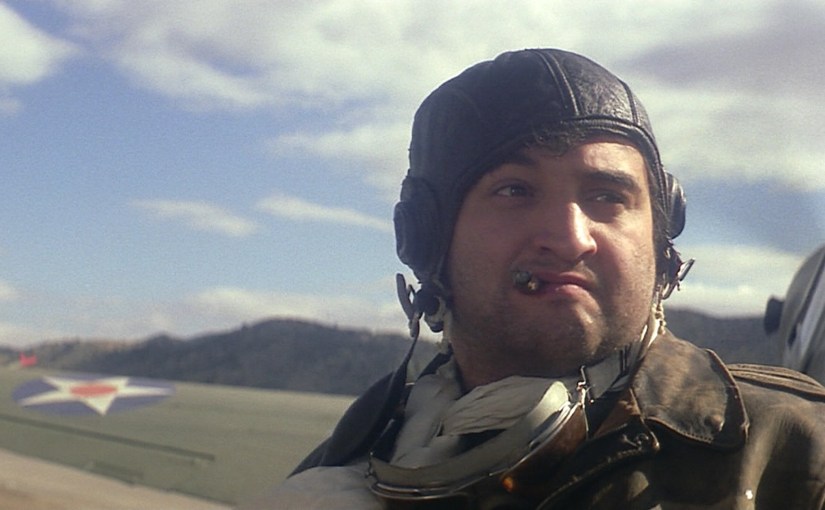
To allow a breather from this, the writers sidetrack over to Tim Matheson and Nancy Allen getting frisky in an out of control bi-plane while being mistaken for the enemy by John Belushi doing a very poor resurrection of his Bluto character from Animal House.  As Captain Wild Bill Kelso, Belushi’s pursuit fires upon everything else in sight, especially Hollywood Boulevard, but misses the plane occupied by Matheson and Allen.

The third point of this rectangle concerns Dan Aykroyd with John Candy and a whole platoon opting to set up a military cannon along the ocean view property belonging to Ned Beatty and Lorraine Gary in anticipation of the Japanese invasion.  Ned Beatty is the best stooge of the entire cast as the nerdy resident determined to protect his home while exercising his patriotic duty.  Gary’s response to Beatty’s ineptitude cracked me up as well.  The house wreckage of The Money Pit has nothing on what occurs in 1941.

The fourth storyline focuses on the enemy with a German speaking Nazi portrayed by Christopher Lee debating with the captain of a Japanese submarine (Toshiro Mifune) plotting to bomb Hollywood.  Somehow, each foil understands the other’s language.  These guys are just here to scream at one another.  There’s nothing funny about them.

Oh yeah.  Robert Stack is the Army General who watches Dumbo in the movie theatre while Hollywood Boulevard gets demolished outside.  Ho! Ho!

Often, I compliment Spielberg for his reliance on the sets he provides.  Everything you see on the screen serves a purpose to his films.  It happened as recently as with his remake of West Side Story in 2021, and it’s effectively used in Close Encounters…  He uses the same approach with 1941.  In this film though, there’s no pulse or significance to the props and pieces that are used.  The house is demolished.  So is the storage shed.  So is the movie theatre.  So is the Ferris wheel.  Yes.  What you’ve already seen in endless Looney Toons cartoons occurs here with a miniature model.  The Ferris wheel comes off its hinge and rolls across the beach side dock into the water along with Murray Hamilton and Eddie Deezen in tow.  When it happens, you’ll tell yourself I was waiting for that to happen.  What you expect to happen, happens, but you’re not laughing at it.

None of what you see in 1941 are terrible gags.  If you watch one scene out of context on a four minute You Tube channel, you may chuckle.  The problem is that every scene is treated like throwing spaghetti at a wall and seeing what will stick.  Mashing all of this together is not appetizing.  I like ice cream and I like steak.  I don’t like my ice cream on my steak.  Any idea of development is completely ignored.  The film can’t even work like a collection of skits.  Even Airplane! had a romantic storyline trajectory to perform with.  Here, two jealous guys have a fist fight and it more or less stretches that fight for an entire two hours.  The Three Stooges knew when to eventually quit.  Spielberg, Zemeckis and Gale didn’t. 

As soon as I saw Belushi on screen, I laughed.  It’s Bluto again.  Yet, the appearance wears off very quickly.  He has little dialogue and is limited to chomping on a cigar while grunting and groaning as the fighter plane he occupies wobbles around shooting at everything in sight.  When he eventually crash lands, Belushi continues to chomp on the cigar and grunt and groan.  Only now, he pratfalls as well…badly.

Ned Beatty is the real star here.  The ultimate nerd is also limited in dialogue. Still, to watch his body language with his glasses and bow tie and pear-shaped physique, accompanied with Lorraine Gary’s helpless gasping wife responding to the damage he commits with the cannon is hilarious.  Absolutely hilarious.  Tape all of their scenes together and make it a short to present ahead of the main attraction in a movie house. The audience will have a great time.

Otherwise, the only other fun I got out of 1941 was spotting the stars that were relevant at the time of its release.  Candy, Aykroyd, Frank McRae, Slim Pickens, Christopher Lee, Robert Stack, the cute blonde daughter from Eight Is Enough.  Even Penny Marshall has a quick blink and you miss it moment.  Oh, and look, there’s Lenny and Squiggy!

I think Zemeckis and Gale were on to a real smart idea here.  They maybe should have consulted with Harold Ramis and his National Lampoon’s crew however, because that’s the direction Spielberg’s film was aiming for.  What sets a film like Animal House apart from a 1941 though is in the set up.  Dialogue also helps.  1941 lacks set up.  1941 lacks dialogue.  It’s all visual and noise and more noise and more noise. 

1941 begins at letter A, and stops at letter A, never making it to B, and definitely never reaching Z.  An idea with potential was put down on paper.  The problem is these guys stopped writing after the first sentence.

THE MAN WITH THE GOLDEN GUN

By Marc S. Sanders

Bond. James Bond going Mano y Mano against Francisco Scaramanga, also known as The Man With The Golden Gun.

Regarded as one of the least successful films in the franchise, Roger Moore’s second outing as 007, with Guy Hamilton directing his fourth installment, is really fun and devious.

Scaramanga (Christopher Lee) is former KGB who lives on his own island where he takes pleasure in carrying out gun duels with anyone up to the challenge. Professionally though, he works independently charging a million dollars to anyone requesting an assassination by means of his golden gun with accompanying golden bullets. Though it seems now the expert marksman is reaching out to Bond as a worthy competitor.

Bond doesn’t even know what Scaramanga looks like. So, he jets off to Beirut, then Thailand, Taiwan and eventually the villain’s own private island located in the seas off the coast of China. Also, there is Scaramanga’s latest toy, consisting of unlimited solar energy, a device he could sell to world powers globally for the highest bid while also bankrupting the oil industry.

Bond has encounters with a quirky henchman again. This time it’s a deadly midget named Nick Nack (Herve Villacaize, Fantasy Island). He’s a lot of fun as he teases both Bond and his boss, Scaramanga, in a fun house obstacle course as they carry out their best efforts to survive.

Two Bond girls (Maud Adams and Britt Eckland) allow Moore to balance the ladies in a hiding game within his hotel room while trying to keep them from running into each other. It’s light farce.

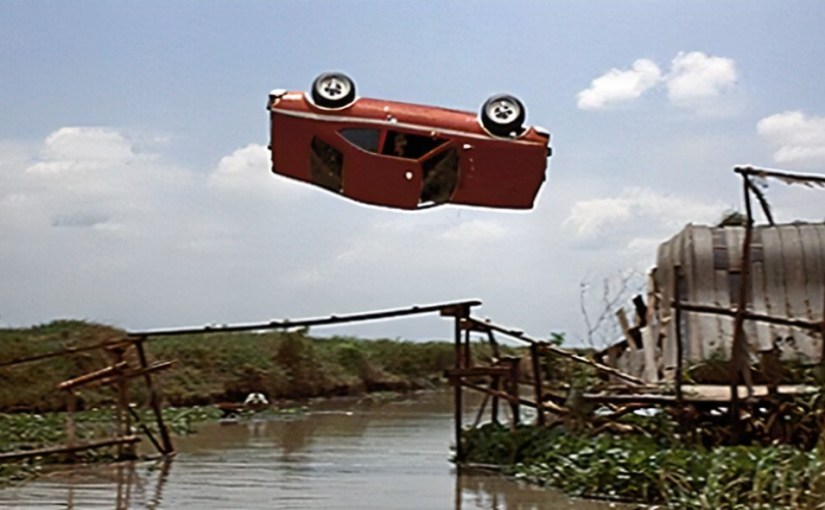
The Man With The Golden Gun also features one of the greatest automobile stunts ever captured on film, an alleyoop flip over a ravine with a broken bridge. Needs to be seen to be believed.

What keeps this film from highest of regard though is the return of Clifton James as Louisiana Sheriff J.W. Pepper for some cheap laughs that didn’t work when we saw him the first time in Live And Let Die. He’s a pest who’s contrived to show up in Taiwan of all places and coincidentally run into Bond again. Really? Seriously? There’s no reason for this annoyance to be here.

Still there’s lots of good moments including Bond vs two sumo wrestlers as well as fighting his way out of a deadly dojo with the assistance of some karate skilled school girls. Then there’s Scaramanga’s flying car which is extra cool.

007 embarks on an adventure that still holds up. Christopher Lee is loving his villainy and Roger Moore continues with the part well. He’s a sharp guy.

The Man With The Golden Gun is a film worth revisiting.