AMERICAN BEAUTY

By Marc S. Sanders

Lester Burnham declares in less than a year he’ll be dead.  When we meet him, he’s masturbating in the shower, sleeping in the back of the family vehicle on the way to work, and declaring that his wife Carolyn used to be lovely.  Heck, he’s acting like he’s dead already.  His life has nothing new or exciting to pursue.  His daughter, Jane, doesn’t give him the time of day.  He’s threatened with being laid off from his magazine call center job that he’s held on to for nearly twenty-five years.  What’s to live for anymore? 

I guess what’s complimentary about poor Lester is that at least he’s honest with himself.  All the other neighbors, except for the gay couple known as Jim & Jim, are just as unhappy it seems and might as well be dead too.  A common theme running through the suburban landscape of American Beauty centers on a sense of mental awakening. Who revives sad, lost folks like Lester and Carolyn?  Perhaps it’s the generation sneaking up behind them, who are on the cusp of taking their place in young adulthood. 

Lester is played by Kevin Spacey, in his second Oscar winning performance.  Carolyn is portrayed by Annette Bening who is way overdue for a trophy.  Jane the daughter is played by Thora Birch.  The headliners of this cast are outstanding in how different and disagreeable they portray a broken family that is forced to live in an unstimulating home while trudging through a lifeless marriage.  Look at the set designs within this film.  There’s an endless amount of blank walls within the interiors of the homes.  Almost no artwork or pictures are to be found. 

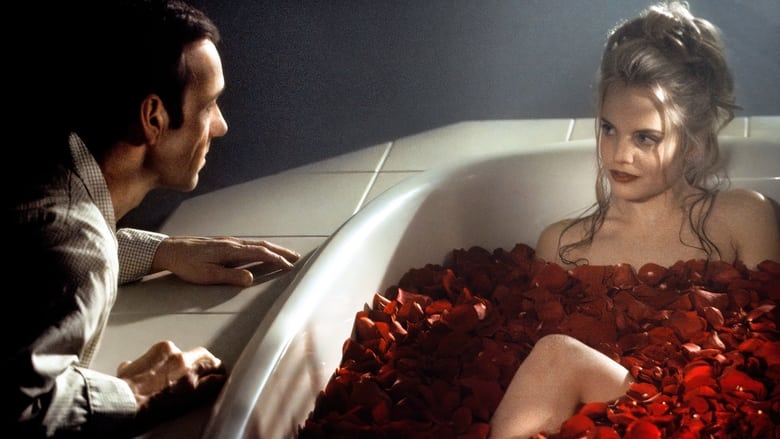
Lester pines and fantasizes about Jane’s best friend Angela (Mena Suvari) getting rained on with red rose petals while she lies naked in a pure white bathtub.  Carolyn, the real estate agent who can’t make a sale, sidles up to the dashing Buddy Kane (Peter Gallagher), her competition. Next door is Chris Cooper in a hospital cornered role as retired Marine Colonel Frank Fitts, with his near comatose wife Barbara played by Allison Janey, and their eighteen-year-old resourceful drug dealing son, Ricky (Wes Bentley). He takes advantage of his camcorder at any opportunity to collect the beautiful images found within the world he occupies and observes.  That could mean he’s capturing Jane in her bedroom window which faces his own.  Later, he’ll show you the freedom of a plastic shopping bag dancing within an autumn breeze.  An old shopping bag has more life among a breeze and brown leaves than Lester, Carolyn, Frank or Barbara.

There is a mystery to American Beauty that seems quite odd.  We know that Lester will die soon, but how and why? Maybe there’s a twist, because that outcome seems more and more impossible as we see Lester discover a spirited mindset to go after what he wants, when he wants and declare that he’s not going to allow himself to take shit from anyone particularly in his boring dead end job or from his unaffectionate wife.  Ricky, the kid with tons of money and electronics equipment, has nothing to lose because he’s not committed to anything at age eighteen and he can just quit an ordinary table-waiting job at any given moment.  Why didn’t Lester have the gumption to ever be like Ricky?   It seems so simple.

There’s a blink and miss it sign hidden in plain sight.  Pinned to the wall of Lester’s work cubicle is the message “Look Closer.”  Director Sam Mendes and writer Alan Ball gives the audience a subtle wink to dig within the cracks of suburban life sidewalks.  These homes may appear perfect on the outside, with neighborly neighbors, but if you watch with a more critical eye you’ll find an emptiness that has been unfilled for too long.  The filmmakers make it easy for you to uncover what eats away at the upper middle-class way of living.  Dinner with Lawrence Welk playing in the background is anything but uplifting.  It’s imprisoning.

When one member of this community opts to seize his moment, no matter if he’s motivated by a kid’s rebelliousness and the drugs he buys off of him, or the fact that he thinks a beautiful teenage blonde has the hots for him, he sets out to change.  He exercises and builds up his body, buys the dream sports car he’s always wanted, quits his job and grows to not caring how this may disturb his unloving wife. 

American Beauty seems to remind us how alive we can be when we are younger and not as restrained by the commitments it takes to live like adults with debts and parenthood and jobs and marriage.  Look closer though because couldn’t we live as well or more aggressively when middle age arrives?

The irony of Alan Ball’s script is that a boring guy like Lester Burnham discovers exciting things about himself just as the end of his life is approaching.  All he needed was stimulation.  He never saw his death coming, and you might forget he told you he will soon be dead, but American Beauty works to show how necessary it is to live each day to the fullest. 

I sound hokey.  I know.  Yet, that’s the direction of this film’s trajectory.  On the side, you observe those people who do not pursue what will fulfill their own lives and desperately need a modification.  Lester was limited to branch out. So is Colonel Fitts and his very sad wife.  So is Carolyn, and Jane and Angela, and maybe so is Ricky.  All of these people uphold facades about themselves to preserve a happiness on the outside when they really feel worse within. 

Sam Mendes is brilliant at drawing upon the subtle messages and insecurities of Alan Ball’s neighborhood characters.   About the only people that Sam and Alan do not dig deeper with is the gay couple.  I guess since they are happily out of the closet, what is left for them to conceal?

I could not help but compare Mendes’ Oscar winning film to Robert Redford’s.  American Beauty is more forthright than Ordinary People. Redford’s film draws out the ugly honesty of the family nucleus when an unexpected tragedy interferes.  Then it takes the entire film before the spouses take off their masks and truly declare how they regard each other.  It’s crushing to realize a sad truth. 

American Beauty rips off the layer right at the beginning, though.  A tragedy does not awaken these people to the natures that embarrass them.  Simply a hellbent, fed up mindset gets one guy going, and if that one member opens his eyes, then so will others because a simple disruption in ordinary life is next to impossible to live with.  Both films are so wise in how they criticize the very people these films were likely catered for.

What do these two Oscar winners say?  They tell the middle class, middle age American to simply look closer.
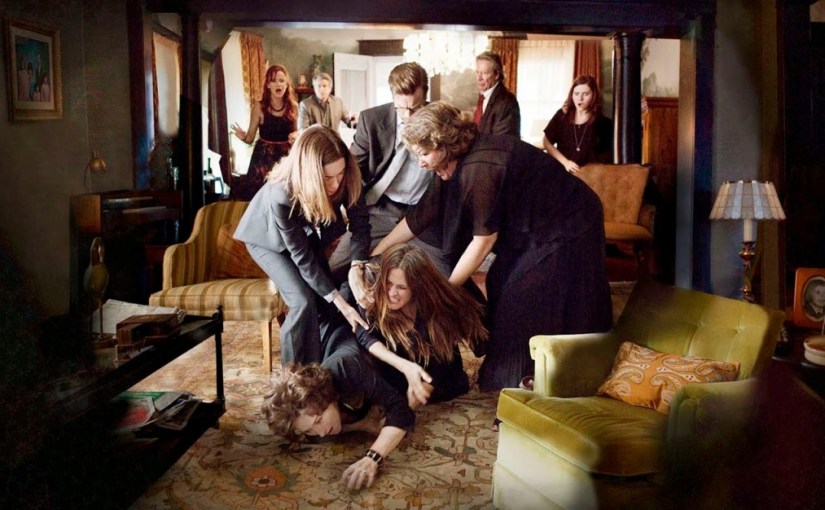
AUGUST: OSAGE COUNTY

By Marc S. Sanders

Once the dead are buried, the secrets come out.  Some mourn the loss.  Others mourn the reality of what existed.  Tracy Letts’ Pulitzer Prize winning play August: Osage County was adapted into a very well-cast film in 2013.  Letts’ screenplay is just as biting as his original source. Perhaps that is because of the performances of not just Meryl Streep and Julia Roberts, but also the entire collection of actors.

Dysfunctional is not a strong enough word for the Weston family of the sleepy, lifeless area of Osage County, Oklahoma.  The patriarch, Beverly (Sam Shepard) hires Johnna (Misty Upham) a Native American housekeeper/helper, for his pill popping, cigarette smoking wife Violet (Streep) who is also stricken with cancer of the mouth.  Shortly after, Beverly disappears.  The family comes home to the dusty shelves of books and old black and white family photographs and learns that Beverly has committed suicide.  The opportunities flood in for Violet (or Vi) to unleash every ugly, harsh truth that her three daughters Barbara, Ivy and Karen (Roberts, Julianne Nicholson and Juliette Lewis) have encountered along with their partners.  There’s also Vi’s sister Fannie Mae (Margo Martindale), her husband Charlie (Chris Cooper) and their son Little Charlie (Benedict Cumberbatch) to revisit the revelations of the Weston family.  Barbara’s estranged husband Bill (Ewan MacGregor) and her daughter Jean (Abigail Breslin) have their own drama to contend with as well.

It’s best not to spoil too much of what is revealed in the movie directed by John Wells.  The centerpiece of the picture is the afternoon family meal following the funeral service.  This must be one of the most intense and captivating dinner scenes caught on film in recent years.  Wells positions his cameras perfectly, so you know where every family member is seated at the table and the trading of barbs that go back and forth between the different combinations of arguments.  I would say the scene lasts at least twenty minutes and Wells manages to seat the viewer next to or right in front of every person at the table.  At one end of the table is Charlie.  Chris Cooper is a reluctant fill in to the void left by Beverly, the original patriarch.  The instigator is Vi. Meryl Streep is placed at the other head of the table where her drug addled eye contact can be had with anyone seated in her presence.  I’d love to have seen Meryl Streep while shooting this scene because even when the camera is not on her for a close up, I can still see that she is there in the dining room.  I’d argue she never turned off this persona during the making of this film. 

The most agonizing relationship is clearly between Vi and oldest daughter Barbara.  The first pairing on screen for Meryl Streep and Julia Roberts.  Why didn’t it happen sooner?  Moreover, why hasn’t it happened again since this film?  Perhaps because it is rare to find material of this dramatic weight to justify what can come from these two incredible actors.

The dinner scene is left discomforting to say the least, but the timing and delivery of Tracy Letts’ dialogue is functioning with high energy.  At age fourteen, Jean is the youngest member at the table, and she is questioned as to why she doesn’t eat meat.  According to her, you are consuming an “animal’s fear.”  The Westons are only adoring when they are cruel to one another.  One of the rare times that the rest of the family will unite with the antagonizing Vi is when they can mock and chortle at young Jean’s philosophy for “claiming” to be vegan, which is also undone by her parents when they reveal what she eats back home in Colorado. 

A hip middle aged Florida man named Steve (Dermot Mulroney) in a Ferrari has accompanied Karen to Osage.  Karen is the flighty one with her head in the clouds.  Steve has been married three times and takes a liking to teenage Jean’s curiosity to try pot.  Vi expresses disdain for the jerk with another welcome facial expression from Streep, but Tracy Letts does not have his character lash out or protest Karen’s choice to marry the guy.  For Violet Weston, it is better that Karen does marry this letch.  It gives Vi more purpose to criticize and belabor upon one more poor decision made by another daughter.  Violet thrives on bellowing out the shortcomings of her children, her dead poet/author husband, her sister, and anyone else within her presence.  It’s how she lives and overcomes her cancer while an unkempt wig conceals her chemo remaining grey hairs.

On the side, a relationship is brewing between first cousins Little Charlie and Vi’s middle daughter Ivy.  They know it’s wrong, but they can’t help hiding their affections much longer.  Cumberbatch goes against type here as a nervous, insecure young man who has not matured from his boyhood nature.  Julianne Nicholson appears to be the most held together of the three daughters as she has never ventured out of Osage while living with her parents.  She is now ready to give up that lifestyle, and she’s leaving it in Barbara’s lap to figure what’s to come of Vi. 

Barbara is the most unhinged.  She is married to sweet natured but boring Bill and it’s likely that the past demons she clung to from her upbringing left Osage with her when she relocated to Colorado with her husband and daughter.  Bill might be having a tryst with one of his college students but is he the worst one in the marriage?  Barbara Weston might be Julia Roberts’ best role since her early career film introduction in Steel Magnolias and her Oscar winning turn in Erin Brockovich.  In films like these, Julia Roberts doesn’t look like the starlet she once was in the 1990s.  In August: Osage County she has downed her appearance with no makeup, unwashed hair, and wrinkled clothes while carrying an emotionally exhausted physique.  However, she’s perfect to play the eldest daughter who somehow must be the one responsible for picking up the shattered pieces of dishware that hit the floor on numerous occasions and fractured connections left behind in the family dynamic.  This is a commanding performance by Julia Roberts; one that needs to be seen.  Incidentally, she never does clean up the broken plates.  I only assume it would be her who must do so.  However, the quiet Johnna is around somewhere. She will make everything disappear.

Memorably, a physical altercation ends the dinner.  The day passes into the next mid afternoon and more secrets are uncovered.  Some are quite horrifying, considering the circumstances that some members of the family have themselves in.  Just when you think that this script is ending with a debate of which daughter will look after mother now that daddy is gone, there’s more troubling truth to grapple with as well.

August: Osage County is a movie hinged on the acting chops of its cast with a smart, unforgiving script for the damaged characters depicted.  It falls in the same category as David Mamet’s Glengarry Glen Ross or Sam Shepard’s True West.  We may be witnessing the abnormalities and sins of these people, but it would be more unusual had these folks possessed genuine happiness and solid affection for one another.  The quietly muted Native American Johnna enters the household of people who replaced her own people, who occupied this land long before the early generations of Westons ever arrived.  It’s telling that Tracy Letts demonstrates the original occupants still survive in peace while the ones that took over can’t find a way to live happily among themselves.  Watch the film or see the play.  Then come back and tell me if the white folks of the Weston family truly belong in the once occupied Native American Osage County, Oklahoma.

THE BOURNE SUPREMACY, THE BOURNE ULTIMATUM, THE BOURNE LEGACY, JASON BOURNE

By Marc S. Sanders

Sometimes the same old thing is all we want, right?  It’s like comfort food.  That’s what the Jason Bourne films offer.  The first time (The Bourne Identity) it is original.  The second time (The Bourne Supremacy) it is familiar.  The third time (The Bourne Ultimatum) it is what we expect.  When you get to the fourth and fifth time (The Bourne Legacy and Jason Bourne), well then perhaps you’ve overstayed your welcome.

The second and third films in the Matt Damon action series function as one long four-hour film.  They are absolutely gripping in high octane, fast cut editing, pulse pounding music from James Newton Howard, and taut direction from Paul Greengrass.  They work because at least two thirds of the material is shown through the eyes of the former assassin Jason Bourne who is trying to learn of his past and who he worked for and why.  Plus, though he may hide deep undercover on the other side of the world in places like populated India, he only resurfaces when he discovers someone is trying to kill him.

The other third of these two pictures function on the other side of the coin with clandestine departments within the CIA who only consider Bourne being alive as a threat to the integrity of their black operations.  He must be eliminated.  There are great acting scenes with Joan Allen first up against an intimidating Brian Cox, and later she’s going toe to toe with David Strathairn.  If you are not part of the chase for Bourne, then you are engrossed in the cause these three supporting players offer with government politics and debate.  With each passing film, it’s an old, grey haired white gentleman in a suit who is insistent on eliminating Bourne and anyone who he associates with.  This started with Chris Cooper in the first film followed by Brian Cox (my favorite) over to David Strathairn.  The baton is then passed to Albert Finney.  A new film moves over to Edward Norton and then Tommy Lee Jones.  Scott Glenn and Stacy Keach are in the recipe too, but they are not as prominent.  All these guys start to look alike and when you watch the films in succession, one after the other, like I recently did, you start to question when this actor and this actor entered the fold.  Best way to describe it is that it is a ladder climb.  There was one guy in charge, then another above him and so on.

The appreciation for the Bourne series comes mostly from its action and the absolute cleverness of its hero.  Jason Bourne functions with ease about staying one step ahead of those trying to kill him.  They think they have a lead on him, but in reality, he has the lead on them.  Do you know how satisfying it is when he calls these people to talk to them and they play dumb? Jason will simply say “If you were in your office right now, then we would be having this conversation face to face.”  Moments like this are what gets an audience to clap and cheer.  The old white guy has been duped.

The action works because, once again I lay claim to the lack of CGI.  So, the overabundance of car chases seems nerve wracking like they are supposed to.  That door on that car is actually getting bashed in.  That taxi cab is really getting t-boned and turning into a 360 tailspin.  Jason can grab a seatbelt, lie down on his side and when the car careens over the barrier onto the landing fifty below, upside down, I’ll believe he gets out with only just a slight limp and a dribble of blood on his brow.  Only Jason Bourne can drag a wrecked rear bumper on a stolen police car through a busy Times Square and bash an SUV into a concrete barrier.

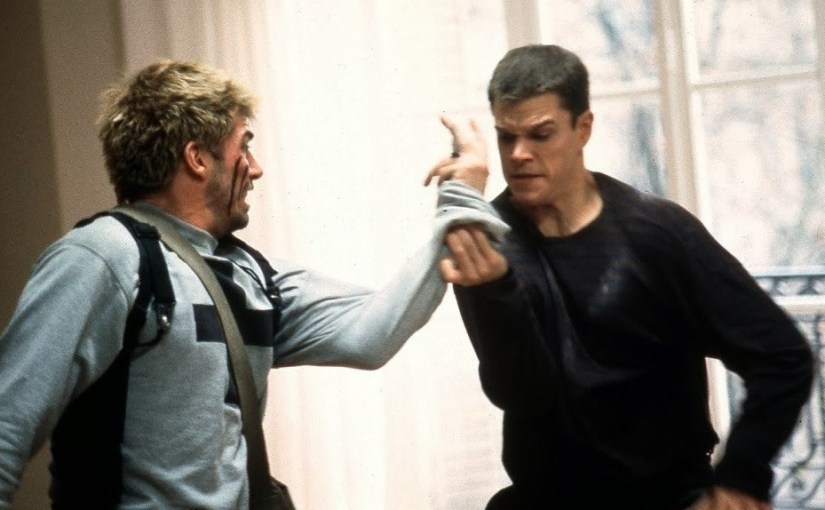
Fight scenes are not just fight scenes in the Bourne films.  It’s not just fists and punches and karate kicks.  Creatively speaking, the films construct their fight scenes to have the hero arm himself with a ball point pen or a magazine that’s wrapped up ready to wallop an opponent in the nose.  I’ll never forget when my colleague Miguel and I saw Ultimatum in the theatres and witnessed Jason punching a book into the face of a dangerous bad guy.  How many times have you seen a guy get punched in the face?  How many times have a seen a guy punch a book into the face of another guy?  There’s a difference. 

Matt Damon has been quoted as saying he believes the Bourne films carried the least amount of dialogue for him to memorize.  Yeah.  That’s likely true.  These films are visual feasts.  They rely on watching Damon move.  They are paced by how he walks, drives a car or tinkers with props.  Even how he listens and observes move with a kinetic progress. 

The locales are spectacular, spanning the globe from India, to Russia, to London, to Morocco, to the Philippines, and on to New York City and Las Vegas.  Following the first film, Paul Greengrass directed three of the next four.  (Writer Tony Gilroy directed the fourth film, The Bourne Legacy with Jeremy Renner taking the lead while Damon’s character was only talked about.) Each film takes every advantage of the atmosphere, using the overpopulated extras as obstacles and means to hide and weave away from the antogonists while on foot, behind a steering wheel or saddled upon a motorcycle.  Greengrass practically invents the concept of putting the viewer so much within the environment, you can almost smell the diesel or the food trucks within the area.  Zoom in overhead shots offer quick glances of the playground and traffic we are engrossed in.  Approximately twenty-five minutes within the center of The Bourne Ultimatum go by with no dialogue as Jason Bourne pursues a bad guy through a labyrinth of apartment tenements and rooftops, while the bad guy pursues actor Julia Stiles.  Finally, when all three catch up to one another, with a leap through a window, do you let out the deep breath you never realized you were holding on to. 

The first three films in the series (Identity, Supremacy and Ultimatum) work as a tight trilogy.  Each film ends with hanging threads to consider and lend to the next film.  By the time Ultimatum concludes, you feel as if all that needed to be told has been covered.  The next two (Legacy and Jason Bourne) function as cash grabs for the studio.  Legacy is entertaining and it boasts a good cast with Jeremy Renner and Rachel Weisz trying to outrun the government adversaries.  It hinges on operating as parallel material that occurs in the prior Damon installment.  While Jason Bourne is being pursued, this is happening over here.  It’s not unwatchable, but it is also truly unnecessary as it doesn’t advance the universe of the series at all.  A thrilling motorcycle chase closes out the film, but it’s a retread of what we’ve seen before.  It gets old quickly.  The film demonstrates that guys like Jason are trained to become dependent on drug enhancements for their highly trained arts of warfare and instinct.  Renner’s character is just another kind of Jason Bourne.  I was more impressed when I thought Jason was just a highly skilled fast learner to all that he’s capable of.  If you tell me blue and green pills lend to what he’s capable of, well then, he’s not much of a superhero in my eyes anymore.

With the final film, Jason Bourne, Greengrass returned to the director’s chair and Damon agreed to come back (paycheck had to be right, I’m sure), though he was significantly greyer and older than his prior films.  It was a weak return.  Just when we think Bourne has learned everything he needed to know and he could now live comfortably underground as a street brawler for bucks, he is informed that his deceased father knew and did some things for these secret agencies that put Jason on this path of special operations.  It doesn’t hold much weight and the payoff is nothing special.  Another car chase occurs in Vegas that appears nearly shot for shot similar to what we already saw in Damon’s prior installments. 

I wrote in an earlier review of The Bourne Identity, that Matt Damon works so well in the role because he’s such an unexpected surprise.  He’s not the muscle guy like Stallone or Schwarzenegger.  He comes off common.  In the first three films, he’s simply a kid.  When you place him in action or see how he gets the drop on a bad guy who is surveilling him, it is so satisfying.  The Bourne films work best with the locales they choose to shoot from.  Bourne will spy on his pursuers from a rooftop building across the street from where they are.  This is inventive filmmaking not just found in the pages of the script.  Paul Greengrass strategically shoots his players.  Director Doug Liman planted the seeds for this series’ potential (The Bourne Identity), very loosely based on the Robert Ludlum novels with creative adaptations from Tony Gilroy, primarily.   Greengrass enhanced the characters and their motivations by use of scenic locales, skillful shaky cameras to make it look like the audience is running at the same pace of Bourne and his adversaries, and quick cut, real time editing.  He applied this approach to his 9/11 film United 93.  The last two films are good even if they seemingly peter out the series, but overall, the four sequels hold up very well. 

If you’re asking, the best of the series is The Bourne Ultimatum, followed very closely by The Bourne Supremacy.  Either way, no matter which film you’re watching, you’re in for a good time when Jason Bourne shows up on the grid.

THE BOURNE IDENTITY

By Marc S. Sanders

Doug Liman’s The Bourne Identity is the story that occurs after the story, with a compellingly determined performance from its lead Matt Damon.

A man floating in the rain swept Mediterranean Sea is recovered by a fishing boat. Two bullets and a capsule containing a Swiss bank safe deposit box number are removed from his back. The man also has amnesia as he can’t recall his name or background or why any of this has happened. Yet, he does remember his fighting skills, weapon handling (even if it’s a BIC ball point pen) and strategic abilities. Eventually he recovers a lot of cash and passports from the box, but he leaves the gun. (No cannoli to take.)

The agency that does know what happened, code name “Treadstone” developed secretly by the CIA, is represented by a frazzled administrator named Conklin, played well by Chris Cooper. Apparently this mystery man did not carry out an assassination as orchestrated and now this assassin must be located and terminated or Conklin will have a lot of explaining to do to Abbott, another, more calm, authority played by favorite character actor, Brian Cox. However, this mystery man is Jason Bourne, and he is not going to be easy to kill or outsmart by the ones who essentially trained him.

Famke Potente portrays a gypsy that Bourne pays to escort him by car through Europe as he tries to remember and uncover the truth. She’s also very good, as the inevitable brief romance brings just the right dimension to the characters. Now there’s something at stake amid the danger.

There’s not much story to this film. In fact, there’s not much story to the sequels that followed. Liman set the standard for the Bourne films that director Paul Greengrass eventually took over. Just keep the pace at high octane. Crash the cars, break the bones, fire the guns. Only make sure Bourne just gets a cut on the head and recovers with a limp. Nothing more. We know that Bourne will never die. The fun is in how he manages to stay alive following one dangerous encounter after another.

Damon is surprising in this first entry in the series. Perhaps that’s because he’s not a repeat action star like Stallone or Schwarzenegger. He was Good Will Hunting!!!!! So, in this film, he’s got the college prep appearance and walks like a short lightweight boxer. I think that’s great. When we see him disable two policemen early on, it is literally jaw dropping. Liman presents the unexpected in Damon’s performance because the plot can’t offer much more development.

The Bourne films remain as one of the best action series of all time. If anything, I think the taxpayers are getting ripped off by the clandestine shenanigans happening within the CIA. The CIA was meant to be secret. However, “Treadstone” better be MORE secret. That way our secrets can hide our secrets. Right? Wait, what? Forget what I said.

As each movie is happy to demand from an authority in a suit, “Find me Jason Bourne!”

MATEWAN (1987)

by Miguel E. Rodriguez

Director: John Sayles
Cast: Chris Cooper, Mary McDonnell, David Strathairn, James Earl Jones
My Rating: 9/10
Rotten Tomatometer: 94%

PLOT: The (mostly) true story of a West Virginia coal town where the local miners’ struggle to form a union rose to the pitch of all-out war in 1920.


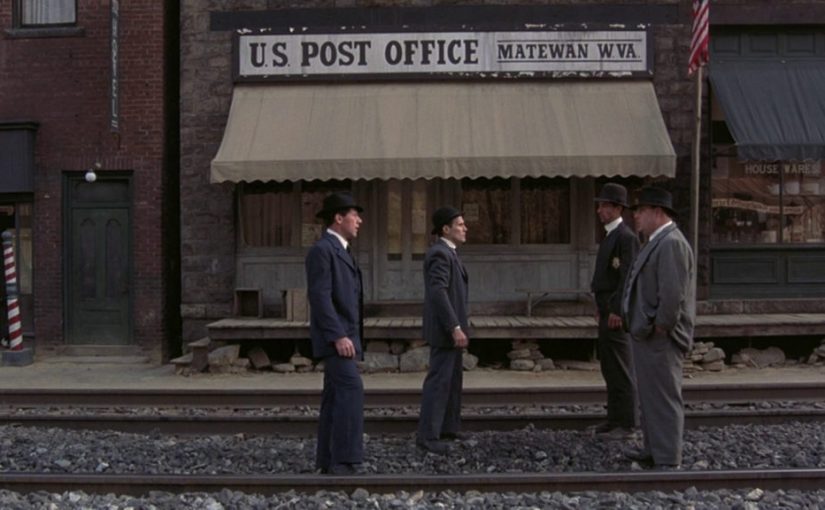
A few nights ago, I watched Matewan for the first time.  I haven’t seen many of director John Sayles’ films, but I’d venture to say it’s one of his best.  With loving authenticity and a keen ear for dialogue and music, Matewan depicts a nearly forgotten chapter of American history when coal miners in 1920 West Virginia attempted to unionize, the big corporation that owned the mine attempted to suppress and intimidate the workers, and everything came to a head one fateful day on the train tracks leading in and out of town.

I can’t pin down exactly why, but I haven’t been able to stop thinking about this movie.  When I was watching it, I tried to stop so I could go to bed and finish it in the morning.  But when I tried to sleep, my mind wouldn’t stop racing, thinking about the film, its message, its look, the SOUND of it.  I had to get back out of bed and finish it to the end before I was finally able to sleep.

The plot is nothing new, at least in broad strokes.  Small town locals take on corporate America and show them what for.  Seen it once, seen it a hundred times.  But for some reason, when this film showed scenes of company men evicting miners from their homes, or humiliating dinner guests at the boarding house where they’re staying, or spreading lies about union organizers, even employing a spy…I got mad.  I wasn’t just upset at the bad guys in a knee-jerk way, like disliking Nazis in a World War II film.  I was genuinely angry.  And I stayed angry for days whenever I thought about the movie.

Maybe it’s the thought of this particular kind of injustice depicted in Matewan that fueled my anger.  Here are people, poor people, desperate people, who lost their land, their homes, their dignity, and their lives so other men hundreds or thousands of miles away could report a six percent increase in profits at the next stockholder’s meeting.

There’s a powerful but terrible scene when the mining boss is introducing a group of new employees to the mine and its rules.  They are presented with tools…but they’re loans from the company, and their cost will be deducted from their first paycheck.  Miners can sharpen the tools with the company’s tool sharpeners…for a monthly fee.  The company provides a doctor…for a monthly fee.  The train ride to the mine was provided by the company…cost to be deducted.  The men are paid in company “script”, redeemable only at the company store.  Purchase any items available at the company store from an outside merchant…and you’re fired.

I remember thinking, this is literally slave labor.  How could anyone live like that, day after day, going down into a hole in the earth where the very real possibility of death, sudden or protracted, loomed over you every moment you’re down there?  And then to hear that the company could make conditions safer, but it’s just too expensive?  No WONDER they wanted to unionize.

Anyway.  Like I said.  It stuck with me.

Leaving aside the story, the film is extremely well made, especially considering the filmmakers were working within an extremely limited budget.  They employed the services of Haskell Wexler, one of the gods of movie cinematography, whose credits include Who’s Afraid of Virginia Woolf? (1966), In the Heat of the Night (1967), and One Flew Over the Cuckoo’s Nest (1975).  He employed a lot of low-light and natural-light photography, and as a result, even though Matewan was released in 1987, the movie looks and feels like a classic ‘70s movie.  It’s so precisely of a particular time and place that it’s a little jarring to see contemporary actors like Chris Cooper and Mary McDonnell in scenes that look like something out of Barry Lyndon or McCabe & Mrs. Miller.

The music choices are also out of this world, especially in a scene where musicians from three separate ethnic communities start riffing on each other’s music.  It’s an eloquent symbol of the kind of community and camaraderie that was needed for the miners to succeed in their task.

The story moves onward.  The miners first rally around Joe Kenehan (Chris Cooper), who came to town with the specific goal of unionizing the mine.  Then things go sour when company enforcers arrive.  The local sheriff (David Strathairn) makes a bad first impression, but later reveals his true nature in immensely satisfying style.  Guns are fired.  Lives are lost.  A spy is discovered.  And everything leads to a final showdown between powerful men with the might of corporate America backing them up and a few desperate miners who just want to be treated like men instead of so much dry goods.

If you’re anything like me, Matewan will stay with you long after it’s over.  Maybe not for the same reasons, but its memory will definitely linger.

QUICK TAKE: Syriana (2005)

By Miguel E. Rodriguez

Director: Stephen Gaghan
Cast: George Clooney, Matt Damon, Jeffrey Wright, Christopher Plummer, Chris Cooper, Amanda Peet
My Rating: 8/10
Rotten Tomatometer: 72%

PLOT: A politically charged epic about the state of the oil industry in the hands of those personally involved and affected by it.


Syriana reminds me of one of those puzzles made out of twisted nails, where the challenge is to untangle them, even though it appears to be impossible.  The difference is, with Syriana, I don’t get tired of trying.  At least, not yet.

The movie is a pleasure to watch, but hard to explain.  It’s a convoluted tale that starts with an impending merger between two oil companies, detours into political and legal intrigue, and sprinkles in some religious fanaticism by the time we get to the end.  I’ve watched it five times, and I still have questions about the plot.  I JUST watched it, and I’m still not entirely sure who Christopher Plummer’s character is and why he matters at all to the story.

Normally, a movie this confusing would turn me off.  (Examples: Full Frontal [2002], The Fountain [2006], The Counselor [2013])  But when I watch Syriana, I get the sense that, underneath the twisty plot and maddeningly oblique dialogue, there lurks a great truth.  Maybe the plot is confusing because, really, the situation it’s describing is so confusing in real life.  Maybe any attempt to parse the complexities of U.S. relations with oil-producing countries is a fool’s gambit to begin with.  So the movie just jumps in with both feet and separates the watchers from the listeners.  You’ve really got to ACTIVELY listen for two hours to make ANY sense of the movie.

Maybe that’s not your thing.  Fair enough.  This is the kind of movie that I can’t defend on objective grounds.  You’re either gonna like it or not.  For myself, I get sucked into it every time I watch, even if I don’t understand it all 100%.  So.  There you go.

QUICK TAKE: Jarhead (2005)

By Miguel E. Rodriguez

Director: Sam Mendes
Cast: Jake Gyllenhaal, Peter Sarsgaard, Jamie Foxx, Chris Cooper
My Rating: 10/10
Rotten Tomatometer: 61%

PLOT: A newly minted Marine sniper is sent to Iraq as part of Operation Desert Shield, only to find himself slowly losing his mind as he waits for a chance to make his first kill.


If Three Kings was the Gulf War version of Kelly’s Heroes, then Jarhead is the Gulf War Full Metal Jacket.  It’s a glorious paradox: a war film where it looks like the hero may never get to fire his weapon.

Jake Gyllenhaal is phenomenal in the lead role of Swofford, but Jamie Foxx steals every scene he’s in, as Staff Sergeant Sykes.

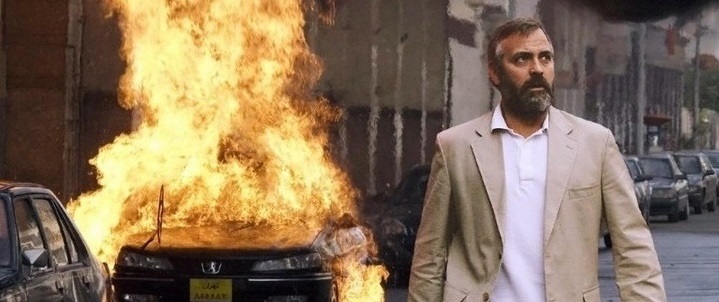
There’s beautiful imagery in the film, from the oil fires in the desert, to an arresting dream sequence where sand makes an appearance from a very surprising place.

I don’t know why, but I empathized a LOT with the Swofford role.  He learns how to use his sniper rifle with deadly force, he finally gets shipped out to where the fighting is…and air power nearly makes him obsolete.  What are they even doing there if airplanes can end the battle in minutes instead of hours?

There’s a great line when someone hears a helicopter flying overhead, blaring The Doors from loudspeakers.  A soldier looks up with exasperation: “That’s Vietnam music…can’t we get our own music?”  These guys wanted to fight, to carve their place into the history books with honor, and blood.  They wanted to distinguish themselves from their fathers or grandfathers who fought in other faraway countries.  The soldiers in the Gulf War of this movie wanted to “do it right.”

Jarhead offers searing insight disguised by a simple story.  It puts me into the head of a soldier who wants to do the right thing, the honorable thing – hell, ANYTHING – and who finds himself frustrated.  It struck me, and still does strike me, on a level I never expected.  I don’t know if I’ve clearly elaborated that with this review.  But there it is.

A BEAUTIFUL DAY IN THE NEIGHBORHOOD

By Marc S. Sanders

Marielle Heller directs A Beautiful Day In The Neighborhood, but it’s not the movie I wanted, nor is it the movie most admirers of Mr. Rogers would want either. A film that boasts one of the most beloved actors of our generation, Tom Hanks, portraying one of the most influential figures of our youth, Fred Rogers, falls very short of offering anything entertaining much less insightful.

The problem with Heller’s film is we learn next to nothing about Rogers and we learn way too much about the depressive state of a fictional Esquire journalist named Lloyd Vogel (Matthew Rhys). He’s a pretty unlikable guy with daddy issues (Chris Cooper). The most eye opening thing about Lloyd is when he gets into a fistfight at his sister’s wedding with Dad. Beyond that, he’s a repetitive close up of sunken eyes and five o’clock shadow. I couldn’t even tell you if Lloyd is actually a good journalist, or a good husband or a good father.

The script by Micah Fitzerman-Blue & Noah Harpster is misguided in its subject matter of Lloyd’s struggles at the forefront of course, but also in delivery. I felt like I was watching Tom Hanks, not Fred Rogers. Hanks really doesn’t hide in the role very well. I only heard Hanks’ voice which is not pleasant for singing and lacks the comforting whisper the real Rogers had. I solidified my opinion when I saw a clip of the real Fred Rogers in the closing credits.

A scene midway through the film has Fred inviting Lloyd into his New York apartment. He tries to console Lloyd and get him to be comfortable with his feelings by use of his famous puppets Daniel The Tiger and King Friday VIII. It’s an absolute failure of a moment between the two leads of the film. What’s meant to be therapeutic and consoling comes off as creepy. Call me cynical, but this Fred Rogers is not a guy I would want to be left alone with. I know that wasn’t the intent, but that’s what was processed. A comparable scene occurs between Matt Damon and Robin Williams in Good Will Hunting (“It’s not your fault!”). You’ll quickly see the difference in effective acting and sensitive direction.

An uplifting moment occurs when they ride the subway together. A few kids recognize Rogers and soon the whole car (construction workers and police officers included) is singing his theme song in harmony. No, I don’t believe this ever occurred, but this is often why we go to movies; to see those opportunities that raise our spirits and help us escape. There are not enough moments like this in A Beautiful Day In The Neighborhood.

The screenplay always teeters on better story potential that never arrives. When we first meet Fred at his studio, he is interacting with a child banging a toy sword while his producer is once again frustrated with his delay in filming. Here are two angles I would have rather seen; how Fred interacts with his impatient producer and how he manages to converse with children. Yet, we don’t go any further than that. We have to be bogged down with Lloyd.

Another moment has Fred sharing with Lloyd better ways to let out your anger like slamming on the percussive notes on a piano. The final moment of the film shows Fred at the piano, alone, tickling the ivories, and then he too slams down on the keys. Fred is angry, and as he tells us repeatedly during the film, “that’s okay,” except now I’m angry. I’m angry because I want to know what Fred’s angry about.

Couldn’t a film that prominently features the human side of Fred Rogers privilege me to the Fred Rogers beyond his studio of make believe?