YOUNG GUNS

By Marc S. Sanders

In the late 1980s a novel idea hit the screens.  An MTV interpretation of the Old West with a rock anthem soundtrack of electric guitars and drums. A far separation from Ennio Morricone’s unbeatable spaghetti western approach.  

The film was Young Guns, featuring handsome stars like Emilio Estevez, Kiefer Sutherland, and Lou Diamond Phillips.  They were each different kind of gunslingers in their own right while delivering stand out personalities.  The film has some problems in editing, and some sequences do not work.  Yet, it remains stylish with impressive set designs, props, costume wear, and an especially appealing array of performances from the whole cast.  

Billy The Kid aka William H Bonney is one of the most notorious outlaws in American history.  Emilio Estevez brilliantly turns the gunslinger into a quick draw joker with an addictive cackle and an adorable smile.  William is taken in by the mentoring John Tunstall (Terence Stamp) who already oversees a collection of orphaned young men.  He’s teaching them to bear responsibility on his farm while they learn proper manners at the dinner table and how to read.

A neighboring industrial enemy, L.G. Murphy (Jack Palance) commissions his men to gun down Tunstall.  Billy and the rest of the gang are then deputized by the local Sheriff to issue warrants for the arrest of the killers.  However, Billy repeatedly exercises his own form of justice by killing one guy after another with his pair of six shooters.  Soon after, the boys are on the run by horseback while creating a whole bunch of mayhem.

I never considered Young Guns to be a perfect film, but I like it a whole heck of a lot.

There are moments that serve no purpose, like when the men get high on peyote, introduced by the Navajo, Chavez Y Chavez (Lou Diamond Phillips).  It’s not amusing.  It’s not quotable and the scene runs too long as we watch the cast walk and talk while in daze.  Frankly, most movie scenes of just watching people get high are boring.  Often, they go nowhere and I’m not sure how to respond. It’s like I’m the designated driver fiddling with my car keys at a drunken binge fest. This is no different.

As well, there seem to be gaps within the body of the story. I know it is inspired by the Lincoln County War, but it’s never entirely clear why Tunstall and Murphy are at odds with each other.  We just have to accept that the two elderly men of equal proportions are against one another.  Still, Palance versus Stamp is a very inviting conflict to look at. (Supposedly, the real John Tunstall was only in his mid-20s.)

Young Guns has a very cool polish.  These cowboys are downright attractive, sexy like Hollywood movies tend to offer, and I love how they handle each other, their horses and their pistols.  Every time a six shooter whips out of a holster and clicks, the movie becomes more alive.  The guys look well-worn within this environment, close to the Mexican border of the 1870s.  The image is just as effective as Clint Eastwood appears in his various assortment of westerns.  

Billy The Kid, over this film and its sequel, is Emilio Estevez’ best role of his career.  The actor has such a cocky, nervy way about him and his over-the-top laugh is impossible to forget.  A favorite scene in all of movies emerges when Billy toys with a bounty hunter in a saloon.  Estevez delivers much fun before gunning the guy down. I never tire of watching that moment.

Kiefer Sutherland is second in line with a graceful sensitivity as the educated and poetically romantic Doc Scurlock.  You worry about him and his courting affair with a young Chinese concubine that is owned by Murphy.  Lou Diamond Phillips specializes in knife throwing as Chavez, the token Navajo.  His presence belongs here as an unpredictable sidekick.  

The best surprise is delivered by Casey Siemaszko as the virginal, boyish illiterate Charlie.  Some gunslingers were afraid to ever become outlaws.  Charlie is ugly and dirty, bumbling and sweet, reminiscent of Fredo in The Godfather films.  Siemaszko never became as established as the others in the cast, but he’s a good performer who delivers panicked fear and brings the glamour of Young Guns down to a semblance of reality.  

Young Guns is a style over substance product.  It has potential for a stronger storyline, but the dialogue works and the cast is stellar, which also includes Dermot Mulroney, Terry O’Quinn and Charlie Sheen.  The sequel is actually better as it commits closer to the intrigue of Billy The Kid.  

Not perfect, but this is a fun escapist western experience.
WALL STREET

By Marc S. Sanders

Oliver Stone is a very good director at providing the evidence of cynicism within the worlds he films.  JFK covered a clandestine, conspiring environment oozing out of the columns of government.  Platoon not only depicted the horrors of war, but also the cancer that poisons the mentality of soldiers expected to protect one another.  Wall Street explores the temptations to cheat the stock market for grand prizes in wealth.  Gordon Gekko is the 1980s tycoon who never knows the meaning of enough.

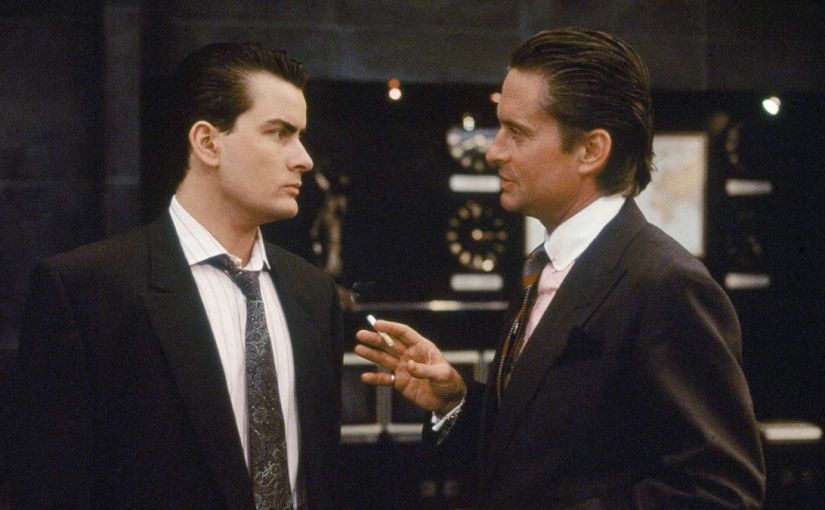
The well-dressed yuppie lizard, Gordon Gekko, is memorably played by Michael Douglas in his only Oscar winning role; regarded as one of the most villainous characters of the last fifty years.  It’s not a modest part, and Douglas’ performance is therefore electrifying.  With slicked back hair, the signature crackle of a voice inherited by his father Kirk, and the newest 80s innovation, a brick size cellular phone, the power to earn money and crush corporate enemies is done with ease.  Gekko relies on obtaining inside information (a federal crime) to find the next chest of treasures.  It might be an illegal practice but the best of the best at making mountains of money do it, and if you keep your process on the down low, nobody will catch wind of what you’re up to.  Gordon Gekko is an absolute genius, and he’s awarded a script of fast talking, slick monologues that justify his sins.

Bud Fox (Charlie Sheen) is the kid on the ground, way below Gordon’s high-rise office, desperately trying to get five minutes with the guy.  A whole day’s wait in the lobby and a birthday gift of Cuban cigars does the trick.  Now the lizard has the fox ensnared in his money-making schemes of deception and pursuits for unlimited greed.

Oliver Stone writes Sheen’s character as virginal when it comes to stock trading.  The kid is dying to get laid with the big boys while getting away from the cold calling hang ups of promising uncertain futures in stocks and bonds.  A subtle and effective angle is to give Bud a mentor.  Hal Holbrook enters the screen from left or right on many occasions to put his hand on Bud’s shoulder and give him his own twist of Confucius philosophy.  Then he exits out of frame towards the opposite direction he enters, leaving Bud to follow the questionable paths that Gordon paves.  Holbrook’s contribution to Wall Street has never been celebrated enough over the years.

Michael Douglas and Charlie Sheen are an outstanding pair of devilish mentorship against innocence lost.  Gekko preaches his passion for wealth on top of more wealth and why nothing should stand in his way, especially the law or the cost of others’ livelihoods.  Bud Fox emulates him as a master of the universe.  Charlie Sheen is great at being the biggest fan in Michael Douglas’ concerts of monologues. Watch how Sheen listens when Douglas has the floor. 

Martin Sheen extends his paternal role to Charlie within Stone’s film.  As Gordon sets designs on taking stock ownership of the small airline company that the father works for, the father/son relationship is tested, and Bud becomes blurred between what is right and wrong.  The Sheens have good debates and heightened dramatic moments.  I wish they were given more to do together though.  Perhaps even showing the wedge of the mother role within this family.

Additionally, Oliver Stone writes dynamics for Bud in a worker relationship with a fellow trader colleague (John C McGinley). There’s a former college pal/now lawyer (James Spader) that Bud tries to squeeze at the behest of Gordon’s demands.  Bud is also covered doing his own tricks of the trade such as dressing as a janitor to dig for what’s forbidden.

Why bring up all of these storylines?  Well, there’s a wealth of great material in Wall Street that’s relevant to the practice of insider trading and corporate overhaul.  Somehow though, Oliver Stone is responsible for writing one of the most unnecessary characters in film history.

Daryl Hannah just had to be cast as the buxom blond love interest for Bud Fox.  She’s never believable as a New York City interior designer and the chemistry between Hannah and Sheen is as thin as water.  Her name is Darien (a 1980s name) and one scene between Michael Douglas and her bustling the streets of Manhattan goes nowhere.  Wall Street is simply not the superb film it could have been because of the amount of time devoted to Daryl Hannah’s character.  Every moment she occupies is cutting room floor material.  When Darien exits the picture she’s never mentioned again.  The history she has with Gordon is never revealed to Bud.  Regrettably, it’s all meaningless.

What’s frustrating with Wall Street is its promise is never fully committed.  The roles awarded to Spader, McGinley, Holbrook and even Saul Rubinek in an early role as Gordon’s nerdy lawyer could have been even more fleshed out in lieu of what is covered with Daryl Hannah’s part.  More moments with Martin and Charlie Sheen would have better served the film.  A competitor tycoon played by Terence Stamp is very interesting and worthy of a larger presence.  Sadly, I imagine a studio producer or even Stone insisted on having a love interest that serves no purpose here except to put a glamorous actress above the title in the credits.  

Nonetheless, Oliver Stone built an authenticity to the hysteria of stock trading and corporate underhandedness.  When he shoots the scenes occupied by Bud and Gordon, he does handheld shaky camera work to emulate that nothing feels sturdy and balanced.  In moments that Bud’s father is at the center, the director shoots with a locked in position, bearing the character’s assured apprehension to trust his son or this prophet of greed.

I especially like the scene where Michael Douglas delivers his famous “Greed…is good!” speech at a shareholders’ annual meeting.  Stone glosses over all the company vice presidents and officers as well as the fat cat suits who carry stakes in the company.  Yet, the filmmaker also takes the time to show that little old lady with the pocketbook who finds her entitled seat to see how the value of her small ownership share is being treated.  Remember, if you own stock like Disney or IBM, you get that invitation in the mail to attend these meetings, and you have just as much a right to attend as all the Gordon Gekkos of the world.

Wall Street serves an important reflection of 1980s capitalism, while taking place in 1985, two years ahead of the infamous market crash of 1987 (the year the film was released).  Guys like Bud Fox had the Charlie Sheen image. Boyish men who got rich quick with little imagination to create and build.  They stood next to tall wealth and learned, but they never gained the knowledge to prepare for quick falls and disheartening sacrifice.  Most importantly, they took their own sense of morale for granted.  These are the best parts of Wall Street.

PLATOON

By Marc S. Sanders

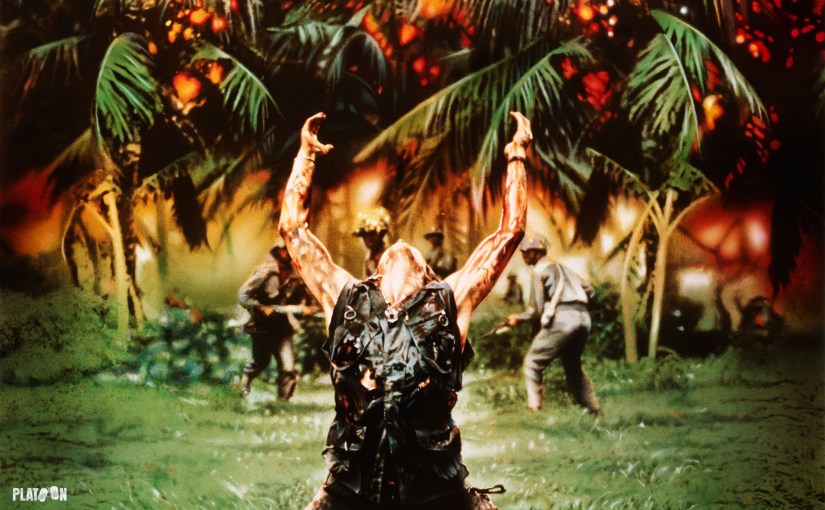
Oliver Stone’s Oscar winning Platoon takes place in the late 1960s, somewhere on the Cambodian border during the Vietnam War.  Many of the chaotic happenings the film presents are based on Stone’s own experiences after he voluntarily enlisted to fight.  However, while there is an unwinnable war occurring for the American troops, there is just as horrifying a battle going on within the ranks of the platoon the film focuses on.

Charlie Sheen echoes a lot of his father’s, Martin Sheen, voiceover narration, and performance in Francis Ford Coppola’s Apocalypse Now.  He portrays Chris Taylor, a college dropout who voluntarily enlisted for a one-year tour of duty to serve.  After only one week within the harsh, humid, and wet jungles, he’s writing his grandmother a letter asking what the hell was he thinking.  Chris is quite virginal to the harshness of war and that won’t work to his advantage when needing mentoring and support from his fellow soldiers.  The newest enlistees are the ones at the front point.  They haven’t devoted enough time to sit in the back and because of their lack of experience with war, they are not as valuable for the ongoing campaign in battle.  Platoon is not the heroics depicted in John Wayne movies.  This was one reason that Oliver Stone wanted to make this picture.  Platoon is a bitter retort to Wayne’s celebrated movie, The Green Berets.

There is an angel and devil flanking Chris in the form of Elias (Willem Dafoe) and Barnes (Tom Berenger).  Berenger is the cruel side of the conflict with his battle-scarred face.  He gives his underlings the impression that because he’s seen so much fighting and endured being shot seven times, that he must be invincible.  Elias is a fighting soldier, but he adheres to the rules of war and when it is time for rest, he joins his fellow troops in a unified vigil of drug-induced relaxation.  Chris warms up to Elias easily despite his initial fears of being a soldier with no experience or knowledge of how to survive, much less fight alongside his fellow men.

What drives the conflict between Barnes and Elias occurs following the first act of the movie.  The infantrymen come upon a Vietnamese village.  Some men, including Chris, get wildly abusive with the unarmed people, burning and pillaging their huts.  Only after Chris gets control of himself does he realize the wrongs he’s capable of by serving in this war.  He prevents a group of men from gang raping a child.  Furthermore, he witnesses Barnes commit the illegal murder of a defenseless village woman, shot at point blank range.  Elias has his bearings though and will file the proper reports when the opportunity permits.  Nothing in Platoon is easy though.  This war rages on and the possibility of an investigation and court martial is held off while the fighting continues. 

An interesting take on Oliver Stone’s direction is that he never really shows any close ups or lends any dialogue to the Viet Cong.  I believe Stone is confident that people know who our battalions were supposed to engage with.  However, as another favorite picture of mine stated (Crimson Tide), the true enemy of war is war itself.  The enemies of Elias, Chris, and Barnes as well as the rest of the platoon permeate within and among themselves and it lends to the chaos of the brutal combat scenes depicted in the film. Stone doesn’t offer much opportunity to see who any of the soldiers are shooting at or who is shooting at them.   There is much screaming and hollering but who are any of the characters shouting at and can they even be heard or understand what is being said amid the gunfire?  Platoon demonstrates that a Vietnam war picture is not one of heroics with grandstanding trumpets and a towering John Wayne who takes a hill.  War is disorganized, messy, and terribly bloody. 

This may be Charlie Sheen’s best film of his career.  As he represents the fictional account of Oliver Stone’s personal experiences, we see the trajectory of his change.  He is supposed to be there for 365 days, and he, along with his buddies, count down to when their tour will be complete.  However, this one short year will be the longest he ever encounters, and it will change him permanently, assuming he survives.  Chris is always tested of his tolerance.  He’s always subject to respond to how Barnes commands or how Elias mentors and leads. 

Oliver Stone is so convincing in his often-documentary approach to Platoon that it is at least understandable to see how the men in this picture behave and carry themselves.  Why do they refer to the Vietnamese as “gooks.”  Why do they bully with intent to commit rape.  Why do they quickly pounce to kill when for even a moment there is no threat.  Moreover, why they are willing to turn on each other.

They were never the decision makers for this conflict.  These soldiers are depleted of sleep and rest.  They are the pawns of a higher power, and they have been left to their own devices in a dense environment infested with bugs, snakes, unbearable humidity, and bodies that infest the waters and land while armed men appear out of nowhere ready to ambush.  Some ensnarements might occur within their own regimen.  None of these men are justified in their actions.  Yet, it is not hard to understand where their motivations stem from.  They are not programmed for heroics.  Keith David portrays a likable soldier who tells Chris that his mission is just to survive until he’s summoned home.  Survive among those you march and sleep with.  Outlast this hellish environment and overcome those that are trying to mow you down in machine gun fire.  Everything else around here is “just gravy.”  When you are an infantryman, you are not making a statement any longer.  You are not fighting for a cause anymore.  You are only trying to stay alive.

Platoon is such a shocking film of unconventional madness and turmoil.  Oliver Stone is relentless in the set ups he stages.  This picture came out in 1986, long before the strategic methods of the modern “shaky camera” approach.  It’s beneficial to watch the film as Stone must be positioning his camera on a track as the platoon hikes through the forest, parallel to his moving lens.  We are walking alongside them.   Early morning overhead shots depict the carnage of battles that occurred in the dark of night. Flares and sparks come from nowhere.  I think you could watch this movie ten times and still not know when to expect gunfire to intersect with the story or when the bombs to go off.  It’s hectic hysteria like I can only imagine these young men experienced before they spilled their blood on the battleground and either died right there or returned home physically and mentally crippled for life.

Platoon is one of the best and most frightening war pictures ever made.

MAJOR LEAGUE

By Marc S. Sanders

Never seen it before!!!! Finally at the behest of my colleague Miguel Rodriguez and company I sat down to take in the view.

Tom Berenger was a B leading man of the 1980s. Rugged with shaggy hair and a hoarse voice in films like Platoon, Someone To Watch Over Me and Shoot To Kill (a secret favorite of mine). Here in Major League, he carries on that tradition as an aging ball player with bad knees. He’s not given many of the gags, but he sure is likable. I didn’t need the inevitable romantic subplot with Rene Russo. Nothing great there. When he’s playing the ball player in a catcher’s uniform though, Berenger is at his best.

Wesley Snipes shows the future of his albeit temporary star power. He’s not on the level of Eddie Murphy funny but he made me laugh nonetheless, as the base stealer. His entrance into the film is hilarious. A cross between a Bentley & Volkswagen Beetle perfectly sums up his character. Looks like class when really he’s got none.

Dennis Haysbert is one guy I never knew was featured. Now, this guy can bring the comedy as a Voodoo believer trying to get his idols to help him hit a curve ball pitch. He was my favorite.

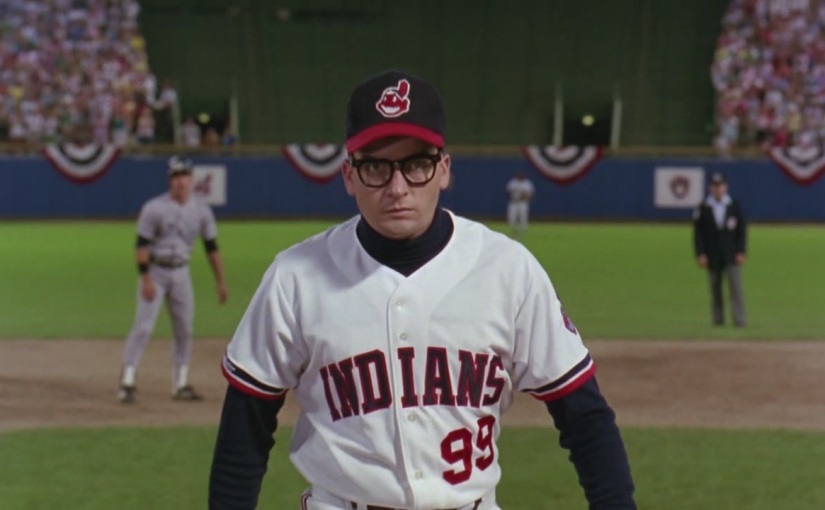
Charlie Sheen is the Wild Thing. It’s not so much Charlie Sheen’s talent. It’s how his character is written that’s hilarious. Writer/Director David Ward (The Sting) doesn’t rely on dialogue for his 2nd billing star. Sheen doesn’t say much actually. Sheen brings the image of a near sighted, out of control, felon with a power arm teetering on 100mph. Throw in some nerd glasses, a punk haircut and an anthem song, and now you’ve got a gag to carry you through a good comedy.

Major League screams of an 80s picture, most especially with the synthesized keyboard soundtrack, Berenger’s Miami Vice sports jacket over a t-shirt, Bob Uecker (great timing as a sports announcer), and 80s mainstay Corbin Bernsen (TVs L.A. Law). Sure, it’s dated but I found the movie to be fun.

Not my favorite baseball film. That belongs to Bull Durham. Still, I’m glad I finally saw Major League.

Oh yeah. As in many sports movies, the team sucks (hey…it’s the Cleveland Indians), the owner wants to stay that way for profit and the team eventually unites themselves to victory.

Exactly!!!! Rene Russo has nothing to do with any of this.

FERRIS BUELLER’S DAY OFF

By Marc S. Sanders

I’ve said before how John Hughes had an instinct for making interesting stories out of the mundane. Sure he might broadly exaggerate, but the storylines stem from relatable anecdotes like cross country traveling, forgotten birthdays or school detention. Thankfully he also explored a day in the life of faking illness and skipping school with Ferris Bueller’s Day Off.

Matthew Broderick memorably plays the title character with an answer for everything and the means to outsmart his naive parents, his pesky sister Jeannie (Jennifer Grey), as well as the dim witted victim of staged slapstick, school principal Ed Rooney (Jeffrey Jones). Hughes teams Ferris up with his beautiful girlfriend Sloane (Mia Sara) and his troubled best friend Cameron (Alan Ruck) for a romp through downtown Chicago.

Ferris Bueller… is simply a party to watch. The tempo of its comedy thankfully gets very familiar, very quickly. There’s gag after gag to celebrate the inventiveness of Ferris. With Cameron, he manages to get Sloane out of school, alter his absent days in the school system, arrange for a high-end fancy lunch thanks to the “Sausage King of Chicago” and actually pilot Cameron’s father’s prized, rare Ferrari convertible. There’s nothing Ferris can’t do, nor won’t do. There’s nothing Ferris can’t get away with. The guy can even hop on a downtown parade float to get the entire city engaged in a rousing rendition of “Twist & Shout,” arguably one of the most fun scenes to ever be filmed. Hundreds of extras crowd the streets to remind any one of us how fun life can be. What a joyous pleasure life is.

As expected with most of Hughes’ films though, this picture has a heart. Life should always be celebrated, but that does not mean we don’t have episodes where we suffer. Alan Ruck as Cameron is not well with his home life. Parental discourse and the lack of a loving home weighs upon him. The storyline is embraced very sensitively. A touching moment occurs as Cameron tours the Art Institute of Chicago and maintains an engrossed stare with the painting called A Sunday Afternoon on the Island of La Grande Jatte. Cameron is a product of loneliness lacking the ability to cry for help unlike the child in the painting. It’s another one of those treasured moments in film where dialogue is not needed to describe a character’s pain.

Jeffrey Jones makes for a good foil in a Three Stooges style storyline as he attempts over and over again to catch Ferris in the act. It never works well for him and leads to hilarious moments with the house dog and every other unfortunate circumstance imaginable such as getting his car towed and his foot stuck in the mud. Hughes pieces these cheap gags together to make them really feel much more valuable than they should be.

Lastly, John Hughes creates good inside gags within his setting. The city of Chicago works as a character concerned with Ferris’ supposed illness, including well wishes from his classmates, to the faculty, and even the police department much to the chagrin of his sister.

Let’s just say it’s imperative we all do our part to Save Ferris!