ROCKY III

By Marc S. Sanders

By the time a series of franchise films reaches its third installment there better be something interesting for the characters to encounter.  Otherwise, it is the same old show.  Not many talk about it, but Rocky III actually does have something new to offer even if the story still feels like the same kind of tread.  What’s new?  Mr. T!

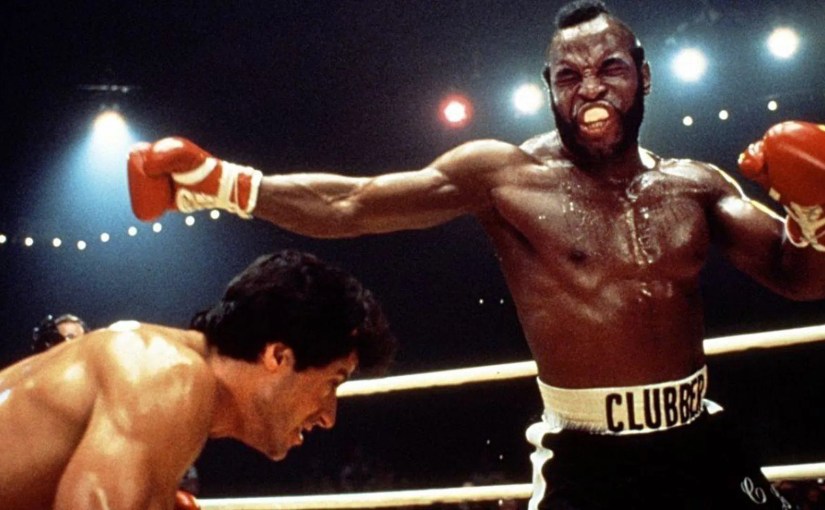
In the lexicon of greatest villains of all time Mr. T’s introductory role of Clubber Lang, the fierce boxer who lacks pity for a fool, should be included within these tabulations.  Reader, I challenge you to find him listed anywhere.  I don’t think you’ll be successful.  Not even as a runner up. That is a terrible oversight.

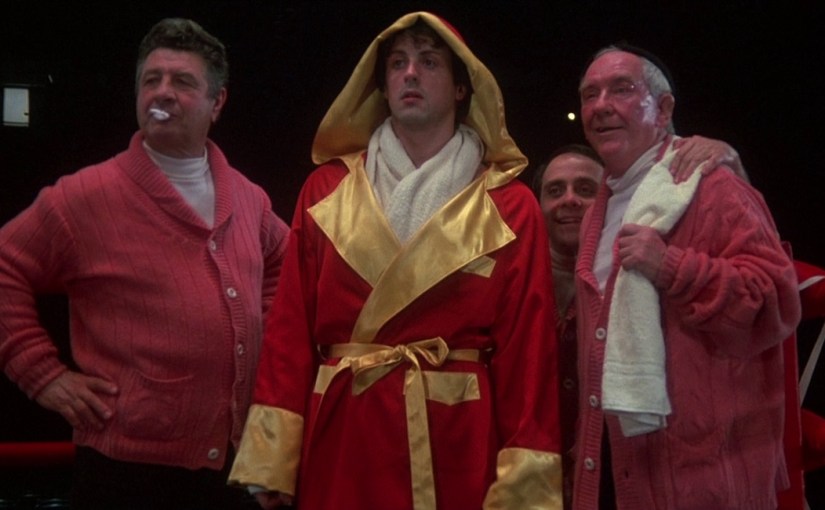
As Rocky III opens with a quick flashback of Rocky Balboa (Sylvester Stallone who also writes and directs) winning the championship away from Apollo Creed (Carl Weathers), quick cuts of the hero show him knocking out one fighter after another with debonair ease.  When he’s not boxing, he’s posing for commercials and magazine covers, or he’s riding his custom-designed Italian Stallion Harley with his wife, a glamorous Adrian (Talia Shire) on the back.  Juxtaposed within this montage, played against one of the greatest songs in film history (Eye Of The Tiger by Survivor), is Clubber Lang executing bloodletting beatings on his own opponents.  He’s angry and he threatens to kill Balboa in the ring. Rocky’s mainstay coach Mickey (Burgess Meredith) attends these fights and grows fearful of this new menace.  Clubber will not give up on this campaign until he has his shot in the ring with Rocky.

Rocky III has a glossy finish the first two installments deliberately withheld.  The photography is sharper. Stallone is quite handsome, rich and fit.  Adrian has abandoned the meek bashfulness and nerdy, wing shaped eyeglasses.  Their furnished house sits on a gorgeous estate complete with servants, a golf cart, and a little boy all their own.  The filth-ridden areas of Philly are behind these protagonists.  Welcome to the materialistic and decadent 1980s.  Frankly, I like how nice and put together everything feels in Rocky III.  It truly is a window into what much of the 1980s looked like.  Stallone and Shire’s characters have evolved amidst their wealth, and I continue to like them. 

The one ingredient that carries over is the alcoholic slob, Paulie (Burt Young), whose grumpiness hasn’t changed.  He is a given a substory in the first ten minutes of the film where he shows his resentment for Rock.  Then, the slugger bails him out of the drunk tank, gives him a job, and he only remains through the film for a few laugh bits.

(SPOILER ALERT) Following accepting the challenge to fight Clubber Lang, Rocky loses in terrible defeat just as Mickey suffers what will be a fatal heart attack.  Not only does he lose, but he cannot overcome his sorrow, and fear has intruded upon his psyche.  Apollo volunteers to train Rocky and encourages him to do one last fight against this new opponent, now champion.  Only now, Rocky has to get that “eye of the tiger” back and he needs to move light on his feet like Apollo originally learned.

Everyone in Rocky III has an energy about them.  These actors are used to one another even if Stallone and Weathers were on opposite sides for the last two films.  Stallone’s script experiments with testing his boxing character to lose what he earned organically in his earlier films.  He also sketches the guy with conceited fault ahead of the film’s first fight when he showboats his training and does not take this new fighter seriously enough.  This is good material for a third follow up piece.  It’s certainly more exciting than what Rocky II offered.

However, the film belongs to Mr. T who became a pop culture icon of the 1980s with gold jewelry, the mohawk, a TV action series, cartoons, toys and guest appearances on telethons, Johnny Carson, Diff’rent Strokes and Silver Spoons.  Forty years later, he deserves some recognition for the impact he had on the American psyche.  This guy was a big influencer.  No one has ever replicated what Mr. T delivered.  If you watch Rocky III again, you can’t help but get caught up in how hostile his Clubber Lang is.  I doubt this guy was written this broad or aggressive in Stallone’s script pages.  Clubber Lang is a villain that owns this picture anytime he appears on screen.  Mr. T is not a diverse actor by any stretch but the personality that was introduced here is unforgettable.  During both training and boxing montages, his muscular physicality is an astonishment, and he’s a terrifying new kind of monster with every threat he screams at this cast of likable heroes.  This guy would burn the whole happy village down if given the chance.

I’m also impressed with Talia Shire.  She’s not given much to do here.  For the most part she is sitting in the audience, cheering on Rocky, or watching from the sidelines while he trains.  However, there is one special scene that Stallone wrote for them that turns the tide of this ninety-minute film ahead of the inevitable, pulse racing training montage.  Her scene of truth-hurting candor with Stallone’s character on California shoreline where all of the pain and anguish surfaces is carried by her against Sylvester Stallone, the superstar.  It’s a reminder why the Rocky films were never anything without Adrian.  The love of Rocky’s life has to always be there to rescue the lug from his despair and lack of confidence.  I love this scene.

I would never argue with anyone who said this franchise became a sad joke upon itself by the time Rocky III rolled around.  The formula is very recognizable.  It’s not a tremendous sequel like The Empire Strikes Back, The Godfather Part II, or even Superman II demonstrated ahead of its release.  Yet, there is a vigor to Rocky III, and the highs and lows are told efficiently at a very comfortable pace. 

I saw Rocky III before I saw the prior two films and at age ten, this had my attention from beginning to end. It’s likely when I left the theatre, I wanted to be a boxer and pound someone’s flesh into a bloody pulp amid a cheering crowd.  I recall the whole audience in the theater applauding as soon as Rocky triumphed again.  I also recall the tears and sniffles I heard at the midway point when poor Mickey’s life suddenly ends.  These are beloved characters that we only want to remain happy and healthy.

Rocky III is not accurate to how it really is for professional boxers.  I do not think the well edited cuts of the fights are genuine either.  A lot of the footage looks like an action movie more than a sports picture.  When Clubber Lang swings with a jab, there’s a whooshing sound.  However, Stallone as a writer/director knew how to touch on the melodrama effectively with laughs, sadness, fears and cheers. 

With that amazing Bill Conti soundtrack, Survivor’s rattlesnake opening chords of their Oscar nominated song, Mr. T and, oh yeah, a giant named Hulk Hogan as a beast of a wrestler named Thunderlips, Rocky III is outstanding, pure escapist entertainment.

TWILIGHT’S LAST GLEAMING (1977)

by Miguel E. Rodriguez

DIRECTOR: Robert Aldrich
CAST: Burt Lancaster, Charles Durning, Richard Widmark, Paul Winfield, Burt Young, Melvyn Douglas, Joseph Cotten, Richard Jaeckel, John Ratzenberger
MY RATING: 7/10
ROTTEN TOMATOMETER: 80% Fresh

PLOT: A renegade USAF general takes over an ICBM silo and threatens to provoke World War III unless the President reveals details of a secret meeting held just after the start of the Vietnam War.


Twilight’s Last Gleaming, one of Robert Aldrich’s last films, is a cleverly constructed Cold War thriller whose pointed message about the Vietnam War nearly torpedoes the suspense.  The political message is hammered home in a scene that goes on for a bit too long with people speaking dialogue that feels hammy and trite.  But the movie surrounding this one scene is good enough that I would still recommend it to anyone in the market for something off the beaten track.

The movie is set in 1981, four years after it was released, so no one could draw any real-life parallels between the characters and people in real life.  In an opening sequence that feels reminiscent of Die Hard (1988), General Lawrence Dell (Burt Lancaster) and his team of military ex-cons manage to infiltrate and take command of a US ICBM missile silo in Montana.  While I highly doubt it would be as easy as portrayed in the film, Aldrich films the sequence so that I got caught up in the suspense of the narrative instead of worrying about pesky details.  (If there’s a drawback to these and other sequences featuring military hardware and installations, it’s the overall low-budget feel to the sets and props; everything looks like it was shot on a TV soundstage instead of a big-budget film set.)

Once inside, Dell makes his demands: $20 million for each of his remaining team (Burt Young and Paul Winfield), the President must read the transcript of a secret meeting held just after the Vietnam war started, and the President must hand himself over as a hostage to secure their escape.  Otherwise, he’ll launch nine Titan ICBMs at their targets.

This creates a little tension among the would-be terrorists.  Winfield and Young couldn’t care less about the secret meeting, but Dell is adamant.  Meanwhile, General MacKenzie (Richard Widmark) formulates a plan to eliminate Dell and his crew using a “tiny” nuclear device, the President (Charles Durning) agonizes over the secret transcript, and his best friend and aide uses some “tough love” to get him to make a decision.

Despite the fakeness of the surroundings, I was absorbed by the thriller elements in Twilight’s Last Gleaming.  I would compare them to the best parts of WarGames (1983) and The China Syndrome (1979).  There is some impressively impenetrable technobabble about booby traps and inhibitor cables and fail-safe systems that I just rolled with.  The plan involving that “tiny” nuclear device leads up to a sequence that I would compare favorably with any contemporary thriller you can name.

One of the ways Aldrich achieves this effect is through the use of split-screens…LOTS of split-screens.  It starts at the beginning of the film with two screens.  Then there are moments with three split screens, two on top and one in the bottom section.  Then, during the most intense sequence of the film, we get four splits in each corner of the screen.  At first, I found it disorienting, but it absolutely works when it most needs to.  (I’m trying not to give away too many plot details, so excuse the vagueness.)  I don’t know that I would want to watch an entire movie like this (Timecode, 2000), but in small doses, it’s very effective.

Where the movie bogs down is the middle section of the film when the President expresses his disapproval of the contents of the secret transcript Dell wants publicized.  It’s a bit theatrical to believe a sitting American President would be this vocal about his feelings in the middle of a dire crisis.  I think the scene would have played just as well if we had gotten a general idea of the transcript, or even if the contents had NEVER been revealed to the audience.  It would have been a perfect Macguffin, leaving viewers free to imagine anything they want.  The truth about Kennedy’s assassination?  Area 51?  Pearl Harbor was an inside job?  The Super Bowl really IS fixed?  Who knows?

Instead, the President insists on reading a portion of it out loud to his Cabinet members, enlisting them to read certain lines.  While I admire Aldrich’s intent (to send a cinematic protest to the architects of the Vietnam war), the scene nearly brought the movie to a stop, which is deadly when dealing with a suspense thriller.

But, like I said, the rest of the movie is so good, I am compelled to let it slide.  Later, we get surprise attacks, snipers, helicopters, a crafty fake-out involving torture, and an ending that is as cynical as they come, but which felt like the best way out of the situation for everyone involved…except for the American people, but that’s another story.  Twilight’s Last Gleaming feels virtually forgotten, and that’s a shame.  Aldrich directs this movie with a lot of passion for the material and milks every ounce of suspense he can with the tools at hand.  If you’re prepared to overlook that middle section, you’ll get a kick out of this movie.

P.S. Look fast for an unexpected appearance by William Hootkins, aka “Porkins” from Star Wars (1977).

CHINATOWN

By Marc S. Sanders

Forget it Jake!  

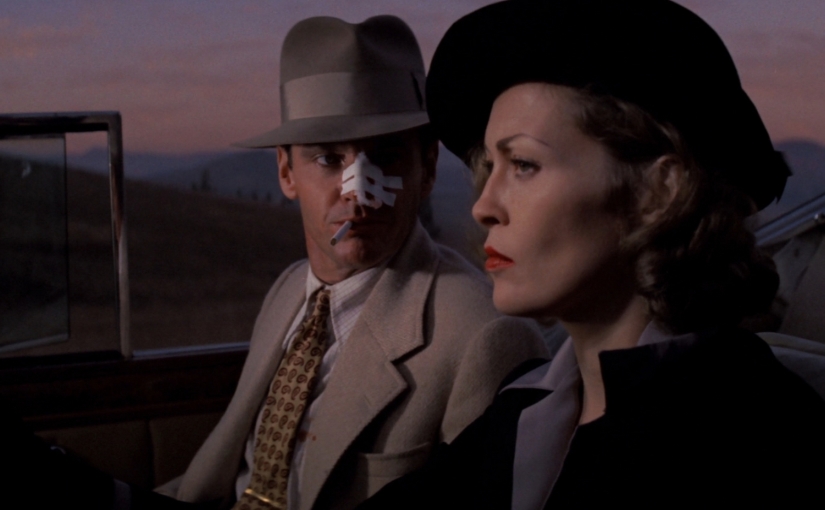
Roman Polanski turned Robert Towne’s page turning script into a noir mystery for the ages.  Practically every scene in Chinatown turns whatever you learned before off its axle.  The mystery of what Jake Gittes, a private dick played so well by Jack Nicholson, is attempting to uncover seems to repeatedly take the guy back to square one.  

Towne’s Oscar winning original screenplay, one of the best ever written, begins with simplicity in motion.  A Mrs. Mulwray insists on hiring Mr. Gittes to find out if her husband is having an affair.  The husband is in charge of the water supply within the surrounding areas of Los Angeles.  Despite Jake’s encouragement for her not to go down this path and recuse herself of heartache, he accepts the case charging his regular fee plus a bonus should he turn up anything that points to something illicit.

Just before meeting with the wife in despair, Jake wrapped up a case, handing over photographs of a wife to her bruiser husband (Burt Young).  The poor guy understands that his spouse was messing around.  None of it is shocking to Jake.  He’s seen the same results many times before and he’ll likely come upon the same situation with Mr. Mulwray.  However, as he follows her husband, it does not seem to be just an affair that is transpiring.  Jake finds himself driving out to a dried-up reservoir and then he’s adjacent to a drainpipe by the ocean shore.  The more he sniffs out, the more likely his nose is going to pay for what he gets closer to.

It’s hard to write about Chinatown as I reflect on the film for a review.  There’s just so much to spoil, even beyond what is now considered to be one of the all time great twists in film history.  I would dare not give anything away.  Some of the luckiest people today are those that have never seen the picture.  To watch Chinatown with a blank slate.  If that’s you…Wow!!! You are blessed of the experience that awaits you.

The cast is a bevy of recognizable faces; character actors who went on to popular television shows and movies (Higgins from Magnum P.I. and Miss Collins from What’s Happening!!!).  Faye Dunaway though is maybe the most unforgettable.  Jake is smart enough not to trust the famed actress’ character (I don’t even want to share the name of who she portrays).  Long before Sharon Stone hammed it up with a less creative eye rolling commando cross legged sitting, Faye Dunaway was best at being sexy, alluring and especially enigmatic.  With her Hollywood glamor appearance in costume wear from Anthea Sylvester, she has that classic noir dame appearance with a smooth inflection in her voice.  Word is that Polanski wanted Dunaway to reflect his own mother’s appearance.

Then there is the celebrated filmmaker John Huston representing old money, a lot of it, in a rare acting appearance.  He plays Noah Cross, a great name to be associated with water.  His gravelly voice and hulking mass lend to what he’s earned demonstrating his power over a commodity resource that everyone cannot live without.  Per Jake Gittes’ experience, he knows it’s best to seek out a motive long before he can uncover a crime.  Gittes’ perusal of some photographs on an office wall will allow him the gumption to go up against a titan like Cross. 

It’s a welcome setting to see late 1930’s L.A.  There is a drought going on and coincidentally Jake is perhaps tailing the guy responsible, but only because of a likely affair.  Still, when his pursuit takes him to the most unexpected places, something more sinister may be happening.  When someone turns up dead by drowning, Chinatown becomes more deliciously complex. Why would Dunaway’s character pay Jake, and later why would Noah Cross double the fee to hire the detective, as well? Jake’s clients may be playing against one another, but he’s the one being tossed in several different directions.

There has to be over a dozen twists in Chinatown.  Thankfully, none of them are contrived or thought up out of the blue.  New depths await further down the rabbit hole.  

I love how Jake Gittes functions.  He might be accused of being sleazy in his profession, but he drives a nice Pontiac classic convertible and dons a stylish wardrobe to go with his fedora hats, designer sunglasses and sterling silver cigarette case.  He’s also quite sharp.  He’s got methods to easily prove how long someone has been at a certain locale and how to follow another car at night.  All of it makes perfect sense.  

Jack Nicholson is great in his role. He does not go all looney like in other pictures, but he’s quiet with his tone, reserved of any kind of shock to the discoveries he finds.  Yet, this particular case might challenge the detective’s sense of acuity into another realm.

Polanski, Towne and Nicholson also thought it best to apply a crudeness to Gittes.  He’ll happily tell an off color joke to his colleagues.  When Dunaway, sneaks up behind him, Gittes is not quick to apologize.  Instead, he gives an annoying scowl for her being there when a prim, genteel woman has no business listening in.  When he gets a phone call, he’ll tell his partners in the room to “shut the fuck up.”  Sam Spade never talked like this.  

The production value is great.  Nothing in or on top of a desk, for example, looks out of place.  From the cars to the interior furnishings of the homes and offices, it’s a Technicolor transport back in time with the dialogue uttered like characters of the ‘70s and ‘80s might deliver.  Humphrey Bogart could never occupy the role of Jake Gittes.

I recently watched The Offer on Paramount Plus which explores how The Godfather made it to the big screen.  Chinatown was next on the horizon, but executives were left confused by a boring middle section about – excuse me, water???? Plus, there was an unsavory plot twist that is hard to even fathom.  The script’s first draft doesn’t even have a scene set in Chinatown.  So what’s with the title? Casting was also unsatisfying.  Now producer Robert Evans wanted you to see more and identify with the chutzpah of the ultra-powerful and wealthy, because only the super-rich are the ones who can get away with murder.

Despite the movie’s welcome yet perplexing surpises, it’s all incredibly satisfying.  Who is doing what to whom, and why?  The best mysteries are the ones that make perfect sense yet can’t be figured out until someone finally starts telling the protagonist the whole shocking truth.  In Jake’s line of work, nothing is shocking. However, the greater the secret, the bigger the liability for everyone involved. 

I’m sorry reader.  I know I’m being vague but therein lies the delight in watching Chinatown.  As you watch, you may throw your hands in the air.  Now what?  You’ll find yourself in disbelief and that would be the best compliment you can give to Roman Polanski, Robert Evans and Robert Towne.

Chinatown is the best example of a film noir pot boiling thriller.  It’s the reason movies continue to thrive; to witness a scene chewing villain, pine after a beautiful, lustrous woman who is not telling us everything, and follow a gumshoe detective who thinks he knows everything but actually could never fully comprehend anything until he makes it all the way back to Chinatown.

THE GAMBLER (1974)

By Marc S. Sanders

James Caan is Axel Freed, The Gambler, and when the film starts it shows the main character figuratively at the bottom of a very deep hole.  From this point on, he’s always looking at its great endless height above; a depth so low or a height so high, that there’s no crawling out of this trap.  No matter the opportunities that rescue Axel from a $44,000 debt to some bookies, he’ll never allow himself to be saved.

The autobiographical inspiration of James Toback’s first screenplay is hardly entertaining, but it held my attention all the way through.  Axel is a well-educated literature professor and an expert on Dostoyevsky but he’s entirely foolhardy.  A parallel inspiration comes from the author’s novella The Gambler.

I dunno.  Whether it’s 1974 or 2024, if I’m told I owe forty-four grand to someone who will otherwise break my legs and then who knows what else, I’d be terrified with fear.  Axel Freed seems to brush off his dilemma as he cruises through the city in his Mustang convertible.  To him, this is just the current setback of the week.  Nothing big.  He’s been in worse situations.  At least that’s what he tells himself. Axel swallows some pride and asks his mother (Jacqueline Brooks) for a loan, and she has to go through her own hoops to scrounge up the funds.  Look for an early appearance from James Woods as an unsympathetic banker.  Once mother’s monies are in hand though, Axel opts for a different route than to wipe his debt clean. Therein lies the anchoring burden of gambling addiction.

Toback’s script, directed by Karel Reisz, is not so much about a story as it is about living with overwhelming compulsion.  He writes good dialogue performed with apathy by Caan.  It’s not about winning.  It’s about the thrill of possibly losing the money he’s got in hand. 

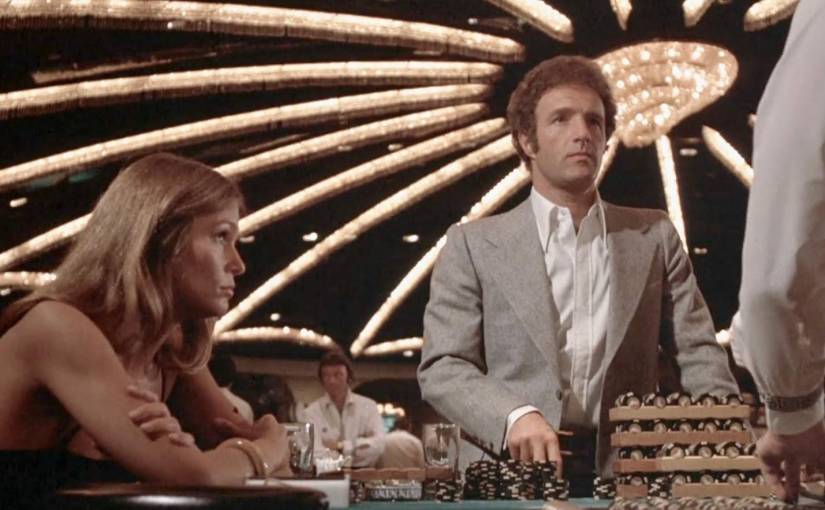
Once Axel obtains money, he ventures off to Vegas feeling sure that he will double what he’s got and still manage to pay off this huge debt.  The brilliance of the film is that it had me tricked as Axel marathons through victory at every table while also feeling confident on three college basketball games that seem to be moving in his favor.  I was not sure if I was looking at a hero or a despairing loser during this sequence.  Reisz convinces me that it can go either way for Axel with his girlfriend, Billie (Lauren Hutton) in tow.

As many films, books, and programs that I’ve encountered focusing on gambling and the addiction it musters, I feel confident I know the outcome of the piece.  What sets The Gambler apart though is the realistic nature of what this kind of craving does to a person.  It depicts the victim as in denial, rejoicing when he dodges bullets, thinking he’s invincible.  The film demonstrates how those close to Axel Freed respond to his mounting dilemmas, but also how they are affected.  It’s inclusive not only of his Billie, his mother, his self-made millionaire grandfather, or even his main bookie (Paul Sorvino), but an admiring student of his as well. 

There are scenes that I could see how they are going to play out as soon as they begin.  I’m sorry but when I see tough guy character actors like Burt Young and Vic Tayback enter a story like this, I know something, or someone, is about to endure some damage and walk away feeling terribly threatened.  Still, I’d be complaining if Toback excised moments like this from his screenplay.

The ending left me feeling a little perplexed as to if it really belongs here.  It’s not a happy ending but seemed to come out of nowhere and I questioned its relevance against everything else that was seen before. 

The strength of The Gambler lies in the honesty of James Toback’s script and the performance of James Caan.  The film belongs exclusively to Caan and his character, with the others entering the frame when they are called upon for a cause and effect of Axel’s actions and decisions.  There’s nothing to celebrate in a hard drama like this, but I applaud the film’s will to uphold a genuine truth of how gambling addiction leaves behind a crippling life for those caught in continuing temptation.

ROCKY

By Marc S. Sanders

Rocky is a story about a bunch of losers.  It really is. It’s actually a film that does not represent or follow the standard ho hum formula that so many other well-recognized sports films that are so familiar, since it premiered on screens in 1976. 

If you examine Rocky, what you’ll find is a story about a boxer by the name of Rocky Balboa (Sylvester Stallone in a role that broke through everything for him), who is not shown doing much boxing or even training.  Instead, the southpaw boxer known as The Italian Stallion, is displayed as a heavy collector for a loan shark in and around the south side of a dirty Philadelphia.  Early on in the film, Rocky delivers monies to the loan shark and his driver asks Rocky “Did ya get the license plate?”  Rocky asks for what, and the driver snaps back with “For the truck that ran over your face.”  It’s delivered with a little humor but it’s also sad.  Is there anyone to uplift poor Rocky’s spirits?  His one-time trainer, Mickey (Burgess Meredith), kicks him out of the gym because he’s tired of Rocky at age 30 wasting his life with the scum of the streets.  Rocky lives in a filthy apartment barely making scratch from underground fights.  About the only redeeming quality Rocky seems to show is his tender loving care for his two turtles, Cuff and Link.  So, it is surprisingly charming when he sweet talks a mousy, petite woman named Adrian (Talia Shire, truly in an underrated performance) for a date. 

Adrian is also a loser, or at least she’s treated like one by her brother, Paulie (Burt Young).  He’s constantly putting her down for her looks and lack of men in her life and any other opportune moment he can find.  It’s the only way that Paulie can build confidence in himself; by putting his sister down.  Beyond that, all he has going for him is his job in the meat locker.  His one dream is for Rocky to give him a job working for the loan shark.  Such aspirations.

By luck, Rocky is called upon by the Heavyweight Champion of the World, Apollo Creed (Carl Weathers), to fight him in the ring.  Anyone else would jump at this chance.  For Rocky, it’s just a way to earn a fast $150,000 and use his face as a punching bag for Creed on live television.

All of these characters within this circle come out of their shells once Rocky is given the opportunity of a lifetime.  The first win for Rocky is when he wins over Adrian on an adoring, near penniless date when he takes her ice skating on Thanksgiving night.  They’re only given ten minutes to skate together.  The transition thereafter is quite revealing.  Director John G. Avildsen transforms Adrian’s appearance by removing her ugly glasses and hat.  Rocky is pleasantly surprised by the red winter coat she wears later in the picture.  Adrian becomes more talkative and expressive.  Initially, she couldn’t even look Rocky in the eye.  When Rocky gives her a shout out at a press conference on TV, Adrian laughs and cuddles up next to Rocky.  Someone has finally treasured her and she adores it so appreciatingly.  Shire really demonstrates a nice character arc, where she comes out from under the strong arm of her brother to find her independence and make choices for herself.  An amazing scene occurs near the end between Shire and Young.  The pent-up frustration the siblings have for one another finally boils over.  This scene is what won both of these actors their Oscar nominations.  It’s a moment in all of the Rocky films that doesn’t get enough recognition.

Mickey is the one who gives tough love to Rocky.  He shares with Rocky his own battles in the ring during the first half of his near 50 years in boxing.  All of the blood and sweat didn’t amount to much beyond the gym he has for the local fighters.  What he earned as a fighter was a cauliflower ear and no family except the poor kids who go in and out of his southside gym.  Now he has a chance at the big time and he has to win over Rocky’s affections so that he can train him properly for the fight that’s coming up.

The biggest loser of course is the title character.  Credit must first go to Stallone for an outstanding insightful script that looks much deeper than any of the numerous sequels that followed this film.  The original Rocky is not about punches.  The script eventually transitions into determination with Rocky giving a sorrowful monologue to Adrian acknowledging he’s a loser with no chance at beating Creed.  At the very least, all he wants to do is settle for going the full 15 rounds with the champion and never falling down on the mat for a count of 10.  Only then can Rocky triumph with a personal victory.

Rocky won the Oscar for Best Picture and Avildsen won Best Director in 1976, beating out incredible films like Network, Taxi Driver and All The President’s Men.  I’ve thought about this endlessly over the years.  Why did it win?  I mean look at the competition it had.  The script for Network is one of the most admired and amazing scripts in Hollywood history; now it’s regarded for how prophetic it has become.  The other two films gave brutally honest, yet cynical portraits of the lack of innocence in the United States.  These other films rightfully question if America is the greatest and most thriving country in the world.  Just writing this, I think I answered my own question, though I will endlessly ponder anyway.  Rocky is the one positive entry of nominated films that year.  Rocky Balboa put aside the differences he had with others and overcame the adversity of those that would antagonize and guide him down the wrong paths. 

It’s totally cliché now to say this but Avildsen’s film, Rocky, is an awe-inspiring triumph.  It’s still okay to identify the picture as such, because it was the first to do what only so many imitations thereafter tried to duplicate.  The outcome of the fight within the film was not about winning the belt and the fortunes of money.  It was a breakthrough from a wasted life – the life of a loser; the lives Rocky, Adrian, Paulie and Mickey were all sadly living before the chance opportunity of supporting one another came to pass.  As Bill Conti’s unforgettable soundtrack closes out the picture, you are not just crying for Rocky and Adrian as they profess their love for one another in the middle of a crowded boxing ring.  You are crying because you realize you can believe in changing your life with will, stamina, endurance, personal strength, confidence and then…finally…love.