TWILIGHT’S LAST GLEAMING (1977)

by Miguel E. Rodriguez

DIRECTOR: Robert Aldrich
CAST: Burt Lancaster, Charles Durning, Richard Widmark, Paul Winfield, Burt Young, Melvyn Douglas, Joseph Cotten, Richard Jaeckel, John Ratzenberger
MY RATING: 7/10
ROTTEN TOMATOMETER: 80% Fresh

PLOT: A renegade USAF general takes over an ICBM silo and threatens to provoke World War III unless the President reveals details of a secret meeting held just after the start of the Vietnam War.


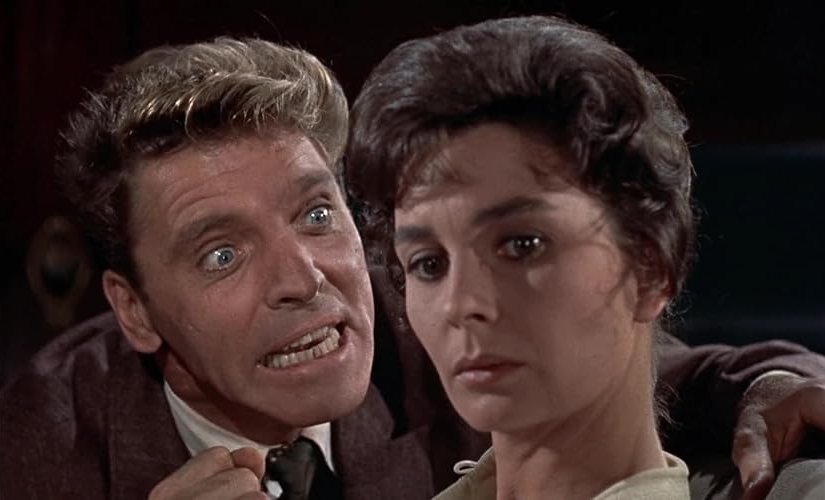
Twilight’s Last Gleaming, one of Robert Aldrich’s last films, is a cleverly constructed Cold War thriller whose pointed message about the Vietnam War nearly torpedoes the suspense.  The political message is hammered home in a scene that goes on for a bit too long with people speaking dialogue that feels hammy and trite.  But the movie surrounding this one scene is good enough that I would still recommend it to anyone in the market for something off the beaten track.

The movie is set in 1981, four years after it was released, so no one could draw any real-life parallels between the characters and people in real life.  In an opening sequence that feels reminiscent of Die Hard (1988), General Lawrence Dell (Burt Lancaster) and his team of military ex-cons manage to infiltrate and take command of a US ICBM missile silo in Montana.  While I highly doubt it would be as easy as portrayed in the film, Aldrich films the sequence so that I got caught up in the suspense of the narrative instead of worrying about pesky details.  (If there’s a drawback to these and other sequences featuring military hardware and installations, it’s the overall low-budget feel to the sets and props; everything looks like it was shot on a TV soundstage instead of a big-budget film set.)

Once inside, Dell makes his demands: $20 million for each of his remaining team (Burt Young and Paul Winfield), the President must read the transcript of a secret meeting held just after the Vietnam war started, and the President must hand himself over as a hostage to secure their escape.  Otherwise, he’ll launch nine Titan ICBMs at their targets.

This creates a little tension among the would-be terrorists.  Winfield and Young couldn’t care less about the secret meeting, but Dell is adamant.  Meanwhile, General MacKenzie (Richard Widmark) formulates a plan to eliminate Dell and his crew using a “tiny” nuclear device, the President (Charles Durning) agonizes over the secret transcript, and his best friend and aide uses some “tough love” to get him to make a decision.

Despite the fakeness of the surroundings, I was absorbed by the thriller elements in Twilight’s Last Gleaming.  I would compare them to the best parts of WarGames (1983) and The China Syndrome (1979).  There is some impressively impenetrable technobabble about booby traps and inhibitor cables and fail-safe systems that I just rolled with.  The plan involving that “tiny” nuclear device leads up to a sequence that I would compare favorably with any contemporary thriller you can name.

One of the ways Aldrich achieves this effect is through the use of split-screens…LOTS of split-screens.  It starts at the beginning of the film with two screens.  Then there are moments with three split screens, two on top and one in the bottom section.  Then, during the most intense sequence of the film, we get four splits in each corner of the screen.  At first, I found it disorienting, but it absolutely works when it most needs to.  (I’m trying not to give away too many plot details, so excuse the vagueness.)  I don’t know that I would want to watch an entire movie like this (Timecode, 2000), but in small doses, it’s very effective.

Where the movie bogs down is the middle section of the film when the President expresses his disapproval of the contents of the secret transcript Dell wants publicized.  It’s a bit theatrical to believe a sitting American President would be this vocal about his feelings in the middle of a dire crisis.  I think the scene would have played just as well if we had gotten a general idea of the transcript, or even if the contents had NEVER been revealed to the audience.  It would have been a perfect Macguffin, leaving viewers free to imagine anything they want.  The truth about Kennedy’s assassination?  Area 51?  Pearl Harbor was an inside job?  The Super Bowl really IS fixed?  Who knows?

Instead, the President insists on reading a portion of it out loud to his Cabinet members, enlisting them to read certain lines.  While I admire Aldrich’s intent (to send a cinematic protest to the architects of the Vietnam war), the scene nearly brought the movie to a stop, which is deadly when dealing with a suspense thriller.

But, like I said, the rest of the movie is so good, I am compelled to let it slide.  Later, we get surprise attacks, snipers, helicopters, a crafty fake-out involving torture, and an ending that is as cynical as they come, but which felt like the best way out of the situation for everyone involved…except for the American people, but that’s another story.  Twilight’s Last Gleaming feels virtually forgotten, and that’s a shame.  Aldrich directs this movie with a lot of passion for the material and milks every ounce of suspense he can with the tools at hand.  If you’re prepared to overlook that middle section, you’ll get a kick out of this movie.

P.S. Look fast for an unexpected appearance by William Hootkins, aka “Porkins” from Star Wars (1977).

THE LEOPARD (Italy, 1963)

by Miguel E. Rodriguez

DIRECTOR: Luchino Visconti
CAST: Burt Lancaster, Claudia Cardinale, Alain Delon, Paolo Stoppa
MY RATING: 9/10
ROTTEN TOMATOMETER: 98% Certified Fresh

PLOT: The Prince of Salina, a noble aristocrat of impeccable integrity, tries to preserve his family and class amid the tumultuous social upheavals of 1860s Sicily.


Visconti’s intimate epic The Leopard evokes the spirit of so many other films, in all the best ways, that it’s hard to know where to begin.

It’s epic in scope and intimacy, like Doctor Zhivago.  The opulent costumes reminded me of Amadeus, and the lush scenery reminded of Barry Lyndon.  The final ballroom sequences must have influenced the wedding party in The Deer Hunter.  The literate screenplay refining tons of background exposition resurfaces in movies like JFK and Nixon.  The theme of a grizzled older man facing his own obsolescence is echoed in scores of Westerns from The Wild Bunch to Unforgiven to Butch Cassidy and the Sundance Kid.

In short, The Leopard takes bits and pieces of many of my favorite films and consolidates them into an absorbing movie that held my interest from beginning to end, despite its esoteric setting: Italy during the tumultuous years of the “Risorgimento,” when the aristocratic ruling classes were faced with extinction as the middle classes rose up, rebelled, and created a democratic Italy.

We first meet Prince Don Fabrizio Salina (Burt Lancaster) as he and his extended family are attending vespers in an upstairs room of their palatial mansion.  Their ritual is interrupted by sounds of commotion and argument coming from outside the room; turns out the dead body of a soldier has been found in the garden.  (In retrospect, this seemed to me an elegant metaphor for the entire rest of the film: a family’s stability and comfort in ceremony and formality being interrupted by outside forces intent on tearing down the old order in favor of the new.)

The dead body is forgotten very shortly amid the return home of a beloved nephew, Tancredi Falconeri (the dashing Alain Delon).  His return is short-lived as he intends to leave and join the middle-class army under General Garibaldi.  Meanwhile, Prince Salina comprehends the way the wind is blowing in his country and befriends a man, Don Calogero Sedara (Paolo Stoppa), who USED to be in a lower class, but who is now on the same social footing as the Prince himself.  As the newly instated supervisor of elections, Sedara wields considerable power in the imminent new society on the horizon, and the Prince knows what must be done, despite his misgivings.

From there, The Leopard evolves into a vivid tapestry of life in the rustic Italian countryside, set among some of the most beautiful Tuscan/Sicilian backdrops I’ve ever seen.  Some of the exteriors, showing seas of wheat or olive groves with peasant workers in the foreground, looked like museum-quality oil paintings.  Some soapy material is introduced, but it never panders, never descends into schmaltz.  For example, Tancredi falls in love with Don Sedara’s daughter, the luscious Angelica (Italian knockout Claudia Cardinale), at the expense of breaking the heart of Concetta, one of Prince Salina’s daughters.  We watch as the Prince boldly strides into a seedy quarter of town to visit the rundown apartment of his mistress.  When his priest rebukes him for this transgression against his wife, the Prince explodes: “What do you want from me?  I’m a vigorous man.  I can’t be content with a woman who crosses herself before hugging me!  …I had seven kids with her.  You know what?  I never saw her navel!”

While this dialogue is both funny and not, it highlights the way the Prince has always viewed himself: as a man of noble birth whose behavior is no one’s business but his own, regardless of morality or social niceties.  But this same man is intelligent enough to know which way the wind is blowing and how to modify his behavior accordingly.

Everything concludes with a magnificent ball held by a neighboring nobleman, attended by “anybody who’s anybody” including the Prince, his family, Tancredi and Angelica, and literally hundreds of others, decked out in some of the greatest costumes I’ve ever seen on film.  During this lavish party, some final decisions are made, and the Prince contemplates what will happen to him and his family, and his entire class, after his death.  The live orchestra plays several waltzes and dances by the one and only Nino Rota, the scorer for Coppola’s The Godfather and numerous Fellini films.  As a result, yet another great film is evoked: as the celebrants dance in a line and weave their way throughout the great house, I was reminded of the famous ending of Fellini’s [1963] and its conga line of circus performers.

Some time ago I read Donna Tartt’s Pulitzer-prize winning novel The Goldfinch.  While it didn’t deliver breathless thrills like a Crichton technothriller, it was nevertheless engrossing.  The language of Tartt’s prose transported me into the world of her hero and his morally complex journey like few other books had before or since.  That’s exactly what happened with The Leopard.  I expected it to be a “spinach” movie [good for you, but yucky taste], so my expectations were a bit low, despite its massive reputation in film circles.  But, like the other Visconti film that I’ve seen [Rocco and His Brothers, 1960], it breaks free of the mold I had created for it and becomes something grand and operatic.  I have a slight issue with the very final scene (I was hoping for something a little less open-ended), but if you have the patience for it – and if you don’t mind watching Burt Lancaster overdubbed into Italian – The Leopard is a treasure worth digging for.

AIRPORT

By Marc S. Sanders

Burt Lancaster described his participation in what would become the first of a batch of 1970s all-star disaster epics as the worst picture he’s ever done.  He declared it “the worst piece of junk ever made.”  Perhaps because of this assessment we were eventually blessed with the Airplane! spoofs a decade later.  

Airport is a sudsy soap opera drama from novelist Arthur Hailey.  It’s an indiscreet invitation to make fun of it, but I doubt it was meant to be regarded that way in 1970.  Then, Airport was likely celebrated as that new kind of picture like The Godfather, Jaws and Star Wars would pioneer in their own rights.   

The film was a box office smash for Universal Pictures, garnering an acting Oscar for kindly old Helen Hayes along with nominations for Best Picture, Cinematography and Screenplay.  It spawned three more films following its success.  Yet, it’s terribly cornball, drowning in floods of cheese, and coated in the thickest of sap.  You better swallow that Maalox now.  This airport is all backed up!

Lincoln International Airport is getting blanketed in one of the treacherous, most blinding snowstorms imaginable.  So naturally it’s the right time to launch passenger airlines into the night sky while also welcoming jets to land.  Were harsh weather conditions not so alarming fifty years ago for air travel?

Well, this blizzard is going to be the first of several problems starting with a plane stuck in the snow right in the middle of the airport’s major runway.  Burt Lancaster is Mel Bakersfield, Lincoln’s Controller, who once again puts aside his family and his troubled marriage to oversee the matter.  He recruits the grizzled, cigar chomping Joe Petroni (George Kennedy) to clear that runway.  Mel firmly believes Joe is the only man who knows what the hell to do.  (Best I could tell is that Joe picks up a shovel like everyone else.) Mel’s other issue is that his pesky wife is disrupting his happy affair with Tanya Livingston (Jean Seberg), the no nonsense, yet perky appearing, blond airline executive with the mini uniform dress hemline.

Further upholding the proud chauvinism of this picture is everyone’s favorite lounge singing lizard Dean Martin as Vern Demerest.  These names!!!! If this movie wasn’t taking place at an airport, I’d swear it was a news station.  Vern also has an inconvenient marriage now that he’s learned his cutie stewardess Gwen Meighen (Jacqueline Bisset) is pregnant.  Cue the squeaky violin music as Vern offers to cover the abortion.  Shocking!!!! Gwen might want to have the child, but she’s gracious enough not to make it an obligation for Vern.  She’s gonna let her dreamboat wonder of a man be, so he remains a doting husband on the side.

So we got melodrama for the airport staff, the pilot, the stewardess… Hmmm…Oh yeah!  The passengers!!!!

A mentally ill, down on his luck man (Van Heflin) spends six dollars cash on a life insurance plan for his wife Inez (Maureen Stapleton) before boarding Vern & Gwen’s plane with a dynamite bomb in his briefcase.  Can Inez warn Mel, Tonya and everyone in time before the plane takes off?

Of course, this kind of stressful tension requires some adoring comic relief, and Helen Hayes as kindly old Mrs. Ada Quonsett delivers an Oscar winning performance.  She takes pleasure in being a habitual stowaway on one flight after another.  Gosh darn it if Tonya is going to make sure to put a stop to this lady’s shenanigans.  

The Cinemaniacs (Miguel, Thomas, Anthony and I) watched this together and Mig pointed out the cinematography first.  It’s dull like straight out of a Sunday night TV movie.  Thomas reminded us that this was in the same vein as most of Arthur Hailey’s material, like Hotel – the book that became a movie that became a TV series.  The soap opera occupies the first two thirds of the picture.  Then a potential threat of disaster occurs, and you work to guess who lives and who dies.  

Directors George Seaton (also screenwriter) and Henry Hathaway work to get the audience invested in these people first while trying to educate us on the most up to date operations in a fully functioning airport.  If George Kennedy’s character is not shoveling snow on a runway and giving it all he’s got in the stuck plane’s cockpit, he’s telling the others what to expect from a potential bomb explosion aboard a jet.  And Look!!! There’s telephones in Mel and Vern’s cars.  Push button ones too.  All over the airport are red phones next to white phones.  There’s luggage.  There’s blankets and pillows for everyone on board the plane. There are also unsuspecting women wearing minks and smuggling jewelry into the country, but the seasoned custom security guard has got a good eye. He can see everything, except for the guy with the bomb. And there’s snow.  Lots and lots of snow but the cabs make it to the airport in the nick of time.  There’s also a message about the need for updating construction on our country’s airports with the most sophisticated traffic controls and operations imaginable.  Should the money be spent?  On top of all this, how are Mel and Vern’s wives and families holding up?

Maybe it’s unfair.  It’s hard to embrace Airport when I have already grown up watching the ZAZ team brilliantly spoof the picture with the Airplane! films.  Yet, I’m confident that had I seen Airport upon its initial release, I likely would not hail the romances of Lancaster, Seberg, Martin and Bisset as the next iterations of Rick and Ilsa.  The dialogue and scenarios are eye rolling at best.  The chemistry sputters as soon as we see the characters for the first time.  The men are twenty five years older than the women, but the love is supposedly passionate?

The extras who are granted snippets of dialogue look like they are reading cue cards and the major players truly look bored.  Watch the cast when the bomb goes off on the plane (like you didn’t think it wouldn’t happen).  There’s no adrenaline from Dean Martin.  He looks lost without his signature scotch and cigarette. The passenger extras never got the memo that they are supposed to be on board a plane with a gaping hole in the rear lavatory.  The priest on board slaps the guy next to him, but I need more convincing of the panic that is supposed to persist.

Fifty years later, the legacy of Airport hinges on only one purpose and that is to give it the ol’ Mystery Science Theater 3000 treatment.  More importantly, once you finish watching it, about all you want to do next is watch Airplane! 

“The cockpit!  What is it?”

“It’s the little room at the front of the plane where the pilots sit, but that’s not important right now.”

ELMER GANTRY (1960)

by Miguel E. Rodriguez

DIRECTOR: Richard Brooks
CAST: Burt Lancaster, Jean Simmons, Arthur Kennedy, Shirley Jones
MY RATING: 9/10
ROTTEN TOMATOMETER: 94% Fresh

PLOT: A fast-talking traveling salesman convinces a sincere evangelist that he can be an effective preacher for her cause.


Elmer Gantry pulls a double, then a triple-fake.  It’s a good thing they stopped at three because you can only subvert an audience’s expectations so many times before they hold it against you.  It starts as a tired (but well-executed) formula, then it turns that formula on its head, and then, just when you think you’ve gotten a stereotypical Hollywood ending, it pulls one more rabbit out of the hat.  In a way, it reminded of The Blue Angel (1930) in the way it presents a clearly hypocritical man to the audience, warts and all, and gets us to feel a little sympathy for him at the end, despite his wicked ways.

The film is also the most intelligent film I’ve seen about religion and Christianity since Robert Duvall’s The Apostle (1998).  It contains the best scene/exchange on the topic I’ve ever seen, between a fire-and-brimstone preacher and a non-believing newspaper reporter.  Both sides score points, but in the end, neither one wins, which I believe is just as it should be.  But I’m getting ahead of myself.

We first meet Elmer Gantry (Burt Lancaster) as he’s telling a dirty joke to some prospective clients in a bar, sometime during the Prohibition era.  The impression he gives right away is that of a huckster, a fast-talking, fast-thinking heel who’ll do whatever it takes to make a sale.  His conversation is interrupted by two nuns soliciting donations.  As a lark, he grabs their collection plate and exhorts the bar patrons to give all they can.  He’s pulling a cynical prank, but his words are surprisingly effective.  And no wonder: we later learn he was expelled from a theological seminary some years ago.  He knows the words, but not the music, but that’s enough for folks to turn out their pockets for him.  No one is more surprised by this outcome than Elmer himself.

Later, after visiting a Negro church service and hoboing around on a train, he visits a traveling revival led by Sister Sharon Falconer (Jean Simmons).  He is immediately smitten by her beauty – because, hello, it’s Jean Simmons – and realizes the only way to get to her is through her vocation.  With some of his trademark fast-talking, he flirts with one of Sister Sharon’s followers and uses what he learns to get closer to Sharon.  He agrees to deliver a mini-sermon at one of her very well-attended revival services to prove his good intentions, but something unexpected happens: the crowd responds to his words as if he were a bona-fide preacher.  Soon he’s touring with Sister Sharon from town to town as crowds get larger and larger.

Meanwhile, we get to see the inner workings of the business side of this religious venture.  We watch as various preachers and pastors debate the merits of inviting Sister Sharon and Gantry to a “big” city, Zenith.  (I learn from Wikipedia this city name is fictional, created by the author of the book on which the film is based…didn’t know that.)  Committee members are uncertain whether Sharon’s and Gantry’s message will increase church rolls in a metropolitan area as opposed to their previous, more rural locales.  I loved this scene because it feels authentic.  Whether it’s realistic or not is not for me to say.  But I can easily imagine well-intentioned religious leaders (and maybe some NOT so well-intentioned) sitting around and discussing, not just the spiritual expectations of such a revival, but also the FINANCIAL expectations, as these men do in the film.

Elmer Gantry is filled with scenes and dialogue that held my attention for the film’s duration.  Growing up as I did in a Christian church environment and graduating from a Christian college, I recognized virtually all of Elmer’s tactics, as well as Sister Sharon’s tactics, in using exactly the right words, gestures, and tone to play a congregation like a fiddle.  The difference is, Sister Sharon genuinely believes she’s been touched or called by God to this vocation, while Gantry is expertly going through the motions as a means to an end.

 (On a personal note, I should mention that Burt Lancaster’s mannerisms and speech patterns as Elmer Gantry strongly reminded me of the pastor of the Southern Baptist church I attended for many years, from his physical appearance to his, pardon the expression, shit-eating grin.  But that’s another story…)

There is one scene that I must specifically mention and dissect.  A Zenith newspaper reporter, Jim Lefferts (Arthur Kennedy), writes an article in which he expresses his skepticism of Gantry’s and Sister Sharon’s motives, as well as of revivals in general.  He writes:

“What qualifies someone to be a revivalist?  Nothing.  Nothing at all.  There is not one law in any state in the Union protecting the public from the hysterical onslaught of revivalists.  But the law does permit them to invest in tax-free property, and collect money, without accounting for how it is used.  What do you get for your money?  Can you get into heaven by contributing one buck or 50?  Can you get life eternal by shaking hands for Jesus with Elmer Gantry?”

(The Lefferts character is asking questions in this article that are as relevant now as they were in 1960, or 1920, or even going back to ancient times when Jesus whipped the moneylenders from the church.  To put it another way, as one dissenting church elder says in the film, “Religion is not a business.  And revivalism is not religion.”)

Sister Sharon and Gantry show up at the newspaper office to officially protest the article to Lefferts and his editor.  Sharon objects to the article’s implications about misusing collection money.  Lefferts calmly asks if Sister Sharon is ordained.  She is not, in fact, sanctioned to preach by any church body.  She points out that neither was Peter or Paul or any of the apostles.  Lefferts retorts:

“Ah, but they said that they lived with the Son of God, were taught by Him, were sanctified by Him.  What gives you the right to speak for God?  …How did you get His approval?  Did God speak to you personally?  Did He send you a letter?  Did you have a visitation from God?  A burning bush, perhaps?  Where in the New Testament does it say that God spoke to anyone except His Son?”

Then Lefferts quotes First Corinthians to show how the Bible says it’s shameful for women to speak aloud in church.  I’m watching that scene, and I’m going, BOOM, game, set, and match to Lefferts.  I remember asking these very same questions when I was younger and having normal doubts about the way church was structured.  Not about women speaking in church, I knew that was archaic and outdated, but I would always hear preachers and evangelists say, “God spoke to me.”  And I wanted to ask, “Well, what did His voice sound like?  Did He have an accent?  Did He speak English?”  But we weren’t SUPPOSED to ask those kinds of questions, we just had to take their word for it because, after all, they’re up there in the pulpit, and I’m down in the pews just listening.

But here’s where Elmer Gantry shows its colors as a film that may SEEM like it’s taking sides, but it really isn’t.  Lefferts finishes his takedown of Sister Sharon, but Elmer has a trick up his sleeve.  He turns Lefferts’s argument against itself by asking why he quoted the Bible if he doesn’t really believe the Bible is factual.  If Lefferts doesn’t believe in the six days of Creation or in the miracle of the loaves and fishes, then how can he use the scripture against Sister Sharon?  It’s a rather brilliant argument that almost feels lifted from Inherit the Wind (released the same year as Elmer Gantry.)

My admiration of this scene stems from the fact that both sides make excellent points, and the scene ends in a kind of stalemate where Lefferts won’t retract the article, but the newspaper offers to run a response to the article.  (Naturally, Gantry wheedles it up to a series of radio broadcasts instead.)  It would be tempting in a movie that is predominantly anti-religion to portray religious proponents as Bible-thumping, spittle-spraying zealots without a brain in their heads.  While Elmer certainly takes cues from that behavioral playbook, he is clearly not a moron, and that is refreshing.

Those who have seen the film before may note that I haven’t even touched on the one Oscar-winning performance from the film.  Shirley Jones plays a prostitute named Lulu Baines, and she has the film’s most unforgettable line as she recounts how a young man once took advantage of her behind a church pulpit one Christmas Eve: “He rammed the fear of God into me so fast I never heard my old man’s footsteps!”  What part she has to play in Elmer’s story, I will not reveal, just in case anyone’s reading this who’s never seen the movie.  She reveals unexpected depths and makes unexpected choices in the last couple of reels that seal both Elmer’s and Sister Sharon’s fates.

Whew!  This was another long one.  Elmer Gantry by its very nature engenders discussion and debate.  There’s even an opening title crawl advising patrons that, while the filmmakers believe that “certain aspects of Revivalism” demand further scrutiny, everyone is free to worship as they please, and patrons should prevent impressionable children from watching the movie.  Perhaps they were afraid children would believe that all religions and evangelists proceed from secular motives, which would lead to all kinds of uncomfortable conversations with their parents, churchgoing or otherwise.  In my opinion, those kinds of conversations can only benefit both the children and the parents.  I believe Elmer Gantry is one of the finest treatments of religious beliefs and activities I’ve ever seen, specifically because, by the time we get to the end credits, I’m still not 100% sure whose side the movie is on.  I think it’s up to us to look at the movie as a whole and make our own decisions.

THE SWIMMER (1968)

by Miguel E. Rodriguez

DIRECTOR: Frank Perry [reshoots directed by an uncredited Sydney Pollack]
CAST: Burt Lancaster, Janet Landgard, Marge Champion, Kim Hunter, Joan Rivers (!)
MY RATING: 8/10
ROTTEN TOMATOMETER: 100% Fresh

PLOT: A well-off ad man visiting friends in a suburban town impulsively decides to swim home via all his neighbors’ swimming pools.


The decidedly odd The Swimmer starts out like it’s going to be one of those pretentious mid-to-late ‘60s “art films” featuring attention-getting zooms, quick edits, and a kitschy/dreamy score that oozes “soap opera” from every note.  (Incidentally, this was Marvin Hamlisch’s first film score.)  It starts mundanely enough, but then it veers imperceptibly into vaguely Lynchian territory, until by the end we’re no longer sure what’s real.  If the payoff doesn’t quite live up to the build-up, I’m prepared to forgive it because of the film’s daring originality, Burt Lancaster’s nude scene notwithstanding.  Hope I didn’t spoil that for you.

Based on an acclaimed story by John Cheever, The Swimmer opens with those ostentatious zoom shots/quick edits of forests and woodland creatures before we meet Ned Merrill (Lancaster), visiting a friend and swimming in their pool.  The neighborhood is decidedly upper-middle class.  The conversation between Merrill and his friends is banal to the point of tedium.  “You ever see such a glorious day?”  “You old son of a gun!”  “Ned Merrill!  How are you, sport?”  Who talks like this?  The dialogue evokes the kind of vibe you’d get from reading a screenplay written by a moderately talented middle-schooler, or perhaps by an advertising executive with no sense of how people talk in the real world.

After some more boring pleasantries and treacly politeness and observations of how nice the weather is, Ned has a brainwave.  He and his wife and daughters live in a house on a hill a mile away.  Or two.  Or five.  It’s never really made clear.  Anyway, he realizes that his friends and neighbors, all of whom have pools, form a river that he can use to swim all the way home.  He never explains where this decision comes from, but whatever, off he goes, to the consternation of his neighbors.

That’s the plot in a nutshell.  For the rest of the film, Ned will visit his neighbors one by one, popping in unexpectedly, take a lap in their pool, and jog off to the next one.  Along the way, he’ll have encounters with his neighbors that will range from friendly to strained to flirty to outright hostility, and two unsavory encounters that involve borderline sexual harassment.  By the time he reaches his goal, everything we’ve seen before will be redefined in light of new information.  I had an idea of what would happen, but I was wrong.  Sort of.  See for yourself.

The Swimmer is a borderline one-trick-pony movie, like Primal Fear.  As good as that movie is, and as good as Edward Norton’s performance is, after watching it the first time, all the suspense is gone.  But The Swimmer is so much odder than anything I’ve ever seen that it gets some kind of award just because of its oddness.  We’re invited to simply watch a man swim in other peoples’ pools and talk to the owners.  At one such encounter, Ned marvels that their 20-year-old daughter, Julie, has grown up so much.  He mentions his own daughters, Ellen and Aggie, probably playing tennis at home.  Julie suggests driving to Ned’s home to meet them…but Ned changes the subject.  This will occur repeatedly.  Ned will mention his wife or daughters, someone will ask how they are, and Ned will abruptly move to the next topic.  (It’s this behavior that made me think I knew what was going on, but as I said, I was wrong.)

The encounter with Julie takes an odd turn: he invites her to join him on his swim, and she agrees.  After crashing a neighbor’s pool, and Ned hurts his leg jumping over a hurdle meant for horses (long story), Ned and Julie share an odd conversation where she confesses she used to like smelling his shirts when she was much younger.  Ned takes in this information and starts flirting with Julie, who is at least 30 years his junior, to the point where it looks as if something unsavory is about to happen.  Nothing does, but the scene itself is a very strange detour, even in the middle of this strange movie.

While Ned’s encounters with his neighbors are all different in one way or another, the first few all have the same thing in common: they’re all trite, by which I mean their dialogue with Ned is filled with lines and sentences that sound, well…scripted.  Not a word of it sounds or feels genuine.  I suppose one could interpret this triteness as an indictment of modern suburbia, where one house and one pool is so like the next as to be indistinguishable from each other.  The same could be said of the people.  One guy brags about his pool’s water filter: “It filters 99.99.99% of all solid matter out of the water.”  Another house features an enormous sliding roof so people can…go swimming while it rains, I guess?  We are treated to scenes of luxury that border on decadence.  At one party, caviar is served, and the guests scoop it up as if it were onion dip.  I was reminded of a line from The Philadelphia Story about “the privileged class enjoying its privileges.”  Is The Swimmer a clumsily disguised diatribe against consumerism?  Sure, why not.

At the end of the day, while The Swimmer does have a buried subtext that is not fully revealed right away, I’ll admit the subtext is not what compels me to recommend it.  I recommend it because it is a cleverly constructed “head-fake” movie, making me think it was about one thing when it was about something else altogether.  Viewers more astute than I may have guessed what was going on, and more power to them.  For myself, my theory was proven wrong at the finale.  The Swimmer gets points for originality, with deductions for the cheesy score and hammy acting.  The back of the Blu-ray describes the movie perfectly: “…a feature-length ‘Twilight Zone’ by way of The New Yorker.

(P.S.  If you have “seeing Burt Lancaster’s bare ass” on your Movie-Watching Bingo card, this movie will help you fill it.  You’re welcome.)

GUNFIGHT AT THE O.K. CORRAL (1957)

by Miguel E. Rodriguez

DIRECTOR: John Sturges
CAST: Burt Lancaster, Kirk Douglas, Jo Van Fleet, John Ireland, DeForest Kelley, and a young bit player named Dennis Hopper
MY RATING: 8/10
ROTTEN TOMATOMETER: 87% Fresh

PLOT: Lawman Wyatt Earp and outlaw Doc Holliday form an unlikely alliance which culminates in their participation in the legendary Gunfight at the O.K. Corral.


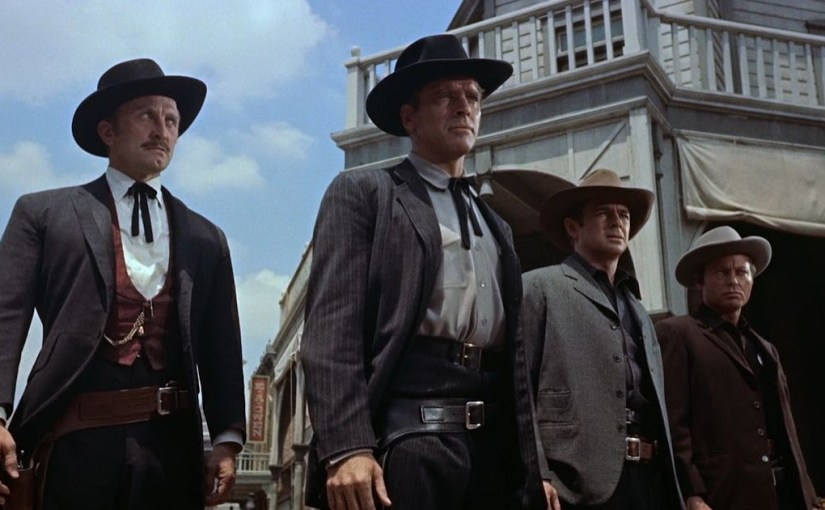
In real life, the legendary gunfight at the O.K Corral in the frontier town of Tombstone lasted thirty seconds, but what kind of movie would that be?  (Kill Bill: Vol. 2 springs to mind…)  A 1950’s Western requires a long-to-medium shot of the good guys – Wyatt Earp, his brothers, and Doc Holliday – striding down the street to meet the challenge of the dastardly Clantons, who had gunned down Wyatt’s youngest brother in cold blood.  We need a gunfight, not too long, but longer than 30 seconds.  And we need to make sure the ratio of surviving bad guys to good guys is just right: 0 to all.

John Sturges’ Gunfight at the O.K. Corral delivers the goods in a remarkably mature film for its time, free (for the most part) of cheap sentimentality and distractions from the main plot.  That’s a double-edged sword, though: we rarely leave the side of either Wyatt Earp or Doc Holliday, but the result is we get little to no information about Earp’s brothers until the final reel, nor do we get many details about Earp’s romance with the lovely Laura Denbow, a high-class gambler who knows enough about cards to beat the men at their own game.  We only find out they’re engaged as an afterthought, it seems.

As for Doc Holliday’s relationship with Kate Fisher (Oscar winner Jo Van Fleet), the word “dysfunctional” is woefully inadequate.  Loosely based on Holliday’s real mistress, referred to only as “Big Nose Kate” on Wikipedia, she seems to exist only to serve as Holliday’s psychological punching bag when required.  Her emotional yo-yoing gave me whiplash: she pledges her unending devotion in one scene, tries to stab him in another, helps him escape a lynch mob, takes up with the loathsome Johnny Ringo after yet another fight, begs to be taken back, and eventually tells him, “I’ll see you dead!”  With friends like these…

But even that kind of sordid melodrama is not enough to derail the throughline of the film, which is focused intently on establishing the rocky relationship between the morally good Wyatt Earp (Burt Lancaster) – who nevertheless wears a black hat the entire film – and the morally chaotic Doc Holliday (Kirk Douglas), a professional gambler who leaves a string of dead bodies behind him, all killed in self-defense, of course.  Earp also helps get Holliday out of town before a mob can lynch him, so Holliday decides to stick around until the debt is paid.

I think the essence of their relationship is summed up in a scene where Earp is forced to deputize Holliday when no other options are available.  Earp reluctantly walks up to Doc, tells him to raise his right hand, and says, “Do you solemnly swear to uphold…oh, this is ridiculous.  You’re deputized.”  Doc: “Wait a minute, don’t I get to wear a tin star?”  Earp: “Not on your life!”  Both men are torn between their philosophy and their sense of honor.  Holliday is no hero, but he’ll help Wyatt until his debt is paid.  Earp despises Holliday’s moral code, but he’s the best gunslinger in town.  What can you do?

All of this is handled in dialogue that seems mostly uncluttered by the hokey clichés I’ve heard in so many other films of the 1950s, even some of the great ones.  This may perhaps be due to the fact the screenplay was written by Leon Uris, a novelist who would eventually go on to write, among many others, Exodus, Topaz, and QB VII.  Listening to the characters talk, it was interesting to hear how natural they sounded, compared to the overblown melodrama of so many other westerns and dramas of that era.  The dialogue was clearly written by someone with a writer’s ear, who wants to get to the point of every scene with a minimum of fuss or flowery exposition.

As I mentioned, however, this quest for directness means we spend all our time with Earp and Holliday and almost no time at all with the Clantons or Earp’s brothers or anyone else.  By the time we hear Wyatt’s brother, Virgil, is in trouble, we’ve almost forgotten he HAS brothers.  As far as the Clantons go, we hear everything about them secondhand until we finally meet them in Tombstone.  We never even see Wyatt propose to Laura; we barely even see them courting (their courtship appears to consist of one false arrest and one kiss in the moonlight).

And I would be remiss if I did not mention…that song.  I learn from IMDb that the song, “Gunfight at the O.K. Corral,” that plays over the opening and closing credits, and which also plays over any transitional scene as Earp moves from one town to the next, was one of the inspirations for the theme song for Mel Brooks’s parody Blazing Saddles.  Brooks even got the original artist, Frankie Laine, to sing for his own movie.  It is so corny and earnest, juxtaposed against the gritty characters and scenery, that any sequence featuring that song loses all credibility.  If the filmmakers had just ditched that song, I might consider this one of the greatest Westerns of all time.  (see also Rio Bravo with Ricky Nelson’s crooning.)

But…having said all that, I must report that Gunfight at the O.K. Corral was entertaining from start to finish.  By avoiding the temptations to give in to melodrama and hokeyness, we are presented with a surprisingly solid Western drama that culminates in a decent (for the late ‘50s) gun battle.  It’s not as flashy as anything from one of Eastwood’s spaghetti westerns, and it’s not quite as thrilling as the one at the end of 1993’s Tombstone, but it’s satisfying, nevertheless.

(And for the record, when it comes to memorable lines, against Val Kilmer’s immortal “I’m your huckleberry”, I would gladly put Kirk Douglas’s venomous, “You slut!” …you have to see it in context, trust me.)

LOCAL HERO (United Kingdom, 1983)

by Miguel E. Rodriguez

DIRECTOR: Bill Forsyth
CAST: Burt Lancaster, Peter Riegert, Fulton Mackay, Denis Lawson, Peter Capaldi
MY RATING: 8/10
ROTTEN TOMATOMETER: 100% Certified Fresh

PLOT: An American oil company has plans for a new refinery and sends someone to Scotland to buy up an entire village, but things don’t go as expected.


Local Hero is not normally the kind of movie I gravitate to.  It’s not slow, but it’s deliberate.  It’s not hilarious, but it’s funny.  It’s not plotless, but it meanders and skips around.  It’s not flashy, it’s not glossy, and it’s not kinetic.  I can easily remember a version of myself that might have turned this movie off after the first thirty minutes.

But today, at this time in my life, for whatever reason, something made me look at this movie in a different way than I might have once upon a time.  The movie started to resemble a memory.  Not one of my memories, but like someone else’s memory, like I was listening to someone tell a story about this one time when he went to Scotland and something happened that didn’t exactly change his life, but it made him look at the world differently.  Fiction or not, Local Hero plays not as a movie, but as a recollection.  Its charm carried me through the entire film.

And I’m not talking about the kind of charm you might see in any 2 or 3 movies set in Scotland or Ireland.  Normally, in films set in and around the British Isles, the villages one might find there are laid back, yes, but filled with eccentric characters who know each other’s business, are friendly but cautious around outsiders, and who are loud and boisterous at the local pub.  In Local Hero, the most eccentric characters are the Americans, and the village pub might fill up, but you’ll never have to raise your voice to be heard.  It’s an interesting switch.

The story: A Texas oil company wants to buy the entire village of Ferness in Scotland so it can turn the surrounding area into a giant oil refinery.  The company’s CEO, Felix Happer (Burt Lancaster), sends a junior executive, Mac (Peter Riegert), to Scotland to facilitate the deal.  When Mac arrives, he gets his first taste of culture shock, not due to all the eccentricities he finds, but due to how quiet this town is.  He is checked into the local hotel by Gordon Urquhart (Denis Lawson, aka “Wedge Antilles” in the Star Wars films), who also turns out to be the town’s bartender, the town treasurer, and the head chef in the hotel’s kitchen.  Mac is accompanied by an eager Scottish assistant, Oldsen (an impossibly young Peter Capaldi), who develops a crush on a local scientist and runs from one assignment to another as if his arms were on fire.

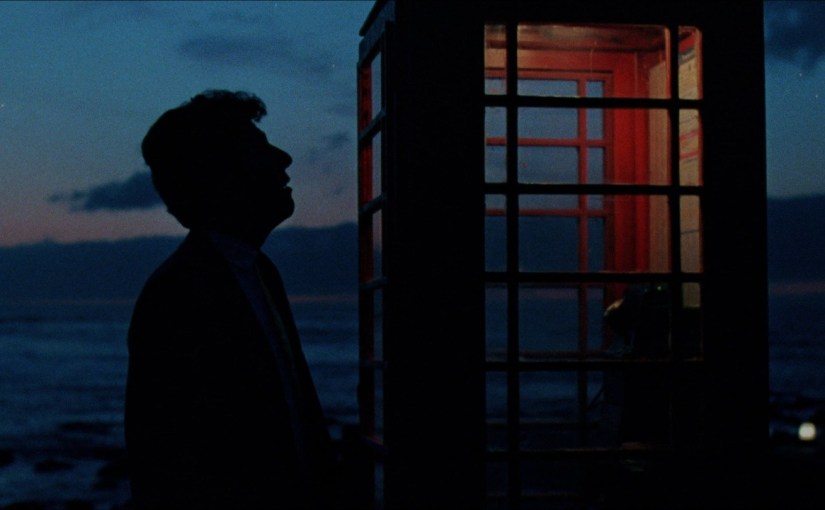
Local Hero throws curveballs every chance it gets.  You’d expect the citizenry to get indignant at the idea of an American mega-corporation wanting to buy their town.  But when the locals get an idea of how much each person would get, they become instant supporters.  When they all convene at the local church, the Reverend is not an inexperienced youth or a crusty old soul, but an African gentleman who, according to the story he tells Mac, came to Scotland to learn the ministry and just…never left.  Happer, the CEO, insists on periodic updates from Mac, and since this is 1983, Mac has to call Texas from a red phone booth just outside the hotel.  But Happer seems less interested in the deal than in the potential discovery of a comet, somewhere in the constellation Virgo.

All of this is told in the laid-back manner of someone telling a story around a campfire.  There are little jumps forward that omit what might seem to be key information, but we pick up on it right away.  Little details emerge, like the motorcyclist who always seems to be roaring down the town boulevard just in time to nearly run Mac over.  There’s a moment when Mac encounters a group of men near the beach, has a pleasant conversation, then notices a baby in a stroller.  “Whose baby?”  His question is met with an uncomfortable silence as the men slowly look at each other, and Mac wonders what just happened.  And the beautiful thing is, that’s it.  That’s the end of the scene.  No one ever answers the question, and we never find out why not.

That kind of thing would normally infuriate me, but in this movie, it reinforced the idea of a fond memory.  I can easily imagine someone telling the story and saying, “And that was it!  No one ever said whose baby it was!  I still don’t know whose baby it was!”  It has the ring of real life, it’s not played up for laughs, and there’s no punchline at the end.  The punchline is that there IS no punchline.

There is a nice moment when Mac has had one or two whiskeys too many one night, and he gets on the phone with Happer in that red phone booth.  Suddenly, the sky starts to glow and glisten – the aurora borealis.  Mac gets excited and tries to explain to Happer what’s going on, but he lacks the vocabulary.  “I wish I could describe it to you like I’m seeing it!”  I know how he feels.  It’s how I felt when I went to Alaska for the first time in decades and traveled on a cruise ship through a narrow fjord and saw towering cliffs covered in trees and intermittent waterfalls cascading over rocks so everything looked primeval, like something out of The Lord of the Rings.  Just describing it doesn’t convey how it felt.  It’s a short moment in the movie, but I felt the reality of it in my bones.

In an interview on the Criterion Blu-ray, the film’s producer, David Puttnam, talks about how, when this movie was made, the general public’s idea of comedy was Airplane! and Blazing Saddles.  If it wasn’t zany, it wasn’t considered a comedy.  He wanted to help make a film that tried to remind audiences that comedy doesn’t automatically mean pratfalls and fart jokes.  Comedy can be gentle.  Local Hero is as gentle as they come.  It’s marvelous closing shot speaks volumes, and it wouldn’t have had the same impact if the story had been told any other way.

SEVEN DAYS IN MAY (1964)

by Miguel E. Rodrigugez

DIRECTOR: John Frankenheimer
CAST: Burt Lancaster, Kirk Douglas, Fredric March, Ava Gardner, Edmond O’Brien, Martin Balsam
MY RATING: 9/10
ROTTEN TOMATOMETER: 91%

PLOT: United States military leaders plot to overthrow the President because he supports a nuclear disarmament treaty, and they fear a Soviet sneak attack.


Barely two years after The Manchurian Candidate shocked audiences, director John Frankenheimer delivered the goods again with a political conspiracy thriller that is the equal of Candidate in almost every way.  Were it not for some overcooked sermonizing during a transitional scene, I would almost call Seven Days in May a perfect example of the genre.  I’m frankly a little surprised it’s not mentioned more often in the same breath with other similar thrillers like Fail Safe, The Parallax View, and Three Days of the Condor.

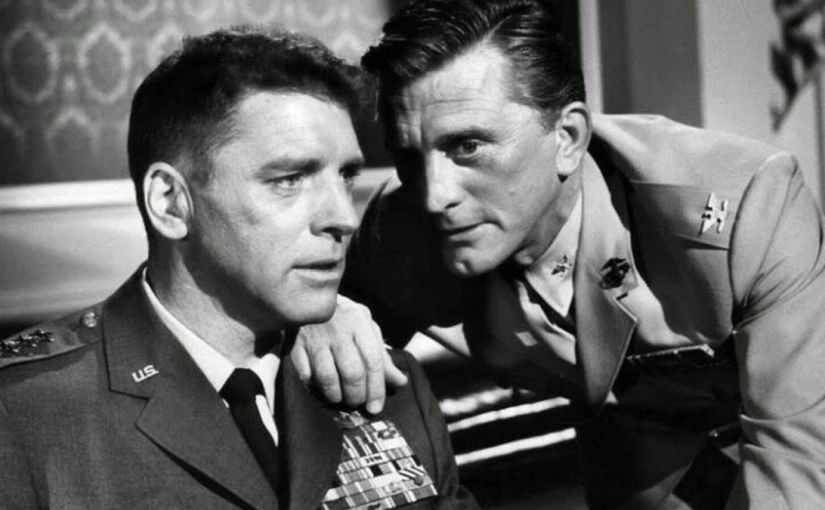
The action starts on a Monday and, predictably, spools out over the next seven days.  We learn that the current American President, Jordan Lyman (Fredric March) has just signed a nuclear disarmament treaty with the Soviets, this being the height of the Cold War in the early 1960s.  His actions have brought his approval ratings to a record-setting low, and demonstrators outside the White House express their desire to see someone else in the Oval Office: General James Scott (Burt Lancaster), a hawkish individual who sees no evidence the Russians will ever honor such a treaty.  General Scott’s aide is Colonel “Jiggs” Casey (Kirk Douglas), a soldier who disagrees with Scott’s views privately, but who knows his duties and performs them admirably.

Over the next couple of days, Casey picks up scraps of conversations from senators and other generals critical of the President.  There is talk of the President attending an “alert”, or an exercise in which armed forces are scrambled in a drill; uncharacteristically, he’s attending alone – no press.  A friend of Casey’s mentions something called “ECOMCON”, a secret Army base in El Paso, and a mysterious “Site Y.”  A Pentagon messenger relays a teletype message from General Scott to other members of the Joint Chiefs about who’s placing bets in the Preakness pool…then gets transferred to Pearl Harbor.  Casey wonders why questions about a horse race would be broadcast over Top Secret channels…

Watching Casey piece the clues together is one of the pleasures of this movie.  It never talks down to the audience, depending on them to follow Casey’s line of reasoning while he draws his own conclusions.  Once he brings his suspicions to the President, and the President elects not to attend the alert, things start happening very fast.  It’s here where the height of suspense occurs, as three men are sent in different directions to accomplish three separate fact-finding missions.  As each man got closer to achieving their goal, there was a feeling in the air, a vibe, a tone that felt like disaster was just around the corner, knocking on the next-door window.  A man drives his car into the desert in search of the secret base in El Paso, and I half-expected the sands to just open up and swallow him whole.

Frankenheimer always was an expert at that kind of suspense generation.  Second only to Hitchcock among his contemporaries, he was a genius at creating tense situations with a minimum of flash, depending on strength of story and screenplay, and his actors, to generate a nervous tension in his viewers.  Those powers are on full display here.

It’s odd…Seven Days in May is a political thriller that doesn’t have any real action scenes or sequences.  A plane crash is referenced but never seen, as opposed to today’s films that would make room in the special FX budget to show audiences the crash.  At least in this film, it’s far more effective when it’s revealed but never seen.  That’s pretty gutsy.  There are no pumped-up chase scenes between a guy with crucial evidence and the shadow forces trying to keep it a secret.  It’s all handled very simply, which makes everything more plausible…and, as a further result, much more suspenseful.

I haven’t mentioned Ava Gardner’s character yet, Eleanor Holbrook, a former lover of General Scott’s.  How she figures in Casey’s plans to uncover evidence of Scott’s treason leads to a devastating scene involving old love letters and mistaken assumptions.  It’s some brilliantly incisive writing, and another example of how the movie achieves plausibility through simplicity.

Any further discussion would necessarily involve spoilers, so I’ll stop here.  Seven Days in May is a prime example of a good story told well, with hardly any bells or whistles.  It reminded me, for some reason, of some of those classic ‘80s thrillers where their only reason for existence was to turn up the tension without getting bogged down in subtext (Body Heat, No Way Out, Blow Out).  There is that one sermonizing speech, as I mentioned before, and I cringed a little when it happened, but it’s a minor quibble.  This is a superior thriller that deserves to be seen.

FIELD OF DREAMS

By Marc S. Sanders

Fantasy can be a real challenge.  The audience must convincingly accept what could never possibly be real.  The Wizard Of Oz from 1939 will always be the best of all fantasy films.  The most visually significant element was bookending the film in black and white, with illuminating color in the center for the Land of Oz to come to life.  You feel transported.

Phil Alden Robinson’s screen adaptation of W.P. Kinsella’s novel, Shoeless Joe, had a big challenge.  The film became known as Field Of Dreams.  How would any of us believe that an Iowa corn crop farmer hears voices and gets the inspiration to throw all common sense out the window and build a baseball field in the middle of his property?  It’s absurd.  Maybe only Kevin Costner, a modern-day innocent Jimmy Stewart of the time in the late 1980s, would convince any of us that this is something that needs to be accomplished.  Robinson’s script offers no logic that any of this should be done.  Re-watching the film, I was still skeptical of accepting the outrageousness.  Then again this is Kevin Costner in his mid-thirties with a toothy grin on his face, chestnut hair, beat up jeans, and an adorable 8-year-old Gaby Hoffman for a daughter and a spitfire Amy Madigan for a wife.  I can’t explain it any more than Ray can explain to his wife why he needs to tear down acres and acres of valuable crops for a baseball field that’ll run him into enormous debt. You just gotta roll with it, I guess, even if your suspension of disbelief isn’t there. 

Thankfully, the authenticity of the fantasy welcomes itself as Field Of Dreams moves on. 

Costner plays Ray Kinsella who had a very estranged relationship with his father who only briefly played in the minor leagues before aging quickly and working himself towards a premature death.  Ray went on to Berkeley in the ‘60s and got caught up in the hippie movement leaving his father’s baseball heroes of Ty Cobb, Rusty Miller and “Shoeless” Joe Jackson behind. 

After Ray builds the beautiful field and waits months and months for something, anything, to happen, the ghost of “Shoeless” Joe Jackson, (Ray Liotta) donned in his White Sox uniform, appears.  Jackson was part of the infamous Black Sox scandal and was denied of ever playing professional baseball again, following being caught accepting bribes to fix games with seven other teammates.  Ray spends the evening with Joe pitching and fielding together.  Now, whatever hasn’t made sense to the viewer suddenly presents some light on this outrageous feat we’ve been witnessing.  Dorothy has met the Scarecrow.

Ray has dreams to find a recluse author named Terance Mann (a superb James Earl Jones who should’ve gotten an Oscar nomination; just an astonishing actor).  Later, he meets a ball player who only played one inning in the major leagues, Archie “Moonlight” Graham – portrayed charmingly by an elderly Burt Lancaster and a spry Frank Whaley.  How they both play the role is a surprise I’ll withhold from this write up.

I share this summary because Field Of Dreams improves itself as it progresses.  The ghosts, the fantasy, and the sheer nerve that Robinson (director and writer) grants to Costner and the cast send you into the imaginary.  You’ll be twenty minutes into the picture and ready to give up.  Thankfully, the storyteller who made the film introduces something unworldly that encourages us to learn more and more.  That’s what happens every time you watch The Wizard Of Oz.  Not just the color, but the décor and strangely adorable munchkins draw you in with curiosity and you want to discover more about this place you’ve never visited before. 

With Field Of Dreams, you don’t have to know anything about baseball.  What you need to understand is that people of a past enter Ray’s life when he never expected them. Now, he’s destined to aid them in fulfilling what they were denied of during a time gone by. 

We all wish to take advantage of our dreams gone by.  Fantasy makes that possible.

Perhaps Ray Kinsella was denied an experience, as well.  You’ll have to watch Field Of Dreams to find out.

THE KILLERS (1946)

by Miguel E. Rodriguez

Director: Robert Siodmak
Cast: Burt Lancaster, Ava Gardner, Edmond O’Brien (and William Conrad in a small role…and yes, he was a big fella even then)
My Rating: 8/10
Rotten Tomatometer: 100%

PLOT: An insurance investigator tries to get to the bottom of a strange case involving a man who waited calmly for two men to find him and kill him.


Over the last several months, I’ve been digging a little more into the film noir genre, specifically going back to the ‘40s and ‘50s, and I’ve discovered some gems.  Pickup on South Street (1953), for example, featuring one of the most violent fight scenes to be found outside of a Tarantino film.  Or The Killing (1956), an early Stanley Kubrick film depicting the kind of ruthless behavior that I didn’t think was permitted at the time.  I’m discovering that, for the adventurous moviegoers back then, there were films available to see that might have made their parents or grandparents gasp in horror.

Take the movie I watched today, The Killers (1946), the film noir that introduced Burt Lancaster to the world.  It’s based on a short story by Ernest Hemingway that was also adapted into a film in 1964, starring Lee Marvin, Angie Dickinson, and, in his last film role, Ronald Reagan.  [Watch this space for a review of that film, coming soon.]  At the beginning of this movie, we’re introduced to two thugs who walk into a small town, cloaked in the kinds of shadows and light that only film noir can get away with.  After terrorizing the patrons of a small diner, they walk to a nearby boarding house and up the stairs to a room occupied by Ole Anderson, aka “The Swede” (Lancaster), who has been alerted to their arrival but makes no effort to escape or call the cops.  He simply awaits his fate.

And what a fate.  The two thugs burst into the room and obliterate the Swede in a hail of gunfire that goes on for quite a long time, even by today’s standards.  (Later, the coroner describes the Swede’s body as being nearly “cut in half” by the barrage…yikes.)  This being 1946, we don’t see any of the actual carnage, but the implication is there.

The movie proceeds in a series of flashbacks.  An insurance investigator named Jim (Edmond O’Brien) tries to find out two things: why the Swede named a kindly hotel maid as beneficiary of his life insurance policy, and what happened to the $250,000 payroll that the Swede helped steal from a hat factory.  Now that I think about it, The Killers is almost like a thick-necked, brass-knuckles, gun-toting variation on Citizen Kane.  We never see anything about the Swede that wasn’t directly observed by someone Jim tracks down, and as Jim continues to dig, things just get mysteriouser and mysteriouser.

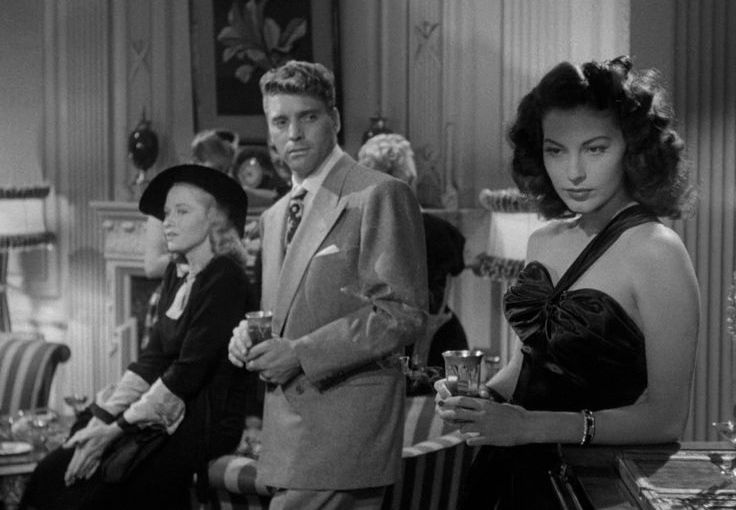
Figuring prominently in the Swede’s backstory is Kitty Collins, played by the ravishing Ava Gardner.  This was not her first film, but The Killers is the movie that put her on the map for good.  We first see Kitty when the Swede goes to a fancy party with his girlfriend, Lilly.  Alas, Lilly is no match for the sultry Kitty, who is wearing the kind of stunning black gown that inspires poetry when it isn’t simply driving men crazy.  How crazy?  At one point, when Kitty is caught by a cop wearing shoplifted jewelry, the Swede claims responsibility, slugs the cop, and winds up doing three years in jail for her.  Talk about being Kitty-whipped.

Naturally, as Jim, the insurance guy, meets more people, the Swede’s story comes more sharply into focus, but there’s still the mystery of what happened to all that money.  The robbery was indeed pulled off by the Swede with three other guys, but none of them have the money, and the Swede doesn’t have the money, so where is it?  As it turns out, the hat factory they stole from is insured by the same company that provided the Swede’s life insurance policy, so it’s in Jim’s best interest to get to the bottom of everything and recover the money, even if it means getting involved with the same kinds of thugs who killed the Swede in the first place.  That’s okay, though.  Jim is prepared.  He carries his own piece, and he comes up with a cool plan to get the guilty parties to confess as much as possible before they wind up dead…or he does.

The Killers is an example of a film that helped define, or at least refine, the relatively new film noir genre.  Similar films centering on crime, criminals, and punishment had been around since the ‘30s, but the real granddaddy of them all, The Maltese Falcon, had only been released five years earlier in 1941.  Since then, World War II came and went, and as dark as noir had been, it got even darker and more violent than Bogey was when he slapped Peter Lorre around.  With this film, director Robert Siodmak turned everything up to eleven.  The shadows aren’t just dark, they’re black, which of course makes the periodic pools of light that much more striking.

And the characters mean business, too.  Among the bad guys, there’s one named Colfax who doesn’t look like much – sort of like a moderately well-built school principal.  But when a genuine thug threatens to fight him, he doesn’t posture like a bully.  He just sits back in his chair and calmly tells the thug: “You’ve got quite a reputation yourself.  You’re supposed to be a troublemaker.  Okay.  Make some.”  And you just know that if the thug so much as lifts a finger, he’ll get it broken for his trouble.  It’s an interesting scene that reminded me of Goodfellas: “Paulie may have moved slow, but it was only because Paulie didn’t have to move for anybody.”

(I should also mention the flashback involving the payroll robbery.  In today’s films, when we marvel at long takes involving complicated camera moves, it’s good to be reminded that, three-quarters of a century ago, The Killers gave us a heist sequence that starts at ground level, follows the robbers up a staircase, shows the actual robbery, follows them back down into their getaway cars, and even provides a small-scale shootout as they drive away – all in one uncut take, using a camera about the size and weight of a SmartCar.)

While I thoroughly enjoyed The Killers, I wouldn’t quite put it in the same weight class as, say, Out of the Past or The Big Sleep, but it’s got all the right ingredients, it tells a good story well, it gives us Ava Gardner in that gown, and it provided a great springboard for the films that came after.  Good film noir is fine; GREAT film noir is better.  This is one of the great ones.

[P.S.  The scene near the beginning of the film where the two thugs terrorize the people at the diner reminded me strongly of the scene in No Country for Old Men when Anton Chigurh quietly tells the store clerk to “call it.”  They were just as calm and serene and tightly coiled as Chigurh.  Pretty creepy.]