
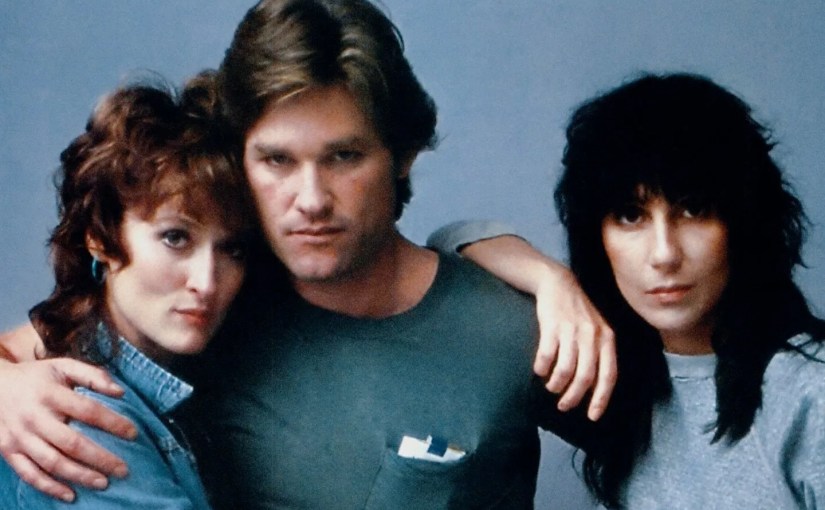
by Miguel E. Rodriguez
DIRECTOR: Mike Nichols
CAST: Meryl Streep, Kurt Russell, Cher, Craig T. Nelson, Fred Ward, Ron Silver, Bruce McGill, David Strathairn, M. Emmet Walsh, James Rebhorn
MY RATING: 8/10
ROTTEN TOMATOMETER: 77% Fresh
PLOT: On November 13, 1974, Karen Silkwood, an employee of a nuclear facility, left to meet with a reporter from the New York Times. She never got there.
The tagline for Silkwood (quoted above) almost feels like it gives the game away, but it doesn’t really. Even if Karen Silkwood’s name isn’t exactly part of the cultural zeitgeist anymore, I am willing to bet that a lot of people know what her name signifies in one way or another. So, it’s not like the movie’s poster or trailers are spoiling what happens at the end of the film because most of us know.
In any event, Mike Nichols’ film isn’t a nuclear-based thriller, like The Day After (1983) or WarGames (1984), that depends on an unexpected resolution. Silkwood isn’t about theatrical heroics or bombastic personalities. It’s a quietly intense character study of an everywoman with an untidy personal life who experiences a seismic shift in her perception and decides she simply can’t stand by and do nothing. This isn’t a crowd-pleaser like Erin Brockovich (2000), but this film’s story and central character are no less important.
The film goes to great pains to show us how ordinary and messy Karen Silkwood is. The incidents at the Oklahoma nuclear facility where she works (along with her live-in boyfriend, Drew, and her roommate, Dolly) are almost secondary to the plot, at least for the first half of the film. Karen has kids that live with her ex-husband and his girlfriend in Texas. Her relationship with Drew isn’t stormy, but it’s not perfect. Dolly seems tolerable as a roommate, but is not shy about speaking her mind. Dolly brings a girlfriend home one night, and there is a slyly amusing conversation between Karen and Drew about Dolly’s sexual preferences. (“I can handle it.” “Me, too.” “…so why are we talking about it?”)
I don’t want to go into too many details about the true-life incidents that occurred at the facility where Karen worked because, if you’re not intimately familiar with the facts of the story, they should be as surprising to you as they were to me. Plutonium is involved, but probably not in the way you’re thinking. Karen learns enough to know she should be more involved in the factory’s union…a LOT more. One plot thread almost feels like it’s ripped off from The China Syndrome (1979), until you realize Syndrome was released four years after the events of Silkwood, so if anything, Syndrome was probably inspired by Karen’s discoveries.
I also have to mention Cher as the roommate, Dolly. Of course, Meryl Streep is amazing and convincing as an everyday, average divorced mom, but Cher more than holds her own in every scene. There is absolutely no hint of the pop music megastar of the ‘70s in this film. Director Mike Nichols insisted she wear little or no makeup in her scenes, which went against every fiber of her instinct as a performer. She understood the assignment: she never upstages anyone. This is not a grandstanding kind of supporting role, like Tommy Lee Jones in The Fugitive (1993) or Cate Blanchett in The Aviator (2004). It required subtlety and understatement, and Cher delivered. I tried to spot her “acting,” and I never could. She was unbelievably natural and, at times, heartbreaking. The movie is almost worth searching out just to see her performance. It’s a clinic in how to own a small role and make it stand out by doing less than you might expect.
Silkwood may not feel as thrilling as some of the other thrillers I’ve already mentioned, but it is just as compelling, specifically because we’re watching an ordinary person under extraordinary circumstances. We’re not watching a hero triumphantly rise to the occasion. We’re watching a struggling divorcee who’s trying to do the right thing after years of inaction, even if it means losing the trust of her co-workers or sacrificing her other personal relationships. I identified more with Karen Silkwood and her situation than I did with Jane Fonda in The China Syndrome or Julia Roberts in Erin Brockovich.
The ambiguous nature of the film’s ending mirrors what happened in real life, and when the credits rolled, I felt a surge of empathy for the people left behind and the unanswered questions they live with to this day. That doesn’t happen to me very often.



 2 UNPAID MOVIE CRITICS!!!!