
DOCTOR SLEEP

By Marc S. Sanders

I never yearned for a sequel to The Shining.  Yet, color me surprised at how well I took to Mike Flanagan’s adaptation of Stephen King’s return to psychic Danny Torrance and the haunting baggage he carries as a middle-aged adult in Doctor Sleep.  This is a time jump sequel that is nearly forty years in the future.

The film version of this story had a tricky challenge.  King notoriously despised Stanley Kubrick’s horror classic adaptation of The Shining. Several important details were not consistent between his book and the movie.  So, what was Flanagan to do?  Well, he got his blessing from the author to move ahead as a sequel to Kubrick’s interpretation because he also ensured that he would not veer too far away from how the novel was edited.  The director reasoned with King that more people are familiar with Kubrick’s product than what’s in King’s pages. Mike Flanagan found the right balance to please not only Stephen King, but also the respective fans of the novels and Kubrick’s unforgettable film.

Danny is played by Ewan McGregor.  He’s often reflecting on his childhood following his survival from his stay at the haunted Overlook Hotel in the snowy mountains of Colorado, where his delirious and murderous father terrorized him and his mother Wendy with an axe.  Now Danny is making efforts to recover from alcoholism as he takes a job as a hospice orderly in a small New Hampshire town.  It keeps him isolated while the ugly hauntings that he shines on stay contained in his mental lockboxes.  He also uses his gift to allow patients to peacefully carry over to the other side.   Danny becomes known as Doctor Sleep.

Elsewhere in the country there is a traveling cabal of people who devour the energies off of young children with similar shining abilities like Danny.  This small cult is known as The True Knot and their leader is the charming Rosie The Hat (Rebecca Ferguson).  The presence of one very special child is Abra (Kyliegh Curran).  Flanagan gets very creative in showing how Rosie, Abra and Danny locate and communicate with one another from faraway points.  Rosie’s technique is reminiscent of an amusing sequence in The Big Lebowski, though as you might expect the mood is altogether different in Doctor Sleep.  

Doctor Sleep is a longer picture than it needed to be.  The exposition goes on for quite a while where three separate stories are proceeding, and it becomes cumbersome to see how the dots are connected.  Yet, the movie eventually finds its way as things become more simplified.  Flanagan works some action scenes and neat visuals into the picture, but he does not neglect Stephen King’s penchant for nauseating and grotesque horror either.  Normally, I feign at seeing victimized children in deadly peril for the sake of escapist entertainment.  Here, it is repulsive on more than one occasion, but the moments serve the story and enhance the motives of the villains.  

The payoff of the film is the third act where this adaptation relies on much of Kubrick’s treatment of The Shining.  As the book was entirely different with its ending, Flanagan had to take a chance with some creative liberties.  Amazingly, his efforts score very well.  I’m not the biggest fan of Stanley Kubrick’s film (read my review on this site), but I had to cheer as more developments gradually unfolded.  There’s much to explore through the eyes of Ewan McGregor as Danny.

Mike Flanagan’s craftsmanship with a cast of supporting actors, including Henry Thomas (E.T.: The Extra-Terrestrial) assuming Jack Nicholson’s role, are quite uncanny and lend to the argument to not depend on AI or “de-aging” visuals to recapture what once was.  Carl Lumbly effectively takes over for Scatman Caruthers and Alexandra Essoe does a very good pick up from Shelley Duvall’s performance as Wendy – a little flighty, melancholy and zany. The little ticks and inflections in these newly cast actors are mimicked quite well without going over the top.

Set pieces etched into anyone’s subconscious who has seen The Shining are impressively recreated by Flanagan’s team, from stained walls, big curtains and chandeliers to that very familiar orange, brown/black sectional pattern on the carpet of The Overlook.  At one point in film, Danny goes for a job interview and the office he sits in is an exact recreation of when his father Jack met with the managers of the hotel at the beginning of Kubrick’s film.  This kind of attempt at consistency has to be saluted.  It’s really amazing.  Mike Flanagan shows his painstaking efforts at recapturing Kubrick’s designs. I do not look at these efforts by Flanagan as commemorations so much as I see an omnipotence that observes Danny like it did to his father Jack before him. Danny might have survived, but the demons of his past and the sins of his father remain. He can never escape where he came from even if he relocates to New Hampshire, or wherever he goes.

Doctor Sleep offers the disturbing imagery you’d expect from Stephen King.  I’ve never been the author’s biggest fan.  Still, I really appreciate the creativity he lent to his sequel nearly a half century later.  It makes sense to have waited this long for the writer to pick up where he left off with some of his most well-known characters and locations.  

This dark fantasy works for its collection of heroes and their villains.

NOTE: I viewed the Blu Ray Director’s Cut which Miguel informed me is the better way to watch the film. I agree. There are more nods to Stanley Kubrick’s original film, and the outline of the picture performs in chapter sections like you might expect in Stephen King’s novel. Mike Flanagan never lost sight of either storyteller’s accomplishments. Doctor Sleep is an undervalued achievement in film. A very worthy sequel.
STAR TREK (2009)

By Marc S. Sanders

Well Batman did it, and James Bond did it.  So why can’t Star Trek do it too? 

JJ Abrams adopted another franchise to direct when he rebooted the outer space western originally conceived by Gene Rodenberry over 50 years ago.  He did well with it too, if you are willing to dismiss the final polish to the look of the picture that Abrams couldn’t resist.  Not so much a polish as it is a tarnish, unfortunately.

I was late to the party of realizing that Abrams has a terrible habit of using “lens flares” on many of his films.  Now that I’m attuned, I can’t help but notice.  I typically get quite entertained by his pictures.  Mission: Impossible III is still the best of the series as far I’m concerned.  The Force Awakens thankfully carried the original trilogy tradition of the Star Wars franchise.  His one original film that he directed, Super 8, is criminally underrated.  However, those films were spared the over saturated and very unwelcome lens flare that dominates his first Star Trek film.  The film opens with an outstanding special effects battle as a Federation starship is being overwon by a Romulan war ship.  The sets of the bridge and decks of the ship are slanted to emote chaos.  There are sparks of fire falling all over the place.  Crew members are being sucked into space, and falling over each other.  And there’s lens flares aplenty which are not so distracting within all the hysteria depicted.  The scene climaxes with the birth of one of the two most celebrated franchise characters, James T Kirk.  It’s a spectacular opening sequence that seems to uphold the traditions of Star Trek while feeling fresh with outstanding visual effects.

Afterwards, the visual effects stay on course with the updated technology that Hollywood now relies upon.  Nothing here looks CGI.  It all feels tangible, hot, and operationally functional.  Abrams accomplished a great looking science fiction film, but then he and his cinematographer spray painted a graffiti of light streaks that never end.  Crew members will be walking down a hallway – there’s a lens flare.  A character gets abandoned on a deserted snow planet – there are more lens flares.  A bar fight occurs, only to be blinded by lens flares.  Every time a guy throws a punch, it’s literally followed with a lens flare.  A hearing in an assembly room takes place.  Why do we need streaks of light in here of all places?  If I were on vacation and taking in the sights of the Golden Gate Bridge in San Francisco within this future, my pictures would be terrible.  Apparently, lens flares have taken over the state of California.  (I guess I should be thankful knowing the state did not in fact eventually sink to the bottom of the ocean.)

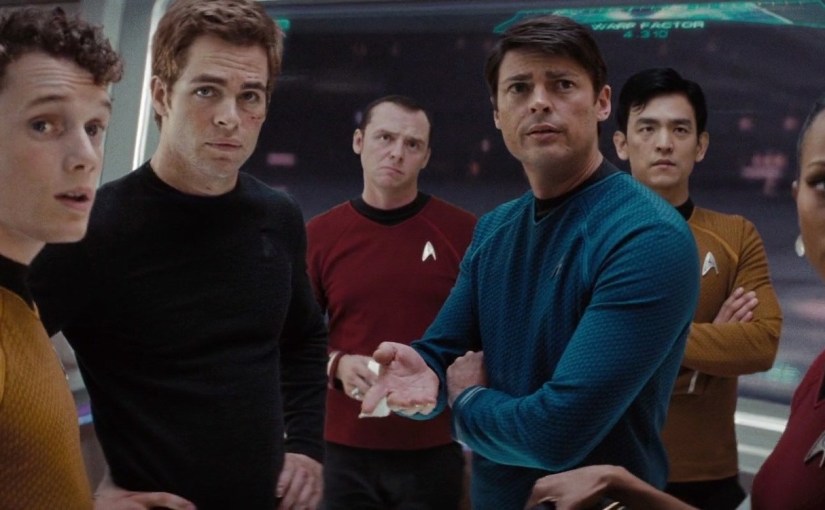
The rebooted story line is fine, yet simple.  A Romulan terrorist named Nero (Eric Bana) from a further distant future is obsessed with exacting revenge on Spock.  Next to that plot, this film serves more as opportunity for production company Paramount Pictures to reintroduce the beloved seven main characters of the original series of television and films with new actors.  Chris Pine is one of the best casting selections.  His Captain Kirk is his own performance and yet when he finally sits in that captain’s chair on the bridge, I could recognize the stature and expressions of William Shatner.  He gives a nice salute to the character and the original actor who played him.  Zachary Quinto is also good as Spock, though this character is distant cry from the original Leonard Nimoy portrayal.  I found it interesting.  This Spock has greater challenges with emotions harbored in the human side of his brain.  Karl Urban is fantastic at taking over the reigns of DeForrest Kelley as “Bones” McCoy, the Enterprise’s eventual resident doctor.  Urban is given the opportunity to be hilariously cynical upon his entrance into the film.

While the visual effects and sets are at the top of their game with Abrams and crew sparing no expense, it is a little eye opening to see the sexuality of the characters take a step forward.  Abrams is not shy about showing Zoe Saldana as Uhura disrobe into her under garments with Kirk standing on the other side of the bedroom.  I’m not offended or prudish about this material but was it really necessary to go with the Porky’s angle?  It doesn’t have to be a requirement to take some of the most beautiful actors in the world and get them to strip to uphold a film.  Star Trek always had much more to offer than that.  Scenes like this come off like a cheap shot.  Pine and Saldana are better actors, worthy of favored franchise fare (DC and Marvel films) than just material like this. 

There are some surprises in this reboot for both the casual and obsessed fans.  It’s kind of welcome actually as it takes the familiar universe of Roddenberry’s conception and turns it on its head.  Certain well known locations and characters arrive at unexpected fates.  Though, unfortunately, the alternate timeline motif pushes its way through the middle of the picture.  I fear for these kinds of stories.  All they do, time and again, is open up unanswered and (forgive me for the pun) illogical answers.  Marvel and DC films are on their way to doing this with their upcoming films following the year 2021 and I can see the whole thing unraveling at the seams.  Was it necessary here, though?  I really didn’t think so.  Abrams had an opportunity to win back an appearance of an actor from the original series and it seemed forced into the film like a square trying to fit into a circle.  The older installments had their moment in the sun.  Let that go.  Focus on this new cast and this new vision.

Again, this Star Trek is a gorgeous looking film full of color and clean looking set designs all around.  The bridge of the Enterprise is something that I’d love to see in person.  The cast is actually quite perfect filling the shoes of their respective roles.  However, JJ Abrams tried too hard I think with a couple of plot developments, and an extremely distracting and very unwelcome LENS FLARE.  I KNOW I’M REPEATING MYSELF.  YET I’M NOT BEING ANY MORE REDUNDANT THAN ABRAMS WAS WITH THE STUPID BLINDING PIECE OF LIGHT. 

Maybe the next time I watch this picture, I’ll wear my sunglasses.