THE BIG SHORT

By Marc S. Sanders

Ever since Adam McKay’s The Big Short was released in 2015, it has remained a favorite film of mine. I watch it at least once every year. McKay’s script with Charles Randolph, adapted from the book by Michael Lewis, is enormously funny but also realistically frightening.

The film shows how America’s housing market crashed in the first decade of the 21st Century. Mortgage backed securities never failed in history until now, and no one anywhere, especially the banks, ever believed a crash would occur, but it did. Only a select few people like Dr. Michael Burry (Christian Bale) and Jared Vennet (Ryan Gosling) foresaw what no one else could imagine, and thus they took advantage of it by making enormous betting transactions against the housing market. To say you need a strong stomach for this kind of investment is a serious understatement.

Burry is the first one to realize that the country as a whole will default on their mortgages once their interest rates go up in 2007. He represents Scion Capital and invests billions of dollars against the mortgage backed investments. Now he watches for the next two years while the capital at Scion declines into negative digits and drowns out the frustration with death metal music. Bale is fascinating as Burry who has a brilliant mind, but he lacks social skills.

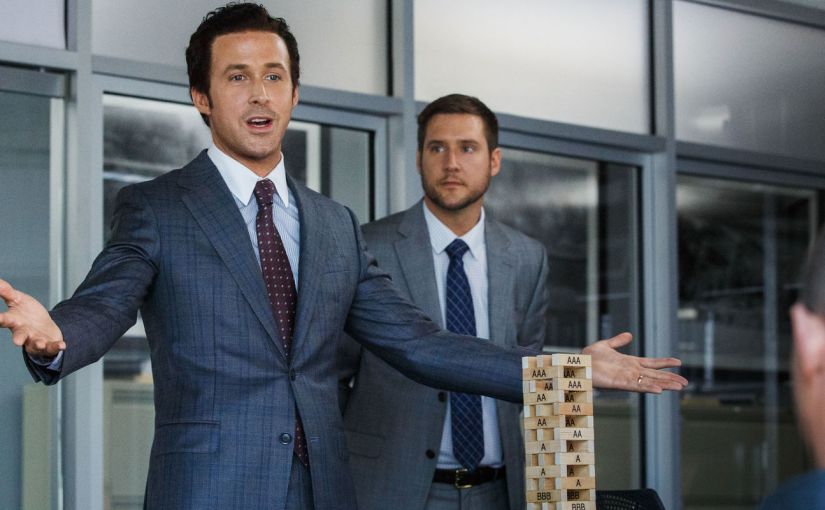
Vennet gets wind of Burry’s discovery and sells the idea to Mark Baum (Steve Carell) and his team of representatives. Vennett narrates how it all played out in the market; how ratings agencies gave triple A rankings to bonds made up of worthless backed securities. McKay wisely has Vennett introduce celebrities like Margot Robbie, Anthony Bourdain and Selena Gomez to break down the vast complexities of everything. Robbie in a bathtub. Gomez playing black jack. It’s hilarious and relatable. Gosling is great. A great scene is his selling presentation which includes a metaphoric prop of a Jenga tower. Vennet has no qualms about collecting premiums as the rest of the country is going down. He’s profiting, and why not? Big banks have been doing it for years.

Carell is spectacular as well as Mark Baum. He has a heart, but he’s an angry individual. It sickens him to make money off this short buy, but it’s the responsible action to take for the benefit of his own clients. Mark also suffers from his brother’s suicide. McKay allows just enough time for this to draw out the misery of this character. Carell should have gotten an Oscar nomination at least. Baum is a guy with no filter as he confronts authoritarian parties throughout the film. He’s a hero really, but he’s not a guy I’d ever want to be left in a room with either.

An additional story arc comes from two young guys (Finn Wittrock & John Magaro) who also uncover this opportunity. They enlist Brad Pitt as a recluse who get them into the arena of big traders. These kids who started their investment company in a garage are great as well. Another party who came out of nowhere to uncover what no one else saw.

McKay assembled a magnificent blend of actors for these unusual characters who always hid behind their computer monitors. He directs with a lighthearted approach having his characters breaking the 4th wall at times to explain what all of this means in the simplest terms.

As simple as McKay makes it with his humor, this was a terrible, terrible tragedy putting millions of people out of work and owners losing their homes. Even renters lost their homes. Pay your rent but it means nothing if your landlord isn’t paying his mortgage. McKay tragically shows this outcome.

It’s terrible to imagine, but it’s a major downfall of the American economy. When the country, is doing well, while paying short term low interest rates, no one concerns themselves with what could all go away in an instant. It’s a vicious cycle, and the only funny thing about it all is that the supposedly most brilliant investors will naively allow this to happen over and over again.

The Big Short is one of the best films made in the last 20 years.

MONEYBALL (2011)

by Miguel E. Rodriguez

Director: Bennett Miller
Cast: Brad Pitt, Jonah Hill, Philip Seymour Hoffman, Robin Wright, Chris Pratt
My Rating: 9/10
Rotten Tomatometer: 94% Certified Fresh

PLOT: The general manager of the Oakland A’s attempts to assemble a winning team on a lean budget by employing computer-generated analysis to acquire new players.


On paper, Moneyball should not work as a movie. What have you got?  A feel-good sports story about the 2002 Oakland A’s utilizing the science of statistics to assemble the right combination of players to get them into the playoffs.

I mean, really?  Specifics aside, a Cinderella story about an underdog sports team trying to make it to the big game is one of the oldest, most predictable tropes in film.  Shall I count them off? Major League, The Bad News Bears, Bull Durham, The Mighty Ducks, Little Giants, Cool Runnings, Hoosiers…need I go on?

And in Moneyball, we barely even get to see any baseball action itself.  The movie is more concerned with the behind-the-scenes action, beating the trade deadline, shaking up the scouting crew, trying to get the manager to believe in the new system.  We don’t really see any major baseball action until we get close to the finale.

[SPOILER ALERT…unless you’re a HUGE baseball fan, in which case you were already aware of this.]

And let’s talk about that finale, while we’re at it.  The A’s make it to the 2002 ALDS elimination game, and what happens?  They LOSE.  Say what???

So why, oh why, does Moneyball work the way it does?

…no, really, I’m asking.  Because I’m not 100% sure myself.  Let me just tick off my thoughts as they occur to me here.

  1. There’s the screenplay.  Here’s some good advice: when you want to make a movie about a potentially dry subject, get both Steven Zaillian AND Aaron Sorkin to write your script.  The pace of the movie is stately, even sedate, but the dialogue is crisp, clean, and precise, getting to the point as efficiently as possible without being flashy.  In one memorable scene, someone walks up to the General Manager’s office and says just one word: “Peña,” and then walks away.  The GM takes it in, says, “Okay”, and calmly stands and flips his desk over.  The whole thing is over in 15 seconds.  I can imagine another movie wasting a lot of time with extra words or edits, but not “Moneyball.”  (SPARTAN.  That’s the word I’m thinking of.  The dialogue is spartan.)
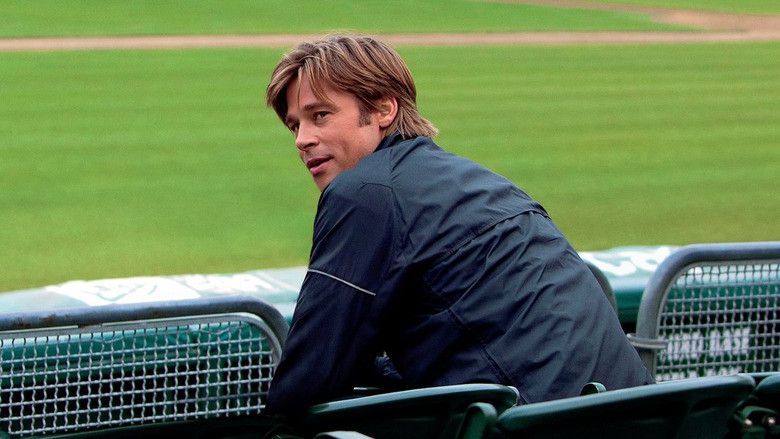
  2. There’s the editing.  The dialogue is sleek and uncluttered, but there is a lot of information that has to be conveyed to those audience members who may not know what a box score is, or what a DH is, or why Billy Beane (the GM, played by Brad Pitt) doesn’t CARE whether his new first baseman can even field the ball properly, as long as he gets ON BASE when he’s batting.  Rather than use flashy editing to generate false suspense or excitement, the Oscar-nominated editors use more of that spartan vibe, with occasional jumps to real-world film clips of the actual team or individual players.  This is especially helpful when the film’s middle section details the woeful first half of the season under the new statistics-based system.  Again, not flashy, but effective.  Very hard to pull off, and deservedly recognized.
  3. There’s the structure…which I guess points back to both the screenplay and editing, but I’m just saying.  As I said, it’s a classic, well-worn trope.  Good guys get knocked down for the count – the A’s flat-out suck for the first half of the season – but then they suddenly start winning games and crawling back into contention.  As many of these films that I’ve seen, I still found myself unwittingly getting caught up in the spirit of the comeback.  In actual fact, the 2002 season is the one where the real Oakland A’s threatened to break the American League record for longest winning streak.  And it all comes down to one at-bat in the bottom of the ninth.  Because of COURSE it does.
  4. …and that sort of brings up another point.  Is there another sport that has as much innate mythology as baseball?  Sure, football has its share of comeback stories, and so does hockey and everything else.  But with baseball…lemme tell you.  A few years ago when the Chicago Cubs were on the verge of winning their first World Series in a hundred-and-eight years, I watched Game 7, rooting for the Cubs.  For those Cubs fans who watched as well, you’ll recall: that game was unmerciful.  The Cubs blew a three-run lead, they ended nine innings in a 6-6 tie, and then there was a RAIN DELAY before the 10th inning started.  But I will never forget that moment when the Cubs made the final out, and they wound up winning 8-7.  It was glorious.  …well, watching Moneyball, watching that section when the A’s are creeping up to winning twenty games in a row, I found myself grinning and laughing spontaneously, without even realizing I was doing it, and I remembered what it was like to watch the Cubs win.  And a big part of it has to do with that unexplainable psychic connection we have to the game itself, that sense of the romantic when someone clobbers a game-winning homer, or makes a dramatic catch to save a no-hitter, or when a relief pitcher retires the side with bases loaded.  I’m not a true baseball fan, I’ll admit…but I know good drama when it happens.  Moneyball gets that aspect of the game just right.

(I haven’t even mentioned the sterling performances from the principal actors, particularly Jonah Hill, who nabbed an acting nomination for one of the most underplayed characters in history.)

In the end, Moneyball is exactly like the Oakland A’s in the film.  It’s an unlikely combination of talent that generated surprising results and was critically acclaimed, gathering six Oscar nods.  It failed to win a single Oscar…much like the A’s were eventually eliminated from the playoffs in 2002.

But in the end, it’s not the shutout at the Oscars that I remember.  It’s the fact that this is still one of the best sports movies I’ve ever seen, and definitely one of the top 2 or 3 baseball films I’ve ever seen.

ONCE UPON A TIME…IN HOLLYWOOD (2019)

by Miguel E. Rodriguez

Director: Quentin Tarantino
Cast: Leonardo DiCaprio, Brad Pitt, Margot Robbie, Timothy Olyphant, Dakota Fanning, Bruce Dern, Luke Perry, Al Pacino, Kurt Russell
My Rating: 10/10
Rotten Tomatometer: 84% Certified Fresh

PLOT: A fading television actor and his stunt double strive to achieve fame and success in the film industry during the final years of Hollywood’s first Golden Age in 1969 Los Angeles.


Quentin Tarantino’s ninth film is a little bit like Beethoven’s Ninth Symphony.  It’s big, bombastic, and goes the long way around the barn to get to the finale, but in the end it all makes sense and is a transcendent experience.

Let’s see, where do I start?

First of all, the film’s evocation of 1969 Los Angeles is like Mary Poppins: practically perfect in every way.  I’m no fashion scholar or visual historian, but every exterior shot of the city was pretty convincing to my layman’s eyes.  The movie theatres, the movie posters, the restaurants (anyone else remember “Der Weinerschnitzel”?), the cars, those HUGE sedans sharing the road with VW Bugs and M/G’s…it’s clear they did their homework.

There’s the performances by the two leads.  Tarantino once said he considered himself the luckiest director in modern history because he was able to get DiCaprio and Pitt to work on the same film.  Can’t argue with him on that score.  They carry the film in a way that few other tandems could have.  (Newman and Redford come to mind.) Mind you, DiCaprio and Putt don’t look much like each other, considering one has to be the other’s stuntman, but you get the idea.

Above all, there’s the story.  DiCaprio plays Rick Dalton, a former leading man from ‘50s TV westerns who is now playing colorful bad guys in ‘60s TV westerns.  Brad Pitt plays Cliff Booth, the stuntman who’s been taking the dangerous falls for Dalton for years.  Dalton happens to live next door to Roman Polanski and Sharon Tate on Cielo Drive in the Hollywood Hills.

All the trailers, and all the industry buzz, reveal that the Manson family and Sharon Tate play a part in the film.  That’s no spoiler.  Given what we know about those events, the movie plays like Gimme Shelter, the landmark documentary about the ill-fated concert at Altamont that was actually due to take place a few months after the events of this film.  It’s all very suspenseful, in the sense that we know what’s coming, but we’re just not sure how the movie is going to approach it.  So every scene with poor Sharon Tate in it is overshadowed by the fact that we know her ultimate fate in history.

It’s like the famous Hitchcock analogy of suspense.  Two people are eating at a restaurant when a bomb suddenly goes off under their table…that’s surprise.  Put those same two people at the restaurant, where the audience knows there’s a bomb under the table, but it doesn’t go off right away as the two people eat and converse and have dessert, and we’re wondering will they leave BEFORE the bomb goes off or not…?  That’s suspense.

And that’s the genius of this movie, with Tarantino’s sprawling, winding screenplay.  We get to know Rick Dalton and Cliff Booth intimately, we get the rhythms of their relationship, of Dalton’s mood on set, of Booth’s quiet acceptance of his role as Dalton’s sole support system.  We are treated to lengthy scenes showing Dalton at work on the set of a TV western, so we can appreciate the vast differences between an actor and their characters.  There’s a brilliant backstage scene between Dalton and a child actor who is impossibly, hilariously advanced for her age, and who winds up giving Dalton some goodhearted advice.

And interspersed through it all is Sharon Tate.  Sharon Tate bopping to music at home.  Sharon Tate picking up a female hitchhiker on her way into town.  Sharon Tate almost passing, then backing up to admire with youthful excitement, her name on the marquee of a movie theatre, right next to (gasp) Dean Martin’s name!  Sharon Tate dancing, walking, smiling, drinking…living.  She’s the diner at the restaurant, and the Manson family is the bomb we know will eventually go off.  It casts a pall over the proceedings, but not in a bad way.  It’s an interesting way to bring the reality of the situation into focus from time to time.

And now I have to end this review before I inadvertently give away certain, ah, plot elements that elevate Tarantino’s film from a mere character study or period piece into the heady heights of cinematic transcendence.  I have not myself read any reviews of the film, so I can only guess that whatever negative reviews are out there probably center on the film’s finale, or perhaps on its meandering script.  All I can say, or will say, is that I am firmly on Tarantino’s side on this one.  The way the conclusion was written and filmed is the kind of thing that people will still be talking about years from now.

So just take it from me.  If you’re a movie fan, and ESPECIALLY if you’re a Tarantino fan, this is right up your alley.  It’s easily his most slowly paced movie since Jackie Brown, but that just gives you time to e-e-e-ease into the characters, like putting on a tailored suit piece by piece.  This film, like Beethoven’s Ninth, is a masterpiece.

INGLOURIOUS BASTERDS

By Marc S. Sanders

If you are going to rewrite history then go crazy.  Go big and bloody.  Go for broke.  Don’t hold back.  Quentin Tarantino didn’t hold back when he penned and directed Inglourious Basterds, my personal favorite of his films.

To date of when this review is published, Tarantino has directed nine films and if ever the maturity of a director is so evident, it really shows with Basterds where three quarters of the picture is performed in either French or German.  English is secondary here, and Italian is limited to only a couple of “Bonjournos!”  and “Gorlamis!”

Tarantino presents early 1940s France when Germany occupied most of the country and practically rounded up all of the Jews.  In 1941, a cunning detective of a Nazi Colonel, Hans Landa (Christoph Waltz performing as one of the greatest villains of all time) visits a French dairy farmer to ensure there are no unaccounted-for Jews scurrying around; scurrying around like their beastly equivalent, the rat.  Landa is the hawk that will most assuredly find them.  This scene is the best written moment within Tarantino’s catalog of various scripts and dialogue exchanges.  The Landa character offers justification as to why a Jew needs to be exterminated to the point that he nearly had me (a conservative practicing Jewish man) believing in his hateful philosophy.  The lines crackle here with Waltz doing most of the talking while the sad dairy farmer can do no more than respond with certifying Landa’s interesting points.  Tarantino closes the peaceful discussion with horrifying violence though.  Hans Landa may be complimentary of a farmer’s milk and his three beautiful daughters.  He may be eloquent in his dialogue albeit French, German or English, but he is a ruthless enforcer of law …of Nazi law at least.  I also would like to note Tarantino’s tactful way of using props like the pipes the characters smoke, the glass of milk that is consumed by Landa and the ink pen and spreadsheet he uses for accounting of the Jews in the area.  There’s an uncomfortable intimidation in all of these items as they are handled by Waltz, the actor.  Later in the film, Waltz will send a chill down your spine as he happily enjoys a delicious strudel with whipped cream.  Inglourious Basterds is a great combination of directing, editing, cinematography and acting.

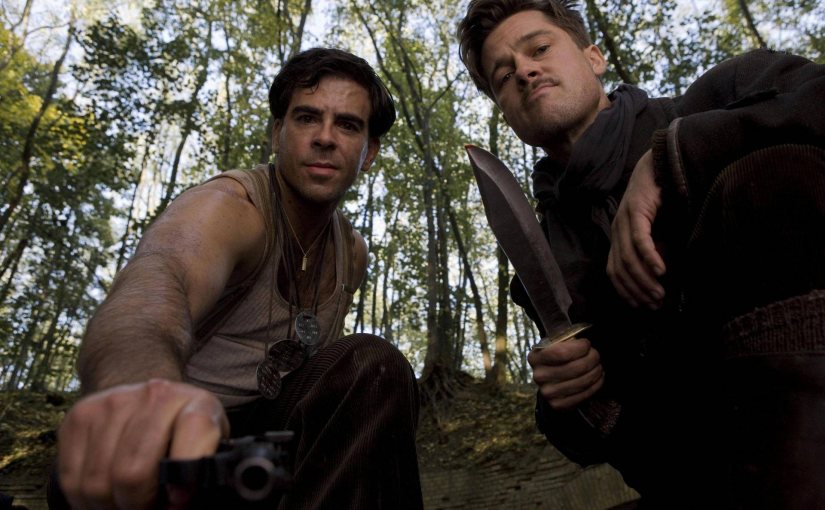
The film diverts into a few separate stories, namely the title characters led by Aldo “The Apache” Raines, played with Tennessee redneck glee by Brad Pitt.  The Basterds consist of mostly Jewish American soldiers tasked with going deep into enemy territory and literally killing and scalping one hundred Nazi soldiers, each.  However, keep at least one alive during each encounter with a carved souvenir on their forehead, to spread the word of the Basterds intent.  This is deliberate B movie Dirty Dozen material and it works because it doesn’t take itself seriously.  Tarantino maintains that pulpy fiction narrative.  A cut to an over-the-top crybaby Adolph Hitler asks, “What is a Hugo Stiglitz?” and then we get a quick pause with big black block letters across the screen spelling out HUGO STIGLITZ.  This guy is a bad ass; a German turncoat who only wants to kill fellow German Nazis.  He’ll shoot them up until they are dead three times over.  He’ll stab them in the face twenty times through a pillow.  He’s not a suave killer.  He likes it violent and bloody messy.  The Basterds are fans.

The heroine of the film is Shoshanna (Melanie Laurent), a Jewish girl who is living undercover as a cinema owner in France.  By implied force she is tasked with presenting Himmler’s proud film of Nazi Germany’s finest war hero, Fredrick Zoller (Daniel Bruhl), recreating his bird’s nest three day sniper battle against an army of three hundred men.  This is where Tarantino does best at writing what he knows, and what he knows best is anything about cinematic film.  He literally uses his knowledge of film and film reels to bridge his story while setting Shoshanna on a mission to actually end World War II in one swift motion.   

In addition, he captures the adoration of film lovers and celebrity status.  Zoller is as heroic a celebrity as John Wayne or Zorro.  When he is recognized in the coffee houses or on the street, he humbly stops his ongoing flirtation with an uninterested Shoshanna, to give an autograph or pose for a picture.

Furthermore, Tarantino applies the scientific knowledge of how 35mm film is more flammable than paper as well as how to edit a film reel to an unexpected moment for Shoshanna’s Nazi audience.  He knows the architecture of a European cinema with its lobby and balconies and seating capacities.  He allows his characters to speak on an intellectual level by discussing great film artists of the time – filmmakers not as well-known as Chaplin here in the United States, but just as great or even artistically better. The art direction of the cinema both inside and out is adorned with washed out, distressed classic noir films.  Shoshanna changes out the lettering of the curved marquee top of the theater as well.  It might sound mundane, but to me it’s all atmospheric.

Beyond the subject of cinematic art, a bad guy will weed out a spy disguised in Nazi garb by recognizing how he signals for three drinks with his hand.  There’s a right way and a wrong way to place an order with a bartender.  Inglourious Basterds may be a fictional historical piece, but it also will give you an education. All of this reminds me that Quentin Tarantino has graduated from the simplicity of Reservoir Dogs to something bigger and grander and glossier.  Production money with a large budget will lend to that status of course, but Tarantino still had to learn to truly know what he was doing.

I will not spoil the ending here.  It’s a bloody blast for sure.  Moreover, it’s shocking.  If anything, Inglourious Basterds introduces an exclusive universe that resides in the mind of Quentin Tarantino where the textbook is thrown away, burned, riddled with bullets and blown up; it is where something else altogether happened, and you know what? I really wish it did actually happen this way.

ONCE UPON A TIME IN…HOLLYWOOD

By Marc S. Sanders

There’s no question the most different of Quentin Tarantino’s directorial efforts is his latest film, Once Upon A Time In… Hollywood. Already described as his “love letter to cinema of the late 60s,” his 9th effort also implies the end of the Hippie Era by devoting a portion of time to B movie actress Sharon Tate, infamously murdered by Charles Manson’s followers when she was 8 months pregnant with Roman Polanski’s child.

Margot Robbie plays a near, gorgeous exact replica of Tate. She’s deliberately short on dialogue and I like to believe it’s because Tarantino treasures her as an innocent angel who was loving the atmosphere of Hollywood. She’s preserved of being nothing but likable. She dances with glee in her bedroom in the Hills or in public at the Playboy Mansion. One day she visits the local cinema to see her performance in “The Wrecking Crew” with Dean Martin. Tarantino shoots close ups of Robbie loving her footage as a pratfall klutz while listening to the audience reaction. She’s loving every second of the experience. People love her and she sees the love she has for people. Critics took issue with Robbie’s lack of dialogue. Not me. The performance is all there. Robbie is wonderful to look at with responses of pure happiness and celebration.

The main focus of the film is on Rick Dalton played by Leonardo DiCaprio with a huge range of drama, comedy and well intentioned over acting when Tarantino is wanting to spoof the TV western for fun. We see a collection of Dalton’s work, most especially on the fictional black and white TV western that airs Sundays at 8:30 on NBC (cue Dalton’s cowboy hat close up accompanied with “BONG, BONG, BONG!).

Rick is realizing he’s becoming past his prime. Marty Schwarz, his agent and a producer, played by Al Pacino warns Rick that he’s at a point where he’s only going to be the villain of the week on The Green Hornet and Batman. Rick does not take this well. Using his stunt double pal, Cliff Booth (Brad Pitt) to talk to, Rick is consumed with insecurity and alcoholism.

Tarantino wants to depict an era in Hollywood on its way out. A fictional character like Rick and the well known fate of Sharon Tate symbolize this turning point.

A third example is with Cliff. Rumored to have killed his wife, Cliff has trouble finding stunt work on a set. So he’s happy enough to just drive Rick around in his Cadillac, and fix his antenna. A great moment occurs when Cliff antagonizes a cocksure fist of fury Bruce Lee to a fight. Bruce doesn’t do so well against Cliff. Bruce Lee maybe not be what he once was, or what audiences ever perceived. Times they a changin’.

This is not the aggressive film that Tarantino is mostly known for. It’s primarily calm as we see these characters navigate around Hollywood locals, listening to The Rolling Stones and the Mamas & The Papas, and various product advertisements. Rick and Cliff are suffering a little. Suffering at the loss of what they were and the world they are forced to enter, nor what they are accustomed to. Sharon is ready for what’s next. Yet, will she get the opportunity to carry on?

The ending is bound to leave people divided. It’s different and very, very unexpected. It makes no difference how you feel about it. What matters is if it generates a response, and based on the theatre where I saw the film, yes! Yes, there is a massive response to what occurs.

Tarantino’s Once Upon A Time In… Hollywood is not his best film. There were moments where I thought it was a little slow and the film lacks the dialogue punch that many know Tarantino for. There’s really not one memorable line that stayed with me. I guess that’s what the trade off is when you finally are served multi dimensional characters that Tarantino has hardly offered before.

It’s the best non Tarantino film that Quentin Tarantino has ever directed.

THELMA & LOUISE

By Marc S. Sanders

The strength of a good solid picture often depends on a strong cast from the top billing, above the title actors, to the bit supporting players who only have a few minutes of screen time.  Thelma & Louise, directed by Ridley Scott, is that film.  The opening credits of the movie come up in black and white over an out west landscape with an endless dirt road in the center of the screen.  Hans Zimmer’s harmonica and banjo, country sounds build on Scott’s camera work here.  The names of each actor are brought up: Susan Sarandon, Geena Davis, Harvey Keitel, Christopher MacDonald, Michael Madsen, Stephen Tobolowsky, and someone named Brad Pitt. The scene goes to color and then it blacks out and comes up on Louise’s (Sarandon) crowded diner where she waitresses.  Nothing is unfamiliar here.  Yet, it seems a little haunting in a way.  We are about to uncover a history to some common folk who live on the southern bend of America, and we will start in the state of Arkansas.

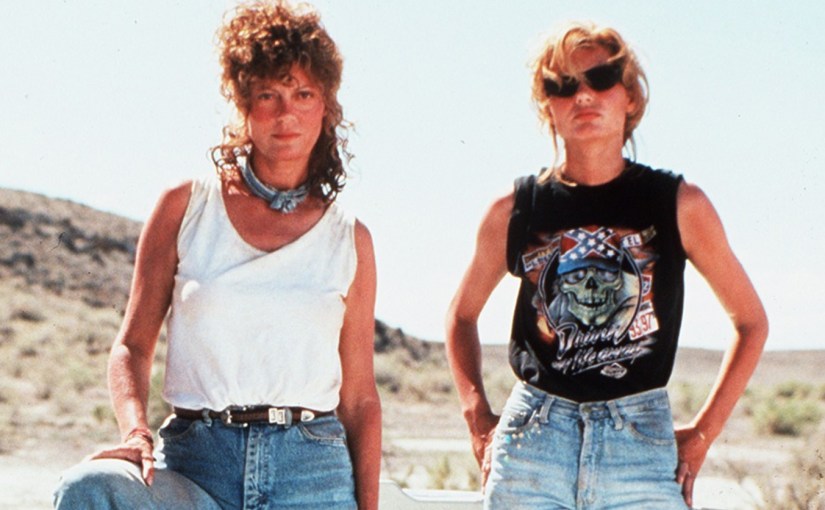
Louise has made arrangements with her best friend Thelma (Davis) to do a weekend cross country road trip to a cabin in the woods.  This is the southern odd couple.  Louise is always put together, clean and organized.  She’ll check herself in the mirror.  In a crowded ladies room, she’ll check her makeup and tidy her hair while intoxicated patrons are pushing around behind her.  Thelma is scatterbrained.  She’ll bite off a piece of a candy bar, put it back in the freezer and make three more stops back at the freezer for a couple of more bites.  She also will dump a dresser drawer of clothes into a suitcase, taking no time to sort through what she’s packing.

Both women have been treated unfairly by the men in their lives.  Thelma’s husband, Daryl (MacDonald) is a proud white trash carpet sales manager who treats his wife with absolute control, complete disregard and thoughtless disdain.  Louise just can’t even get a hold of her boyfriend Jimmy (Madsen), a musician who can’t commit to anything.  On the first night of their trip, the two ladies hit the road in an iconic 1966 green Ford Thunderbird convertible (one of the greatest, most memorable vehicles in film screen history), they’ll realize there may be worse men than the ones they’ve encountered.  Following an attempted rape, a shooting occurs and the ladies are hitting the road, hoping to make it to Mexico.

Thelma & Louise is at least Ridley Scott’s most sensitive film.  It was not the first or last time he used women as leads in his pictures.  Yet, the film moves symbolically along the stretches of highway and dirt roads as a means to reveal the strength and confidence a woman can have when she escapes the controlling shadow of a man.  At least that’s what I think.  The beginning of Scott’s film, with an Academy Award winning script from Callie Khouri, displays the title characters as weighed down by their past and current lives.  It is only when the two break free (with little options following an unforeseen dilemma) they understand they can be stronger than any man who’s ever dominated them before.  As the road trip moves on, they will encounter more hang ups and they will make mistakes, but by the time the third act comes along Thelma and Louise will sever any restraints that have held them back before.  It is such a gratifying story.

My father encouraged me to go see this movie with him.  It was 1991.  I was graduating high school.  I’d seen trailers for this picture and it was loaded with high energy country music.  I don’t like country music, typically.  In fact, I only can like country music when it is incorporated into a film.  Thelma & Louise is the best example of that feeling.  I hated the title.  Still kind of do.  It doesn’t have the ring of say Starskey & Hutch or Batman & Robin.  However, those are guy pairings.  Thelma & Louise are about two women, and I was never going to forget that.  Once I saw the film, I could not stop thinking about it.  I grew so accustomed to Ridley Scott’s direction and use of cinematography with Adrian Biddle.  The sun on the screen felt hot.  The dirt on the character’s faces and the Thurderbird felt gritty.  The sunburns on Sarandon and Davis felt sore and dry.  The glow of the car’s dashboard light felt bright in my vision. The settings spoke to me.  There’s a great moment where Louise seems to shed her feminine and dainty skin so to speak.  She hands over her jewelry to an old timer sitting on the side of road at an abandoned truck stop.  No words are shared between them.  This guy was born on this spot.  He’s never moved from this spot and Louise will leave her history behind with him.  Later, as the stakes grow, with the FBI and law enforcement closing in on the fugitives, there’s a moment where Thelma tells Louise, that she feels awake; like really awake and alert.  I knew what she was talking about.  I’ve already been on this hike for two hours with these characters, along with the crimes and entanglements they’ve gotten into and the movie has my full attention.  All these years later with repeated viewings, and I still feel that way.  I feel absolutely awake the moment the movie begins.

Khouri supplies her script with a variety of men.  Some are sensitive like the detective played by Keitel who knows that a murder didn’t just happen maliciously.  There’s more to the circumstances at play, and he’s hoping for the best for the ladies.  Some are just procedural like Tobolosky, who doesn’t recognize them as women, only as fugitives. Some are enlightening, yet deceptive like Brad Pitt’s hitch hiking handsome and charming loner that the ladies pick up, and some are simply cruel and vicious, like the rapist or Thelma’s husband, Daryl (MacDonald).  Maybe a trucker along the way is like that as well.  How will Thelma and Louise respond to each of these guys?  As the story contains a gamut of what all these men are, I never regard the picture as a middle finger protest to the male population.  Not at all.  There are men who will give women a chance and will treat them with respect and at least equality, within their surroundings.  Khouri’s script allows time for that.  Sadly though, thirty years later there are still men who will treat women like punching bags with no value and esteem.  It’s wrong.  It’s why the “Me Too” movement had to eventually come into play, long after the release of this picture. 

At the risk of sounding political with potential for debate and preach, watching Thelma & Louise last week, I could not help but think of recent current events that have occurred in mid year 2021.  Bill Cosby was set free from his prison sentence following a technicality that justified his release, but never exonerated him of his crimes of rape.  A former kid actor named Drake Bell was sentenced to three years’ probation for sending sexually explicit materials and texts to an underage girl.  More physical details have been implied on that relationship but Bell was never charged with anything on that topic.  Hence, no jail time.  A Disney channel actor has a warrant out for his arrest following missing a court date with similar charges as Bell.  Following the early rape scene in this film, the attacker is shot and killed in a parking lot.  The ladies consider going to the police and explaining what exactly happened, but they choose to run.  Why?  Because, they know that the police would never believe them.  They were witnessed minutes earlier drinking and partying with this guy in a bar.  Why would anyone believe he would try to rape one of them?  Reader, I know what they mean.  I understand.  Each time I watch the movie, I truly understand.  I know what Thelma and Louise are talking about.  It’s sad.  It’s wrong.  It infuriates me because it’s so unfair.

Callie Khouri and Ridley Scott created an outstanding adventure picture with suspense, and lots of natural humor by means of the outlaw way like Butch Cassidy & The Sundance Kid.  A surprising robbery midway through the picture is hilarious and serves as a legit character change for Thelma.  Davis is great here.  She has scenes of drama and fear throughout the movie, but she also has time for laugh out loud moments.  Alternatively, the Louise character that Sarandon portrays seems to hinge on the dramatic element.  I love a hanging thread that Khouri weaves into the script of an unknown traumatic occurrence that happened in Louise’s past.  I am certain that Sarandon knows what it is even if the audience doesn’t entirely know.  Later in the film, the humor that Louise encounters comes through as Thelma transitions over to a new kind of personality.  These women don’t change individually.  They change together.  It’s a great couple dynamic for sure.

The film is sexy and at times sweet as well.  Yet, it’s also very terrifying, with very real drama.  Thelma & Louise is an important picture to see.  I plan to show it to my teenage daughter when she is a little older.  The rape scene holds me back right now as I find it hard to watch and requires a mature eye.  Nonetheless, I want her to be aware of what is out there.  I want her to know how people, men in particular, respond and treat women.   I want her to be alert and strong when faced with any kind of adversity, deserved or not; justified or not.  I find that some movies offer the best lessons of life about the cruelty and kindness of the world.  Most especially when they are filmed with sensitivity and authenticity, like Schindler’s List or The Shawshank Redemption.  Countless viewings later with thirty years behind it, and I still learn from Thelma & Louise.  It’s another one of my favorite movies.