INTERVIEW WITH THE VAMPIRE: THE VAMPIRE CHRONICLES

By Marc S. Sanders

Fantasy of the supernatural or science fiction work best when the writer can teach the reader or the viewer how its foreign worlds work and how the characters who occupy the environments function and live.  Anne Rice had her own interpretation about how creatures of the afterlife live by night.  Her vampires possessed theatricalities.  Some were charming and sophisticated, and relished how they lived immortally while satisfying a hunger for the blood of living humans.  Some struggled with the discomfort that comes from being a remorseful bloodsucker.  The first of Anne Rice’s series of vampire novels, Interview With The Vampire, runs a very wide gamut of perceptions.  By the end of the film adaptation, directed by Neil Jordan, I’ve earned quite an education.  (Frankly, Rice’s novel was tediously slow moving and bored me to tears.)

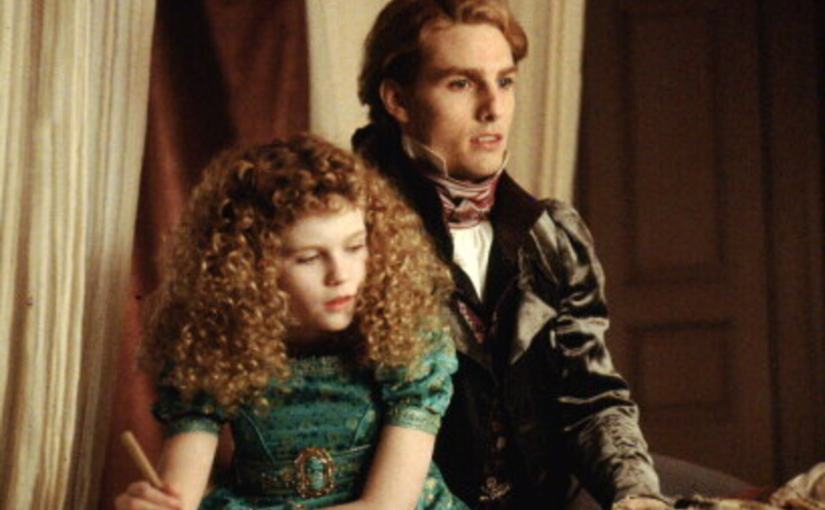
In present day San Francisco, a young man (Christian Slater) sets up his tape deck to record a conversation with a soft spoken pale faced man in a dark suit with a neat ponytail in place.  This mysterious person is Louis, played by Brad Pitt.  His story begins two hundred years earlier, in New Orleans, back to the day when he was incepted into an immortal life as a vampire. His agent of delivery is the devil-may- care and mischievous Lestat, one of Tom Cruise’s most surprising and unusual portrayals.  He gives a brilliant performance that’s as far a cry from his lawyer roles or his Maverick and Ethan Hunt heroes as possible.  

Lestat is eager to guide Louis into the benefits of vampire life.  Louis, having already been depressed following the loss of his wife and daughter during childbirth, cannot grow comfortable with Lestat’s insatiable appetite to feast on aristocratic figures or plantation slave servants.  This is not a match made in heaven and their chemistry as a couple is tested. Louis would rather miserably feast on chickens and rats, while Lestat grows frustrated by unsuccessfully swaying his partner to taste the sweet nectar of blood dripping from the wrist of a lovely young lass.  Lestat turns towards a grander extreme to maintain his embrace of the morose Louis.

Through deception, the men welcome an eleven-year-old “daughter” into their underworld.  Her name is Claudia, played Kirsten Dunst in her introductory role.  I still believe this is her best performance, worthy of an Oscar.  The life of a vampire is delightful to the child, the same as Lestat perceives it.  However, as the decades move on, with changes in fashions and industry quickly developing, so does Claudia’s understanding.  Her body never matures, destined to always remain within the shell of a preteen child, and thus she commiserates with Louis.

It appears like I’ve summarized Anne Rice’s entire story, but I have not even come close.  Interview With The Vampire is to gothic horror the same way The Godfather is to mafia gangster life.  Both communities victimize people of an innocent world, but their members are expected to follow codes of decorum and respect.  The conflict lies in living as a bloodsucking vampire or a criminal gangster.  When a peer interferes or does not cooperate, then the individuals of these respected worlds become violent unto each other.    The viewer/reader observe how their patterns of behavior all play out and how one action or policy generates one response after another.  These films are high ranked authorities on their subject matters.

Louis explains to his interviewer how Bram Stoker’s celebration of vampires is dreamed up escapist fiction, though coffins and the avoidance of sunlight are absolute necessities to carry on.  Just like any person, vampires want to live happily, but life gets in the way and that can be frustrating on any number of different levels.  

Neil Jordan’s film is a marvelous exploration into the mindset of being a vampire.  Tom Cruise perfectly exudes Lestat as a vampire ready to joyously live with sin while he savors and lives a life of eroticism and material wealth.  A child like Claudia sees the attraction of being spoiled and spoiling herself, and she cannot get enough consumption of blood. Eventually though, her mentality outgrows what becomes redundantly mundane.  Louis is relatable like many people.  He is unhappy living the life he was born into.  Lestat grows aggravated with his family’s resistance to partake of what he relishes.  There is an extensive range of emotions on display with Interview With A Vampire. To be a vampire can be a privilege or a curse. It all depends on who you interview.

The look of this film is astonishing.  I know it was shot within New Orleans, Paris and San Francisco locations.  However, I can easily recognize some sound stage locales, and I have no complaints.  The art designs from Dante Ferretti are thoughtfully crafted with lantern lit, rain-soaked cobblestone streets of the seventeenth century to mucky, moonlit swamps.  Horse drawn carriages transporting abundances of coffins serve a purpose of humor and narrative as character misdeeds are routinely committed by Louis, Claudia and especially the trickster Lestat.  The furnishings of the aristocracy are embracing too.  It’s a remarkably convincing step back in time.  

The periodic costume wear by Sandy Powell completes the settings with colorful, silk garments, white ruffled shirt sleeves and buckled shoes for both the men and women as well as for Kirsten Dunst and some cherub cheeked children who come into play.  Everything looks so rich. The whole picture feels like stepping into one of those late-night ghost walking tours I’ve taken in small southern towns like Savannah and St Augustine.  Every scene, even when the film jumps to late twentieth century, is immersive.  

Anne Rice’s screenplay adaptation tells so much within two hours.  She allows time for the characters to sail to Europe seeking out others like them.  The second half of the film teaches us more about what it means to uphold oneself as a vampire.  

Neil Jordan sometimes delivers his film like a how-to documentary because you are consistently learning new details, not so much about plot but about a people you are not as familiar with. Often, the film segues into theatrical play as you might expect from Phantom Of The Opera.  It’s no wonder since eventually Anne Rice puts us in touch with the cabal known as Theatres des Vampires. Stephen Rea and Antonio Banderas get to take center stage within a literal theater where the facade of behaving like a vampire can be executed beyond the suspicions of a – ahem- live audience.  

Rice and Jordan get playful while also performing with horrific familiarity.  The bites on the neck are known to many of us for drinking blood.  Did you also realize that a vampire can drink from a crystal wine glass? There’s an elegance to how the actors’ characters consume the blood of humans.  Cruise and Pitt begin by going in for a passionate kiss, either on the neck or the weightless wrist of a victim.  Lestat is more aggressive. Louis caresses his meals on the rare occasion he dines. Claudia gives a puppy love bite. Cruise especially finds new and titillating ways to dine with each new feast.  Both actors are deliciously homoerotic, but on different parental planes with their child. Their love/hate relationship operates like Shakespearean stage work. That’s why I really take to Neil Jordan and Dante Ferretti’s choice of soundstages.  

I’ve become so bored with zombies and vampires.  How many iterations must be churned out of the same kind of monster.  This year’s horror hit, Sinners, was superb until it stopped being eye opening with surprise.  It eventually became the same old thing and offered nothing new to show me in its final blood-shedding act.  

Interview With The Vampire is one of the best vampire films though.  The film never ceases to speak directly to its audience.  The settings describe how life is lived.  The characters grapple with both internal and external struggles.  

It’s one shortcoming is that Anne Rice, Neil Jordan and cast/crew did not follow up with the author’s subsequent tales.  The subtitle, The Vampire Chronicles, seemed to promise an extension of this universe. I know of other Anne Rice film adaptations that chose not to continue on from what was done here, and the execution was terribly poor and disappointing.  There’s a biographical intelligence to Neil Jordan’s film that many films of all genres lack.

Anne Rice’s first film adaptation set the standard on vampire culture, and I have trouble thinking of anything since its release that closely matches it.  

Interview With The Vampire is the only one with a blood curdling bite.

F1

By Marc S. Sanders

Miguel and I are the two unpaid movie critics who find ways to entertain ourselves beyond the IMAX picture on the screen.  By now, I know when Nicole Kidman is arriving and I start her off by saying out loud “We come to this place…”. Mig turns his head down in sarcastic annoyance.  We applaud at the return of Jaws in theaters this August.  There’s a rhythm we chemically thrive on.

Thirty minutes after a series of trailers plus an unwanted Allstate commercial (Thanks a lot AMC), the film begins, and the personal hand gestures begin.  Excuse me a moment.  I must pause for a moment.  (a-hem!) 

GET YOUR MINDS OUT OF THE GUTTERS!!!  

Now, where were we?  

Oh yes…

During the running time of Brad Pitt’s racing movie, F1, there were animated fist pumps (“Yeah!  Alright!!”).  There was rhythmic poking in and out of my right index finger jamming into my left thumb and forefinger (“Brad is about to get it on with Kate, the staple romantic interest, played by Kerrie Condon”).  A palm up facing twirl of the wrist (“Of course.” “Naturally!”). There’s the muted gasp pat on Miguel’s arm (“Is it?” “Could it be?” “Don’t tell me!” “Brad is fully recovered and walking through the steam cloud to pilot his race car?” “Again?”  “For one last time?”).  F1 covers all the expected beats.  

Frankly, I am not aware of too many racing films.  Days Of Thunder with Tom Cruise, of course.  Ron Howard did an engaging piece called Rush.  Ford Vs Ferrari works better as a bio than just a racing movie.  Pixar has its series of cute films. Still, just like the new Jurassic World picture, and I’m sure the latest Superman iteration arriving later this week, F1 is all too familiar like any kind of sports movie or Top Gun on the track Jerry Bruckheimer pic.

Tom Cruise—I mean Brad Pitt—is legendary stock car racer Sonny Hayes, a middle aged, washed up and broke recovering gambler desperately invited by his friend and former teammate Gabriel (Javier Bardem) to rescue his racing team from going belly up and leaving him hundreds of millions of dollars in debt.  Gabriel already has a cocky, promising driver named Joshua enlisted. He is performed very well with a lot of appeal by Damson Idris.  However, the young man does not have focus yet and lives for his social media likes and attention.  It’s up to Sonny to make the Formula One racing squad look like a contender while reigning in Joshua who can’t let go of personal conceit and a jealous animosity.

Kerry Condon is the engineering designer of Sonny and Joshua’s racing vehicles.  With each race, Kate trouble shoots what needs improvement and what can advance the drivers’ rankings.  Too bad she can’t fully invest her expertise as F1 demands she flirts with Sonny.  (Cue my right index finger while Miguel is ready to brush it away.)

The most impressive moments from Joseph Kosinski’s (Top Gun: Maverick) film are the racing scenes.  You are seeing both Pitt and Idris tucked within the snug cockpits of these low to the ground speedster machines.  The editing is superbly matched with the roaring sound and a pulsing soundtrack from another Hans Zimmer masterpiece.  

My one issue is the final cuts of the various races lacked overhead shots.  I would have liked to have seen moments from above where I could follow when the race cars pull in and out of a pit stop for example and stay on pace with unnamed competitors.  Kosinski gives an overabundance of close-up shots of the actors in the cars but not as much outside of the vehicles.  It’s all very exciting though, and when a film opens with revving engines playing in tandem with Led Zeppelin’s Whole Lotta Love, well you have me hooked.

F1 is like another exciting amusement park ride that you’ve experienced a hundred times before.  In between the races, while there are well drawn characters played by good actors, there’s ho hum filling material that keeps this speedy ride going about a half hour to forty-five minutes too long.  The guys have to argue.  They have to lose the race.  They each have to crash their cars.  They have to be tricked into getting along.  There also has to be a traitor among the ranks.  There has to be sequences of music overplaying a series of different races and the voiceover commentators chiming in with standard fare like “…and here comes Sonny Hayes from behind…” As well, Pitt and Condon have to get it on.  She has to tell him she doesn’t get romantically involved with racers before they hump each other’s brains out (Cue the index finger!).  

Sonny also has to be told he’s finished, before emerging from that humid, sunlit steam cloud where Joshua and the pit crew slowly raise their sunglasses and drop their jaws, upon his return. (Cue the muted gasp, followed by my twentieth fist pump.)

Look, F1 is entertaining.  It’s well made.  It’s got great action with impressive direction and an enthusiastic cast.  Still, I’m tired of this more of the same.  I alluded to my same feelings yesterday with Jurassic World: Rebirth.  It’s all the same flavor and these iterations are not daring enough to take big risks or surprises with what they offer.  Consider Avengers: Infinity War and Endgame.  Those films were expected to play by the same beats and yet there were some shocks to come through.  Look at what happened with The Empire Strikes Back.  Anyone see those surprises when first encountered?  The stakes were always surprisingly high, and the heroes were getting personally affected, not just episodically, but permanently.  

Blockbusters need not be so cookie cutter all of the time, but that’s exactly what is happening.  I already know the outcome of the upcoming Fantastic Four movie.  It could not be more apparent and unimaginative.  

I watched Companion which just hit HBO MAX earlier this month and in ninety minutes, that bloody delicious film diverts in so many different directions with a bare minimum setting and a small cast.  It’s as bloody as most thriller movies we’ve seen but an applied script turns on its axis over and over again.

On an IMAX screen, F1 especially delivers. Yet, while I’m absorbing well staged cuts of movie made racing footage, my mind is turning into comatose mush and the only thing that keeps it electrified is to acknowledge the standard beats.  

Declaring “Gentlemen, START YOUR ENGINES!” will not hold my attention for 200 laps.

Do it with me now:

Fist pump!

Finger fuck!

Muted gasp!

The Of Course!

Now you know the drill! Hit the gas!!! Turn up the volume and let Robert Plant remind you that You need coolin’/Baby I’m not foolin’

KALIFORNIA (1993)

by Miguel E. Rodriguez

DIRECTOR: Dominic Sena
CAST: Brad Pitt, Juliette Lewis, David Duchovny, Michelle Forbes
MY RATING: 9/10
ROTTEN TOMATOMETER: 58%

PLOT: A journalist duo go on a tour of serial killer murder sites with two companions, unaware that one of them is a serial killer himself.


Ask any movie fan for names of actors who played memorable serial killers in film, and you’ll get a lot of obvious ones (Anthony Hopkins, Charlize Theron, Anthony Perkins) and you might get a few not-so-obvious ones (Michael Rooker, Andrew Robinson, Peter Lorre).  But I’m willing to bet no more than one person in 20 will name Brad Pitt, whose performance as the skeevy Early Grayce dominates Kalifornia, the 1993 directorial debut film of music video director Dominic Sena (Gone in 60 Seconds, Swordfish).  Pitt is so convincing and deliberately off-putting that I came close to switching the movie off and returning it to the thrift store where I found it.  Why would I want to keep watching a film where I’m repulsed by one of the main characters nearly every second he’s on screen?

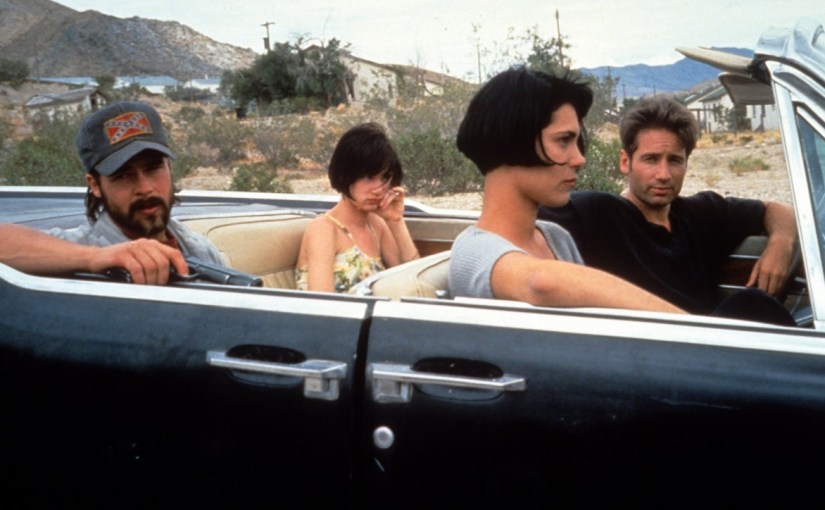
Kalifornia may be predictable to some, but I was blown away by the story development.  Brian (David Duchovny) and his longtime girlfriend, Carrie (Michelle Forbes) are embarking on a cross-country road trip from Pittsburgh to California.  He’s an author writing a book on serial killers.  During their trip, he will visit infamous murder sites to gather material, and Carrie, a professional photographer, will take pictures for the book.

(The first time we see Brian, he’s mixing drinks at a party and holding forth about how the government should rehabilitate killers instead of executing them.  They are products of their environment, their upbringing, they’re not ultimately responsible for their own actions because they simply don’t know any better, and so on.  Over the course of the movie, his beliefs will be put to the test.)

Brian is short on cash until he finishes his book, so he places an ad on a university message board looking for people willing to split gas and food costs on a cross-country road trip to California.   One of the most incisive moments in the movie comes when Brian and Carrie drive to a meet-up point and spot their new travel companions: Early and his girlfriend, Adele (Juliette Lewis), a young woman whose mental development seems to have been arrested at about a 13-year-old level.  Carrie whispers to Brian, “Look at them, they look like Okies.”  Meanwhile, Adele whispers to Early, “Oh, Jesus, Early, they look kinda weird.”  The movie seems to be setting us up for an awkward odd-couple road-trip movie where, uh oh, one of them is a serial killer!  But you ain’t seen nothing yet.

During their road-trip, and in between visits to famous murder sites, Early and Brian start to bond a little, much to Carrie’s dismay.  Brian has a theory about why the Black Dahlia killer was never found, but Early has another: that he’s alive and well in a trailer park somewhere, “thinkin’ about what he’s done, goin’ over it and over it in his head, every night, thinkin’ how smart he is for gettin’ away with it.”  Ohhh-kay…

One night when Brian and Early are at a bar, Carrie and Adele get to talking, and Adele reveals that she doesn’t smoke because “he broke me of that.”  Carrie asks her if Early hits her, and her reply is as heartbreaking as it is terrifying: “Oh, only when I deserve it.”

This and several other red flags get to be too much for Carrie, and she gives Brian an ultimatum: “Either they get out at the next gas station or I do, your choice.”  What happens at that next gas station I would not dream of revealing, but it ignites the slow burn of the previous hour and turns Kalifornia into a tense, bloody thriller that rivals anything by David Fincher.

I’ve given so many establishing plot details above (I left some juicy bits out, trust me) because I’m trying to convey how this film, which starts out like a slightly amped-up basic-cable movie-of-the-week, shifts into another gear in the second hour.  Unsuspecting viewers like me, who have only heard of the movie but never even seen the trailer, will watch the first hour wondering where the good movie is.  But have patience, it’s coming.  The payoff is worth the wait.

[Author’s note: by the way, don’t watch the trailer for this movie.  It gives away WAY too many plot points that I haven’t mentioned, both before and after the gas station incident mentioned above.  Just the worst.]

Visually, I didn’t see a lot of the music-video camera pyrotechnics that director Sena would later employ in Gone in 60 Seconds, etcetera.  The movie is content to let the dread sort of speak for itself.  The various murder sites they all visit seem even creepier and uglier than they need to be.  Slick editing brings little details into focus that heightens the tension.

Ah, I can’t think of any way to explain how great this movie is without giving away more plot details, and this movie is best seen in a vacuum, knowing as little as possible.  So trust me.  If you’re a fan at all of serial killer movies or documentaries, this movie will not only entertain, it will give you a lot to chew over.  Kalifornia belongs in the serial killer movie pantheon with The Silence of the Lambs, Psycho, and Henry: Portrait of a Serial Killer.  Especially that last one.

12 MONKEYS

By Marc S. Sanders

Bruce Willis is a time traveler from an ugly dystopian future in 12 Monkeys.  His name is James Cole and his mission is to uncover why all but one percent of the world’s human population perished from a mysterious virus in the year 1996. 

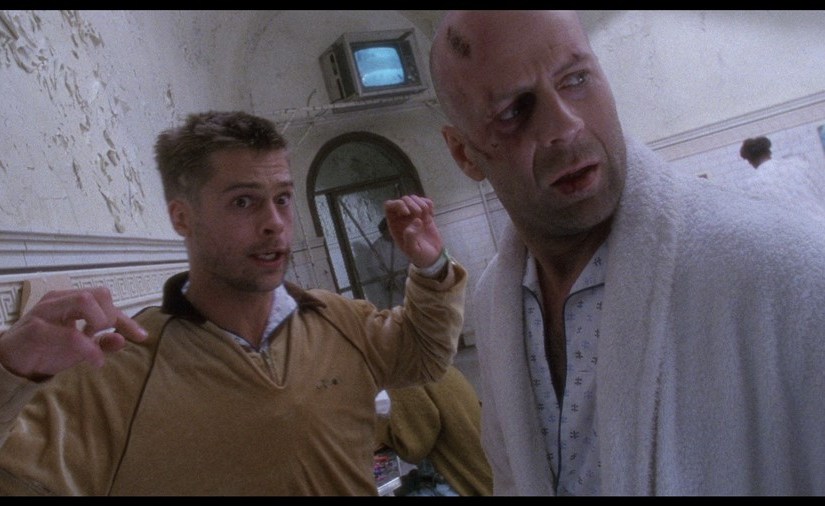
Director Terry Gilliam specializes in disorienting his films.  No shot or closeup is well defined.  He’ll position his camera on a slant or he’ll turn it on an uneven axis so that nothing appears completely clear.  In 12 Monkeys, the viewer is as confused as the protagonist, James Cole, along with a psychiatrist he periodically encounters named Kathryn Railly (Madeleine Stowe).  Beyond the camera trickery, the script of the film offers up oddball characters in both Cole’s present time period (the “future”) and in his past.  Jeffrey Goines (Brad Pitt, in his first Oscar nominated role) is one particular weirdo, residing in a mental institution that Cole is entered into when he time traveled back to Baltimore, Maryland in the year 1990.  During his stay in the loony bin, Cole is talking gibberish to Dr. Railly and her team.  Jeffrey has his own language of nonsense.

Cole’s dreams of himself as a child are intermittently weaved into the final edit of the film.  There’s a woman running after a man, a rapid beep, beep, beep and a gunshot.  Later returns to this dream will provide more clues fleshing out its significance.

It would be easy to have a five-minute conversation and spell out what occurs in 12 Monkeys, but that would be defeating the cleverness of the film.  The achievement of its story relies on the sum of its parts.  Terry Gilliam strategically lays out breadcrumbs with fractional pieces of dialogue, words and pictures that quickly flash in front of you.  It may even hinge on a news story or memorable pieces of music playing on a radio. Still, he also unnerves the characters and the viewer with uncomfortable and sometimes grotesque imagery. 

The first time you watch the film your attention may turn to the long stream of bloody drool hanging from Bruce Willis’ mouth when he shares his first scene with Madeleine Stowe.  Repeat viewings, which I believe only enhance the picture, will have you focus on the nonsensical dialogue that James Cole is continuously uttering.  Other characters are seemingly disruptive to your concentration, particularly the herky jerky behavior of Brad Pitt’s character, but their purpose is essential to a mystery that has left the world of the future in a tailspin where the last of the human race lives underground while animal wildlife roam the cities above.  Furthermore, who or what can explain the enigma behind a team of people perhaps known as The Army Of The 12 Monkeys?

12 Monkeys is a very weird and very unusual kind of science fiction film and that is its crowning achievement.  I have spoken before of how sometimes a movie can not be determined as a success until it reaches its climax, say the last five minutes of its running time.  Terry Gilliam’s picture is one such example.  Gilliam has a keen sense of foreshadowing with tactical layering of complexity.  He is wise with how everything neatly unravels at just the right moment. The answers to the mysteries that James Cole pursues eventually rise to the surface, reminding us that everything was right under our nose the whole time. 

I recall the elation I had the first time I saw the film in theaters.  On repeat viewings, I grin at how the movie is assembled.  Quick references that seem like blink and you miss it moments add up to a satisfying conclusion in Terry Gilliam’s film.  My colleague, Miguel, and I both agree on the time travel motif in 12 Monkeys.  It is one of those rare occasions where the science built within the story’s fiction seems to make sense.  Too often time travel movies paint themselves into a corner and can’t escape the gaping plot holes they leave behind.  Yet the different time settings of 12 Monkeys cooperate with themselves.  Because the film doesn’t color outside of its lines, its worth applauding how ingenious the picture truly is from beginning to end.

12 Monkeys may require your patience the first time you watch it.  It’s not a comfortable journey.  However, you’ll be glad you stayed with it as the story answers its own questions.

BABYLON

By Marc S. Sanders

Director Damien Chazelle has come a long way since his first major motion picture, Whiplash, a small film about a young, tortured drummer.  Since that accomplishment, he seems to get more and more elaborate with each project.  Babylon certainly exceeds ambition in any select 3–5-minute scene it offers within its grand opus.  The main title card doesn’t appear on screen until after the first thirty minutes and by then you are exhausted, yet completely awakened.

Babylon begins in the mid-1920s, during the pioneering times of Hollywood filmmaking where silent films were fresh and were regarded outlets for escapism and entertainment.  Big studios like MGM were not quite on the scene just yet and movie makers experimented with their films having no regard for rule and caution while constructing them.  On a busy day of shooting at around 3:15pm, an open field sword and sandal battle might turn up an extra in an accidental death with an impaled spear.  No matter.  Must keep shooting before daylight is lost and everything runs off schedule. 

It was at this time that a star like Jack Conrad (Brad Pitt), rugged with a square jaw and dashing with a pencil thin mustache, offered greatness in movie houses that showed silent pictures.  A new discovery like Nellie LaRoy (Margot Robbie) who seemingly came in off the street captured producers and patrons alike with her wide-eyed expressions and lanky, yet appealing posture.  These were the first celebrities of the advancing twentieth century.  They were starlets that brought people back and back again to the cinemas to witness battles of roman conquest or dancing on top of a bar while batting their long eyelashes for a mug at the camera.  The filmmakers loved to work with them. 

These performers ruled Hollywood until the Talkies appeared on the scene.  Movies with sound revolutionized the industry, but these famed individuals couldn’t keep up with the evolution.  Audiences and filmmakers couldn’t accept a compatibility.  Try to imagine a Jack Conrad listen to a packed movie house chuckle at one of his romantic speaking scenes.  It’s heartbreaking to watch.  He was admired, but now he’s a joke.

When the sun would set, the parties soaked–make that drenched–in orgy and debauchery would begin and nothing was off limits.  Naked women would happily get high and drunk and tossed over a large crowd.  Prop penises would be inserted into one partygoer and then another and then another.  Fat ugly men would happily accept getting urinated on.  Endless amounts of liquor and especially cocaine would be gulped and snorted and the greatest dares imaginable would always try to top themselves.  Have you ever heard of a party getting so out of control that someone would go so far as to wrestle a rattlesnake in the middle of the desert?  Jack happily watched all this decadence go down.  Nellie joyfully became the outrageously intoxicated and fearless ringleader. 

I have offered only a sliver of description for Chazelle’s over three-hour film.  To sum up, Babylon offers a hard-edged response to the family friendly interpretation found in Singin’ In The Rain.  Both films delve heavily into the transition of silent filmmaking to talking pictures and those who were left behind.  Gene Kelly and Stanley Donen’s G rated picture will have you giggle at their Lina Lamont with the squeaky voice and pratfalls who’s all wrong for the next phase.  The heavy R rated dramatic interpretation is offered in Chazelle’s script with Margot Robbie’s Nellie LaRoy and her Jersey accent, accompanied by unrefined posture and behavior.  Her drug binges are no help either.  Margot Robbie is fearless in her performance.  She is messy, sloppy, harsh and frenzied with her character.  One thing that came to mind as she is snorting line after line of coke is that at that time, there was no such thing as a means for rehabilitation like today.  No one was even looking out for the harm that drugs and alcoholic binging could have on people.  People were left to their vices to just drown in their poison of choice.  For silent pictures, you could plaster them in makeup and costume and let them mug and bat their eyes for the camera.  It didn’t matter if their speech was slurred.  Talkies required much more concentration of their performers.

The main player of the film is newcomer, Diego Calva, as Manny Torres.  A Mexican who inadvertently finds himself in the Hollywood nightlife while pushing an elephant up a steep hill only to get shit on.  (The elephant serves no purpose except to make an appearance at one of these crazy parties.)  Manny has an instinct for what’s to come in the movies and builds himself up into a studio executive.  While he’s dangerously falling in love with Nellie, he’s also discovering next big things like a Negro entertainer who’s magnificent with a trumpet, Sidney Palmer (Jovan Adepo).  Manny is a good man who swims above the dangerous life of Hollywood partying and decadence.  He’s an innovator that’ll never receive credit for what he uncovers.  That’s for the white executives to profit from.

A minor but welcoming story is Sidney’s.  He’s soon hung on posters outside movie houses, and performing with big bands.  Hollywood awards him with riches he could never imagine and never asked for.  However, ironically, his complexion comes off too white against some of his other band players and the idea of caking himself in charcoal makeup is insisted.  How will Sidney respond to this humiliating request? The wealthy also have a particular regard for him.  His status as an entertainer.  Do they see him as a showboat clown or the artist he values himself to be?  How does Sidney want to be considered?

With all of the parties and drinking and drug use to go around, Babylon goes off in a hundred different directions before it finds an even keel outline that switches storylines from Jack to Nellie to Manny and Sidney.  Chazelle strives to one up what other filmmakers before have attempted.  I could not help but think about Paul Thomas Anderson’s Boogie Nights which follows the porn industry in the late 70s and early 80s.  Happiness abounds until time and technology and constant self-abuse cause everything to unravel.  Babylon follows a very similar trajectory.

A friend of mine found Babylon too be overly gratuitous.  She’s not wrong, but while she took it as a complaint with the film.  I take how superfluous the movie is as a major compliment.  There are long scenes where Chazelle will not surrender for the audience.  He shows how drug raged Nellie is when no one will fight that rattlesnake by having her violently pick it up, swing it around and thus it will eventually latch on to her neck while she’s running around amid a gang of naked partygoers.  Then we get to see another starlet cut the snake off below it’s head, rip its fangs out of Nelly’s skin and proceed to suck the venom out.  Oh, you’ll squint and squirm through the whole scene.  What do we learn from this?  Drugs are bad.  Really bad, and they will delude you into acting with no vices or boundaries.  So, let’s be completely honest about it.

When Nellie is recruited for a talking film, we see take after take after take of her trying to make her mark while it is shouted over and over again to the crew to shut the fuck up.  There can be absolutely no noise from anywhere that the mikes can pick up and it doesn’t matter if a crewman is getting dangerously overheated in a soundbox.  (No air conditioning could be allowed because the hum would be picked up by the microphones.)  It’s a brilliantly, well edited, long and tortuous scene of flaring tempers, sweat, heavy light and stress.

I remember reading an interview with Henry Hill, the mobster who was the focus of Martin Scorsese’s Goodfellas.  Hill said with no uncertainty that the characters portrayed by Joe Pesci and Robert DeNiro were not even close to how frightening and violent their real-life counterparts were.  So maybe even Scorsese glossed over how harsh that world ever was.  Damien Chazelle is a relentless filmmaker with Babylon.  Nothing is whitewashed.  Most of what you see is shock value, but that’s the message he’s conveying and per his research he must be convinced the life of this era was actually this outrageous and way over the top. He’s certainly not forgiving with how manic these people lived, particularly with Margot Robbie’s character.

At the same time, he calms the film down to offer a harsh truth to a quickly becoming has been like Jack Conrad, Brad Pitt’s character, no longer in his prime.  Jean Smart portrays a gossip columnist reminding Jack that the height of his career is long gone, but fifty years from now, new generations will be rediscovering his achievements.  He will be a legend for all eternity.  Chazelle is speaking to us, those that appreciate what Turner Classic Films and other formats like videotape and DVD offer to see the first of these kinds of pictures where it all began with legends like Jack and maybe Nellie and especially Chaplin. Chazelle was an important student of this later generation.  This is the best scene of the picture with a magnificently written monologue, and I won’t be surprised if Jean Smart gets an Oscar nomination that no one ever saw coming.  I’m inclined to declare she should just get the award.  It’s such a telling moment for all kinds of movies.

Chazelle loves to make films.  The epilogue to Babylon demonstrates his affection as his story jumps to twenty years later, and an older Manny watches Singin’ In The Rain in a theatre. From what he inadvertently brought to the fold all those years ago, movies have evolved and continue to develop into bigger scales of what we could never have thought possible.  Chazzelle edits in a sequence where it started with silent films like A Trip To The Moon and Keystone Kops over to grand musical ensembles and adventures like Ben-Hur and then on to special effects with quick cuts of Raiders Of The Lost Ark, Terminator 2, and Avatar.  Flashes of color appear on the screen and then quickly cut back to these captions in celebrated films and film stock.  I don’t believe any of this spoils anything of the film, but I like to recognize how Chazzelle takes inspiration from Stanley Kubrick’s bewildering conclusion to 2001: A Space Odyssey.  Movies are going on and on and on.  Whoever is hot now and presently significant will have to adjust to an ever-changing industry.  Once celebrated puppeteers working for guys like George Lucas have no value in an age of computer graphic engineering.  Big box office stars might not be able to uphold their careers during a time of streaming films that come to us by means of our flat screen TVs we can affordably buy at Walmart.  Kardashian girls are more widely recognized than maybe a Jack Nicholson or a Meryl Streep.  (Someone I know had no idea who Carol Burnette is.)

It’s hard to sum up everything captured in a film this big and ambitious and yes, gratuitous.  Perhaps, the best I can tell you is simply that a hard truth to accept is that casualties come from discovery in a film like Babylon

FIGHT CLUB

By Marc S. Sanders

David Fincher’s Fight Club is a deliberately ugly and dreary film. It has to be to evoke the insomnia its narrator (Edward Norton) suffers from, as well as his lonely depression that offers no answers for his purpose to exist or to be loved by another person.

To alleviate his need for something fulfilling, the narrator resorts to attending support groups for men suffering from illnesses and debilitating diseases like testicular cancer. There he meets a former body builder named Bob (the singer Meat Loaf) who has developed floppy breasts after going through hormone therapy. Bob follows the processes of the self help group and embraces on to Norton’s character as a means of support; stuffing his face into Bob’s breasts. The narrator eventually becomes accustomed to this maternal practice and the ritual of attending these meetings as a regular process. However, he feels he is getting upstaged by Marla (Helena Bonham Carter), a punk looking girl with dark eyeliner and wild jet-black hair.

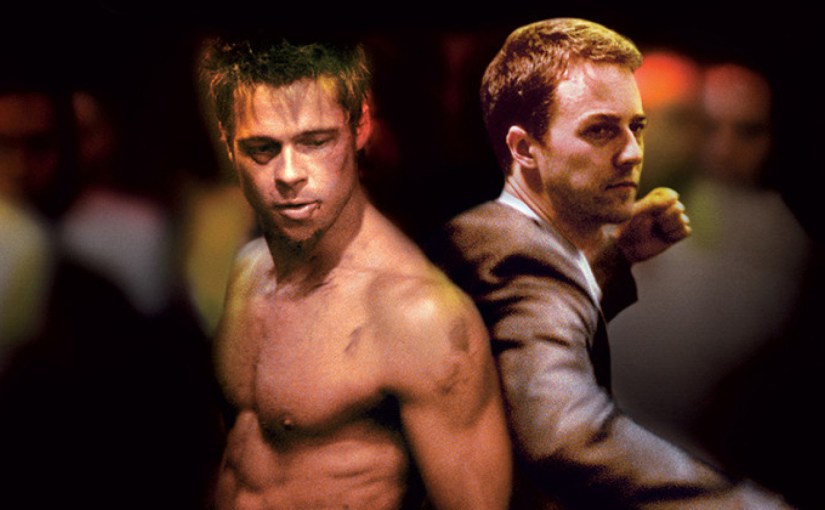
Even though Marla and the narrator negotiate who attends what meetings and on what night, Norton meets another punk like reckless character known as Tyler Durdin (memorably played by Brad Pitt) who manufactures and sells soap but also edits film reels, sneakily inserting penis images into family films. Tyler also works as a waiter at a high-end restaurant where he proudly adds a little of “himself” to all the courses that are served.

The narrator only works at a boring desk job where his boss uses any opportunity to look down upon him and chastise him on his performance or appearance, but never recognizing anything further within his nature. The boss could care less about him. Naturally, the narrator becomes in awe of Tyler’s behavior. Tyler is a rebel and offers much more beyond Bob’s comfort. Tyler serves a purpose for the narrator to pursue.

When Tyler challenges the narrator to hit him as hard as he can it eventually leads to a new kind of gathering for both of them, a support group known as Fight Club. Men from all over soon gather underground to partake of letting out their aggressions with bare knuckle fists and wrestling. Anyone attending gets a therapeutic vibe from bleeding and bruising themselves upon one another. The narrator certainly feels better.

Going a step further leads Tyler and the narrator to fight back against a system of order and capitalism. Their philosophy picks up traction and soon a form of revolution is taking place across the entire country. Somehow, the narrator is taken off guard by this new belief system.

There’s a lot to consider and question in Fight Club, though I’m not sure I care for the film as a whole to debate its message. Sometimes it feels like it’s not moving anywhere. Norton’s character learns things about his own consciousness and need to falsely subject himself as a cancer survivor or as an underground brawler because he has nothing else really going for him. I get that, but why should I care or like it?

Tyler Durdin resides in a broken down house on the other end of the city that is leaking from every pipe and it’s electricity could ignite another fire that maybe this decrepit dwelling survived once before. Tyler is happy with his home and happy to share it with the narrator as well as Marla whom he has endless sex with. Tyler doesn’t want the fancy trappings. It’s revolting to even possess such materialism and suck off the tit of a capitalist regime. With the narrator at his side, he encourages a fight against the power of commercialism and wealth. Find a way to destroy the structures of what the country has built itself into, perhaps.

That’s the message of Fight Club. I just can’t lay claim that I cared for the execution of the revolt. I’m supposed to laugh at Tyler’s antics at times like when he steals the gross liquid fat from liposuction patients to manufacture the soap he sells. Yes, we get a moment where the bags of fat leak and splatter all over the place. It was just never amusing for me. I found no symbolism in this passage. It’s just absolutely disgusting. When Tyler happily pisses in someone’s soup, I don’t think it’s funny either. I don’t like Tyler. I don’t envy him or want to be him. I don’t find anything to cheer for with him. I’ve got more admiration for John Bender in The Breakfast Club than I do for Tyler Durdin. I might respect what he stands for to a degree as we are a culture brainwashed by advertising and commercialism. I just don’t care for the actions taken by this so-called martyr on behalf of the self-described unfortunates like Norton’s narrator.

I also find it ironic and quite hypocritical that Fincher’s film is a call to stand up to materialism and commercialism and yet the cast is headlined by Brad Pitt, arguably one of the biggest box office stars of the last 30 years, complete with his name above the title and his image front and center ahead of Edward Norton’s on the film posters that promote the film. Pitt is also the guy you see first, last and all over the middle of any of the film’s trailers and advertisements.

Now tell me, is that not a contradiction in terms?

SEVEN

By Marc S. Sanders

There’s an interesting dynamic to David Fincher’s Seven that is not touched upon often enough.  Beyond the clever and grisly murders set to a theme of the Seven Deadly Sins, the two police detective protagonists are carved from completely different molds.  The spine of Fincher’s film, written by Andrew Kevin Walker, focuses on how these men approach the craft of the killer’s accomplishments.  One man wants to cut to the chase, find the criminal and cuff him.  The other wants to study the nature of this mystery man, and only then will it lead to the suspect’s true identity.

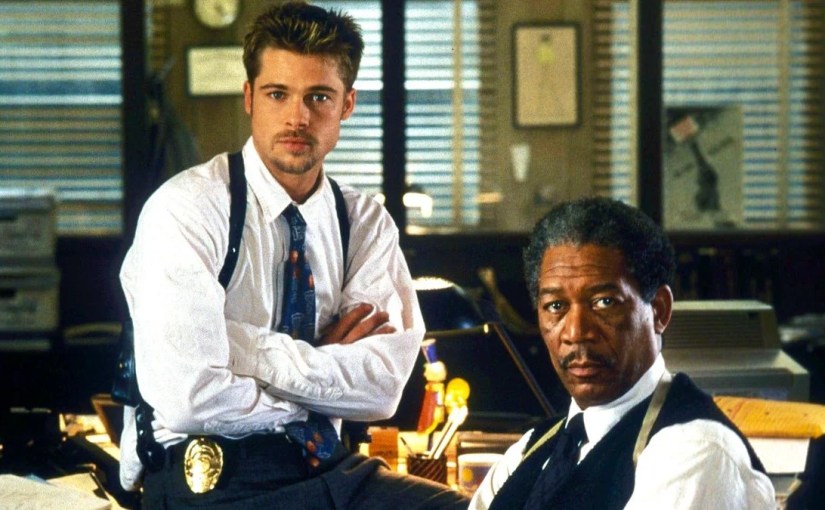
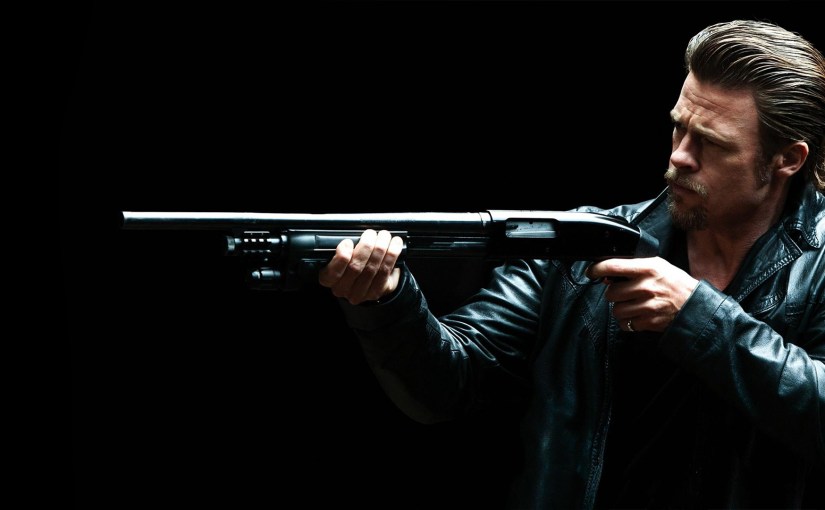
Detective William Somerset (Morgan Freeman) stems from a time gone by for the cinematic detective.  He’s the trench coat wearing investigator who examines and connects dots, never resorting to fists or police intimidation with a gun.  Newly assigned Detective David Mills (Brad Pitt) dons the leather jacket with the cute goatee and boy blond haircut.  He’s more apt to making fun of the sick weirdo they are chasing, hardly lending any valuable insight or observations.  Somerset will approach with respect for the killer and his work.  Mills, with nowhere near the experience of his new partner, will disguise his loss of where to begin with this case by resorting to cheap shots at the killer’s expense, calling him Yoda and surmising this guy must be pleasuring himself in peanut butter, perhaps.

Fincher is widely recognized for the dark photography of his films, like the cherry wood hallways of Harvard in The Social Network or the lurid neighborhoods in movies like Zodiac and Gone Girl.  In Seven, the setting is very much a character in and of itself, but other than the fact that it is a California (thanks to a throw away piece of dialogue) metropolitan area, we never know the name of this city.  It is a dreary, ongoing rain-soaked environment that hinders the police officers and keeps everyone contained in the film, especially David’s wife Tracy (Gwyneth Paltrow), unsettled.  The city has no name or identity.  Therefore, the police officers who occupy it are not the stereotypical cops designed for this place.  One works as a tired, wise and experienced Colombo figure, minus the sarcasm.  The other is an aggressive hot shot who is over trying to prove himself to peers and superiors.  Now he wants to be in charge.  They both follow the footsteps of the mystery together.  Yet, they are reading different roadmaps.

With seven days left before retirement, Somerset meets newly arrived Mills.  They are quickly dispatched to a filthy apartment for an ugly murder scene of an odd nature.  It is a scene labeled as Gluttony by the killer.  Greed follows shortly thereafter, and Somerset knows none of this random.  Whoever has orchestrated these two executions is methodical and resourceful, with a point to prove.  The artistic measure and inspiration are too creative, far from the sloppiness of a standard stabbing or gunshot to the head.  Somerset already knows five more murders will likely turn up and doesn’t want to get involved.  He’s seen enough.  Mills has the cavalier attitude.  Find the freak, and maybe take him out in a blazing shootout.  It’s reckless. 

Could Seven be an answer to how cop movies performed at one time and how they act now?  Seven may be the closest outline of pairing Humphrey Bogart’s Sam Spade with Mel Gibson’s Martin Riggs.  Sure, the murder scenes are hard to look away from, as deliberately repulsive as they are.  Even after multiple views of the film, I still get curious with how the killer planned all of this out to the absolute most minute detail.  However, ninety percent of the dialogue is exchanged only between Freeman and Pitt. Paltrow has a couple of scenes that help paint the sad picture of life in this city, but ultimately the film belongs exclusively to the two cop characters.  Seven has one action scene, but it primarily covers how the two men respond to the nature of what they come upon.  Mills will crack jokes that maybe his college pals would snicker at.  Somerset asks the young man to just be quiet while he explores the scene.  Mills gets grossed out by a bucket of vomit.  Procedurally, Somerset will ask Mills if there was any blood in it.  Mills will resort to Cliff’s Notes on the Seven Deadly Sins.  Somerset will spend his evening in the library, digging through the original source.  Mills will kick down a door without authority.  Somerset will protest against that action without following the standards of procedure.  It’s a dichotomy of impatience versus patience.

The two men actually don’t come to a common platform until the third act of the picture, when the rain has subsided, the sun comes out, and the killer opts to surrender himself.  Still, the mystery of his purpose remains and there’s an unknown element of what to expect next.  So, while the partners may agree that there’s more to come, they still respond to the killer, in person, differently.  Mills can only yell at the deranged suspect and call him names.  Somerset interviews the gruesome and imaginative architect with questions. 

Seven is a sensational crime drama.  It’s eerie, creepy and appreciatively sickening in its crimes.    The outline of some of the killer’s actions might seem conveniently questionable or far-fetched.  Some of the crime scenes were planned over a year’s time. Others were not meant to be revealed until a certain point within these particular seven days.  So, the writing might be a little too overly precise.  However, that should not be dwelled upon.  Rather, one kind of cinematic cop is not the standard in Hollywood films anymore.  Another kind of cop has filled that void in its stead. 

Andrew Kevin Walker’s script follows a very structured outline.  It’s not until the story’s infamous end does the film divert itself, as it is almost unfathomable that it could have actually happened. 

It is fortunate that David Fincher was allowed vast liberties with the production of only his second film, following the abysmal Alien 3 which famously took away any of the personal oversight he depended on as a rookie filmmaker.  With Seven, Walker and Fincher draw out four characters quite well – Somerset, Mills, the city with Tracy as its spokesperson, and the killer’s actions.  Blend these elements together and see if they make for a good product.  Fact is they couldn’t be any more disagreeable, but the chemistry works perfectly. 

Seven is a sensational movie and will likely always remain as one of David Fincher’s best films.

KILLING THEM SOFTLY

By Marc S. Sanders

What did I just watch? A mob movie, or a 2008 Presidential debate where the candidates are no shows, and their respective commercials are aired in their place? Andrew Dominik directs Killing Them Softly, with Brad Pitt who also produces.

Reader, I don’t get the appeal. Maybe it’s the outstanding cast which includes Pitt, as well as James Gandolfini, Ben Mehndelson, Richard Jenkins, Scoot McNairy and Ray Liotta. Sadly, these guys are given next to nothing do of any consequence.

After it is revealed that Liotta’s character, Marky, ripped off his own mob poker game a few years back, an idea is presented to two street addicts played McNairy & Mendehelson to do the same thing because, heck, they’d never be suspected and logic dictates that Liotta must have done it again. So, he’ll be the one to blame and get whacked. The game is robbed and now Brad Pitt’s hitman character is on the job. Simple enough story, almost like a Guy Ritchie picture.

Killing Them Softly is an adaptation of a 1974 novel by George V Higgins. I never read the book, but I’m curious if it contains any kind of relation to Andrew Dominik’s idea of editing recurring speeches and ads, compliments of Obama, McCain and Bush 45. Truly, what was the point of this recurring theme? A two-sentence piece of dialogue finally acknowledges this in the final minute of the film, but I’m still lost on the significance. Somehow Dominik made a dirty, cold, rain-soaked picture that has an omnipotent viewpoint from our most prominent politicians, and I don’t know what one thing has to do with another.

As well, Gandolfini arrives in the story and I never could gather what was his purpose. I think he is a hitman who is washed up, never getting his ass up to carry out the job and just monologues about nothing like the hooker he pays off; topics that Quentin Tarantino might’ve thrown in the editing trash bin.

Mendelsohn looks incredibly convincing as an addict living off the streets, yet his storyline has no end. He’s arrested. Then what happens? What does that mean for everyone else? Liotta has a long drawn out sequence of getting the shit kicked out of him by two mob foot soldiers. The scene goes on and on and on. His face cracks and bleeds, and bleeds some more. Brad Pitt? Well, he’s the hitman who just looks cool. Yeah, the black leather jacket he wears looks very cool on him. That’s about it.

There’s no development to Killing Them Softly. No surprise or twist. The guys you expect to get killed, get killed, and there’s no good dialogue.

This film is just an empty void of poorly, uninteresting violence.

TRUE ROMANCE

By Marc S. Sanders

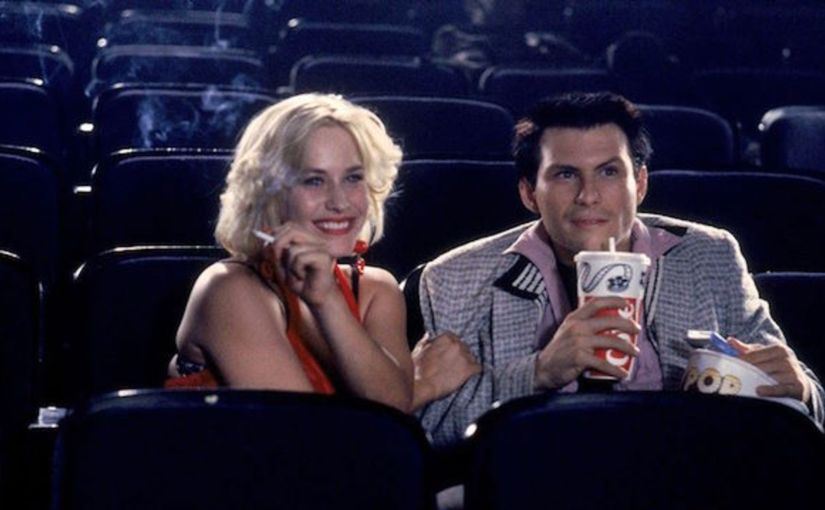
The structure built into the script for True Romance by Quentin Tarantino, directed by Tony Scott, is like the trunk of a solid oak tree with strong, sturdy branches representing its collection of seedy characters in off color scenes. Tarantino sets it up – an Elvis infatuated boy meets a rookie call girl (Christian Slater, Patricia Arquette). Boy marries girl, and then boy & girl find a suitcase filled with a fortune in uncut cocaine. A simple storyline that now allows a bunch of fun, short vignettes to be played out, all leading to one moment after the other within this universe of outlandish, lurid debauchery.

What works so well in True Romance is that literally from beginning to end, you are always meeting a new and incredibly interesting character. Each scene welcomes someone else into the fold. For that, you need an all-star cast. Gary Oldman, Samuel L. Jackson, Christopher Walken, Val Kilmer, Conchata Farrell, Dennis Hopper, James Gandolfini, Brad Pitt, Bronson Pinchot, Saul Rubinek, Michael Rapaport, Tom Sizemore, Chris Penn, Ed Lauter, Elvis & martial arts master Sonny Chiba. The list goes on and on. It should be noted that some of this cast were hardly bankable stars before this film, which flopped at the box office in 1993. Before the movie became a cult B movie obsession on home video and cable, it was blazing the trail of well-established careers for much of its talent.

Nearly every character can have a story of their own written about them. Take Gary Oldman in one of his best roles as the vicious looking pimp named Drexel, a white guy adopting a Jamaican gangsta accent with dreadlocks, gold caps on his teeth, a blind eye and wickedly curved scar down the side of his face. His appearance alone makes me beg to know this guy’s background in a whole other movie. Drexel’s introduction comes early when he pumps a shotgun into two hoods. Shortly thereafter he’s conversing with Clarence Worley (Slater), and we know who’s in charge of this scene. Oldman is only given about 10 minutes of screen time, but it’s hardly forgettable.

The same goes for Walken, as a well-dressed mafia don interrogating Clarence’s father (Hopper). This scene has become legendary for film lovers, and it carries into a stratosphere of intelligence and timing in performance duality. It remains one of the best scenes Tarantino ever wrote as we learn a probable origin of Sicilians from a doomed Dennis Hopper. This is an acting class at its finest.

Jeffrey L Kimball filmed the piece showing contrasts of a wintery cold and dirty Detroit versus a sun-soaked Los Angeles. It’s sharp photography of gorgeous colors schemes.

Hans Zimmer scored the soundtrack, deliberately saluting Terrance Malick’s Badlands where we followed a similarly young criminal couple played by Martin Sheen and Sissy Spacek. Zimmer’s fun, melodic tones to celebrate Arquette and Slater’s adventures is perfectly in tune with the two-dimensional charm of their new and happy relationship. Most of Tarantino’s script is not taken seriously. Zimmer was the right device for that.

A few spare moments are played with dread, though. Slater and Arquette are truly in love. So, Tarantino & Scott threaten what the film treasures. Arquette as a call girl named Alabama Worley is incredible throughout the film. She’s a silly, adorably cute Southern belle dressed in secondhand store accessories, such as a cow spotted patterned skirt with neon blue sunglasses, and red cowgirl boots. This is not someone you’d hire to manage your accounting firm or run a library. However, Arquette’s emotional range really comes through during a brutal beating scene with Gandolfini. It pains a viewer to watch the moment, but it comes long after we’ve grown to love her.

Later, towards the end, our favorite couple is again endangered during a three way Mexican standoff. It’s hilarious, and way off kilter, but then it also gets downright scary.

That’s the beauty of True Romance. It’s a well-organized mess of emotions from comedy to drama to violence and silliness. Tarantino has great set pieces put together in a connect the dots rhythm.

It’s an endlessly quotable film. It’s a visual film. It’s a literal roller coaster of dangerously amusing storytelling told with affection and gratuity. It’s also quite sweet.

True Romance remains one of my favorite films of all time.

THE LOST CITY

By Marc S. Sanders

Sandra Bullock’s film The Lost City is nothing more than rollicking fun at the movie theater.  A popcorn movie.  You can simply focus on gorging yourself with endless amounts of popped kernels and large fizzy drinks and you’ll never find yourself lost in a complex plot.  It’s a screwball adventure in the same vein of Romancing The Stone.  What I appreciate is that it is not a duplicate blueprint of Romancing The Stone.  Maybe just the opening scene, but no matter.

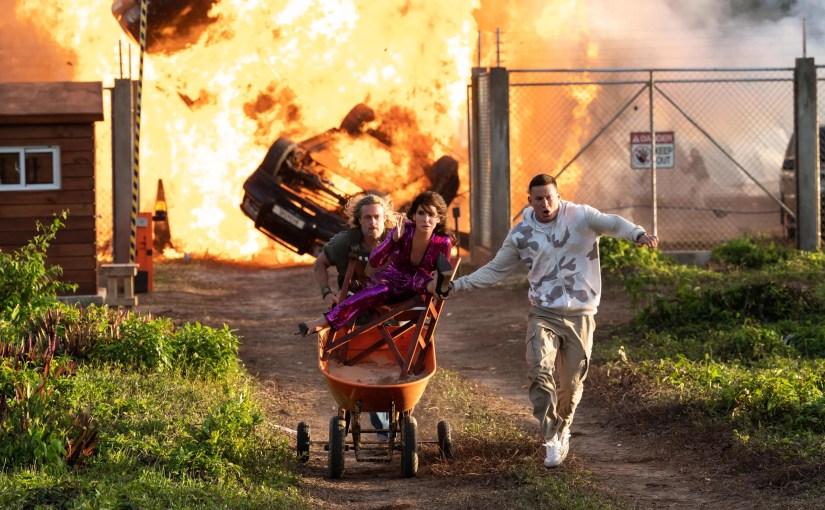
Bullock is Loretta, a reclusive romance novelist, who knows that her books are nothing more than cheesy pulp material to the umpteenth degree.  Her agent Beth (Da’Vine Joy Randolph) keeps a positive attitude as she encourages a book tour to promote Loretta’s newest installment in a series that follows the adventures of Loretta’s fictional swashbuckler.  That hero is preserved on the covers of her novels in the image of fashion model, Alan (Channing Tatum) – a Fabio inspiration.  Alan dons the gorgeous blond locks wig with the beefcake chest and the fans seem to go wild for him more than they do for Loretta’s work.  Even the glittery purple jumpsuit with stiletto heels that Loretta dons for an appearance at a book fair doesn’t deter the screaming fans away from Alan’s muscular build and chiseled chin.

When Loretta is captured by a spoiled brat of a villain known as Abigail Fairfax (Daniel Radcliffe), she finds herself having to research the location of a lost city on a remote island rumored to possess treasures beyond anyone’s wildest dreams.  Somehow, within Loretta’s fiction she implied the actual location of this place.  Abigail needs her to delve even further towards the destination.

This all sounds cliché.  It is, actually.  So what!

What saves The Lost City is the screwball comedic approach to the film.  Bullock and Tatum are nearly twenty years apart in age.  Yet, they make a great pair in the same way that Hepburn and Grant did in Bringing Up Baby.  I could care less about the actual lost city and whatever treasure was there.  The symbols etched on an old piece of parchment that Loretta attempts to decipher never mattered to me.  Two days after seeing the movie, I don’t even remember what the lost city revealed when they eventually got there.  I did like the endless pratfalls of Tatum and Bullock, however. 

Channing Tatum looks like the adventurer of a romance novel.  Yet, he’s nothing more than a pretty boy or a “mimbo” as Jerry Seinfeld might describe him.  He’s actually got a crush on Loretta and upon determining that she’s been kidnapped, he recruits the legendary problem solver Jack Trainer (who could only be encapsulated in the form of a gorgeously blond, tan and muscular Brad Pitt) to rescue Loretta.  It’s important to Alan, though, that he gets recognized as the savior.  So, he kind of learns as he goes. 

Adventures in the jungle abound.  There are bad guys on motorcycles.  Guns, of course.  Fires within Alastair’s luxury SUV. Rock climbing.  Rivers with leeches.  Dark caverns and on and on and on.  Yeah.  I’ve seen this all before.  Again, I say so what!  It’s just a fun time at the movies that brought me back to the fast-paced escapades found in the 1980’s films I grew up on.  Yet, it has its own spin thanks to the relationship of Alan and Loretta.

Daniel Radcliffe and his beard are also great characters.  It’s a nice departure from the shoe horned role that’ll never leave him as a certain boy wizard who will not be named here.  He just brings out his fun bratty side.  His beard seems to wink along with him.

A better side story could have come with Da’Vine Joy Randolph though.  As the agent goes from one traveling step to the next as she attempts to find Loretta herself, Randolph just doesn’t look comfortable in the role with her sky-blue pant suit and big breasted physique that is intentionally in your face.  Where’s the slapstick that should be accompanying her?  She’s specifically made up to look like diva luxury and you’re waiting for one disaster after another to befall her. Beyond having to fly on a puddle jumper plane carrying farm animals, she simply survives her trek unscathed.  Either this storyline should have been excised all together, or it should have been rewritten to be just as silly as what Bullock and Tatum are delivering.  A flop in the mud or a slip in the river would have helped this plotline. 

The Lost City is just a cute film for Sandra Bullock and Channing Tatum to look…well…cute together, and in a world where celebrities are slapping each other silly on live television, isn’t this a much better escape on a Saturday afternoon?