
by Miguel E. Rodriguez
DIRECTOR: James Mangold
CAST: Timothée Chalamet, Edward Norton, Elle Fanning, Monica Barbaro, Boyd Holbrook
MY RATING: 9/10
ROTTEN TOMATOMETER: 79% Certified Fresh
PLOT: In 1961, Bob Dylan arrives in NYC for the first time. Four years later, his groundbreaking performance in Newport changed the music world forever.
The 1994 documentary Hoop Dreams began as a small-scale, 30-minute project concentrating on two inner-city boys who dreamed of making it to the NBA. It was supposed to cover only a few months in their lives, but as their stories progressed, the filmmakers just continued filming, and the sprawling documentary eventually covered five years and became an absorbing three-hour odyssey.
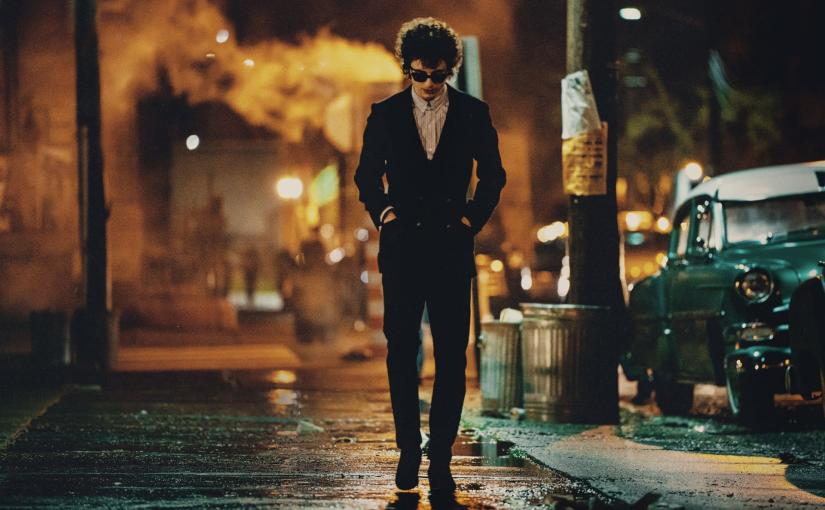
In a weird way, that’s how I felt about James Mangold’s Dylan biopic A Complete Unknown. The movie opens with no backstory, no flashbacks, just a disheveled young Bobby Dylan (Timothée Chalamet) arriving in 1961 New York City with his guitar, determined to meet his idol, legendary folk singer Woody Guthrie, hospitalized at the time with Huntington’s disease and no longer able to sing or speak. In Guthrie’s hospital room, Dylan also meets another folk legend, Pete Seeger (Edward Norton), in what must count as one of the greatest musical summit conferences of all time.
The way this scene is shot, it almost feels like, after it’s over, it could be the end of a marvelous short film about three legends bumping into each other. But, like Hoop Dreams, this biopic remains focused on the unknown Bobby Dylan, with his nasal whine and preternatural gift for lyrics, for five years. He eventually gets more and more exposure and cuts his first album. Along the way, he meets two women who will be his emotional touchstones during the film: the celebrated Joan Baez (Monica Barbaro), whom Dylan accuses of being and singing “too pretty,” and Sylvie Russo (Elle Fanning), who becomes his girlfriend despite his flirtations with Ms. Baez.
But throughout the film – and this is one of the reasons I enjoyed it more than I thought I would – we remain focused almost exclusively on Dylan, the man and his music. We are treated to countless scenes of Dylan performing live, Dylan recording in a studio, Dylan scratching out a new song note for note and word for word. If a soundtrack album were ever compiled of the full-length versions of all the songs we hear in A Complete Unknown, I have to believe it would be between two to three hours long, if not more.
Why did I react so favorably to this kind of treatment? My two favorite musical biopics of all time are Ray [2004] and Amadeus [1984]. Amadeus certainly contains a LOT of music, much like A Complete Unknown, but we are given a lot of background information into Mozart’s life, his relationship with his father, his childhood years, and so on, whereas the Dylan film presents him as a blank slate without a single flashback to his younger years. Ray is much more in the vein of your “traditional” musical biopics like Walk the Line [2005, also directed by Mangold] or Bohemian Rhapsody [2018], containing the standard story beats of struggles in their personal lives, a haunting past, liberal-to-moderate use of flashbacks, you get the idea.
I suppose part of my enjoyment of A Complete Unknown stems from the fact that, even though I’m not a Dylan fan, or Fan with a capital F, I appreciate the songs themselves, with their intricate lyrics and folksy rhythms, so I thoroughly enjoyed the myriad musical breaks. I also liked the way the movie did not spoon-feed me chunks of information it felt I needed to know. Instead of the movie telling me how I should feel about a scene or a moment with clunky dialogue or exposition, it simply presents a situation and kind of stands back from it, allowing me to form my own emotional reactions to the material. That’s a tricky storytelling method; one false step and you’re left with a story with no heart, no meat in the middle. But A Complete Unknown pulls it off extremely well. I’m sure there’s a way to explain how they did it, but I’m not the one to try. I just know that it works, and that’s enough for me.
Any discussion of this movie must necessarily include Timothée Chalamet’s magnetic performance as Bob Dylan. It is destined for an Oscar nomination. I am reliably informed that Chalamet did all the singing himself (as did Norton and Barbaro as Seeger and Baez, and Boyd Holbrook as Johnny Cash), and he went to great lengths to mimic Dylan’s trademark sound. Combined with the pitch-perfect hair and makeup, it really feels like the real Dylan onscreen, especially when the movie jumps forward to the Newport Music Festivals of ‘64 and ‘65. Of course, I wasn’t alive back then, but I have seen pictures and documentary footage of the man himself, and Chalamet is utterly convincing. Even if you’re not a Dylan fan, this movie is worth watching just to see Chalamet’s performance…he’s that good.
My colleague, Marc Sanders, mentions in his review how the production design of the film went to great lengths to recreate early-1960s New York City, and I second that statement. It’s as utterly convincing as Chalamet himself, especially when it comes to the various “underground” music clubs Dylan performs in, clubs where the folk music revolution was born. I get the feeling that anyone who watches this movie, who was also alive at the time, will be easily transported back to that era when Kennedy’s Camelot was in full swing, as was the hippie movement, the folk movement, the civil rights movement, the Cold War, the Beatles. There are aspects of this film that I may never fully appreciate since I was born in the early ‘70s, but I get the gist.
I feel compelled to rebut a specific argument from my girlfriend, who did not like the movie because it did not give us any real background information about who Bob Dylan really is. (We only get a single tantalizing glimpse when someone leafs through one of his old scrapbooks that had been delivered to a “Mr. Zimmerman.”) All the movie does, so her argument goes, is present us with a performer singing his music, culminating in a pivotal big concert, of which the same could be said of many other biopics that came before. A Complete Unknown could just as well have been about Richie Havens, or Jerry Lee Lewis, or Janis Joplin, or anyone else. There is no real personal conflict presented in the film.
To which I have to say…that’s not quite true. I acknowledge the absence of background story and flashbacks, but for me, as I said, that’s a strength, not a weakness. It follows the theme set up by the film’s title, after all. Also, there is a real conflict in the story, as Dylan, after becoming the figurehead for the folk music movement in America, takes the unprecedented step of recording an album and performing live songs that are (gasp!) non-acoustic. He complains that his fans want him to sing “Blowin’ in the Wind” for the rest of his life. This generates shockwaves throughout the folk community, and at one of his concerts where he performs an electric set, the crowd jeers, throws trash at him, and even calls him “Judas.” That pretty much counts as “conflict,” in my opinion.
A Complete Unknown goes down as one of the best films of 2024 that I’ve seen. For Dylan fans, it is an absolute must-see. For fans of great acting, it’s also a must-see. If you’re not a Dylan fan at all, well, it’s not likely to change your mind, but do yourself a favor and give it a chance. Not many musical biopics, or films of ANY kind, are made this well and with as much loving care as A Complete Unknown.
 2 UNPAID MOVIE CRITICS!!!!