THE PLEDGE

By Marc S. Sanders

The Pledge is a moody and bleak crime drama that follows a retired detective’s descent into obsessive madness.

Director Sean Penn opens his film with the gruesome discovery of a murdered nine year old girl found amid the snow covered woods outside a small Nevada town.  She happens to be discovered on the evening of veteran detective Jerry Black’s (Jack Nicholson) retirement party.  Upon receiving word of the crime, Jerry leaves his celebration to explore the scene that is carelessly compromised by the local sheriffs.  His protege partner Stan (Aaron Eckhart) rushes through a possible suspect’s (Benicio Del Toro) interrogation that draws a quick conclusion along with an unnecessary and bloody outcome.

Jerry surrenders his position with the police department, but he’s not entirely convinced the crime has been solved.  He obligates himself to uphold a devout promise he gave to the victim’s parents (Patricia Clarkson, Michael O’Keefe) that he will catch their daughter’s killer.

Time passes and rather than retire into a quiet life of fishing, Jerry purchases an old gas station located within the vicinity of the crime scene as well as nearby where two other murders with similar circumstances occurred.  Jerry is going to wait out the next attempt committed by “The Wizard” or “The Racoon Killer,” and catch him in the act.

The Pledge is a brooding and lonely film.  Sean Penn’s piece offers an impressive list of who’s who actors that appear in small roles to shape out the detective’s progress.  Amidst all of these familiar names in the cast, Jack Nicholson has never appeared so isolated or despondent before.  His character is limited on dialogue.  A thin mustache and a wrinkled complexion with a smoking habit hide any humor or joy.  Jerry Black knows he’s the last capable police detective in this area.  It pains him to abandon his post to the halfwits he leaves behind.

A promise is a dangerous gesture.  If you adhere to it, all obstacles become nonexistent.  Anything will be done to uphold a pledge and conclude your wild theories, even if proof is not conveniently supplemented.   Nothing stands in the way of pledge.  

The second half of The Pledge moves at a slower pace when Jerry welcomes an abused mother (Robin Wright Penn) and her daughter into his home.  A new life seems destined for these three people but at what cost?  Is the hero of this film at least as dangerous as the psychopath that supposedly remains at large?

Would you go to the great lengths that Jerry puts himself through?  Is the expense of his own sanity, and the safety of an innocent woman and her daughter worth this pursuit?

Sean Penn’s film does not operate on suspense. What action there is only fuels Jerry’s chase at a long-shot truth.  It’s a slow burn crime drama that makes the central murder a far second priority to how the initial discovery overtakes the main character.  Again, this kind of mania is a different breed from Jack Nicholson’s other crazed portrayals found in One Flew Over The Cuckoo’s Nest, Five Easy Pieces, or The Shining.  Nicholson is not as vocal or expressive in this role.  Yet, we all know what drives this guy with what few words he uses.

Robin Wright Penn and Nicholson share some effective scenes together. Their motive to be with one another stems from a misery loves company ideal. Good casting here, and throughout the film with small appearances from Helen Mirren, Harry Dean Stanton, Sam Shepard, Vanessa Redgrave, Mickey Rourke, Tom Noonan, Clarkson, O’Keefe, Del Toro and Eckhart.

Sean Penn is very good at creating visual moods to his film. The image of Nicholson standing within the pen of a crowded turkey farm with the anguished parents of the victim is truly haunting. Animals of all kinds seem to emote a cold harshness as well. The first image to appear consists of a swarm of large, winged birds soaring above this backwoods area where the biggest thing to happen is a town parade. Otherwise, as one girl tells Jerry there’s nothing else to do here. This remote Nevada area is unprotected from greater powers, and its only guardian is forced to accept retirement, leaving his community vulnerable. This formerly decorated Marine is now a formerly decorated cop, and the unseen animals-or monsters-still roam.

I won’t spoil the ending which I commend, but there is one moment that Sean Penn includes in the final cut that is objectionable.  For the first time in the picture since Jerry Black accepted the case, one moment near the end of the movie tells the audience everything they need to know while leaving Jerry in the dark.  I think it was a poor choice to go this way.  The audience is going along with Jerry’s pursuit until they are spoon fed a resolution they didn’t earn because Jerry never arrives at this conclusion.  A better route would be to leave the audience in the same dizzying haze that Jerry must live with.  Some hanging threads should be left untied. The Pledge is a pot boiling, well-made and disturbing film, but with minutes to go before the end credits roll, a less is more approach should have been adopted.

AVENGERS: INFINITY WAR

By Marc S. Sanders

Avengers: Infinity War is a really FAT movie. Like ORCA FAT (thank you Keyser Soze), because it is chock full of so much to see. If this equated to gorging on junk food, after two hours and forty minutes, I would have a diabetic cardiac arrest immediately following the credits. Is this a film that is worth that handicap, however? You bet it is.

There is an ensemble of top Hollywood talent portraying a huge cast of characters, once again, and thus another installment has surfaced in the franchise that allows them to have various moments to shine. Producer Kevin Feige with all of Disney’s support, has mastered the formula to ensemble casting and production, as good as when George Clooney and company performed under Steven Soderbergh’s direction in the Ocean’s 11 remake. Thousands of special effects shots do not overpower the stage presence of the actors. The Marvel movies succeed because a story is always written first. Then witty dialogue comes thereafter, and then valid, convincing shock value. The special effects are the final ingredient. This is what the Transformers franchise and (yes, I’ll even own up to it) the Star Wars prequel trilogy (about ¾ of it) failed to achieve. This successful formula gives merit to the (at the time) biggest opening weekend ever, worldwide, and Avengers: Infinity War deserves the accolades.

How good is it? Well, reflecting back to May 1980, when sitting in a crowded theatre watching the ending to The Empire Strikes Back, by comparison I think audiences have finally been served up a cliffhanger (10 years in the making) that is just as effective. How is this all going to wrap up from here? How is this all going to be resolved? Reader, I don’t know if the next chapter will be satisfying. I don’t know if we will feel cheated like Annie Wilkes from Stephen King’s Misery. Presently, however, I’m turning an ending like this over in my mind; the same way I did with my pals in 1980 debating the survival ratio of Han Solo and if Darth Vader has told the truth, and if that was Vader’s brain or head that I saw, and who is this “another” that Yoda referred to….and that, my friends, is what makes a spectacular film. I don’t care if it gets watered down in the hype and McDonald’s promotions and toys. If you can mull over a movie long after it has ended, for days, even months and years, then a film like The Empire Strikes Back and Avengers: Infinity War has more than served its purpose.

Josh Brolin provides a villain with a justification to his madness. He’s not just twirling his mustache to be mischievous and sinister. He has a destiny to fulfill, and his portrayal of the mad titan Thanos does not compromise. This is a beast of a purple villain with size 52 boots and gold-plated armor with a chin that looks like it was clawed by Wolverine. Thanos cries, actually cries, while committing his crimes. He’s not just cackling. He flat out says that he executes his actions all so that he can relax and retire. Isn’t that what we are all trying to do, anyway? Nothing wrong with that. Guy sounds like a CEO to a large corporation. Maybe Thanos is updated to resemble an Elon Musk. 

All of the other actors from main staple Robert Downey Jr to Chris Pratt to Chadwick Boseman to Zoe Saldana and Chris Hemsworth, and so on, remain consistent to what we’ve seen of various prior installments. Their gimmicks continue to avoid becoming stale. Audience applause is cued by their appearances. These are well loved characters.

As an avid comic book reader of the silver age (1980s), Avengers: Infinity War presents itself as of one those annual limited series runs that were special because they were MAIN EVENTS!!!! My favorite back then was Marvel’s Secret Wars. Typically, a comic book from the 1980s would average about 18-22 pages with advertisements sprinkled in. Nearly every scene in this film equates to one issue of a limited run of a main event. That is a why a fat movie like this succeeds. The cast of characters are separated in various story lines. The scenes are given their time to flesh out and develop to move the subplots and overall story along. Each scene is like reading a new 18 page issue comic book. If I’m watching a comic book film, by golly, I want to see how a comic book is brought to life in a cinematic medium. Marvel’s films succeed greatly over DC’s films (produced by Warner Bros) because they rely on the source material. They know they got the goods. Cast it right, adapt it properly and go with that. If it ain’t broke, don’t fix it. A wealth of material (nearly 70 years) and Marvel/Disney uses it all. (How does DC/Warner Bros miss the mark so often?)

Of all of the Avengers films, Infinity War is definitely the best one. Ironically, I wasn’t expecting it to be. I was waiting for this stuff to get old and tiring. It just hasn’t faltered yet. It hasn’t gotten lazy yet. It all seems so fresh still. It’s a fantastic cinematic accomplishment. Sure, its main story is a guy chasing down six different colorful MacGuffins. So what! It’s simple. It allows the characters to stand out from there. An organized plotline like this doesn’t take much effort or time to explain its purpose. It states its conflict early on, and then the show stopping moments present themselves. One after the other after the other until a monster of an ending that is so jaw dropping, head shaking, thrilling and gasping, satisfyingly arrives. 

More importantly, the MacGuffin search drives the motivations and fleshes out the film’s main character, Thanos. This Marvel installment belongs to Josh Brolin as Thanos. Everyone else serves as his antagonists. What matters is that the bad guy wins this time, just like demonstrating that an Empire will strike back. Ironic that Spider-Man makes a humorous correlation to that celebrated franchise from almost forty years ago.

Avengers: Infinity War ended up in my top 10 list of 2018, and still holds as the best film in the Marvel Cinematic Universe.

THE USUAL SUSPECTS

By Marc S. Sanders

There’s something inviting – or maybe intriguing – about seeing a person in a hat with a dark trench coat on.  Just the person’s silhouette will leave you asking for more.  What is it to this guy?  Steven Spielberg does that in the first few minutes with Indiana Jones in Raiders Of The Lost Ark.  Before Indy, there was Orson Welles as Harry Lyme in The Third Man.  Guys like these have a danger to them, and we can’t look away.  In The Usual Suspects, one of many variations of a legend called Keyser Soze has a dangerous reputation that carries him, and we want to know more about the figure in the hat and coat.  In the first few minutes of the film, we see this mysterioso extinguish a kerosene flame by urinating on it.  Who is this guy?  Maybe we, as the viewers, are Icabod Crane looking at an updated inspired spawn of The Headless Horseman.  Perhaps, we are actually catching a glimpse of that boogeyman who hid in our closets or under the beds.

Bryan Singer’s modern day film noir, masterfully written with inventive riddles by Christopher McQuarrie, works towards its ending as soon as the opening credits wrap up.  Each scene hops from a different setting or time period and as a viewer you feel like you are sitting at a kitchen table turning puzzle pieces around trying to snap them together.  Not all of it makes sense by the time the picture has wrapped up.  That’s okay though, because one of the players in the story perhaps played a sleight of hand and we can do nothing but applaud when we realize we’ve been had.  Magic is fun when you never quite realize where or when the deceit began.

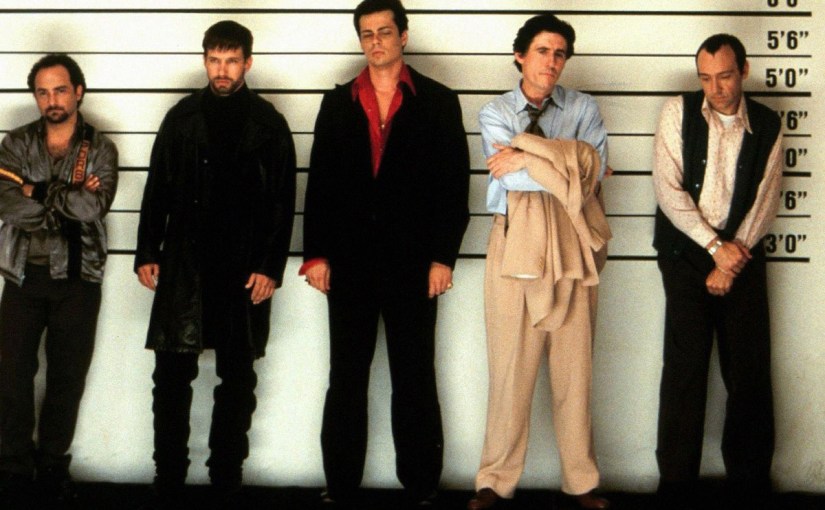
A scenario is set up early on that assembles five different kinds of criminals in a police lineup.  It works as a device to team these guys together to pull off additional heists.  A prologue to the film depicts the aftermath of their last job together.  One holdover, a hobbled cripple named Verbal Kint (Kevin Spacey) is brought into a police precinct to be interviewed by a determined detective named Kujan (Chazz Palminteri).  Verbal might ramble on endlessly in circles about nothing, but Agent Kujan is going to get to the bottom of what happened the night prior on a shipping dock that turned up several corpses.  How did it all go down, and where is the money and cocaine that was expected to be there?

Verbal was one of the five in that lineup, along with McManus (Stephen Baldwin), Hockney (Kevin Pollack), Fenster (Benicio Del Toro) and Keaton (Gabriel Byrne).  Each carries a different specialty or personality, but Keaton is the guy that Kujan is really after.  He’s a master criminal who’s been known to fake his own death, supposedly turn legitimate while dating a high-priced lawyer, and now may be the lead suspect in an armored truck heist.  On the other hand, maybe it was one of these other four guys. 

Amid all of this back and forth and side stepping stories, there is mention of a name – Keyser Soze.  Whenever he comes up in the vernacular of the script, the mood seems to change.  These criminals, usually comfortable in their own cloth of transgressions, get noticeably frightened and concerned if there is even a remote possibility that this Soze character is the engineer behind what follows them. 

It’s fun!  The Usual Suspects is fun.

McQuarrie’s script will toss out names of people we never meet.  It will quickly imply an anecdote from another time.  It’ll share a bunch of short stories with how these five guys work together, like upending a secret criminal sect of the New York City police force while robbing them of their fortunes. Yet, a tall tale of lore will intrude on their typical heists to derail what we may normally be familiar with in other crime dramas or noir films.   

Spacey is the real star of The Usual Suspects.  He earned the Academy Award for Supporting Actor because Verbal Kint is so well drawn out as a weak, unhelpful, and frustrating man.  Often, you ask yourself what the heck is this geeky looking crippled guy even talking about. 

On other occasions, I’ve noted that sometimes with movies I can not determine if I just watched a superior film or dreadful nonsense until I’ve reached the final five minutes.  The final five minutes of a movie can be the verdict.  Sometimes you’ll claim the journey getting there was great, but the conclusion was a big letdown.  If you have never seen The Usual Suspects, then you likely won’t know if the path towards its end is good until you’ve reached the culmination. 

Roger Ebert couldn’t stand this picture, and I’m not going to say he didn’t know what he was talking about or that he was wrong.  Bryan Singer and Christopher McQuarrie’s assembly of scenes don’t make for a well-defined picture, even after the movie is over.  Ebert was less than fond of that technique.  I think that was their intent, though.  Everything you have seen doesn’t have a suitable answer.  Certain parts don’t link well with others.  However, the director and screenwriter were always working towards an ending while piloting the film in swerves and unexpected knee jerk turns.

Unlike Ebert, however, I’m wholly satisfied with the film.  In fact, the first time I saw the movie, I cheered for the conclusion that got more than just one over on me.  On repeat viewings, knowing how the picture wraps up, I treasure the path towards its finale. 

If you study Verbal Kint, you’ll realize that he doesn’t offer easy answers and explanations for what’s occurred, thereby lending to the frustration of Agent Kujan who only demands cookie cutter, fall-into-place arrangements. What can I say Roger Ebert?  How else should I lay it out for you Agent Kujan? Life is messy with no easy answers sometimes.  Especially, in film noir.  

Ironically, one of Ebert’s favorite cinematic characters is Harry Lyme.  So, I guess Keyer Soze couldn’t live up to that threshold or repute.  If that’s the case, then I forgive you Roger.

LICENCE TO KILL

By Marc S. Sanders

Regular James Bond screenwriters Richard Maibum and Michael G Wilson (also co-producer) along with director John Glen were not really doing any favors for Timothy Dalton with his 2nd and final outing as 007, with Licence To Kill. The story was a huge departure from what Bond audiences are accustomed to where the super spy goes rogue in the Florida Keys and Cuba, to seek vengeance against a Columbian drug lord named Sanchez (Robert Davi). The problem is this is all beneath Bond. James Bond prevents world domination, not drug trafficking.

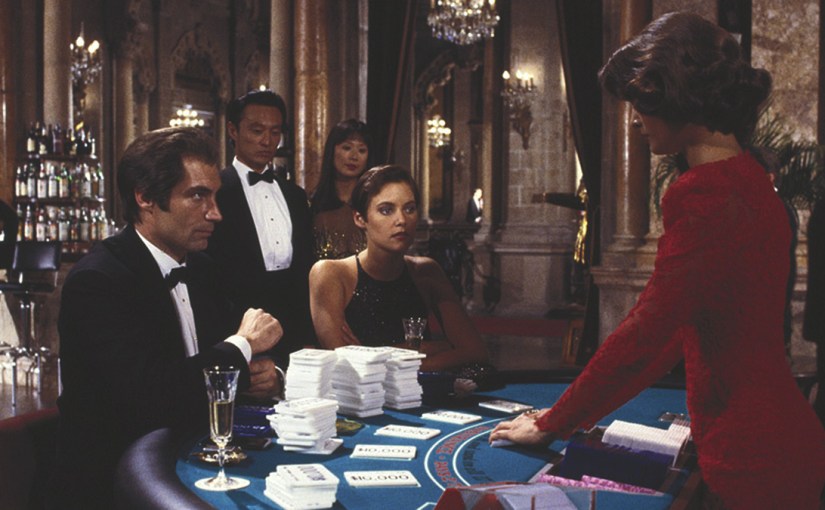
Okay. So the story doesn’t hold much water. Dalton’s role is not written very well either. His prior entry in the series established him as a tougher Bond with less sarcastic wit, but certainly a man of culture and sophistication. This one takes out all the sarcasm. Dalton doesn’t even seem to wear his tuxedo very well here. He just isn’t carrying the Bond stature. There’s not much left to the guy.

The ladies are lacking, too. Carey Lowell (eventual Law & Order attorney) is a tough talking CIA operative lacking any sort of romance or chemistry with Dalton. At times, though they might share the same frame, they could have easily been acting in separate rooms. Dalton and Lowell never seem to be listening to one another.

Talisa Soto is Sanchez’ mistress. She’s positively beautiful and exotic like many Bond women before her, but like Lowell she doesn’t appear to really be acting the story. At one point, she tells Lowell “I love James.” I’m trying to figure when the seduction actually occurred though. A movie can’t just tell me that. A movie has to show me that.

Davi is quite vicious as a villain and Licence To Kill features one of the cruelest deaths in the entire series when Sanchez forces a traitorous drug runner into a depressurizing chamber. Yeah. We are treated to a gory, fun inflatable head explosion. As vicious as Sanchez is, his character seems more appropriate for a Lethal Weapon or Die Hard film. Sanchez just doesn’t mesh well in the James Bond universe. Nor does Wayne Newton, actually. Yeah, he’s here too, believe it or not, as a drug cover front messenger posing as a televangelist. Who wants to see Wayne Newton, and how is this funny or entertaining?

The big attraction is a tanker truck chase along a desert road. Big explosions here along with fights on top of the moving rigs. It’s fun but nothing great.

Nothing is at the top of its game with Licence To Kill. That’s a major problem for a relatively new actor taking on such a celebrated role. Primarily, since the story is so weak, it’s hard to accept Timothy Dalton and I think that lent to his end with the franchise after just two entries. Yes. There were known financial issues mired in studio buyouts and bankruptcy leading to Bond taking a near six-year hiatus following this lackluster film, but as soon as Licence To Kill finished its tenure in cinemas, I don’t think anyone truly missed Timothy Dalton.