ROGUE ONE: A STAR WARS STORY

By Marc S. Sanders

On my 4th viewing of this film, I second guessed myself over and over. I know I’m a Star Wars junkie, but can I truly give an objective opinion about Rogue One? I think I can.

Rogue One: A Star Wars Story is of one of the best films of the last ten years. Now there are conditions that accompany that observation. It’s difficult to follow its trajectory if you haven’t seen A New Hope (the intended follow up story; the original Star Wars film). Frankly, reader if you are watching this film without ever watching A New Hope, I’d imagine you’ve been on a deserted island with a volleyball for a friend, unaware of this pop culture geek-oriented phenomenon from a galaxy far, far away, and upon your return to civilization you were just randomly flipping the channels. So, let’s just go ahead and dismiss that parameter right now.

Disney is the only studio with enough resources and scrutiny to ensure a good product is developed in the franchise. Rogue One proves that theory. From the Rebel uniforms to the Stormtroopers, to the Yavin 4 set recreation, and even a harkening back to Darth Vader’s original 1977 appearance (red eyes in the helmet), director Gareth Edwards, Lucasfilm and Disney ensure consistency in its side chapter apart from the 9-part saga. You relish the familiarity of it all, and what’s new you welcome with appreciated enthusiasm. It all works within the long-established universe.

The cast is superb with major highlights from Felicity Jones as Jyn Erso (great name) as a brash no nonsense rogue in and of herself. Jones comes off with tough bravado reminiscent of Susan Sarandon and Geena Davis, as well as Jodie Foster. Nothing will intimidate her, though she will show her heart and soul for her father, the reluctant architect of the Empire’s Death Star played by Mads Mikkelson, an important character to the story but not much material for him to capitalize on.

Alan Tudyk is a marvelous voice actor here as the tall droid K2SO, with a personality combination of Chewbacca & C3PO. He’s honest, maybe a little to honest, but he’s also physically strong and a smart aleck. His tone is Anthony Daniels, but his delivery is snide and arrogant. He’s just so entertaining.

Ben Mendohlson plays Imperial Director Krennic as a frightening antagonist who embraces the terror of this super weapon he oversees. “Oh it’s beautiful,” he sighs and really believes he sees beauty as a planet gradually combusts under the laser blast emanating from the Death Star. He expects greatness from his accomplishments and Mendohlson is also good at surrendering to what he’s not permitted to celebrate thanks to a strong Darth Vader and welcome return of Grand Moff Tarkin, a beautifully recreated CGI of deceased actor Peter Cushing. Tarkin is important to the Krennic storyline and his insertion in the film is flawless.

The cast also boasts Donnie Yen. He’s a real crowd pleasing blind martial artist. Not a Jedi, yet arguably even more fun.

The planets are crowded and different. Scarif where the final battle takes place is draped in palm trees and ocean blue. Great because it’s daylight setting allows all the action to be seen. Nothing is blurred.

The story structure is phenomenal as it centers on a race to make contact with an Imperial pilot who has just defected and then on to Jyn’s father in order to prevent this new Death Star from going into operation. I especially salute its honest, uncompromising, but still necessary ending. You’ll get a lump in your throat, followed by an adrenaline shot of excitement in the last five minutes. The end is pure genius. One of the great cinematic endings. Absolutely absorbing.

I really appreciate the various demographics in the film as well. For a story about an unending and lived in galaxy everyone should look and sound different. So, we are treated to Caucasian, African American, Hispanic, Asian, and English, and then you have the droids and fictional alien species.

If anything is shortchanged, it might stem from some of the actors’ dialects. Forrest Whitaker, Diego Luna and Riz Amed play primarily roles that at times are hard to comprehend, even in a fourth viewing. This is forgivable though. The story lends value to all of the players on screen.

So yes. Rogue One: A Star Wars Story is sensational; the best of the 4 Disney produced films thus far. There’s weight to its story, and its characters on both sides. It moves at a fast pace of action, dialogue and runaway suspense. It will go down as one of the best installments in the vast franchise that’s thrived for over 40 years so far.
KILLING THEM SOFTLY

By Marc S. Sanders

What did I just watch? A mob movie, or a 2008 Presidential debate where the candidates are no shows, and their respective commercials are aired in their place? Andrew Dominik directs Killing Them Softly, with Brad Pitt who also produces.

Reader, I don’t get the appeal. Maybe it’s the outstanding cast which includes Pitt, as well as James Gandolfini, Ben Mehndelson, Richard Jenkins, Scoot McNairy and Ray Liotta. Sadly, these guys are given next to nothing do of any consequence.

After it is revealed that Liotta’s character, Marky, ripped off his own mob poker game a few years back, an idea is presented to two street addicts played McNairy & Mendehelson to do the same thing because, heck, they’d never be suspected and logic dictates that Liotta must have done it again. So, he’ll be the one to blame and get whacked. The game is robbed and now Brad Pitt’s hitman character is on the job. Simple enough story, almost like a Guy Ritchie picture.

Killing Them Softly is an adaptation of a 1974 novel by George V Higgins. I never read the book, but I’m curious if it contains any kind of relation to Andrew Dominik’s idea of editing recurring speeches and ads, compliments of Obama, McCain and Bush 45. Truly, what was the point of this recurring theme? A two-sentence piece of dialogue finally acknowledges this in the final minute of the film, but I’m still lost on the significance. Somehow Dominik made a dirty, cold, rain-soaked picture that has an omnipotent viewpoint from our most prominent politicians, and I don’t know what one thing has to do with another.

As well, Gandolfini arrives in the story and I never could gather what was his purpose. I think he is a hitman who is washed up, never getting his ass up to carry out the job and just monologues about nothing like the hooker he pays off; topics that Quentin Tarantino might’ve thrown in the editing trash bin.

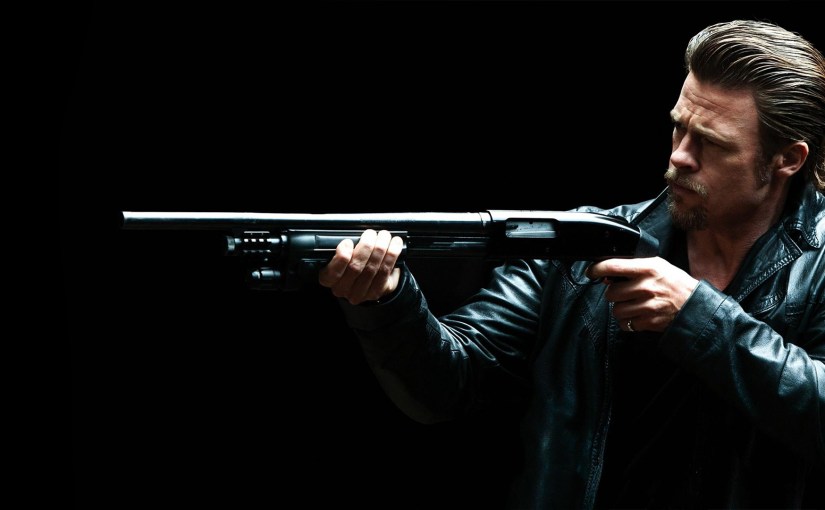
Mendelsohn looks incredibly convincing as an addict living off the streets, yet his storyline has no end. He’s arrested. Then what happens? What does that mean for everyone else? Liotta has a long drawn out sequence of getting the shit kicked out of him by two mob foot soldiers. The scene goes on and on and on. His face cracks and bleeds, and bleeds some more. Brad Pitt? Well, he’s the hitman who just looks cool. Yeah, the black leather jacket he wears looks very cool on him. That’s about it.

There’s no development to Killing Them Softly. No surprise or twist. The guys you expect to get killed, get killed, and there’s no good dialogue.

This film is just an empty void of poorly, uninteresting violence.

READY PLAYER ONE

By Marc S. Sanders

Steven Spielberg’s masterpiece, Ready Player One is the best Easter Egg to search for today.

As a huge fan of Ernest Cline’s novel chock full of pop culture salutes, this latest effort from Steven Spielberg is the film I was looking forward to the most in 2018; more than Solo and definitely more than Avengers: Infinity War.

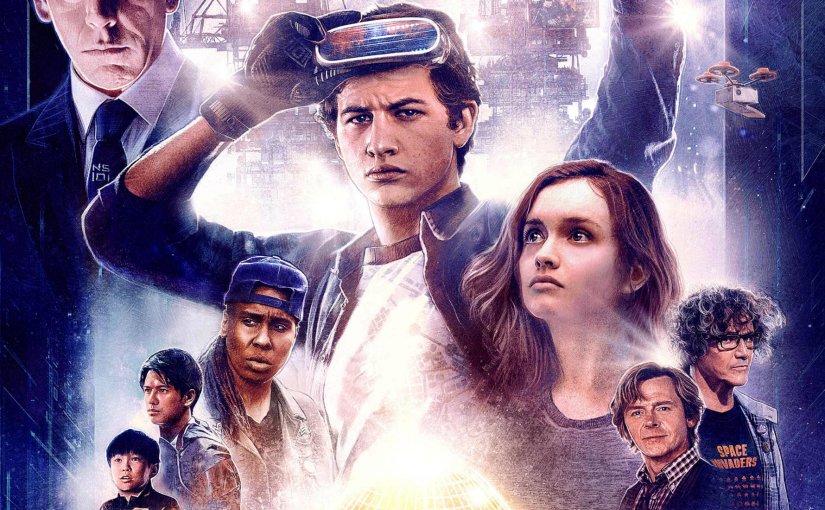
The film adaptation almost completely succeeds. It is very well cast and the expansive imagination of Spielberg and his crew get everything right. It’s the greatest amusement park for the eyes. When there are not hidden gems to look for, I still found the young cast of characters portrayed by talented unknowns to be engrossing, and more importantly endearing to those cinematic kids of the ‘80s from John Hughes films, as well Spielberg’s other classics.

Authenticity was also truly a priority for Spielberg. I dare not spoil the highlight of the film’s second act but let’s just say the attention to detail was perfection to every minute crammed on the screen. You can’t help but laugh, grin and slap your knee. In fact, you really do it through the whole film practically, but Act 2 really reaches for the skies.

Now the one issue I have. Like Spielberg’s Jurassic Park, the villain was pulled back in their deviousness from the original source material. The danger did not feel threatening enough for me. Here the antagonist is this large conglomerate run by a CEO, and I’m afraid that’s all that Ben Mendelsohn is sadly reduced to. The stakes didn’t seem high enough. Cline’s novel made sure that your life could end as you got closer to solving the puzzles of the “Oasis,” the interactive virtual world that everyone willingly engulfs themselves in. The threat was more convincing in the novel. In the film, I’m afraid it’s a little too watered down.

Still, Ready Player One is incredibly fun with an awesome soundtrack; “Staying Alive” by The Bee Gees will always be the greatest song to bless any film, ever. This film especially supports that argument.

“LET’S SAVE THE OASIS”

KNOWING (2005)

by Miguel E. Rodriguez

Director: Alex Proyas

Cast: Nicolas Cage, Rose Byrne, Ben Mendelsohn (plus an early sighting of a young Liam Hemsworth in his first movie role)
My Rating: 9/10
Rotten Tomatometer: 33%

PLOT: M.I.T. professor John Koestler links a mysterious list of numbers from a 50-year-old time capsule to past and future disasters and starts to wonder…what happens when the numbers run out?


[SPOILER ALERTS…not that anyone is going to rush out and stream this, but whatever, still … SPOILER ALERTS]

Knowing is a polarizing film from Alex Proyas, the visionary director of The Crow (1994) and Dark City (1998).  It tells the story of an M.I.T. professor whose son is given an envelope that has been sealed inside a time capsule for 50 years.  Inside the envelope is a list of seemingly random numbers that appear to be meaningless, until he notices a pattern emerging.

I remember when this movie came out very well.  I was stoked to go see it because Alex Proyas is one of my favorite directors. But it got PANNED right out of the gate.  And most of the negativity stemmed from the movie’s ending, which turned off the vast majority of moviegoers who thought was the equivalent of someone saying, “It was all a dream!”

Knowing does NOT have one of your typical Shyamalan-esque endings.  The ending follows the strict logic of everything that has come before and arrives at an astonishing, awe-inspiring conclusion that left me gobsmacked.  But more on that later.

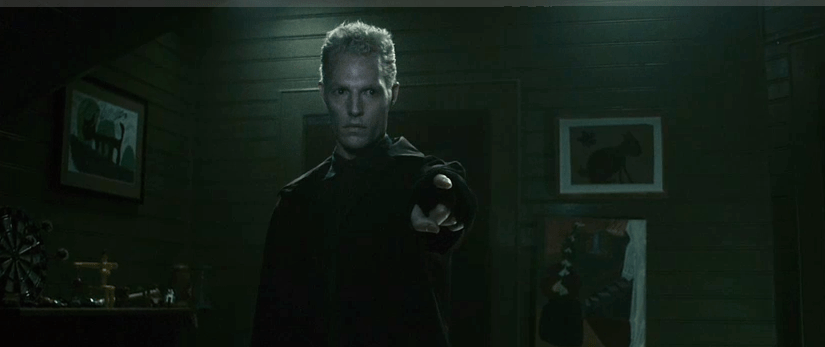
Let’s talk about how Knowing works.  First, everything about the movie sets us up for what appears to be a standard horror movie with Nicolas Cage’s son apparently in danger from mysterious pale figures in dark coats who show up at their house in the middle of the night and just stand there…watching the house.  Creepy.  At one point, one of them somehow gets INSIDE the house, a sequence that ends with the boy having a nightmarish vision of a raging forest fire.

These are, so far, basic horror tropes.  But director Proyas uses skillful styling and editing to create something that feels as creepy and suspenseful as any horror movie I’ve seen.  In fact, every time I watch Knowing, I find myself still on edge during certain scenes, particularly the ones involving the pale strangers.

Another feature of the movie that I feel elevates it is the visceral nature of the key scenes involving various accidents.  See, that 50-year-old list of numbers is actually a list of dates on which various catastrophes occurred over the last 50 years, along with the number of casualties…and Nicolas Cage’s character, John Koestler, can plainly see that three of them are coming up in the next few days.

So it’s a foregone conclusion that we, the audience, are going to see some sort of major accidents.  And, man…I have never seen, before or since, such astonishing, nerve-racking sequences of horrible accidents in films.  I don’t want to be a spoiler, but I CAN say that I guarantee this is one movie that will never be an option for in-flight movie channels on commercial airliners.  I mean…when it happens, it’s out of the blue, and it feels as real as these things can get with CGI.  It literally takes my breath away every time I watch, and I’ve seen it like ten times.  Easily.

So now that Koestler has proof the list is real, the question that keeps nagging at him is…what happens when the numbers run out?

And that’s where Knowing leapfrogs over other genre thrillers and actually becomes ABOUT something.  Before finding that fateful list, Koestler asks his students at M.I.T. to write a paper on determinism versus coincidence in the natural world.  That is, do you believe that everything up to this point has happened for a reason, or is literally everything we do completely random, with no purpose or design?  Koestler believes in the latter, even though he’s the son of a minister, a man with whom he’s had no contact for years.

Koestler has his reasons.  Years ago, his wife was killed in a hotel fire, an event which he perceives as a random accident.  But then he gets this list, and it seems as if someone has been able to accurately predict seemingly random events.  This list flies in the face of everything he’s believed for years.  If these accidents are predictable, is everything ELSE predictable?  Is there a REASON for the accidents?  Is life more than just the result of millions of years of evolution and genetic mutations?

Koestler cannot square this list with his personal beliefs, and it’s that conflict that’s at the heart of the movie.  Knowing forces its main character (and, by extension, the audience) to make a decision one way or the other.  Is there a plan for existence, or is it random?  How long can he ignore the evidence of his own eyes before he makes his choice?

And over all of that, there’s still the issue of the list running out of numbers.  What happens then?  The end of the world?  Is he destined to SAVE the world?  Or stand by helplessly as pre-determined events spin forward out of his control?

This is why the movie stands above other genre sci-fi thrillers.  It poses tough questions and forces us to confront our own beliefs.  And the movie does not take the easy way out by trying to have it both ways.  The finale of Knowing is as implacably logical as it is visually stunning.

Detractors of the movie decry this finale as a “deus ex machina” that cheapens everything that came before.  I even remember some mild laughter in the audience when I first saw it.  But seriously…given everything that happened before, what ELSE would have been a good ending?  Have Koestler wake up from a dream?  Have him discover that it was all really a government experiment?  A drug-fueled hallucination?

None of those would have worked NEARLY as good as the ending the movie DOES provide.  As I said before, it follows the logic of its own story to the bitter end, and gives us some spectacular visuals into the bargain.  It doesn’t cheat, it doesn’t pander or cop out.  We have gone from point A to point B, and the only way out is through point C.  When you think about it, isn’t that kind of audacious?  How many movies have had the nerve to follow the courage of its own convictions?  (I’m reminded of The Bridge on the River Kwai with its own fatalistic finale, combining spectacular visuals with an ending that was not a “happy” one by any stretch of the imagination.)

I stand behind this movie as one of the great sci-fi mystery thrillers.  Love the ending or hate it…I challenge you to come up with an ending that would have been better than the one presented in the film.

CAPTAIN MARVEL

By Marc S. Sanders

Anna Boden & Ryan Fleck directed the Captain Marvel installment of the Marvel Cinematic Universe. The film has some successes, but some failures as well. Fortunately, where it lacks happens early on and then the film continues to get better.

Boden & Fleck must have directed a film that was never released because this Captain Marvel begins in the middle of a story with exposition that’s terribly hard to follow. I’ve seen it three times now, and it’s still hard to piece the first 40 minutes together. The title character is known as “Vers” (pronounced “veers”) played by Brie Larson. She dons a green uniform space suit and is part of a civilization called Kree. Her mentor is Yon-Rogg played by Jude Law. They head a team on a mission to rescue a spy of their own held captive by the shape shifting Skrulls. The mission goes awry and Vers is captured. Small snippets of a life lived on Earth flash in her subconsciousness as the Skrulls study her mind. When Vers manages to escape, she ends up on Earth in 1995. Gradually, with the assistance of a young Nick Fury (Samuel L Jackson with hair, a clean CGI complexion and no eye patch), Vers learns of her true history that she seems to have forgotten. Reader, I just summed up the first third of this film better than the movie ever did.

Boden & Fleck have some nice touches to this film but only in the second and third acts. Captain Marvel salutes the grunge music of the 90s while also taking inspired narratives from films like The Terminator. There’s some nice twists in the film too.

However, the whole first act should be thrown away and redone. It’s terribly confusing with dark cinematography on what is to be an alien planet at night and a dimly lit unfamiliar space ship. Hardly any characters are fleshed out yet but they talk in conversations that lose me. The Skrulls are shape shifters that can adapt the image of another person or creature but because it’s all so dark, it’s difficult to decipher who is who. Not much payoff comes when you are finally able to piece some material from this whole sequence later on, based on what Vers uncovers about herself, the Kree and the Skrulls.

Brie Larson is fine in the role while primarily playing it straight. Nothing special, but nothing terrible either.

Samuel L Jackson plays this Nick Fury with more naivety than seen before. He’s a younger version of himself after all. So that’s somewhat humorous, especially his chemistry with an odd cat called Goose.

Ben Mendelsohn continues to break into these mainstream film franchises as an antagonist of some sort but sadly no one remembers him, I would think. He needs to be regarded in the same league with guys like Gary Oldman and Christopher Walken. What’s next for him? How about a James Bond villain?

Annette Bening is a welcome presence as the “supreme intelligence” for Vers. Accompany her sashaying to Nirvana’s “Come As You Are,” and I’m entertained.

There was a better film here. Due to a weak beginning, I can only mildly recommend Captain Marvel. Pop culture references and a redeeming two thirds of the film rescue it from utter confusion. Still, if I have to pause the film on occasion to explain to my wife and daughter what is going on, I think that is more an issue with the film than with the viewer.