
THE SUGARLAND EXPRESS (1974)

by Miguel E. Rodriguez

DIRECTOR: Steven Spielberg
CAST: Goldie Hawn, Ben Johnson, Michael Sacks, William Atherton
MY RATING: 6/10
ROTTEN TOMATOMETER: 87% Certified Fresh

PLOT: A young wife breaks her husband out of prison in 1969 Texas so he can help reclaim their infant from a foster family.  The ensuing media circus takes everyone by surprise.


Watching Steven Spielberg’s The Sugarland Express is like looking at one of those historical medieval tapestries of fierce battles, created by artists who didn’t yet know how to depict perspective.  There is plenty of action on display, but everything looks and feels flat.  The film took an award at Cannes that year for Best Screenplay, probably (at least partly) in recognition of how it shies away from a traditional Hollywood resolution, but even its downbeat ending is reminiscent of earlier, more resonant films like Bonnie and Clyde [1967] or Butch Cassidy and the Sundance Kid [1969].  As a stepping stone in the career of an eventual legend, it’s worth a view.  As a stand-alone film, it never quite achieves liftoff.

Based on real events, The Sugarland Express tells the story of Lou Jean Poplin (Goldie Hawn at her irrepressible, bubbly best), the young wife of prison inmate Clovis Poplin (William Atherton).  During a conjugal visit, just four months before Clovis is to be released, Lou Jean boldly busts him out because she needs his help to reclaim their infant, Langston, from a foster home.  Lou Jean herself has just finished serving time at a women’s prison, and the state, probably very wisely, determined Langston was better off with a foster family.  But they need to hurry because “I bet those Methodists are gettin’ ready to move out of state.”  Lou Jean’s delivery of “Methodists” tells you all you need to know about her feelings on the matter.

After Lou Jean breaks him out, a comedy of errors ends up in a situation where she and Clovis have hijacked a police cruiser and are holding a police officer at gunpoint.  They demand to be left alone while they drive to Sugarland, Texas, and retrieve their son, at which point they’ll release their hostage.

Now, this has all the makings of a smart, character-driven “road” movie, instigated by desperate people with no real plans for their end-game.  But for reasons I can’t put a finger on, nothing ever happens in the film that got me on the edge of my seat, figuratively speaking.  I fully comprehended the situation intellectually, but the film never got to me at an emotional level.

Could it be because we never really learn a lot about Lou Jean and Clovis in order to make them more empathetic?  No, I don’t think so, because over the course of the film, we’ll hear all about their past histories and previous brushes with the law.  The very fact they’re executing this plan to essentially kidnap Langston is proof of how unfit they are as parents.

I think part of the problem with the movie is…

…I’ve been sitting here for the last fifteen minutes trying to finish that sentence.  I can report that the film didn’t get to me emotionally, but I am struggling to explain why.  Could it be as simple as I think they’re not such great people, but the film seems to be siding with them as the movie progresses?  I mean, the movie HAS to side with them at least partially in order to make their journey mean anything.  Look at Butch Cassidy and the Sundance Kid.  Bank robbers, lawbreakers, but clearly the good guys because, duh, Paul Newman and Robert Redford are playing them.

So, maybe it has to do with the casting?  The Sugarland Express had one of America’s sweethearts as a woman willing to resort to kidnapping just to commit another kidnapping in the name of maternal love.  So, we’ve gotta root for her, right?  But then we see her behaving in the most inane, brainless way for so much of the movie.  I found it difficult to side with her when I just wanted to, forgive the expression, slap some sense into her.

What about Clovis?  I could side with him.  He appears to have misgivings throughout the entire film, right up to the point of no return.  But the way he willingly goes along with the scheme because, dammit, it’s his wife…something about that also turned me off on him.  There are moments I felt sorry for him, for them both, because I could see where this movie was headed early on.  But that empathy wasn’t enough to make me feel a catharsis of tragic energy at the film’s finale.  There’s just something about Clovis and Lou Jean that wouldn’t allow me to get too worked up over their fate.

I guess I identified most with the kidnapped police officer, Slide (Michael Sacks).  Maybe too much.  From the beginning, Slide is begging them to drop their weapons and turn themselves over to the police.  At first, he looks like he’s just following his training.  But then the movie progresses, and doggone it, he starts to like these two loonies, even though Clovis handcuffs him and even shoots at him a couple of times in the heat of the moment.  He can see where this road ends, and he pleads with them not to do exactly what the Texas state troopers expect them to do, because he doesn’t want to see them dead.  Because Slide never stops imploring the Poplins to see sense and do the smart thing, I guess he’s who I sided with for the entire movie.  (Well, him and his superior, Captain Tanner [Ben Johnson], who also doesn’t want to see them die.)

But…isn’t that the wrong way to approach this movie?  I shouldn’t be siding with the cops, for cryin’ out loud, should I?  At least, not in this movie.  Discuss.

From a technical standpoint, it is pretty cool to see how Spielberg, in only his second film, was able to marshal vast resources to create some arresting imagery.  The sight of what looks like literally hundreds of cop cars following the Poplins is a deceptively difficult feat, logistically speaking.  There’s a tense shootout in a used car lot that would have been right at home in The French Connection.  And everywhere, there’s bits of humor that made me smile.  From the elderly couple abandoned on the road (long story) to the solution of how to get Lou Jean to a toilet while in the middle of an extended police chase, Spielberg constantly pokes us in the ribs.  If this had gotten to the hands of someone like John Landis, it’s easy to see how this could have been turned into an out-and-out comedy with thriller elements, instead of the other way around.

One other aspect I did like was the media circus that blew up around the Poplins’ plight.  I’m sure it is yet another link to previous anti-heroic films, but while I was watching it, I was reminded of only one film: Oliver Stone’s Natural Born Killers [1994].  The outpouring of affection from the general public for these two, let’s face it, outlaws was both funny and sobering at the same time.  It would have been interesting to see a scene or two at the end of the film as an epilogue, so we could get a reading on what the public thought about how the police should have handled the situation.

If comparing The Sugarland Express to most of Spielberg’s later films, it certainly comes up lacking, no question.  As a lifelong Spielberg fan, I am compelled to say it SHOULDN’T be compared to his later films because it was made before he’d had a chance to hone his skills and become the populist/mainstream film icon he is today.  Look carefully at the two-dimensional storytelling and you can see the outlines of what was coming around the bend for this modern-day master.

THE SUGARLAND EXPRESS

By Marc S. Sanders

Steven Spielberg’s second film, and first full-length theatrical release, is The Sugarland Express.  It’s inspired by real life events that consisted of a convict couple making their way to the Sugarland estate, located in Texas, to reunite with their toddler child living with foster parents.  Goldie Hawn played the mother, Lou Jean, who easily springs her husband, Clovis (William Atherton) from a pre-release penitentiary.  Clovis only had four months to go before a full release.  Once they’re out, they hijack a police car with the deputy driving and make their way across the state for Sugarland.  The rest of the police force, along with out of state authorities, are hot on their tail.  Pitifully speaking though, this becomes a long, drawn-out slow car chase.  It’s a pretty dim-witted story, but because it’s based on fact, well, some thought it’d make for an interesting two hours on film.

Unlike Spielberg’s first film, Duel, I didn’t find much inventiveness with The Sugarland Express.  If anything, it was likely green lit following what the director accomplished so well, at such a low expense, with his first film.  Car crash/car chase movies were also becoming trendy in the early ‘70s with Steve McQueen’s Bullitt becoming such a pioneering film of incredible automobile stunt work.  The French Connection would go on to win Best Picture a few years later with a centerpiece car chase to hang its hat on as well.  The Sugarland Express however is quite silly and very inferior to those pictures, though.

I was impressed with the infinite number of cars at Spielberg’s disposal and many of them get bashed up and crashed up in so many ways.  Yet, I grew tired of the novelty too.  The stakes didn’t seem so high with this film.  It is perhaps a film of its time.  After so many on the run pictures that were made with much better sophistication in the decades that followed, Spielberg’s film often feels unconvincing and unintentionally silly.  A funny moment occurs when Lou Jean needs to finally pee following miles and miles of endless driving.  The outlaws force the police led by Ben Johnson, in a nothing role with a big cowboy hat, to bring in a port o potty in the middle of an open field.  Cop cars are everywhere.  It’s clear as day outside.  Yet no one takes the opportunity for aggressive action.  Lou Jean gets to relieve herself.

As the pursuit carries on, Lou Jean and Clovis become celebrities, and crowds of townsfolk approach the car they occupy to lend them money and good wishes and even a pet pig.  Silly stuff mostly, but just not very amusing to me, and Goldie Hawn, who is normally a natural and adorable comedienne, is not very endearing here.  Lou Jean mostly screams in her redneck dialect and as a former beautician, styles her hair in the back seat applying endless amounts of hair spray to irritate Clovis and the deputy.

I didn’t find much camera work to impress me from Spielberg either.  I appreciated one moment in time however.  As the characters manage to hide out in an RV parking lot overnight, they watch an outdoor screening of a Roadrunner cartoon short out their back window.  Wile E Coyote falls victim to one of the Roadrunner’s tricks, and Spielberg captures a close up of Atherton with a foretelling expression of doom cross over his face.  It’s a nice moment that brought me back into the film, but then the ongoing themes of the film return thereafter.

I don’t care if it’s a true story.  I don’t care how ridiculously absurd it all amounted to.  The Sugarland Express was just noise for me.  Other absurdist stories of the 1970s, approached their subject matter better.  Films like Dog Day Afternoon whereas the ordeal continued to prolong, so did the mental exhaustion and desperation of the characters.  I’m afraid Spielberg just didn’t capture any of that here.

THE LAST PICTURE SHOW

By Marc S. Sanders

Peter Bogdonovich’s classic adaptation of Larry McMurtry’s The Last Picture Show is a display of the ends of things that perhaps at one time had life.

The film opens on the main street of the fictional town of Anarene, Texas in November 1951, just as the Korean War was occurring.

A strong gust of wind blows while a mute, mentally handicapped boy fruitlessly sweeps a dusty street, and a junky pick up truck careens down carrying Duane Jackson (Jeff Bridges) and Sonny Crawford (Timothy Bottoms); both on the brink of adulthood with no future in sight. Anarene is a town that has a past and only a few remnants of a present represented by a pool hall, a diner and movie house. All three are owned by Sam “The Lion” (Ben Johnson in an Oscar winning performance). Sam is old and wise. The town speaks through Sam, who is well aware nothing of promise is offered here anymore. So it’s no surprise that all the remaining townsfolk can occupy themselves with are their televisions and sexual conquests.

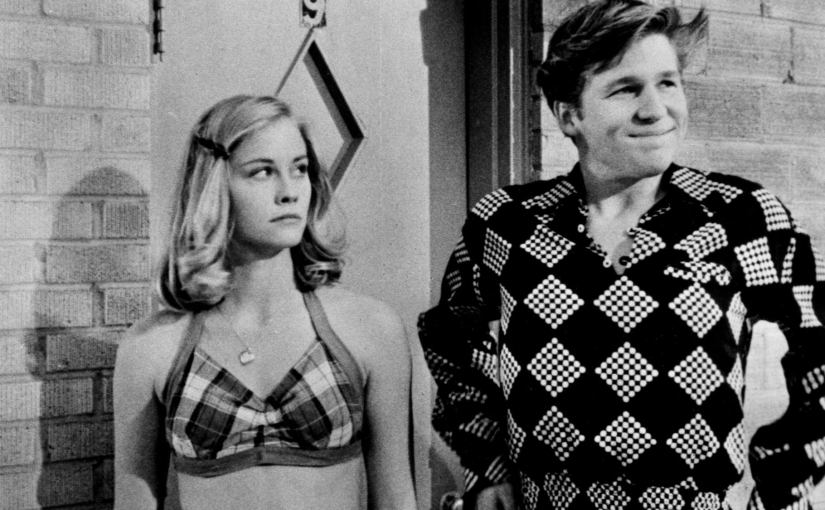
Variations of perspectives that are sexual in nature continue to symbolize what is dying in Anarene. Cybill Shepherd in her very first role portrays Jacy, the pretty girl. Her innocence will be lost as soon as she gives away her virginity. It matters little to her how that happens. Bogdanovich offers a great scene where Jacy attends a swimming pool skinny dip party. Jacy is pressured into standing on a diving board to undress in front of the revelers. I looked at this moment as a teetering balancing act. Jacy is bordering saying goodbye to her youth forever. She does undress all the way only to almost trip off the board. For the moment, Bogdonovich saves the character’s present state as she narrowly avoids falling in the water.

Later, on a whim during New Year’s Eve, Sonny and Jackson go off to Mexico with little money in their pockets and no plan in mind. When they return, an unexpected turn of events has occurred. The fate of this town is withering away with the breeze that’s always intruding. The mute boy will occasionally sweep the street again but accomplish nothing from it.

The films in the movie house represent those that were once celebrated but are now almost never noticed as these families are becoming more glued to the next common household appliance, the television with variety hour shows.

The music never changes or grows up. Hank Williams Sr, occupies the minds of folk who maintained this town at one time and are slowly dying off. The next generation does not have much appreciation for it.

I could go on. Every scene in The Last Picture Show brings about another example of an ending. Bogdonovich was meticulous in his symbolic method of McMurty’s story.

I love that the film, released originally in 1971, was shot in black & white because it shows the story in a historical context; this is what’s left of what once was. The sexual situations don’t hold back in nudity. It’s wise as I thought the nudity clashed with the black & white; it was almost intrusive. The nudity is overcoming the home life heartland that small towns like Anarene used to be remembered for. Sadly, the characters have a hard time accepting this fate.

Cloris Leachman portrays Ruth Popper, the wife of the high school coach who she suspects of being gay. She engages in an affair with young Sonny and her big moment comes when she frustratingly throws a coffee pot at the wall in a rage. She’s terrified that Sonny could never retreat to her pace of life. He’s apt to move on from her. She’ll be stuck with a closeted gay husband in an unstimulating environment. Time has become stagnant for Ruth within the confines of a lifeless marriage and a dead town.

A new way of life awaits. Destiny for Jacy, Sonny and Duane do not include Anarene in their plans.

Eventually Sonny and Duane attend a showing of John Ford’s “Red River” featuring John Wayne. The next morning, after the movie house has closed forever (no one buys tickets anymore), a new fate awaits, maybe even death. Worse yet, maybe for one of them, there is no fate. Maybe, for one of them all that’s offered is an absence of life while residing in Anarene, Texas.

I didn’t realize how much material I absorbed until after The Last Picture Show was over. Peter Bogdonovich provided more for me to think about then I was aware of. The initial slow pace of the film seems mundane at first until you understand that people like Ruth and Sam have memories they experienced but will never carry forward. It’s sad. Their history had meaning at one time. The legacy of their past, however, has no future.

The Last Picture Show is on AFI’s 100 best movies from 2007. It deserves to be as Bogdonovich deftly shows how a past withers away from a nowhere future. His set pieces and direction of characters show the suffering they endure with an unsure end they can not escape.

I haven’t stopped thinking about The Last Picture Show since it ended.