SILKWOOD

By Marc S. Sanders

As the 1980s were setting its stride, Silkwood might have been one of the earliest in a line of films to focus on the union worker who fights back at the billion-dollar corporation.  Some might unfairly regard the movie as The China Syndrome, Part II. Other well-known pictures of this mold are even more familiar to me like Michael Mann’s The Insider.  However, director Mike Nichols, working with a first screenwriting effort from Nora Ephron who partnered with Alice Arlen, showcases the aggravation on not just Karen Silkwood, the real life potential whistleblower, but also her friends and co-workers in a one factory town just outside of Oklahoma City.

Karen (Meryl Streep) lives with her boyfriend Drew (Kurt Russell) and her best friend Dolly (Cher) in a run-down house in the middle of nowhere.  They ride to work together at the local plutonium manufacturing plant where they dress in scrubs and gloves. Punch in, punch out kind of days, and often they are expected to work double shifts and weekends.  Karen works an assembly line where she places her hands in rubber gloves and assembles dangerous combinations of chemicals in an enclosed box.  It’s also routine that before you leave your station you wave your hands over a sensor to ensure you have not been exposed to radiation.  There’s even sensors you walk through as you enter and leave the plant.  When those sensors go off, a calm kind of film seemingly turns into a horror movie.  The last thing anyone could ever want is to get “cooked.”

Karen does not live a perfect life.  Her three kids reside with their uncompromising father in Texas.  Money is not ideal.  Dolly is a slob and has also invited her girlfriend to live with them.  Karen can manage with all of this, but when she observes some unconventional activities around the factory she gets up the nerve to head the union for better protection and working conditions.  However, the further she goes looking at files and photos, jotting down notes of what people say and do, plus taking trips to Washington DC, and getting phone calls from attorneys at night, she becomes more and more isolated from Dolly and Drew, along with the rest of her close-knit workers.  Karen is not just risking her job, but everyone else’s jobs and worse her own life.

The attorneys lay it out to the townsfolk and the union of the horrifying statistics that go along with radiation exposure.  The tiniest fraction of a miniscule of exposure to the smallest crumb of chemicals could increase a human’s bearable limit towards radiation and cancer.  The sad irony is that the more that is learned, the more the people of this area smoke and smoke some more.  Granted, this story takes place in the early 1970s, though.    

The company is primarily represented by an intimidating Bruce McGill.  He’s great in everything he does and is worthy of an Oscar nomination somewhere.  M Emmet Walsh has no lines but his presence is enough to shake you; the slimy guy you easily recognize from every other movie you have seen.  While the company’s overbearing intrusion is shown plenty, the script for Silkwood focuses more on how these working people get by.  They are treated unfairly and in dangerous working conditions, but they also know this is the only place that offers steady income in the area.  Without this factory, the whole town would be left in dire straits.  Karen is repeatedly told or implied to leave well enough alone.

Meryl Streep notches another harrowing performance on her resume and bears such a departure from more sophisticated characters found in Sophie’s Choice and Kramer Vs Kramer.  Karen Silkwood is not educated and she bears an unmistakable white trash dialect but she’s also not stupid and the more progress she makes at exposing the plant’s shortcomings the more unfairly she is treated with department transfers and workplace shake ups that she is indirectly blamed for.  Potential threats on her life begin to build, but she only upholds a bravery.  You really observe the strength of Meryl Streep.  She’s at the top of an elite class of actresses at this time that also included Sally Field, Jessica Lange and Glenn Close.

Cher plays Dolly in her first on screen role.  The variety act performer probably subjected herself to a bigger departure than Streep.  She was not a professionally trained actress at the time.  Mike Nichols insisted on no makeup along with her hair unkept and flat, while dressed in green chino pants and baggy sweatshirts.  The new actress carries herself so well without the usual glitz that accompanies her.  Her scenes with Streep are workshops in acting technique. 

Kurt Russell delivers another understated performance.  One of the best actors out there who has never been enough of a critical darling.  Drew is likable and Kurt Russell plays him as a settled in match for Streep’s portrayal of Karen.  Watch how they tangle up in each other’s arms in bed or when he snaps at her as she carries on her crusade while he’d rather things be left alone.  His timing is perfect for the script.

Mike Nichols keeps his film calm, except when the go by the numbers narrative must be disturbed.  A radiation cleanse with high pressure hoses will make you wince.  The factory alarms will terrify you.  Meryl Streep accepts the physical taxations necessary for this setting.  Nichols gets in close with his camera to show how cleansers dressed in scrubs and masks rub Streep down until her skin is a burning red.  I distinctly remember how her right ear appears in this scene, getting flushed by something just short of a fire hose, and the aftermath of her sitting in a chair is so discomforting while a company doctor assures her that there’s not much to worry about as long she brings in her urine samples daily.  In fact, soon all of the employees are tasked with delivering their urine samples.  What kind of place is this?

While Silkwood is based on a true story with a burning question left behind, I do not want to reveal too much.  Many have seen Silkwood since it was released over forty years ago, but as the third act begins, the fallout only becomes more disturbing and Mike Nichols directs a horrifying sequence built primarily on the pealing of old wallpaper.  That’s all I want to suggest. 

Karen Silkwood was a very unlikely crusader.  She probably never envisioned what she would become and what she would fight for.  Yet, she uncovered horrible truths that should not have been occurring under the eye of billion-dollar corporate America.  After watching Silkwood, I can only imagine what else was there to turn over.

NOTE: Another good reason to watch Silkwood is to discover early performances from some amazing character actors who were either just starting their careers or continuing to hide in the crowd. 

Scavenger hunt for Anthony Heald, James Rebhorn, David Strathairn, Ron Silver, Fred Ward, Diana Scarwid, Bill Cobbs, M Emmet Walsh, Craig T Nelson, Tess Harper, Will Patton, Richard Hamilton and Josef Sommer.

RED DRAGON

By Marc S. Sanders

So this may be director Brett Ratner’s best film, but that doesn’t make it a great film. Ratner directs Anthony Hopkins as Hannibal “The Cannibal” Lechter in this prequel film to The Silence of The Lambs.

Hopkins does his best with a script that lacks the wit of the original Lambs script. The puns are lacking this time as he plays mind games with Edward Norton’s FBI agent who is trying to apprehend “The Tooth Fairy,” a deranged killer of families played by a disturbing Ralph Fiennes.

Red Dragon boasts a who’s who of a great cast; Hopkins, Norton, Fiennes, Harvey Keitel, Emily Blunt, Mary Louise Parker and Phillip Seymour Hoffman. Yet, every player is incredibly boring. It’s as if they memorized their lines and just recited them at the call of action. There are no nuances. No fear or fascination within their interactions, and thus what’s at stake seems awfully minimal. We get a LOT of Norton just talking to himself or a tape recorder. It’s all very flat.

Ratner’s art director should be commended for effectively duplicating Hannibal’s prison from Lambs. That’s where the eye-popping stops, however. Hannibal’s infamous muzzle mask also makes a return.

I remember loving this book by Thomas Harris. It was so imaginative and descriptive. Very fast reading. Ratner gets all the important scenes in his film as well as some additional fodder for Hopkins but it’s all color by numbers. Nothing is here to carry a swell of emotion. No close ups. No lighting technique.

The best that Ratner comes up with is to chain Hannibal to a steel cable like a wild animal. He lunges for Norton and the chain rattles. Meh. A cat jumping out of nowhere has given me worse nightmares. Ratner forgot to cast the cat, however.

THE PELICAN BRIEF

By Marc S. Sanders

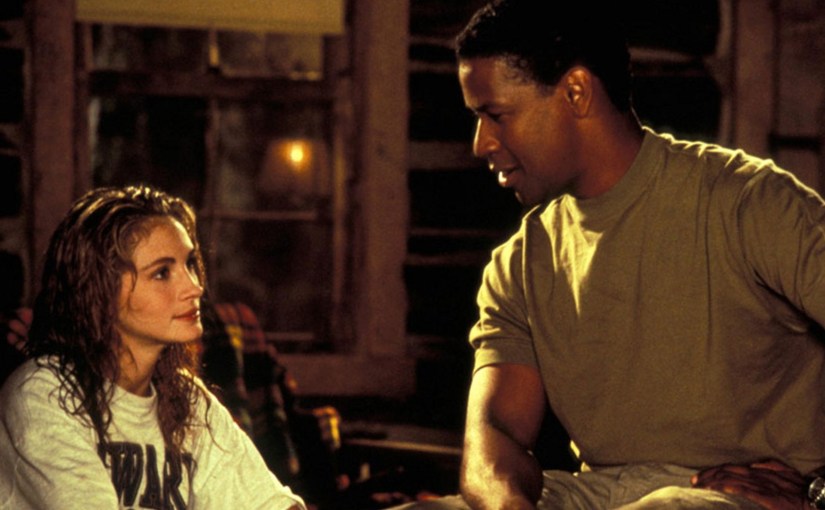
Tulane Law Student Darby Shaw (Julia Roberts) is unbelievably lucky. She can find herself being pursued by one white guy in a suit after another over the course of a two hour movie and will be fortunate enough to escape every threat by sheer chance. It’s only to her benefit when she is being chased by two assassins in a creepy downtown parking garage that someone left an angry doberman in a car to startle the killers. As well, it’s really a blessing that Darby has caught on that if an engine sputters when turning the ignition it can only mean one thing – car bomb! GET OUT!!!!!

Darby is the main protagonist of The Pelican Brief directed by Alan J Pakula, adapted from John Grisham’s best-selling novel. When the eldest and the youngest Supreme Court justices are murdered, Darby conceives of an outrageous conspiracy stretching all the way to the President and documents the whole rundown in the so-called Pelican Brief. She shares the document with her law professor who shares it with his government friend who shares with the CIA who shares it with…and so on and so on.

Pakula is an under celebrated director when you consider his better thrillers like Presumed Innocent, Klute, and especially All The Presidents Men. Here though, I think he got a little lazy with his screenplay and direction. The Pelican Brief is a little too paint by numbers.

Sure, the film has suspense. I think Grisham’s story has some convincing weight to it where wealth and government won’t stand for the platforms of environmental causes and therefore people have to die. Still, while the meat of that story eventually surfaces, we are left with A LOT of buildup before Darby gets involved. Just a lot of white guys in different office buildings walking down hallways, entering doorways and talking on the phone. Every so often we come across a DC crack reporter, Grey Grantham (Denzel Washington) who gets a phone call from a potential informant. When that guy gets scared and hangs up, thank goodness Darby just happens to call two seconds later regarding the same story. Good on you Grey for being by that telephone.

That’s my problem here. Pakula just works in the lucky conveniences to keep Grey and Darby on the trail. Neither of them ever truly escape a bind on their own. Neither of them ever truly dig the hole any deeper without something COMING UPON THEM to help them along at just the right moment.

We learn a safe deposit box belonging to a dead character exists. Darby just strolls into the bank and posing as the widow, who is not a signer on the box, is just asked for her address and phone number. No proper identification necessary. Why didn’t anyone ever tell me it’s that easy? Folks, hide your valuables because I’m gonna be robbing you blind.

Pakula will even set up a good scenario where Darby thinks she’ll be meeting someone who can help but it’s an assassin ready to kill, only suddenly the assassin is killed while holding Darby’s hand in a crowded courtyard. Wow!!! Lucky again, Darby. I’m still fuzzy on who actually killed the guy. That didn’t concern Pakula though. It’s explained in a quick throwaway line before the credits roll. Pakula only had to get Darby out of danger again. So let’s see he’s got the barking doberman for something else, the engine sputter will be used later on. Hmmmm??? Meh!!! we’ll just have someone randomly kill this guy. Now run, Darby. RUN!!!

Notice I haven’t talked about performances. Well, there’s not much to them. The Pelican Brief boasts an impressive cast of character actors like Sam Shepherd, Anthony Heald, John Lithgow, Stanley Tucci, Robert Culp and John Heard. Yet, these guys, along with Roberts and Washington are flat. Just reciting their lines when the cues call for them. There’s nothing very exciting to any of them really. Very monotone. Roberts is beautiful yet depressing even before she gets caught up in the mystery. Washington, while handsome, does not seem to have the gusto that Pakula’s reporters did when he directed Hoffman & Redford. Grey is too neat, physically fit and tailored for an always on the job, aggressive reporter looking for a scent.

There was a better movie to be made here, thanks to some convincing motivations that were started with Grisham’s novel. Unfortunately, Pakula just didn’t devote enough respect to the original author’s imagination.

THE SILENCE OF THE LAMBS

By Marc S. Sanders

Everyone remembers Anthony Hopkins’ memorable turn as the infamous Dr. Hannibal Lecter in The Silence Of Lambs.  He was “Hannibal The Cannibal;” a renowned and brilliant psychiatrist who was eventually captured for being the one who ate his victims with sophisticated glee.  The real attraction, though, is how director Jonathan Demme delivers the film adaptation of Thomas Harris’ best selling novel through a lens that only finds one strong heroine amid a sea of intimidating men.  The heroine is the intuitive, but petite Clarice Starling.  The men are nearly everyone else cast in the film, and I mean everyone all the way down to the extras; the extras, here, are a perfect example how necessary they are towards any film’s palette.

Ever since the film was released in 1991, the dialogue of Ted Tally’s script is worthy of repeating and mimicking in social circles.  Lecter remains spoofed in nearly every pop culture medium.  Hopkins’ character is unforgettable and he’s been ranked among the greatest film villains of all time with the likes of Darth Vader and Harry Lyme.  It’s a worthy honor.  His timing is subtle and mischievous while he remains silently dangerous.  You can’t take your eyes off the actor and you can’t erase the devilishly fun and evil character from your sub conscious.  Opposite this performance though is Jodie Foster in a top billing role as an FBI trainee named Clarice Starling, assigned to interview and maybe study Lecter as a means to a solid lead in finding a serial killer that has been identified in the media as “Buffalo Bill.”  Bill has been skinning and killing girls with large physicalities, around the east to mid-west portion of the United States.

So, there is a detective story at play here as Hannibal aids Clarice in her search for the killer, but only under his rules.  Demme paints the film with Clarice ably performing her job no matter the towering strength or perverted fantasies found in nearly any man.  An outstanding image early on shows her small frame entering an elevator.  She has been summoned to her supervisor’s office from the outdoor obstacle course.  She is sweaty, and looking tired.  The elevator is full of a dozen men in red uniform polo shirts that hug every muscle; they are strong, fit and healthy.  Clarice stands front and center and she has no reluctance to stand among this exclusive group.  Later in the film, Clarice is invited by her supervisor, Jack Crawford (Scott Glenn in a deservedly dark and quiet performance), to investigate one of Bill’s victims that turned up in the swampy waters of West Virginia.  The coroner’s examination room is filled to the max with sheriffs who believe they serve a purpose to stay there to witness what’s uncovered.  The strength of Clarice is really shown here as she shoos them away.  The men’s facial expressions tell us they don’t care for this request, but Clarice isn’t going to allow them to remain.  Most importantly are her encounters with the head of the Baltimore psychiatric ward that houses Lecter.  He is known as Dr. Chilton played by Anthony Heald.  Chilton – a great character name that clearly colors in the twisted perversion of this guy.  Chilton is happy to boast of his prized attraction, Lecter, as if he’s a rare tiger and he has no reluctance to hit on Clarice when she comes to visit with Lecter.  Always, Clarice will not allow herself to be succumbed, patronized or victimized by any of these towering figures of masculinity in what is unfairly regarded as a man’s world in law enforcement, crime or psychiatry.  Starling easily reminds Chilton that she was a student at the University of West Virginia, not a charm school.  With Tally’s script, Jodie Foster uses these deflective techniques of her character without effort.  Her methods of fencing with these men are a natural ability.  Even when she’s in film transition periods of training at the Academy, Clarice can maintain her stance against a hard-hitting male boxer pounding away at her boxing shield.  She just won’t fall over. As well, she doesn’t wince as the male students give her a glance from behind when she’s jogging on the grounds. 

Demme is an outstanding director who uses these interpretations of this woman to drive his film.  This very same year, 1991, Ridley Scott directed Thelma & Louise.  In that film, the title characters had to realize that they didn’t have to take any shit from a man.  They started out weak, though, and had no choice but to eventually get stronger.  Here, it’s already part of the woman’s instinctive nature. 

Hannibal Lecter is shown to be well versed in the finer things of art, literature, music and, forgive me, cuisine.  At one point, Demme focuses on a picture Lecter has sketched depicting Clarice in an almost angelic nature.  I’ve never forgotten that image.  Nearly all of the settings in The Silence Of The Lambs include stairways that always lead us in the down direction, to an assortment of various hells.  Clarice, the pure angel with nary a fault beyond limited experience as an FBI agent peels the onion away on her quest for a killer by entering into the treacherous depths beneath her; pits of hells.  The opening shot of the film has Clarice pulling herself up with a rope on an obstacle course as if she is ready to enter the heavens, ready to stand above everything, but then she is summoned to Crawford’s office located at the Department of Behavioral Sciences at the FBI.  She has to take an elevator down and then various stairways further down into a labyrinth of claustrophobic offices with no windows, surrounded by cinderblock and populated with men in uncharacteristic suits that don’t appear warm or cuddly.  Crawford may seem like her ally, but really, he’s using her as a sacrificial pawn on a chess board putting her in an arena with psychotically dangerous prisoners, in particular, the worst of them all, Hannibal The Cannibal. 

When Clarice goes to visit Hannibal, she is escorted by Dr. Chilton, who relishes in describing how careful he handles his prized thing, and willingly shows what this monster is truly capable of by providing an unwelcome photograph of how Lecter brutalized a female nurse.  This conversation is played upon a much more frightening descent of unlimited stairways and bars that clang loudly and are painted red and rusted, eventually leading to a stone walled dungeon for these unimaginable beings of death and perversion.  Clarice is left all alone to navigate her way down a long corridor until she reaches Lecter’s cell.

Yet, an even more frightening third descent into hell occurs in the final act as Clarice’s pursuit leads to Buffalo Bill.  Bill’s home is dark, lurid, filthy and maze like; but always seeming to go down further and further into one doorway after another and down one staircase after another, including a deep well where his latest victim is kept.  Like the other descents, Clarice uses her femineity as a tool of strength to survive.  I can claim without any hesitation that Clarice Starling is one of the greatest heroines in the history of film. 

The one man who rattles her, and weakens her, though is Hannibal Lecter.  Watch their tete a tete when they meet for the first time.  Starling demonstrates some overconfidence against Lecter’s seemingly polite demeanor.  With her white trash Virginia dialect, she even gets a little smarmy with the Doctor, but then he disarms her immediately with a comeback that shakes her very core.  Demme’s reliance on close ups for both characters serve this scene and others so well.  Clarice’s encounters with Hannibal are the most important and vital moments in the film because they are the only opportunities for Jonathan Demme and Ted Tally to show the main character’s weakness.  Every hero has to have a weakness if they are to remain compelling.  Clarice is not, in fact, undefeatable. 

The film could have simply worked as a basic detective story.  Put up the clues and the narration of the picture will eventually assemble all together for a resolution where the bad guy is captured.  Yet, Thomas Harris’ character creation uses Hannibal as a defiant obstacle blocking the path for Clarice.  Hannibal lacks much stimulation in a cold, specially designed prison cell.  He’s maybe only honored with impenetrable plexiglass to contain him as opposed to traditional bars.  He needs to be enthralled.  On the surface, Clarice appears as a frail prey that he can take his time munching on.  He’s happy to help Clarice catch Buffalo Bill with the case files she provides, but in exchange he wants to uncover what haunts her psyche.  Such a strong character Clarice is, but she has to be willing to weaken and expose herself to desperately find a dangerous killer.  Can she do it?  She’s never allowed herself to do that before.  And thus, we come to comprehend the obscure title of this film and the book it stems from.  (Anthony Hopkins actually thought it was a children’s fantasy when he was sent the script to read over.)

This write up is not necessarily a review, but a means to honor the careful film and storytelling technique that Jonathan Demme strives for with The Silence Of The Lambs.  You might say, yeah, there’s a lot of walking in this picture, but pay attention to the direction of the walking.  Always going down, somewhat reminiscent as Little Red Riding Hood entering a dark and spooky forest and encountering the biggest and baddest wolf.  Jodie Foster might be in a company of men here, but the film works as a dual of femineity vs masculinity.  It’s strange to believe that Demme actually had Michelle Pfeiffer in mind for the Starling role initially, a more than capable actress, but one who at the time was more glamourous (The Fabulous Baker Boys and The Witches Of Eastwick).  Beyond the silly Disney films, Foster was known for lurid pieces like Taxi Driver and her first Oscar winning role as a rape victim in The Accused.  Clarice Starling is a character beyond a pop culture appearance of the time, and Jodie Foster emanates that portrayal.

The writing of The Silence Of The Lambs is so intelligent.  There’s a witty, yet deliberately poor taste, of sarcasm to Hannibal Lecter as he thrives off his superior intellect over Jack Crawford and the FBI.  It’s only enhanced when he’s dealt a lowly, formally white trash female student to play with.  Ted Tally offers precise timing in the dialogue with Clarice and Hannibal.  Thomas Harris’ drive to further a cameo appearance of Lecter in a prior novel (Red Dragon) with this book is a gift to readers and eventually movie watchers.  The Silence Of The Lambs doesn’t follow formula with a Law & Order technique of ballistics and witness interviews.  It drives into other directions to feed its development. 

Jonathan Demme’s film is pioneering.  I recall seeing it in theatres with other high school friends.  I was not enthused to see it.  The title was too odd.  The picture was primarily a talking piece.  There were gross and unwelcome images within the film.  It’s very ugly at times.  I was frankly accustomed to the likes of Dirty Harry and Lethal Weapon films for my cops pursuing the robbers ideals.  I recall not even liking the film when we left, and I couldn’t comprehend its appeal that followed for the remainder of nearly an entire year, all the way up to when it was awarded the five main categories of Oscar wins (Actress, Actor, Screenplay, Director and Picture).  I definitely wasn’t accustomed to a strong character like Clarice.  Later that year, I saw Thelma & Louise and fell in love with their eventual triumph.  I needed to be spoon-fed their initial weaknesses at first.  Who was this Clarice in this picture, though?  I could not identify her strength that displayed right from the get go.  I wasn’t even 18 years old at the time and now I can say I just wasn’t mature enough for this film back in 1991.  Now, it’s thankfully clearer, though I still appreciate its subtlety so much. Jonathan Demme had such a clear vision of where he was taking this film and because it’s not dated, The Silence Of The Lambs stands as thriller, and an intelligent thought provoking piece that stays with you for a long time after each viewing.