SECRET IN THEIR EYES (2015)

By Marc S. Sanders

So here is a movie I thought I had figured out; the twist, I mean. Yet it’s ending didn’t turn out to be that way at all.

So, what did I get from Secret In Their Eyes? Well, I guess the confidence that I am probably a better writer than the ones who doctored this crap.

This is another mystery thriller, where everybody working in the same law enforcement department must remain divided and have animosity towards each other because if they didn’t have conflict they’d only get along and solve a very basic murder case.

See, it has to be this way.

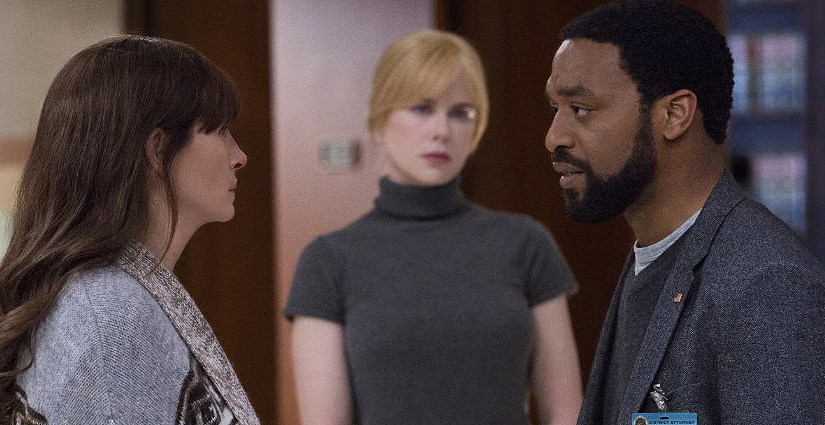
The main character played by Chiwetel Ejiofor must play the obsessive (13 years obsessed!!!) FBI investigator prone to making dumb and impulsive mistakes because if he didn’t there’d be no movie.

Julia Roberts, effectively departing her glamour roles, as the cop/mother of a murdered daughter will only conveniently appear to make things awkward for Ejiofor and DA Nicole Kidman who is unnecessarily, overtly sexy to drive a subplot for more awkwardness. Oh, hi Julia. Didn’t expect you to step on to the elevator. Well, look who showed up at the office just as I get into town; things like that.

Nothing that these characters do seem very wise or necessary but we are supposed to believe these are some of LA’s best legal minds; break in and steal evidence without a warrant, solve a murder by looking at a picture from company picnic, beat a confession out of a suspect, and presume you found the killer again because a guy made parole 13 years later and the ages match up. He might have had a nose job, but that’s gotta be the guy. Ejiofor says it is. So it must be true. Stop arguing with me. Ejiofor says he’s right and you’re wrong. Case closed. Shouldn’t these great legal minds look a little deeper before they make their conclusions? There’s more concrete evidence in a game of Clue than anything I found in Secret In Their Eyes.

I guess now that I’ve watched the film and see that my predicted ending never turned up, maybe I’ll keep it to myself, jot it down on paper and sell my own screenplay. If this crap could attract a Hollywood budget with top talents to fill the roles, how bad could I do?

AN EDUCATION (2009, Great Britain)

by Miguel E. Rodriguez

Director: Lone Scherfig
Cast: Peter Sarsgaard, Alfred Molina, Rosamund Pike, Dominic Cooper, Olivia Williams, Emma Thompson, Carey Mulligan
My Rating: 9/10
Rotten Tomatometer: 93% Certified Fresh

PLOT: A coming-of-age story about a teenage girl in 1960s suburban London, and how her life changes with the arrival of a playboy nearly twice her age.


Lone Scherfig’s An Education, written by famed British author/screenwriter Nick Hornby, is yet another example of how my preconceived notions of a film are often very wrong.  Based on the plot description above, I assumed I was in for what I call a “spinach movie”: something that’s good for you, but not a lot of fun to eat.  I thought the film would be dark and deep, delving into unsavory territory involving a predatory older man putting the make on an underage girl.  Lessons would be learned, but it would be an uncomfortable watch.

For about the first half of the film, I felt I was mostly right.  It’s 1962 in England, and Jenny (Carey Mulligan in her first major role) is a sixteen-year-old student who is studying hard to pass her A-levels – I think I got that right – with flying colors, which she hopes will give a favorable impression to the admissions board at Oxford.  Her father (Alfred Molina) supports her plans…or rather, he supports HIS plans for her.  He gives several impassioned speeches about the importance of getting a higher education, making sacrifices, dropping her cello hobby, etcetera, all in the service of getting those Oxford-level grades.

One day, Jenny gets caught in the rain and is rescued by David (Peter Sarsgaard), a charming older man driving an irresistible maroon sportscar.  He isn’t just charming, he’s effortlessly charming, turning the exact right phrases to put Jenny at ease.  The morning after he drives her home, he leaves a bouquet of flowers at her doorstep.  He bumps into her again quite by accident, or “accident”, and asks her on a date for dinner and a concert.  For this, he must convince Jenny’s very suspicious father…which he does with silver-tongued ease.

Jenny is caught up in this whirlwind of attention from a much older man who is clearly well off with sophisticated friends, Danny and Helen (Dominic Cooper and Rosamund Pike).  Jenny’s father, Jack (Alfred Molina), is torn between his protective instincts and the idea that Jenny might have met a man who could make her dreams of Oxford…moot.  Why worry about the expense of university when a rich husband can keep his daughter well cared for?

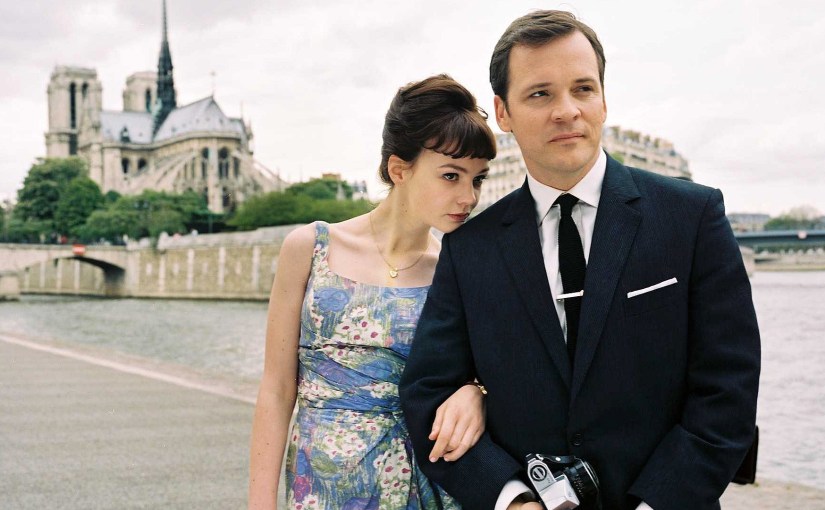
Despite the father’s (and my own) forebodings, Jenny is genuinely enjoying herself.  She loves music, so David takes her to a concert.  She loves art, so David takes her to an art auction.  She loves learning and speaking French, so David takes her to Paris.  His method of getting Jenny’s father to agree to this overnight trip is simultaneously simple and diabolical.  Jenny is having fun for what seems to be the first time in her life.

She’s having so much fun that, for a while, I wasn’t quite sure what the movie was advocating.  Is it supporting this relationship?  She has a very frank conversation with David regarding her wish to remain a virgin until her seventeenth birthday.  David agrees…then, in one of the ballsiest (and creepiest) moves I’ve ever seen from a guy in a movie, he asks her to give him a “peek.”  What is going on?!?  This guy is clearly a cad.  But he’s so nice to her…and she’s having fun…!

Put it this way: I was prepared to throw something at the television by this point.

Around the midway point, though, the movie finally makes its true purpose known.  It’s not about judging Jenny, which is too easy to do, or even judging David, which is ridiculously easy to do.  The film is based on a memoir by a British journalist named Lynn Barber, which made some of the revelations about David’s past and how he makes a living easier to swallow, knowing that it’s based at least partially on fact.  It also made all the “icky” parts in the first half of the film a little more palatable.  When you realize that someone really went through this, it puts everything in a different light.  I had the same epiphany during Schindler’s List; the concept that this all actually happened brought a deeper level to the viewing experience that I hadn’t expected.  (It’s also what made Fargo so much more entertaining than your average crime film, but that’s another story…)

Anyway, this happens and that happens, and before you know it, Jenny has made the kinds of decisions that would make grown men and women tremble with anxiety. The movie’s title takes on a whole new meaning.  It’s not just about Oxford anymore.  It’s about studying at the University of Life, where the only way to know if you passed your test is if you’re still willing to take the next one, and the next, and the next.  Even David learns a thing or two.  Maybe.  It’s a little inconclusive when it comes to that guy.  What a jackass.

So…is it any good?  Yes, it is.  It’s got brilliant performances working from a Nick Hornby script that switches easily among pathos and embarrassment humor (witness the predicament of Jenny’s other suitor at her 17th birthday party) and even a little suspense.  I tend to think of Hornby as Britain’s answer to Cameron Crowe.  Hornby’s books and screenplays walk that same tightrope time after time (About a Boy, High Fidelity, the original Fever Pitch – soccer, not baseball), just like Crowe’s best work (Jerry Maguire, Say Anything, Almost Famous, which I don’t particularly love, but I do acknowledge its craftsmanship).  By the time I got to the end of An Education, the double- or triple-meaning of the title is fully realized.  Everyone has learned something.  Not all of it has been good.  It doesn’t all tickle.  But, except possibly for David, everyone has taken what they’ve learned, good or bad, and put it to good use.  That’s a satisfying ending.

[Side note: after this movie was over, I found myself thinking of Licorice Pizza and its plot regarding an underage boy and an adult woman. I can imagine my friend and partner-in-crime reading my favorable review above and asking me, “If you like this movie, how can you not like Licorice Pizza?” (He really loved Licorice Pizza.) The difference is that, by the time An Education is over, the characters have EVOLVED. Discuss.]

BOOGIE NIGHTS

By Marc S. Sanders

Boogie Nights was director Paul Thomas Anderson’s second feature following a very different and very quiet film debut with the gambling addiction piece Hard Eight.

Heck, it’s fair to say all of Paul’s films are very different; here is the seediness of porn while later in his career he will focus on the ruthlessness of a wealthy and angry oil man and then an obsessed dressmaker devoid of care for the models who parade his accomplishments. (See There Will Be Blood and Phantom Thread.). Paul was definitely striving for recognition with his familial depiction of life in the California pornographic film industry.

What I’ve always liked about Boogie Nights was Anderson’s intent to show the naive innocence of this large cast of characters. Filming blatantly oblivious awful porn scenarios can still be regarded as very proud efforts by its talent.

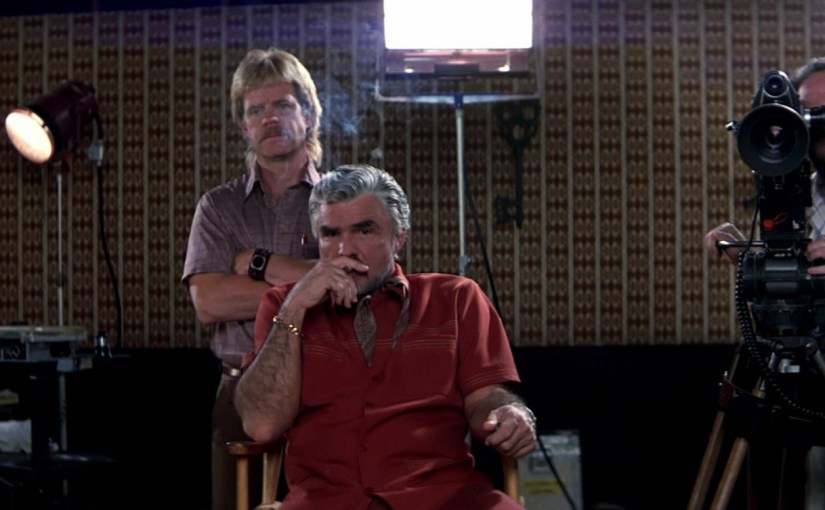
The main character is Eddie Adams (aka the amazing Dirk Diggler) played with macho pathos by Mark Wahlberg. It’ll likely be the best role of Wahlberg’s entire career. Dirk is proud of his natural talent in front of the camera. He’s even more proud of what God has gifted him. Don Cheadle is another porn star named Buck. He’s also proud of his accomplishments and simply a kind fellow looking to make country cowboy a trendy look for a black man while selling the “Hi-est Fidelity” in stereo equipment on the side. Julianne Moore is Amber Waves, the maternal porn mom of the bunch; very affectionate, very comforting and very reassuring when Dirk shoots his first porn scene. The one individual who really holds all of these misfits together is Burt Reynolds as Jack Horner, the porn film director. He’s the paternal one who believes in his artistic merits of shooting porn but with a story, and only with the integrity of film, and never the cheapness of videotape. So, Jack is like any artist who insists on a certain type of canvas. It might be smut, but he has principles, and he has pride.

Anderson is wise in how he divides up the developments. The film begins in the late 1970s during evening night life and decadence and everything seems fine and innocent and right despite the endless debauchery of reckless sex and drug use on a Disco backdrop. Wahlberg’s character is welcomed lovingly into this world, and nothing appears wrong. It all seems to stay that way for Dirk until New Year’s Eve, 1979. The 80s begin with a gunshot and then Anderson’s cast must pay for the revelry of their sins. A great moment presented on this night is where Amber Waves introduces Dirk to cocaine. Dirk has been thriving, making money, developing a following and now it is jeopardized in one moment thanks to his naivety. Julianne Moore is superb in this particular scene against Wahlberg. She’s the mentor with the peer pressure to pass on her high and keep it running.

Drug addiction, violence, sexual abuse and even changes in pop culture lead to hard times for these likable people.

It’s a hard life. It’s a complicated life. Yet it’s not all necessarily illegal. Morally, it might appear wrong, but it’s a life nonetheless.

Anderson was wise to use (at the time, relatively new) filming techniques of Martin Scorsese with rocking period music and fast edits along with savored moments of great steady cam work. One long cut especially works when the film first begins on the streets of Reseda and on into a crowded night club. This industry doesn’t sleep. So, neither will the camera that follows it. The music must also be celebrated. I do not listen to Night Ranger’s Sister Christian without thinking of firecrackers and a dangerously drug addled Alfred Molina playing Russian roulette. Though I know which came first, I also wonder if Three Dog Night’s Momma Told Me Not To Come and Spill The Wine by Eric Burton & War was written to enhance the celebratory introduction for Dirk when he attends his first party at Jack’s house. It’s another great steady cam moment from a driveway, followed by steps in and out of Jack’s house to simply a bikinied girl’s dive in the swimming pool. As a viewer I was absorbed in the California haze. Superior camera work here.

The cast of unknowns at the time were a blessing to this film. Anderson writes each person with care and attention and dimension. They have lives outside of this world like Amber’s child that we never get to meet, thanks in part to her lifestyle. She might be maternal but that doesn’t make her a good mother. Julianne Moore should have won the Oscar she was nominated for. Burt Reynolds’ own legacy seems to carry his role. His distinguished silver hair and well trimmed beard earn him the respect of every cast member and he performs with a quiet grace of knowledge, and insight, even if he will inevitably be wrong with how things turn out. Phillip Seymour Hoffman plays the dumb kid Scotty insecure and unsure of his homosexual attraction to Dirk. It’s not easy to play a dumb character when you are not doing it for laughs. Hoffman makes a huge impact with little dialogue but Anderson is wise enough to capitalize on him.

Boogie Nights offers one of the best cast of characters and assembled talents in any film ever made. An individual movie could be made about each of these people, and it’d be interesting and entertaining.

Try to avoid a blush and mock at the industry depicted because then you’ll see how another walk of life truly lives day to day. It might be porn. It might be smut. Yet, it’s still a thriving industry.

MAGNOLIA

By Marc S. Sanders

Ernie Anderson was the cool voiceover for the ABC television network that would introduce upcoming programs for years. He was a staple of the television industry from the 1970s through the ‘90s. I promise that you or your parents know his sharp, recognizable tempo. So, it makes sense that his son Paul Thomas Anderson would center his multiple story crossover film Magnolia around the television industry, within a 10-block radius in the Hollywood Area. Magnolia presents the off-chance coincidences that somehow happen and the unusual phenomena that can occur when never expected.

Anderson’s three hour epic offers storylines centered around former and present day game show quiz kids (Jeremy Blackmon, William H Macy), the game show host stricken with cancer (Phillip Baker Hall), the drug addicted daughter he’s estranged from (Melora Walters), the dying game show producer (Jason Robards), the producer’s son who is a motivational speaker for men to sexually conquer women (Tom Cruise), and the producer’s gold digging wife (Julianne Moore).

Because the narrative of the film has a biblical theme specifically referencing Exodus 8:2, there are also two good natured guardian angels involved. John C Reilly as a sweet but clumsy police officer proud of his work, and a sentimental hospice nurse played beautifully with bedside sympathy by Phillip Seymour Hoffman.

Anderson’s film opens with three stories of random coincidence that resulted in the deaths of three different men. More than likely most people would say these tall tales of legend could only occur in a movie. Yet, the voiceover narrator , Ricky Jay, says they did not, and thus begins one specific day with torrential downpours of rain, where all of these random characters will come in contact with a personal experience of monumental impact that will change their individual lives forever. Oddly enough, all these people are somehow connected to one another and are within blocks of each other located near Magnolia Blvd in the Hollywood Hills.

Like Boogie Nights, Paul Thomas Anderson directs a film of very weighty emotions that thematically focuses on the sins of fathers that carried over to the futures of their children. The game show is titled “What Do Kids Know?” which likely symbolizes what they didn’t know while at the behest of their parents during their youth. What they know now about their fathers is a burden to bear in insecurities, drug abuse and outright cruelty for the opposite sex. Every character represents some aspect of this ongoing theme during Magnolia. It’s a lot, a whole of information, but fortunately it moves at a very swift pace with an energetic steady cam and dramatic notes of instrumental soundtracks.

Anderson consistently shows different references to Exodus 8:2 by either using the numbers in clocks or decks of cards or temperature readings of the weather or on marquee signs. It’s almost like a scavenger hunt when seeing the film on a multiple viewings.

MAYBE A SPOILER ALERT:

“But if you refuse to let them go, behold, I will plague all your country with frogs.”

Sure. Most recognize the Bible verse as Moses’ decree to Pharaoh to release the Jews from Egypt. I like to think Anderson used Magnolia to release his beloved, but damaged, characters from their own sins or the sins of their fathers. Set them free even if it could be by means of confession, judgment, offering and begging for forgiveness, or journeying towards a personal salvation.

The smart device that Anderson uses is the angelic music of Aimee Mann. Often I talk about how I love when film characters would spontaneously dance. In Magnolia, the cast surprisingly breaks into song with Mann’s confessional number entitled “Wise Up.” It more or less summarizes each individual plight that all the various characters must endure. Magnolia is only an even better film because of Mann’s music.

Magnolia is a beautiful film that I draw many personal parallels from, especially having now lost both of my parents and being by my father’s bedside during his difficult final days of illness.

It is very touching, sometimes funny, and sometimes a difficult film to watch with a belief in random coincidence that is only stronger after watching it.

Like the film insists “we may be through with the past, but the past ain’t through with us.” After Magnolia finishes, you won’t be through with Paul Thomas Anderson’s film. It’s a film that will stay with you.