
TWISTER

By Marc S. Sanders

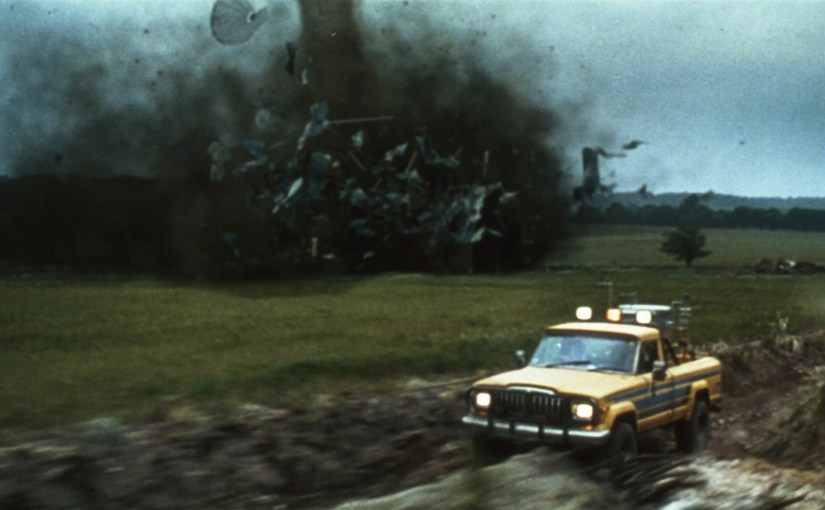
About twenty minutes into Twister, Helen Hunt and Bill Paxton crash their pickup truck while trying to outrun the title character.  Amid the high wind, mud and rain, they take cover under a narrow bridge.  Then Hunt’s character, Jo Harding, becomes enamored, almost hypnotized, with what she sees of the powerful storm and steps out saying she wants to see more while reaching with her hand.  Paxton’s character, Bill Harding, pulls her back down.  Reader, why did Bill have to pull Jo back down?  I don’t care about Jo.  I don’t care about Bill.  They’re not characters.  They’re talking objects.  The only character given any kind of care and treatment is the twister.  The next most important character is the next twister and then after that it is the next twister.

Jan De Bont’s Twister is devoid of a brain with a big head full of wind.

A thin story is inserted to connect these talking props.  Bill needs to convince Jo to sign divorce papers.  Jo is focused on getting a tin can thing named Dorothy into the center of a tornado so it can release sensors and thus their team will be able to study the characteristics of a tornado’s behavior like wind velocity for example.  With each new tornado, their attempts fail and somehow the team has another tin can ready to go.  Where are they hauling these things?  As well, how can such a clunky thing that looks less sturdy than a beer keg offer up so much information?  Dorothy looks like it can easily get its ass kicked by R2-D2.

I guess for escapist humor, Bill brings along his fiancé Melissa (Jami Gertz).  Melissa is here for a couple of lame reasons.  One, to wear a white suit with a fashionable hairdo that you know is bound to get messed up (but actually really doesn’t).  Two, to be used as the device for the rest of the cast to explain where they are going next and what they are seeing.  After whatever explanations have been exhausted, the script literally has her exit the picture in a quick announcement. 

I have not seen the new follow up film, Twisters, but I want to and I’m embarrassed to admit that.  It’s the special effects my dear reader.  The visual effects are all that is to be cared about in these movies.  Visually and audibly these effects are unbelievably impressive and I can only expect some enhancements in the new film.  Unfortunately, once I see one twister, I’ve seen them all.  I’m risking cavities for the five minutes of flavor I get in a Starburst.

What’s regrettable about Twister is that with a good collection of actors that also include Philip Seymour Hoffman, Cary Elwes, Alan Ruck and Jeremy Davies, the acclaimed author Michael Chrichton and Anne-Marie Martin hardly attempt to insert any intelligence into the science of weather phenomena or the trauma that goes with it.  I know just as little about tornadoes as I did before I saw this film. 

A prologue scene has Helen Hunt’s character witness her father being violently taken away in a sudden storm.  However, it is never referenced again.  I started to think about that monologue from Jaws performed by Robert Shaw about his experience aboard the sunken vessel the USS Indianapolis.  The scene is an actor’s dream, but it also makes the nature of the world we live in much more personal for that character.  Shaw’s character has a personal vendetta against sharks based on experience.  That’s what is missing from Twister.  None of it looks personal. Helen Hunt is an Oscar and Emmy winning actor.  She could have had a brilliant monologue that demonstrated her need to follow tornados and learn more about their unforgiving nature.  Chrichton even lent more passion to John Hammond (Richard Attenborough) in the film adaptation of Jurassic Park.  The entrepreneur talked of aspirations for a dinosaur zoo.  Jo Harding possess neither passion nor animosity for her purpose in life.  Twister could have operated better as an observational documentary than a special effects action picture.

Since a tornado cannot have an evil laugh or a handlebar mustache, there must be another source for villainy and that falls on Elwes and his crew.  Jo, Bill and the rest of the gang do not like Bill because he leads a convoy of black (black like Darth Vader) SUVs with the most up to date technology around to study weather patterns.  Yet, what is so wrong with any of that?  We have to hate these guys because they drive shiny SUVs.  Is that all it takes?  At best, the competition heats up as the two convoys nearly sideswipe each other or cut each other off on multiple occasions.  None of this is exciting.

A beloved elderly aunt is conveniently nearby so the gang can chow down and disgust Melissa with their eating habits.  Later, the aunt’s house happens to be in the path of a storm and then a sequence is devoted to rescuing her amid the crashing debris.  We get to see the beautiful mid-west house crash upon itself because to see another twister would just be more of the same.  I hardly got to know the aunt.  So, I don’t care if she lives or dies or becomes catatonic or turns into a superhero named Storm.  This is extra cream filling in an over expired Twinkie. 

The mouth pieces of Twister just don’t matter and while I’m dazzled by seeing a tractor, a cow, another cow (or was it the same cow?), and a house fly around and topple all over the roads amid the wind and the rain, I’m just not taken with any kind of suspense or care. 

Special effects only work if they are ingredients to a story, and not just the story. 
SPEED

By Marc S. Sanders

Jan de Bont’s Speed is one of the best action thrillers ever made. It moves at a breakneck pace with huge suspense, big laughs and never-ending excitement. It’s also really smart with its crazy storyline.

A mad bomber (Dennis Hopper) manages to terrorize the city of Los Angeles by rigging a high-rise elevator with a bomb. Thirteen hostages need to be rescued and for an opening scene of a movie it does not get better than this. The heights and cramped space of the elevator and shaft are tightly claustrophobic, leaving you biting your nails. Small explosions come unexpectedly. This is what Hitchcock is always talking about. Putting a bomb under a table is suspense. The moment you detonate the bomb, the fear is over. De Bont blows up some bombs, but he leaves you hanging for when he’s going to set off the biggest bomb of all – the one that’ll put a hole in the world.

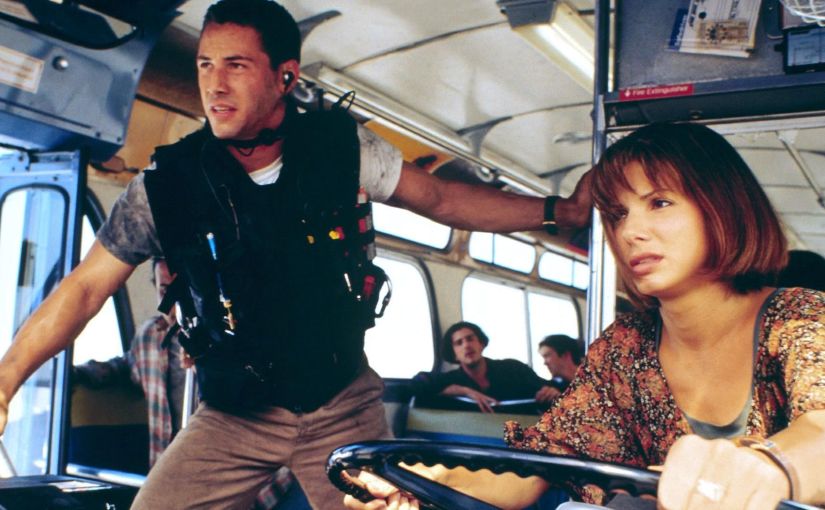
Later, the bomber does the same to a city wide transit bus traveling the freeway routes of rush hour traffic in the city. If the bus’ speed drops below 50 MPH, it’ll explode. Imagine pulling two tricks of Hitchcock all in one film. Imagine trying to never slow down a bus. This bad guy is destroying the city without even setting the big bomb off yet. This is great writing from Graham Yost. The whole scenario is tension at a maximum level.

The cop trying to stop the bomber is Jack Traven (at the time of release, an unlikely Keanu Reeves). Reeves is a perfect hero in this film. He allows the film to stand apart from being just another Die Hard rip-off by avoiding the Bruce Willis smart aleck stance. He’s a smart guy who keeps focus on just the situation at hand. He’ll get the bad guy later.

Sandra Bullock plays an adorable character named Annie who consequently has to drive the bus. This was Bullock’s breakthrough performance and I truly think it still holds as one her best. She’s funny, but she has some good dramatic moments as the tensions build up where Hopper’s crazed bomber makes things more difficult for Jack and the passengers. Bullock is good at crying on film, but she also knows how to deliver a line too.

De Bont does a great job at poking fun at the mundane trappings of traffic and intercity daily activity. As the bus careens through the city, pedestrian crossings are at risk, tow truck cars are problematic, cop cars are bashed up, and Annie is mindful enough to turn her blinker on as she careens around the corners. That last gag kills me every time. De Bont does what I always insist works in most films. He makes the setting of his film the character as well. This bomb rigged bus is stressing out the city of Los Angeles, for sure.

Seeing Speed holds a special memory for me. I saw it on its opening Friday night with some college buddies. Two days later, I insisted on taking dad to see it. Dad could not stop laughing through the absurdity of it all as street signs crash down, cars get totaled, and the fast editing blended with Annie’s laughable panic. Most especially, he loved a hapless driver (a scene stealing cameo from Glenn Plummer) in his gorgeous Jaguar convertible known as “Tuneman” by his license plate. Jack desperately hijacks his car as a means to catch up to the bus. As Tuneman’s car gets more and more wrecked, Dad could not get over it. He was in stitches. This is why movies can be so vital in our lives. I’ll never forget Dad’s nonstop laughing. I carry it with me forever, and I heard it again last night as I caught up with Speed. He’s gone now, but these are the moments I miss most about Dad.

A third act of the film is just as thrilling. Let’s see. We’ve done an elevator and a bus. How about a subway train? It’s a briefer sequence for the climax of the film, but it keeps the thrills ongoing.

Speed works on so many levels with a brilliant cast of B actors (at the time of 1994) that also include Joe Morton, Alan Ruck and a great Jeff Daniels as Jack’s partner with bomb experience. The action sequences cannot be complimented enough, and the Oscar nominated editing from John Wright with De Bont’s direction pair perfectly in timing.

Speed is an absolute thrill ride and a rocking great time at the movies.

FERRIS BUELLER’S DAY OFF

By Marc S. Sanders

I’ve said before how John Hughes had an instinct for making interesting stories out of the mundane. Sure he might broadly exaggerate, but the storylines stem from relatable anecdotes like cross country traveling, forgotten birthdays or school detention. Thankfully he also explored a day in the life of faking illness and skipping school with Ferris Bueller’s Day Off.

Matthew Broderick memorably plays the title character with an answer for everything and the means to outsmart his naive parents, his pesky sister Jeannie (Jennifer Grey), as well as the dim witted victim of staged slapstick, school principal Ed Rooney (Jeffrey Jones). Hughes teams Ferris up with his beautiful girlfriend Sloane (Mia Sara) and his troubled best friend Cameron (Alan Ruck) for a romp through downtown Chicago.

Ferris Bueller… is simply a party to watch. The tempo of its comedy thankfully gets very familiar, very quickly. There’s gag after gag to celebrate the inventiveness of Ferris. With Cameron, he manages to get Sloane out of school, alter his absent days in the school system, arrange for a high-end fancy lunch thanks to the “Sausage King of Chicago” and actually pilot Cameron’s father’s prized, rare Ferrari convertible. There’s nothing Ferris can’t do, nor won’t do. There’s nothing Ferris can’t get away with. The guy can even hop on a downtown parade float to get the entire city engaged in a rousing rendition of “Twist & Shout,” arguably one of the most fun scenes to ever be filmed. Hundreds of extras crowd the streets to remind any one of us how fun life can be. What a joyous pleasure life is.

As expected with most of Hughes’ films though, this picture has a heart. Life should always be celebrated, but that does not mean we don’t have episodes where we suffer. Alan Ruck as Cameron is not well with his home life. Parental discourse and the lack of a loving home weighs upon him. The storyline is embraced very sensitively. A touching moment occurs as Cameron tours the Art Institute of Chicago and maintains an engrossed stare with the painting called A Sunday Afternoon on the Island of La Grande Jatte. Cameron is a product of loneliness lacking the ability to cry for help unlike the child in the painting. It’s another one of those treasured moments in film where dialogue is not needed to describe a character’s pain.

Jeffrey Jones makes for a good foil in a Three Stooges style storyline as he attempts over and over again to catch Ferris in the act. It never works well for him and leads to hilarious moments with the house dog and every other unfortunate circumstance imaginable such as getting his car towed and his foot stuck in the mud. Hughes pieces these cheap gags together to make them really feel much more valuable than they should be.

Lastly, John Hughes creates good inside gags within his setting. The city of Chicago works as a character concerned with Ferris’ supposed illness, including well wishes from his classmates, to the faculty, and even the police department much to the chagrin of his sister.

Let’s just say it’s imperative we all do our part to Save Ferris!