THE RUSSIANS ARE COMING. THE RUSSIANS ARE COMING.

By Marc S. Sanders

Farce works best when the serious explodes into the outrageously absurd.  When Jonathan Winters is a lawman who insists to Brian Keith “We gotta do something! I mean we really gotta do something!” you should know that whatever needs to be done has got to be out of unreasonable paranoia.   Yet, the desperation and nonsensical fear is something you can empathize with because if I were told the states were being invaded, I’d surely think twice as I reach for the tennis racket in the back of my closet to use as a weapon.

Norman Jewison set aside his penchant for intense drama, socially reflected in films like In The Heat Of The Night, to direct a madcap satire imagined from the very real threats of The Cold War of the 1960s.  At a time when submarines were being used for silent spying and espionage, a Russian sub gets stuck on a sand dune within the shallow ocean waters just beyond the New England town of Gloucester.

Alan Arkin as Rozanov leads a squad expedition off the vessel and intrudes upon the vacation home of Walt and Elspeth Whitaker (Carl Reiner, Eva Marie Saint).  With a pistol pointing at the family of four, all that is really needed is a boat to nudge the helpless submarine back into the water.  Yet, as word spreads of who has arrived, that’s not what the townsfolk will have you believe.

Before the age of the internet, hysteria still managed to catch fire with word of mouth.  Reader, perhaps you heard of what happened when Orson Welles aired his radio show of H.G. Wells’ The War Of The Worlds.  Yes!  Apparently, an alien invasion was really happening.  What amuses me about Jewison’s film is that only a very few people even get an opportunity to see the Russians in person.  Still, the fear overcomes everyone in town.  The battle crazed old codger named Fendall (Paul Ford) dons his sword, and because he carries said sword, he seems most fitting to lead the charged brigade.  

The Russians Are Coming. The Russians Are Coming. works like a pre-cursor picture to what the team of ZAZ would later do with Airplane! and The Naked Gun.  The town switch board gets overrun.  The men take hold of their rifles, but stop at the bar for a belt first. Two of the wives board a motorcycle with a side cab waving a poster that says “Alert” in front of their faces so they can’t see where they’re going.  What’s anyone supposed to gather from saying “Alert,” anyway?  It’s ridiculous, but the palpable tension of these fine folks is convincing when they come alive on this sleepy Sunday morning off the northeast coastline.

As comedic as Jonathan Winters always was, he takes it seriously as a deputy who does his best to lead while wearing his badge.  Brian Keith is great at just being Brian Keith, the grump who tries to keep things in perspective but can’t because everyone else is ready to take up arms.  Carl Reiner doesn’t have to do anything but occupy the screen and he’s funny.  He’s the antsy father to an eleven-year-old boy who he chooses not to believe.  In all seriousness, are we ever to take Carl Reiner seriously when he tries to offer a sound explanation for the Ruskies’ arrival?

Alan Arkin is just lovably speaking fluent Russian at times while trying to navigate his team around the island with no idea of what to do or what to say.  He might be the most sound character of the whole picture. He’s lovable and hilarious.

The film takes place in one day and it’ll leave you curious with how it all gets resolved among the two misunderstood factions.  Just when Norman Jewison ably reaches the highest summit of intensity, the oddest occurrence happens to shift the tide of the film’s characters and comedy.

Like other satire, particularly Sidney Lumet’s Network, The Russians Are Coming.  The Russians Are Coming. stands prophetically.  It was released in 1966, at the height of The Cold War with very fearful circumstances occurring in the news such as The Bay Of Pigs invasion.  Earlier this year, a sense of nervousness arrived when it was announced that Russian submarines have docked themselves outside of Cuba, seemingly lined up with Florida.  Anything could suddenly turn into a sad reality.  Still, how we respond to scary possibilities is how we live through these moments.  

You can laugh at The Bay Of Pigs crisis now.    Could you do it back when it was actually happening?  I wouldn’t know.  Yet, that doesn’t mean we shouldn’t make light of the situation.  Hogan’s Heroes, The Three Stooges, Mel Brooks, Charlie Chaplin and even the Looney Tunes ably served the purpose of needing to self deprecate our innate fears that would get all of us into nonsensical tizzies.  The Russians Are Coming.  The Russians Are Coming. was one of the best films to accomplish that feat.  

We gotta do something! I mean we really gotta do something!
GLENGARRY GLEN ROSS

By Marc S. Sanders

The characters in David Mamet’s Glengarry Glen Ross are under terrible pressure.  They are salesmen who are consistently chasing insurmountable sales goals in real estate properties.  One of them has an ill daughter in the hospital.  Another has a temptation to rob his office as a means of earning some fast cash.  Another is in despair of his self-worth.  To be a salesman, of any kind of commodity, is a tough life to lead.  The payoffs can be enormous when a sale is successful.  However, once a transaction is complete, the response is often “what have you done for me lately?”  These guys are never happy.  However, they are also some of the cruelest, most insensitive, and thoughtless people you will ever meet.  They have no other choice but to behave that way.  It’s the nature of the business.

The film adaptation of Mamet’s Pulitzer Prize winning play contains a collection of outstanding actors doing some of their best work.  They embrace the brutal dialogue the screenplay hands over to them with relentless cursing and flaring tempers.  Glengarry Glen Ross has you believe that you run your sales career on your own with little help or encouragement from the people you slave for. 

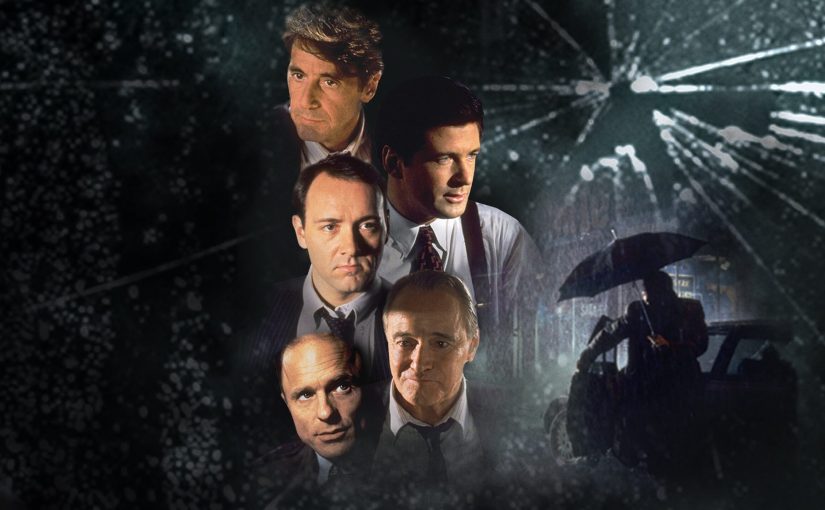
Early in the film, Alec Baldwin, known only as a man named Blake (based on the end credits) visits the office where these salesmen are based out of.  He delivers an unforgiving and harsh reality of what these men must do.  They either get their sales numbers high on the board, where they can win a new Cadillac, or they settle for a set of steak knives for second place.  After that, they are fired.  Regardless of where they currently stand though, they should not even be pouring themselves a cup of coffee.  Coffee is only for closers.  The office manager, known as Williamson (Kevin Spacey), only provides the men with sales leads that have already been exhausted with rejection and hang ups. 

Director James Foley does a wise technique with color.  The first half of the film appears in drabs of greens and greys amid an evening of torrential rain downpour.  Before Blake finishes his threatening presentation, he dangles new leads, the “Glengarry Leads,” in front of the men saying these are not for them, because they are only for closers.  The old leads that Williamson hands out are on green index cards, nothing flashy.  Blake’s leads are bright pink with a gold ribbon tied around them.  Foley makes sure that even a prop tells a story.

The salesman that gets the most attention is perhaps Shelley “The Machine” Levene played by Jack Lemmon.  He’s elderly and past his prime with no numbers currently on the sales board.  Frequently, he is making calls to the hospital for an update on his daughter who is due for surgery, but if he can’t make a payment, then the procedure is likely not to happen.  Lemmon is fascinating in maybe the best performance of his career.  Many of his scenes are toe to toe with Spacey as he shifts from pleading to demanding to disingenuously threatening and ultimately bribing Williamson for the new leads. Levene is so out of touch now that he can’t even sell Williamson on helping him out.  Spacey as Williamson is terrific in his defiance to not lend any sort of aid to Shelley.

David Mamet added additional material to the script, not found in the stage play.  The Blake character is new to the film, for example, and I think it is a better, more fleshed out story because of it.  As well, Foley is able to go outside of the reserved settings of the bar and office, as he follows Levene making a knock-on-the-door sales call in the middle of the rainy night to a family man.  This may be Lemmon’s best scene of the film as he weasels his way into the home to quickly get his raincoat and hat off and get a seat on the sofa as he begins his “once in a lifetime” opportunity that the potential customer may miss out on.  It’s a sales pitch, despite Lemmon’s charm, and the patron can see right through Levene’s performance.  As the door closes on Shelley, you’re terribly sad for his desperation and failure.

On the other end of the spectrum is the current, most successful salesman named Richard Roma.  He’s played by a showy looking Al Pacino who initially doesn’t perform in the broad strokes he’s become recognized for as an actor.  Pacino does a quiet, delicate approach to his character’s sales presentation as he shares a table with a sap (Jonathan Pryce) who is weeping into his liquor glass.  Roma stretches the rainy evening out in the bar with this guy, talking about vague anythings, until he can subtly pounce on him with a brochure that’ll get his signature on a contract. 

Two other salesmen, Moss and Aaronow (Ed Harris, Alan Arkin) vent their frustrations elsewhere in the bar as they eventually segue into an idea of burglarizing the office for those tempting new leads.  However, are they working together as a team on this idea, or is one working something over on the other?  Mamet’s dialogue is chopped up perfectly with utterances and interruptions, that before a character reveals his intentions, you are left flabbergasted.  What is demonstrated here is that a skillful salesman is also an efficacious manipulator.

The second half of the film is set on the following morning where the sunlight has come through.  New revelations following the stormy night from before will present themselves as the men gradually arrive at the office to find it actually has been robbed.  The obvious of circumstances are there.  However, Mamet sets up an ending that’ll leave you breathless.  It did for me the first time I watched the film.  Just when you think you are watching a protagonist throughout the film, something else entirely comes up.

Glengarry Glen Ross has been regarded as a modern-day Death Of A Salesman.  Maybe it is.  I’ve worked in this kind of field before. There were months where I was good at it, and like everyone else, I would brag about my success with recaptured anecdotes and celebratory curse words flying out of my mouth.  There were also months where I would gripe about how uncompromising this life is. When I didn’t want to do sales any longer, I spent twelve years as an assistant to sales representatives.  They are not your friend.  They are only focused on the next contract to be signed and booked before month end, and they will ask anything of you with a seething f-word attached to their request.    Are we so terrible if we can not make an unreachable goal with tools that offer no help and supervisors that lend no encouragement or forgiveness?  To be a salesman means that any of your past accomplishments or education do not define you.  You are only identified as the one who must acquire the next thing, and then the next thing after that.  It will change your attitude about yourself and how you treat others.  It’ll alter your dialogue which is so vitally apparent in Mamet’s story.  It will even influence you to take measures you never thought you’d be capable of.

James Foley enhanced an already electrifying script from David Mamet.  He knew that if he was going to show how hard and challenging it is to be a salesman of boring, uninteresting, and practically intangible parcels of land, then he was going to have to be relentless in the art direction and settings contained in the film.  The first half of the film never, ever lets up with the rain storm going on outside in the city street.  The evening is as black as can be, and yet Williamson casually will ask Levene if he is going out tonight. Who in the dead of night in the rain is going to want to talk to a droning salesman about anything?  Yet, that’s what is expected of this life.  The office setting is unfriendly, decorated with ideals that hang from the walls with phrases like “A man must embrace further than what he can reach.”  Little touches like this only add to the uncaring and selfish nature the men really have for one another. 

Glengarry Glen Ross depicts a hard life for the man in a suit.  You may dress like what is expected of a professional, but you are also always scraping the bottom of another bottom.  The cliché that money can’t buy happiness is personified in a film like this.  You may get to the top and score a nice commission, but it’ll soon be forgotten and nothing you’ve done before will lend to your current state.  Next month, someone else will be standing where you are standing.  Worse, you may never be standing on top again, and then what will you do?

Sadly, I believe that Glengarry Glen Ross reflects what many people experience at least at one point in their lives.  We are all salespeople to a degree whether we are doing a job interview or even trying to impress the parents of someone we are dating.  It doesn’t always work out.  The question is where do any of us go from that point.

ARGO

By Marc S. Sanders

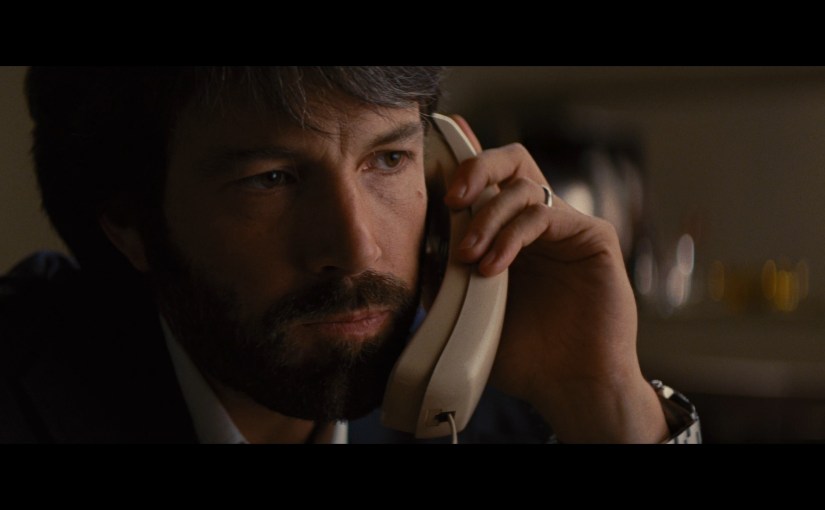
Ben Affleck’s third directorial effort Argo is his best. It makes me wonder why he followed this with playing Batman, a done to death cinematic character.

Argo showed promise of another great actor/director in the same vein as Orson Wells, Woody Allen, Robert Redford and Clint Eastwood. I’m sure Affleck will direct again but a Batman commitment certainly sidelines you. I hope he’ll direct again. I’m a big fan of his previous films, The Town and Gone Baby Gone.

The story tells of one aspect of the Iranian hostage crisis that spanned the end of 1979 through 1980. Six employees of the riot stormed American embassy in Iran manage to escape and hide in the Canadian ambassador’s home. Slowly but surely their hideaway will be revealed and they will inevitably be taken prisoner. Affleck plays CIA operative Tony Mendez who is tasked with getting them out. His plan, with assistance from John Goodman as legendary Hollywood makeup artist, John Chambers, and Alan Arkin as producer Lester Siegel, will make up a cockamamie story about producing a fake science fiction Star Wars rip off film called, you guessed it, Argo. They will do marketing write ups, poster advertising, and even a costumed table read at the Beverly Hills Hotel, all with the intent to just appear authentic as a film studio seeking out production locales in exotic Iran. The six hostages naturally are the film’s crew.

Affleck directs two acts here with two different narratives using both masks of theatre. Namely comedy and tragedy. The pleasure comes in watching Arkin and Goodman pair up to bring the Hollywood flavor that’s necessary. It’s great fun, especially when watching Arkin (in an Oscar nominated role) shyster his way with character actor Richard Kind to buy the Hollywood script-these two guys are like Oscar and Felix. Goodman is great as the been there done that Hollywood insider. He says “You can teach a Rhesus monkey to be a director.”

The drama comes with Affleck’s talent for delivering taut tension from his directing especially but also from his own performance as well as his cast of six hostages consisting of Tate Donovan, Scoot McNairy and Kerry Bishe. Bryan Cranston is also good as Mendez’ comunica from home. Cranston is just good in anything.

The tension builds with intimidating locals screaming of their loyalty to the Ayatollah as well as the eventual airport security. It’s all very nerve racking.

The critique for the the film lies in its own admission of historical inaccuracies. The escape was not as tense as the film suggests. More importantly, the caper was really primarily pulled off by the Canadian Ambassador, Ken Taylor (great actor Victor Garber). No. Canada is not given enough credit in the film. Still, here is a rare exception where I don’t mind. I guess because the suspense Affleck offers up is at its peak. You really shake your head at it all.

Forgive the cliche but Argo is a nail biting, edge of your seat thriller. At best, I can be grateful for learning about the true story following seeing the film. It’s a story that was kept hidden for 17 years. In these times of hardship and turmoil in America, it’s fortunate that a success can finally be celebrated.

Argo was undoubtedly worthy of its Best Picture Oscar win, and Ben Affleck should have at least been nominated for Best Director.

Fun Fact: Argo is produced by two former Batmans: George Clooney and Ben Affleck.