THE NAKED CITY (1948)

by Miguel E. Rodriguez

Director: Jules Dassin
Cast: Barry Fitzgerald, Howard Duff, Dorothy Hart, Don Taylor
My Rating: 7/10
Rotten Tomatometer: 85%

PLOT: In almost documentary-like fashion, New York City cops investigate the brutal murder of a young woman.


It’s that narration.

If The Naked City hadn’t included that cockamamie narration, I might have given it a “9” instead of a “7.”  Here is a police procedural ahead of its time, a pre-television-era herald of popular entertainments from Dragnet to Law and Order to CSI.  The story is absorbing and engaging from beginning to end, even if some of the acting is not especially Oscar-worthy.  There are enough twists and turns in the search for a cold-blooded killer – or killers – to keep your attention all the way through.  And over it all, intruding where it’s not wanted, is a Disney-esque narration from the film’s producer, Mark Hellinger, who also produced a superior prison film a year earlier, Brute Force (1947), also directed by Jules Dassin.

Imagine a scene where foot-weary detectives are pounding the streets, making inquiries at jewelry stores, hairdressers, pawnshops, looking for leads.  As we watch the scene progress, we hear the narrator: “Are your feet tired, detective?  Not to worry, only 400 more jewelry shops to go.”

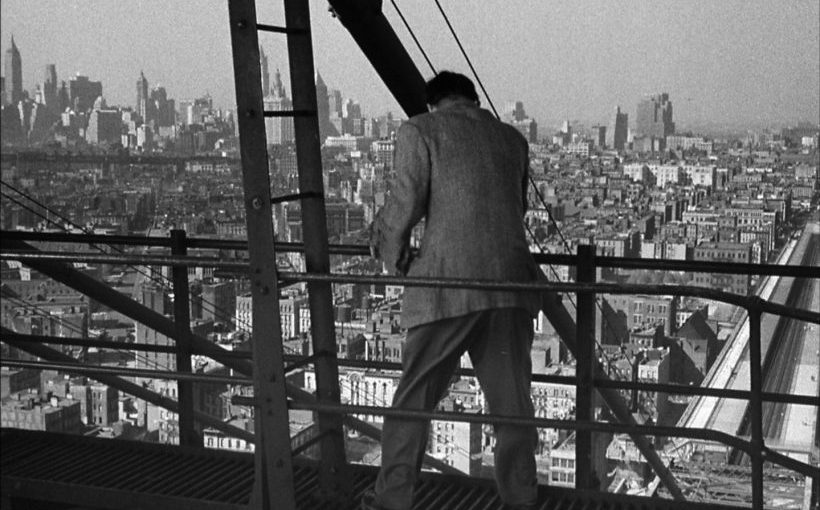
Or another scene where a detective looks wearily through a window at the city laid out below, pondering where to go for the next clue.  Cue the narrator: “There’s your city, Halloran.  Take a good look.  Jean Dexter is dead, and the answer must be somewhere down there…”

I hated the narration in this movie.  It reduced what I was watching to the level of one of those Disney animated shorts where Goofy is playing some kind of sport and the narrator describes the action while Goofy screws it up spectacularly.  Another example, as morning comes to the city: “The city is quiet now, but soon it will be pounding with activity.  This time yesterday, Jean Dexter was just another pretty girl, but now she’s the marmalade on 10,000 pieces of toast.”  Give me a break.  I fully understand how future TV shows made use of this kind of narration, but not to this degree.  It made a crime story sound like an industrial video.

So let us stipulate that I hated the narration.  The rest of this review will discuss the film as if the narration didn’t exist.  It’s best for you, it’s best for me…it’s best for us.

The Naked City opens with the murder of a young woman, Jean Dexter.  The rest of the movie details the police investigation and search for her killer.  In broad strokes, that’s pretty much it.  In its own way, it reminded me a little bit of All the President’s Men (1976) in that we’re focused exclusively on the process of investigation with very little cutting away to other participants.  The lead figures are a very Oyrish Lieutenant Muldoon (Barry Fitzgerald) and the dependable Halloran (Don Taylor).  The chief suspect is Frank Niles (an impossibly young Howard Duff, whom you may recall as Ted Kramer’s attorney in Kramer vs. Kramer [1979]).  Niles raises so many red flags that I started to think he was an obvious red herring.  Under questioning, he lies and lies and lies again, even “forgetting” to tell the police he’s engaged to the dead woman’s best friend.  Can this guy be for real?  We have seen so many criminals in so many TV shows and movies who are so much better at lying to the police…but he’s so bad at it that he must be innocent by default, right?

The investigation continues.  Clues and leads are chased down.  Another murder occurs.  False confessions are heard and dismissed.  The dead girl’s parents come down to the mortuary to identify the body.  (That particular scene was notable for being filmed at an actual New York City mortuary, a first for its time.  In fact, the vast majority of The Naked City was filmed on location in the Big Apple, one of the first major Hollywood productions to do so.  It’s hard to conceive of now, but this caused a minor sensation upon the movie’s release.)

While the mystery of the murder is the real meat of the story, I got the impression that the goal of the film was to bring these mundane police procedures to the masses, to show audiences that, while you work and eat and play and raise your families and go to baseball games, the good guys are on the case whenever something goes wrong.  And this is what they do for just one murder case.  In a city like New York, who knows how many murder cases are being worked on at once?  As the closing narration famously says, “There are eight million stories in the naked city.  This has been one of them.”  (Okay, that’s the one bright spot in the narration, let us never speak of it again.)

I can even draw a direct line between The Naked City and The Silence of the Lambs (1991).  In The Naked City, Halloran uncovers a possible connection between the second murder victim and the prime suspect in the first murder.  (It’s complicated.)  He gets permission from Muldoon to chase it down, despite how unpromising it is.  As he’s following his nose, Muldoon chases down a lead of his own, getting closer to the true mastermind behind this case.  In this way, there is a direct parallel in The Silence of the Lambs where Crawford takes a task force to a suspect’s house while Clarice follows a nearly invisible trail to Jame Gumb’s doorstep.

Everything comes to a head with a foot chase that leads to the Williamsburg Bridge, scenes that must have been a little mind-blowing for 1948 audiences as the camera seemingly defies gravity, climbing higher and higher into the scaffolding with the fleeing suspect.  (It should also be noted that the film perhaps romanticizes inner city life to a degree…as the suspect flees across the bridge, he breaks up a group of children skipping rope on the footpath.  Not the kind of thing I’d expect to see today, for sure.)

The Naked City is about as good as crime dramas in the ‘40s could get without resorting to the darkness and shadows of film noir.  This is, after all, a film about the good guys, not the bad.  Watching cops interrogate witnesses and compare notes about stolen jewelry isn’t quite as “sexy” as watching Bogie draw down on some hoodlums, but hey, that’s the kind of thing that really happens in the big bad city.

LA STRADA (1954, Italy)

by Miguel E. Rodriguez

Director: Federico Fellini
Cast: Anthony Quinn, Giulietta Masina, Richard Basehart
My Rating: 8/10
Rotten Tomatometer: 98% Certified Fresh

PLOT: A child-like woman is sold to a traveling entertainer, consequently enduring physical and emotional pain along the way.


Fellini’s La strada, the very first film to win the Academy Award for Best Foreign Film, is widely considered to be one of the greatest movies of all time, a touchstone of the Italian neo-realist movement that grew out of Bicycle Thieves (1948) and Umberto D. (1952).  Ask anyone who knows me, and they’ll tell you that, while I appreciate these kinds of films, they are not exactly my bread and butter.  There are some Italian movies that I will probably never watch, and I am quite sure I won’t miss them.  However, I am happy I finally sat and watched La strada.

But why?  La strada is not a happy movie by any stretch of the imagination.  It tells the story of a vaudevillian strongman, Zampanò (Anthony Quinn), who entertains street crowds by stretching a chain across his chest muscles until it breaks.  When the movie opens, he is paying the mother of a large family 10,000 lire for Gelsomina (Giulietta Masina), a child-like woman with a hugely expressive face.  For that princely sum, she will leave her family forever and learn a trade as Zampanò’s assistant.

They hit the road.  Zampanò is not a very nice man.  He teaches Gelsomina the basics but refuses to let her learn any more than is necessary.  When they eat dinner at a restaurant, he picks up a local floozy and ditches Gelsomina for the night.  When she tries to run away, he runs after her and beats her.  When they take up with a traveling circus, he refuses to let her perform with anyone else but him.  Gelsomina despairs of her existence, but she has convinced herself she can’t leave because she can’t think of anywhere else to go.

In a traveling circus, Gelsomina meets a carefree acrobat/clown known only as The Fool (Richard Basehart).  The Fool lives up to his name: performing dangerous high-wire acts and recklessly teasing Zampanò for no apparent reason, even heckling Zampanò during his act.  This is not a smart man, but he manages to steal a quiet moment with Gelsomina where, in his own way, he tries to let her know that her life has a purpose because EVERYTHING has a purpose, even a pebble he picks up off the ground.  “I don’t know what this pebble’s purpose is, but it must have one, because if this pebble has no purpose, then everything is pointless.  Even the stars!”

Examine that statement closely enough and it’s not quite as life-affirming as it seems, but it lights a spark in Gelsomina’s otherwise bleak existence.  From then on, she holds fast to that conversation, referring back to it when new hardships or doubts arise.  Meanwhile, Zampanò remains as cold and ruthless as ever, even trying to steal from a convent.

And then something unexpected happens that seems as if it will finally break Zampanò’s hold on Gelsomina, but no.  Gelsomina clings to the belief that her purpose is to be with Zampanò, no matter what happens or how miserable she might become.

…so, yeah, this isn’t exactly a happy film.  This is not the kind of movie I would normally seek out.  But in its bleakness, it achieves a kind of aching beauty, like Atonement (2007) or The Remains of the Day (1993).

A lot of that beauty is achieved through the must-see performance by Giulietta Masina as Gelsomina.  It’s clear that Gelsomina is stuck in a woman’s body but with the emotional maturity of a child.  Is she developmentally disabled?  The movie never makes it clear.  Perhaps she simply chose to retain her innocence while the rest of the world moved on around her.  In that way, she becomes almost like a character in a fairy tale.  I found myself wondering if the movie would have played the same had Gelsomina been a child rather than a grown woman.  It might have played a lot like the sequence in Pinocchio (1940) when he is captured by Stromboli and forced to perform for street crowds.

Masina’s performance as Gelsomina would be the single best reason I can think of to recommend this movie to anyone who might not otherwise watch it.  Her face and eyes light up like candles on a birthday cake when she smiles.  When she frowns, she puts clown makeup to shame.  And when she dons clown makeup herself and dances and plays the trombone, you can’t help but grin a little.  When she weeps because she can’t see The Fool anymore, she sounds like a little girl who’s lost a pet.  It’s one of the greatest performances I’ve ever seen.

That performance is key to the movie.  Zampanò’s cruelty and dismissive nature masks his own fear of Gelsomina’s innocence.  He keeps her down because he doesn’t dare allow himself to believe he might be in the wrong.  Watching the movie, we allow ourselves to hope that perhaps Zampanò will reach a turning point where he throws himself at Gelsomina’s feet, begging forgiveness for his terrible behavior and past misdeeds.  But will it happen in time to make a difference?

On the Criterion Blu-ray of La strada, director Martin Scorsese states in an interview that, if you’ve never seen a Fellini film in your life, you could watch La strada and 8 ½ (1963) and you’d know all there is to know about Fellini and his films.  I’m certainly no Fellini expert, but that sounds accurate to me.  La strada contains all the seeds – the score, the performances, the circus theme – that come to fruition in 8 ½.  But La strada is the more accessible of those two films, in my opinion.  If you’re going to start somewhere, start here.

THE LAST WALTZ (1978)

by Miguel E. Rodriguez

Director: Martin Scorsese
Cast: The Band, Eric Clapton, Neil Diamond, Bob Dylan, Joni Mitchell, Neil Young, Emmylou Harris, Ringo Starr, Dr. John, Van Morrison, Ronnie Hawkins, Muddy Waters, Ronnie Wood
My Rating: 8/10
Rotten Tomatometer: 98% Certified Fresh

PLOT: In 1976, American rockers The Band performed their last concert ever with an unforgettable guest list.  Director Martin Scorsese filmed it, and the rest is history.


I mean, 16 years on the road, the numbers start to scare ya. I mean, I couldn’t live with 20 years on the road. I don’t think I could even discuss it.
– Robbie Robertson, vocals and lead guitar, The Band


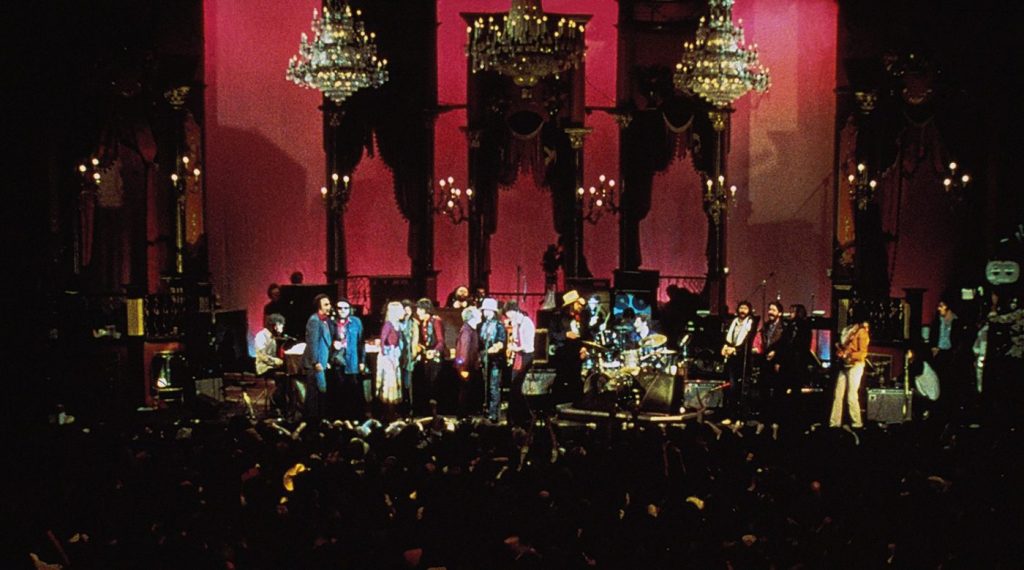
Martin Scorsese’s film of The Last Waltz, the Band’s epic final concert in 1976, is a curious exploration of the highs and lows of what it means to be a rock star.  Or not just a rock star, but one of the stars of a touring band, one of those perpetually traveling bands like The Grateful Dead or Phish or, God help us, The Rolling Stones.  In their performances, you can clearly see the heedless joy with which every musician plays their part, whether it’s a rockin’ guitar solo or a yell during the refrain or a keyboardist getting lost in his own world for a minute or two.  There are smiles and grins and humble bows to the cheering audience in the dark.

But Scorsese makes an important choice with The Last Waltz not to show just the highs of live performance.  With intercut interviews, filmed some months after the concert itself, we get quiet, introspective feedback from band members who clearly love performing, but who recognize just how much touring has taken from them.  They have no desire to follow in the footsteps of predecessors who paid the ultimate price for fame.  “You can press your luck,” says Robbie Robertson at one point.  “The road has taken a lot of great ones.  Hank Williams.  Buddy Holly.  Otis Redding.  Janis.  Jimi Hendrix.  Elvis.  It’s a goddamn impossible way of life.”  Here is a man who has decided it’s time to end the show before it jumps the ultimate shark.

In this way, The Last Waltz becomes more than just a concert film or a pretentious exercise in cinéma verité.  It clearly presents both sides and asks the viewer: how much would you give to achieve the fame and fortune of a rock star?  Certainly, the highs are deliriously addictive.  But in their interviews, members of The Band seem diffident or downright dismissive of their fame and fortune.  One band member is happier when they’re OUT of the spotlight.  “And as soon as company came, of course, you know, we’d start having fun.  And you know what happens when you have too much fun.”

But in focusing on their interviews, I don’t want to give the impression that The Last Waltz is anything but entertaining from beginning to end.  Let’s be honest: the concert footage is what’s going to amaze you at the outset.


Scorsese sets the tone right at the start with a title card in huge letters: THIS FILM SHOULD BE PLAYED LOUD.  The ensuing concert footage proves his point.  Especially on the newest Blu-ray from the Criterion Collection, the music coming out of the speakers is crisp and clean and begs to be blasted.  One number in particular, “Mystery Train”, is a pounding rockabilly song that felt and sounded most like I was really there.  The other guest performers do their part.  Muddy Waters gives a lesson on where the blues came from, putting pretenders to shame.  Joni Mitchell brings a more delicate touch with a heartfelt ballad about a wanderer who is imprisoned by the white lines on the road.  Van Morrison, whom I’ve never seen in any concert footage anywhere else, gives a damn good impression of Joe Cocker in his tight flared bellbottoms and low-cut T-shirt over his ample stomach – an image I would never have connected to Morrison.

I could go on, but you get the picture.  On the basis of the music and the performances alone, The Last Waltz is easily in my top three favorite concert films of all time, with first and second place rounded out by Monterey Pop and Gimme Shelter, respectively.  (For the record, I have never really cared for Woodstock…go figure.)  Combine that stirring music with the inside information from the interviews, and you’ve got a movie that captures a moment in time, a so-called “end of an era.”  Punk and disco are right around the corner.  Did The Band know it?  Watching it this time around, I couldn’t help but think of the ending of Peckinpah’s The Wild Bunch, with the gang walking to their certain doom because the world is changing, and they know they can’t change with it.  The Last Waltz isn’t quite that gloomy, of course.  But the sentiment is there.

NATIONAL LAMPOON’S ANIMAL HOUSE

By Marc S. Sanders

When a film opens with two students walking across a college campus as the classical horn music of proud alumni accompany them, and then one of the students stops to pull up his fly, you know you are probably in for a contrast of ideals.

Animal House set a new standard in comedy featuring a John Belushi whose expressions and improvisations appeared too fast for the camera to catch everything he’s doing. The script never gave him much dialogue because his routines of smashing beer bottles, smashing guitars, smashing beer cans and just getting smashed merited no dialogue. He might have looked like a dirty slob, but he was a craftsman of facial expressions.

Every scene of Animal House plays like an episode of an ongoing sitcom; a raunchy one at that. A dead horse, a pledge ceremony, a toga party, a sabotaged parade, and a food fight. Each topic is the title of a sitcom’s various episodes.

John Landis directed the snobs vs slobs script co-written by Harold Ramis, and 40 years later the material still holds up. Then again, 40 years later, I wonder if this film would even get made. I’d rather not dwell on that.

What I do know is that this movie is still funny. Outrageously funny.


CODE OF SILENCE

By Marc S. Sanders

I must admit I have not watched many Chuck Norris movies. Just a handful here or there like The Delta Force, but on my radar to catch was always the cop thriller from 1985, Code Of Silence. I always intended to watch it someday as the film is highly endorsed by Siskel & Ebert. As well, it’s directed by Andrew Davis, the skilled filmmaker who would go on to direct The Fugitive and Under Siege.

Code Of Silence works in two ways; two stories that live up to the title. Norris is a Chicago cop named Eddie Cusack who heads a squad of under covers within the city. The film opens with what is supposed to be a well-planned drug bust that goes wrong when the one mob faction is overrun by another mob. Cusack’s informant as well as others turn up dead just before his band were to move in with arrests. Nearby, two of Cusack’s men come upon a young, unarmed man. The rookie officer witnesses the elder officer accidentally shoot the kid, and afterwards he plants a pistol in his hand to make it look like self-defense.

Now Cusack has to contend with a mob war in the streets where a boss’ daughter (Molly Kagan) is the only survivor of an attack and he must protect her. While at the same time he has to deal with his squad turning on him because he knows what the elder cop really did. The code of silence motif is expected to be honored in both camps. Personal vendettas and violations of police policy need to remain quieted.

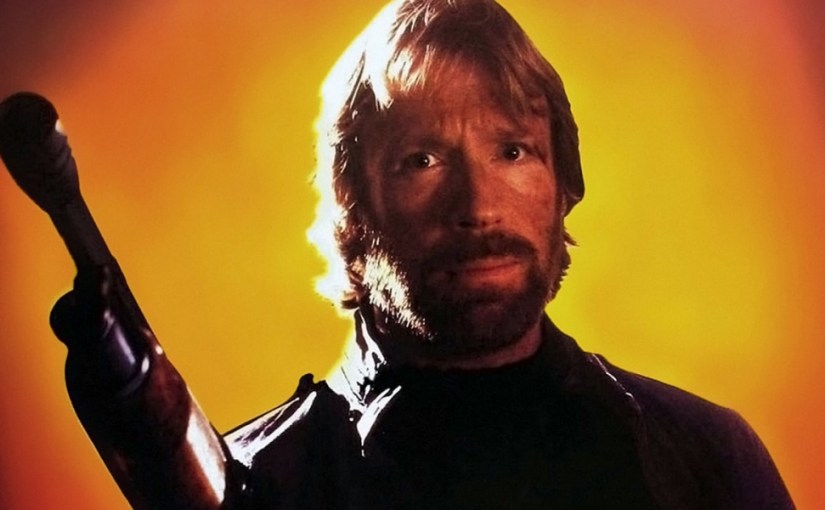
The film belongs to Norris exclusively. Andrew Davis allows some of the action star’s kickboxing skills to work their way into the movie, and it all becomes a sidestep dance routine really. It always amuses me in these action pictures where the star will take on twenty guys at once yet he fights one or only two of them at a time. The other eighteen or nineteen thugs wait their turn. Why not just have all of them tackle Norris all together? No. Then we wouldn’t get his outstretched 360-degree roundhouse kicks in the air.

There’s also an unnecessary cop robot contraption that Norris pilots for the climactic action packed ending. This thing looks a rejected auditioner for the role of Johnny 5 in Short Circuit. The robot must have been too tall for the part and rather clunky. It has no relevance to either storyline and was obviously inserted for fun, campy violence of fireballs and explosions in the necessary old, abandoned warehouse where all of these actioners have to take place.

Fortunately, Code Of Silence has good story material to work with, and some thrilling stunt work including Chuck Norris pursuing a bad guy on top of a moving elevated train that makes its way with an eventual leap into the river. From what I could tell, that was really Mr. Norris himself in that whole scene. Good footage here.

Andrew Davis relies on what would become regular side characters that appear in many of his other films including Ron Dean and Joseph Kosala. They always make for good cop antagonists within the Chicago settings of his films. Norris is also good in a quiet Clint Eastwood kind of manner as he holds his own beliefs against the rest of his department who support the elder cop.

I like the conflicts that happen on both sides of the law in Code Of Silence. Sure, it’s got some silliness to it with the kickboxing and the gigantic, cop robot that shamelessly waddles along, but the two stories hold up by keeping me engaged of their outcomes.

Code Of Silence is a pretty effective thriller.

CLERKS

By Marc S. Sanders

Did Kevin Smith know he’d create a lasting cultural phenomenon when he recruited his neighborhood friends to depict the mundane life of a convenience store clerk (Dante) and video store clerk (Randall)? How could he? He made this very shoestring budgeted movie by maxing out his credit cards. He’s on a short list of entrepreneurs who went all in. Bravo!

Clerks is a film that doesn’t seem to say much, but actually says a lot by the time it’s finished. Smith wrote a script where Dante mulls over how hard it is to move on, to change and accept the fact that even his ex-girlfriend moved on to get married, while he’s nothing but number 37 on his current girlfriend’s oral conquests. It’s a challenge as he and Randall debate over the accomplishments of Star Wars films. Then there are the eccentric customers like Smith’s friend Walt Flanigan (of Comic Book Men) as a guy looking for the perfect dozen eggs, or another one offended by the harsh language of a couple of bored clerks.

On paper, this all looks ordinary and boring. Yet, that’s the point. It’s fair to say we have all experienced the boredom of work with no definitive vision of a future. So, we complain about how we are not supposed to be there on our day off, or that the most important, immediate need is participating in a Saturday afternoon hockey game. Since we gotta work, we’ll compromise. If we can’t leave work, we will move the game to the roof of the store.

Two legendary cinematic characters also debuted, Jay & Silent Bob (Jason Mewes & Smith). They just lean against a wall, smoke and do not much else. Still, they offer atmosphere. There’s always loiterers mulling around a 7-11 or Circle K. They have stories as well, but we will likely never know. They just cross our paths as we pick up a soda. Smith wrote these guys as anybody we’d recognize and who we’re familiar with.

Kudos to Kevin Smith for following through with Clerks. This doesn’t look like much of anything, but it’s everything.

MISS SLOANE

By Marc S. Sanders

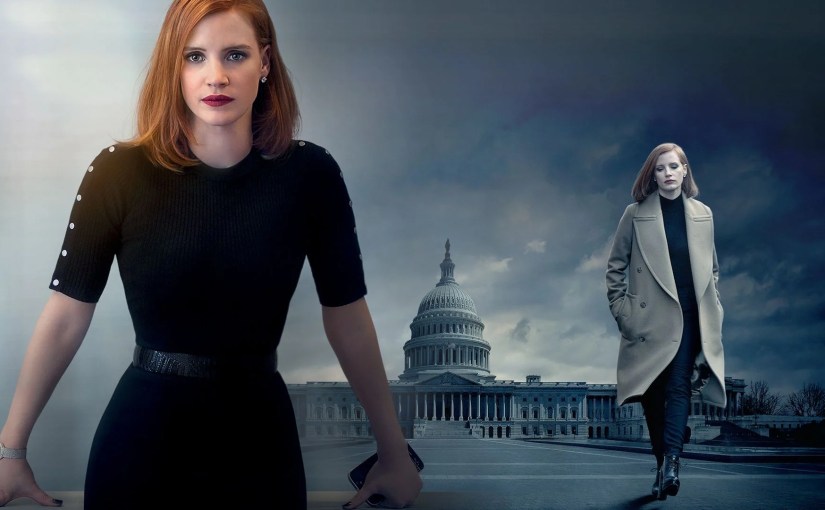
Jessica Chastain is an aggressive actress. The talent is on par with Meryl Streep or Katherine Hepburn for sure, and the Oscar trophy she won earlier this year is evident of that. Actually, she’s worthy of more than just one. My question, though, is if she is too aggressive. Films like Zero Dark Thirty, Molly’s Game, and Miss Sloane, put her in characters that never stop to react and smell the roses. That wears me out. Could you just slow down Jessica, so I can take this all in, please? You’re talking faster than I can think.

In Miss Sloane, Chastain portrays an impenetrable lobbyist. Nothing gets past this woman and despite her shortcomings, nothing will harm her either. Elizabeth Sloane will always be one step ahead of the game. This is a fierce chess player in the political arena. She’s omnipotent and admits to hardly ever sleeping. Maybe the pill popping helps with that. Like the Faye Dunaway character from Network, she also has no time for personal relationships or sensitive sex. So, she’s a high paying client for a male escort who will wait for her to come home to satisfy her fix.

Elizabeth is first employed with a wealthy private law firm who wants her to head up a bill in favor of the gun lobby. She declines, walks out the door with one long speech, a way over the top laugh (this is where there’s too much Jessica in my morning coffee) and over half her staff. She goes to the other side of the aisle to lobby aggressively against the gun bill.

From there it’s one aggressive maneuver after another and Elizabeth more than proves that she’s got the balls for this game. Only thing is, as Elizabeth proceeds to countermeasure and attack from her side, is she losing sight of the subject at play? Will her soul swim to the surface showing any sense of morality?

The film begins where Elizabeth is being questioned at a hearing headed by a state Senator (John Lithgow, always a pleasure to see). Then it moves on to show us how Elizabeth finds herself at that hearing.

Miss Sloane has no limits to what she’ll do to protect the integrity of a client’s argument for the bill even if it means embarrassing a traitorous teammate, putting another teammate in an unwelcome limelight of political journalism or maybe even employing a cockroach of the sort to use as a listening device. Miss Sloane won’t hesitate to take risks for the lobby she’s been hired to pursue, even if it risks someone’s life or their reputation.

A twist presents itself at the end and yeah, it could work assuming you believe Elizabeth Sloane, the brilliant lobbyist, can telegraph about fifty different actions that could take place amounting to that one moment. The math adds up, but were the numbers fudged to allow the arithmetic to work? That’s why a film like Miss Sloane is hard for me to swallow.

Does this woman have ESP? The final card she plays would require not only her own personal endurance, but that of a colleague as well. A lot of factors all have to be in sync to make this story work out the way it does. So my suspension of disbelief was really tested with this film.

I go back to Jessica Chastain. Zero Dark Thirty remains my favorite of hers. She was a great underdog against a male oriented governing body in the pursuit of Bin Laden. After that, Miss Sloane released a few years later and Chastain got bit by the Aaron Sorkin bug, I think. Endless talking works as an intellect that’s hard to challenge. Problem is, I’m the viewer and I’m wondering for the first thirty minutes what in the hell you’re talking about. Miss Sloane isn’t an Aaron Sorkin film, but Jessica Chastain will have you convinced she wants it to be.

Fortunately, writer Jonathan Perera with director John Madden ease up on the brakes allowing much more realistic and human characters to invade the film including Lithgow, Alison Pill and an especially riveting performance from Gugu Mbatha-Raw (recently seen by me with a subpar script called The Whole Truth) who becomes Elizabeth’s trusted sidekick both behind and in front of the cameras for political jockeying. This is an actress ready for some lead roles.

I described Miss Sloane as omnipotent earlier and that’s a problem for the first act of the film. This character never shuts up early on. There’s next to no impact on anyone around her. She just talks and talks and talks and she convinces me that she’s the smartest one in the room, but she also makes me want to turn the movie off. The film saves itself with the able supporting cast eventually.

To watch Miss Sloane is not to take any position on gun lobbying especially seriously. I’m not sure the filmmakers have a stance to play. I’m not sure the filmmakers know whether to even regard the titled character as a hero or villain. Actually, I just think the purpose of the film is to show corner cutting and how aggressive a made-up lobbyist can actually be, devoid of any determining factors. We are privileged to see how far a woman with stiletto heels, a cinched up red head ponytail and a tight business suit will go to win at any cost. It’s intriguing, but I guess I just felt unfulfilled by the end. It was all there. It just seemed to work itself all out too conveniently by the end. 

THE BIRDS

By Marc S. Sanders

Alfred Hitchcock’s monster movie is The Birds from 1963.  There’s really not much to the piece as far as a story goes.  Characters are just given a purpose to be with one another so that they can be tormented together.  In this case, the film offers up a near hour introduction of newspaper heiress Tippi Hedren playing meet-cute with attorney Rod Taylor.  How ironic that they begin a flirtation in a bird shop of all places only to reconnect at Taylor’s harbor island home in Bodega Bay, located on the outskirts of San Francisco.  Still, as only Hitchcock can demonstrate there’s an ominous feeling sprinkled throughout before the real terror takes flight in the movie’s second half.

While I don’t rush for repeat viewings of The Birds, there’s no doubt as to its influence.  Each time there’s a shot of a bird soaring in the sky, your eyes open wider.  Something will eventually take effect.  At the beginning of the film, Hedren looks out into the San Francisco sky to see large flocks of birds soaring overhead.  Later, while taking a boat in Bodega Bay towards Taylor’s home that he shares with his mother and sister (Jessica Tandy, Veronica Cartwright), she’s attacked by a random gull.  It’ll raise the hair on your arms for sure. 

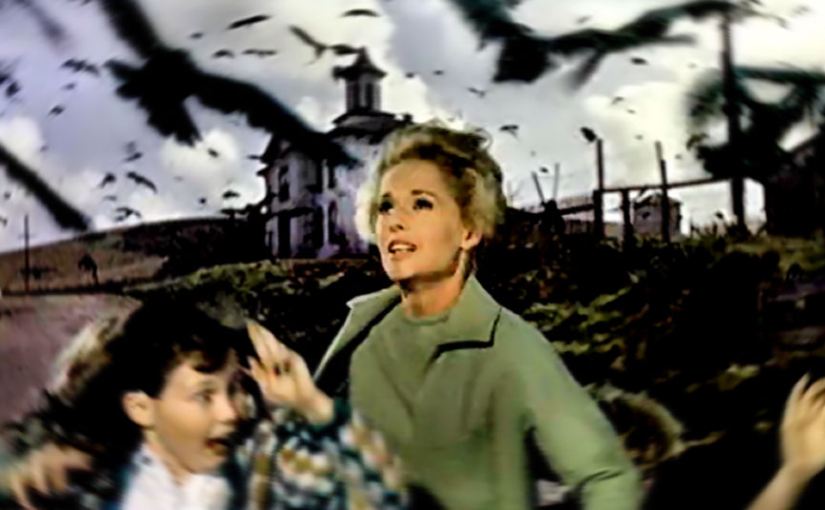
I’ve noted before how Alfred Hitchcock builds suspense.  The audience knows there’s a bomb under the table.  The characters in the film don’t. So, the audience is nervous as to when the bomb is going to go off or if the characters are even going to discover the explosive.  An outstanding sequence in The Birds includes Tippi Hedren sitting on a park bench near the jungle gym, outside of a school house.  The children are singing along inside.  One crow lands upon the jungle gym.  Then Hitch returns to a shot of Hedren calmly lighting a cigarette.  Then back to the jungle gym and there are four more birds perched just behind her.  Then back to Hedren, unaware.  Then back to the jungle gym for Hedren to turn around and there are suddenly hundreds of crows congregated together.  Effectively, other than the innocent harmonies of the children nearby, Hitchcock opts not to use any music to shock his audience as the scene develops.  The visuals lend to the fear.  The danger that threatens Hedren and the children heard off screen is at the forefront of the viewer’s mind.  No more is needed.  It’s scary, and you want to be as quiet and unalarming as Hedren so as not to instigate the monsters right next to you.

A later scene has Hedren ascend a dark staircase to open a bedroom door.  The roof has been torn open and suddenly the blackness comes alive with flapping wings from every direction.  That’ll make you shift in your seat.

Hitchcock offers plenty of set pieces for bird attacks, but another effective device is to show dissention among the ranks.  From a character perspective, the picture takes a sideways route to imply an oedipal complex between Rod Taylor and Jessica Tandy, who plays his mother.    Therefore, the script suggests Hedren as a threat to their relationship.  Before the film is over, they are likely going to have to develop a united front or it could be their undoing.  (Maybe it’s a nod to Hitchcock’s popularity with Psycho. A cute wink and nod.)

There’s also Suzanne Pleshette as the school teacher that we learn had a tryst with Rod Taylor’s character at one point.  That doesn’t spell out too well for Hedren, either.  As this bizarre epidemic becomes clearer, a scene in the town diner goes so far as to suggest that these random bird attacks didn’t start until Hedren arrived the day before.  Yes!!!!  It’s all her fault!!!! 

None of this will eventually matter though.

Other disaster films and monster movies later relied on exchanges like these, from Jaws to The Towering Inferno.  Hitchcock was wise enough to build tension.  Not a single bird in the scene, but still the fear and doubt among each other bares the strain.  There’s even an advocate for the birds with a strange elderly woman proudly debating her ornithological expertise, while a drunkard at the end of the bar declares the world is coming to an end.  All of these characters could have come from different movies, only to be pasted on to this canvas thereby lending to the frenzy.  Chaos must ensue among the masses.

Often, I get frustrated when there’s no explanation for a film’s central story.  I gave up on the TV show The Walking Dead many years ago because there never was a cause revealed for the zombie epidemic.  It became a smut of soap opera cliché accompanied with ridiculous gore.   Forgive the SPOILER ALERT, but I commend Hitchcock’s film for not providing a wrap up to The Birds.  The film ends with an uneasy final caption.  Nearly every inch of space on the screen is occupied with birds as the cast makes their way to the car to slowly drive out of town, careful not to disrupt the now dominant species of this universe.  Hitchcock provides a picture where the laws of nature declared a winner.  As intelligent as humans are considered to be, they have not won out.  They have had to surrender.  Why the birds attacked, we’ll never know.  Odd phenomena can happen.

There’s nothing thought provoking about The Birds.  It’s simply a film based on heightening your discomfort.  Often, I find the material and dialogue laughable.  The townsfolk notice a man lighting a cigarette right over a stream of gasoline and urge him to put out the flame.  Wouldn’t the dumb guy smell the diesel?????  However, then we wouldn’t get a fantastic fire ball to observe up close as well as from Hitchcock’s “God shot” in the sky with the birds looming into frame over the town below. 

The visual effects look outdated of course, but they still hold because of how Hitchcock demands they are used.  I noticed that his reliable composer Bernard Hermann is credited, but as a “sound consultant” this time.  The shrieking of the birds is what sends the chills down your spine.  Also, there’s the fact that Hitchcock offers up birds flying right at the screen or the windows.  A great sequence includes the front door of a house being gradually shredded apart by the bird masses.  The wood proceeds to splinter.  You don’t see the monsters but you know they’re right there on the other side.  Once that door breaks open or those windows shatter, then it’s likely all over for our heroes.  George A Romero exercised bits like this in Night Of The Living Dead.  Very, very effective.

The Birds is just okay for me, honestly.  The fright material is what keeps its legacy.  Yet, there’s a lot of soapy material among the cast of characters that’s not all that interesting.  Again, a purpose has to be served for these people to occupy the story.  Just offering a movie where birds hover and peck at people wouldn’t be enough.  So, we have to follow Rod Taylor and Tippi Hedren’s trajectory.  It’s fun to see screaming kids run from these animals turned menace, though.  I found it hilarious to watch a birthday party run amok.  I also yelp when I see a flock storm into Jessica Tandy’s house from the chimney turning the living room into a contained disaster area.  An especially gruesome discovery by Tandy later in the film is absolutely eye opening (pardon the pun, if you know what I mean), and clearly an inspiration to a well-remembered scream out loud moment in Jaws.

The Birds is fun, but it’s not the artistic merit you’ll find in other Hitchcock classics like Rear Window, Vertigo, Suspicion, or even Psycho. What I can promise is that once you get through the plodding character connection build up, you’re allowed to forget about any of their value to the picture and simply relish in the mayhem. 

PSYCHO

By Marc S. Sanders

To watch Alfred Hitchcock’s Psycho today is a blessing and a curse.  You can’t take your eyes off the craftsmanship of the film.  Yet, you know all the surprises and plot twists.  There’s only so much blood you can draw from the stone. 

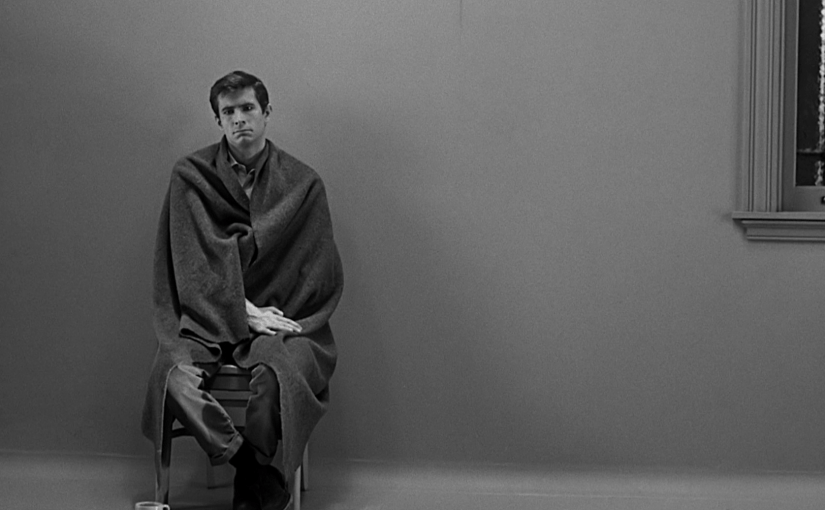
Recently, I told my fourteen-year-old daughter, who doesn’t like scary movies, that she needs to watch the film.  If only because she knows absolutely nothing about Psycho.  She has no idea what’s to come of Marion Crane (Janet Leigh). She’s never heard of the shower scene.  She doesn’t know about the true relationship between Norman Bates (Anthony Perkins) and his chastising mother.  Imagine, assuming you have seen the movie and/or know all its secrets already, watching the movie with someone who is seeing it for the first time with a completely blank canvas to go on.  Oh, the reactions you’ll get to see!!!

Hitchcock’s film, with a screenplay from Joseph Stefano, works under a lot of different dimensions.  It’s classified as the first “slasher movie.”  That may be true.  However, it’s much more intelligent than a typical Jason or Freddy Krueger fright fest.  Psycho begins as one story with a central character, seemingly innocent, carrying out a crime.  Later, it turns on itself and becomes something else altogether.

Marion Crane makes off with $40,000 in cash from a chauvinistic, obnoxious client of her real estate boss.  She hits the road, heading towards her lover’s home in nearby California.  Her impending doom is never implied.  Stefano and Hitchcock focus only on Marion’s scruples with the crime she’s committed.  She gets haunted by a curious police officer.  She certainly wonders what her boss must think when he’ll discover that she never deposited the money in the bank.  Is the used car salesman going to follow up on her after she urgently trades in her car for a new one with new plates?

Soon though, none of that will matter when she has no choice but to pull off the road for the evening to stay at the Bates Motel, currently with twelve cabins and twelve vacancies.

For the one or two readers who have never heard of Psycho, I’ll stop there with the narrative.  However, what I appreciate about the second half of the film is that the new central character, now young, quirky, altogether strange Norman Bates, seems to respond with avoidance when a private investigator named Arbogast (Martin Balsam), and then later Marion’s lover Sam (John Gavin) and her sister Lila (Vera Miles) start questioning him about Marion’s whereabouts.  Arbogast is on the trail of a thief who went off with $40,000.  Sam and Lila are also curious about the theft that seems unheard for Marion to commit.  Yet, there’s something else leaving them curious.  Norman, on the other hand, knows nothing as to what Marion was up to.  In his eyes, the only odd thing about her is that she checks into the motel under a different name.  All of these characters are coming in conflict with one another, but not for the reasons they think they are.  The fun part is that we are the only ones who know the hands that each player is holding.  Even more fun is when we uncover a secret that Norman has been hiding from the audience all along.

Hitchcock tricks his audiences with Psycho.  With its first story, we are in suspense of one criminal.  Will she get away with the theft? Rather, how and when will she get caught?  With its second story, we are unnerved by someone far worse and frighteningly mysterious.  Following the infamous shower scene, it’s a little nerve wracking to watch as Norman tries to hide the evidence in the trunk of a car that he pushes into the nearby swamp.  Any storyteller would just have the car simply sink.  Hitchcock brings in shadowed close ups (with his wise idea of black and white photography) of Norman chewing gum, and then becoming completely still when the car actually stops sinking midway through its descent.  As a viewer, your jaw drops.  What is Norman going to do if the car doesn’t fully submerge?

Later, it’s a wonder how Norman is going to circumvent around the unexpected visits form Arbogast, Sam and Lila.  Then, we are in suspense of their safety.  They’re just looking for the missing money while tracking where Marion went off to.  Unbeknownst to them, they have can’t even fathom her demise.

I was talking with one of my Cinephile brothers about Psycho, explaining how it follows a similar dynamic that the second half of Vertigo moves upon.  In Vertigo, the main characters, Scottie and Madeliene, are both in love with one another.  Yet, it’s for different reasons that they can’t explain to each other.  In Psycho, the characters are all under suspicion and even paranoid of each other, yet for all different reasons.  Norman never knew of Marion’s crime.  Though the other characters suspect that he does.  In both pictures, only we, the audience, know almost everything at play.  According to various documentaries I’ve watched, Hitchcock wholeheartedly trusted his screen writers to flesh out the stories.  He concerned himself more with constructing the film with a faithfulness to the script.  What’s commendable about the films Alfred Hitchcock chose to make is that he sought out these conundrums where his chess pieces are left bewildered or unaware of why they are sharing the stage with the other players.  The director had a way of channeling into deceiving his characters against one another, allowing the viewers to relish in their trickery.  Going a step further though, Hitchcock reveals other twists never suggested in the film to turn the audience on their ear in shock.

You can’t take your eyes off Psycho, even with knowing all the goodies that Hitchcock provides. 

Anthony Perkins especially is a tense and unnerving menace.  He has a boyhood innocence to him that should not appear threatening to Janet Leigh’s Marion Crane.  It’s in his relaxation with the role that it feels all the more terrifying to the viewer.  Simply look at the way Arbogast pulls up to the motel and Perkins is sitting calmly on the porch eating his bag of candy.  Watch how he casually shares with Marion how he relishes in stuffing the birds he has mounted on the parlor walls, or even how he casually offers cabin number one for Marion to occupy so that she can be close to everything.  Norman Bates hides himself very well in his virtue.  A wolf in sheep’s clothing.

The Bates Motel and the large house poised behind it on the hill were set up on a Universal back lot.  It remains one of the most famous settings in film history.  When you see the silhouette of Norman’s mother in the window from afar or young, slender Norman standing in front of the house, the images of the chilling locale stay with you whether it is on a dark and stormy night or even during a sunny afternoon.  Hitchcock opted to shoot the film in black and white to taper the goriness of the piece.  Outside of the gore elements though, the black and white lends a foreboding feeling to this destination.  Even before we realize that Marion is in danger, we feel uneasy with just arriving at this place.

The shower scene of course is one for the ages.  I’m not here to discuss all of the mechanics of film’s centerpiece.  The assembly of the scene’s elements are masterful though.  Can you imagine the scene without Bernard Hermann’s shrieking score?  Hermann was to Hitchcock like John Williams is to Steven Spielberg.  The aftermath is brutally shocking as well.  The camera does a zoom out on Janet Leigh’s eye as the soaking head of her corpse lays down on the bathroom floor.  I notice the eye does just the slightest twitch.  For me, that’s all the more disturbing than just a very still open eye.  It implies the last bits of life leaving her body and consciousness.  Later, when Norman cleans up the bathroom, Hitchcock shows his process with a mop and neatly wrapping Marion in the torn shower curtain and disposing of anything belonging to her, including a newspaper that isn’t just a newspaper.  Norman is methodical.  Perhaps this strange man has done something like this before.

I do have one grievance with Psycho.  The air is kind of sucked out of the film in its last few minutes before that delicious last close up on Norman.  Stefano’s script offers up a psychological explanation for what Norman Bates seems to suffer from.  It’s as if we are given a scientific description for what ails him. This is all painfully boring.  I dunno.  Maybe in 1960, when Psycho was a pioneering kind of horror film, and moviegoers were not as familiar with the genre that seemed far scarier than Boris Karloff, and vampires and mummies, they needed a summation like this.  Sixty years later, naturally this is not necessary.  We know all to well that there are disturbed people who live among us.  We know, sometimes, to be cautious of folks like these.  For someone as reputed as Hitchcock was, being identified as the “Master of Suspense,” this long monologue, spoon fed diagnosis from the psychiatrist kills all of the horror we’ve bared witness to over the last two hours. 

Psycho was the first slasher movie.  It was the first movie to feature a toilet and have it flush on film. It has one of the most famous characters in all of film history.  It has one of the most famous scenes of all time.  It was directed by one of the greatest directors of all time.  Yet, it also has one of the worst conclusions of all time.  If ever a scene should have been cut from a finished product, it is the second to last scene of Psycho.

Now, go find someone who has never heard of Psycho, knows nothing at all about Psycho, and watch them watch Psycho.  Of course, as the famous marketing campaign for the film insisted, by all means do not start the movie or walk in the middle, and never reveal any of its secrets.

MISSION: IMPOSSIBLE III

By Marc S. Sanders

Remember that CW TV show called Felicity?  I’ve never seen an episode, but I remember the advertisements.  Beautiful, former child actor, Keri Russell with the golden, curly locks of love, was on her way to college.  Every commercial had that crisp, home like comfort feel voiceover.  It left me with an impression that this was a corny, yet sweeping exploration of coming of age while at college, and gaining independence.  The show came from JJ Abrams.  Abrams is a good director and writer.  He’s now one of the biggest producers in Hollywood.  Back in the early 2000s however, he wanted to nurture his characters.  Protect them.  Make them feel warm and content.  After Felicity, he went on to develop a spy thriller series called Alias with Jennifer Garner.  She was a college student with a lovable roommate by day and was super spy by night, or whenever the moment called for it.  Abrams went on to blending his coziness with that of stunts and explosions that modernized a series like, say…Mission: Impossible.  Naturally, when Tom Cruise recruited him for the third film of the high-octane franchise, we got the “Felicity Finish” applied.  Ethan Hunt is sweet and kind, and he’s ready for married life.  How precious!

Don’t get me wrong.  Mission: Impossible III is likely what kept the still running blockbuster movie series going.  Following a style over substance lackluster entry before, from action director John Woo, this third entry went in a completely different direction.  Ethan Hunt hugs a soon to be sister-in-law. Ethan Hunt cries.  Ethan Hunt has feelings.  Ethan Hunt has to rescue who he regards as his “kid sister,” Felicity…I mean adorable Keri Russell from being held hostage.  Ethan Hunt belongs on the cover of a Hallmark card with actress Michelle Monaghan.

I imagine JJ Abrams is not fond of the early James Bond movies.  I’d make a case that he watches them and wishes that someone, anyone would just give 007 a warm and sincere hug after he saves the world, and hold him close.  Superspies have emotions too, ya know?

The story of this third M:I chapter focuses on the pursuit of a MacGuffin known as the rabbit’s foot.  A powerful weapons dealer named Owen Davian (a brutally frightening Phillip Seymour Hoffman) is working to get a hold of it.  Following a first act rescue mission that Ethan and his IMF team (Ving Rhames, Maggie Q, Jonathan Rhys Meyers) engage in, the main hero finds reason to capture Davian and intercept the mysterious rabbit’s foot.  Complications get in the way because Ethan has fallen in love with an adorably beautiful doctor named Julia (Monaghan), who is unaware of her fiancé’s exploits.   

The action is superb in Abrams cinematic directorial debut.  Once it gets started after a sweet engagement party scene, it does not let up.  Everything is well edited and choreographed. An essential part of a Mission: Impossible movie.  An unexpected attack on a bridge crossing is spectacular.  The covert tactics are fun to watch as well.  When Ethan and team secretly invade The Vatican, the step-by-step maneuvers are carried out with gleeful ease.

There are twists and double crosses at play as well that you are not even thinking about looking for.  Frankly, they work more effectively here than they did in the original M:I film directed by Brian DePalma.  When the traitor is revealed to deliver a line like “It’s complicated,” it is not unreasonable to gasp.

Hoffman still remains the best of the villains in Cruise’s action franchise.  Maybe that’s by Abrams’ design because this is probably the most personal of all the films to date.  Phillip Seymour Hoffman is the guy who will be apprehended and braced to a railing on an airplane by the IMF team, and yet will still hold the upper hand.  A question like “Do you have a wife or a girlfriend?” has a much more sinister context when uttered by Phillip Seymour Hoffman.

I do recall when I first saw the film that the ending is not original.  It’s an opportunity for Tom Cruise to do another running scene, but it was first used in an episode of Alias where an operative is remotely giving directions to the hero while talking on a cell phone.  Clever the first time.  The second time seeing it, I was just calling it out.  So, Abrams needs to stretch his imagination a little.  No matter.  The pulse of the adventure races at high speed.

Mission: Impossible III might be unabashedly hokey and corny.  Everyone looks like they belong in a JC Penney commercial at Christmas time, or on a CW TV show like Felicity. However, it won’t deny you of what you are looking for which are big stunts in the sky and on the ground, along with the cool gadgets and those signature pull away masks that made the original series so memorable. 

I still realize that by the time film series reached this chapter, the franchise still belonged exclusively to Tom Cruise occupying every frame.  Once again, his team of IMF agents really don’t matter or carry any substance except to wear clothes.  At least this time, Tom Cruise cries over someone else.  So, he’s not as self-involved as the last couple of times, or even the last couple of dozen movies.  That’s a nice change of pace.