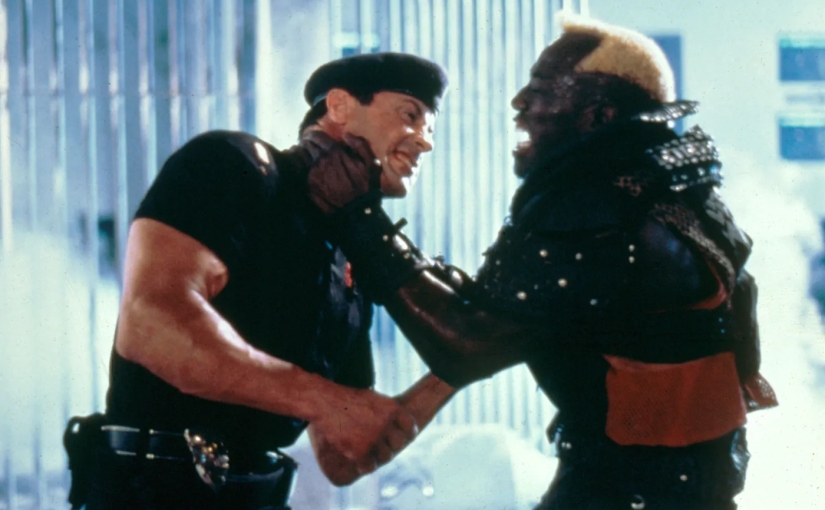
DEMOLITION MAN

By Marc S. Sanders

In the years since the Sylvester Stallone/Wesley Snipes futuristic action picture Demolition Man came out in 1993, bloggers have been giddy to post about how brilliant the satire is, especially since much of its fictional future set in a totalitarian San Angeles (formerly Los) in the year 2032 ended up becoming real to some degree.  Okay, fine.  I’ll go with what they say.  However, Reader, this is not on the same level as Paddy Chayefsky’s prophetical film, Network, and the legacy it has bestowed.  Demolition Man remains just as stupid as it was when it first came out.

In a mid-1990s prologue of fire, gunfire, and flames, a vicious killer named Simon Phoenix (Snipes), with a happy go lucky habit of giggling through the mayhem he unleashes, is apprehended by decorated cop John Spartan (Stallone).  However, both men are sentenced to decades of cryo-freeze imprisonment because the hostages that Phoenix held had perished and Spartan was found neglectful.

The film jumps to 36 years later. Phoenix has been released and immediately returns to his old habits.  The problem is the law enforcement of this period is not equipped to contain the crazed criminal.  So, Spartan is defrosted as well to go up against Phoenix.  This future is occupied by the cute smiles and charms of Sandra Bullock, Benjamin Bratt and Rob Schneider as the cops who happily sing the melodies made famous by radio and television ads.  Guns are entirely outlawed along with drugs, alcohol, spicy food, and obscene language.  Say a curse word and a machine is nearby, quick to charge you with the offense.  Touching and the exchange of bodily fluids are forbidden as well.  A high five with no contact was an uncanny precursor and is now reminiscent of the early days of the Covid crisis when it was strongly urged that people not even shake hands.  About the only favorable improvement of this future is that toilet paper is no longer used, and people resort to solving their hygiene problems with three seashells.  Regrettably, the technique is never demonstrated.

This film invests a lot of time in its satire, and I appreciate the attempt to find its humor.  The problem is the humor is delivered by Sylvester Stallone and he’s not Bill Murray or Aaron Eckhardt (check out Thank You For Smoking).  Satire is not a wheelhouse for Stallone to reside in.  Sandra Bullock on the other hand is cute in her response.  A memorable scene could have been so much better had Bullock had a more appropriate scene partner.  Lovemaking takes on a whole new method in this 2032 future.  Head devices are used to stimulate the mind.  Oddly enough, you could say that’s the direction that virtual reality has taken.  I appreciate the intuitiveness, but Stallone’s performance doesn’t.  What was intended to be a foreign experience for sexual gratification, comes off very clunky with Stallone.  Imagine what Ben Stiller or Paul Rudd could have done here.  Bruce Willis would have been marvelous in a scene like this.

Wesley Snipes is just as good an action star as Stallone or Willis or Schwarzenegger.  Unfortunately, his Simon Phoenix is so one note as a villain.  He’s a got a bleach blonde crew cut and a giggle and nothing else.  Stallone’s character describes Phoenix as a dirt bag, and the dastardly bad guy shoots guns and does quick kicks.  There’s nothing to know or learn about this guy.  He’s just a target for Sylvester Stallone to do his typical Sylvester Stallone with a shotgun and a handgun and his signature rahhhhhhh bellow that he’s provided in Rambo and Cliffhanger and Cobra and most of the rest of his career.  (Don’t get me wrong though.  Stallone does have a good repertoire of movies.  This one in particular is what doesn’t work.)

Denis Leary lends to the thin plot for a time.  Back in ’93, Leary was known for a few MTV ads where he did his infamous ranting monologue while popping a cigarette.  Because the script for Demolition Man is so nil, the angry comedian is granted opportunity to do his schtick here…twice!  It didn’t amuse me in ’93.  Now it’s just terribly outdated.

Back to the satire, I question the response of the players.  This film takes place only 36 years after a time of violent crime and cursing and smoking and drinking and all the debauchery that we were tolerated.  When Rob Schneider and the police look shocked and terrified at Simon Phoenix’ measure of violence, they are completely oblivious to what’s occurring.  I dunno.  Should they be that gullible?  This guy is only from a time that’s just over thirty years ago.  It hasn’t been that long.  Bullock even has a poster of Lethal Weapon 3 hanging in her office.  The response was hard for me to swallow, and that’s what killed the satirical attempts.  You can’t be that dumbfounded or naïve, can you?

There was a good idea here, but any kind of semblance of thought went out the window once that was jotted down.  The right player was not inserted into the main slot.  Stallone is miscast.  That’s the biggest problem.  Demolition Man hinges on the ho hum gunplay of any Sylvester Stallone actioner and stands on a sliver of irony with how dynamics have played out since the film’s release.  That’s not enough to consider it a fun kind of popcorn flick, though.  Demolition Man needs to remain frozen in time.

LIFEGUARD

By Marc S. Sanders

Sam Elliott is Rick, the Lifeguard at a sunny Los Angeles beach in 1976.  He’s handsome with his trademark mustache and bronze tan.  He’s also in his early thirties and his parents as well as some friends think it’s time he moves on from his occupation into a more responsible and adult line of work.  Even Rick considers the fact that perhaps it is time to finally come of age.

This film from director Daniel Petrie is nothing special or necessarily memorable.  However, while I first thought it would be a wasteful story of just the various walks of life that peruse the beach, it turns out to be a personal story about a man well past the time when he should have transitioned into the next phase of his life.

Rick has been invited to his fifteenth-year high school reunion.  It’s pretty telling when he enters the ballroom.  Petrie does close ups of the other attendees who are all talking about their jobs, maybe their children and spouses as well, maybe even their divorces.  Rick arrives in his gorgeous bachelor ride, a Corvette Stingray convertible, donning a leather jacket and a shirt unbuttoned to the middle of his chest.  He’s a fish out of water with his former classmates, but he’s still admired and welcomed.  He rekindles a romance with an old flame, Cathy (Anne Archer) who’s a successful art dealer, and he’s welcomed to get to know her young son.  Cathy is ready to go the distance in a relationship with Rick.

At the same time, Rick is trying to hold on to his youth of a bygone time.  He warns his new, college age lifeguard partner, Chris (Parker Stevenson), not to get involved with a cute and precocious seventeen-year-old kid named Wendy (Kathleen Quinlan).  Wendy has her eye on Rick though, and for a moment he returns to when the beach and the surf were once new to him, and he welcomes her invitation for an evening of lovemaking.  Later, as Rick becomes more aware of people his own age doing more appropriate activities for his generation, does it become a challenge for him to reject Wendy’s ongoing attention. 

The legalities and morals of Rick’s involvement with an underage girl are approached but the movie doesn’t delve much deeper than that.  It’s a film of its time, made in the mid-1970s.  I thought of movies like Little Darlings and even the original Meatballs when the drama focused on the internal struggle of some of its main characters. 

Lifeguard starts out episodic as it shows the shenanigans of its beachgoers.  Rick and Chris laugh as two goofballs manage to strip a bikini top of a young blond.  They also fend off a couple of potheads picking on a teen regular.  They deal with a perverted flasher.  Then the movie improves as it gets personal with Elliott’s character and his performance. 

Rick is the guy that everyone looks up to, but he’s human and he can even falter on a team relay race, gasping for breath that just won’t come as he sprints out of the water.  This is a good moment in the film.  Rick is desperately trying to catch his breath and young Wendy is looking right at him trying to see if he’s okay.  Rick’s youth is speaking directly to himself fifteen years later. 

He’s encouraged by a classmate to become a Porsche car salesman where he could make good money.  A good dinner table scene with his parents also occurs when he’s pointedly told to grow up.  I remember a couple of conversations like that with my father.  The question is who does Rick have to grow up for, himself or those around him? At the same time, he’s a very responsible and good lifeguard, and he reminds us that being a lifeguard is also about being a literal life saver.

I appreciate the conclusion to the film.  It’s more realistic and grounded than other movies might have offered with similar themes.  Framed around acoustic guitar and vocals from Paul Williams, Daniel Petrie allows moments of silence for Rick to contemplate and think while gazing at a sun soaked beach and ocean, not talking with anyone about what his next step in life should be.  Don’t we all do that, where we just sit and think, pondering the possibilities of various outcomes for ourselves? 

Lifeguard may be outdated, nearly fifty years after it was filmed, but it is an honest account of a guy who may be content with his current state, even if he’s not ready to consider what’s to come as he continues to age. 

THE LOST WEEKEND

By Marc S. Sanders

Ever wonder why I write so many reviews?  It’s because I yearn to be a successful playwright/screenwriter.  I’ve directed three original plays that I’ve written over the years.  I will be directing a fourth for the holiday season later this year.  Had a few short plays I wrote performed locally as well.  Still, I suffer from a terrible ordeal that often grinds me into bouts of depression and internal rage.  Writer’s block! 

My father always told me that he stayed away from gambling and casinos. He said it was because he could have an addictive personality and he was not confident he could stop if he started.  I know what he means.  I have an addiction.  One that’s not commonly recognized, but I obsess over something every single day. Without fail, every damn day.  It’s my weakness.  Sorry.  I must keep that to myself, though.  Yet my pursuit of what preoccupies my mind taxes on my motivations to write and stretch the imagination needed for churning out one script after another.  So, a remedy is to write about movies that speak to me in lieu of my next great play. 

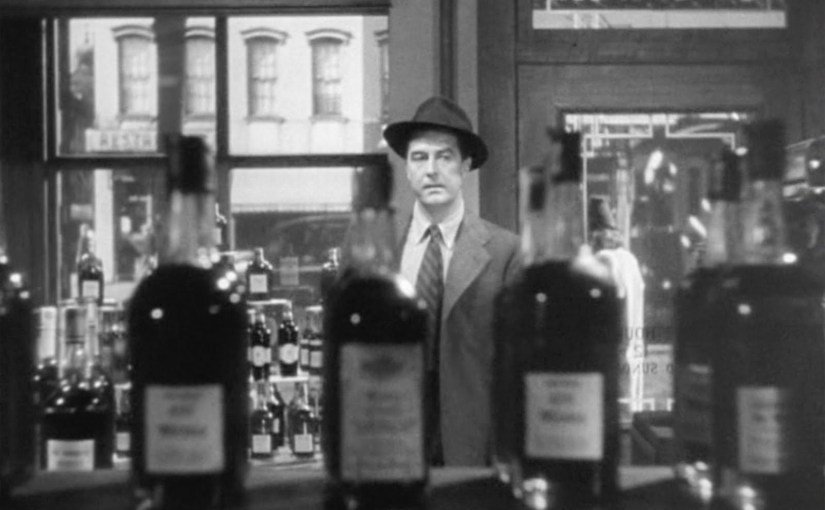
Billy Wilder’s Oscar winning drama The Lost Weekend demonstrates a writer’s inability to exercise his talent when an endless need for alcohol consumes his every waking moment.  Ray Milland delivers an Oscar winning performance as Don Birnam, an alcoholic wannabe writer of the worst kind.  When Wilder’s film opens, Don seems healthy and spry.  He’s clean shaven, well dressed, and ready to pack a bag for a weekend getaway that his brother Wick (Phillip Terry) has arranged for him along with Don’s girlfriend Helen St. James (Jane Wyman).  Wick implies to Don that this trip is just what his brother needs after what he’s recently been through, and he’ll have his typewriter with him to write in calming solitude.  Eventually we get an idea of what Wick has been referring to as Don attempts to sneak a bottle of rye that is strung outside the window of his New York apartment.  Wick catches Don in the act, pours the bottle down the drain and assures him that he won’t find another drop of liquor anywhere.  He doesn’t even have money to go to the corner bar.  So, Wick and Helen leave Don alone for a few hours before it’s time to depart. Don gets ahold of some cash though, and thus begins a spiral into a drunken binge over a four-day weekend.

I read that when this film was released, test audiences laughed at it.  I guess in 1945 people were not attuned or prepared to witness an account of a very real disease like alcoholism.  I’m not certain it was even diagnosed as a disease at that time.  Surely, the addiction was an ailment though, and Billy Wilder uses some effective cinematic devices to demonstrate the journey into madness and desperation for even just a tiny shot glass of gin or rye. 

A repetitive device is to show a tormented performance from Milland within the shadow of bars or fences.  He’s trapped in his own need for swill.  A telling moment occurs when Don is desperately trying to pawn off his typewriter just for some money to buy more alcohol.  Every store in the city is gated and closed on this particular Saturday though.  It’s the Jewish holiday of atonement for past sins, Yom Kippur.  I found that little detail to be interesting.  Surely, it’s a sin to harm yourself whether by alcohol or suicide, for example, and the holiday is a time for speaking to your inner self and Hashem (G-d) for your past transgressions.  Yet, that is no matter to Don.  He’s not ready or wanting to climb out of his dark hole.

Inanimate objects or props are also given much focus.  Early on, Don is seen at the local bar and Billy Wilder brings an inventive visual to explain just how much this character has consumed in under two hours.  The camera focuses on the wet rings on the bar top left by Don’s shot glass.  First there are two rings, then four and soon, fifteen.  Wilder also zooms his lens into the very bottom of the small glass filled with liquor to show how much the audience will drown in Don’s despair over the course of the film.

Other props also work towards Don’s paranoia such as a ceiling lamp bearing the shadow of a hidden bottle.  Milk bottles left in front of his apartment are not collected from one day to the next showing the passage of time for this weekend, and how even the most basic chore is dismissed so Don can extend his stupor.  A lady’s unguarded purse offers temptation.  A tossed lamp shade seems to glare at Don like a hole that he’s in, as he gets weaker and weaker. 

A magnificent scene, one that I can envision a skilled director doing today with quick cuts on digital film, occurs as Don recalls sitting in a crowded opera house watching the toasting scene of La Triviata; one of the most recognizable operas of all time.  Don is one of many in the audience, and yet he’s the only one alone with the production’s props of various drinking glasses and champagne bottles being used on stage that are mere inches away.  Very quickly into the scene, Billy Wilder skillfully draws focus from the opera singers and diverts towards the immense amount of liquor adorning the stage and the cast with quick cuts of Don salivating and perspiring alone in a chair of a crowded theater.  Everyone else is watching the performance.  Don is gazing at the alcohol.  I wouldn’t be surprised if Martin Scorsese had much admiration for such a sequence.

Phillip Terry is very good in his performance.  I’m surprised he’s not promoted as much as the other two stars of the picture.  Wick cares for his brother, but he’s ready to give up on him after six years of this ordeal, with one more transgression played out. He’s exhausted from lying to cover for Don’s weakness.  He represents the outsider of the dilemma who’s been affected by someone else’s ailment. Jane Wyman as Helen serves a nice purpose as well.  The one last hope for Don.  She’s the only one left who holds on to the faith that she can pull Don out of this nightmare.  Wilder presents these characters as side effects in the Oscar winning script written by him and Charles Brackett. 

Another haunting, but effective dimension comes when Don finds himself in the alcoholics’ ward at Bellevue Hospital, shot on location, and the first film to ever do so.  With an eerie use of a theremin in the soundtrack from Miklós Rózsa, Don is surrounded by dark shadows and tormented victims suffering from drying out just like him.  A nurse explains that he still has the DTs to experience like envisioning being surrounded by horrifying images like bugs crawling on him or something comparatively worse.  I recall from childhood seeing this symptom used on an episode of M*A*S*H.  Wilder invents his own kind of imagery and it’s pretty shocking in its grotesqueness.

I ask for forgiveness when I say that The Lost Weekend seems a little melodramatic. Maybe that’s because movies have built themselves into much more graphic and honest depictions of alcoholism since 1945.  The ending seems to welcome a stringy violin to accompany Ray Milland’s final scene with Jane Wyman.  However, I’m completely impressed with how pioneering this movie must have been for its time.  Billy Wilder didn’t shy away from the dramatic side of drinking. 

The Lost Weekend is certainly an effective and important piece on the study of alcoholism.  I’d recommend it as a visual reference to what can happen to the one who suffers, as well as those around him, including the bartender who deals with the regulars he easily knows by name.  While it’s certainly a movie of its time, the message remains the same.  Though I’m no expert on the effects of alcohol, I’ve seen enough friends who deal with the problem to know that the message in Wilder’s film still rings true.  An addiction to drink will dominate a life.

I always say that movies offer another valuable avenue to learn from.  There’s much to learn from The Lost Weekend.

SPIDER-MAN: ACROSS THE SPIDER-VERSE

By Marc S. Sanders

Spider-Man: Across The Spider-Verse is a gorgeous kaleidoscope of color and kinetic energy.  Joaquim Dos Santos, Kemp Powers and Justin K Thompson are a directing powerhouse trio making every scene, moment, or caption completely unique from anything you’ve seen before.  This movie never stops being inventive with itself, all the way down to its end credits.

Within the first half hour of the film, two stories unfold where two “Spider heroes” from different dimensions are struggling with maintaining their costumed alter ego while grasping with lying to their families.  Reader, having just seen the 2023 live action interpretation of The Little Mermaid, I can tell you that in comparison, Across The Spider-Verse is more frank and honest in its characters with what makes them tick and what pains them during their adolescent years.  The acting in this film of various forms of animation is sensational.  Often, animated films don’t let up on the high energy, like the Minions movies for example.  It can get tiring.  This Spider-Man picture allows those quiet intimate moments where it is hard for any teenager to come to terms with his or her parents.  Gwen and Miles are fearful of disappointing those that are close to them.  They’re also reluctant to surrender the secrets they value only with themselves.  Thus, it puts a strain on their respective familial relationships. 

Eventually, the two friends must even come to grips with secrets they’ve kept from one another.  It doesn’t matter that these characters are superheroes.  This is a coming-of-age film on the same level and maturity that writer/directors John Hughes and Cameron Crowe approached with many of their films.  Most teenagers have something unusual in them, and part of growing up is sometimes struggling with whether to ever let our guard down.  The conflicts that Gwen and Miles experience are trying to figure out what is best for themselves and the relationships they have with their parents.  I really felt for them in those quiet moments when the music was turned off and the fast paced scene changes that moved the film’s adventures came to a welcome pause.  Santos, Powers and Thompson know the beats to uphold their story.

Gwen Stacey (Hailee Steinfeld) is known as Spider-Gwen.  Miles Morales (Shameik Moore) is known as Spider-Man, residing in different dimensions of Earth separate from Peter Parker’s interpretation that most people are familiar with.  Complications arise when an inventive new villain causes mayhem in Miles’ neighborhood.  This guy is known as Spot (Jason Schwartzman), who opens holes or portals for him to transport objects like, say an ATM machine from one spot to another as he tries make way with his robbery loot.  Seems like a simple villain of the week, but then Spot gets some ideas and before you know it, Miles is following Gwen into another alternate dimension in pursuit of the dastardly mischief maker. 

Much like we see in time travel films like Back To The Future, if you mess up what was meant to be, it could alter everything else a million fold.  Just one tiny pebble rippling across the water can cause all sorts of trouble, and without even realizing it, Miles’ heroics may have caused a problem that can’t be undone.  This only invites more trouble for the poor kid.

The real treat of Across The Spider-Verse is what Gwen and Miles encounter, which is pretty much the entire history of the most famous Marvel Comics character of all time.  So many different interpretations of Spider-Man eventually lend to this story, and each one serves a purpose within the two-hour film.  My comic book experience allowed me to recognize so much from cartoons of the 1960s to the Saturday morning series of the 80s, and all the way through the various iterations found in newspaper pages and comic magazines. The last 20 years of films are also given their due.  It’s unbelievable how deep the filmmakers go.  Still, you don’t have to know about one single Spider-Man to follow this picture and appreciate all of its frolics.

Beyond a Best Animated Film Oscar, here is an animated film worthy of a nomination in film editing.  Miles and Gwen call it threading.  I love that term!  When they are swinging over skyscrapers and then down into the valleys of the metropolitan city streets alongside the multi lanes of traffic, buses and cabs, through alleyways, over sidewalks, and then up into the skies again, only to run atop an elevated train, the action moves so fast and seamlessly.  It’s a glory to watch it play out.  It feels like a wonderous amusement park ride.  The action is bridged together beautifully in different shades of reds, blues, greys, pinks, and purples.  This is how you assemble a film and take passion in the project.

I did think the movie ran about ten or fifteen minutes too long.  However, the ending packs such a punch.  When the film finishes, I defy you not to hearken back to the first time you saw The Empire Strikes Back, or The Fellowship Of The Ring, or Avengers: Infinity War.  The preview audience that my Cinemaniac pal Anthony and I were a part of roared with cheers at the conclusion of this film with tremendous applause.  Put it this way, reader, sadly the theatre we saw this film at left me wanting a better sound system.  The volume was way too low.  However, it never hindered the thrilling experience we had with this inventive picture story.  (That’s another recommendation.  See Spider-Man: Across The Spider-Verse with the best sound system you can find on the best screen you can uncover.)

Spider-Man: Across The Spider-Verse may be one of the top 10 best films of the year.  I know I’ll be considering it for my list come late December/early January.  Few films get as inventive as this, and it is definitely one of the best Spider-Man films to ever grace a movie screen.

THE LITTLE MERMAID (2023)

By Marc S. Sanders

Film remakes can go either way.  It’s even more of a challenge for it to succeed artistically if the original interpretation is such a favorite among the masses.  The 2023 updated version of Disney’s The Little Mermaid directed by Rob Marshall is fair, but it also never overcomes the challenge.

The new film primarily repeats the same story that many are familiar with.  A youthful mermaid girl named Ariel dreams about living among the humans above the surface.  Her father refuses the idea as he finds humans to be vile and dangerous.  Ariel makes a deal to trade in her beautiful voice to Ursula, the sea witch, in exchange for becoming a human.  She is granted three days to fall in love with Prince Eric.  If at the end of the three days she has not kissed the prince with a means of true love, she will turn back into a mermaid and will remain a prisoner of Ursula forever.

To call this new film adaptation of the Hans Christian Anderson fairy tale a live action film is only partially true.  If we are to witness the undersea life of mermaids and talking fish, well then, it’ll have to be animated somewhat, even if it is done digitally.  Therefore, to have the freedom to animate the sequences set to unforgettable numbers like “Part Of Your World” and “Under The Sea,” I wish the filmmakers were paying a little more attention. 

Consider some lyrics to “Under the Sea:”

Down here all the fish is happy…

Up there all the fish ain’t happy

They’re sad, cuz they’re in the bowl

It doesn’t win my attention if Sebastian the singing crab is singing about fish while the heroine of the story, Ariel, is swimming among dolphins who are scientifically regarded as mammals!!!!!!  You can show me any number of different colorfully prancing ocean dwellers, and you show me dolphins?????  In a musical number, the choreography must serve the purpose of the song.  In the original 1989 film, every animated image of any particular song lines up with the lyrics of numbers written by Alan Menken and Howard Ashman.  Regrettably, Rob Marshall seems to have turned the sound off while reinventing this moment. 

Sadly, I didn’t care for the updated composition of “Under The Sea” (an Oscar winning number) or “Part Of Your World.”  Why alter the notes and vocal delivery of some of the most famed pieces in Disney’s musical library?  Steven Spielberg’s update of West Side Story didn’t do that.  Spielberg knows that if ain’t broke, don’t fix it.  These are favorites!!!!  I can’t be the only one who doesn’t like it when the artists change everything about his/her/their greatest hits when I’m at their concerts.  The same accounts here. 

Still, it’s not all bad in this new The Little Mermaid.  Most of the cast is quite good.  Newcomer Halle Bailey (sure to be memorable in the upcoming musical version of The Color Purple) is sensational and she’s wonderful to look at as either the mermaid or the human version lacking a voice.  She has a wonderful singing voice and she’s a terrific actor against a CGI world of complicated water shots and imaginary creatures serving as her companions.  Melissa McCarthy is unrecognizable as Ursula, the sinister squid sea witch.  Her voice has a gruff intimidating edge to it and her torso and head donned in purple texture flow nicely with the CGI tentacles.  Javier Bardem is not doing his best work here because the script doesn’t demand it of him, but he fits in nicely as Triton, king of the undersea and father to Ariel.

Jacob Trembley lends a preteen personality to Flounder whose role is significantly diminished in this update.  That’s a mistake.  Instead, we get more of Scuttle who doesn’t look like a pelican any longer but is a bird who can somehow hold his breath under water for long periods of time to carry on panicked conversations with her pals.  Awkwafina voices Scuttle, and though I heard some laughter from the audience in response to her performance, it just didn’t win me over.  I found this Scuttle to be a nuisance that took me out of the film with each appearance.  The hip hop rap number (written by Lin Manuel Miranda) she performs was a very underwhelming substitute for comedy.  What was sacrificed was the hilariously silly, slapstick number from the original, where the French chef enthusiastically sang “Les Poisson,” as he torments poor Sebastian in a kitchen full of knives, boiling water and searing hot stoves.

Sebastian, the well-known sidekick, is just okay.  Daveed Diggs is a talented vocal performer, but I don’t think the final product served him well.  Often, I looked at this little guy and was not impressed, as remembrances of disappointment came back to me when I saw Jar Jar Binks for the first time.  Just like that Star Wars character, the googly eyes are detached from the head and Sebastian only evokes expression in that one area.  Nothing is done with the tiny mouth or cheekbones or ears.  Not even his claws or tiny legs offer much to do.  This crab lacked life.  As my colleague Miguel simply put it, the crab was not funny.  He just wasn’t funny in the slightest. 

A nice surprise comes from Jonah Hauer-King as the dashing Prince Eric, rescued from a shipwreck by a mysterious woman with a hypnotically, sensuous voice.  Eric’s role is thankfully expanded with the inclusion of his mother the island Queen (Noma Dumezweni).  Grimsby, the Prince’s aid, is also a welcome appearance (Art Malik) with more to do this time around.

I know for sure that I preferred the second half of the film over the first where new surprises are offered.  Rob Marshall’s film switches the influence of the story to a calypso/Caribbean vibe which is different from the slightly implied Greek environment of the 1989 piece.  This change allows a variety of different people of color and cultures to blend nicely together with believability.  After Ariel transforms into a human and Eric guides her across the island for a day of fun and escape, the story and settings come alive in color and calypso harmony.  In this area of the picture, much of the script is concentrated on Eric and his debates with his mother and her disapproval of the undersea colonies.  Confidant conversations also arise between Eric and Grimsby that I liked.  There’s more innocent flirtations between him and Ariel.  Hauer-King has good scenes with all of his co-stars from Halle Bailey to Noma Dumezweni and Art Malik.  The first half of the film is where much of the underwater life takes place, and it only convinced me so far, really taking me out of the film with the reinvention of the movie’s most famous songs.

Ultimately, like the live action interpretations of Aladdin and Beauty And The Beast this new version of The Little Mermaid is not a must watch and as much as I’m impressed with Melissa McCarthy, Halle Bailey and Jonah Hauer-King, I can’t recommend seeing it at $15 a ticket.  Why should you when the easily accessible and wholly original film is available?  This is just an unnecessary venture.

I’ve grown up as a Disney fan, but once again the Mouse House is demonstrating a lack of will to broaden its imagination.  They’d rather run in with another cash grab at the box office by issuing a substandard product repeat. 

PRINCE OF THE CITY (1981)

by Miguel E. Rodriguez

DIRECTOR: Sidney Lumet
CAST: Treat Williams, Jerry Orbach, Bob Balaban, Lindsay Crouse
MY RATING: 8/10
ROTTEN TOMATOMETER: 92% Fresh

PLOT: A New York City narcotics detective reluctantly agrees to cooperate with a special commission investigating police corruption, and soon realizes he’s in over his head, and nobody can be trusted.


Sidney Lumet’s Prince of the City is based on a true story, and it never lets you forget it.  In a good way.  The film is defiantly ambiguous when it comes to the main character, Danny Ciello (Treat Williams), who is onscreen in virtually every scene, so we get to see every detail of his epic, tragic fall from a revered cop in the NYPD’s Special Investigations Unit to a glorified stool pigeon for the feds.

…ah, but see what I did there?  Without even realizing it, I’m already sort of siding WITH Ciello, who participated in many, MANY counts of outright theft, evidence tampering, bribery, and so on and so on.  But…in a very Dirty Harry way (but much more realistic), he was helping to cut through the frustrating red tape that would otherwise enable career criminals to get around the system.  But…he had to break the law to do so, and his fellow officers in the SIU were all complicit, some to greater degrees than others.  Their unbreakable code: never rat out your partners.  Ciello has a revealing line at one point: “I sleep with my wife, but I LIVE with my partners.”

This somewhat misguided code of honor is central to Prince of the City.  The film opens as Ciello’s unit makes a lucrative drug bust, confiscates some or most of the cash, and parades the captured criminals into a ramshackle courtroom, whereupon the assorted drug dealers are immediately sent back to Central or South America, bing, bang, boom, no muss, no fuss.  Meanwhile, a special commission, the Chase Commission, has begun questioning officers about police corruption.  Ciello is naturally resistant to cooperating at first, but a feisty conversation between him and his ne’er-do-well brother puts doubts in his mind.  “Look at you in your big house and your two-car garage!  You think I don’t know where this all comes from?  You think I’m stupid, Danny?!”

Ciello’s conscience finally gets a hold of him, and he agrees to cooperate with the commission.  This includes the unbelievably dangerous practice of wearing a wire to meetings between himself and assorted mob-affiliated tipsters.  I’ve seen numerous other films involving wires and mobsters, but Lumet does something different here, and it carries throughout the entire film.  Instead of punching up the suspense with crazy edits or inserts or spooky music, he simply explains the danger and lets the scene play out with as little movement as possible.  In its simplicity, there is as much suspense there as in anything by Hitchcock, accomplished with much less cinematic “pizzazz.”

This simple style pays off in two incredible scenes.  One is where a mobster is dead sure Ciello is wearing a wire and searches him thoroughly…but Ciello’s sixth sense warned him earlier to leave the wire at home.  Another comes when Ciello unthinkingly hands over some evidence to the mobster…wrapped in a post-it that basically says, “From the desk of the State Attorney’s Office.”  Because everything has been presented in such a straightforward style leading up to this moment, this scene has an astonishing effect on the viewer.  There is real danger here, an almost documentary-like feel to it.  The resolution of this scene, including the unexpected appearance of a gun at the worst possible moment, is one of the emotional highlights of this nearly three-hour film.

The casting of Treat Williams in the lead role of this crime epic was also a key to its success.  In the early ‘80s, there were any number of leading men that might have been a much more natural choice for this part: Pacino, De Niro, Hoffman, Beatty, even Travolta.  Putting a relatively unknown, but VERY talented, actor in such a prominent role was a calculated gamble that paid off.  Since he had no major previous roles, Williams was essentially a blank slate.  He hadn’t been typecast as either a villain or a hero yet, so that supports the film’s foundation of maintaining a neutral stance toward the lead character.  The movie isn’t going to come out and tell you if it’s for or against Ciello.  The audience has to make that decision for themselves.

For myself, I would in no way condone his corrupt behavior.  But I admire his decision to at least try to do the right thing.  Despite his adamant stance that he will never, ever turn in his partners, it becomes abundantly clear that the various feds, attorneys general, prosecutors running his case will have no qualms whatsoever about putting him in jail the second he refuses to play ball.  As a result, he winds up being forced to provide crucial evidence that generates indictments for several of his partners.  The aftermath of those indictments varies from partner to partner.  Ciello is being eaten alive by remorse.  He believes he’s doing the right thing, but he can’t stand watching his partners go down one by one.  It’s a fascinating conundrum, manifest at every turn, even in the very last scene of the movie.

In one great scene, a group of prosecutors meet to decide whether to formally indict Ciello and pursue a prison term, even after he has provided them with information that led directly to countless arrests and indictments.  They are divided.  One prosecutor threatens resignation if charges are filed.  But another prosecutor’s argument stuck with me:

“I’ve never known a lawyer to risk his livelihood to expose the crooks in his profession.  And where’s the doctor who ever exposed Medicaid fraud?  Or unnecessary and botched operations?  Or even dope, for that matter?  What doctor ever came in?  Dan Ciello came in, and I don’t care why.  To me, Danny Ciello’s a hero…and we’re trying to decide whether to put him in jail or not.”

For me, that sealed the deal.  The movie is admirably restrained in providing its own standpoint on Ciello, but I would side with those calling him a hero instead of a villain.  I found myself thinking back to Sunday School and the parable of the prodigal son.  After the prodigal forsakes his father and his family, he returns, contrite and humble, begging forgiveness.  The loyal son can’t understand why his father rejoices upon the prodigal’s return, to which the father replies, “We have to celebrate, because your brother was dead and is alive again; he was lost and is found.”

Ciello is that lost soul who desperately wants redemption, no matter how it might hurt himself or his literal partners in crime.  For that, I consider him a hero, not a villain.  Perhaps he’s no longer a prince of the city, but he is at least back on the side of the angels.

THE DEAD POOL

By Marc S. Sanders

Sometimes five is too much.  It was for Clint Eastwood as Inspector Dirty Harry Callahan.  The Dead Pool was the fifth and final entry in the famed crime drama series.  Eastwood moves slower this time.  He does not come off as much of a rebel any longer.  Most notably, the story doesn’t have the feel of a Dirty Harry film.  The cop who was infamous for questioning the laws set in place seems to be just slotted into this film. 

The Dead Pool is directed by Buddy Van Horn, who had a long career as a stuntman and assistant director for many of Eastwood’s films, and other actors like Charlton Heston and Henry Fonda.  He does a ho hum job with the picture.  I don’t need to be treated to inventive shots or camera angles to enjoy a movie.  I have yet to visit San Francisco, but at least Buddy Van Horn provides enough locales to feel like I’m getting a serviceable tourist view.

A twisted game is being played in the underground scene.  People are making lists and betting on local celebrities they expect to die soon.  One name includes a heavy metal rock star played by James Carey, later to be known as Jim.  There’s also a snobby film critic who is a deliberate inspiration of Pauline Kael.  (Kael’s reviews were not too kind to many of Eastwood’s films over the years, particularly the original Dirty Harry.)  At the bottom of the list is Harry himself, who is surprisingly favored by the police department officials – first time that has happened – for putting away a powerful mob boss.  A side story consists of the boss giving orders out to his crew to take revenge on Harry and provide some escapist shootouts to move the film along. 

The police department want Harry to cooperate as their hero poster boy.  Harry doesn’t care for fame, though.  It’s not his style.  Yet, a persistent television reporter (Patricia Clarkson) wants his story.  A little romance is implied but Harry is not one for gossip fodder.  Unfortunately, Eastwood and Clarkson are really lacking chemistry here.

The rock star and the movie critic are murdered.  Harry must be next, and a horror film director (Liam Neeson) seems like the prime suspect because his dead pool list had included all three names. 

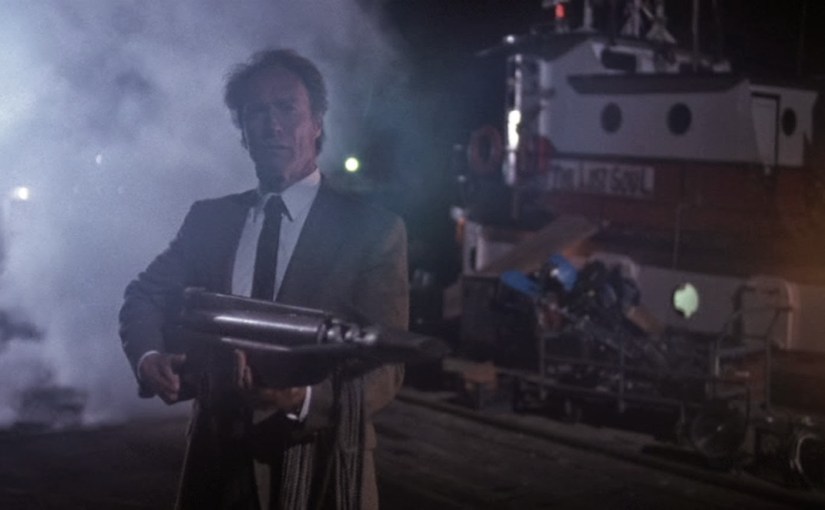
The Dead Pool is not a terrible movie, but it does not live up to other Dirty Harry installments. Primarily because it does not follow the character’s familiar mantra against the bureaucrats and the flawed system of prosecution and law enforcement that he’s always been challenged with.  At times, I’m looking at Eastwood and I’m asking myself who is this guy?  Sure, he’s got a few one liners of dry wit.  The famed eyebrow stare is there too, and the .44 Magnum as well.  However, Harry doesn’t seem to stand apart so much from everyone else as he did in the other films.  Beyond the giant gun, that is what made Harry Callahan so famous on screen. 

The investigation that Harry is assigned to with a Chinese American cop (Evan C Kim) is very bland.  We hardly get to know any of the victims or what they stand for, and when the true killer is revealed, it turns out to be a last-minute introduction of someone we’ve yet to see.  There’s no surprise to the culprit behind all of this. 

The series is also well known for the partners that Harry is forced to work with.  In The Enforcer, Tyne Daly brought out Harry’s regard towards women working in his dangerous field that demonstrated his initial frustration followed by his reluctant acceptance.  In the first movie, Remi Santori came about when it was okay to say that Harry took issue with all kinds of demographics, including Mexicans.  A chumminess nicely developed between those two guys as they tracked down the killer, together.  The second film, Magnum Force, offered a partner to also care about.  These are good side performers that colored in much of the Harry Callahan lore.  In this movie, Evan C Kim has one standout moment in the first ten minutes where he surprises everyone, especially Harry, with how he disarms a robber by use of martial arts.  It’s a great scene.  After that, though, he’s given nothing to do.  This actor had promise for more interactions with Eastwood.  It just never delivered.

The series started in the gritty times of 1971 when political correctness was not ever considered.  By the time the last two films were released in the 1980s of Ronald Reagan, who famously adopted “Go ahead.  Make my day,” for Gorbachev, there was a new wave of sensitivity abound.  I like to believe with the prior installment, Sudden Impact, Harry Callahan learned something new about himself with regards to the rights women had or were denied of while still applying his own code.  With The Dead Pool, the writing seems reluctant to go anywhere near a potential debate, and so it drips itself into a stale slasher movie with the cop ready to fire his six shooter.

The grand highlight of the film is a car chase on the hilly streets of San Francisco, which is the best place for a car chase, always.  What separates this one from the others is a little remote-controlled car that pursues Harry and his partner, ready to activate its equipped detonator at just the right moment.  The editing of this sequence is really fun, and it’s a great salute to Bullitt and other gritty, urban cop films, particularly the Dirty Harry movies.  This toy car flies over fruit stands and careens through sidewalks and over sewer holes.  Meanwhile Harry screeches down one hill after another trying to evade this pesky rapscallion.  It’ll definitely put a smile on your face while the moment lasts.

I recall being eager for another Dirty Harry movie.  I grew up loving many of Clint Eastwood’s films.  Dirty Harry is a favorite character of mine.  Yet, I also remember feeling really let down when my dad and I walked out of the theatre.  The Dead Pool just doesn’t have the same flavor as the other Eastwood products.  Again, it’s not the worst picture.  It’s standard cop fare coming in at a lean ninety minutes.  Eastwood and the rest of the cast are okay with what they’re doing.  I just would’ve changed the name of the main character listed at the top of the cast list.  He could have been Dirty John Doe for all I care.

A MAN CALLED OTTO

By Marc S. Sanders

There’s A Man Called Otto who seems to be liked by everyone except himself. People in his neighborhood happily say hello to him every morning as he shovels the snow off his walkway.  They will try to chat with him on their morning jog.  He won’t even allow his work, where he was forced to retire, to send him on his way with a celebratory going away party. 

On the other hand, Otto prefers to occupy himself with insisting that the UPS truck driver not drive down their block, sniffing out whose dog left behind a present on his yard and scaring off the real estate agent in the fancy BMW who attempts to convince elderly residents to sell their townhomes and move into assisted living.  A new family moves in across the street and they appreciate Otto’s grumpy insistence of properly parking their car with a U-Haul trailer attached.  What Otto doesn’t appreciate is how one more attempt at a planned-out suicide is foiled by their disruption.

I’m told this late 2022 release is an adaptation of book called A Man Called Ove, which was also turned into a European film that is supposedly better than this picture.  I can’t offer an opinionated comparison as I have neither seen that other film nor read the book.

Tom Hanks is the title character in this film from Marc Forster.  He’s very good and right for the role.  I’m one of the few who find Hanks to be miscast on occasion.  Not here though.  His performance had me thinking back on a more subdued Jack Nicholson in About Schmidt.  Hanks has transitioned finally to the older generation of characters that are not as wide eyed with discovery, innocence and gusto that were depicted in films like Philadelphia, Big or Forrest Gump.

Marc Forster is striving to tug at the heartstrings.  Flashbacks of Otto when he meets his eventual wife, Sonya (Rachel Keller) hint at what led to his current state of nonstop crankiness.  Otto’s a widower but why is he so bitter with himself or any kind person who comes his way?  The younger Otto is portrayed by Truman Hanks, one of Tom’s sons in real life.  It’s inspired casting, because there is a consistency towards the mannerisms and personality within the two separate performances.  Truman Hanks and Rachel Keller pair up nicely as young adults from different backgrounds who convincingly fall in love.

The standout though is the pregnant wife/mother of the new family who’s moved in. Mariana Treviño is Marisol, and she is superb in her comedy as the Hispanic neighbor who is always getting in Otto’s way with prepared home made food to bring over while she relies on the grouch to babysit her children or give her a ride because she doesn’t have a license.  Eventually, a terrific scene arrives where Otto is teaching her to drive, and the two characters open up to one another despite their different backgrounds.  Treviño carries so much range with her part.  She’s ditzy but intelligent, sensitive, and very warm, lovable, and funny.  Every time she appears on Otto’s doorstep, Marisol is a new surprise.  You might think at first that she’s scatterbrained.  When you see her next, she’s intuitive.  Otto may think she knows this person from just one or two encounters, but Mariana Treviño’s performance is so well done and beautifully written that even the viewer really doesn’t know her until the climax of the film.  If A Man Called Otto had gotten a little more publicity traction upon its release, she could have been an Oscar nominated contender.  I think she was definitely worthy of more praise than I could uncover.

The script sets up a lot of questions that carry the film and keep it interesting.  Otto’s internal crisis is one thing, but there’s also a neighbor’s mute husband who apparently shares history with the title character.  There is also a scheme being plotted out behind this pesky real estate agent who blasts his hip hop music from his luxury car. (TRIVIA: Another son of Tom Hanks, Chet, is the rapper heard on the radio.)

I was never really convinced that A Man Called Otto could be a real-life story, however.  Call me a cynic, but the number of sweet natured people all living in one small space seems far-fetched.  These happy go lucky folks, including a transgender teen (Mack Bayda, wonderfully likable in his first film role) who was kicked out of his father’s house, find so much positivity out of life.  I’m not sure real life lays it on this thick!  Sometimes, the side characters appear like walking Hallmark cards.

I also felt uneasy about the suicide theme that is most prevalent throughout the picture.  I think I counted four different ways that Otto attempts to end his life (hanging, shotgun to the mouth, jumping in front of a train, carbon monoxide poisoning).  Each attempt is interrupted somehow and how it’s done is nothing so inappropriate or spoofed, but it is done with an intent of irony and humor. It started to feel comparable to another foiled attempt by the Coyote trying to capture the Road Runner.  Looney Tunes serve a purpose escapist slapstick.  Suicide, even when cheerfully disrupted, often doesn’t put a smile on my face. 

Otto does go through a character arc that I appreciate though where demonstrations of heroism and soul saving are captured.  The ending, while sad, is also quite rewarding.  With Marc Forster’s film, I’ve gotten to know a beautiful collection of well-intentioned and thoughtful people who do not give up on trying to rescue one of their own from a life currently mired in misery. 

A Man Called Otto is a good film worth watching.  The cast is absolutely wonderful and through the performances, everyone seems positively proud of what they accomplished with the final product.  I’d be up for seeing this exact same cast perform this script live on stage.  Still, I offer a warning of caution.  While it is trying to deliver sugary optimism at every turn, it is also coming off a little bit like artificial sweetener. 

THE HUNGER GAMES

By Marc S. Sanders

Some of the worst atrocities in history have often spawned some of the greatest stories.  I’d expect it would at least leave us feeling melancholy, but I hope it shapes a future that learns from humanity’s worst offenses.  That’s what came to mind as I watched the film adaptation of Suzanne Collins’ dystopian best-selling novel The Hunger Games.

In what was once a supposed North America, the continent is now called Panem and it is divided into twelve districts, with each specializing in some means of living.  Districts 1 and 2 are the upper-class wealthy.  Districts 11 and 12 are the starving destitute.  To maintain a semblance of order, President Snow (a chillingly older Donald Sutherland) oversees the nation’s Annual Hunger Games where a boy and a girl from each district is selected to compete in a dangerous competition of being the last one to outlive their competitors.  May The Odds Be Ever In Your Favor!  In the 74th edition, expert hunting archer Katniss Everdeen (Jennifer Lawrence in her most celebrated role) volunteers herself from District 12 to spare her younger sister from danger and selection.  She is paired up with the District 12 boy, Peeta Malark (Josh Hutcherson). 

Like any sporting competition, Collins’ story takes time to hype up the event.  The youths are fashioned up in the most glamourous adornments and interviewed for television by Caesar Flickerman portrayed by a delicious, yet unsung Stanley Tucci in bright blue hair and sparkly suits, doing his best Griffin, Carson, Letterman, Leno, and O’Brien.  With every white molar revealed in Tucci’s broad smile, he appears even more sinister in the purpose he serves for the Games, Panem, and President Snow.

Jennifer Lawrence gives a faithful portrayal to the Katniss character found in the pages of Collins’ series of young adult novels.  A new hero has been conceived – the rebel who stands along other well knowns like Luke Skywalker, Robin Hood and Harry Potter.  Katniss is not looking to be a savior but with influence from a prior Hunger Games champion (Woody Harrelson, doing his drunken best) and a calm, but humble fashion designer (Lenny Kravitz) she finds herself elevated towards a promising future.  Katniss Everdeen inherits the moniker known as “The Girl On Fire” with a three finger salute and a somber three note battle cry harmony.

I’ve likened the setting of The Hunger Games to the Holocaust and the early twentieth century European Nazi occupation.  (It seems more apparent in the next film, Catching Fire.)  If I had to compare the real-life period to this fictional one, then they are not anywhere close.  Yet, Suzanne Collins and director Gary Ross’ film depict hardship and oppression from a ruling upper class gleefully using their young for savage sport entertainment, while being forced to dwell in concentration camps with no permission to escape or run free, lest they suffer terrible punishments for themselves or those they care most about.

The Hunger Games values the themes of sacrifice while some characters inadvertently become heroes for a people against a domineering force.  It’s fantasy.  It’s adventurous.  It’s sprinkled with romanticism for Katniss and the triangle she’s pitted within for her care of Peeta but also her loving affections for another District 12 resident named Gale (Liam Hemsworth).   Frankly, the romance angle is a little weak in the films and books.  Ultimately though, it is harsh for the young characters in the story, which is why my wife refuses to invest her time.  I empathize with her position.  However, I find the story inspiring.  It’s also a hell of a thriller.

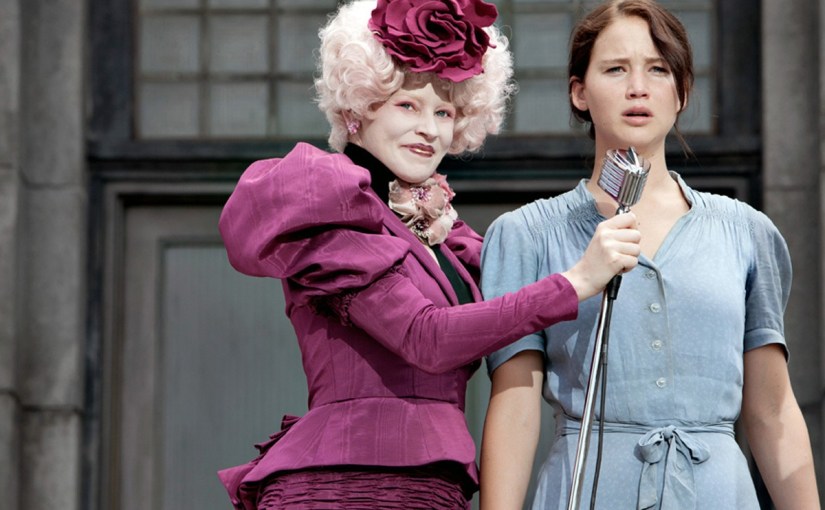
As a film, Gary Ross assembled a strong and alive production of gaudy, bright colors within the capital against morose grays found in District 12.  The clash of the two settings is no more apparent than when squeaky Effie Trinkett in her garishly loud facial makeup and wardrobes arrives in District 12 to host the Reaping, also known as the selection of the child contestants.  So many actors in this cast are memorable.  An unrecognizable Elizabeth Banks is no exception.  As Effie, her personality that publicly represents a hesitant Katniss and Peeta is deliberately inappropriate and further demonstrates how demonically twisted the mentality of The Hunger Games truly is. 

When it is time to finally arrive at the manufactured arena where the contestants will do battle to the death, Gary Ross effectively incorporates the inventive surprises offered by Collins’ source material.  Some competitors are brutal in their combative skills, but environmentally speaking the forest like jungle is dangerous as well.  Especially notable is a hive of stinging tracker jackers that’ll leave the viewers shaken. 

Suzanne Collins’ first installment of her series persists in leaving its ending completely questionable.  Will all these children, some of them who are noble and good, actually die?  Could a good soul like Katniss follow through with what the Games demand of her like killing Peeta for example?  I appreciate the imagination that went into the ending, leaving a subsequent tale to be told beyond this film.  

My one complaint is common in action films.  Gary Ross does really well with the edits and filming of his movie.  However, one of the last scenes develops into a hand-to-hand combat moment taking place in darkness with very shaky camera work and uneven grunts, punches, and kicks.  I abhor when filmmakers go this route.  It’s lazy work.  I can’t tell who is hitting who or where.  I’m just supposed to accept the final struggle that the hero is having with the bad guy and feel a sense of urgency and suspense as they supposedly cast a harsh blow to their enemy and fall over. I might as well close my eyes during moments like this because it’s all just blurry streaks in midnight blackness with sound editing filtered into the sequence.  This tiring approach happens so often in movies, and it becomes a let down for me time and again.   I love a well-made, thought-provoking thriller but the filmmaker hacks it all up near the end and it looks like he’s got to meet a deadline for the final print to get out to the theaters.

There’s much to discuss and think about in The Hunger Games.  Suzanne Collins’ idea stemmed from how television viewers soaked up the drama found in reality tv shows like Survivor and Big Brother.  It’s not so much the fate of the contestants that we care about, but how do they serve the producer’s crafted storylines.  Even American Idol steers the drama of the kids who get their shot at Hollywood fame.  The Super Bowl will position a star player like Tom Brady as a focus with questions of whether this is his final season, and how the championship games affect his marriage and family.  Does he get along with his coach?  None of this has anything to do with the points on the board.  Is all of this about the games, or is it about those tasked with playing the games, and for whose benefit of control, wealth, and power?  In this fantasy film, do the people of Panem cry at the drama spurned from the horrifying death of a child they got to know from Caesar’s colorful interviews, or are they in despair at the loss of another young life?  Whether it is real or fictional, is the drama of these gladiator games and competitions focused in the right direction?

The cast and production team under Gary Ross have put together an effective dystopian and bleak future reliant upon what the world focuses on more than anything beyond who they truly love or what they stand for.  The Hunger Games might seem inconceivable, but it is frighteningly relatable. 

CLIFFHANGER

By Marc S. Sanders

It’s an action picture.  What’s common?  Sylvester Stallone, the MacGuffin is money, and the villain has a European accent.  What’s uncommon?  The setting is a Colorado snow covered mountain. 

The movie is Cliffhanger directed by Renny Harlin.

This film deserves much praise for the photography it offers of Stallone and his sidekicks (Michael Rooker, Janine Turner) scaling steep rock formations while trying to evade brutal, but moronic, thieves who have foolishly lost their booty in midair. Now the bad guys must recover the stolen Federal Reserve bills which are scattered in three different locations within the mountain range.  When their plane crashes they force the heroes into leading them on an expedition to locate the money before they will surely kill them.  John Lithgow leads the villains.  Thanks to his slithery English dialect, he’s not bad in the part.

For a pinch of character depth, Gabe (Stallone) is haunted by the opening scene of the film where he failed to rescue the girlfriend of his buddy, Hal (Rooker).  Gabe and Hal will be awarded the opportunity to make amends thanks to this unexpected adventure.  Cliffhanger is not just a thriller.  It’s also a chick flick for guys. 

On a modern flat screen TV, it is quite discernable to recognize the CGI and handcrafted sets that make up much of the scenes.  However, the thrill of it all still holds up and as noted before, the overhead shots really look spectacular.  Stallone really is hanging from these bottomless heights with just one hand; at least that’s what it looks like.  If there is an illusion at play, then there are moments where I can’t tell if I’m being deceived.

The opening scene is the highlight of the picture as Gabe must zip line himself upside down over a wide crevice while attempting to save a hapless climber whose harness has given out.  It’s impossible not to sit still during a well edited and directed moment like this.  This is a masterful scene of terror and suspense.  Renny Harlin is certainly an undervalued director in the action genre.  (I wonder what he’s been up to these days.)

The bad guys are quite hapless though, as they freely bicker among themselves and give away how they’ll happily kill the heroes quickly, allowing one to warn the others.  They are dumb right from the start by killing the pilot of the plane they’re on before fully completing their mission and idiotically losing the money at play.  Then again, as my Unpaid Critic colleague would say, “Then there’d be no movie.”  True Mig!  Very true.

Still, the atmosphere of Cliffhanger is what works.  Blustery snow and wind come off convincingly as Gabe is forced to freeze and shiver with no layers to keep him warm while executing some daring escapes.  Rescue helicopter stunts and collisions are sensational.  There are obligatory shootouts and bloody slashes of skin from climbing tools.  There’s even a bat cave, with no superhero in sight, but it will give you the willies.

I’m hot and cold on many of Sylvester Stallone’s films.  Don’t get me started on Assassins with Antonio Banderas or The Specialist with Sharon Stone.  Those movies required some nuanced acting that the action star just wasn’t offering.  However, here the adventure makes the piece thanks to the director, and Stallone fits right into this environment where the role demands strength, stamina, and outdoor intuition.  Renny Harlin is the top hero here, allowing the marquee actor to look really good on screen.