FARGO

By Marc S. Sanders

The seeds of a crime begin in the dead of winter, in a saloon, located in Fargo, North Dakota.  A car salesman requests two thugs kidnap his wife so that they can demand an eighty-thousand-dollar ransom from his wealthy father-in-law.  The salesman will split the monies with the crooks and all will be well.  Hold on there!  It’s not as simple as it looks.

The Coen Brothers (Joel and Ethan) completed some of their most legendary work when they opted to “adapt” a supposedly true story that sheds blood over the snow-covered plains of northern Minnesota when all of the characters involved choose not to cooperate with one another.  The unpredictable is what keeps their film Fargo so engaging.  With each passing scene, you ask yourself “What next????”

Jerry Lundegaard (William H Macy, in my favorite role of many good ones from him) is the salesman who gets in over his head.  This cockamamie scheme of his stems from a need to land a get rich quick investment, but he doesn’t have the money and his father-in-law Wade Gustafson (Harve Presnell) certainly won’t lend it to him.  Steve Buscemi and Peter Stormare are the hired criminals, Carl and Gaere.  As quick as the agreement is made, Jerry wants to call off the arrangement, but things are already set in motion.  The kidnapping occurs, albeit sloppily, and a late-night pullover on a dark, snow covered back road leads to the bloody shootings of three people. 

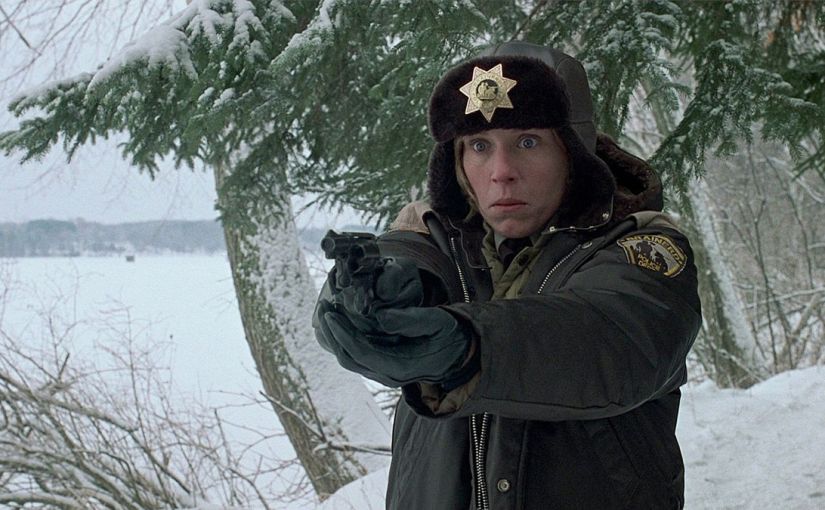
Marge Gunderson (Frances McDormand, in her first Oscar winning role) is awoken early in the morning.  Her sweet husband makes her a quick breakfast and she’s off in a jiff to inspect the crime scene of the three murders.  She is seven months pregnant, but she’s got a job to do.

Murder, kidnapping, fraud, and embezzlement piece together the Coens’ Oscar winning script.  What makes Fargo special though is how out of frame it all seems among these odd and quirky characters.  The Minnesotan dialects and vernacular (“You betcha!!” “You’re darn tootin’!” “Oh, for Pete’s sake!!!”) from Marge and Jerry do not seem standard in a story like this.  Even their names – Lundegaard and Gunderson – seem totally out of place here.  However, the pregnant, sweet natured police officer should not be underestimated, and the puppet master behind this plot should have known better.  In fact, other than Marge, no one should be doing what they’re doing, and yet that’s exactly what spins everything off the rails.

The Coens humanize the characters of their film.  Marge must stop inspecting the grisly crime scene because her morning sickness is about to overtake her.  “No, I think I’m gonna barf!” It is not the blood or the cold winter that’s holding her back.  Natural pregnancy gets in the way.  When clues lead her to Minneapolis for an overnight stay, she takes advantage of meeting with a high school friend.  Their meet-up has nothing to do with the central plot, but the writers insist on showing Marge during her off hours.  It’s a hilarious scene and Frances McDormand’s timing is naturally comedic with a guy who just has an overenthusiastic way about himself.  Marge is not just a smart cop.  She’s got a life outside of her career as a loving wife, friend and soon to be mother.

As well, Jerry insists to Wade not to contact the police and let him deal directly with the kidnappers when they call.  Wade isn’t just going to sit by for long though.  He got to the top of his powerful pyramid by taking things head on.  Jerry just doesn’t have the instinct to realize this is how the cards will fall.  Wade was not to be involved, under any circumstances.  Yet, that’s exactly what is happening.  This is not good Jerry.

Carl and Gaere (These names!!!!  I’m telling ya.), as crooked hoods, have no honor among themselves.  One might betray the other and that could lead to another gory, very gory, yet inventive moment. 

Other than Marge, either no one is particularly smart in Fargo, or they are just not seeing the possible outcomes all the way through.  Still, even the dumbest of folk can make a turn of events gone awry so fascinating.  When one tiny detail gets out of place, then the players improvise. That only twists several other expectations to go off kilter and the dominoes begin to tumble.  Very quickly, as everything has unraveled, it is any wonder how this all began in the first place. 

Fargo demonstrates that crime is hardly committed with a perfect plan.  Fortunately, the imperfections are at least as entertainingly curious as the perfections found in so many other films.  Oh, you betcha!!!!! 

JERRY MAGUIRE

By Marc S. Sanders

Writer/Director Cameron Crowe loves all of the characters he creates.  He loves them so much that I bet he’s got volumes of background histories on each one ranging from a nanny – sorry Au Pair – to a cute seven-year-old kid to a brash, hot shot professional sports agent like Jerry Maguire.  Everyone, absolutely EVERYONE, in Crowe’s films has to have a substantial amount of dialogue to bring them attention.  Often it works.  Yet, it’s also his Achille’s heel. 

Roger Ebert called Jerry Maguire a very busy picture and I could not agree more.  Do not mistake me.  I’m quite fond of the film, but yeah, Cameron Crowe unloads a lot in its over two-hour running time.  The title character, played by Tom Cruise in one of his best roles, is the superstar agent who has everything going for him.  He’s engaged to a beautiful talent scout named Avery (Kelly Preston), he has a knack for negotiating the best contracts for the greatest up and coming athletes, and he’s loved – strike that…adored by everyone.  Well…not everyone.  A hockey player’s kid tells him to eff off after his dad suffers his fourth concussion and can barely recognize his family or remember his own name.  It’s only then that he has a revelation in the middle of the night to document a multi-page memo inspiring his colleagues to sidestep the need to make more money. Less clients, and more personal attention to the ones you represent.  Call for everyone in his firm to get behind him in this mentality.  Jerry Maguire will be their martyr.

Well, that gets him fired, and ultimately he’s deemed a loser which is something that poor Jerry cannot learn to live with comfortably.  His one last hope at redemption lies in a promising wide receiver named Rod Tidwell (Cuba Gooding Jr – in a still very memorable role, likely the greatest of his career).  Rod remains committed to sticking with Jerry, but that is not going to make it easy.  He’s often uncooperative.  His pregnant wife, Marcy (Regina King) will not stand for any BS.  Rod is more concerned with obtaining the million-dollar contract, and it takes every last breath of Jerry’s to convince his client that it starts with getting back to just loving the game.

There is also another chance for Jerry to try his hand at love.  Wait, is it love, or is it that Jerry cannot handle being alone?  The test will lie in his relationship with his assistant Dorothy (Renee Zellweger in her breakthrough role), a twenty-six-year-old widow with the cutest kid (Jonathan Lipnicki, impossible not to fall in love with) for a son and a divorced sister named Laurel (Bonnie Hunt) who only has the support of her crying, pessimistic divorced wives support group.

Are you catching on yet to what Roger Ebert was trying to say?  There’s a lot of ingredients to make this stew.  Fortunately, all of it is good material with a great cast, but they are all distractions for one another as well.  At times there seems to be three movies going on at once.  Jerry the agent needs to get back on the horse.  Rod needs to humble himself and listen to his agent.  Dorothy needs to decide if this handsome guy who is the spitting image of Tom Cruise is best for her while she’s trying to be a single mother with a seven-year-old. 

The kid’s Au Pair has ten pages of dialogue.  Marcy has fifteen.  Avery has maybe five, but that’s quite a lot too.  It feels like Laurel and her divorced wives group have fifty pages.  Then there is the jerky antagonist who fired Jerry played Jay Mohr.  There’s just a lot of stuff here.

Jerry Maguire is a well-made film with a natural, feel-good comedic approach.  Cameron Crowe has feelings for all of his characters.  I think he doesn’t even want the Jay Mohr character to get hurt.  Crowe just wants to cradle everyone and kiss them goodnight and give them all a big part in the school play.  It’s a blessing the cast has terrific chemistry.  Anyone sharing a scene with Tom Cruise is doing brilliant work, especially Renee Zellweger and Cuba Gooding Jr.

Crowe’s dialogue might feel schmaltzy during the love story aspect, but it’s captivating.  Cuba Gooding Jr performs like he wrote the character, not Crowe.  He must have invented more to his Oscar winning portrayal of a cocky wanna be football star than the writer could have ever imagined.  “Show me the money!!!!” is still hailed as an all time great scene, chartered by the actor. 

As a director, Cameron Crowe is doing some of his best work.  I recently watched the movie with my Cinemaniac pals and noted to them how much lighting is pointed at the handsome faces of the cast.  It could be Cruise making a negotiation with a promising football star and his no nonsense dad (Jerry O’Connell, Beau Bridges) around a coffee table, or it could be a seductive scene between the romantic leads on a porch.  You never saw so many faces with flawless complexions and the photography of the film looks great from beginning to end.

As overstuffed as Jerry Maguire is, the film ultimately belongs to Tom Cruise, and he delivers Cameron Crowe’s character arc beautifully.  It is such a dynamic portrayal with a lot for Jerry to redeem, learn from and surmise.  The conceit I expect from Cruise is evident.  Sure!  However, it is still a well-constructed portrayal. 

This movie makes me yearn for Tom Cruise to seek out those roles that would come from nowhere and with surprise.  The roles that on the surface never seem like he should be occupying.  Think about this for a second.  This guy has played the seductive Vampire Lestat which was initially poo poo’d by Anne Rice.  He was crippled Vietnam War veteran/protestor Ron Kovic, soon after he played fighter pilot Maverick.  He played the cruelly extreme chauvinistic motivational speaker Frank TJ Mackey amid another crowded cast of exceptional talents and characters. He’s also portrayed Jerry Maguire.  The range of this actor’s talent can only be stretched further and further.  I’d rather know what wonderous role Tom Cruise has in store next, rather than what ridiculous stunt he wants to accomplish for another Mission: Impossible set up. 

Jerry Maguire is a gluttonous picture, but fortunately every entrée is served with heart, genuine emotion, and relatable caricatures.  It’s one of Cameron Crowe’s best films.

NYAD

By Marc S. Sanders

When some people go through a midlife crisis, they might buy themselves a car, get a new job or opt to not get out of bed for several days.  When Diana Nyad goes through a midlife crisis in her early sixties, she motivates herself to swim 103 miles from Cuba to Florida.  She came up short at age 28, but over thirty years later no one is going to convince her she shouldn’t try again.

Annette Bening portrays the real-life swimmer whose determination will bear the brunt of self-torture to complete arguably the maritime equivalent of climbing Everest.  Jodie Foster is Diana’s best friend and coach, Bonnie Stoll.  As acting partners and the characters they play, the leading ladies make a good pair.  

My first compliment has to go to the makeup department led by Ana María Andrickson.  The actresses received Oscar nominations, but the work done on Bening to play Nyad is astoundingly convincing. Diana makes several attempts to try to complete this challenge that’s never been accomplished before.  With each try, the dried-up complexion, blistering sunburns, chapped lips and bloodied cracks that prominently show on her body are truly painful and awfully uncomfortable to gaze upon.  At times, I was not as focused on the dialogue shared between Foster and Bening as I was on Andrickson’s masterful work.  The makeup alone tells an impactful story. A clear oversight by the Academy.

Annette Bening is particularly good in her role.  At times she’s a terrible annoyance and unlikable.  Yet, a sixty something year old woman who wants to defy all logic and the literal forces of nature will have to be a certain brand of jerk to move forward with her goals. This also comes with the natural degeneration of a body of freckled dry skin, loss of muscle mass and arthritic bones. Bening is far removed from the glamorous roles of an impressively long career past (Bugsy, American Beauty) to get to a persistent, unwavering zenith that the real Diana Nyad had to emote.

Jodie Foster is fine as Nyad’s best friend and former lover now coach.  I’m not sure all the award nominated praise she’s received for this part is merited, but she’s worthy of falling in line with other celebratory coaching mentors like Mickey from the Rocky films and Mr. Miyagi from The Karate Kid.  The film focuses so much on Diana Nyad though that there’s not much depth to Foster’s role.  She does the job, but it did not feel like it demanded much.  Frankly, Viola Davis in Air and Maura Tierny in The Iron Claw left me with more of an impression in an astounding year of great films and performances from 2023.

The unsung cast member who’s getting next to no press recognition is Rhys Ifans as John Bartlett, an oceanographer recruited by Nyad and Stoll to gauge immediate weather patterns and what the currents of the Atlantic are expected to do during the swimmer’s trek.  Ifans is a fantastic supporting character actor who is tasked with finding that suitable small window of time for Diana to start her journey. Within the context of the script, he offers the suspense needed for this sports film.  Can Diana Nyad hold up against the very real and insurmountable warnings that John describes?

Swimming is quite boring to watch.  However, this venture has cause for concerns.  Brutal storms, stinging jellyfish with undetectable approaches, and sharks.  Salt water, weakness and fatigue, the chops of the tide and mental hallucinations are also bears of contention.  A charter boat with Bonnie and John on board with a watchful, supportive crew sail alongside the swimmer, but they can only do so much if she intends to achieve her seemingly impossible goal unassisted.

Elizabeth Chai Vasarhelyi and Jimmy Chin are the directing team for Nyad with a script written by Julia Cox based on Diana Nyad’s novel account.  Most of the film is patterned like many other sports films focusing on an underdog.  I knew nothing about this person or her accomplishments.  Frankly, what I’ve learned is unbelievably impressive beyond what this picture focuses on.  Naturally, you’ll get an idea of how the story is going to conclude.

To enhance the ho hum activity of the swimming scenes, the filmmakers incorporate some of Nyad’s dreamlike delusions to get inside her head.  Falling rainbow stars onto the ocean surface as well as a yellow brick road leading to the Taj Mahal look as fantastical as they should, even if they drift into sidebar distractions.  I appreciated the handful of scenes where Rhys Ifans lays out the desperate concern shared with Jodie Foster about a lack of progress where Diana is wasting strokes against a current as well as his fear of oncoming sharks.  He builds suspense to keep the film focused. It’s pretty cool by the way how the crew responds to the shark issue.  

In addition, as good as Bening and Foster are with enormous careers of outstanding roles, much of their shared dialogue often comes off a little too hokey.  Granted, it’s a standard sports film and it’s more impressive that it’s all true, but Nyad sometimes plays off like a cheesy TV movie lacking that cinematic edge I was looking for.

An unclear element offers glimpses of Diana’s past as a beginner child swimmer who suffered personal trauma. It’s clear what happened to her, but these quick flashbacks are also mixed in with an unclear picture of her parental lineage and other ingredients.  I still don’t know why there were snippets of Diana playing Parcheesi.  Nor do I know who she was playing with to uphold its significance in the final edit of the movie.

Nyad is a biography worth seeing. The endurance the central character sustains to achieve the impossible is tremendously inspiring.  The thought that was running through my mind over the course of the film is that this woman wants to dominate over a powerful Mother Nature.  By the end, you see real life clips of Diana Nyad insisting to audiences that no matter who you are or what age you’re at in life, nothing can defeat what you want to overcome.  As well, whatever you succeed at likely deserves enormous credit for the support team that accompanied you.  Often, I’m a naysayer of Diana’s mantra because I think I’ve chalked up at least five times more failures than successes in my life.  Still, here is the person who eventually proved me wrong.  I should also note that I learn from my failures and remain hopeful that it will lead to success.

I often tell myself never to argue with a woman. Well, at least now I know never to argue with Diana Nyad.  

THE ZONE OF INTEREST

By Marc S. Sanders

Rudolph Höss, and his wife Hedwig, have five children and they seem to live in peace and serenity within a beautiful home that contains plenty of bedroom space, sunlight, a vegetable garden, a pool to splash in and a babbling brook to fish and swim in.  You might say it is The Zone Of Interest that keeps their life so fulfilling.  Yet, beyond their pleasures is the Auschwitz concentration camp conveniently located next door for Rudolph to carry out his responsibilities as a Nazi Commandant. 

Jonathan Glazer writes and directs this quietly effective piece while breathlessly showing a flawed ignorance and apathy for the countless Jewish lives lost during the Holocaust.  The tactics Glazer uses in his film work on your senses first.  Following a long series of production company names that herald from America, England and Poland, the title of the movie appears in big white thin letters against a black screen.  Slowly over a long 3-4 minutes the letters fade as faint music and sound transition.  The music gets softer, as birds chirp and then there are faint gunshots in a distance.  A picture finally appears, and we see the Höss family basking under blue sky and sun while picking flowers alongside the brook.  It’s not even possible to identify the time or setting of this story yet.  Soon after, Rudolph (Christian Friedel) is stepping out of his home in his full-dress Nazi uniform on the morning of his birthday.  Hedwig (Sandra Hüller, Oscar nominated in Anatomy Of A Fall) and the children gift him a beautiful, freshly painted kayak.  Glazer then changes the position of his camera in the opposite direction and the towering wall of the concentration camp is just beyond the pretty stone walkway and front yard that leads out from the family cottage.  Black smoke billows from the smokestacks beyond the wall, and none of this is even remotely disturbing to the family. The pops of gunfire are heard beyond.

The Zone Of Interest does not focus on the suffering of the European Jews during the Holocaust. Jonathan Glazer’s script is wise enough to know his viewers are aware of what occurred even if the mass genocide seemed to have no imaginable end.  He never shows footage of activity inside the camp because this story is told through the eyes of a family who chose not to become aware or alarmed at that massive amount of death and torture that was happening.  The Holocaust was simply a way of life.

A sack is delivered to the Höss home which contains slips and nighties for Hedwig to rummage through for her use.  More interesting is a beautiful fur coat.  Hedwig tries it on for a personal fitting and looks upon herself in her bedroom mirror.  She finds a lipstick in the pocket.  Does she like the color?  She’ll have to see and draws it across her hand just like my wife and mother would do in a shopping mall.  All the while, the undisturbing (to Hedwig) next-door sounds continue on.

Miguel and I went to see this film together and had an extensive discussion afterwards.  To Miguel’s advantage, he had absolutely no idea what this film was about.  Didn’t know it was another Holocaust picture.  He didn’t know who directed it.  He didn’t know the cast.  I only knew that Jonathan Glazer wrote and directed, though I’m not as familiar with his work as Miguel is, and that it took place during the time of the Holocaust.  To observe my colleague’s surprise early on in the film gave me an interesting experience.  Miguel first witnessed the serenity and peace among the family, and then realized the sinister world that surrounds them and which they choose to be naïve towards.

The Höss family will have you believe they experience the same challenges that any ordinary family encounters.  Beyond what I have described, there are two other scenes that stay with me. 

Rudolph holds a meeting in his home. An architect/scientist is describing the effectiveness of a new model oven that will efficiently slaughter hundreds of Jews per day.  He provides well designed blueprints.  Rudolph asks for a closer estimation.  The architect says it is likely a thousand can be taken care of in one day.  Seems satisfactory.  Take a conversation like this out of the context of the picture and these men could just have easily been talking about an assembly line in a chocolate factory.

Another moment occurs between Rudolph and Hedwig.  The husband explains that because he’s been so good at his job, he’s been promoted to oversee the operations of all the concentration camps and therefore the family will have to relocate.  Hedwig is not happy about this as they have begun their new life here in their beautiful home (located next to Auschwitz).  The wife insists her husband speak to Hitler about this and request he reconsider.  Any of us would know it’s not that simple.  “Oh, excuse me Mr. Hitler…” Uh uh!  Would not work so easily. 

Jonathan Glazer demonstrates how simple dilemmas and pleasures that come with a happy home life can appear common.  Yet, in this case, should it? 

The Zone Of Interest may be a period piece.  Yet, what you witness when you watch this film is all too similar to what often occurs today.  The world has gotten smaller with information coming to us quickly by means of the internet that can update me on Middle Eastern wars or American immigration or the spread of white supremacy as quickly as developments take place.  However, I believe many still remain ignorant, often by choice, of what is presently happening.  Mass suffering and totalitarianism still runs easily and freely, but what remains important to us are the vast luxuries we treat ourselves to while hardly giving a care of what goes on outside our bedroom windows. Our toughest challenges are our inconveniences. 

I’m not chastising anyone, Reader.  We deserve our peace, our solitude, and our happiness.  The Höss family is something else altogether, though.  They live in prosperity right next to the worst way of living imaginable and the patriarch is primarily responsible for that experience.  Yet, as their comfort becomes so commonplace, the naivety only increases.  Their children grow only knowing that a train arrives on a frequent basis, with chimneys exhausting black smoke and there are distant pops on the other side of a brick wall.  It simply goes with splashing around in the garden pool or making mud pies on the edge of the brook.  The title of Glazer’s film serves the perspective of a family who are being raised not to know any better.

Miguel asked me where I would rank the picture.  At the time I gave it a middle grade.  It is a slow-moving piece.   It is not accompanied by a soundtrack of music to easily cue my emotions.  There are no big, momentous monologues.  I found the ending a little ambiguous but perhaps I was not concentrating enough, and Miguel had to explain something to me.  However, two days after watching the piece while also doing some background research on the film, it is worthy of a better grade than I originally gave it credit for while walking out of the theater.

Glazer will set up scenes where nothing happens for the longest time and then an eye opening and very uncommon discovery is made.  A particular moment happens while simply watching Rudolph waist deep in the river while fishing and wearing an SS t-shirt.  Again, out of context, this t-shirt could have been a Tampa Bay Buccaneers shirt.  There’s a disturbing comfort to moments like this before anything is revealed. 

The writer/director positions his camera like a documentarian.  There are no steady cams.  Often shots are from a far end of a hallway or outside a door frame simply to witness the commonplace activities of the family while the horrifying sounds of Auschwitz carry on in the near distance.  Miguel noticed a horizontal technique.  Glazer must have put his camera on a track to follow Hedwig as she walks off her property and marches parallel across the outside wall of the concentration camp.  She is undisturbed by anything happening on the other side of that brick structure laced with barbed wire at the top.

This is a disturbing piece that effectively shows a lack of care for suffering and horrific execution while a family attempts to live their best life and circumvent around common issues like job promotions or gardening or family time or valuing someone else’s belongings to accommodate them.  The Zone Of Interest is a haunting film and Jonathan Glazer has accomplished a tremendous feat, showing comfort just outside of a world of treachery and genocidal productivity.  This is a must watch film.

PS: My recommendation is to watch The Zone Of Interest without taking a break or taking a pause in the picture.  Watch it all the way through, unstopped.  I believe it is necessary to judge the film as a whole rather than in just parts.  As I reflect, it feels like one ongoing hour and forty minute scene.

THE HOLDOVERS

By Marc S. Sanders

Alexander Payne’s The Holdovers plays like a modern-day Christmas Carol.  Paul Giamatti is the Scrooge of the story set during mid-late December in 1970.  He’s an arrogant, unforgiving and unlikable teacher at Barton Academy, an all-boys Massachusetts boarding school.  Two other Scrooges round out the headlining cast.  Da’vine Joy Randolph is a cafeteria cook at the school.  Dominic Sessa is senior student – very bright, but also a troublemaker.  With uninvited circumstances facing the trio, they are the holdovers at the snow-covered school campus during the Christmas break, and they’ll have no choice but to get along or at least tolerate one another.

Alexander Payne often specializes in bringing attention to sad sack lonely souls like in Sideways, The Descendents, and About Schmidt.  His films begin with the characters seeming to accept their fates which lack a desire to smile and be cheerful.  Death or abandonment are common sources for their conditions.  Yet, with each of his wonderful films, it’s always fresh and new.  After an endless series of superheroes, I’m glad I get an occasional reminder of the humanity that can be found and treasured within entertaining films like The Holdovers.

Giamati is Paul Hunham.  Paul is disliked by everyone including his colleagues, the dean of the school (who was a former student of his), and especially the students.  Sessa is Angus who has a discipline problem but normally gets good grades. It’s most impressive that his B+ in Mr. Hunham’s class is leagues ahead of his classmates.  Randolph is Mary who recently lost her son, a recent graduate of Barton, after his entry in the Vietnam War.  These very different individuals have to share their lonesome disregard for one another.  Eventually though, their shields will whittle away and perhaps a couple of viewings of The Newlywed Game will open themselves up to each other.

I would be doing a great disservice to spoil the character backgrounds of these three who stem from different worlds and have nothing in common.  However, a theme found especially in Angus, and surprisingly in Paul, is a tactic of lying and exaggerating.  Within the context of the script written by David Hemingson, the untruths his characters tell work because it opens up further revelations that color in Paul, Angus and Mary’s current states.  The goal of The Holdovers is to scrape away the dirt on the surface in order to uncover the likable or sad nature hidden within. During a trip to Boston, Paul and Angus visit a museum and the irascible teacher finds an opportunity to remind his student that we do not study the past to only see what once was.  Paul tells Angus “…history is not simply the study of the past. It is an explanation of the present.” If The Holdovers were to have a mission statement, this is what the film stands upon.  Angus, Paul and Mary may all be a variation of a Scrooge, but this story explores what precisely added up to their respective states of misery.

The performances in The Holdovers are perfection.  Dominic Sessa offers one of the best film introductions in history.  This actor looks as if you have seen him before and it’s surprising that his only experience ahead of this picture were school plays, he’s done at his own Massachusetts prep school where he was discovered by the filmmakers who were scouting locations for this film.  He ranks up there with the debut performances of Whoopi Goldberg in The Color Purple and Lukas Haas in Witness.  Da’Vine Joy Randolph is heartbreaking, yet lovable as a grieving, chain smoking widow and mother.  Having also watched her bring out her acerbic funny side in Only Murders In The Building, she’s now one of my favorite eclectic character actors working today.  She is wonderful with either natural comedy and drama or just broad, satiric humor.  Arguably, Paul Giamatti occupies the best role ever written for him.  He finds the right beats during different plot points in the movie.  He’s positively unlikable but there’s an understanding to be found amidst the carnage of his past and present.  The sensitivity of Mr. Hunham eventually shines through, but Giamatti keeps it blended with the angry grouch he’s introduced as in the first few scenes of the film.  It’s a dynamic portrayal.

Alexander Payne reminds me once again that everyone we encounter in life is going through some form of turmoil and suffering.  Some of us can hide it well.  Others have given up concealing what’s not attractive or pleasing to our peers.  If we only take the time to look beyond what’s in front of us then maybe a person’s past will justify their present heartache, and we can either grieve, lend support or simply listen.  Payne will have you convinced to do anything except give up on a person.

As I write this last particular paragraph, I recall when Da’Vine Joy Randolph’s character prepares to attend a Christmas Eve party.  She lays out a nice dress.  She does her hair up attractively.  She puts on makeup.  She brings fresh baked brownies and gives them to the hostess with a welcome smile.  A few minutes later though, poor Mary is breaking down in the kitchen and Paul and Angus are seeing a colleague at her weakest when she was doing her best to uphold a semblance of strength.  Mary’s past defines her present to both Angus and Paul.

Alexander Payne is a genius storyteller of the human heart.  He’s already been quoted as saying The Holdovers is not a Christmas movie and he despises the reference.  Mr. Payne will simply have to forgive me though.  His Oscar nominated piece is a wonderful film to watch ritually during the year-end holidays.  Christmas and New Year’s may be a time to celebrate with our loved ones and the fact that we’ve lived through another year gone by.  However, it is also the loneliest for many of us who can no longer celebrate with a family or friends.  It’s important to acknowledge the pain that comes with living under that circumstance.  Fortunately, Payne, with David Hemingson’s screenplay, finds the humor needed for these souls to shed their agony and proudly reveal the faults they carry and the suffering they had no choice but to endure.

The Holdovers is funny, touching, insightful and it’ll leave you embracing a new collection of characters that will not soon be forgotten within the enormous lexicon of memorable movie roles.  

This film will likely win Oscars for screenplay, supporting actress and actor.  A shame that Dominic Sessa was not nominated as well.  There could never be too many accolades for this picture.  It’s marvelous.

The Holdovers is another wonderful film.  Another best of 2023.

LOCAL HERO (United Kingdom, 1983)

by Miguel E. Rodriguez

DIRECTOR: Bill Forsyth
CAST: Burt Lancaster, Peter Riegert, Fulton Mackay, Denis Lawson, Peter Capaldi
MY RATING: 8/10
ROTTEN TOMATOMETER: 100% Certified Fresh

PLOT: An American oil company has plans for a new refinery and sends someone to Scotland to buy up an entire village, but things don’t go as expected.


Local Hero is not normally the kind of movie I gravitate to.  It’s not slow, but it’s deliberate.  It’s not hilarious, but it’s funny.  It’s not plotless, but it meanders and skips around.  It’s not flashy, it’s not glossy, and it’s not kinetic.  I can easily remember a version of myself that might have turned this movie off after the first thirty minutes.

But today, at this time in my life, for whatever reason, something made me look at this movie in a different way than I might have once upon a time.  The movie started to resemble a memory.  Not one of my memories, but like someone else’s memory, like I was listening to someone tell a story about this one time when he went to Scotland and something happened that didn’t exactly change his life, but it made him look at the world differently.  Fiction or not, Local Hero plays not as a movie, but as a recollection.  Its charm carried me through the entire film.

And I’m not talking about the kind of charm you might see in any 2 or 3 movies set in Scotland or Ireland.  Normally, in films set in and around the British Isles, the villages one might find there are laid back, yes, but filled with eccentric characters who know each other’s business, are friendly but cautious around outsiders, and who are loud and boisterous at the local pub.  In Local Hero, the most eccentric characters are the Americans, and the village pub might fill up, but you’ll never have to raise your voice to be heard.  It’s an interesting switch.

The story: A Texas oil company wants to buy the entire village of Ferness in Scotland so it can turn the surrounding area into a giant oil refinery.  The company’s CEO, Felix Happer (Burt Lancaster), sends a junior executive, Mac (Peter Riegert), to Scotland to facilitate the deal.  When Mac arrives, he gets his first taste of culture shock, not due to all the eccentricities he finds, but due to how quiet this town is.  He is checked into the local hotel by Gordon Urquhart (Denis Lawson, aka “Wedge Antilles” in the Star Wars films), who also turns out to be the town’s bartender, the town treasurer, and the head chef in the hotel’s kitchen.  Mac is accompanied by an eager Scottish assistant, Oldsen (an impossibly young Peter Capaldi), who develops a crush on a local scientist and runs from one assignment to another as if his arms were on fire.

Local Hero throws curveballs every chance it gets.  You’d expect the citizenry to get indignant at the idea of an American mega-corporation wanting to buy their town.  But when the locals get an idea of how much each person would get, they become instant supporters.  When they all convene at the local church, the Reverend is not an inexperienced youth or a crusty old soul, but an African gentleman who, according to the story he tells Mac, came to Scotland to learn the ministry and just…never left.  Happer, the CEO, insists on periodic updates from Mac, and since this is 1983, Mac has to call Texas from a red phone booth just outside the hotel.  But Happer seems less interested in the deal than in the potential discovery of a comet, somewhere in the constellation Virgo.

All of this is told in the laid-back manner of someone telling a story around a campfire.  There are little jumps forward that omit what might seem to be key information, but we pick up on it right away.  Little details emerge, like the motorcyclist who always seems to be roaring down the town boulevard just in time to nearly run Mac over.  There’s a moment when Mac encounters a group of men near the beach, has a pleasant conversation, then notices a baby in a stroller.  “Whose baby?”  His question is met with an uncomfortable silence as the men slowly look at each other, and Mac wonders what just happened.  And the beautiful thing is, that’s it.  That’s the end of the scene.  No one ever answers the question, and we never find out why not.

That kind of thing would normally infuriate me, but in this movie, it reinforced the idea of a fond memory.  I can easily imagine someone telling the story and saying, “And that was it!  No one ever said whose baby it was!  I still don’t know whose baby it was!”  It has the ring of real life, it’s not played up for laughs, and there’s no punchline at the end.  The punchline is that there IS no punchline.

There is a nice moment when Mac has had one or two whiskeys too many one night, and he gets on the phone with Happer in that red phone booth.  Suddenly, the sky starts to glow and glisten – the aurora borealis.  Mac gets excited and tries to explain to Happer what’s going on, but he lacks the vocabulary.  “I wish I could describe it to you like I’m seeing it!”  I know how he feels.  It’s how I felt when I went to Alaska for the first time in decades and traveled on a cruise ship through a narrow fjord and saw towering cliffs covered in trees and intermittent waterfalls cascading over rocks so everything looked primeval, like something out of The Lord of the Rings.  Just describing it doesn’t convey how it felt.  It’s a short moment in the movie, but I felt the reality of it in my bones.

In an interview on the Criterion Blu-ray, the film’s producer, David Puttnam, talks about how, when this movie was made, the general public’s idea of comedy was Airplane! and Blazing Saddles.  If it wasn’t zany, it wasn’t considered a comedy.  He wanted to help make a film that tried to remind audiences that comedy doesn’t automatically mean pratfalls and fart jokes.  Comedy can be gentle.  Local Hero is as gentle as they come.  It’s marvelous closing shot speaks volumes, and it wouldn’t have had the same impact if the story had been told any other way.

ANATOMY OF A FALL

By Marc S. Sanders

Was Samuel Maleski pushed or did he commit suicide? It appears he fell from the balcony of the French chalet he shares with his wife Sandra Voyter (Sandra Hüller) and their blind son, Daniel (Milo Machado Graner).  That is the focus of Anatomy Of A Fall, one of the films to be recognized in several Oscar categories for 2023 including Best Picture, Best Director for Justine Triet, Screenplay, Editing and an acting nomination for Hüller.

Triet’s film kept my attention right from the start because this newsworthy story has all the elements many would look for in a Netflix documentary or a Dateline program.  New details are introduced in nearly every scene whether it stems from conversations that Sandra has with her attorney Vincent (Swann Arlaud) or as part of the witness interrogations during the thrilling trial scenes that take place a year after she has been indicted for causing her husband’s death.

Sandra is German.  Samuel (Samuel Theis) is French.  To stay on a common ground, they speak to one another in English.  We learn this as the film flashes back to conversations and arguments the pair have prior to the deadly scene that occurs soon after the film begins.  The inconsistency in how they communicate as a married couple will have one ponder how pertinent it is when Sandra is considered a prime suspect in her husband’s death.  Also, it’s curious that Samuel suddenly decided to record a number of their disputes.  More evidence is revealed as the story carries on.

On the surface, the story plays like a typical Law & Order episode.  However, there’s a fresh quality to this kind of supposed crime drama.  A large portion of Triet’s screenplay (co-written with Arthur Harari) takes place in a French courtroom and it’s interesting to see how the procedures of witness questioning varies from what American audiences are accustomed to.  For example, an expert on blood splatters gives testimony and conclusion. While he is still on the stand awaiting further questioning, the Procureur will divert questions directly at Sandra, the accused, for explanations. 

The material witness for both sides is Daniel. After returning from a nature walk with the dog, Snoop, he comes upon his deceased father lying in the snow with blood gushing from the side of his head.  The blind son is thoroughly questioned about if he could hear arguments coming from his parents while loud music was blasting from his father’s upper-level workspace.  He’s probed about his parent’s relationship and how he got along with his mother and his father respectively.  Daniel is also put to the test of reenactments on the day in question.  While he is outside with Snoop, could he hear the argument his parents were having over the loud volume of the music from 50 Cent playing.

A sort of competition between Sandra and Samuel is also noted, as she is a published author. He has been insecure of becoming a writer himself after giving up his job as a literature professor and moving the family into the mountains to restore this chalet as a personal project. 

The performances in Anatomy Of A Fall are outstanding, especially from its lead Sandra Hüller, whose role was specifically written with her in mind.  Of the many great dramatic moments, there’s a specific flashback scene introduced as evidentiary recording.  It is a telling argument between Sandra and Samuel in the kitchen.  Justine Triet directs this long scene as a common occurrence among most marriages but then it begins to elevate.  Just when you think the two spouses are winding down, the intensity cranks back up again only it goes from a lower pitch to a much more aggressive state very quickly.  Their quarrelling becomes erratic, and while we are watching the flashback, it cuts away the moment it gets physical. Triet wisely returns the film to the courtroom observing Sandra listening to her memory all over again while the packed audience focuses.  In particular is the boy Daniel who is learning more about what weighed on his father and mother both individually and as a married couple.  When the argument gets physical the viewer of the film is in the same position as everyone in the courtroom, or more specifically blind Daniel, left to only imagine who breaks what dish and who slaps who.

Vincent, Sandra’s attorney, reminds his client early on that there is the truth and then there is what a jury and a court of public opinion will believe.   Swann Arlaud is not an actor I’m familiar with.  (Actually, I’m not familiar with anyone involved in this film.)  Arlaud is a standout though.  I like how he listens and asks well timed questions of Sandra as she recounts what occurred the day of the incident; where Samuel was and what he was doing along with where she was, interviewing someone about one of her books, on the floor below.  Swann Arlaud has a dubious expression as he absorbs all the information.  Even he knows this could have gone several different ways.  Maybe Samuel did intentionally jump to kill himself.  Perhaps the aggravation that Sandra endured of her husband motivated her to push him over or to hit him bluntly on the head causing his fall over the balcony railing.  There’s evidence to suggest a number of different outcomes. 

Anatomy Of A Fall succeeds on the examination of a crime and how it is tried, particularly in a French court of law.  Fortunately, the script does not offer many definitive answers when it concludes.  There are hanging threads left to consider and wonder.  Yet, it goes in depth with analysis so that when the verdict arrives, I could accept either decision of guilt or innocent.  It’s unfair, but in a murder trial, especially if there’s a possibility that the accused is not guilty, then the victim is somewhat put on trial as well.  Anatomy Of A Fall lends a case for either party.  This film deserves its accolades for its fair and thought-provoking writing as well as the performances of the cast which include a main character that you might or might not find believable.

MILLION DOLLAR BABY

By Marc S. Sanders

Clint Eastwood has one of the most remarkable careers in Hollywood history.  As his appearance has aged, so have the roles he’s occupied. He’s got these long lines that run down his cheekbones and across his forehead that compliment his signature scowl and white hair.  These facial features lend to a background in many of the characters he’s portrayed over the last thirty years ranging from a “Frank” in In The Line Of Fire to a “Frank” in Million Dollar Baby, his second film to be a recipient Oscars for Best Picture, Best Director, and Best Supporting Actor.  A Best Actress Oscar was also garnered for Hilary Swank. 

Swank won her second Oscar as Maggie Fitzgerald, a backwoods product of a hillbilly upbringing, who only lives for one dream and that is to be a championship boxer.  When she’s not waitressing to collect coins and singles for tips, she is spending every waking moment at Frank’s boxing gym, The Hit Pit.  Maggie keeps to herself by punching a bag, but she is persistent at convincing a closed off Frank to become her trainer.  Frank has no interest in training a girl, but maybe there’s more to why he’s reluctant to take her on.  The lines on Eastwood’s face seem to metaphorically hint at a challenging past.

Frank’s best friend is Eddie, or otherwise known as “Scrap Iron,” played by Morgan Freeman in a very long overdue Oscar winning role.  Some may argue that Freeman was bestowed with an award for such an illustrious career.  That’s fine.  I still believe that this performance is just as worthy as his other celebrated works (Driving Miss Daisy, The Shawshank Redemption).  Eddie lives in a small room in the gym and manages the place by day.  Frank is a crank towards Eddie, but they’re the best of pals. Frank carries the responsibility for Eddie losing an eye in the ring while under his coaching. 

Frank also suffers from the loss of a relationship with a daughter.  He writes her but the letters come back “return to sender.”

Million Dollar Baby is a boxing movie but the film, written by Paul Haggis, serves a much deeper and intimate purpose.  Eastwood, as director, gives beautiful and sensitive focus towards a relationship between Maggie and Frank.  Maggie has an ungrateful family with a mother (Margo Martindale) who spits the gift of a purchased home back in Maggie’s face.  Hilary Swank offers silent, yet agonizing hurt at the rejection and Haggis writes a simple line for her to share with her coach by asserting “You’re all I have, Boss.”  In turn, without his daughter, Maggie is all Frank has.  Their commonality is “Scrap Iron” who is there to offer insight into what Maggie needs from Frank, and what Frank needs from Maggie.  As well, Scrap even suggests that Maggie seeks out another manager to salvage both of their souls.

Haggis and Eastwood go even further with the setting of The Hit Pit.  A mentally disabled kid who proudly identifies himself as Danger (Jay Baruchel) relies on the gym for his own personal glorification.  Danger is a kid with no experience and no business being a boxer, but he glorifies himself as the next all-time great champion while the other boxers (Anthony Mackie, Michael Pena) tease and jeer him.  Frank hems and haws at Scrap Iron to get rid of him.  Danger doesn’t belong here.  Scrap Iron just lets the kid come and go.  The two old guys are both protecting Danger.  One doesn’t want to see another kid get permanently injured, but the other is well aware this kid has nowhere to go.

Million Dollar Baby is a film of acceptance when every other direction leads to rejection for its characters.  Every main character is destined to serve a purpose for another character.  The surprisingly heartbreaking third act is an ultimate test for a dare-to-dream fighter and her coach, however. 

A grizzled old trainer like Frank will laugh in the face of one of God’s ministers with his daily visits to Mass to hide the guilt he feels responsible for, while a girl boxer who wasn’t even much of a fighter until Frank reluctantly accepted her is forced to question how useful she is for herself or Frank or Scrap Iron after she’s been trained to be an elite.

There is so much to appreciate of the sins and curses that weigh on Frank, Scrap Iron and Maggie.  Accompanied with their anguish is a quiet, tearful piano soundtrack composed by Clint Eastwood, himself.  To complete the picture is the dark shadowed cinematography from Tom Stern.  So often, Eastwood with Stern shoots the cast in silhouette. A narrow beam of white light points down on Maggie punching the bag with earnest, but no rhythm.  It could also be Scrap Iron looking from a window upon his friends who accept the pain they live with.  The characters show only a small portion of profile while they are involved in their character.  You’ll catch a glimpse of Frank’s chiseled lines, or Maggie’s black eye and broken nose, or the rough texture of Scrap Iron’s dark complexion.  Other moments, Eastwood follows himself walking through the front door of Frank’s home to find another letter on the floor coming back to him, unopened, returned to sender.  The pain never gets numb.  The darkness of Stern’s photography is haunting, and yet it’s blanketed as comfort for these lonely souls.

Morgan Freeman as Scrap Iron narrates this bedtime story, and we eventually learn who he’s actually speaking to.  It’s the last element of the picture needed to complete Million Dollar Baby.  Freeman is the best candidate for any kind of voiceover.  He only draws attention to these people, in this beat-up old boxing gym, who never acquired acceptance from who they once thought should matter most in their lives. 

This film takes place in and out of a boxing ring.  However, it’s not so much about the sport as it is about surviving through personal battles that’ll never be won. 

Million Dollar Baby is one of the best films Clint Eastwood directed as well as performed in, and it belongs at the top of Freeman and Swank’s career best as well.  It’s just a beautiful piece.

NIMONA (2023)

by Miguel E. Rodriguez

DIRECTORS: Nick Bruno, Troy Quane
CAST: Chloë Grace Moretz, Riz Ahmed, Eugene Lee Yang, Frances Conroy
MY RATING: 9/10
ROTTEN TOMATOMETER: 94% Certified Fresh

PLOT: Framed for a crime he didn’t commit, a knight in a futuristic world reluctantly accepts the help of a shapeshifting teenager to prove his innocence.


Just when I thought the Spider-Verse animated films held the current monopoly on creating cool futuristic worlds, along comes Nimona with its delirious fusion of medieval pageantry with flying cars, cellphones, and annoying TV jingles.  Put aside what some will no doubt call its “woke” agenda/storyline and just drink in the amazing visuals, as knights in shining armor wield swords as they ride hoverbikes into battle.  (There is the occasional horse, naturally…some traditions apparently die hard in this version of the future.)

The pre-requisite prologue explains how a brave warrior queen, Gloreth, defeated a vile monster a thousand years ago.  To maintain vigilance against any future attacks, Gloreth’s subjects erected a wall around their magnificent city and created the Institute, a sort of school-for-knights, to train their protectors from generation to generation.

One thousand years later, the city prepares to matriculate its current class of knights, including, for the first time in their history, a commoner, Ballister (Riz Ahmed), championed by the current Queen Valerin as a symbol of progress.  What matters a knight’s lineage if his heart is brave, and his spirit is bold?  This choice has not gone over well unanimously in the queendom, unfortunately, but she is confident in her choice.  However, in a twist of fate, Ballister’s sword malfunctions during the knighthood ceremony, resulting in the Queen’s death, and Ballister, minus an arm, finds himself a fugitive.

He has exactly two allies.  One is his romantic partner and fellow knight candidate, Ambrosius Goldenloin, a direct descendant of Gloreth herself, who spearheads the search for Ballister in an attempt to keep someone else from killing him outright.  The other is a flighty, impetuous teenager who tracks Ballister down the following night and offers her services as sidekick to what she thinks is the newest villain in town, Ballister the Queen Slayer.  This is Nimona (Chloë Grace Moretz), a shapeshifter who can assume any form she desires, although her favorites appear to be a pink rhinoceros and a giant pink whale.  She likes pink.  And punk, as it turns out.

I imagine one could be cynical and say that what follows story-wise is nothing new: our heroes overcome initial adversities and suspicions of each other, they track down clues, deal with one or two serious crises, and eventually expose the truth of what really happened the day the Queen was killed.  But that’s like saying The Stand is about a bunch of people who survive the end of the world and eventually defeat the bad guy.  Well, duhNimona doesn’t offer anything outrageously subversive in the story department.  What it offers is a fresh new imagination and perspective in how it tells this story, especially when it comes to the character of Nimona herself, the very definition of the rebel outsider who literally doesn’t fit in anywhere.

What makes great kids films work – what makes MOST films work – is how it invites the juvenile audience to identify with the main character.  In Pinocchio, what little kid doesn’t know what it’s like when a lie grows out of control?  In The Wizard of Oz, what little kid has never felt homesick?  In Harry Potter and the Sorcerer’s Stone, what kid has never dreamed that they were special, not really meant for everyday life?

In Nimona, what kid has never felt alienated at some point in their life because of something that makes them different?  They’re not as old as the grown-ups.  They’re not as young as little babies anymore.  They’re in an in-between world where they’re only as strong as the friends they make, if they’re lucky enough to make friends.  What if there is something inherently different about them?  Nimona has tried shapeshifting before, tried to explain her gift, but people immediately think of her as a monster instead of someone who’s gifted.  There are echoes of the X-Men films here, too, but those mutants were lucky enough to find a home at Xavier’s mansion.  Nimona is not so lucky.  So, she decides to embrace the monstrous role society thrusts upon her.  I imagine there are lots of people out there who feel the same to one degree or another.  I’m not a sociologist, but it seems logical.

The real villain of the story (I won’t reveal their identity) does everything in their power to manipulate the narrative in the eyes of the public.  At one point, their scheme is all but exposed, but they discover yet another way to maintain power: turn society on itself.  They reveal the existence of the shapeshifter, explaining to the city that the real monster could be sitting next to you, or playing with your child, or living in your house.  The sinister nature of this ploy made me genuinely angry, mostly because of how effective it is, both in the film and in real life.  When you’re too busy fighting each other, the true villains win.

Enough philosophy.  Nimona stands among the best animated films yet produced by Netflix (Klaus, Guillermo del Toro’s Pinocchio).  There is plenty of humor to go around to leaven the moments when the film goes deep into territories unexplored even in the best Pixar movies.  (Correct me if I’m wrong, but I can’t recall a Pixar film where a character contemplates suicide as an alternative to grief.)  The end credits inform me that Nimona is based on a graphic novel.  Guess what I’m looking for on Amazon in a few minutes.

SMASH PALACE (New Zealand, 1981)

by Miguel E. Rodriguez

DIRECTOR: Roger Donaldson
CAST: Bruno Lawrence, Anna Maria Monticelli, Greer Robson-Kirk, Keith Aberdein, Desmond Kelly
MY RATING: 8/10
ROTTEN TOMATOMETER: 100%

PLOT: After the break-up of his marriage, a racing driver sets out to get back his daughter – at any cost.


Since last night, I’ve been trying to figure out what to compare Smash Palace to, and I finally came up with something: John Sayles.  Smash Palace resembles the best films of John Sayles, in that they are concerned with nothing more than character and plot.  The performances and camerawork do not strive for effect or bias, and the plot, while it proceeds with perfect logic, remained a mystery to me right up to the final scene.  I can’t quite vouch for its re-watch value, but any movie that can keep me guessing until the credits roll gets its due in my book.

Alan (Bruno Lawrence) is a once-famous Grand Prix racer who has semi-retired to a sprawling auto junkyard, the titular Smash Palace, with his fragrant wife, Jacqui (Anna Maria Monticelli), and their 7-year-old daughter, Georgie (Greer Robson-Kirk).  The fact that these actors were all unknown to me created an atmosphere of reality that would have been more difficult to reproduce with established names and faces.  The movie opens with a spectacular single-car crash on a lonely road and establishes Alan’s job: to haul away totaled cars to his junkyard for scrap.  The size and scope of his automotive graveyard is shown in a shot that astonished me.  (I was even more astonished when I learned in the Blu Ray special features that this graveyard is an actual location that still operates today.)

We watch as Alan tinkers in his garage with a racing car he plans to drive in an upcoming race.  He’s also restoring an older car (from the ‘20s, maybe?  I’m not an expert) for his best mate, Ray (Keith Aberdein), a local policeman.  These opening scenes establish everyone’s relationship: Alan loves his wife and daughter, Jacqui loves their daughter but has become exasperated with Alan’s unwillingness to sell Smash Palace and move out of the sticks, and Georgie loves her mum and dad and enjoys helping Dad with his repair jobs.  When Jacqui wants to go to a party, Alan demurs, citing work.  Jacqui then says she won’t go at all, and Alan does what he thinks is the right thing: offers to drive her to the party, and Ray can drive her home.  Alan’s perfect logic completely ignores the crumbling state of his marriage, much to Jacqui’s dismay.  Even young Georgie questions his decision-making when Alan tucks her in that night.

Jacqui winds up driving herself to the party.  At the party, Ray, Alan’s cop friend, finds it necessary to drive Jacqui home when she is drunk and claims her car won’t start.  On the way home, a moment passes between Ray and Jacqui.  We are teased with the possibility that either something or nothing happened.  The next morning when Ray drives out to pick up the stranded car, he finds no trouble and the car starts with no problem.  Curious…

As the song says, one thing leads to another.  Alan and Jacqui get into a quasi-violent argument at home while Georgie retreats to her room, sucks her thumb, and turns a flashlight on and off, on and off, a precisely observed scene that brought back strong memories of when my own parents had their fair share of arguments leading up to their eventual divorce.  We get a deeper sense of Alan’s emotional depth, or lack thereof, when his idea of making everything all right is apologizing to his wife while she cries on the bed, then having rough makeup sex.  In the afterglow of their “lovemaking”, Jacqui calmly informs Alan she’s leaving him.  His nearly wordless response is worth the ticket price.

I don’t want to reveal too much of what happens next, because while it may seem like we’re heading into soap opera territory, and we kind of are, it’s important that I convey a peculiar emotional tug-of-war that occurred as I watched.  There are scenes of violent emotions getting the best of Alan.  I’m not talking about physical violence or beating his wife or anything like that; this movie is too smart to tip its hand in that direction so quickly and obviously.  But, for example, at one point, Alan points a shotgun at someone while he yells at his daughter to “get in the truck!”  Now, speaking as a rational person, there is obviously no situation, ever, in which pointing a shotgun and essentially kidnapping your own daughter would ever be justified.  I think we can all agree there.  But the subtle genius of Smash Palace is that, while the scene unfolded, I could so clearly see why Alan was doing what he did that, yes, in the moment, I sided with him.  It wasn’t until the scene was over that I found myself wondering, wait, that’s not cool what he did.

But then, was it “cool” for Jacqui to file the New Zealand equivalent of a restraining order against Alan when he had taken her hunting without informing her after they were separated?  Was it “cool” for her to almost immediately take up a relationship with Ray, Alan’s best mate, a move that would almost certainly enrage Ray even further?  Well, what difference does “cool” make?  Jacqui is doing what she feels is best for her and her daughter in the face of a loveless marriage to a man who would rather bury himself in the hood of a car than face up to his responsibilities as a husband.

That’s the beauty of Smash Palace.  We may not agree with what these people do, but we can clearly see the why at every turn.  The movie takes the trappings of a soap opera and turns it into a crystallized character study that explains why a man with limited emotional resources would point a shotgun at someone’s face because he believes that’s his last remaining option.  Alan’s shortcomings have trapped him, and while we audience members know he’s in the wrong, we sigh and commiserate with him: “That poor, dumb bastard.”  And the same applies to Jacqui.  We know she’s doing the right things by moving out and taking Georgie with her, but because we know how shortsighted Alan is, and we know SHE knows it, too, we feel the same kind of regret when her actions force Alan’s hand.  An old family friend, Tiny, even tries to warn her of the consequences of her actions, but she will not be deterred.  Poor, dumb bastard.

Smash Palace may infuriate some viewers who have been programmed by Hollywood convention to see clearly defined boundaries between heroes and villains, especially in domestic dramas involving custody of a child.  This movie denies them that.  Instead, it invites viewers to probe their own psyches and wonder about themselves: what would I do to get my daughter back?  What would I do to keep her safe?  How far am I prepared to go to be happy in this world?  The characters in Smash Palace supply their own answers to those questions in ways that had me rooting for both sides simultaneously.  Now that’s hard.