
by Miguel E. Rodriguez
DIRECTOR: Joseph L. Mankiewicz
CAST: Humphrey Bogart, Ava Gardner, Edmond O’Brien, Marius Goring, Rossano Brazzi
MY RATING: 7/10
ROTTEN TOMATOMETER: 100% Fresh
PLOT: The life of a Hollywood star whose candle burned briefly and brightly is told (mostly) by the writer/director who helped discover her.
Towards the beginning of The Barefoot Contessa, I let my expectations get the best of me, as I tend to do. There were scenes between movie producers and directors and conversations about actors and the movie business and dialogue about bad dialogue at the movies, and I settled myself in for another scorching “behind-the-scenes” movie like Sunset Blvd. or The Bad and the Beautiful. Heck, it was written and directed by All About Eve’s Joseph L. Mankiewicz, so how could I NOT expect something similar? But I was wrong. True, the film takes potshots at the industry, but later on it all feels incidental, a necessary sideshow to lead us to the main attraction.
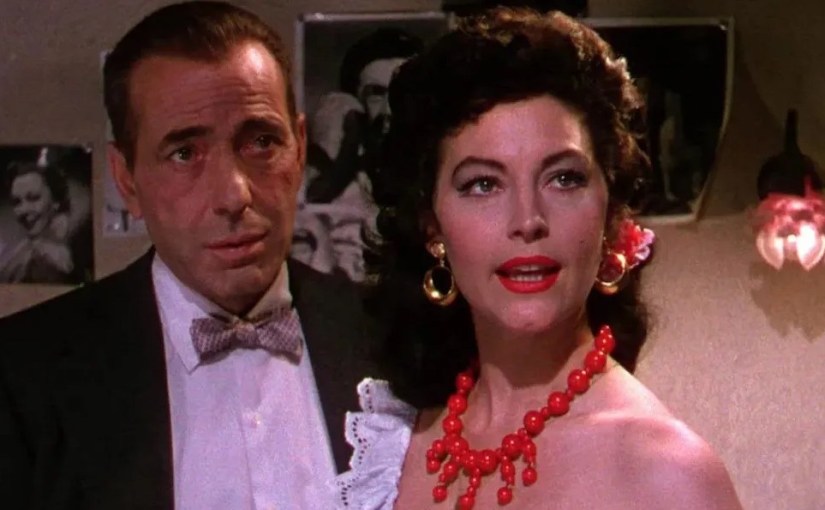
The Barefoot Contessa is a character study about a woman named Maria Vargas (Ava Gardner), who is discovered dancing in a Madrid café by B-movie writer/director Harry Dawes (Humphrey Bogart) and kajillionaire producer Kirk Edwards…whose resemblance to Howard Hughes had to be toned down under threat of legal action from Mr. Hughes himself. They are scouting for new talent along with Edwards’s gofer, Oscar Muldoon, played by Edward O’Brien, who won an Oscar himself for the role.
Maria is convinced to do a screen test, not by Oscar or Edwards, whose wealth has turned him into a spoiled child, but by the gentle persuasion of Harry Dawes, who quickly sizes Maria up as someone who is not to be bullied or cajoled. One thing leads to another, and she makes three films in America, all directed by Dawes, and she becomes an enormously popular star, beloved by millions…and three weeks after her fairy-tale wedding to an Italian count, she’s dead. (That’s not a spoiler; the film opens at her funeral.)
There are so many stories of Hollywood stars who achieve overnight success only to die young for one reason or another. The Barefoot Contessa tries to get into the mindset of one such actress, but only from the outside, as the public knew her. Not her friends, because she really only had one: Harry Dawes, the only person who really knew what made her tick, thanks to a heartfelt conversation outside her impoverished Spain apartment. How much of this conversation reflects what really goes in any actor’s head? Probably a lot. She talks about childhood fears, a desire to be loved, her unhappy home life with her parents, insecurities, superstitions (she refuses to wear shoes whenever possible)…there isn’t an actor walking this earth who couldn’t identify with at least two of those issues.
We follow Maria as she moves to Hollywood, changes her last name to D’Amata because it’s more exotic, and becomes a superstar almost against her will. Ava Gardner plays Maria as someone for whom acting is not a dream job, it’s just a job. If the by-product is fame and fortune, well, that’s just a lucky break. Maria is looking for the fairy tale, but it doesn’t involve limos and red carpets, nor does it involve finding a prince who’ll put the slippers back on Cinderella’s feet.
The Barefoot Contessa shifts narrators a couple of times, but it all leads to her fateful meeting with, and eventual wedding to, the dashing Count Vincenzo Torlato-Favrini, an Italian nobleman who “rescues” her from a verbally abusive paramour. The Count, though, harbors a secret that Dawes, with his “number six sense”, is bothered by, but can’t quite pin down…and since I knew Maria would be dead soon, I thought I knew what that problem was, but boy, was I wrong…
This film may not spark and crackle like All About Eve, but it’s chock full of ideas. There were times when it felt like it was trying just a little too hard to be a “great” movie, and I know that’s vague, but it’s the best way I can think of to describe it. I think I need to watch it again, now that I know more or less what’s going to happen, and appreciate what it’s trying to say in the context of stars like Jean Harlow, or Heath Ledger, or Marilyn Monroe, or James Dean.
This movie isn’t so much a “at-what-price-fame” kind of story, though, like Walk the Line or [insert title of musical biopic here]. It’s more like a portrait of someone who beat the system, who was able to reap the benefits of stardom without being consumed by it, much to the consternation of everyone around her. (But it’s not what killed her; write that up to her desire for the fairy tale.)
 2 UNPAID MOVIE CRITICS!!!!