

DIABOLIQUE (France, 1955)

by Miguel E. Rodriguez

DIRECTOR: Henri-Georges Clouzot
CAST: Simone Signoret, Véra Clouzot, Paul Meurisse, Charles Vanel
MY RATING: 10/10
ROTTEN TOMATOMETER: 95% Certified Fresh

PLOT: The wife and mistress of a loathsome school principal plan to murder him with what they believe is the perfect alibi.

[NOTE: If you have not yet seen Diabolique, READ NO FURTHER.  I will try not to give spoilers, but discussion of the story may give unwanted hints or clues.  Beware.]


Am I giving Diabolique, Clouzot’s classic of French suspense, a perfect rating because it fooled me?  No.  Is it because of the acting?  Not quite, although Véra Clouzot is an obvious standout.  In my mind, the lion’s share of the credit for my perfect rating goes to the impeccable screenplay and the masterful direction from H.G. Clouzot, director of other French classics like Wages of Fear (1953) and Le corbeau (1943).  The story is so good that Hitchcock famously regretted not grabbing the movie rights from the novel on which the movie is based, so he made sure he purchased the rights to the author’s next novel almost immediately.  [Fun fact: the movie of THAT book yielded Hitchcock’s legendary Vertigo (1958).]

The story of Diabolique will come as no great surprise to any modern moviegoer.  As soon as key facts about the major players were revealed, my mind immediately went to Ira Levin’s Deathtrap (1982), which was CLEARLY inspired by Diabolique, as were many others.  What makes Diabolique such a standout is that it was first.  Before Psycho, before Peeping Tom (both 1960), before Don’t Look Now (1973), Diabolique wowed and shocked audiences in equal measure.

Diabolique’s method is deceptively simple.  With admirably economic storytelling, Clouzot presents us with the three main players: the headstrong mistress, Nicole (Simone Signoret); the timid, sickly wife, Christina (Véra Clouzot, the director’s real-life spouse); and the detestable man they both share, Michel (Paul Meurisse).  The three of them run a boys’ boarding school, with Michel as the headmaster.  Michel is immediately set up as despicable.  The first time we see Nicole, she is sporting a black eye behind some shades, already seeming to plot with Christina.  A little later, Michel forces Christina to choke down some rotten fish served for their meal (he got a bargain at the market for day-old fish…eeyuck).  When she loudly wishes she were dead, Michel evokes Ebenezer Scrooge: “Hurry up, then.  We’ll arrange a nice funeral and be well rid of you.  The school won’t notice, and I’ll feel much better.”  Charming.

So, when the two women hatch a plot to get rid of Michel, we’re on board, because who WOULDN’T want to get rid of this jackass?  But in classic fashion, nothing goes down the way it’s supposed to.  First, there’s a problem with noisy plumbing (I’m being purposefully vague here).  Then there’s the broken handle on the large trunk.  Then there’s the pesky body that simply won’t behave the way a dead body should.  Then there’s the empty hotel room, and the Prince-of-Wales suit, and the schoolchild who claims he saw the headmaster at a time and place where he ABSOLUTELY should not have been…and so on.

Despite the fact that I kind of called what was happening and why, I still thoroughly enjoyed Diabolique, the same way that I enjoy watching some of my favorite films over and over again.  Here’s a plot that we’ve all seen repeatedly, but it’s done so well that you just have to sit back and admire its audacity.  Nothing is overdone, no one strains for any kind of effect, the characters are who they are, simple without being simplistic, if that means anything.  They’re intelligent people, not placeholders, so when they can’t figure out what’s going on, we believe it.

I loved the fact there was no musical score except for the opening and end credits.  That was amazingly effective, especially in scenes toward the end that relied heavily on the kind of shots and editing that reminded me of movies like M and Nosferatu.  And I haven’t seen water used so atmospherically since Brian De Palma’s Femme Fatale (2002).

Depending on how you define “twist”, it could be argued that Diabolique was the first movie to contain a full-on twist ending, one that redefines everything you saw previously and compels you to go back and watch the movie again to pick up on clues you missed the first time around.  (A case might be made for Mildred Pierce [1945] being first, but that film’s ending is not quite as insane as Diabolique’s.)  For that reason alone, and because it accomplishes it so well, this movie is worth seeking out.  Just don’t let anyone spoil it for you.
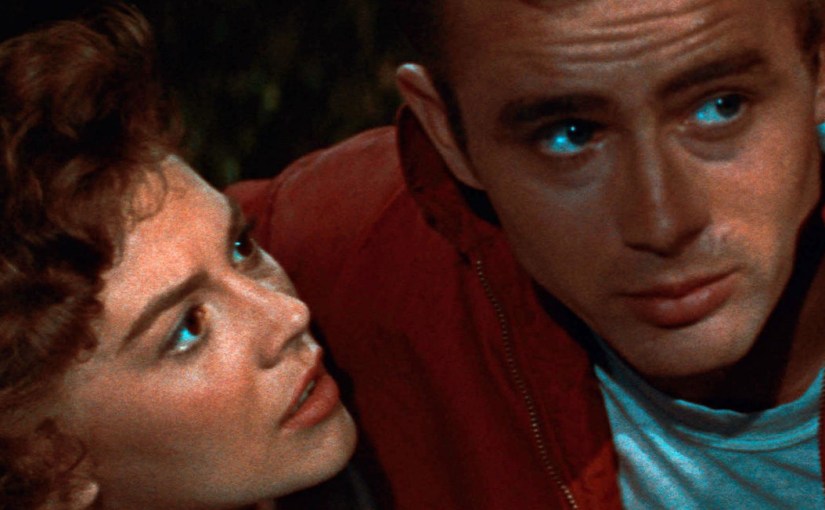
REBEL WITHOUT A CAUSE (1955)

by Miguel E. Rodriguez

DIRECTOR: Nicholas Ray
CAST: James Dean, Natalie Wood, Sal Mineo, Jim Backus
MY RATING: 7/10
ROTTEN TOMATOMETER: 91% Certified Fresh

PLOT: After moving to a new town, a troublemaking teen forms a bond with a troubled classmate and falls for a local girl who is the girlfriend of a neighborhood tough. When the new kid is challenged to a dangerous game of “chicken,” his real troubles begin.


To begin with, yes, Rebel Without a Cause is dated.  It is lurid, obvious, and heavy-handed, leaving very little to the audience’s imagination when it comes to the film’s message.  On the other hand, there are some not-so-subtle references to even deeper issues at play that make this dated, hammy film still relevant today.  I had always thought Rebel was simply about a troubled teenager pleading for compassion from an uncaring society.  Who knew it also dealt with a forbidden homosexual attraction and implied incest?  For a movie made when the Production Code was still being enforced, that is a LOT of subtext to unpack.

Jim Stark (James Dean) opens the film being hustled into a police station for public drunkenness in the wee hours of the morning.  Here, he will cross paths with two other teenagers: Judy (Natalie Wood) and Plato (Sal Mineo).  Over the next 24 hours, Jim will change their lives irrevocably just by trying to stay out of trouble, which has no problem finding him.

It’s here, when Jim’s parents arrive to bail him out, that Dean delivers his immortal line, “You’re tearing me APAAART!!!”  I’m kinda glad we got that out of the way so early so I didn’t have to anticipate it for the rest of the movie.  We also get the first of the film’s heavy-handedness, as Jim converses with a sympathetic cop, Ray (Edward Platt), who asks him the kinds of probing questions that only a psychiatrist would ask.  They become unlikely friends as they bond over the foolishness of Jim’s parents, who are so clearly out of touch with his inner turmoil.

During a field trip to the Griffith Observatory (the movie takes place in Los Angeles), Jim winds up in a knife fight with a local tough guy, Buzz, whom he eventually overpowers.  (The reason: Buzz called him “chicken,” just like Marty McFly…just throwing that in there.)  Buzz wants another chance, so he challenges Jim to a “chickie-run.”  That night, the two of them will drive a couple of stolen cars at high speed towards a high cliff drop; first one to bail out of their car is a chicken.

Before that can happen, we get the first of two surprising plot devices.  Jim runs into Plato at school, and it becomes instantly clear that Plato is attracted to him.  I promise I’m not reading too much into it.  The fact this wasn’t toned down even more in a movie from the mid-‘50s is a little shocking to me.  Plato looks at and hangs around Jim the way a girl with a crush latches on to the object of her desire.  Plato even has a fan-photo of Alan Ladd in Shane hanging in his locker.  It’s so obvious that I found myself wondering whether the movie would go so far as to let Plato try to kiss Jim.  Later, the screenplay makes it clear that Plato was just looking for a father figure, but dude.

Later that night, after the fateful “chickie-run”, Jim tries to explain to his parents what happened, but they’re unable to respond with anything but disbelief, and his mother even threaten to move again.  It’s abundantly clear that Jim’s parents are out of touch, a point that his hammered home again and again.  This approach at first seems overpowering, but director Nicholas Ray apparently was trying to lend the film an emotional, operatic sensibility to give the lead characters more of a mythic stature.

This is also conveyed through the film’s use of color Cinemascope, creating a frame that is just begging to be seen on the big screen where the colors and figures wouldn’t just pop, they’d EXPLODE.  If this was not a popular drive-in movie, it should have been.  That might actually be the best way to watch this movie, if at all possible.

There’s also a curious scene involving Judy’s home life that implies something unsavory is going on.  Judy approaches her father at the dinner table and tries to give him a kiss hello, but he rebuffs her: “Aren’t you getting a little old for that kind of thing?”  She feels hurt and tries again and gets a slap on the face for her trouble.  She runs out of the house and the father says something like, “She used to be so nice, now she’s nothing but trouble!”  A father who can’t accept an innocent kiss from his daughter has more going on underneath than the daughter, I can tell you that.  It’s an eyebrow-raising moment that does more to shed light on Judy’s behavior than anything else in the film.

The message of the film is simple, and it’s directed squarely at the parents: listen to your kids.  The parents in this movie do nothing but express sadness and dismay at their kids’ behavior, and never once do we see any real compassion, except when Jim’s dad (wearing his wife’s apron – more subtle coding?) tries to comfort him before the “chickie-run.”  But his words are hollow and meaningless, because he doesn’t take the time to ask the real questions that need to be asked.  Rebel Without a Cause was released at a time when popular opinion said that juvenile delinquency was largely a product of kids raised in slums or ghettos.  Rebel demonstrated that it didn’t matter where the kids were raised, it’s HOW they were raised that caused their problems.

I give the movie a 7 out of 10 because, while I acknowledge its place in film history, especially with regard to its star, I do feel the dated qualities hard.  But I give it props for delivering an important message, in a film that was powerful enough to lead some communities to ban screenings at local theaters for fear it would give the youth community bad ideas.  Talk about not seeing the forest for the trees…