
by Miguel E. Rodriguez
DIRECTOR: Sergey Bondarchuk
CAST: Sergey Bondarchuk, Lyudmila Saveleva, Vyacheslav Tikhonov
MY RATING: 8/10
ROTTEN TOMATOMETER: 100% Fresh
PLOT: The Russian aristocracy prepares for the French invasion on the eve of 1812 in one of the most ambitious epic films ever made.
The “Why” of Sergey Bondarchuk’s mammoth War and Peace is key to understanding the “What” and “How” of it.
In 1960, the citizens of Soviet Russia fell wildly in love with another version of War and Peace, directed by King Vidor and starring Audrey Hepburn, Henry Fonda, and Mel Ferrer. It was notable for its extravagant scope, but also for its myriad historical inaccuracies and departures from Tolstoy’s text. The Soviet government was unhappy with its popularity, so they commissioned their country’s film industry to create their own adaptation, with the full cooperation of the government, the Red Army, and the citizens of Moscow. Basically, it was a case of, “Anything you can do, I can do better.” Director Sergey Bondarchuk was tapped to direct. Five years (and two strokes) later, this gloriously Russian version of War and Peace would go on to win the Academy Award for Best Foreign Film.
The scale of this film is mindboggling. Clocking in at an intimidating seven hours, War and Peace is divided, like Tolstoy’s novel, into four chapters…basically four movies intended to be viewed one after the other. That might seem daunting at first, but how many of us have binged a streaming show all at once, or an entire miniseries in one day? Same difference. Anyway, three of the chapters focus on one of the principal trio of characters: Pierre Bezukhov, a timid aristocrat; Natasha Rostova, a tempestuous young woman whose emotional output puts modern soap operas to shame; and Prince Andrei Bolkonsky, a sober-minded aristocrat/soldier who woos Natasha despite a substantial age gap. The remaining film (which is actually third in the chronology) details the French invasion of Moscow in 1812, led by Napoleon Bonaparte, with the spectacular Battle of Borodino as its centerpiece.
I’ll get to that battle in a second, but it must be noted that I went into this film aware of its reputation, but prepared to be absolutely bored out of my skull. I have not seen very many Russian films, but my favorite by far is Come and See (1985), and I was certain this movie would not be anywhere near as compelling. However, Bondarchuk’s expressionistic style kept me interested the entire time. I was never truly bored…well, I tell a lie, the fourth chapter felt a little drawn out to me, but aside from that, the camera tricks on display – as well as the lavish and elaborate costumes and set pieces – were a constant source of surprise.
One highlight of Bondarchuk’s method is his liberal use of what I call a subjective camera. There may be another word for what I’m describing, but that’s what I’m sticking with. There is narration throughout the film that clues us in occasionally to what someone is thinking, but sometimes, instead of narration, the camera will give us the character’s POV along with a stylistic embellishment like a swaying motion, or giving everything a kind of blur, or enhanced lighting, or even what appears to be water being poured directly onto the lens to simulate tears or dizziness. (At one point, during a battle sequence, we even get a CANNONBALL’S-eye view as it crashes to the ground amid friendly troops…kinda neat, especially for the 1960s.) There are WAY more examples that I could point to, but ain’t nobody got time for that. Visually, this movie is a feast.
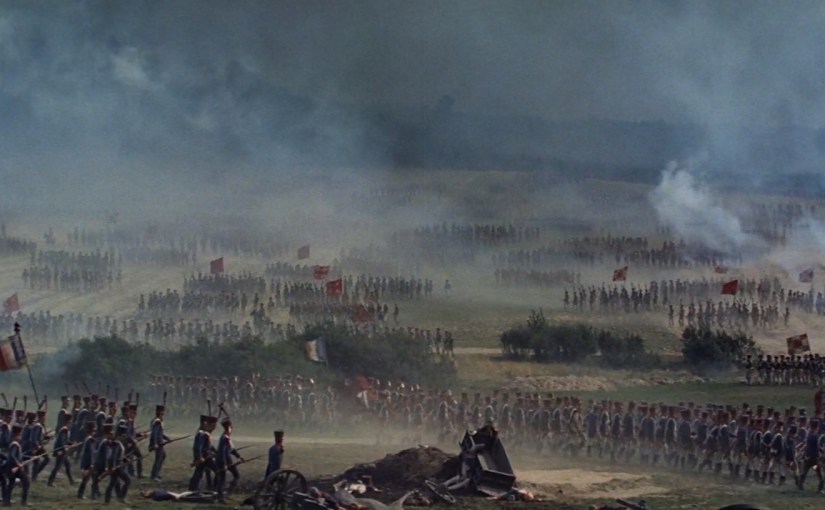
But all of that is nothing – NOTHING compared to the titanic Battle of Borodino featured in film three. Since Bondarchuk had access to as many troops and extras as he needed, this battle contains camera shots that would have made Kurosawa or Kubrick green with envy. In any given shot, look at the backgrounds toward the horizon, and you’ll see hundreds, thousands of fully costumed extras marching in formation, stretching literally as far as the eye can see. No cardboard cutouts, no matte paintings (as far as I could tell), no masses of CGI soldiers. I can’t imagine what it must have taken to coordinate that many people for any given single shot, let alone a battle that takes up nearly an entire chapter of the movie.
I realize I haven’t said much about the STORY of the film. (What can I say, the technical achievement really floored me.) I have never read Tolstoy’s novel, but it’s been said that this is the most faithful adaptation likely to ever be made. I believe it. Including the three principals, there are over three hundred speaking roles in the film. There were times during the first film, and maybe half of the second, when names were being mentioned, and I couldn’t for the life of me remember who they were. “Wait, who’s Maria again? Or Ilya? Or Kuragin? Is that Pierre or Nikolai?” But, around the halfway mark of the second film, I got my footing and was able to keep track of all the moving pieces. This movie does not reward passive viewing, just as the novel is not something you would pick up for some light reading. But these characters are compelling.
To try to summarize the plot is a fool’s errand. Love is found, lost, found again; soldiers go off to fight, some return, some don’t; and the aristocratic class of Tsarist Russia gets some jabs for supporting the war effort with “thoughts and prayers” rather than actions. Lyudmila Saveleva, who plays Natasha Rostova, looks like she was cast after winning an Audrey Hepburn look-alike contest. Her huge eyes and expressive face get us on her side, even when she makes a truly boneheaded decision in the middle of her chapter. True, she was misled and emotionally manipulated, but I said I wouldn’t summarize the story, so…
Am I glad I watched War and Peace? Absolutely. Will I watch it again? I think so, yes, although I couldn’t tell you when that will be. Not next week, not next year, but yes. I want to admire Bondarchuk’s bold cinematic choices again. It’s beautiful to look at. Some of it resembles the old Technicolor films, giving the whole enterprise an air of nostalgia, which is appropriate. And it’s worth watching again for those epic battle scenes which have to be seen to be believed. War and Peace lives up to the sobering title of its source material, and then some.
 2 UNPAID MOVIE CRITICS!!!!