
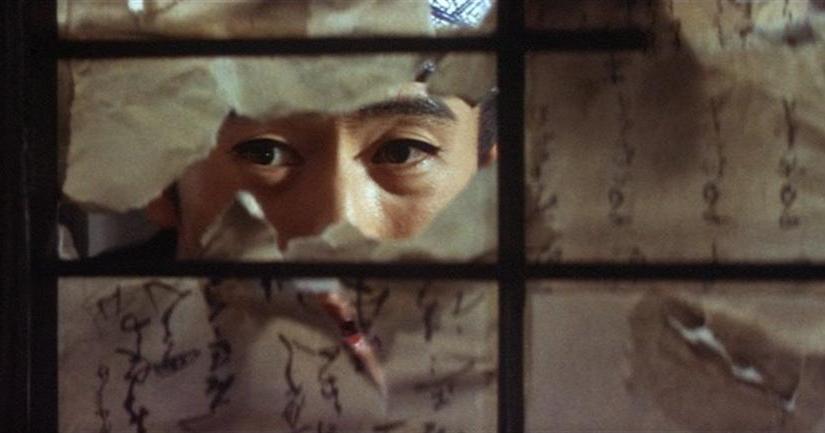
by Miguel E. Rodriguez
DIRECTOR: Kon Ichikawa
CAST: Kazuo Hasegawa, Fujiko Yamamoto, Ayako Wakao
MY RATING: 7/10
ROTTEN TOMATOMETER: 95% Fresh
PLOT: A kabuki actor exacts a bloody revenge after he encounters the wealthy businessman who destroyed his family.
In terms of good old-fashioned melodrama, Kon Ichikawa’s An Actor’s Revenge pulls no punches, utilizing a highly stylized, kabuki-esque visual language to tell a story that was old when it was first made into a movie in 1935, starring the same actor in the same lead/dual roles. But I am obliged to report that I never quite got a thrill of excitement when it came to the story. (…well, that’s not exactly true, there was ONE moment that genuinely thrilled me when it occurred.) I found that mildly disappointing because, as an amateur actor myself, finding a movie that combines two of my favorite plot devices – revenge and theatre – gave me high hopes. Perhaps I was expecting too much? But I thoroughly enjoyed the film’s style, celebrating artifice as much as any live stage production.
Kazuo Hasegawa plays two roles that he originated nearly 30 years earlier: a female-impersonating kabuki actor named Yukinojo, and a Robin-Hood-like bandit named Yamitaro. Director Ichikawa sets the visual tone immediately as we open on a kabuki performance with Yukinojo as the lead. While in character onstage, he spies three people in the audience, and we not only get his internal monologue about who they are and how urgently he seeks revenge on them, but we also get some cool visual tricks to reinforce his POV. First, the stagey set – fake snow falling, painted backdrops – is unexpectedly replaced with a “real” set. That is, it’s still obviously fake (the entire film was shot on studio sets), but it’s more realistic than before. Then, as Yukinojo looks out to where the audience used to be, we see what he sees with a kind of variation of the iris shot that opens up, almost as if he were looking through a solid wall with X-Ray vision.
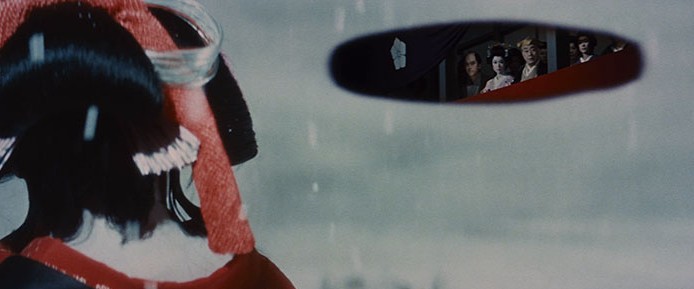
For me, this had the effect of creating an almost Shakespearian vibe. It’s like Ichikawa said, “Okay, you want melodrama? Let’s go all the way with it.” This kind of stylistic flair pops up through the entire film; there are too many examples to mention, but you’ll just have to trust me. It’s really cool to look at.
(Scorsese utilized similar throwback visual devices in films like Hugo and even The Departed.)
Story-wise, after that striking opening sequence, we get some filler about various audience members, some of whom we’ll see again later, before settling into your standard revenge story a la The Count of Monte Cristo or even Ben-Hur, where the wronged party bides their time until the moment is right. But it’s not enough for Yukinojo to just kill his targets in cold blood. First, he has to make them suffer.
I should note that this movie’s visual style repeatedly reminded me of another Japanese film, Onibaba, released a year later in 1964. Also shot in widescreen, Onibaba’s story is even older than An Actor’s Revenge, but it uses arresting widescreen compositions that evoke, not kabuki theatre, but comic books. I wonder if An Actor’s Revenge influenced that later film to any degree. Visually, it feels like it, but I’m not a Japanese film scholar, so…there you have it.
There is an interesting gender-bending aspect to the story throughout the film, as well. The character of Yukinojo is, of course, a man, but he never once breaks character as a woman. He speaks in a high, falsetto voice and keeps his movements soft and feminine at all times. There are odd moments when two different women confess their love to him, always referring to him as a man or a husband, while he is in drag the whole time. There’s a message there somewhere about pronouns and gender fluidity, but I’m not the one to explicate it.
This movie is on the list of 1,001 Movies to See Before You Die, but not for the reasons I was expecting. I will concede that my expectations were raised due to the subject matter, but while I can’t say my socks were blown off from a story perspective, I did love the visual approach to the storytelling, especially considering the year it was made.
 2 UNPAID MOVIE CRITICS!!!!