CHRISTY

By Marc S. Sanders

Boxing movies are nothing new.  The best ones depict the fighter surviving personal battles outside of the ring.  That was likely true with the fictional Rocky Balboa.  It might have also been what kept Jake LaMotta alive well beyond his demons.  It’s definitely a fair argument for Christy Martin, the first boxing champion to bring the sport into the mainstream for females.

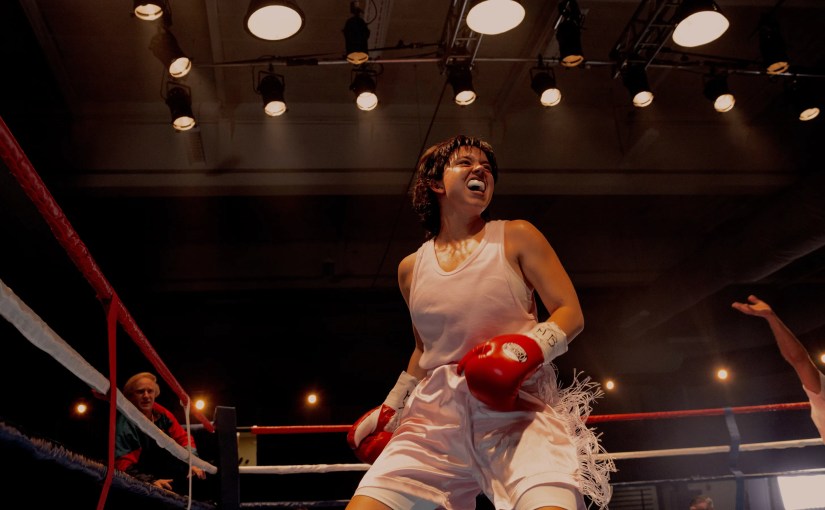
Her story comes to the big screen with an astonishing Oscar caliber performance from Sydney Sweeney.  I saw Christy a week ago and I cannot stop thinking about it.  The material within this biography from writer/director David Michôd is entirely familiar.  Still, the character of Christy and what she endures is worthy of a movie.

Beginning in 1989, eighteen-year-old Christy Salters haphazardly begins her climb up the ranks with small time underground fights in her Virginia hometown.  She’s not educated and she’s not embarrassed about being in a relationship with her girlfriend.  Her bible loving mother Joyce (Merritt Weaver in an authentic, all too real and villainous role) says otherwise. She’d take her daughter to the local minister to draw the gay out of her if the girl wouldn’t rebel with a temper inflamed by F-bombs.

Christy is summoned for higher stakes fights in Texas.  She wins that one and then is connected with Jim Martin (Ben Foster) who witnesses one hard swing from the girl in a sparring match. He commits his entire life to being her coach.  Ask Jim and he’ll say he made Christy what she becomes, a near undefeated champion adorned in signature pink and on the cover of Sports Illustrated – a first for a female boxer.  The film reminds the audience that Jim’s perspective is hardly true.  This jerk nearly screws up Christy’s chances of getting a lucrative contract with Don King (Chad L Coleman) which included pre-fights ahead of Mike Tyson’s Vegas appearances in the ring.  If only Jim’s laziness and procrastination were his worst qualities, though.

Christy becomes an emotional challenge to watch as it progresses. David Michôd’s film burrows into the dark underbelly of athletic success. Once Jim and Christy are married, a limited lifestyle cages the young phenomenon with the husband/coach’s monstrous tendencies.  The torment that victimizes this woman is beyond compare as she must succumb to demonizing sex slavery for his twisted, intoxicating yearnings, as well as for anyone he collects money from who ready to engage in brawls with her, in dirty hotel rooms.  Working in her corner at the fights, Jim does not protect Christy against opponents that she is clearly no match for.

Christy is physically abused and mentally tortured by Jim, and maybe by other intimidating powers like Don King.  Chad L Coleman delivers a brilliant and familiar persona to King.  The boxer is also financially getting ripped off, despite opening a Florida gym in her name with Jim listed before her on the front door.  

It’s astonishing to see how much peace Christy can find in a boxing ring alone against an opponent.  At home, she can only acquiesce to what’s demanded or forced upon her.  There’s no fight at home.  Only surrender.

I had recently seen Sydney Sweeney host Saturday Night Live.  It was one of many terrible episodes in the show’s history because the writers only catered to Sweeney’s youthful glamour and looks.  There was a skit taking place in a Hooter’s restaurant where her character was collecting the biggest tips based upon how she filled out the signature uniform.  It was lousy, unaware and insensitive writing.  Actors like Anne Hathaway or Natalie Portman were never treated this way on the program. None of the skits gave Sweeney something unique and worthy of what she’s capable of.

In Christy, with a white trash twang, and a puffed up brunette curly hair style (later it becomes blond corn rows), Sydney Sweeney is doing what Meryl Streep would have committed to in a physically taxing role like this.  Sweeney demonstrates a focused young girl going after what she wants even if it means she has to make up for her husband’s shortcomings as a negotiator.  He’ll beat the shit out of her, but Christy Martin matures as Michôd’s film progresses with intense training moments and riveting fight scenes that have Sweeney in action.  

Ben Foster is that committed actor who never looks the same in two different roles.  I didn’t even recognize the former Disney kid until I saw his name in the end credits.  Outdated polyester clothing and track suits from the 1990s do not hide that paunch, ugly belly.  Christy’s winning purses of prize money cannot conceal his bleach blond combover or his trashy southern accent.  Yet, he is nothing but noticeable when he is on screen.  Foster is the worst kind of cad with a terrifying grip on his wife and her career.  A terrible eyesore within the presence of the film.  Jim Martin is none too bright, but he knows how to hold a wrenching grasp and he’s entirely frightening.

Merritt Weaver is the quiet antagonist.  Unlike Foster’s character, the mind games that Joyce plays on her daughter are not so intentional as they are natural.  This mother refuses to see beyond the expected dominance of a man to uphold a catholic home, devoid of sinful lesbian practices.  It’s awful when a mother will side with a daughter’s abusive husband. Weaver’s portrayal of Christy’s bible committed mother demands to be hated.  

Ahead of seeing this film, I knew nothing about Christy Martin.  So, when a shocking moment occurs in the third act, my jaw dropped at the direction of the scene.  An action occurs and Michôd’s camera seems frozen in position as a character paces in and out of the room.  Then the character returns and commits a much uglier act.  Then the back-and-forth pace continues with a harrowing stare down before exiting to take a shower.  I know Christy is just a movie.  Yet, I cannot recall the last time I felt so helpless as a witness to what I was observing. I wanted step into the screen and lend aid. I only hope that when the film comes out in digital format, some insight is provided into how Sydney Sweeney and Ben Foster circumvented around their clashes of characters.  All of it feels too real.

Sydney Sweeney is also convincing as the battering boxer.  Like most films that cover sports, there are typical training and fighting montages here.  Sweeney is not afraid to behave ugly for the showmanship needed to be in an elite ring.  There’s one expression she delivers in a blink/miss wide shot lens after she knocks out an opponent.  It feels so organic as a bloodied Sydney Sweeney outstretched with her gloved fists, prances around the ring, gives a shoulder shrug and sticks her tongue out.  This actress knew exactly how to play this character, soaked in sweat with blood streaking out of her mouth and nose absent of any kind of humility that would show weakness in a champion fighter.

I am afraid though.  Christy is currently not the box office titan it deserves to be and come awards time, I’m certain Sweeney, Foster, Coleman and Weaver will be wrongfully overlooked.  Sydney Sweeney, a producer on the film, was asked what her reaction is to the sluggish financial returns.  Best she could, she replied by saying not all films are made for the money.  Some need to be made for the art.  I’ll go a step further and declare that Christy serves as an advocate for awareness of domestic violence and prevention.  Amazingly though, this film executes astounding triumphs for those underdogs who have next to nothing.

Christy is one of the best films of the year.  

HIGH PLAINS DRIFTER

By Marc S. Sanders

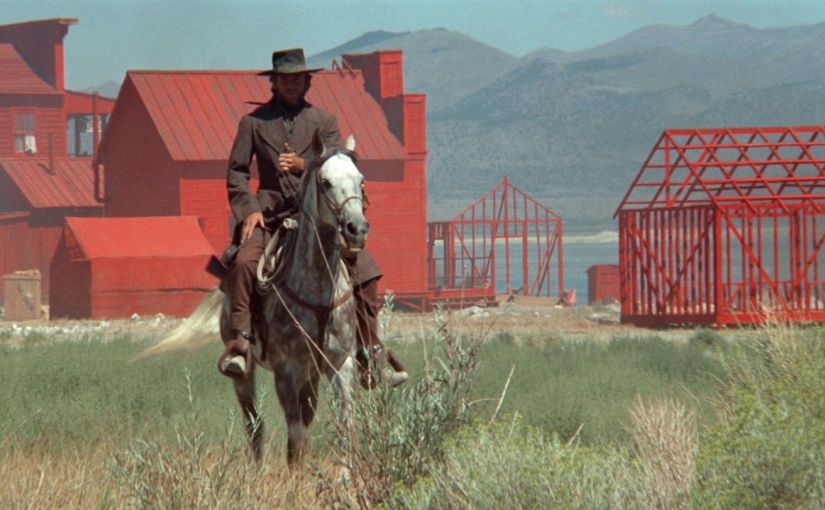
Because Clint Eastwood’s career of acting roles is thematically the strong, silent type, it’s easy to appreciate that in one film he may be The Man With No Name, while in another picture he’s simply The Stranger.  In the second film he directed, High Plains Drifter, he’s an intimidating force riding on horseback into the lakeside town of Lago.  

He may enter the saloon for a beer and a bottle and then cross the street to the barber for a shave and a bath, but you likely do not want to ever involve yourself with him.  He is also horrifically unkind to one of the few women in these parts.  Let’s just say it ain’t no roll in the hay.  This Stranger is a scary dude in a black hat.

The townsmen recognize a convenience in this man’s arrival though.  He’s demonstrated what he is capable of and therefore he appears to be the one qualified to kill three outlaws who were just released from prison with vengeance on their minds as they make a return to Lago.

There’s a hint of supernatural play in High Plains Drifter.  The Stranger recalls a harsh night when the local Marshall had been whipped to death by the townsfolk.  Could the Marshall be the Stranger?  Perhaps.  The victimized Marshall is portrayed by Eastwood’s long time stunt double and occasional director Buddy Van Horn (Pink Cadillac, The Dead Pool).  While that bloody slaughter occurred, the townsfolk simply watched with no offer to help.  For a while, High Plains Drifter was rumored to have been inspired by a real-life rape from the mid-1960s which ultimately led to the need for calling 911 in the event of an emergency.  Art imitates life even in the Old West.

The Stranger agrees to help the town prepare for the outlaws’ violent return, but like a fantasy character he makes special requests of his own including reassigning the sheriff’s badge to the town dwarf, plus taking whatever merchandise he wants from the mercantile and occupying the two best rooms in the hotel.  Also, he gives instructions to load up on a large supply of red paint.  Is the town of Lago getting what they bargained for or are they dwindling into a worse fate? Could be a deal with the devil or as Jewish mysticism might imply, the town of Lago might be inheriting a gollum.

Clint Eastwood salutes his prior directors that prepped him to become an esteemed filmmaker.  Don Siegel’s (Dirty Harry) and Sergio Leone’s (The Dollars spaghetti westerns) names are engraved on tombstones within the nearby cemetery built for the set.  Eastwood adopts some of their famed techniques while not setting himself apart from what those influencers accomplished.  He was still finding his footing behind the camera. High Plains Drifter is just a tale of revenge with recognizable set ups found within typical Hollywood westerns.  

Visually, the film starts out mysteriously with The Stranger’s arrival out of a sun soaked desert boil.  The photography looks deliberately grainy before the modern twenty-first century film restoration appears. Not a word of dialogue is uttered until after the picture has run for over seven minutes.  

Lago becomes a town with a new kind of identity later in the film as mandated by the script.  This is where Eastwood finds opportunity to do things with his western that his earlier pictures had not offered yet.  A bloody, hellish war is expected.

High Plains Drifter traverses in different directions while primarily staying in this one small town and you may wonder what this storyline has to do with that storyline.  Well, the commonality of its various parts is The Stranger’s arrival.  

You’ll may question who this unnamed man truly was by the time film ends.  Maybe it was not a man at all.  There are moments included by Eastwood’s direction to question what precisely occurred.  

Is High Plains Drifter a western or is it a ghost story? Like me, perhaps you’ll uncover moments that support either argument.

THE EXTERMINATING ANGEL (Mexico, 1962)

by Miguel E. Rodriguez

DIRECTOR: Luis Buñuel
CAST: Silvia Pinal, Jacqueline Andere, José Baviera
MY RATING: 9/10
ROTTEN TOMATOMETER: 94% Fresh

PLOT: The guests at an upper-class dinner party find themselves unable to leave the drawing room in Buñuel’s famous, none-too-subtle satire.


Buñuel’s The Exterminating Angel has many moods.  On the one hand, it’s a dark comedy of manners railing against the entitlements of the upper classes, much like the more recent Triangle of Sadness (2022), which owes much to this film.  On the other, it’s a Serling-esque horror story mining a common occasion for unexpected suspense, like The Ruins (2008) or Open Water (2003).  On a deeper level, perhaps it’s a Lynchian exploration of the human psyche, regardless of class, like Mulholland Drive (2001) or…well, with Lynch, you can probably just take your pick.

I experienced all of those moods while watching The Exterminating Angel.  I haven’t seen such an effective juxtaposition of tone since Everything Everywhere All at Once (2022).

The weirdness starts right away, in scenes that seem to be setting the stage for a Marx Brothers comedy.  Edmundo Nobile (“Nobile”, “noble”, get it, wink, wink?) has invited a large number of his posh friends to his mansion for dinner following an opera.  The moment they arrive, Nobile notes that his servants are not stationed at the door to take the visitors’ coats.  This is because most of the servants felt the sudden need to take the night off and left, being careful to avoid their employer.  He makes a statement about his servants, then everyone troops up the grand staircase to the dining room.

Moments later, this scene literally repeats itself, not by re-using the same footage, but in a separate take.  This kind of repetition occurs multiple times during the actual dinner scene, as well.  If there’s a deeper meaning to this device, I’ll have to leave it to film scholars to analyze.  For myself, it simply added a layer of oddness to the proceedings, but not in a bad way.

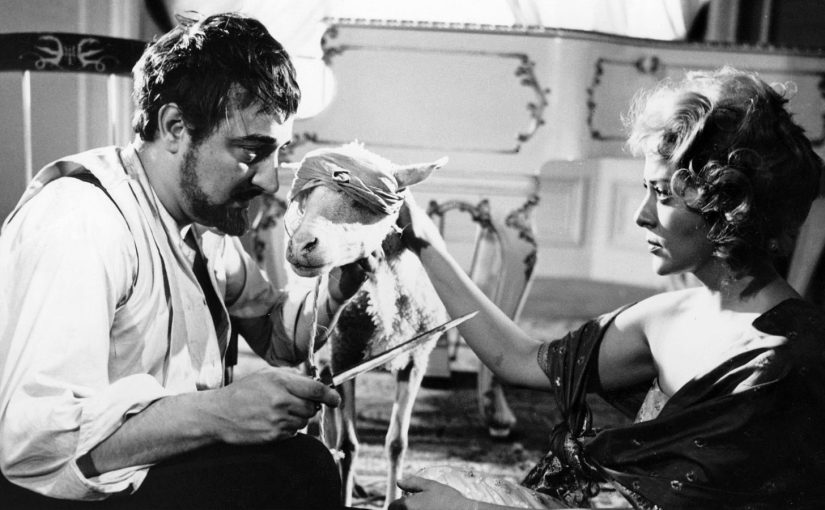
The dinner scene contains pratfalls, repeated conversations, and a visit to a side room containing three or four lambs and a bear on a leash.  What the WHAT…?  I remember thinking, okay, so this is going to a broad comedy turning upper-class manners into slapstick.  Seen it before, so I hope this movie executes it well.

The weirdness escalates when everyone retreats to a drawing room just off the dining room, where one of Nobile’s guests entertains everyone with a piano solo.  But when one of them tries to leave, he finds he can’t.  Not physically, like there’s suddenly an invisible wall, but one by one the guests discover they’re simply unable to leave the room.

They slowly realize the logistics of this bizarre situation.  The drawing room has no food.  Water runs low.  The one servant who remained outside manages to bring in a tray of water and coffee, but when he tries to leave to bring food…he can’t.  There’s no phone for them to call anyone about their predicament.

Outside the house, people find themselves unable to enter the grounds, so no one can tell what has happened to the people inside.  Curious crowds gather.  Inside, social structure starts to degenerate.  There are no restrooms, but one quick shot reveals a closet full of nothing but vases, and we see people entering and exiting these rooms repeatedly.  Ick.  Arguments are started with the drop of a hat.  One couple finds a unique, but undesirable, method of escaping their prison.

I responded to this material very unexpectedly, due mostly to its unpredictability.  I wasn’t cheering at the sight of upper-class twits being brought low when faced with bizarre circumstances, but I was more in tune with the horrific aspects of this story.  Buñuel has stated in interviews that he regretted not being able to take the story even further by including cannibalism, which is honestly where I thought things were headed.  It would have made a marvelous satirical statement, hearkening all the way back to Jonathan Swift.

(So, what DO they eat, you may be asking yourself?  Wouldn’t EWE like to know?)

I realize this review of the film hasn’t been much more than just a summary of its events, minus the surprising, “circular” ending.  A more detailed analysis might require listening to the commentary or reading Roger Ebert’s review or something.  But I hope I’ve conveyed how much I enjoyed The Exterminating Angel.  It was weird and surreal and absurd, and comic and horrific, and slapstick and satiric, and totally unpredictable all the way to the final frame.

P.S.  Now that I’ve seen this movie, the Woody Allen film Midnight in Paris (2011) has even deeper resonance when Gil meets Buñuel at a party and gives him the idea for The Exterminating Angel, and even Buñuel can’t understand it: “But I don’t get it. Why don’t they just walk out of the room?”  Funny stuff.

ASHES AND DIAMONDS (Poland, 1958)

by Miguel E. Rodriguez

DIRECTOR: Andrzej Wajda
CAST: Zbigniew Cybulski, Ewa Krzyzewska, Waclaw Zastrzezynski
MY RATING: 7/10
ROTTEN TOMATOMETER: 96% Fresh

PLOT: Against a backdrop of internal political turmoil at the end of World War II, a Polish resistance fighter faces a crisis of conscience when ordered to assassinate a Soviet official.


The Polish film Ashes and Diamonds is reportedly Francis Ford Coppola’s favorite movie, and Martin Scorsese has stated in interviews that he used it as an answer for one of his finals at film school.  From a technical standpoint, I can see why.  Echoes of this film (and perhaps others from director Andrzej Wajda’s filmography) are overwhelmingly evident in the bodies of work of both directors, from the mobile camera to the shocking moments of violence to the psychological makeup of the characters themselves.  As an emotional experience, I confess I didn’t get “worked up” over it, but it was interesting to see where two of the greatest American film directors got a healthy dose of inspiration.

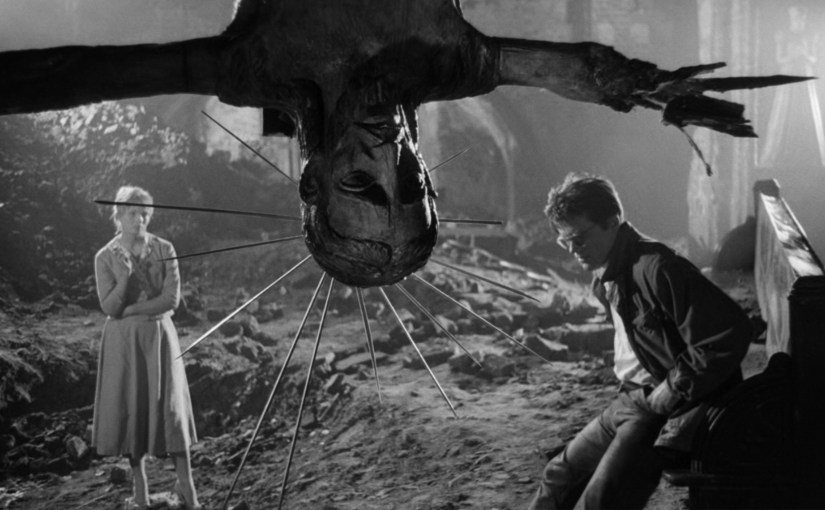
Ashes and Diamonds opens on May 8, 1945, with an idyllic scene outside a country church that quickly degenerates into a brutal double murder.  The killers are the calm, detached Andrzej and the flighty, charismatic Maciek, who spends most of the movie behind dark sunglasses.  We quickly learn their victims are not who they thought they would be.  Instead of killing two Soviet/Communist officials, they have killed two innocent factory workers.  War is hell.

Later, through circumstances that feel very Hitchcockian, Andrzej and Maciek hole up in a hotel bar, only to discover that one of their real targets, Szczuka, has booked a room in the very same hotel.  Maciek books a room directly below Szczuka’s, and the rest of the film plays out with that element of suspense hanging in the background, leaving us to wonder when and how Maciek will complete his assignment.

Complications arise when Maciek becomes infatuated with the hotel bartender, Krystyna, a blond beauty who rebuffs Maciek’s advances at first.  Later, they connect, but she doesn’t want to get involved with someone when it will eventually have to end: “I don’t want bad memories when memories are all I have left.”  Maciek falls for her so hard that he starts to doubt his resolve to kill his target.  “Will he or won’t he?” becomes the movie’s prime conflict.

Where to begin with the comparisons to Coppola and Scorsese?  The most obvious one is the unblinking attitude towards violence.  The two killings at the beginning of the film are done with very few cutaways as we see the multiple bullet hits on each victim, with one of them getting hit in the eye and another shot in the back at point blank range with such force his shirt catches fire.  (Malfunctioning squib?  Possibly, but it’s still effective.)  It’s interesting that this movie predates Bonnie and Clyde (1967) by almost a decade, but its depiction of onscreen violence feels very modern, even by today’s standards.

Then you’ve got the moral struggle of the main character, a man of action capable of casual murder who is suddenly given a reason to make something different with his life.  This reminded me of Scorsese’s The Departed (2006), with DiCaprio’s character undergoing the same internal conflict.  Maciek has multiple opportunities to kill Szczuka throughout the film, but something always pulls him back from the brink.  His partner, Andrzej, becomes impatient and reminds him what happens when soldiers let personal feelings interfere with their duties.  I had a vivid flashback of Michael Corleone’s credo: “It’s not personal, Sonny.  It’s just business.”

(I also felt that the dynamic between Maciek and his more level-headed partner Andrzej were evoked in Scorsese’s Mean Streets [1973], with De Niro’s Johnny Boy and his more level-headed partner Charlie, played by Harvey Keitel.)

But, cinematic comparisons aside, I didn’t find Ashes and Diamonds to be as gripping as other war or crime dramas of that era, such as Elevator to the Gallows, Touch of Evil (both 1958), or Rififi (1955), to name a few.  It’s a little weird to me, because all the pieces are there for a first-rate thriller.  I’m not asking that every drama pack the exact same kind of emotional gut punch every single time because I know that’s unrealistic.  But the fact remains: Ashes and Diamonds, while clearly very influential on future filmmakers, did not get me as involved as I would like to have been.  I was never bored, but neither was I over the moon.  It was…average.  Perhaps one day I’ll watch it again with a fresh eye to maybe see what I missed the first time around.