
By Marc S. Sanders
Oliver Stone is a very good director at providing the evidence of cynicism within the worlds he films. JFK covered a clandestine, conspiring environment oozing out of the columns of government. Platoon not only depicted the horrors of war, but also the cancer that poisons the mentality of soldiers expected to protect one another. Wall Street explores the temptations to cheat the stock market for grand prizes in wealth. Gordon Gekko is the 1980s tycoon who never knows the meaning of enough.
The well-dressed yuppie lizard, Gordon Gekko, is memorably played by Michael Douglas in his only Oscar winning role; regarded as one of the most villainous characters of the last fifty years. It’s not a modest part, and Douglas’ performance is therefore electrifying. With slicked back hair, the signature crackle of a voice inherited by his father Kirk, and the newest 80s innovation, a brick size cellular phone, the power to earn money and crush corporate enemies is done with ease. Gekko relies on obtaining inside information (a federal crime) to find the next chest of treasures. It might be an illegal practice but the best of the best at making mountains of money do it, and if you keep your process on the down low, nobody will catch wind of what you’re up to. Gordon Gekko is an absolute genius, and he’s awarded a script of fast talking, slick monologues that justify his sins.
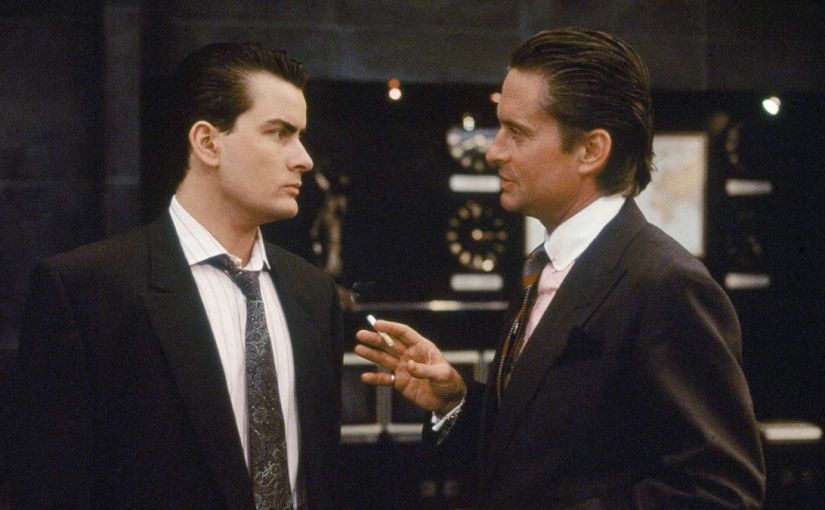
Bud Fox (Charlie Sheen) is the kid on the ground, way below Gordon’s high-rise office, desperately trying to get five minutes with the guy. A whole day’s wait in the lobby and a birthday gift of Cuban cigars does the trick. Now the lizard has the fox ensnared in his money-making schemes of deception and pursuits for unlimited greed.
Oliver Stone writes Sheen’s character as virginal when it comes to stock trading. The kid is dying to get laid with the big boys while getting away from the cold calling hang ups of promising uncertain futures in stocks and bonds. A subtle and effective angle is to give Bud a mentor. Hal Holbrook enters the screen from left or right on many occasions to put his hand on Bud’s shoulder and give him his own twist of Confucius philosophy. Then he exits out of frame towards the opposite direction he enters, leaving Bud to follow the questionable paths that Gordon paves. Holbrook’s contribution to Wall Street has never been celebrated enough over the years.
Michael Douglas and Charlie Sheen are an outstanding pair of devilish mentorship against innocence lost. Gekko preaches his passion for wealth on top of more wealth and why nothing should stand in his way, especially the law or the cost of others’ livelihoods. Bud Fox emulates him as a master of the universe. Charlie Sheen is great at being the biggest fan in Michael Douglas’ concerts of monologues. Watch how Sheen listens when Douglas has the floor.
Martin Sheen extends his paternal role to Charlie within Stone’s film. As Gordon sets designs on taking stock ownership of the small airline company that the father works for, the father/son relationship is tested, and Bud becomes blurred between what is right and wrong. The Sheens have good debates and heightened dramatic moments. I wish they were given more to do together though. Perhaps even showing the wedge of the mother role within this family.
Additionally, Oliver Stone writes dynamics for Bud in a worker relationship with a fellow trader colleague (John C McGinley). There’s a former college pal/now lawyer (James Spader) that Bud tries to squeeze at the behest of Gordon’s demands. Bud is also covered doing his own tricks of the trade such as dressing as a janitor to dig for what’s forbidden.
Why bring up all of these storylines? Well, there’s a wealth of great material in Wall Street that’s relevant to the practice of insider trading and corporate overhaul. Somehow though, Oliver Stone is responsible for writing one of the most unnecessary characters in film history.
Daryl Hannah just had to be cast as the buxom blond love interest for Bud Fox. She’s never believable as a New York City interior designer and the chemistry between Hannah and Sheen is as thin as water. Her name is Darien (a 1980s name) and one scene between Michael Douglas and her bustling the streets of Manhattan goes nowhere. Wall Street is simply not the superb film it could have been because of the amount of time devoted to Daryl Hannah’s character. Every moment she occupies is cutting room floor material. When Darien exits the picture she’s never mentioned again. The history she has with Gordon is never revealed to Bud. Regrettably, it’s all meaningless.
What’s frustrating with Wall Street is its promise is never fully committed. The roles awarded to Spader, McGinley, Holbrook and even Saul Rubinek in an early role as Gordon’s nerdy lawyer could have been even more fleshed out in lieu of what is covered with Daryl Hannah’s part. More moments with Martin and Charlie Sheen would have better served the film. A competitor tycoon played by Terence Stamp is very interesting and worthy of a larger presence. Sadly, I imagine a studio producer or even Stone insisted on having a love interest that serves no purpose here except to put a glamorous actress above the title in the credits.
Nonetheless, Oliver Stone built an authenticity to the hysteria of stock trading and corporate underhandedness. When he shoots the scenes occupied by Bud and Gordon, he does handheld shaky camera work to emulate that nothing feels sturdy and balanced. In moments that Bud’s father is at the center, the director shoots with a locked in position, bearing the character’s assured apprehension to trust his son or this prophet of greed.
I especially like the scene where Michael Douglas delivers his famous “Greed…is good!” speech at a shareholders’ annual meeting. Stone glosses over all the company vice presidents and officers as well as the fat cat suits who carry stakes in the company. Yet, the filmmaker also takes the time to show that little old lady with the pocketbook who finds her entitled seat to see how the value of her small ownership share is being treated. Remember, if you own stock like Disney or IBM, you get that invitation in the mail to attend these meetings, and you have just as much a right to attend as all the Gordon Gekkos of the world.
Wall Street serves an important reflection of 1980s capitalism, while taking place in 1985, two years ahead of the infamous market crash of 1987 (the year the film was released). Guys like Bud Fox had the Charlie Sheen image. Boyish men who got rich quick with little imagination to create and build. They stood next to tall wealth and learned, but they never gained the knowledge to prepare for quick falls and disheartening sacrifice. Most importantly, they took their own sense of morale for granted. These are the best parts of Wall Street.
 2 UNPAID MOVIE CRITICS!!!!