
by Miguel E. Rodriguez
DIRECTOR: George Stevens
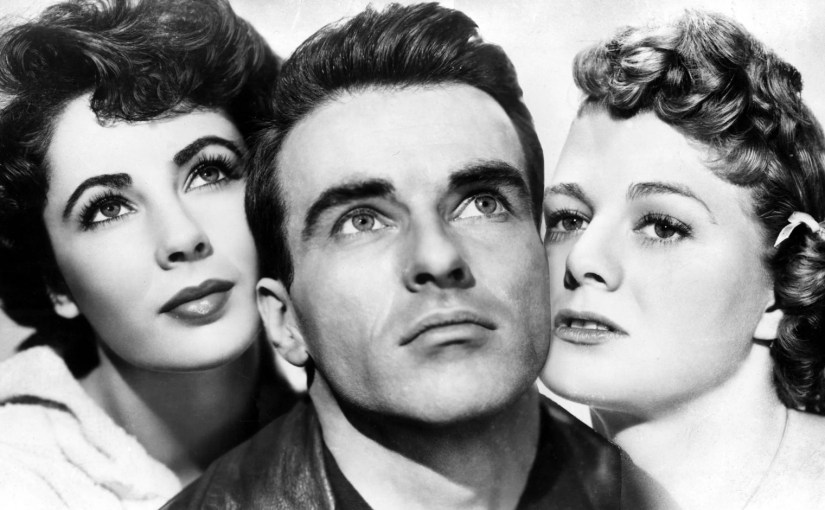
CAST: Montgomery Clift, Elizabeth Taylor, Shelley Winters, Raymond Burr
MY RATING: 9/10
ROTTEN TOMATOMETER: 82% Fresh
PLOT: A struggling young man gets a job working for his rich uncle and ends up falling in love with two women, one rich and one poor.
I first saw A Place in the Sun many moons ago at a friend’s house. I remember enjoying it but thinking it was too soapy for my taste. Years went by. I finally got around to watching Woody Allen’s Match Point and was stunned at how much Allen’s film borrowed from George Stevens’ celebrated melodrama. Having just re-watched A Place in the Sun, my opinion of it has warmed considerably, without diminishing my admiration for Match Point, which remains one of my favorite films of all time.
A Place in the Sun tells the story of young George Eastman, played by Montgomery Clift at or near the height of his powers. He’s a bit of a layabout who wrangles a job at his rich uncle’s swimsuit factory. When George meets his rich relatives, I was reminded of a George Gobel quip: “Did you ever get the feeling that the world was a tuxedo and you were a pair of brown shoes?” That’s George Eastman to a T, a ne’er-do-well in a sea of the well-to-do.
Against company policy, George falls in love (or at least in lust) with a rather plain girl, Alice, played by Shelley Winters in a de-glamorized role that went completely against type at that point in her career, winning her a Best Actress nomination. Alice and George flirt and hold hands and occasionally neck (mildly scandalous for a 1951 film), but George can’t help but stare at another girl who pops up occasionally: Angela Vickers. Angela is played by a ravishing Elizabeth Taylor, who was only 17 at the time of filming and empirically one of the most beautiful women in Hollywood, if not the world. It’s not too hard to imagine any man, let alone poor George Eastman, falling in love with her instantly.
But George is still connected to Alice, especially because he’s already slept with her. When George learns Alice is pregnant, he despairs because he had been planning to end things with Alice to pursue Angela. Alice even visits a doctor who might possibly provide an abortion. Of course, this being 1951, “abortion” is never mentioned out loud, nor is the word “pregnant.” But Alice’s visit to the doctor is handled with incredible intelligence and brilliant screenwriting that manages to say everything it needs to say without ever uttering those forbidden words.
The rest of the film examines what George may or may not be willing to do for the sake of his love for Angela, who loves him back, it turns out…but she doesn’t know about Alice. Since this is based on a then-famous novel called An American Tragedy (by Theodore Dreiser), it may not be too hard to divine what is in store for George before the final credits roll, but getting there is the fun part. By casting heartthrobs as the hero/anti-hero and the rich girl he loves, the film cleverly gets us to root for them a little bit, even when George is considering murder.
While Elizabeth Taylor dominates every scene she’s in just by standing there, the Academy made sure Shelley Winters was recognized for her incredibly difficult performance as Alice. There are some movies where, if a character is an emotional yo-yo, it can be frustrating. With Alice, Winters never crossed a line into unlikability, even when she calls George at a fancy dinner party demanding he marry her tomorrow, “or else.” It’s clear she has no options left to her if she wants to have any semblance of a life in polite society (by 1950s standards, anyway). I felt bad for her. But I also felt bad for George – to a degree – when he demonstrates how sincerely he has fallen head over heels for Angela. Not just because she’s stunningly beautiful, but also because she really seems to have fallen for him, too.
Lately, my movie-watching itinerary of classic films has involved a fair share of outstanding melodramas (Leave Her to Heaven, 1945; The Heiress, 1949; Dodsworth, 1936). A Place in the Sun fits right into that mold. It doesn’t quite achieve the perfection of The Heiress, but it is a fantastic example of its genre, good enough for Woody Allen to “reimagine” its basic story for Match Point, so it’s definitely worth a look if you’re into that kind of thing.
 2 UNPAID MOVIE CRITICS!!!!