
DIRECTOR: John M. Stahl
CAST: Gene Tierney, Cornel Wilde, Jeanne Crain, Vincent Price
MY RATING: 9/10
ROTTEN TOMATOMETER: 85% Certified Fresh
PLOT: A writer falls in love with a young socialite, and they quickly marry, but her obsessive love for him threatens to be the undoing of them both as well as everyone around them.
Leave Her to Heaven is one of the earliest examples in my movie collection of what I call a “head-fake” movie. There is a tiny bit of foreshadowing in its opening moments, but after that, it appears to fall into the traditional pattern of an old-fashioned, melodramatic potboiler, with a spurned fiancé, lovers in a whirlwind romance, and glorious three-strip Technicolor production design and cinematography that makes everything feel like a Douglas Sirk soap opera. When it makes its left turn into unanticipated territory, I was on tenterhooks.
Author Richard Harland (Cornel Wilde) has a classic, almost clichéd meet-cute with the ravishing Ellen Berent (Gene Tierney, who has never looked more beautiful) during a train trip to New Mexico. He’s visiting friends, she’s there for a funeral, and their circles of friends unexpectedly mesh. He winds up staying with her family at their ranch house. She and her family remark how much Richard resembles Ellen’s late father. He notices her engagement ring, but a few days later he also notices its absence along with her declaration that she’s removed it “forever.” (I’m REALLY condensing here to get to the point…)
Her fiancé, Russell Quinton (a very young Vincent Price), arrives upon hearing she’s broken off their engagement. He leaves after a brief conversation, and a few minutes later she literally proposes to Richard. They marry and enjoy a few scenes of wedded bliss (in separate beds, of course, this is the ‘40s), during which Ellen makes some red-flag-raising statements to the effect of, “I’ll never let you go” and “I want you all to myself.”
During all of this, the filmmakers exhibit terrific restraint. In some high-tension scenes, there is a notable lack of background score, which is a bit unusual for these kinds of pictures. You usually get ominous for tension, or pastoral for outdoor scenes, etc. But Stahl seems determined not to cue the audience for what they’re supposed to feel at any given moment, with one or two exceptions. This method contributes greatly to not giving away what’s coming. Ellen’s own words do that all by themselves.
There are other plot developments I could mention: Richard’s brother, Danny, who is disabled and comes to live with them for a while…Ellen’s fixation on how much time Richard spends with her sister, Ruth…Ellen’s attempt to get Danny’s doctor to prescribe more bedrest…these and other signal markers start to twist this apparent soap opera into something else entirely. It reminded me of the great head-fakery in Woody Allen’s ingenious Match Point [2005], which also started out in soap opera territory and wound up somewhere altogether more sinister.
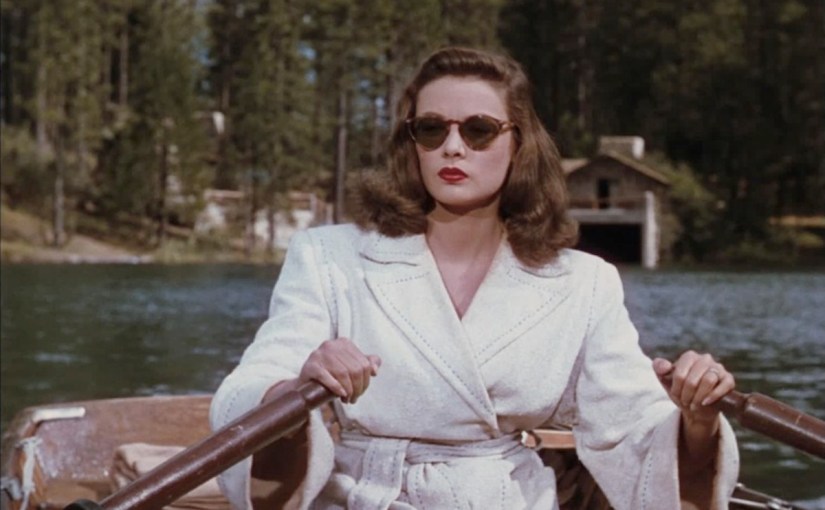
Much is made of the film’s Oscar-winning cinematography, and rightly so. In an era when color films were an extravagance for a movie studio, they made the right choice here. Cinematographer Leon Shamroy and production designer/art director Lyle R. Wheeler create picture-postcard images of a bygone era, lending an air of “vintageness” to the rooms, wardrobe, and makeup of the actors. Look at Gene Tierney’s marvelous red lips, or the gaudy red of her swimsuit, worn at a time in the film when she probably shouldn’t have been so extravagant.
But I particularly love the music choices, or rather the choices to NOT use music during key sequences. One in particular stands out. If you’ve never seen Leave Her to Heaven, I won’t spoil it for you. It’s the scene with a rowboat and one character’s attempt to swim across a lake. In many other films of the time, there would almost certainly have been tense strings, low cellos and brass in the background. For some reason, my mind goes to Miklós Rózsa’s magnificent score for Double Indemnity [1944]. That’s the kind of music normally heard in scenes like this. But the filmmakers made the canny decision to let us merely listen to the actors and watch as Ellen makes a crucial decision. That dread silence fairly SCREAMS as the scene progresses.
It’s tempting to look at this movie as a kind of Fatal Attraction [1987] prototype, but that’s not giving either movie its due. Fatal Attraction is a straight up thriller, and it’s about an unfaithful husband getting what he deserves. Leave Her to Heaven is also a cautionary tale, but not because the husband did anything wrong, aside from choosing to ignore a lot of red flags in Ellen’s behavior until it was far too late. It might also be possible to interpret the film as a warning to men against women who think for themselves too much, who are too “take charge”, or would be considered such in the 1940s. But I would disagree with that interpretation, too.
Look at Leave Her to Heaven as a whole, and I think it most closely resembles Lawrence Kasdan’s Body Heat [1981], or vice versa. Both feature femme fatales who are not shy about doing what’s necessary to get their way. The film’s ending even seems about to resemble Body Heat’s ending, but it veers away at the last second from the later film’s bleakness, providing an ending that seems just a little too pat. I have a sneaking suspicion the filmmakers had a different ending in mind, but were forced to make changes to please the censors. If there’s anyone out there who knows how the book on which the film is based ends, sing out.
Leave Her to Heaven is a singular experience. I even knew about the famous boat scene, and I was still on the edge of my seat. I simply couldn’t believe she was going to go through with it. That’s the sign of a great film: you know what’s coming, it’s inevitable, but instead of feeling predestined, there is real suspense, a desire to know why this is happening, and what’s going to happen next.
 2 UNPAID MOVIE CRITICS!!!!