
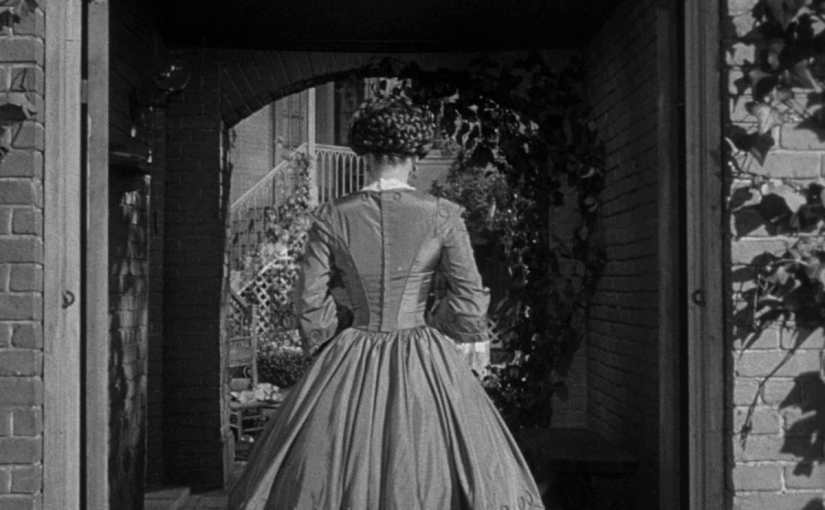
by Miguel E. Rodriguez
DIRECTOR: William Wyler
CAST: Olivia de Havilland, Montgomery Clift, Ralph Richardson, Miriam Hopkins
MY RATING: 10/10
ROTTEN TOMATOMETER: 100% Fresh
PLOT: In the mid-1800s, a naïve young woman falls for a handsome young rogue whom her emotionally abusive father suspects is the male version of a gold-digger.
[Author’s note: If you have not seen this film, but intend to do so, I urge you not to seek out spoilers. The final resolution of this movie deserves to be seen in a vacuum, if you know what I mean.]
The AFI’s list of the 50 Greatest Villains in American film does not include Dr. Austin Sloper, played with indifferent cruelty by the great Ralph Richardson in William Wyler’s The Heiress. This is a miscarriage of justice, as Dr. Sloper is one of the most ruthlessly harsh characters I’ve seen in a movie in many years. The fact that he is successfully upstaged by Olivia de Havilland as his daughter, Catherine, is a triumph of screenwriting, directing, and pitch-perfect acting from both performers. The fact that both performances nearly overshadow a charismatic young Montgomery Clift is something that must be seen to be believed.
The film starts in the mid-1800s in the Washington Square area of New York City. It’s a time of horse-drawn carriages, corsets, and garden parties. Catherine Sloper is a very plain, very shy, single woman who lives in a three-story brownstone with her widowed aunt, Lavinia (Miriam Hopkins), and her father, a financially successful doctor who will bequeath a $30,000-a-year inheritance to Catherine upon his death. In addition to the $10,000-a-year she already receives from her mother’s inheritance, Catherine will be financially comfortable for the rest of her life. Alas, her social graces are virtually nonexistent, and she is quite plain when compared to her late mother…as Dr. Sloper casually mentions from time to time, utterly oblivious to the effect this has on Catherine.
At a garden party, during which Catherine is socially humiliated by a thoughtless gentleman, she meets the well-dressed, well-behaved, and nearly penniless Morris Townsend (Clift), who makes it clear that he is utterly taken with her and would like nothing more than to spend the rest of the evening talking or dancing with her and no one else. Her aunt Lavinia is ecstatic the next day, but Dr. Sloper is skeptical. In his mind, no gentleman in his right mind would express romantic intentions towards his socially unsuitable daughter unless he simply wanted the money that comes with her, and he says as much to Mr. Townsend AND to Catherine. The callousness of Dr. Sloper’s behavior is abhorrent, and I found myself thinking, “If this guy were drawn and quartered by the end of the movie, that would still be too good for him.”
The brilliance of the screenplay becomes apparent when Morris boldly announces his love for Catherine, to her complete stupefaction. And when he actually proposes, that pushes her over the edge, and she falls head over heels in love with him, because he’s the first man who has ever shown anything more than polite tolerance towards her…including her father. Dr. Sloper lays out his case for what he believes Townsend’s true intentions are: to take control of or squander her inheritance after they marry.
Dr. Sloper’s brutality knows no bounds…but you find yourself thinking: what if he’s right? Certainly, Townsend is completely genuine in his love for Catherine, or at least seems to be. He knows exactly what to say, and when and how to say it. Is it an act? He’s handsome enough to be an eligible catch for any number of society women in the city, so why waste his time on such a plain-Jane girl as Catherine?
This conflict occupies the main thrust of at least the first half of the film. What transpires and how and when, I will not say. I will say that the story led me in one well-traveled direction, took a left turn, then took another unexpected turn that left me kind of breathless at its audacity. The movie as a whole has been compared in some circles to Scorsese’s The Age of Innocence (1993), and deservedly so.
Olivia de Havilland’s performance as Catherine is one of the greatest performances I’ve seen in any film of that era. It trumps even her powerful turn in The Snake Pit a year earlier. Clearly, de Havilland was anything but plain and awkward in real life, but careful makeup and performance nuances helped her bring off one of the most commanding roles of her career. There is an emotional transformation that occurs at one point where she is able to affect a complete one-eighty in her character, and it never once feels histrionic or gimmicky. She shares a scene with her father in which she has “found [her] tongue at last,” as he puts it, that I would rank as one of the greatest two-handed scenes I’ve ever watched. The surgical application of language to inflict harm on another person is breathtaking. Neil LaBute or David Mamet couldn’t have written it any better.
The Heiress left me feeling a little wrung out at the final credits. I remember watching this movie many years ago, but nothing stuck with me except that ending. Despite this foreknowledge, the movie still worked its spell on me, leaving me with a dropped jaw and a blown mind. The ending is somehow definite and ambiguous at the same time, a screenwriting miracle. (And I don’t mean in a Sopranos kind of way, either.) The Heiress is officially one of my new favorite films.
 2 UNPAID MOVIE CRITICS!!!!
Spot on review…. made me want to dust the VHS off and watch it again Thanks !
LikeLike