
by Miguel E. Rodriguez
DIRECTOR: Anthony Mann
CAST: James Stewart, Shelley Winters, Dan Duryea, Stephen McNally, Millard Mitchell, Rock Hudson, Tony Curtis
MY RATING: 9/10
ROTTEN TOMATOMETER: 100% Fresh
PLOT: A cowboy’s obsession with retrieving his stolen rifle leads to a violent odyssey through the American West.
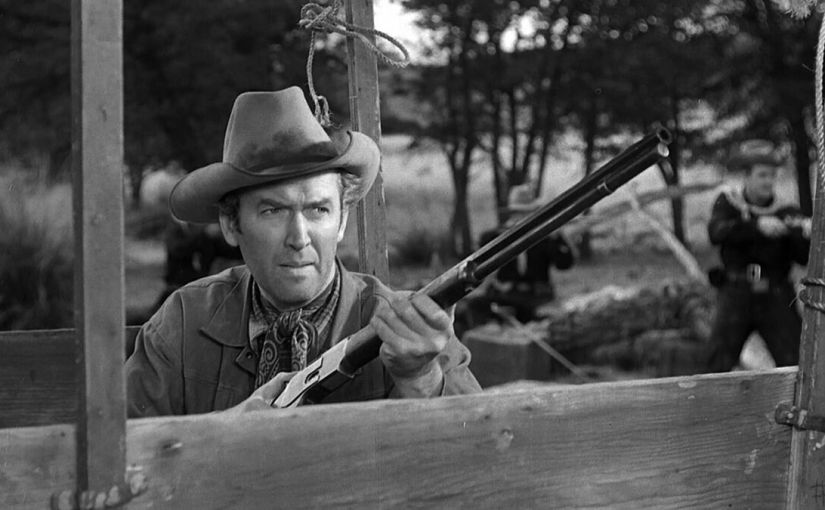
Even without knowing the full history of how the film impacted contemporary audiences, Anthony Mann’s Winchester ’73 still packs a punch. Using an ingenious story structure, courtesy of a very Western MacGuffin, the film follows the path of a rare, expensive Winchester rifle from hand to hand for ninety taut minutes. James Stewart is top billed, but he is on screen for less time than you’d think. That’s actually a good thing in this case, as Mann’s focus is not on star power, but on metaphor and mythology. (Although Stewart’s star power certainly doesn’t hurt, as he demonstrates in several key moments.)
The movie plops us right into the action with nary a flashback nor an expositional monologue in sight. The legendary town of Dodge City is holding a shooting contest to celebrate Independence Day, 1876. Sheriff Wyatt Earp (!) is officiating, and the prize will be a rare model of the Winchester ’73 repeating rifle. Arriving in town that day is Lin McAdam (Stewart) with his partner, High-Spade Frankie Wilson (Millard Mitchell).
(Around this part of his career, Stewart’s trajectory was on the decline, as he was getting too old to play the aw-shucks-y kind of roles that were his bread and butter in the ‘30s and ‘40s. Winchester ’73 was an opportunity to showcase his range, and he delivered. Lin McAdam is not the villain, but neither is he the kind of character Stewart had ever played before. It’s been written that, when audiences of the day saw Stewart get violent and pin a man to a saloon bar, there were gasps.)
Lin is none too friendly towards another man in town, Dutch Henry Brown (Stephen McNally), who reciprocates in spades. There is clearly some kind of history, but what that history entails would take too long to explain, so the movie wisely doesn’t try. They’re enemies, and that’s enough. Somewhat predictably, they both enter the contest for the prize Winchester, but in the first of many twists, the contest doesn’t play out exactly as you would expect. Then the rifle is stolen, Dutch and his pals skip town, and Lin and his partner give chase.
From there, the movie gets episodic. There’s the Indian trader, the Indian himself, Young Bull (Rock Hudson in a fake nose and braids!!!), the obligatory feisty lady, Lola (a luminous young Shelley Winters) and her beau who behaves in a most unmanly manner, a run-in with some cavalrymen (featuring an unknown young actor billed as “Anthony Curtis”), and winding up with a real sleazeball, Waco Johnny Dean (Dan Duryea). How the rifle makes its way from place to place I will not reveal, but it’s all perfectly feasible.
(I will leave it to wiser minds than I to discuss the racist portrayal of Indigenous Americans, including using Rock Hudson in “red-face” to play a tribal chief. Yes, it’s shameful and unfortunate, but it happened, and I use the term “Indian” earlier because that’s how they’re referred to in the film, for better or worse.)
If I had to explain what this movie is actually about, beyond its brilliant plotting, I’m not sure I could do it. I can report that it was engaging and crisp and surprising and almost demands a rewatch after the end credits, but aside from just being a darn good entry in the Western genre, it’s hard for me to pin down its message. Is it a screed against the violence in the real West? How some men searched for violence because it was in their nature, or because they felt it was their duty? I mean…yeah, I guess, but that feels like just scratching the surface. What were Mann and Stewart trying to say?
Maybe it’s one of those movies where the message depends on the viewer. If you look at it as an anti-violence film with a bittersweet ending filled with moral ambiguity, it’s there. If you look at it as just a travelogue or tapestry of the old West, made by a director who loves the genre and an actor sinking his teeth into a great role, that’s there, too. (Mann and Stewart would go on to make seven more films together, five of them Westerns.) There’s even melodrama and a hint of romance along the way, but never too much to drown everything else out. For me, Winchester ‘73 is much harder to unpack than Unforgiven (1992), whose message is crystal clear from beginning to end. Both movies are equally entertaining, though, don’t misunderstand me.
If any active readers have made it this far, feel free to let me know what the “true meaning” of Winchester ’73 is. Whether I find out or not will truly not matter, because the movie is still hugely entertaining with or without an explanation. I might have a tiny bone to pick with the final battle, with its foregone conclusion, but it comes with the territory, so I have to forgive it. This is a great entry in the genre, featuring a star pushing his boundaries and a director who knew how to harness that energy.
 2 UNPAID MOVIE CRITICS!!!!