
by Miguel E. Rodriguez
DIRECTOR: Carl Th. Dreyer
CAST: Julian West, Maurice Schutz, Rena Mandel, Sybille Schmitz
MY RATING: 8/10
ROTTEN TOMATOMETER: 98% Certified Fresh
PLOT: A drifter obsessed with the supernatural stumbles upon an inn where a severely ill adolescent girl is slowly becoming a vampire.
Carl Th. Dreyer’s Vampyr [pronounced “vom-PEER” in this German version] is not the scariest vampire film I’ve ever seen, but it is definitely one of the creepiest. There’s a difference. Dreyer’s film doesn’t move with the pacing seen in more standard horror fare. Instead, it forsakes typical plot development for scenes that linger on the horrific or the unexplained. In its own way, it is more directly related to the films of David Lynch than to any other contemporary monster movies of the time (Dracula or Frankenstein, for example, both 1931).
The story is fairly simple, but it belies the complex imagery that awaits the viewer. A young drifter, Allan Grey, happens upon an inn from which he thinks he can hear animal sounds, or perhaps a young woman screaming. The village doctor, who looks like a bespectacled long-lost relative of Doc Brown from Back to the Future, vehemently denies the presence any animals or young women on the property. The innkeeper invites Allan to stay the night. In the middle of the night, Allan’s sleep is interrupted by a mysterious visitor to his room who intones, “The girl must not die!” The gentleman then leaves a package on Allan’s desk and writes a most portentous message: “TO BE OPENED ONLY UPON MY DEATH.”
What is this book? What did Allan hear? And how do you explain the shadows he saw on his way to the inn? Shadows of people running along the lane – with no corresponding people attached to them? Wouldn’t YOU like to know.
Vampyr is positively drowning in atmosphere. Dreyer apparently shot many scenes with a piece of thin gauze over the lens, creating a misty layer that makes everything feel like a dream, even when Allan is awake. Allan goes on frequent excursions around the inn and the surrounding property, and it’s here where most of the fantastical imagery is seen, especially when it comes to disembodied shadows. In one mildly unsettling sequence, a shadow of a man with a peg leg descends a ladder and appears to sit on a bench…re-joining itself to a peg-legged man already sitting on the same bench.
There’s a lot more, but I don’t want to just write a list. However, I am compelled to mention one sequence in particular that exudes as much creepiness as anything I’ve ever seen from this cinematic era.
It turns out there is, not one young woman at the inn, but two: Gisèle and Léone. Léone is seen early on, confined to her bed with a mysterious illness, which we later learn has been brought on by her contact with a seldom-seen old woman who lurks somewhere on the property. And there are some odd injuries on her neck…UH oh.
At one point, Léone awakes while Gisèle is alone with her. I don’t remember what they discuss, but Léone goes into this weird sort of trance. Without the use of any strange Chaney-esque makeup or camera tricks, Léone’s face becomes an object lesson in creepiness. Her eyes open wide, her face breaks into a creepy grin, and she slowly moves her head from side to side, while Gisèle backs away in terror. It might be the scariest sequence in the film, one which could easily compare to any subsequent monster or vampire movie.
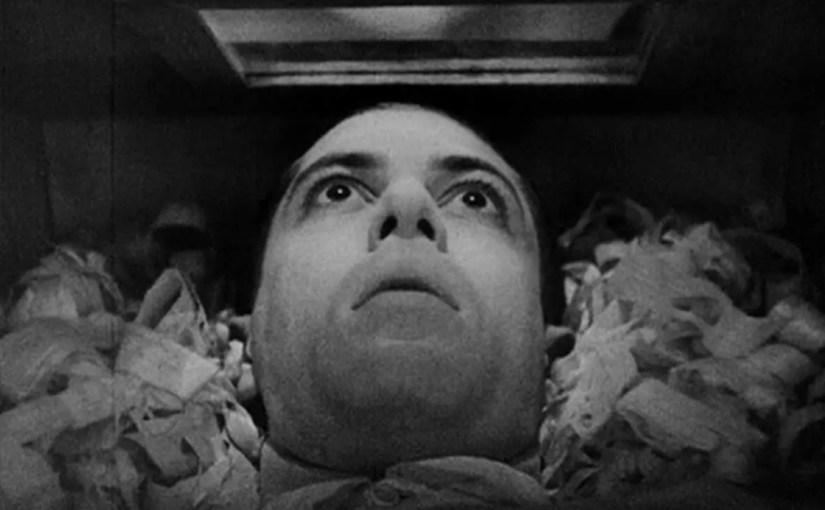
Later, Dreyer throws more camera tricks at us in increasingly imaginative ways. Allan dreams of a skeleton handing him a bottle of poison. A dead man’s face appears in the sky during a sudden thunderstorm. Dreyer includes camera moves that would fit right into any modern film. And in a sequence that reminded me of Wes Craven’s The Serpent and the Rainbow (1988), Allan watches as his own body is sealed inside a coffin with a tiny square window for his apparently dead eyes to look out of.
If nothing else, Vampyr is an interesting artifact of cinema’s transitional era from silent to sound. Even though there is a conventional soundtrack and we hear people’s voices as they speak, a lot of expository information is provided via title cards and long looks at passages from a book of vampire lore. Given that the vampire mythology was then not as popular as it is today, I can forgive these beats that tend to bring the momentum to a halt.
While Nosferatu (1922) and the Bela Lugosi Dracula are much more famous, Vampyr is worth a look if you’re a horror fan. While it doesn’t involve the kind of fear factor I tend to expect as a child of the 1970s and ‘80s, it is nevertheless creepy as hell.
 2 UNPAID MOVIE CRITICS!!!!