SILKWOOD (1983)

by Miguel E. Rodriguez

DIRECTOR: Mike Nichols
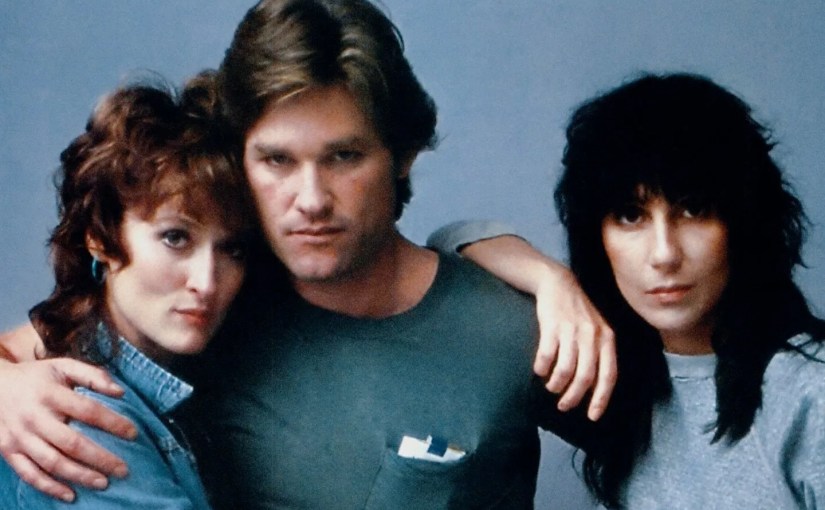
CAST: Meryl Streep, Kurt Russell, Cher, Craig T. Nelson, Fred Ward, Ron Silver, Bruce McGill, David Strathairn, M. Emmet Walsh, James Rebhorn
MY RATING: 8/10
ROTTEN TOMATOMETER: 77% Fresh

PLOT: On November 13, 1974, Karen Silkwood, an employee of a nuclear facility, left to meet with a reporter from the New York Times. She never got there.


The tagline for Silkwood (quoted above) almost feels like it gives the game away, but it doesn’t really.  Even if Karen Silkwood’s name isn’t exactly part of the cultural zeitgeist anymore, I am willing to bet that a lot of people know what her name signifies in one way or another.  So, it’s not like the movie’s poster or trailers are spoiling what happens at the end of the film because most of us know.

In any event, Mike Nichols’ film isn’t a nuclear-based thriller, like The Day After (1983) or WarGames (1984), that depends on an unexpected resolution.  Silkwood isn’t about theatrical heroics or bombastic personalities.  It’s a quietly intense character study of an everywoman with an untidy personal life who experiences a seismic shift in her perception and decides she simply can’t stand by and do nothing.  This isn’t a crowd-pleaser like Erin Brockovich (2000), but this film’s story and central character are no less important.

The film goes to great pains to show us how ordinary and messy Karen Silkwood is.  The incidents at the Oklahoma nuclear facility where she works (along with her live-in boyfriend, Drew, and her roommate, Dolly) are almost secondary to the plot, at least for the first half of the film.  Karen has kids that live with her ex-husband and his girlfriend in Texas.  Her relationship with Drew isn’t stormy, but it’s not perfect.  Dolly seems tolerable as a roommate, but is not shy about speaking her mind.  Dolly brings a girlfriend home one night, and there is a slyly amusing conversation between Karen and Drew about Dolly’s sexual preferences.  (“I can handle it.”  “Me, too.”  “…so why are we talking about it?”)

I don’t want to go into too many details about the true-life incidents that occurred at the facility where Karen worked because, if you’re not intimately familiar with the facts of the story, they should be as surprising to you as they were to me.  Plutonium is involved, but probably not in the way you’re thinking.  Karen learns enough to know she should be more involved in the factory’s union…a LOT more.  One plot thread almost feels like it’s ripped off from The China Syndrome (1979), until you realize Syndrome was released four years after the events of Silkwood, so if anything, Syndrome was probably inspired by Karen’s discoveries.

I also have to mention Cher as the roommate, Dolly.  Of course, Meryl Streep is amazing and convincing as an everyday, average divorced mom, but Cher more than holds her own in every scene.  There is absolutely no hint of the pop music megastar of the ‘70s in this film.  Director Mike Nichols insisted she wear little or no makeup in her scenes, which went against every fiber of her instinct as a performer.  She understood the assignment: she never upstages anyone.  This is not a grandstanding kind of supporting role, like Tommy Lee Jones in The Fugitive (1993) or Cate Blanchett in The Aviator (2004).  It required subtlety and understatement, and Cher delivered.  I tried to spot her “acting,” and I never could.  She was unbelievably natural and, at times, heartbreaking.  The movie is almost worth searching out just to see her performance.  It’s a clinic in how to own a small role and make it stand out by doing less than you might expect.

Silkwood may not feel as thrilling as some of the other thrillers I’ve already mentioned, but it is just as compelling, specifically because we’re watching an ordinary person under extraordinary circumstances.  We’re not watching a hero triumphantly rise to the occasion.  We’re watching a struggling divorcee who’s trying to do the right thing after years of inaction, even if it means losing the trust of her co-workers or sacrificing her other personal relationships.  I identified more with Karen Silkwood and her situation than I did with Jane Fonda in The China Syndrome or Julia Roberts in Erin Brockovich

The ambiguous nature of the film’s ending mirrors what happened in real life, and when the credits rolled, I felt a surge of empathy for the people left behind and the unanswered questions they live with to this day.  That doesn’t happen to me very often.
MEET THE PARENTS

By Marc S. Sanders

Am I the only one who used to get tired of feeling sorry for Ben Stiller?  The go to formulas of his earlier comedies made him the unfortunate stooge.  The best of that batch was The Farrelly Brothers’ hilarious There’s Something About Mary.  Every gag, every cast member, every storyline was straight up side splitting.  Late last year, during the hurricane chaos in Florida I got around to watching Along Came Polly.  Poor Ben had to play basketball defense against a bare chested wookie hairball of a guy and his close up of misfortune carried the advertising campaign for that movie. 

Back in the year 2000, Stiller suffered through a terrible weekend with an intimidating Robert DeNiro frowning on his every move in Meet The Parents, also known as the first of a “Fockers Trilogy.”  Yeah, Meet The Parents is funny.  You shake your head at the absurd comedy that befalls Stiller’s character, Greg Focker. Though that isn’t even his real name at birthright.  Still, I can’t recall feeling so guilty for one guy’s misfortune that he can hardly ever help to avoid.  This guy is destined to never win, to never overcome, to never live without self-consciousness.

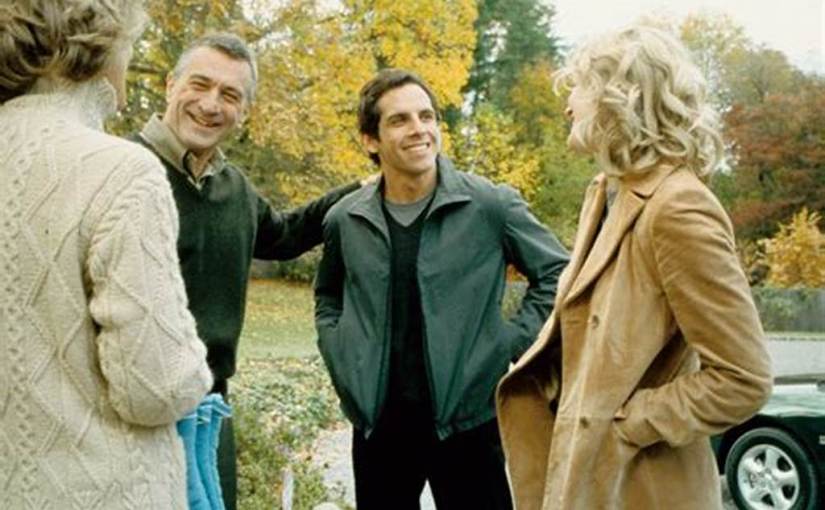
Greg Focker is ready to propose to his loving girlfriend Pam Burns (Teri Polo). First, he has to survive a weekend at her parents’ house where the other daughter is getting married.  Not so easy because first the airline loses his luggage and poor Greg has no clothes to wear, other than what Pam’s pot head brother can provide. Baggy jeans and baggy sweatshirt on a short and svelte Ben Stiller is one sight gag of many.  The guy also has to nonchalantly dismiss his uninviting surname and the fact that Pam’s father Jack (DeNiro) is unimpressed with his occupation.  Greg is not a nurse.  Greg is “a male nurse,” who opted not to go all the way for the MD, even after taking the exams. 

Jack and his wife Dina (Blythe Danner) are less than impressed with Greg’s housewarming gift.  Jack’s precious cat Mr. Jinx is a bit of a problem because Pam can’t keep her mouth shut that Greg is not fond of cats.  Doesn’t make him a bad guy, but does her cat loving father need to know this interesting tid bit, right away?  Pam’s ex-boyfriend Kevin (a hilarious Owen Wilson against Stiller’s pitiful expressions) can do absolutely no wrong – like nothing at all.  The biggest challenge for Greg though is Jack.  Whether it’s Taxi Driver or Meet The Parents or Rocky & Bullwinkle, Robert DeNiro is the embodiment of intimidation. 

Meet The Parents is funny, and it serves no purpose to surrender the many sight gags or one liners that are offered in the film.  I laugh.  I laugh hard when I watch this movie, but I hardly ever feel good about myself.  Poor Greg never catches a break.  He’s in a no-win situation and I’m just uneasy about the whole thing.  The guy chooses not to go swimming because he has no swimsuit. Then Kevin offers one and well…yeah…I’m on Greg’s side and it’s not funny for Greg.  If I was a guest in someone’s home only to wake up late when the whole family is dressed and finishing breakfast, and I’m wearing my girlfriend’s dad’s PJs, of course I’m going to feel insecure.  For the sake of the comedy in Meet The Parents, the set ups are simply awkward situations to laugh at that one guy in the room.  Poor Greg.  Poor, poor Greg. 

In fact, the real villain of Meet The Parents is not even DeNiro’s Jack Burns who has some secrets to hide.  Actually, the unsympathizing bad guy is Teri Polo’s character.  Pam never makes it easy for her boyfriend.  Greg rightfully asks why didn’t she wake him up or why didn’t she tell him her dad is not a florist, or why this and why that, and Pam is naïve to Greg’s justified concern, never empathizing with his position.  In fact, when he tries to explain his feelings, she’s nothing but insensitively dismissive. 

Yes.  It’s a comedy, but I was begging and begging and BEGGING Greg to just leave.  Leave this place.  LEAVE PAM FOR GOOD AND GET OUT OF THIS HOUSE.  You know, like we would tell the counselors in a Friday The 13th flick?  It’s not so much the father as it is his girlfriend who quickly nosedives Greg’s comfort into an inescapable hell.  You know how people love to say Jenny is the villain of Forrest Gump?  Well, I got one better.  Pam Burns is an unthoughtful, uncaring, spoiled brat of a daddy’s girl with nary a shred of consideration for others. 

I despise you Pam Burns – daughter of Jack and Dina Burns, rotten and heartless girlfriend to Greg Focker!!!!! 

MYSTIC RIVER

By Marc S. Sanders

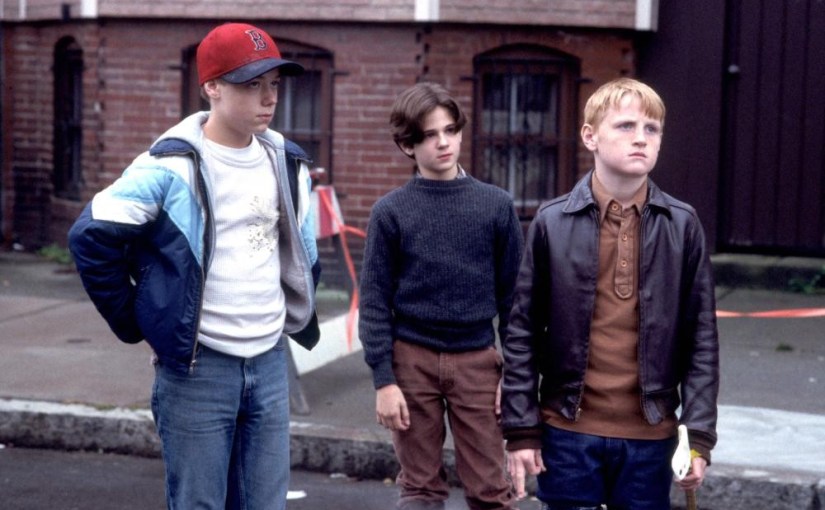
Two crimes, thirty years apart, pave the destiny for three childhood friends during their adulthood, while residing in the same Irish neighborhood of Boston.  Sean Penn is Jimmy, a former criminal.  Kevin Bacon is Sean, a police detective.  Tim Robbins is Davey, who was held captive and molested for four days following an afternoon when the guys were playing street hockey together.  Naturally, Davey was never the same but over the course of events in Clint Eastwood’s psychological crime drama, Mystic River, we learn that Jimmy and Sean likely changed too.

Jimmy’s daughter, Katie (Emmy Rossum), is found brutally murdered following an evening of bar hopping with girlfriends.  Sean and his partner Whitey (Laurence Fishburne) head up the investigation.  While the magnetic screenplay written by Brian Helgeland, based upon the novel by Dennis Lehane, relies on a who done it track, that seems to be less a priority as details unfold for the trio of men.  Jimmy and Davey’s wives (Laura Linney, Marcia Gay Harden) may be hiding some information.  A possible murder weapon invites some curious questions. There’s reason to question Katie’s boyfriend, and Davey’s odd behavior combined with his childhood trauma raises eyebrows as he was one of the last men to see Katie alive.

The less you know about Mystic River the better, but this engrossing cast which earned Oscars for Penn and Robbins, plus a nomination for Harden, is not the only stand out feature.  This film is one of Clint Eastwood’s best directing efforts; definitely one of my favorites.  

First, Eastwood hides many of his characters in dark shadows so the viewer never forgets that all these people have pasts they regret or would rather not resurface.  Sometimes, you hauntingly recognize the silhouettes of Sean Penn and Tim Robbins, each for different and unnerving reasons. Eastwood notably shoots himself this way often when he’s in front of his camera (Unforgiven, Sudden Impact, Million Dollar Baby).  It’s a brilliant photographic strategy that will make you fear or empathize with his flawed protagonists.

Second, Clint Eastwood shoots much of the Boston neighborhood with wide overhead shots in the daytime.  Interiors offer little light no matter the time of day.  Exteriors present the multi floor homes which are easy to see and showcase a labyrinth of crevices, yards and blocks where activity occurs.  

While the title of Lehane’s mystery is hardly spoken until a series of shocking revelations occur at the end, Eastwood ensures the setting of this Boston Irish populace is given much attention.  The more closely located these homes are up against one another, the less apt that any of the residents can truly see what’s going on under their nose.  These people live on top of each other with no room to spread out.  Their nearsightedness is practically blinding.

Furthermore, Eastwood composed the morose soundtrack for this piece. The director seems to speak to the audience because nothing good will likely arrive for any of these folks who grew up together like the generations before them.  Even a colorful Red Sox cap worn by Davey does not offer much cheer or Boston pride.  Eastwood’s musical compositions paint a modern-day setting encased in unimaginable heartache.  

Mystic River is not an easy film to watch.  Yet it’s not gory.  It’s not scary.  It’s the internal struggles of these characters that’s hard to imagine or observe. On the surface Lehane’s story seems reminiscent of most any other crime drama or Law & Order episode of the week.  The challenge is to watch these masterful performances, especially from Sean Penn, Tim Robbins and Marcia Gay Harden.  

We’ve seen moments where the father comes upon the crime scene of a murdered child.  However, Sean Penn delivers this staple with raw, unbearable heartache.  This actor invests his soul into the moment and reminds any one of us, whether we are a parent or child, of how wrenching it is to even imagine losing a loved one to senseless violence.  If I had to ever experience an episode like this, it might just take the entire police force to hold me down too.

Robbins and Harden are husband and wife, who get in over their heads when incidents of surprise occur.  Harden is especially ripped apart with what she knows and what she suspects.  Robbins embraces an inner child who has never outgrown a trauma that stubbornly stays attached to him, even if he’s a loving father.

As difficult as Mystic River is to watch, I’ll return to it on repeat because this cast and crew are at the top of their game.  Dennis Lehane has written other Boston crime stories (Gone Baby Gone with the film adaptation directed by Ben Affleck), particularly involving children, and he recycles his characters for future tales.  To my knowledge, I do not believe he’s ever written a sequel to Mystic River, but I’d love to see what happens to these people after the events of this film unfolded.  

Everything is revealed in Mystic River, except what happens next and I’m dying to know.  

THE HEIRESS (1949)

by Miguel E. Rodriguez

DIRECTOR: William Wyler
CAST: Olivia de Havilland, Montgomery Clift, Ralph Richardson, Miriam Hopkins
MY RATING: 10/10
ROTTEN TOMATOMETER: 100% Fresh

PLOT: In the mid-1800s, a naïve young woman falls for a handsome young rogue whom her emotionally abusive father suspects is the male version of a gold-digger.


[Author’s note: If you have not seen this film, but intend to do so, I urge you not to seek out spoilers.  The final resolution of this movie deserves to be seen in a vacuum, if you know what I mean.]

The AFI’s list of the 50 Greatest Villains in American film does not include Dr. Austin Sloper, played with indifferent cruelty by the great Ralph Richardson in William Wyler’s The Heiress.  This is a miscarriage of justice, as Dr. Sloper is one of the most ruthlessly harsh characters I’ve seen in a movie in many years.  The fact that he is successfully upstaged by Olivia de Havilland as his daughter, Catherine, is a triumph of screenwriting, directing, and pitch-perfect acting from both performers.  The fact that both performances nearly overshadow a charismatic young Montgomery Clift is something that must be seen to be believed.

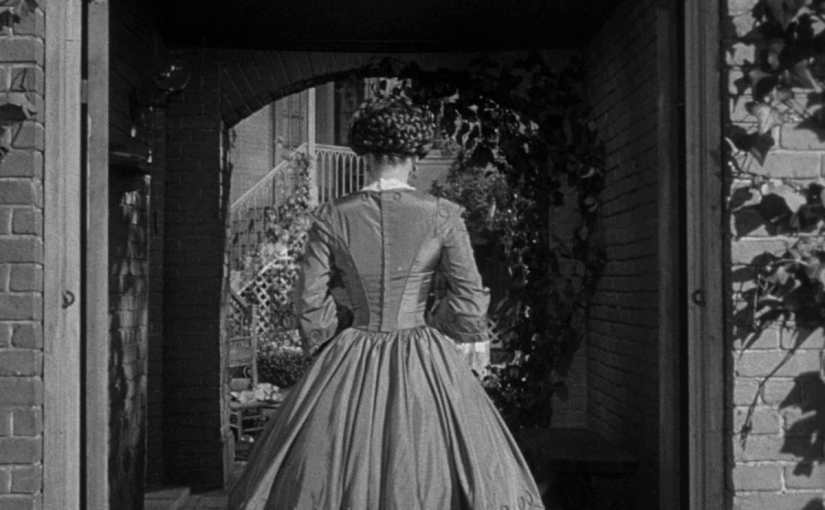
The film starts in the mid-1800s in the Washington Square area of New York City.  It’s a time of horse-drawn carriages, corsets, and garden parties.  Catherine Sloper is a very plain, very shy, single woman who lives in a three-story brownstone with her widowed aunt, Lavinia (Miriam Hopkins), and her father, a financially successful doctor who will bequeath a $30,000-a-year inheritance to Catherine upon his death.  In addition to the $10,000-a-year she already receives from her mother’s inheritance, Catherine will be financially comfortable for the rest of her life.  Alas, her social graces are virtually nonexistent, and she is quite plain when compared to her late mother…as Dr. Sloper casually mentions from time to time, utterly oblivious to the effect this has on Catherine.

At a garden party, during which Catherine is socially humiliated by a thoughtless gentleman, she meets the well-dressed, well-behaved, and nearly penniless Morris Townsend (Clift), who makes it clear that he is utterly taken with her and would like nothing more than to spend the rest of the evening talking or dancing with her and no one else.  Her aunt Lavinia is ecstatic the next day, but Dr. Sloper is skeptical.  In his mind, no gentleman in his right mind would express romantic intentions towards his socially unsuitable daughter unless he simply wanted the money that comes with her, and he says as much to Mr. Townsend AND to Catherine.  The callousness of Dr. Sloper’s behavior is abhorrent, and I found myself thinking, “If this guy were drawn and quartered by the end of the movie, that would still be too good for him.”

The brilliance of the screenplay becomes apparent when Morris boldly announces his love for Catherine, to her complete stupefaction.  And when he actually proposes, that pushes her over the edge, and she falls head over heels in love with him, because he’s the first man who has ever shown anything more than polite tolerance towards her…including her father.  Dr. Sloper lays out his case for what he believes Townsend’s true intentions are: to take control of or squander her inheritance after they marry.

Dr. Sloper’s brutality knows no bounds…but you find yourself thinking: what if he’s right?  Certainly, Townsend is completely genuine in his love for Catherine, or at least seems to be.  He knows exactly what to say, and when and how to say it.  Is it an act?  He’s handsome enough to be an eligible catch for any number of society women in the city, so why waste his time on such a plain-Jane girl as Catherine?

This conflict occupies the main thrust of at least the first half of the film.  What transpires and how and when, I will not say.  I will say that the story led me in one well-traveled direction, took a left turn, then took another unexpected turn that left me kind of breathless at its audacity.  The movie as a whole has been compared in some circles to Scorsese’s The Age of Innocence (1993), and deservedly so.

Olivia de Havilland’s performance as Catherine is one of the greatest performances I’ve seen in any film of that era.  It trumps even her powerful turn in The Snake Pit a year earlier.  Clearly, de Havilland was anything but plain and awkward in real life, but careful makeup and performance nuances helped her bring off one of the most commanding roles of her career.  There is an emotional transformation that occurs at one point where she is able to affect a complete one-eighty in her character, and it never once feels histrionic or gimmicky.  She shares a scene with her father in which she has “found [her] tongue at last,” as he puts it, that I would rank as one of the greatest two-handed scenes I’ve ever watched.  The surgical application of language to inflict harm on another person is breathtaking.  Neil LaBute or David Mamet couldn’t have written it any better.

The Heiress left me feeling a little wrung out at the final credits.  I remember watching this movie many years ago, but nothing stuck with me except that ending.  Despite this foreknowledge, the movie still worked its spell on me, leaving me with a dropped jaw and a blown mind.  The ending is somehow definite and ambiguous at the same time, a screenwriting miracle.  (And I don’t mean in a Sopranos kind of way, either.)  The Heiress is officially one of my new favorite films.

HOOSIERS

By Marc S. Sanders

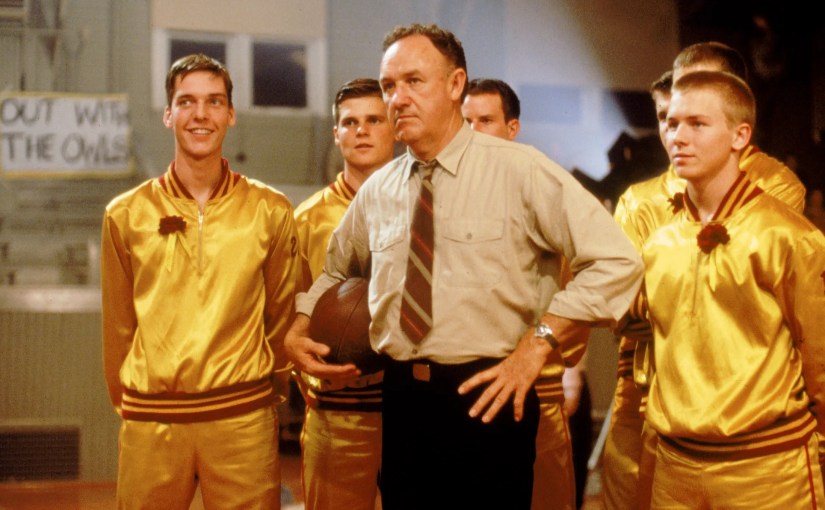
Hoosiers is a sports film offering nothing truly new or inventive.  What sets it apart though is that this high school basketball picture has Gene Hackman as the coach, Norman Dale.

Like so many films, this one occupies its opening credits with the cross country drive of the outsider arriving in small town USA with Jerry Goldsmith’s orchestral horns conducting the journey.  Welcome to the sweeping farmlands of Hickory, Indiana, 1951.  

Coach Dale has been hired by the local high school to lead the team of seven boys for the upcoming season.  Everything typical happens from there.  The potential love interest gives the guy the cold shoulder.  The town, who take such pride in the boys basketball team, find the coach unfit and work the first half of the story trying to vote him out. There’s the one kid who makes every shot and is stand offish, but just won’t play.    There’s a player who has strife with his father, the town drunk called Shooter (Dennis Hopper).  Coach gets kicked out of the games too.  Even Hackman’s recognizable short fits are here to stir it up with the referees.

Yet, is this team gonna get in shape and take it all the way to the championship?  I’ll let you decide if that’s rhetorical question.  

I dunno.  Maybe it’s because I’ve never been wild about basketball that Hoosiers just didn’t do much for me.  A film like Hoop Dreams or even the actor/players shown here impress me with their abilities to make one jump shot after another, while their capabilities to dribble appear like artistic forms of dancing.  The game however has never done much for me.  A team scores and then they go to other side the court where the other team scores.  For me, only the last few seconds of a basketball game seem important.  Otherwise, it’s a back-and-forth scrimmage to me.  Hoop Dreams lends more of a story within its tragic documentary footage than Hoosiers provides.

When I observe the team making plays on the court, there’s not much to open my eyes wider.  David Anspaugh was a new director when this movie was released. Much of the cuts within his footage are the players jumping and passing and Hackman’s sideline expressions where he slaps his play sheet before another cut to the cheering or booing crowd.  This is nothing but action takes. Where are the shortcomings and triumphs that come with cinematic athleticism?

Even the final game does not work like a story.  It’s all just a collection of basketball players making shots.  It never worked for me because I hardly know any of the kids.  The star player, Jimmy, literally has three lines in the film.  I could never pick out which young man was Hopper’s son because most of the team members are given such little attention.  It’s only when a scene or two finally presents itself for the father and son that I connect the dots, but that’s resigned for a quick last act.  The one I could always pick out was the short guy who is not very good and mostly sits on the bench.  The kid who prays too long?  Good gag, but when he’s not on one knee I don’t recall who he is among the crowd.  The players are not given distinct personalities. They are scarcely shown in close up and so I don’t know one from the other.  

Watch Teen Wolf with Michael J Fox.  Beyond the lead who is a werewolf, there are two or three others on the team that triumph, as well as faithful members of the school student body. Thus, that movie ending game becomes something entirely special and touching.

Gene Hackman is always an attraction even if some of the traits he lends to his characters are the same.  I love his grin and his quiet, sometimes sarcastic, cackle. When he throws a temper it’s not one that can be duplicated.  I’ve never seen someone who can do an exact impersonation of Gene Hackman.  He’s simply one of a kind. He’ll always be favorite actor of mine, no matter the material.

Dennis Hopper is very good as well.  He’s not just a drunk, but Shooter is a likable guy who looks worthy of a second chance.  Hopper’s body language defines all of that.  It’s not just the booze or the drying out moments that lend to the performance.  The celebrated actor is given scenes where the character is lost and helpless while trying to contribute moments of value to the basketball team.  Even the unpressed, oversized suit and greasy combover he wears tell a story.

Barbara Hershey seems underutilized.  For most of the film she proceeds with a scowl on her face, and I was never certain of her disdain for the Coach or the school where she teaches.  I could never confound exactly what her problem was anyway. At best, she’s here for an eventual on-screen kiss with the lead, but then the relationship doesn’t progress.  I read that much material went on the cutting room floor, and I can’t deny there’s an absence to her storyline.

Hoosiers is serviceable, but nothing it offers moved me and grabbed my attention.  This is a step by step sports film with every standard cliche included.  I didn’t stand up and cheer when that final shot swished through the basket in slow motion because I did that at the end of Rocky and The Karate Kid, and Teen Wolf too.  When The Bad News Bears ended I did a hard clap because those tykes had balls.  At the close of Slapshot, I couldn’t contain my laughter.  I couldn’t stop thinking about Hoop Dreams for good, long week. Other pictures focusing on athletics always possessed a way of making their stories special.  Hoosiers looks like it stole its play by play from those wunderkinds. 

TRIVIA: Look for Sheb Wooley, who portrays Hackman’s first assistant coach. He is the origin of the famous Wilhelm Scream uttered by Indiana Jones, several Stormtroopers and during the demise of various superhero villains.

WINCHESTER ‘73 (1950)

by Miguel E. Rodriguez

DIRECTOR: Anthony Mann
CAST: James Stewart, Shelley Winters, Dan Duryea, Stephen McNally, Millard Mitchell, Rock Hudson, Tony Curtis
MY RATING: 9/10
ROTTEN TOMATOMETER: 100% Fresh

PLOT: A cowboy’s obsession with retrieving his stolen rifle leads to a violent odyssey through the American West.


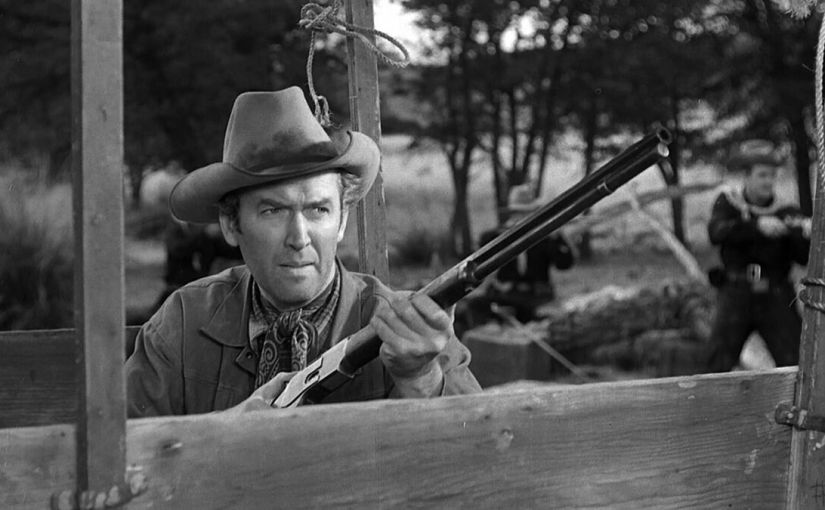
Even without knowing the full history of how the film impacted contemporary audiences, Anthony Mann’s Winchester ’73 still packs a punch.  Using an ingenious story structure, courtesy of a very Western MacGuffin, the film follows the path of a rare, expensive Winchester rifle from hand to hand for ninety taut minutes.  James Stewart is top billed, but he is on screen for less time than you’d think.  That’s actually a good thing in this case, as Mann’s focus is not on star power, but on metaphor and mythology.  (Although Stewart’s star power certainly doesn’t hurt, as he demonstrates in several key moments.)

The movie plops us right into the action with nary a flashback nor an expositional monologue in sight.  The legendary town of Dodge City is holding a shooting contest to celebrate Independence Day, 1876.  Sheriff Wyatt Earp (!) is officiating, and the prize will be a rare model of the Winchester ’73 repeating rifle.  Arriving in town that day is Lin McAdam (Stewart) with his partner, High-Spade Frankie Wilson (Millard Mitchell).

(Around this part of his career, Stewart’s trajectory was on the decline, as he was getting too old to play the aw-shucks-y kind of roles that were his bread and butter in the ‘30s and ‘40s.  Winchester ’73 was an opportunity to showcase his range, and he delivered.  Lin McAdam is not the villain, but neither is he the kind of character Stewart had ever played before.  It’s been written that, when audiences of the day saw Stewart get violent and pin a man to a saloon bar, there were gasps.)

Lin is none too friendly towards another man in town, Dutch Henry Brown (Stephen McNally), who reciprocates in spades.  There is clearly some kind of history, but what that history entails would take too long to explain, so the movie wisely doesn’t try.  They’re enemies, and that’s enough.  Somewhat predictably, they both enter the contest for the prize Winchester, but in the first of many twists, the contest doesn’t play out exactly as you would expect.  Then the rifle is stolen, Dutch and his pals skip town, and Lin and his partner give chase.

From there, the movie gets episodic.  There’s the Indian trader, the Indian himself, Young Bull (Rock Hudson in a fake nose and braids!!!), the obligatory feisty lady, Lola (a luminous young Shelley Winters) and her beau who behaves in a most unmanly manner, a run-in with some cavalrymen (featuring an unknown young actor billed as “Anthony Curtis”), and winding up with a real sleazeball, Waco Johnny Dean (Dan Duryea).  How the rifle makes its way from place to place I will not reveal, but it’s all perfectly feasible.

(I will leave it to wiser minds than I to discuss the racist portrayal of Indigenous Americans, including using Rock Hudson in “red-face” to play a tribal chief.  Yes, it’s shameful and unfortunate, but it happened, and I use the term “Indian” earlier because that’s how they’re referred to in the film, for better or worse.)

If I had to explain what this movie is actually about, beyond its brilliant plotting, I’m not sure I could do it.  I can report that it was engaging and crisp and surprising and almost demands a rewatch after the end credits, but aside from just being a darn good entry in the Western genre, it’s hard for me to pin down its message.  Is it a screed against the violence in the real West?  How some men searched for violence because it was in their nature, or because they felt it was their duty?  I mean…yeah, I guess, but that feels like just scratching the surface.  What were Mann and Stewart trying to say?

Maybe it’s one of those movies where the message depends on the viewer.  If you look at it as an anti-violence film with a bittersweet ending filled with moral ambiguity, it’s there.  If you look at it as just a travelogue or tapestry of the old West, made by a director who loves the genre and an actor sinking his teeth into a great role, that’s there, too.  (Mann and Stewart would go on to make seven more films together, five of them Westerns.)  There’s even melodrama and a hint of romance along the way, but never too much to drown everything else out.  For me, Winchester ‘73 is much harder to unpack than Unforgiven (1992), whose message is crystal clear from beginning to end.  Both movies are equally entertaining, though, don’t misunderstand me.

If any active readers have made it this far, feel free to let me know what the “true meaning” of Winchester ’73 is.  Whether I find out or not will truly not matter, because the movie is still hugely entertaining with or without an explanation.  I might have a tiny bone to pick with the final battle, with its foregone conclusion, but it comes with the territory, so I have to forgive it.  This is a great entry in the genre, featuring a star pushing his boundaries and a director who knew how to harness that energy.

VAMPYR (Germany, 1932)

by Miguel E. Rodriguez

DIRECTOR: Carl Th. Dreyer
CAST: Julian West, Maurice Schutz, Rena Mandel, Sybille Schmitz
MY RATING: 8/10
ROTTEN TOMATOMETER: 98% Certified Fresh

PLOT: A drifter obsessed with the supernatural stumbles upon an inn where a severely ill adolescent girl is slowly becoming a vampire.


Carl Th. Dreyer’s Vampyr [pronounced “vom-PEER” in this German version] is not the scariest vampire film I’ve ever seen, but it is definitely one of the creepiest.  There’s a difference.  Dreyer’s film doesn’t move with the pacing seen in more standard horror fare.  Instead, it forsakes typical plot development for scenes that linger on the horrific or the unexplained.  In its own way, it is more directly related to the films of David Lynch than to any other contemporary monster movies of the time (Dracula or Frankenstein, for example, both 1931).

The story is fairly simple, but it belies the complex imagery that awaits the viewer.  A young drifter, Allan Grey, happens upon an inn from which he thinks he can hear animal sounds, or perhaps a young woman screaming.  The village doctor, who looks like a bespectacled long-lost relative of Doc Brown from Back to the Future, vehemently denies the presence any animals or young women on the property.  The innkeeper invites Allan to stay the night.  In the middle of the night, Allan’s sleep is interrupted by a mysterious visitor to his room who intones, “The girl must not die!”  The gentleman then leaves a package on Allan’s desk and writes a most portentous message: “TO BE OPENED ONLY UPON MY DEATH.”

What is this book?  What did Allan hear?  And how do you explain the shadows he saw on his way to the inn?  Shadows of people running along the lane – with no corresponding people attached to them?  Wouldn’t YOU like to know.

Vampyr is positively drowning in atmosphere.  Dreyer apparently shot many scenes with a piece of thin gauze over the lens, creating a misty layer that makes everything feel like a dream, even when Allan is awake.  Allan goes on frequent excursions around the inn and the surrounding property, and it’s here where most of the fantastical imagery is seen, especially when it comes to disembodied shadows.  In one mildly unsettling sequence, a shadow of a man with a peg leg descends a ladder and appears to sit on a bench…re-joining itself to a peg-legged man already sitting on the same bench.

There’s a lot more, but I don’t want to just write a list.  However, I am compelled to mention one sequence in particular that exudes as much creepiness as anything I’ve ever seen from this cinematic era.

It turns out there is, not one young woman at the inn, but two: Gisèle and Léone.  Léone is seen early on, confined to her bed with a mysterious illness, which we later learn has been brought on by her contact with a seldom-seen old woman who lurks somewhere on the property.  And there are some odd injuries on her neck…UH oh.

At one point, Léone awakes while Gisèle is alone with her.  I don’t remember what they discuss, but Léone goes into this weird sort of trance.  Without the use of any strange Chaney-esque makeup or camera tricks, Léone’s face becomes an object lesson in creepiness.  Her eyes open wide, her face breaks into a creepy grin, and she slowly moves her head from side to side, while Gisèle backs away in terror.  It might be the scariest sequence in the film, one which could easily compare to any subsequent monster or vampire movie.

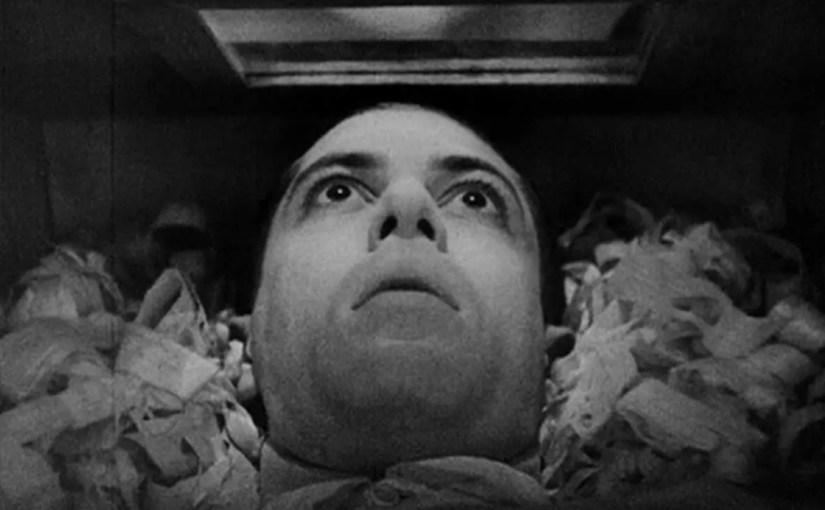
Later, Dreyer throws more camera tricks at us in increasingly imaginative ways.  Allan dreams of a skeleton handing him a bottle of poison.  A dead man’s face appears in the sky during a sudden thunderstorm.  Dreyer includes camera moves that would fit right into any modern film.  And in a sequence that reminded me of Wes Craven’s The Serpent and the Rainbow (1988), Allan watches as his own body is sealed inside a coffin with a tiny square window for his apparently dead eyes to look out of.

If nothing else, Vampyr is an interesting artifact of cinema’s transitional era from silent to sound.  Even though there is a conventional soundtrack and we hear people’s voices as they speak, a lot of expository information is provided via title cards and long looks at passages from a book of vampire lore.  Given that the vampire mythology was then not as popular as it is today, I can forgive these beats that tend to bring the momentum to a halt.

While Nosferatu (1922) and the Bela Lugosi Dracula are much more famous, Vampyr is worth a look if you’re a horror fan.  While it doesn’t involve the kind of fear factor I tend to expect as a child of the 1970s and ‘80s, it is nevertheless creepy as hell.