THE MAGIC FLUTE (Sweden, 1975)

by Miguel E. Rodriguez

DIRECTOR: Ingmar Bergman
CAST: Josef Köstlinger, Irma Urrila, Håkan Hagegård, Birgit Nordin
MY RATING: 8/10
ROTTEN TOMATOMETER: 91% Fresh

PLOT: Valiant prince Tamino and his zestful sidekick Papageno are recruited by the Queen of the Night to save her daughter from the clutches of evil.


Here lies the noble, magical illusion of the theater.  Nothing is; everything represents. – Ingmar Bergman

Ingmar Bergman’s whimsical staging of Mozart’s opera The Magic Flute is a movie made by a theater fan, for theater fans…and to a certain degree, it’s about theater fans.  I use the word “staging” instead of “film of” because, throughout the movie, Bergman never once lets us forget that we’re watching a staged production.  The opera’s overture plays over shots of the audience members, and at intermission we watch actors passing the time by playing chess or smoking where they shouldn’t be.  Once or twice, we see the hands of the stage crew as they move from one “cue card” to the next.  Fishing wire is clearly visible when objects “float.”  But the very artificiality of the production is what makes it so charming.  It celebrates artifice and scorns reality.  It wouldn’t surprise me if this were one of the favorite films of Tim Burton or Terry Gilliam.

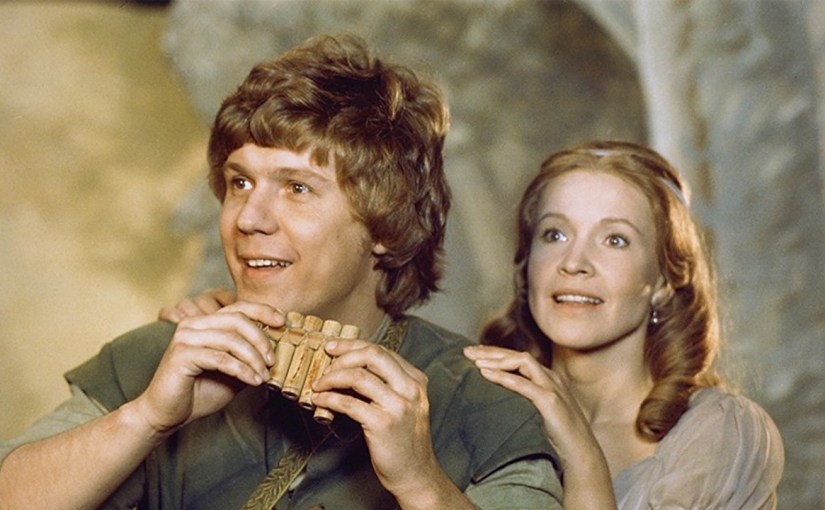
Since my only previous knowledge of the story of The Magic Flute comes from a precious few scenes in the film Amadeus (1984), here’s a brief summary for anyone else who knows as much about opera as I do.  The brave, handsome prince Tamino and his enthusiastic sidekick Papageno are recruited by the Queen of the Night to rescue her beautiful daughter, Pamina, from the clutches of the evil Sarastro.  Before the opera is over, there will be revelations, separations, reunions, laughter, tears, semi-divine intervention, and even an operatic strip-tease.  There are monsters, woodland creatures, villains, three angelic young boys in a hot air balloon, and, of course, a magic flute.  And it’s all portrayed as it might be seen if we were watching it on a real stage in a real theater, with some obvious cinematic licenses taken with time and space.

I’m gonna be brutally honest: having never seen an opera, I had moderate-to-low expectations of how much I would enjoy it, even if the music is by my second-favorite classical composer of all time.  (Beethoven is the king, and that is that.)  But Bergman’s film sidestepped my expectations by not trying to present anything in a realistic way, or by simply staging a live production and just filming it from multiple cameras.  By keeping everything clearly artificial, clearly staged, and occasionally using clever movie tricks, The Magic Flute held my attention, making me curious about what other tricks Bergman might have up his sleeve.

For example, he’ll start a scene with a wide shot, showing the entire stage with the flats and fake backdrops, then cut to a medium shot, making us think we’re in the space we just were, then panning over to reveal a completely separate set that was invisible before.  But because it’s been established that we’re in the realm of theater, this kind of spatial paradox isn’t jarring, it’s almost expected.  You can get away with certain things in theater, especially opera, especially in a fantasy, that would never fly in a regular movie.  In The Magic Flute, a person’s face can be completely made over with a simple edit.  A picture in a locket can come to life.  A journey through a fantastic hellscape can be suggested by clever editing and careful camera placement.

But what if you simply don’t like opera?  Is The Magic Flute enough to convert you?  I mean…maybe?  If you’re a fan of the films of Terry Gilliam, particularly Brazil (1985) and The Adventures of Baron Munchausen (1988), then this movie is going to be right up your alley.  They share the same visual strategies and production design sensibilities.  Even if you believe you don’t like opera, The Magic Flute could still win you over for at least this one movie, simply because it’s such fun to look at.

Looking back over what I’ve written so far, I don’t believe I’ve accurately conveyed how the deliberate “fakeness” of the film enhances its effectiveness.  Live theater has the ability to get audiences to suspend their disbelief in a way that film cannot always achieve.  I’ve seen community theater productions where, for example, the walls of a café are supposed to “fly” off the stage revealing a night sky, and the effect was accomplished by simple lighting tricks.  A clubhouse foyer can be magically transformed into a golf course with a green carpet and some more selective lighting.  In live theater, the audience is constantly aware that it’s fake, but when they’re in the grip of a good story, their mind fills in the blanks.  That’s the effect Bergman is going for in The Magic Flute, and it works.

So, in the end, what you have here is a love letter to the stage, to opera, to Mozart, to fantasy.  Throughout the film, Bergman will cut to the face of young girl, an audience member, who watches with rapt attention and an almost Mona Lisa-esque smile.  Not only is he reminding us, the viewer, that this is a staged production, but maybe he’s also sending a reminder to filmmakers to never forget that, for a movie or play or opera to work, you have to remember who you’re making it for: the paying audience.  Speaking as an occasional audience member myself, I know that, when I buy a ticket, I want to be taken out of myself.  I want to believe that a man can fly, or that a wooden puppet can come to life, or that a valiant prince can overcome three tasks to win the heart of his beloved.  The Magic Flute is a tribute to the magic-makers and the storytellers, to the genius of Mozart, and to the people out there in the dark who make it all possible.
DODSWORTH (1936)

by Miguel E. Rodriguez

DIRECTOR: William Wyler
CAST: Walter Huston, Ruth Chatterton, Mary Astor, David Niven
MY RATING: 10/10
ROTTEN TOMATOMETER: 91% Fresh

PLOT: A retired auto manufacturer and his wife take a long-planned European vacation only to find that they want very different things from life.


Melodrama.  It gets a bad rap in some circles.  Synonymous with “soap opera.”  Do it right and you get masterpieces like Terms of Endearment (1983) or fan favorites like Beaches (1988).  Do it wrong and you’ve got a sappy, soppy, shamelessly manipulative mess like [too many to mention].  In days past, I would take what I thought was the high road and say it’s not my favorite genre at all, too schmaltzy, blech.

But then I started expanding my viewing habits a little and started watching some older films.  I discovered hidden jewels like Peter Ibbetson (1935), a shameless weepie about separated lovers who connect in the spirit world.  I finally watched The Blue Angel (1930) with Marlene Dietrich as the semi-willing agent of a snobbish professor’s emotional and professional destruction.  Soap opera, but done right and very effectively.

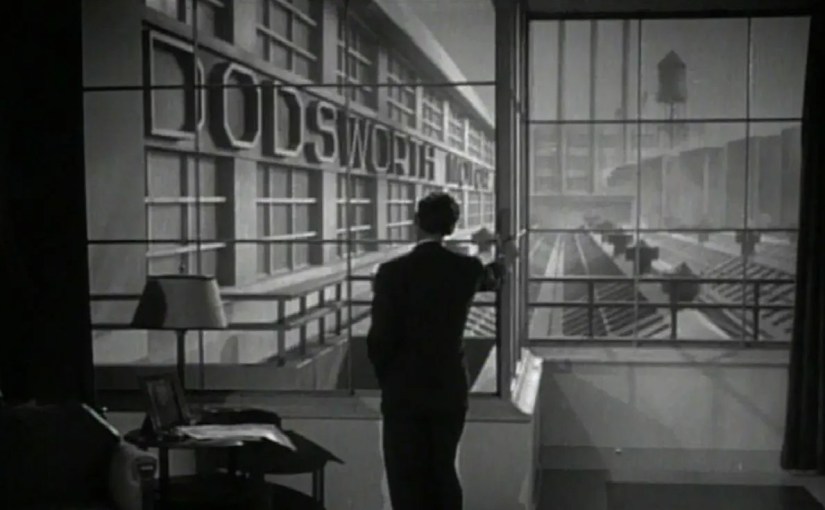
And now here’s Dodsworth, a domestic drama about a middle-aged couple where the husband, Sam (Walter Huston), has just retired from running his immensely successful car company.  He’s looking forward to relaxing with his rod and reel, his golf clubs, “with nothing more important to worry about than the temperature of the beer…if there is anything more important.”  But first, his wife, Fran (Ruth Chatterton), who is tired of spending her life in society circles, wants to see the world on a transatlantic cruise – on the Queen Mary, no less – to London, Paris, and wherever the spirit moves them.  “In Europe,” she says, “a woman of my age is just to the point where men begin to take a serious interest in her.”

At this stage, I felt like I was in the grip of a fairly standard plot whose signposts I could see a mile away: married couple on European vacation, wife going through midlife crisis is courted by a dashing young man who believes her husband is ignoring her, husband finds out, wife denies it, does some self-reflection, slightly farcical situations, some touching speeches on a moonlit balcony, and the married couple return home stronger than ever.  Even if this was going to be a well-made movie, I was pretty sure I would be bored.

Oh, how I do love being wrong.  Dodsworth takes this trope-ridden plot and drives it down some roads where I never expected a movie from the ‘30s to go, at least not when dealing with the sacrosanct institution of marriage.  Fran doesn’t get hit on when she gets to Europe, she gets hit on while still in transit in the Atlantic, by a British cad played by an indescribably young David Niven.  He makes no secret of his attraction to Fran, though later on it seems possible he was trying to take advantage of Fran’s situation.  He even kisses Fran, who offers no more than token resistance…after the fact.

During this semi-tryst, Sam is above deck enjoying the sea air when he has a kind of adult meet-cute with Edith Cortright (Mary Astor), an American divorcee who is younger than Sam by, oh, let’s say at least fifteen years, maybe more.  They have two conversations, and then circumstances send them on their separate ways, Sam to France with his wife and Edith to Naples.

A word about their two conversations.  This is some of the best adult, mature dialogue I’ve ever heard in a film, let alone one from the 1930s.  These are two mature adults who are speaking to each other, neither one with an agenda, but there is something intangible in the language and how the actors play it and how Wyler directed it.  The scene is pregnant with subtext, not sexual, but a sense of connection without being obvious about it.  I found myself starting to root for Sam and Edith to get together before their ship docked, but the movie played around with my own expectations multiple times.

In Paris, Fran and Sam’s relationship deteriorates.  Sam makes plans to sightsee, but Fran has made hair appointments and lunch appointments with her new French acquaintances, so he goes alone.  In her frantic desire to prove how cosmopolitan she is, as opposed to being a middle-aged woman from middle-America, Fran wants to spend more time on the town than being a tourist.  She meets another dashing European gentleman, this one a Frenchman named Arnold Iselin.  It seems as if Fran wants to have her cake and eat it, too: remain married to Sam while indulging in flirtations – flings? – with handsome men with foreign accents.

It all comes to a head one night when Fran suggests that Sam return to America without her.  She wants a “break.”  Sam fights for her, but in the end…but I’m not going to tell you what Sam decides.  Again, your predictions may or not be correct, but there are some deliciously written curveballs up this movie’s sleeve.

I should also mention the delightful discovery of Walter Huston as an actor.  Oh, sure, we’ve all seen him in The Treasure of the Sierra Madre, made twelve years later, featuring his deserving Oscar-winning performance as the prototypical prospector with his little jig and his forever-imitated accent, but that’s how I ALWAYS pictured him.  In Dodsworth, Huston is, quite frankly, a revelation.  His performance is as far removed from Sierra Madre as it’s possible to be.  Sam Dodsworth is a respectable man of business, especially handsome when he’s dressed to the nines, congenial, and smarter than the average bear.  He is what they call, dare I say, a silver fox, the kind of man other women might willingly set their cap for, whether they’re his age or not.  Huston’s delivery and portrayal of this character make Dodsworth immediately likable, which is important in later stages of the movie when he seems on the verge of making a questionable decision.

Then there’s Ruth Chatterton as Fran Dodsworth.  Chatterton was in a strange predicament as an actress for this film.  At the time, she was desperately trying to revive her career at an age when, unfortunately, Hollywood (and society) was ready to put her out to pasture…by which I mean early forties.  And she’s playing a character who is also desperately trying to hang on to her youth.  So, there is a layer of authenticity, and courage, to her performance that cannot be overstated.  Even when she engages in some questionable behavior, I was still able to empathize with her.  She isn’t doing anything out of pure spite.  She is responding to impulses she can’t explain or ignore.

Dodsworth is one of the best films from Hollywood’s first golden age that I’ve ever seen, and yet I don’t hear too many people mention it in their lists of favorite films from the ‘30s.  It deserves to be mentioned alongside the greats, because it IS one of the greats.  And it’s melodramatic as hell, in the beginning, the middle, and especially that shamefully schmaltzy final shot…but you know what?  Dodsworth makes it work.  Soap opera?  Meh, who cares?

SING SING

By Marc S. Sanders

Coleman Domingo is that under the radar actor who is on his way to becoming a marquee name.  Of late, I’m loving everything he’s participating in. Check out the Netflix series The Madness and the acclaimed film Rustin for which he received a well-deserved Oscar nomination. His second Oscar nominated role in another of 2024’s best films, Sing Sing, is directed by Greg Kwedar.  As soon as this film begins, you will fall in love with Domingo’s role as he completes a stage performance in A Midsummer Night’s Dream.  However, the theatre that is bursting with applause is located within the infamous Sing Sing Maximum Security Prison.  Coleman Domingo portrays a resident here as wrongly imprisoned John “Divine G” Whitfield.

Divine G is a founder and one of a handful of prisoners who cope with their caged lifestyle as members of the Rehabilitation Through The Arts program (RTA).  Every six months, the RTA prepare a play to perform for the prison population and other local benefactors.  Their director is Brent (Paul Raci), a much smaller guy than anyone in the troupe, white, tattooed and on the tail end of a hippie middle age.  Yet, the men trust their leader and he is nothing but encouraging with theatre exercises to uphold their spirits and get everyone energized. 

A new member of the group does not appear to have much promise.  Clarence Maclin (played by Clarence Maclin) stems from a hard living street life of gang culture.  While he champions the suggestion of a comedy for the next production, he is nevertheless resistant to engage and perform as Hamlet with the famed To Be Or Not To Be monologue.  Divine G works to penetrate Clarence’s stubbornness and get him to recognize how the program can be beneficial and enriching.  Consider Divine a combination of Red and Andy from The Shawshank Redemption – a well-respected realist but also a teacher.  Divine even takes it upon himself to prepare Clarence for his upcoming parole hearing, while he’s getting himself ready, following new evidence that may exonerate him.

Brent collects ideas from all of the men who are enthused to stage ancient Egyptians, cowboys, pirates, Hamlet, and even Freddy Krueger.  Rather than pick one, Brent takes the weekend to write a 148-page script that has all of these elements.  The spine of the plot?  Time travel!  Makes sense, and as Clarence originally suggested, it most certainly is a comedy.

I read that Sing Sing is collectively owned by the cast and crew.  Many people who worked on this production play characterizations of themselves and use their actual names and prison monikers in the dramatization of this film.  They produced and wrote the screenplay, designed the characters based on themselves and their experiences, having been members of the RTA.  The auditions for the play you see in the film are the actual auditions the cast did to be part of the film. So, be ready to be impressed because these rehabilitated prisoners, now actors, are outstanding. 

Coleman Domingo in the leading role only makes the whole cast look even better.  He is absorbed in this environment.  B28, his assigned prison cell, looks like a sanctuary for the plays that he writes with inspiring and researched articles taped to his walls and a typewriter to click away on.  With his wise looking gold rimmed eyeglasses, he looks like a guy who knows every corner of every room, every chip on every wall, every blade of grass within the courtyards and auditoriums.  Divine G may not belong here, but he’s all the more familiar and depended upon by the men he resides with.  Partnered with Clarence Maclin, the two actors have duet scenes that work effectively with one relaxed in the comfort of hope and promise while the other is ready to give up on any kind of prosperity or semblance of a future.

Sing Sing is about the incarcerated men who put on plays to nurture the days of punishment they are sentenced to serve.  Yet, the actual film could also operate like a live stage play.  It has more of that feel than anything traditionally cinematic. These men converse and discuss like a committee seated in a circle while determining the next best thing for the program.  They are led by Brent in exercises that allow them to reflect on past moments in their respective histories.  They do the silly walks to shed insecurities that come with urging the brave face needed to perform in front of people.

An extra reward arrives during the end credits when personal cell phone footage shows clips of the various plays that have been produced among the prison population.  Everything from their inventive stage sets to their costumes and lighting along with their blocking is extraordinary.  To bring men who once lived among a world of violence towards the escape of theatrics seems unheard of.  I mean, really, a gang member can now perform Shakespeare? 

Films have the ability to show what’s unheard of and what’s daring. They are not just run of the mill Mission: Impossible movies with the wildest stunts imaginable.  A courageous feat also comes from the theatre. Sing Sing reveals the most unlikely people to accomplish what no one could ever envision they would relate to. 

Sing Sing is an inspiringly beautiful piece of performance work from every member of its cast, in addition to Oscar nominee Coleman Domingo.

SEPTEMBER 5 (Germany, 2024)

by Miguel E. Rodriguez

DIRECTOR: Tim Fehlbaum
CAST: Peter Sarsgaard, John Magaro, Ben Chaplin, Leonie Benesch
MY RATING: 10/10
ROTTEN TOMATOMETER: 93% Certified Fresh

PLOT: During the 1972 Summer Olympics in Munich, Germany, the ABC Sports broadcasting team must adapt to providing live coverage of Israeli athletes being held hostage by a terrorist group.


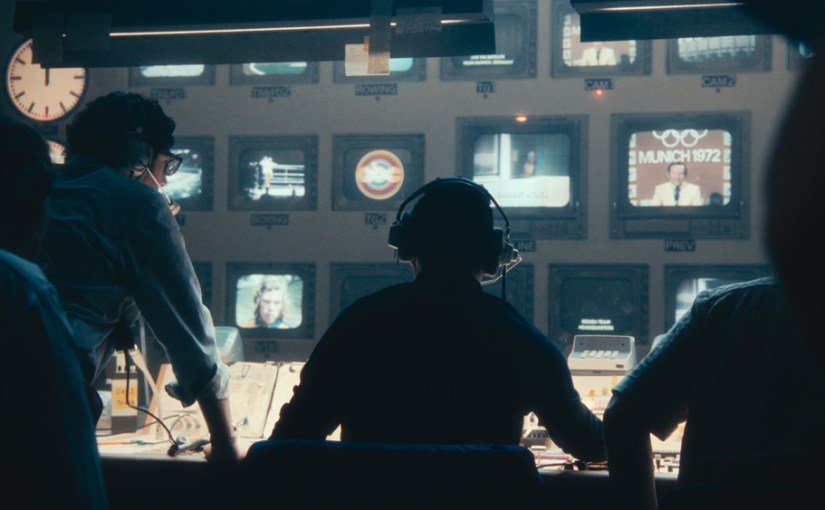
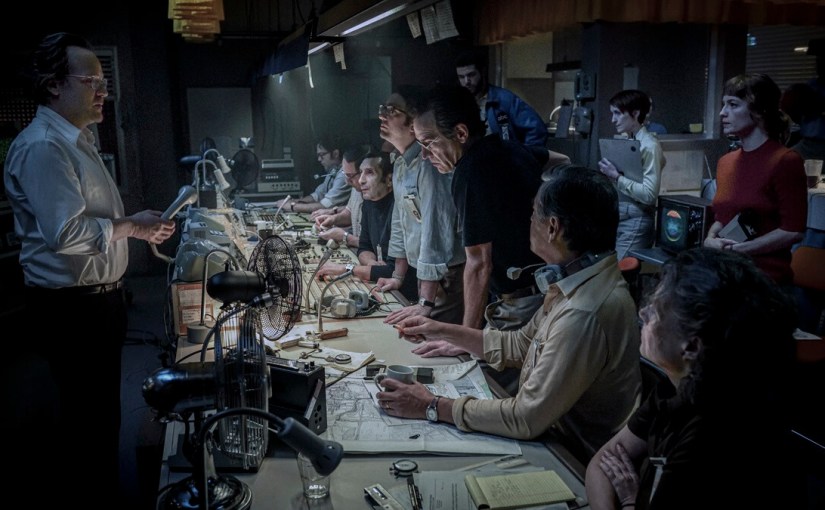
Two of my absolute favorite true-life movies (United 93 [2006], Bloody Sunday [2002]) happen to be from the same director, Paul Greengrass.  Watching Tim Fehlbaum’s film September 5 felt at times like I was watching a Paul Greengrass film, and I can offer no higher compliment than that.  From the moment the first gunshots are heard coming from the Olympic village in Munich in the wee morning hours of September 5, 1972, this movie never lets up on the tension.  Over the next 24 hours, we will follow the ABC Sports broadcasting team as the managers and crew work through a tangle of journalistic ethics and operational logistics to report on the biggest news story of their lives while maintaining objectivity and their obligation to the truth, and ALSO keeping the safety of the victims and their families in mind.

The four major characters are legendary ABC Sports executive Roone Arledge (Peter Sarsgaard); a then-unknown control-room functionary, Geoffrey Mason (John Magaro), who was in the right place at the wrong time; ABC Sports producer Marvin Bader (Ben Chaplin); and German-to-English translator Marianne Gebhardt (Leonie Benesch), who is probably an amalgam of several different people who were most likely present during the actual events of the film.

One of the masterstrokes of September 5 is how it rachets up the tension by staying inside the claustrophobic control room and connected offices for the entire film, minus the opening and closing shots showing Geoff arriving for work and leaving the next morning.  Anything showing us the outside world is only visible on the banks of television monitors in front of them, which leads to much confusion towards the end of the film as reports of the Israeli hostages being freed begin circulating, but no one can actually see what the hell is going on.  This is one of the ways the film reminded me of some of the best scenes in United 93 when the people responsible for making the most crucial decisions of their lives were limited by what they could see and hear on the news.

I have never worked in a TV studio, but this movie carries a palpable authenticity that made me believe everything I was seeing.  I never knew, for example, that chyrons (those small captions on the bottom of a TV screen during the news) were analog back in 1972.  Whenever a new development occurs, the control room has to call up a woman in a completely separate room/mini-studio so she can manually place individual letters onto a physical message board, then get behind a camera and shoot the image so it can be superimposed back in the main control room.  Exhausting!

Peter Jennings is reporting remotely across the street from the Israeli apartments, but he cannot be heard live from his radio into the audio feed for the TV signal.  So, some random dude takes a phone handset, unscrews it, solders some wires, clamps it all together in front of a microphone, and presto, now Jennings is live.  The whole operation is put together with spit and baling wire.  It feels like it’s a miracle that anything was televised at all.

The other conflicts presented to us are no less important.  Marianne, a German woman, is drafted into helping with the translation, but first she must endure some brief accusations from Marvin.  The fact these Olympics are being held in Munich less than thirty years after the end of World War II is something many people are still coming to terms with.  He asks her if her parents knew about the concentration camps.  She stares for a second and gives the best answer possible: “But I am not them.”  After that, she earns the complete trust of the entire staff.

The subtext of the German guilt over World War II is bubbling just beneath the surface for the entire film.  A German maintenance worker won’t release replacement cables to a French tech until Marianne talks him into it.  It is theorized at one point that German military forces could possibly end the hostage situation within minutes, but the German military is constitutionally forbidden to operate within the Olympic village, for obvious reasons.  Roone Arledge watches Mark Spitz win yet another gold medal, and instead of going to a closeup of Spitz, he instructs the cameraman to cut to the face of the German swimmer who lost.  Someone asks him, “Do you really want to bring politics into this?”  And he replies, “It’s not about politics, it’s about emotions.”

Which brings in the other major point of retelling this story in this way.  There is a point where ABC’s cameras have great shots of the building, the balcony, and the entire complex, and they are broadcasting live (the first time the Olympics had been broadcast live, by the way).  Someone spots German policemen – non-military – getting into position with sniper rifles.  Marianne hears chatter on the police band about an operation getting the green light.  The press is ordered out of the area, but ABC’s cameras continue to broadcast live.  Someone notices that a TV appears to be on inside the apartment where the hostages are being held.  Geoff suddenly asks a reasonable question: “Are the terrorists seeing this?”  Minutes later, German police storm the ABC control room and demand the cameras be turned off, pointing a gun at the crew at one point.  The cameras get turned off and a furious Arledge kicks the Germans out of the building, but the point is made.  Minutes later, the operation is called off. 

“They should’ve cut the electricity to the apartment, it’s not up to us to double-check on them,” says Marv.  But Geoff makes a point: “Marv, it’s not okay if we made it worse.”  The fine line between the freedom of the press and general public safety could not be more elegantly portrayed than it is here.  Earlier in the film, just as the cameras have been set up with shots of the balcony of the apartment, someone asks, “Black September [the terrorist group responsible], they know the whole world is watching, right? …if they shoot someone on live television, whose story is that?  Is it ours, or is it theirs?”

It seems like an easy question to answer: “Public safety comes first.”  But who gets to decide what’s in the public’s best interest?  Those policemen who burst into the control room and shut the cameras off at gunpoint?  Perhaps it should be left to each newsperson’s individual conscience, but can that always be trusted?  These are questions I am not qualified to answer, but I appreciate films like September 5 because they have enough faith in the viewer to pose those questions and then refrain from providing a tidy answer.  It’s one of those rare thrillers that tells a crackling good story and also asks some big, relevant questions that you may not even think about until you’re driving to work the next day.

One of the last things we hear is Marianne talking to Geoff, who had sent her to the German airport where the hostages were supposed to have been flown out of Germany.  “I was there with hundreds of people, we stared into the night.  We were waiting for something to happen because we wanted to take a picture of it.”  While that’s a rather bleak way of describing a profession that has given us some compelling images that have swayed the world’s opinion on vitally important matters, perhaps it’s also a way to caution those who would exploit situations, like the paparazzi who chased Princess Di into that tunnel.

SEPTEMBER 5

By Marc S. Sanders

September 5 is a sweeping account of how breaking news used to be assembled.  You had to be in the right place at the right time.  If you weren’t, then perhaps the sports department of your media conglomerate is, and they will get the story. 

The very first televised terrorist attack was broadcast at a sadly appropriate time.  The 1972 Olympics were being covered by the ABC television network.  For the first time, homes all across the world would be able to watch the games in color, from a satellite feed shared among the big three networks.  ABC had the broadcasting rights to the games though.  The setting is especially interesting to this story.  The Olympics are being hosted by Germany, primarily out of Munich.  This is an opportunity for the country to finally redeem itself, only twenty-seven years after World War II had come to an end and their country’s Nazi regime had been overthrown.  Germany had a lot to make up for.

The Sports Division of ABC news turn over in the wee hours of the morning of September 5.  Geoffrey Mason (John Magaro) slumps into the studio and relieves Roone Arlege (Peter Sarsgaard) following long hours of editing and covering competitions in swimming, volleyball, boxing, track and so on.  There’s minimal staff on shift as the athletes and coaches are asleep for the night, but then Geoffrey and crew believe they hear machine gun fire out of the direction of Olympic Park, and suddenly everyone is awakened and scrambling to put together the story fast. 

No other broadcasts are reporting on this alarming incident.  This is a story that comes at ABC Sports in their own time.  Had this happened today, amid an age of worldwide shrinkage with the existence of the internet, these guys would have been way behind.  In 1972 however, they can rely on Mariane Gebhardt (Leonie Benesch) a female German flunky of the sports division to translate the various radio communications between the terrorists and the German negotiators, and what plans are being put in place.  Nine Israeli athletes have been taken hostage in their hotel rooms with two believed to have already been killed.  The terrorists (believed to be a Palestinian militia group called Black September) demand that Israel release two hundred of their prisoners or they will kill a hostage every hour beginning at noon.

Forgive the cliché terminology, but September 5 is a taut, nail biting, documentary style thriller told only through the perspective of the ABC Sports division.  While the developments of the hostage situation feel urgent, for these unshaven guys in glasses and wrinkled shirts who are operating on little sleep and a lot of coffee, it is about getting the news out quickly and accurately, and just as importantly, first.  Geoffrey and Roone are constantly on the phones trying to learn whatever they can from Peter Jennings, the eventual famed ABC reporter, who is nearby the incident and at times hiding from the German police who are desperately trying to clear the area of the press.  The guys even send in a staff member with a smuggled camera and reels of film taped to his belly while he poses as an Olympic weightlifter.  The Germans forbid the press from trespassing but insist the games carry on.  So, the athletes and coaches are the only ones who can enter the area to prepare for competitions of the day.  Even Howard Cosell happens to be in a hotel staircase nearby and can provide feedback. 

In the news control room, the guys are literally putting walkie talkies next to microphones that broadcast live on air with Jim McKay who is behind the desk, talking to the world.  This is bare bones news broadcasting with unsophisticated technology to aid them in this short window of time.  The director of this film, Tim Fehlbaum, brilliantly captures the desperate inconveniences of reporting this way. 

Roone and Geoffrey also have to contend within their own ranks.  This is not a sports story.  This is a news story and so Roone must insist on keeping the story.  They are the only ones there.  How much more effective would a news division located on the other side of the world fare?  Therefore, Roone’s team are the only ones qualified to cover this developing story.  ABC News will not have access to this. 

Roone also has to improvise how the satellite feed is shared with their competitor, CBS Sports.  It’s a pain in the ass inconvenience and yet the resourcefulness and quick thinking of the control room staff find a way to uphold their claim on this story.

While watching this account, it matters little if we know the outcome of the September 5, 1972, Munich attack.  This film’s purpose is covering how the first few who knew about the situation responded. By the time the ninety-five-minute film is over a lot has been shared.  Tim Fehlbaum, with an Oscar nominated screenplay written by him along with Moritz Binder cover quite a bit.  The pace moves as fast as these people in the control had to move on that terrible day.  So, the information comes quick.  With real life archived ABC footage spliced within the film, you feel as if you are standing in the corner of this dark room with various tv screens, microphones, and telephones. 

You watch John Magaro feed information to Jim McKay, and then the picture cuts to real life footage of McKay at the desk.  It’s quite inventive how the script is accommodated to work in line with what Jennings, Cosell, McKay and others literally said as the crisis was being reported.

Having seen all ten Best Picture nominees for 2024, it is disappointing that September 5 did not make the cut.  Tim Fehlbaum’s picture certainly deserves more recognition and a slot over other contenders this year.  Still, the screenplay is a well-deserved accolade.  To interweave a fresh script that hinges on what was literally said on television screens around the world at that time is a marvelous strategy. 

September 5 is a crackling thriller of a terribly sad day.

GREY GARDENS (1975)

DIRECTORS: Ellen Hovde, Albert Maysles, David Maysles, Muffie Meyer
MY RATING: 6/10
ROTTEN TOMATOMETER: 94% Fresh

PLOT: The celebrated Maysles brothers spearhead this cult classic documentary about Big and Little Edie Beale, reclusive and eccentric cousins of Jackie Onassis who occupy a crumbling mansion in East Hampton, New York.


I have seen and loved many documentaries in my life, from the sublime (Baraka, 1992) to the absurd (The Aristocrats, 2005), from the terrifying (Gimme Shelter, 1970) to the edifying (Dark Days, 2000).  But after watching the cult classic Maysles brothers documentary Grey Gardens, I am sitting in front of my computer terminal and I am at a loss of what to say about it, beyond a summary of its contents.

As the film opens, Big Edie Beale, who celebrates her 79th birthday during the film, and her daughter, Little Edie Beale, 52, reside in a sprawling mansion nicknamed Grey Gardens in a high-end East Hampton neighborhood.  Their biggest claim to fame before this film is that they are cousins to Jackie Onassis.  To say their house is a mess is an insult to both the words “house” and “mess.”  It’s a dump, although we are shown newspaper articles that seem to indicate the house was in even worse condition before the Maysles started filming.  The state health department threatened eviction unless the mansion was cleaned up; there’s even a photograph of Jackie O pitching in with the cleanup.  Through the course of the film, the Maysles and their film crew will capture what some have described as “an impossibly intimate portrait” of a relationship between two people whose minds have retreated to a point where they scarcely notice their surroundings as they repeatedly hash out old arguments from years past.

Any fan of film has at least heard the name Grey Gardens or the names of the Beales at some point in their life.  I’m told it’s featured prominently in at least one episode of the television show Gilmore Girls.  The Criterion Blu-ray contains two interviews from noteworthy fashion designers who have both designed clothing lines directly inspired by Little Edie’s clothing in the film.  There are even pictures of a European photo shoot that replicates scenes from the movie.  This is arguably one of the most famous documentaries of all time.

So, I hit play on my Blu-ray player and started watching.  The cameras do indeed capture intimate moments between mother and daughter.  Little Edie’s fashion sense involves never being seen without something covering her head, whether it’s a turban, a sweater, or a dishtowel.  Big Edie spends – based on what I saw – most of her days in bed, leaving only to take in the sun on her porch or to use the restroom.  Sometimes she leaves the bed to eat a meal, but Little Edie usually brings the food to her mother.  In one sequence, Big Edie cooks corn on the cob on a hot plate while sitting in bed.  She shares her bed with one or more of their many cats, as well as various boxes, books, binders, and photographs.  The mattress is dotted with water stains and what appears to be rust.

But wait, there’s more.  There is a hole in the top corner of a wall in one of the hallways.  This is where a raccoon lives.  At one point, Little Edie leads the camera crew to the attic to perform her version of pest “control.”  She empties a loaf of Wonder Bread onto the attic floor.  Then, as an added treat, she empties an entire box of dry cat food on top of the bread.

Now, why am I mentioning the state of their surroundings instead of recounting the delightful (I guess) eccentricities these two women proclaim at each other night and day?  Because I could not take my eyes off the backdrop of the house itself, which is as much a character in the film as the Overlook Hotel is in The Shining.  There is a room that Little Edie is in the process of decorating, but it looks as if her design process is stuck at a fourth-grade level.  The grounds of the mansion appear to be in utter disarray, overgrown and wild, with unchecked vines and bushes threatening to swallow the house itself.  Every corner of Big Edie’s bedroom is laden with stacks of boxes containing old photo albums and vinyl records, many of which feature Big Edie herself.  (She was a recording star back in the day, apparently; she doesn’t sound half bad.)

We are treated to many scenes featuring Little Edie talking to us about her past, how her mother curtailed her ambitions to be a model in Europe in order to come back home and take care of her.  How her mother sent away one of her suitors because she, Big Edie, didn’t want another cook in her kitchen.  We hear from Big Edie talking about how wild Little Edie was, how she was so hard to handle, so she had to treat her sternly.  There’s a scene where Little Edie sings and sings, and it’s clear she is not as gifted as her mother was, but do you think that’s going to stop her?  No, ma’am, not even when Big Edie begs for a radio so she can listen to something else, ANYTHING else.

I’m watching all of this play out, as the directors capture remarkable footage and whispered conversations.  It is undeniably bizarre, yes, and some of it is mildly entertaining.  (Little Edie’s dancing scenes are worth the price of admission.)  But I could not stop asking myself this question while I was watching: “Why?”  Why is this movie necessary for me to watch?  What do I gain by becoming a fly on the wall and being privy to conversations between two people who would be better off if they lived in separate houses?  In separate states?  What am I missing?  I would imagine I could find all those answers in various other online reviews or movie blogs, but if those answers didn’t occur to me while watching the film, who should I blame?  My own preferences, or the film itself?  Yet another answer I don’t have.

I’d like to think my cinematic taste is relatively evolved, although I was a bit of a late bloomer.  I didn’t see the gangster masterpiece The Public Enemy (1931) until recently, and I have yet to see more than one film by Abbas Kiarostami.  But I love a great documentary, and this has a reputation for being one of the genre’s best.  So, why did I not respond to it as enthusiastically as so many other people have?  What am I missing?  How is this entertaining?  This might hit more poignantly with mothers and daughters, but I’m just speculating.

I have no answers.  I can only promise that, at some point, I will watch this movie again because I do think it deserves another chance.  I don’t know when that will be, but when I do, I’ll try to ignore the house and focus more on the characters.  I’ll keep you posted.