
by Miguel E. Rodriguez
DIRECTOR: Sidney J. Furie
CAST: Stan Shaw, Andrew Stevens, James Canning, Michael Lembeck, Craig Wasson, Noble Willingham, R. Lee Ermey
MY RATING: 9/10
ROTTEN TOMATOMETER: [no score]
PLOT: In 1967, five young men undergo Marine boot camp training before being shipped out to Vietnam. Once they get there, the experience proves worse than they could have imagined.
[This review contains MILD SPOILERS concerning the film’s finale.]
I remember a short while ago, when I watched the original The Taking of Pelham One Two Three (1974) for the very first time. I remember asking myself, “Why did it take me so long to finally watch this movie? It’s fantastic!”
I’ve just had the same exact experience after watching Sidney J. Furie’s The Boys in Company C, which I think (someone correct me if I’m wrong) is the first attempt by Hollywood to provide a genuinely realistic portrayal of being a combat soldier during the Vietnam War. There are some obvious parallels to Kubrick’s Full Metal Jacket (1987) and Fuller’s The Big Red One (1980), but this one was first out of the gate. Company C is just as visceral, just as riveting, and just as entertaining to watch as those other films. I have only seen a handful of Furie’s other films (including Iron Eagle [1986] and Superman IV: The Quest for Peace [1987]), so I can’t make a 100% informed opinion, but in my limited experience, this is far and away his masterpiece. It goes on the list of my favorite war movies ever made, and I think it’s a real shame that it appears to have been nearly forgotten.
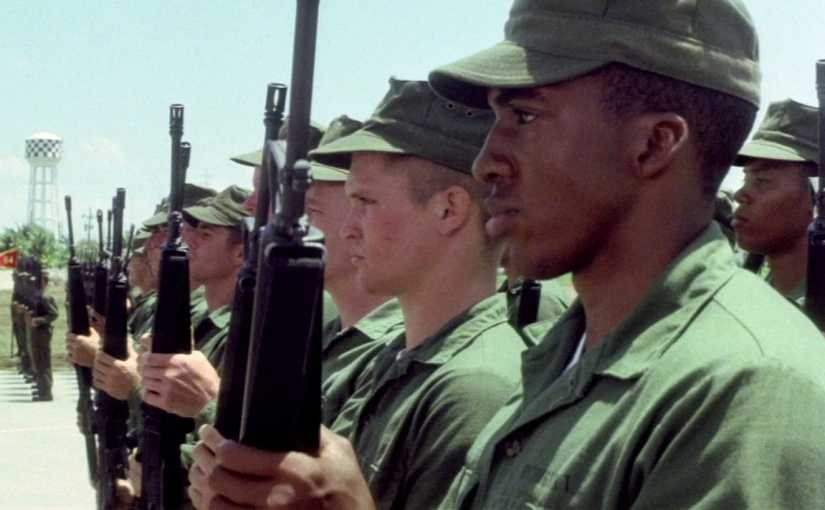
Like so many other war films that came after it, The Boys in Company C begins at boot camp. More properly, it begins right outside the recruitment center (I think?) in late 1967, as several young men – boys, really – kiss their loved ones goodbye before getting on a bus. In a weird way, this sequence reminded me of the opening scene in The Breakfast Club (1985) as each student is dropped off for detention by their parents (except for Bender, of course). We are introduced to the boys who will become the key players: Washington, the angry black man (Stan Shaw); Pike, the country boy (Andrew Stevens); Foster, the aspiring writer (James Canning); Fazio, the Italian American from Brooklyn (Michael Lembeck); and Bisbee, the pacifist who is put on the bus in handcuffs (Craig Wasson). Stereotypes? Sure, I guess. But the screenplay doesn’t limit them to JUST their stereotypes. Washington, for example, starts out in camp as a guy who is looking out for himself, but after a surprisingly passionate speech from his drill instructor (R. Lee Ermey in his film debut!), he assumes the mantle of leadership and wears it exceedingly well.
We get the by-now standard scenes of the recruits getting their heads shaved, struggling through exhausting training runs, being called names that would’ve made George Carlin blush, and, eventually, graduation, where their reward for making it through boot camp is being assigned to combat duty in the ‘Nam. Their problems begin even before they disembark from their troop carrier when the Vietnamese port comes under artillery fire. It all sort of goes downhill from there.
The movie so far is nothing incredibly new, at least not to someone watching in the present day, but I had to keep reminding myself that this was probably the first time American audiences had seen a relatively honest representation of combat that wasn’t filtered through layers of self-censorship and jingoism. M*A*S*H (1970) did show us the bloody reality of surgery in the field, but it didn’t concern itself too much with actual combat – plus it was set in Korea, not Vietnam. A minor quibble.
There are a LOT of plot details I won’t relate here – the clueless captain, the “vital” convoy, Washington’s drug trafficking plans – because of the soccer subplot that reveals itself to be the film’s beating heart and real cry of protest. Much like Kilgore and the California surfer in Apocalypse Now (1979), the squad captain learns that Pike, the country boy, is pretty good with a soccer ball. There is a squad of elite Vietnamese military men who are also good at soccer. The captain dreams up a plan: put together a soccer team of American soldiers who will play the Vietnamese men in an exhibition match. If the American team wins, they will get a reprieve from combat and go on a “goodwill” tour of southeast Asia, including Tokyo and Bangkok.
Sounds good, right? But complications arise when, at the match, the American general watching the match is approached by his opposite number in the Vietnamese army. With the Americans leading at the half, the order is passed to the team: lose the match so the Vietnamese can save face in front of their own people. If they throw the match, they will still get reprieved from combat to go play mare matches against Vietnamese teams…and lose every time.
The Americans can’t believe it. Pike (and everyone else) wants to get back home, but he is afraid he can’t live with the shame of intentionally throwing a match, no matter what the big picture looks like. But the orders contain no ambiguity. Throw the match and go on tour, or win and go back to frontline combat the next day.
This is what the movie has been driving towards the whole time. The squad has to collectively decide what is more important: winning or surviving. I hope I don’t come off like an amateur historian here, but to me, that is the same question that could have been asked about the entire Vietnam conflict. As a country, we had a chance to ask ourselves: is winning this war worth the price we’re paying? How much more are we willing to spend, in money and lives? In the film, the squad is asked to balance that equation themselves on a smaller, but no less important, scale.
Is this about honor? Should they win the match to preserve their own personal integrity, even if it means going back to fighting in the jungle and maybe never making it back home? Or should they throw the match, increasing their odds of making it home alive and boosting morale for their Vietnamese allies, but leaving them with a stain on their integrity? Is this kind of thinking the reason the American government participated in possibly the most unpopular war in American history? Because losing face was worse than losing lives?
These are questions I would not presume to think I could answer. I know, of course, what I would have done in that situation, but I can only speculate because I have never been a soldier in a time of war. The Boys in Company C put me right there and allowed me to understand the whys and wherefores of each major character in a way that we’ve seen in every notable war film ever since. This is an incredibly important artifact in the history of war films, and it deserves to be seen by every movie fan.
[Trivia note: this movie was executive produced by none other than Raymond Chow, the man behind Enter the Dragon (1973) and nearly 200 other Hong Kong films, and virtually the entire movie, including the boot camp sequences, was filmed in the Philippines.]
 2 UNPAID MOVIE CRITICS!!!!