IPHIGENIA (Greece, 1977)

by Miguel E. Rodriguez

DIRECTOR: Michael Cacoyannis
CAST: Irene Papas, Kostas Kozakos, Tatiana Papamoschou
MY RATING: 9/10
ROTTEN TOMATOMETER: [Not scored]

PLOT: In ancient Greece, King Agamemnon, in order to appease the gods, is told he must sacrifice his favorite daughter, Iphigenia, before his troops can march to war.


To my mental library of favorite closing shots in cinema, I must now add the final image of the engrossing Greek film Iphigenia.  I won’t spoil it, but the hatred in the eyes, the set expression of the face, spell out exactly what will follow in the years to come without saying a word.  It’s cinematic, yes, but it’s also theatrical, expressing oceans of passion (good or bad) with a stare instead of a monologue.

Director Michael Cacoyannis’ filmed adaptation of an ancient Greek tragedy by Euripides (Iphigenia in Aulis) does not immediately seem like the kind of film I would cotton to.  I’ve never read any of the ancient Greek plays, nor have I ever read the Iliad or the Odyssey, though I am familiar with their plots…barely.  This is not the kind of literature I have traditionally sought out, and I am content in my decisions.  But a weird thing happened while watching Iphigenia.  After a somewhat rocky start, I became enthralled with the language these characters were using.  I don’t mean the Greek language itself, but the subtitles used in the English translation.  I cannot say with any certainty how closely the subtitles mirror what is actually being said, but if they’re even just fairly accurate, then I now understand, at least to a small degree, why these plays have endured for millennia.

The story itself is one that has undergone countless interpretations and revisions over the course of history.  King Agamemnon (Kostas Kozakos) and his vast army are ready to set sail for war against the kingdom of Troy, but their ships are stranded by a lack of wind.  The seer Calchas informs Agamemnon that the winds will not blow until he sacrifices his eldest and favorite daughter, Iphigenia, to the goddess Artemis, who is withholding the winds because his men have offended her by killing a sacred deer.  (And now I know where the title of The Killing of a Sacred Deer [2017] comes from…knowledge really IS power!)

Agamemnon agonizes over this decision, but his hand is forced by the eagerness of his troops to sack Troy; he’s afraid they’ll mutiny if he doesn’t go through with the sacrifice.  He invents a pending marriage of Iphigenia to the great warrior Achilles to get Iphigenia to the encampment, but Clytemnestra (Irene Papas), her mother and Agamemnon’s queen, tags along unexpectedly.  The rest of the movie churns with gloriously over-the-top melodrama, as Clytemnestra rages at Agamemnon, Iphigenia pleads for her life, and Achilles swears to defend Iphigenia at all costs.  Agamemnon also argues with his brother, Menelaus, in a terrific scene during which they both change each other’s minds just a little too late.  In the meantime, the winds never blow, the Greek troops grow restless, and the seer waits a little too eagerly for the chance to carry out the impending sacrifice.

It was during Agamemnon’s argument with Menelaus that I really started to perk up.  This is not an easy scene to write or act out.  Even with English subtitles, the sentence construction and syntax were occasionally overworked.  I remember thinking at one point, “Huh…this is almost Shakespearean.”  Except these scenes were written roughly two thousand years before Shakespeare was born.  When that concept smacked me in the face, I started paying attention a little more to the style and the passion of the words.  And I can’t explain it, but everything acquired a new dimension.  It started to feel more like a play than a film.  It became – at the risk of sounding a tad abstract – poetic.

That feeling permeated everything after that scene.  Throwaway scenes felt more immediate, and really important scenes felt monumental.  Sure, there is some overacting, particularly from the actor playing Achilles, but really, it’s called for in this scenario.  When Clytemnestra promises her husband that, if he goes through with the sacrifice, she will accept his will but hate him for the rest of her life…I really felt it.  And it’s not just the language, but the zealotry of the acting on display, especially from Irene Papas, who must have salivated at the chance to play this fiery woman, a proto-feminist who accepts her duty as a queen but never lets the king forget who truly rules the roost.

And then there’s Iphigenia herself, played by a waifish, almost elvish actress I’d never heard of before seeing this movie, Tatiana Papamoschou.  In her first scenes, she’s almost too innocent to be taken seriously.  It’s only when Iphigenia learns of her father’s plans to murder her for the sake of war that Papamoschou’s acting style allows her to really embody the character, and she delivers a speech late in the film that is, for lack of a better word, biblical.  She accepts her fate and shames the men around her with the same surgical precision that can be found in the Gospels when Jesus accepts His own fate while dismantling the Pharisees with His words.  There are monumental themes at play behind the scenes, and “normal” dialogue just would not feel adequate.

And then there’s that final shot.  I did a tiny bit of research on the original play, and when you learn what historically happened to the main characters after the play’s events, that last look carries even more weight, foretelling decades of death and tragedy without saying a word.  That a foreign film of a 2,200-year-old play was able to affect me this greatly was very pleasantly surprising to me.  I doubt any newer version with today’s technology or modernized dialogue would affect me the same way.  Iphigenia was a very pleasant, surprisingly effective discovery.

BLUE COLLAR (1978)

by Miguel E. Rodriguez

DIRECTOR: Paul Schrader
CAST: Richard Pryor, Harvey Keitel, Yaphet Kotto, Ed Begley Jr.
MY RATING: 6/10
ROTTEN TOMATOMETER: 96% Certified Fresh

PLOT: Three financially strapped automotive factory workers rob their own labor union, but when they get more than what they bargained for, their friendship and loyalty are tested.


There may come a day when I revisit Blue Collar and revise my current opinion.  It’s not impossible.  I’ll be a different person five or ten years from now.  I may have a different job with different bosses and co-workers, or I may be living in a different neighborhood in a different house.  All sorts of things could change that will affect my perception differently.  Until that happens, though, this is what I think:

Blue Collar, the directorial debut of eminent screenwriter Paul Schrader, author of Taxi Driver (1976), Raging Bull (1980), and American Gigolo (1980), is a film with a good story to tell.  Not just good – important.  This is an important story about loyalty, friendship, and duty to your family.  Richard Pryor turns in a great performance, flexing his dramatic muscles as he seldom did, unfortunately.  Schrader’s screenplay, co-written with his brother, Leonard, and using source material from Sydney A. Glass, pulls no punches regarding corruption within the powerful auto workers union.  Character motivations are crystal clear from the opening scene to the final, cynical freeze frame.

But…but…I wish this story were contained in a film that made me care about these characters while the movie itself was playing.  Intellectually, I see the value of the story.  But as a moviegoer, I was less than moved.  Schrader’s direction is competent, but the film moves from beat to beat with the energy of a sloth.

Zeke (Richard Pryor), Jerry (Harvey Keitel), and Smokey (Yaphet Kotto) are three working-class friends on the line at an automotive plant in Detroit.  Their closeness is established in a bar scene that gave me hope for the rest of the film.  It plays almost like an Altman film, with some overlapping dialogue, simple but clear direction, and conversations that give us an instant picture of who these three disparate characters are.

It’s unclear what Smokey’s financial situation is until later in the film, but Zeke has back-taxes to pay because he has declared too many dependents for the last three years, and Jerry has a teenage daughter who is so desperate for expensive braces that she tries making some herself, with exactly the kind of results you’d expect.  Their union, which is supposed to help them, is a joke as far as they’re concerned; they can’t even fix Zeke’s broken locker door.  So, after Zeke makes some observations at the union’s local office, he and his pals hatch a plan to rob the office vault.

What they find there drives the rest of the plot, so I’ll tread lightly from here on out.  But the vault robbery is a good example of where the movie is lacking for me.  The plan is simple and relatively risk-free, but I was hoping for at least SOME suspense during the robbery.  A moment occurs when they’re about to be discovered, so they don their masks…but the masks that Zeke bought aren’t masks.  They are, in no particular order, plastic vampire fangs and a funny hat, a pair of sunglasses covered by an American flag design, and a pair of googly-eye glasses – you know, the ones where the eyeballs are attached to the glasses by long springs?  This crucial moment was ruined by the utter ridiculousness of their “costumes”; it felt like a transplant from some other Richard Pryor comedy about incompetent criminals.

After that, the screenplay feeds us important chunks of information, but there is no dynamic energy to the editing or the direction or something.  It just felt…boring.  Which is a shame because, again, there is a good story here.  The union local blatantly lies about the contents of the vault after the robbery.  An FBI agent tries to get Zeke, Jerry, or Smokey to spill what they know about union corruption, but they are too loyal to turn stool pigeon.  Zeke has to make some hard choices in one of the movie’s better scenes towards the end.  Smokey displays strength when threatened by union thugs, but he pays for it later.  And Jerry just wants to do the right thing without anyone getting hurt.

But there was just zero energy to the narrative.  I never felt carried along by the tide of the story.  And without that forward momentum, every scene felt like it was just marking time before the next.  To the degree that I understood the plight of these blue-collar workers, the movie just didn’t make me care enough to feel anything about it.  I did feel empathy for Zeke, mostly due to Pryor’s powerful, angry performance, but even that empathy was turned on its ear by the time we got to the closing credits.

There is, I guess, something to be said about how the screenplay is constructed so that, at any given point, you could say that any of the three main characters are the true lead of the film.  The story is truly balanced, and I give it credit where it’s due.  I just wish the storytelling was more dynamic.  Like I said, the day may come when my opinion of this movie will change.

Today is not that day.

…tomorrow’s not looking good, either.

MY COUSIN VINNY

By Marc S. Sanders

The American Bar Association’s publication, The ABA Journal, ranked My Cousin Vinny #3 on its list of the “25 Greatest Legal Movies.”  Surprised?  You really shouldn’t be.  

This “fish out of water” film follows a goodfella who did not pass the bar exam until his sixth try.  Now he’s defending his cousin and another UCLA college kid in an Alabama courtroom.  It’s Vinny’s first murder trial.  So he’s gotta learn the ropes of how to dress properly for court all the way up to discrediting material witnesses and demonstrating reasonable doubt to get his clients exonerated.  It’s a great courtroom picture because within the dense slapstick comedy there are authentic lessons to learn about being a member of the Bar and having confidence in yourself.

Bill and Stan (Ralph Macchio, Mitchell Whitfield) are roadtripping through southern America, en route to UCLA, when they get pulled over and framed for the murder of a convenience store clerk.  With no money or hope of retaining a reliable public defender, the young men turn to Bill’s cousin Vinny.  

Straight out of the five boroughs of New York wearing a black leather jacket, black boots and a slick pompadour, Vinny Mancini arrives in small town Alabama.  You know something?  If I didn’t know any better I’d say he looks and acts a lot like Joe Pesci.  With him is his long time fiancée, Mona Lisa Vito (Marisa Tomei, in her very well remembered Oscar winning role). Mona Lisa Vito!  I love when there’s some thought put into a character’s name.

The future looks grim for the accused as Vinny doesn’t know where to begin.  The iron horse Judge Chamberlain Haller (Fred Gwynne) habitually holds the guy in contempt because Vinny can’t shed his New York ways either in wardrobe or proper decorum. The prosecutor played by Lane Smith really doesn’t have to try hard at all.  Though he deliberately gets all Southern showy each time he faces the jury, made up of friendly locals.  In an unexpected and tender moment, the tough guy, Vinny, admits to Lisa that he’s “a-scared.”

I never cared for My Cousin Vinny since I had seen it in theaters.  However, there’s much I appreciated on only my second viewing of this film directed by Jonathan Lynn, an actual law scholar.  Lynn is always striving for an authenticity within the courtroom.  His protagonist might not know anything about being a litigator, but the director ensures that a genuine regiment of customary courtroom behavior, procedure, and theatrics will be upheld even if this is only a silly, little comedy flick.  

Outside the courtroom, there’s primarily an updated George and Gracie situational comedy at play.  Marisa Tomei is of cinema’s great scene stealers.  Mona Lisa Vito might look like an overly familiar character, but the actress’ performance is entirely unique.  She never plays Lisa as a dumb side character to her boyfriend who will not commit to marriage.  Lisa comes off generous, always offering to assist Vinny despite his rejections.  She’s also positively smart as a whip with her extensive knowledge of automotive repairs, and she’s a quick study of Alabama law.  When she gets put on the witness stand it hardly matters what she’s saying.  Marisa Tomei owns the expertise and defiance of Lisa.  Turn the scene on mute to watch her doing some of her best work would be equally effective.

Go look at Silver Linings Playbook when Jennifer Lawrence rhythmically dictates numeric football statistics at Robert DeNiro.  Both actresses won Oscars for these respective roles.  These performances stand apart from so many other second, third and fourth billed actresses because they are written with immense intelligence.  That’s what Tomei and Lawrence normally embrace first, ahead of costume and makeup.  The confidence from these actors is uncanny.  More women need to be cast in roles like these.  

Joe Pesci is doing his reliable, familiar schtick from Goodfellas, Raging Bull and Easy Money.  He’s in a what if scenario though.  What if there’s a movie with Jersey Boy Joe Pesci, but he’s put in Alabama country with roosters crowing and trains chugging into town at five in the morning? There can even be a communication gap between the Judge and Vinny for some padded laughs.  “What is a yoot?”

I was bored with this movie the first time I saw it.  I just didn’t think the humor was funny even if I recognized the attempts.  Over thirty years later, what I appreciate is the heart that feels much more apparent.  The hero feels weak and at a loss.  Only when he is given strength and support from a wisecracking, sexually frustrated girlfriend does he get the drive to behave like a lawyer he’s licensed to become.  I like Vinny.  I like Lisa.  Therefore, now I can laugh at their unfortunate dilemmas as they work towards an end goal – getting him to do his best at becoming a courtroom lawyer and hopefully reaching a not guilty verdict. 

I gotta give a shout out to the supporting cast.  Bruce McGill plays a familiar sheriff that we’ve seen before, but so what.  It’s the way he carries himself that I’m always welcome to see him in a movie.  Same goes for Lane Smith.  These guys are sophisticated Dukes Of Hazzard.  Fred Gwynne, most famously known as Herman Munster, was always a brilliant character actor.  He has the ability to be goofy and intimidating all in the same scene.  To place his towering stature against little Joe Pesci? Who needs dialogue? Watch Fred Gwynne’s moments in My Cousin Vinny.  He could’ve been Oscar nominated, and I would not have complained.  While Ralph Macchio is doing his typical routines (same things we saw in The Karate Kid, The Outsiders and so on), it’s Mitchell Whitfield playing his buddy who really stands out.  This is a nothing role but it’s as if this guy fell out of a Woody Allen or Neil Simon picture to claim his own territory among an outstanding cast.

My Cousin Vinny is one of those comfort films to put on when the stress is becoming too much in real life.  Everyone is so likable here.  There isn’t a villain to dual against.  Instead, it’s a conflict of cultures who must work together to uncover truths within a murder trial while also learning about what any one of us is actually capable of accomplishing. 

Vinny from da Bronx is a lawya???? 

FUGGETABOUTIT!!!!!

FALL

By Marc S. Sanders

Sometimes a movie will simply cover a circumstance.  The crew of Apollo 13 end up lost in space.  James Franco gets trapped behind a rock for 127 Hours.  Chrissy Watkins and Alex Kintner wind up abandoned in shark infested Open Water.  I recall Ryan Reynolds being buried alive in a coffin for ninety minutes.  Haven’t seen that one yet.  Not interested, honestly.  

Any of you curious to see what happens when two expert rock climbers neither of whom wear safety gloves, while one wears Converse All Star high tops, (Pass the grain of salt, please!) opt to climb a rusty 2,049-foot-high television antenna and get stuck at the top?  That’s about all there is to Fall, directed by Scott Mann.  

Granted, there is a thin slice of characterization layered on the crust.  Becky (Grace Caroline Currey) is severely depressed and maybe suicidal following a rock-climbing accident that took her beloved husband Dan (Mason Gooding) away from her.  Fifty-one weeks later, she still defies her father’s (Jeffrey Dean Morgan) pleas to help her.  Yet, her best friend Hunter (Virginia Gardner) urges Becky to accompany her while she records their climb up the infamous B-67 TV Tower, located in the Mojave Desert.  Hunter’s thousands of online followers will be in awe!

Subtle beats of conversation show that Hunter may be hiding a secret from Becky.  Frankly, if you’ve at least read a Dr. Seuss book, you’ll be much more intuitive than Becky, and know what the secret is.  So why should I waste the keystrokes spelling it out for you?

The climb up is pretty unchallenging as the young ladies are tethered together by about fifty feet of climbing rope.  The photography will dazzle you though. They’ve got their cell phones and a drone for some masterful sights of the wide expanse of desert and unlimited blue sky.  One water bottle between the two should be enough. The vultures are nothing to worry about as they are feasting on a near dead coyote down below.  Only thing is that we know something the girls don’t.  As the ascent gets higher into the upwards void, the frailer the rusted ladder becomes, and the more bolts and beams pop off.  You can guess what happens next and follow the film all the way down to its end.

What saves Fall from being a waste of time is Scott Mann’s use of his camera.  IMDb states that he insisted on not doing green screen work.  If he was going to be this daring, the climb up and the need for the ladies to hold out on a grilled, narrow platform high above had to be as authentically real as possible.  Mann’s team built a duplicate antenna on the top of a high mountain location, that reached as close to the structure’s actual height as possible.  So, the height matches that of the real structure.  The recreated antenna was apparently shorter though.  Hey, I was convinced of everything I was looking at from a scorching sun to heavy breezes to sunburns and running mascara and the eventual exhaustion, fear and despair the girls had to endure while trying to survive close falls and drops.  

The edits will make shout and gasp as one of the girls slips or barely holds on to a bar or rope or hand that could give way.  It’s not as impressive as some of the material in Cliffhanger.  Remember that opening?  The enormity of the elevation also does not compare to what Robert Zemeckis did across the open chasm between the World Trade Center Towers either (The Walk).  However, there’s much to look at and take in with a strong sense of vertigo and shortness of breath.

Becky and Hunter’s dilemma left me with trying to figure how they’ll get out this scenario.  You account for what they climbed up with and what might be at the top of the pole for them to use.  You also consider the injuries they suffer when they attempt a risk at gaining an advantage.  Most of what is tried seems apparent.  Though I question their short cut knowledge for charging a cell phone or drone battery.  

I was skeptical of their plight as well.  Expert climbers would wear gloves while climbing a rock or an old rusty two thousand foot high ladder.  Converse sneakers with no tread on the soles? C’mon!  As well, this giant, narrow thing is erect in the middle of the scorching, desert sun.  These girls ever experience going down an aluminum playground slide?  My hands were burning just looking at every rickety piece of this thing.  How did Becky and Hunter avoid painful skin tears and callouses? How did they not have any sort of involuntary reflex against touching what should be burning hot, rusted metal?

Despite the unnecessary, or maybe neglected liberties, the film takes, Fall is watchable. Just take your bathroom breaks during the two “it’s only a nightmare” scenes that look lifted straight out of Jaws: The Revenge. When will filmmakers realize how stupid and unnecessary an “it’s only a nightmare” scene is? The only time it worked was in Aliens. Beyond that, this stale uncreative kind of filler is there simply to muster a jump scare that does not advance a character or teeter a plot. Just stop with the nonsense.

Fall offers a situation I never want to end up in.  I’ve actually developed a fear of heights as I’ve gotten older.  Yet, I’d love to observe from the safety of my home theater how others like Becky and Hunter respond.  The ending is acceptable with a mild twist.  I think I would have embraced this fictional circumstance much more had the story been more frank with itself and the characters who were selected to play this foolhardy game.

One thing I’ve learned though. Nursery rhymes will not help you get your mind off the heights. Thing about what happened to Humpty Dumpty, or if we all play Ring Around The Rosie. Yikes!!!!!!!

AMERICAN BEAUTY

By Marc S. Sanders

Lester Burnham declares in less than a year he’ll be dead.  When we meet him, he’s masturbating in the shower, sleeping in the back of the family vehicle on the way to work, and declaring that his wife Carolyn used to be lovely.  Heck, he’s acting like he’s dead already.  His life has nothing new or exciting to pursue.  His daughter, Jane, doesn’t give him the time of day.  He’s threatened with being laid off from his magazine call center job that he’s held on to for nearly twenty-five years.  What’s to live for anymore? 

I guess what’s complimentary about poor Lester is that at least he’s honest with himself.  All the other neighbors, except for the gay couple known as Jim & Jim, are just as unhappy it seems and might as well be dead too.  A common theme running through the suburban landscape of American Beauty centers on a sense of mental awakening. Who revives sad, lost folks like Lester and Carolyn?  Perhaps it’s the generation sneaking up behind them, who are on the cusp of taking their place in young adulthood. 

Lester is played by Kevin Spacey, in his second Oscar winning performance.  Carolyn is portrayed by Annette Bening who is way overdue for a trophy.  Jane the daughter is played by Thora Birch.  The headliners of this cast are outstanding in how different and disagreeable they portray a broken family that is forced to live in an unstimulating home while trudging through a lifeless marriage.  Look at the set designs within this film.  There’s an endless amount of blank walls within the interiors of the homes.  Almost no artwork or pictures are to be found. 

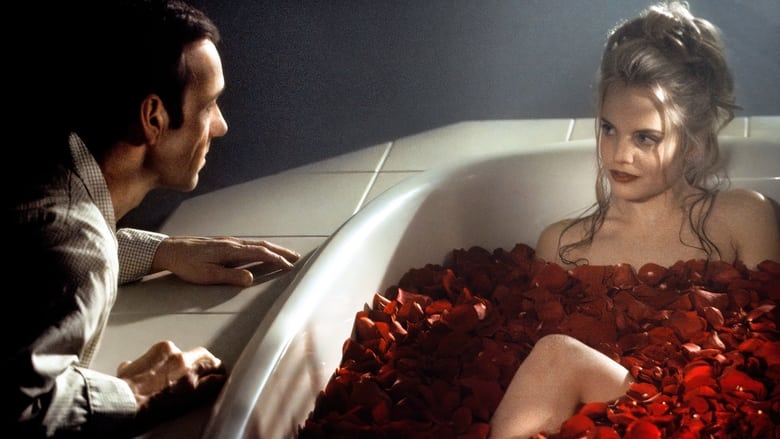
Lester pines and fantasizes about Jane’s best friend Angela (Mena Suvari) getting rained on with red rose petals while she lies naked in a pure white bathtub.  Carolyn, the real estate agent who can’t make a sale, sidles up to the dashing Buddy Kane (Peter Gallagher), her competition. Next door is Chris Cooper in a hospital cornered role as retired Marine Colonel Frank Fitts, with his near comatose wife Barbara played by Allison Janey, and their eighteen-year-old resourceful drug dealing son, Ricky (Wes Bentley). He takes advantage of his camcorder at any opportunity to collect the beautiful images found within the world he occupies and observes.  That could mean he’s capturing Jane in her bedroom window which faces his own.  Later, he’ll show you the freedom of a plastic shopping bag dancing within an autumn breeze.  An old shopping bag has more life among a breeze and brown leaves than Lester, Carolyn, Frank or Barbara.

There is a mystery to American Beauty that seems quite odd.  We know that Lester will die soon, but how and why? Maybe there’s a twist, because that outcome seems more and more impossible as we see Lester discover a spirited mindset to go after what he wants, when he wants and declare that he’s not going to allow himself to take shit from anyone particularly in his boring dead end job or from his unaffectionate wife.  Ricky, the kid with tons of money and electronics equipment, has nothing to lose because he’s not committed to anything at age eighteen and he can just quit an ordinary table-waiting job at any given moment.  Why didn’t Lester have the gumption to ever be like Ricky?   It seems so simple.

There’s a blink and miss it sign hidden in plain sight.  Pinned to the wall of Lester’s work cubicle is the message “Look Closer.”  Director Sam Mendes and writer Alan Ball gives the audience a subtle wink to dig within the cracks of suburban life sidewalks.  These homes may appear perfect on the outside, with neighborly neighbors, but if you watch with a more critical eye you’ll find an emptiness that has been unfilled for too long.  The filmmakers make it easy for you to uncover what eats away at the upper middle-class way of living.  Dinner with Lawrence Welk playing in the background is anything but uplifting.  It’s imprisoning.

When one member of this community opts to seize his moment, no matter if he’s motivated by a kid’s rebelliousness and the drugs he buys off of him, or the fact that he thinks a beautiful teenage blonde has the hots for him, he sets out to change.  He exercises and builds up his body, buys the dream sports car he’s always wanted, quits his job and grows to not caring how this may disturb his unloving wife. 

American Beauty seems to remind us how alive we can be when we are younger and not as restrained by the commitments it takes to live like adults with debts and parenthood and jobs and marriage.  Look closer though because couldn’t we live as well or more aggressively when middle age arrives?

The irony of Alan Ball’s script is that a boring guy like Lester Burnham discovers exciting things about himself just as the end of his life is approaching.  All he needed was stimulation.  He never saw his death coming, and you might forget he told you he will soon be dead, but American Beauty works to show how necessary it is to live each day to the fullest. 

I sound hokey.  I know.  Yet, that’s the direction of this film’s trajectory.  On the side, you observe those people who do not pursue what will fulfill their own lives and desperately need a modification.  Lester was limited to branch out. So is Colonel Fitts and his very sad wife.  So is Carolyn, and Jane and Angela, and maybe so is Ricky.  All of these people uphold facades about themselves to preserve a happiness on the outside when they really feel worse within. 

Sam Mendes is brilliant at drawing upon the subtle messages and insecurities of Alan Ball’s neighborhood characters.   About the only people that Sam and Alan do not dig deeper with is the gay couple.  I guess since they are happily out of the closet, what is left for them to conceal?

I could not help but compare Mendes’ Oscar winning film to Robert Redford’s.  American Beauty is more forthright than Ordinary People. Redford’s film draws out the ugly honesty of the family nucleus when an unexpected tragedy interferes.  Then it takes the entire film before the spouses take off their masks and truly declare how they regard each other.  It’s crushing to realize a sad truth. 

American Beauty rips off the layer right at the beginning, though.  A tragedy does not awaken these people to the natures that embarrass them.  Simply a hellbent, fed up mindset gets one guy going, and if that one member opens his eyes, then so will others because a simple disruption in ordinary life is next to impossible to live with.  Both films are so wise in how they criticize the very people these films were likely catered for.

What do these two Oscar winners say?  They tell the middle class, middle age American to simply look closer.

THE BOYS IN COMPANY C (1978)

by Miguel E. Rodriguez

DIRECTOR: Sidney J. Furie
CAST: Stan Shaw, Andrew Stevens, James Canning, Michael Lembeck, Craig Wasson, Noble Willingham, R. Lee Ermey
MY RATING: 9/10
ROTTEN TOMATOMETER: [no score]

PLOT: In 1967, five young men undergo Marine boot camp training before being shipped out to Vietnam. Once they get there, the experience proves worse than they could have imagined.

[This review contains MILD SPOILERS concerning the film’s finale.]


I remember a short while ago, when I watched the original The Taking of Pelham One Two Three (1974) for the very first time.  I remember asking myself, “Why did it take me so long to finally watch this movie?  It’s fantastic!”

I’ve just had the same exact experience after watching Sidney J. Furie’s The Boys in Company C, which I think (someone correct me if I’m wrong) is the first attempt by Hollywood to provide a genuinely realistic portrayal of being a combat soldier during the Vietnam War.  There are some obvious parallels to Kubrick’s Full Metal Jacket (1987) and Fuller’s The Big Red One (1980), but this one was first out of the gate.  Company C is just as visceral, just as riveting, and just as entertaining to watch as those other films.  I have only seen a handful of Furie’s other films (including Iron Eagle [1986] and Superman IV: The Quest for Peace [1987]), so I can’t make a 100% informed opinion, but in my limited experience, this is far and away his masterpiece.  It goes on the list of my favorite war movies ever made, and I think it’s a real shame that it appears to have been nearly forgotten.

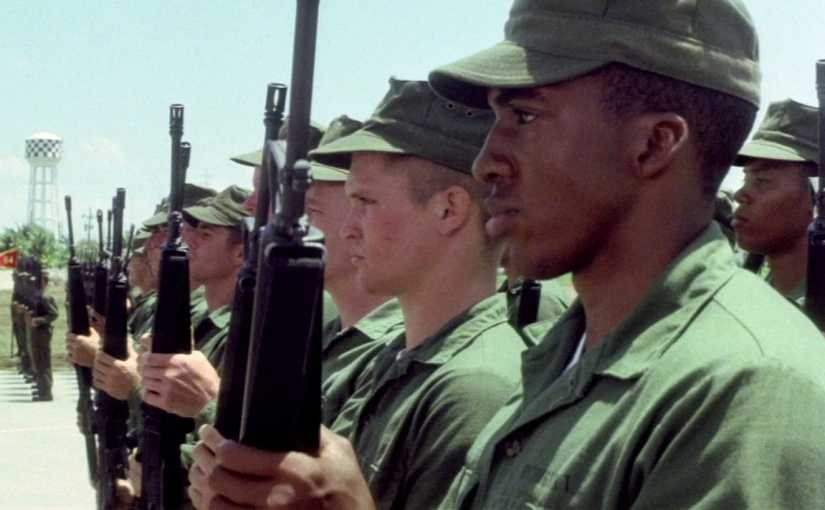
Like so many other war films that came after it, The Boys in Company C begins at boot camp.  More properly, it begins right outside the recruitment center (I think?) in late 1967, as several young men – boys, really – kiss their loved ones goodbye before getting on a bus.  In a weird way, this sequence reminded me of the opening scene in The Breakfast Club (1985) as each student is dropped off for detention by their parents (except for Bender, of course).  We are introduced to the boys who will become the key players: Washington, the angry black man (Stan Shaw); Pike, the country boy (Andrew Stevens); Foster, the aspiring writer (James Canning); Fazio, the Italian American from Brooklyn (Michael Lembeck); and Bisbee, the pacifist who is put on the bus in handcuffs (Craig Wasson).  Stereotypes?  Sure, I guess.  But the screenplay doesn’t limit them to JUST their stereotypes.  Washington, for example, starts out in camp as a guy who is looking out for himself, but after a surprisingly passionate speech from his drill instructor (R. Lee Ermey in his film debut!), he assumes the mantle of leadership and wears it exceedingly well.

We get the by-now standard scenes of the recruits getting their heads shaved, struggling through exhausting training runs, being called names that would’ve made George Carlin blush, and, eventually, graduation, where their reward for making it through boot camp is being assigned to combat duty in the ‘Nam.  Their problems begin even before they disembark from their troop carrier when the Vietnamese port comes under artillery fire.  It all sort of goes downhill from there.

The movie so far is nothing incredibly new, at least not to someone watching in the present day, but I had to keep reminding myself that this was probably the first time American audiences had seen a relatively honest representation of combat that wasn’t filtered through layers of self-censorship and jingoism.  M*A*S*H (1970) did show us the bloody reality of surgery in the field, but it didn’t concern itself too much with actual combat – plus it was set in Korea, not Vietnam.  A minor quibble.

There are a LOT of plot details I won’t relate here – the clueless captain, the “vital” convoy, Washington’s drug trafficking plans – because of the soccer subplot that reveals itself to be the film’s beating heart and real cry of protest.  Much like Kilgore and the California surfer in Apocalypse Now (1979), the squad captain learns that Pike, the country boy, is pretty good with a soccer ball.  There is a squad of elite Vietnamese military men who are also good at soccer.  The captain dreams up a plan: put together a soccer team of American soldiers who will play the Vietnamese men in an exhibition match.  If the American team wins, they will get a reprieve from combat and go on a “goodwill” tour of southeast Asia, including Tokyo and Bangkok.

Sounds good, right?  But complications arise when, at the match, the American general watching the match is approached by his opposite number in the Vietnamese army.  With the Americans leading at the half, the order is passed to the team: lose the match so the Vietnamese can save face in front of their own people.  If they throw the match, they will still get reprieved from combat to go play mare matches against Vietnamese teams…and lose every time.

The Americans can’t believe it.  Pike (and everyone else) wants to get back home, but he is afraid he can’t live with the shame of intentionally throwing a match, no matter what the big picture looks like.  But the orders contain no ambiguity.  Throw the match and go on tour, or win and go back to frontline combat the next day.

This is what the movie has been driving towards the whole time.  The squad has to collectively decide what is more important: winning or surviving.  I hope I don’t come off like an amateur historian here, but to me, that is the same question that could have been asked about the entire Vietnam conflict.  As a country, we had a chance to ask ourselves: is winning this war worth the price we’re paying?  How much more are we willing to spend, in money and lives?  In the film, the squad is asked to balance that equation themselves on a smaller, but no less important, scale.

Is this about honor?  Should they win the match to preserve their own personal integrity, even if it means going back to fighting in the jungle and maybe never making it back home?  Or should they throw the match, increasing their odds of making it home alive and boosting morale for their Vietnamese allies, but leaving them with a stain on their integrity?  Is this kind of thinking the reason the American government participated in possibly the most unpopular war in American history?  Because losing face was worse than losing lives?

These are questions I would not presume to think I could answer.  I know, of course, what I would have done in that situation, but I can only speculate because I have never been a soldier in a time of war.  The Boys in Company C put me right there and allowed me to understand the whys and wherefores of each major character in a way that we’ve seen in every notable war film ever since.  This is an incredibly important artifact in the history of war films, and it deserves to be seen by every movie fan.

[Trivia note: this movie was executive produced by none other than Raymond Chow, the man behind Enter the Dragon (1973) and nearly 200 other Hong Kong films, and virtually the entire movie, including the boot camp sequences, was filmed in the Philippines.]

NOVOCAINE (2025)

by Miguel E. Rodriguez

DIRECTORS: Dan Berk, Robert Olsen
CAST: Jack Quaid, Amber Midthunder, Ray Nicholson, Jacob Batalon
MY RATING: 9/10
ROTTEN TOMATOMETER: 82% Certified Fresh

PLOT: When the girl of his dreams is kidnapped, a man incapable of feeling physical pain turns his rare condition into an unexpected advantage in the fight to rescue her.


Just when I thought the John Wick franchise had shown me everything there was to see in terms of modern action films, along comes Novocaine.  If there are philosophical rumblings at the heart of the screenplay, I didn’t see them.  There is a brief scene where a character says probably the deepest line in the film, something along the lines of, “We all have something to hide.  Maybe we’re just looking for someone to show it to.”  Apart from that, though, this movie is a machine designed for one thing: thrill you and make you laugh and cringe all at the same time.  That’s three things, but you get the point.

Because this machine has only one purpose, any criticisms accusing it of not doing something it wasn’t designed for are moot.  You don’t eat a cheeseburger and then complain it didn’t taste like chateaubriand.  I got what the movie’s goals were after 10-15 minutes – or, actually, even after just watching the red-band trailers.  I went in with eyes wide open, and I was not disappointed.  My only real complaint is that those same trailers gave away a little too much of the very best fight scenes in the film, ruining two of the best gags (the deep fryer and the ball-and-chain).  But I forgive the trailer editors because the rest of the movie was so freaking entertaining.

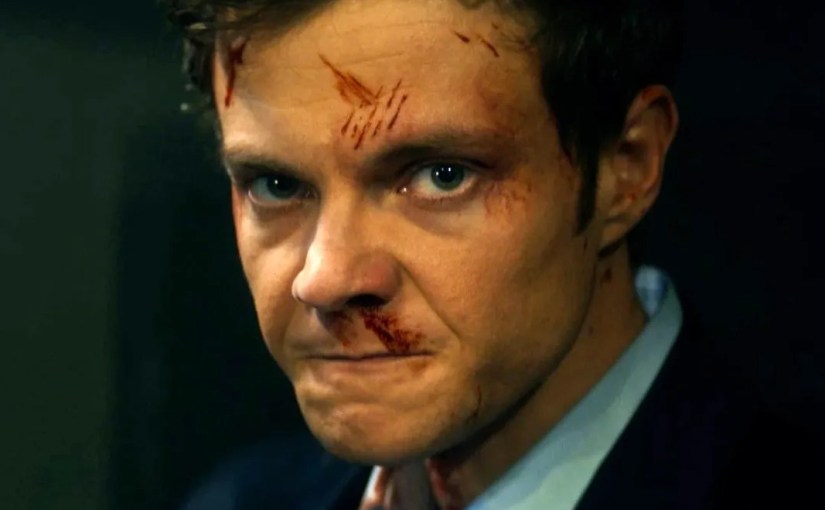
Nathan Caine (Jack Quaid, whose father’s famous smile will haunt his face for the rest of his life) is an assistant bank manager living with a very real genetic disorder called Congenital Insensitivity to Pain, or CIP.  He literally cannot feel pain, to the degree that he can’t even chew solid food because he could theoretically chew off bits of his tongue and not realize it.  His obligatory meet-cute with the love interest, Sherry (Amber Midthunder), involves him spilling scalding hot coffee on his hands, but of course he doesn’t feel a thing.  One thing leads to another, and they spend the night together.  Apparently, Nate can’t feel pain, but pleasure is another story.  (I thought that scene might include a homage to Marilyn Monroe and Tony Curtis’s love scene in Some Like It Hot [1959], but alas.)

Next day, as is revealed in the trailers, three robbers dressed as Santa Claus rob his bank, kill his boss, and take Sherry hostage.  On impulse, he takes off after them in a stolen police car, which of course leads authorities to believe he’s in on the case.  This also leads to the first of several jaw-dropping fight scenes, not because they’re insanely choreographed like a Jackie Chan movie, but because the physical violence shown on screen goes beyond anything I can remember seeing before in a fight scene.  Maybe Oldboy (2003) comes close.

Fair warning: if you are squeamish, this movie is simply not for you.  Just in the first fight scene alone, we see Nate get kicked, punched, seared by a scalding hot frying pan, and burned horrifically, which results in him wearing a bandage (and a disturbingly realistic prosthetic) on his hand for the rest of the movie.  The comedy comes from equal parts watching as Nate gets injured and simply powers through it, and from cringing and cursing and covering your face as those injuries occur.

I won’t give anything else away.  The movie does include an intriguing story development that I did not see coming.  My fellow Cinemaniac, Anthony, also made an interesting observation.  It was unusual to see a clearly comic film featuring so many actual deaths: multiple cops murdered after the bank robbery, a death inside the bank itself, and the body count keeps adding up as Nate gets closer and closer to rescuing Sherry.  Nate himself contributes (minimally) to the body count, but it’s mostly the bad guys killing anyone who gets in their way.  Is it possibly to balance almost slapstick physical comedy with so many, almost gratuitous deaths?

For myself, I didn’t think so.  I look at a movie like Tarantino’s Kill Bill: Vol. 1 (2003), with umpteen deaths, but it’s a movie that’s clearly having fun with the kung-fu genre, which requires lots of death.  Novocaine felt to me like a riff on the John Wick movies.  John Wick mows through LEGIONS of bad guys, getting punched and shot and sometimes falling from four-story buildings onto vans and just getting up, brushing himself off, and moving to the next fight scene.  Nathan Caine does the same thing, just not with legions of bad guys, but you’re constantly aware that he could be killed at any minute.  That kept the stakes raised, so I didn’t feel like I was watching a video game come to life.

Novocaine might be the most fun I’ve had at the movies in 2025 so far.  I laughed a lot, I CRINGED a lot (usually while I was laughing), and uttered more curse words at the screen than I have in a long time (usually “JEEEsus!” or “Oh SHIT”).  The story doesn’t quite reinvent the wheel, but the execution is superb.  Just to restate my warning from earlier: if you don’t like graphic onscreen violence, stay away.  Everyone else, enjoy!

3 WOMEN (1977)

by Miguel E. Rodriguez

DIRECTOR: Robert Altman
CAST: Shelley Duvall, Sissy Spacek, Janice Rule
MY RATING: 6/10
ROTTEN TOMATOMETER: 83% Certified Fresh

PLOT: Two roommates/physical therapists, one a vain woman and the other an awkward teenager, share an increasingly bizarre relationship.


Ever see the movie Big?  Tom Hanks, Elizabeth Perkins, Robert Loggia, directed by Penny Marshall?  YOU know.  Well, there’s a scene in Big, AFTER the hero boy has magically changed into Tom Hanks, and he’s now working as a toy-tester at a big toy company.  He’s invited to a focus group to give his feedback on a new toy that transforms from a robot into the Empire State Building.  The other suits are enthusiastic, but Hanks (because he’s a little boy at heart) is confused by it.  He raises his hand and tells the designers: “I don’t get it.”  They try to explain the demographics and the survey results, etc.  He nods, takes it in, and says, “I still don’t get it.”

That was me after watching 3 Women and reading about it a little.  I didn’t get it while I was watching it, and I still don’t get it after I learned more about it.

Robert Altman’s 3 Women is a dreamlike psychodrama that explores concepts of identity, self-discovery, and, I guess, femininity that reminded me, oddly enough, of the Burt Lancaster film The Swimmer (1968), mostly because a lot of it centers around water, but also because of the similar atmosphere created by both films: creepy and reluctant to give up its secrets.  There are numerous shots that are filtered through one of those store-bought wave machines that were so prevalent in the ‘70s and ‘80s, so the shot achieves a surreal effect that’s hard to describe.  It feels like foreshadowing, and in one respect it is, but for the most part it’s just there to either illustrate someone’s mental state or…I’m not sure what else.  I’ve had a day to think about this, and I’m no closer to interpreting exactly what those shots are supposed to mean.

Anyway.  We meet two women, Millie Lammoreaux (an impossibly young Shelley Duvall) and Pinky Rose (an even younger-looking Sissy Spacek).  We’ll get to the third woman later.  They both work at a physical therapy center, assisting elderly patients as they walk through a pool or sit in a hot tub – more water.  Millie is a wannabe sophisticate who is very friendly on the outside, but she doesn’t seem to have any actual friends.  Her co-workers and her neighbors at her hotel do their best to ignore her and her endless patter about articles in McCall’s and what she’s cooking for dinner tonight.  Pinky, whose real name is Mildred, is a young woman whose emotional maturity seems to have peaked around the age of fifteen.  She is immediately awestruck by Millie and contrives to be as close to her as possible at all times.  It’s essentially hero worship, though Millie hasn’t given her anything to really worship aside from being…herself.  They will eventually become roommates.

Millie is fond of yellow; Pinky dresses in, you guessed it, pink.  Millie will talk to just about anyone; Pinky is shy and introverted.  Millie has a large closet full of clothes; Pinky seems to own only one outfit, including underpants.  They are as opposite as it’s possible to be.  These points are drummed home in scene after scene.  The two women frequent a themed saloon called Dodge City, where we will eventually meet the third woman, Willie Hart (Janice Rule).  Willie, who is pregnant, communicates with glares.  She also paints these amazing, disturbing murals featuring what appear to be harpies or something like the mythological Furies.

I could go on with the story, but why bother?  This is not a movie about a story.  This is a movie about conveying a mood.  Altman literally conceived of this movie in a dream, pitched it to 20th Century Fox almost on a whim, and insisted on shooting without a finished script.  The pervasive mood of the film is one of suspense and foreboding.  There are a pair of twins who lurk in the background of scenes of Millie and Pinky at work.  Foreboding.  The musical score is atonal and creepy.  Foreboding.  Pinky starts to read Millie’s diary.  Foreboding.  You may have noticed that the last part Millie’s last name, Lammoreaux, is phonetically similar to Pinky’s last name, Rose.  Foreboding.

So, okay, Altman’s movie is about creating a mood.  To that degree, he succeeded.  It’s nothing if not creepy.  Events occur that were surprising.  Mystery abounds.  But…there came a point about halfway where it all became repetitive to me.  How many scenes of Millie being snubbed socially do we need to get the idea that Millie is not popular?  How many times do we need those shots that are filtered through the wave machine?  How many lingering panning shots do we need of those murals?  I’m just saying.  I got the point after five each.  Call me crazy.

And when we get to the final sequence…man, if I wasn’t confused before, I was completely at sea when the credits rolled.  I’ve seen some open-ended movies before, some I loved (Mulholland Drive, 2001), some not so much (The Lobster, 2015).  When it’s done right, I find it exhilarating to see a film that trusts a viewer’s intelligence so much that it doesn’t spoon-feed you.  But 3 Women gave me an ending that is so open to interpretation that it backfired.  Because it could mean so many different things, it ultimately meant nothing and left me feeling a little cheated.

I get it.  This is not that kind of movie, by Altman’s own admission.  Fair enough.  I give it 6 out of 10 based purely on the craftsmanship and sheer chutzpah of the film, and because the performances by Duvall and Spacek are worth the price of admission.  (And I just wanna say, Duvall may have won Best Actress at Cannes, but my vote would have gone to Spacek, who is utterly convincing as a woman-child in a state of arrested development.)

But I cannot really call this movie “entertaining.”  I don’t mean in the sense that I didn’t laugh or cry or whatever.  I just mean that watching it felt like a homework assignment, not an escape.  I never connected to it emotionally, so I ultimately didn’t care what was happening, or why.  I have enjoyed so many of Altman’s other films, but this one might have just become my least favorite Altman film that I’ve seen, finally replacing [name redacted so I don’t get doxxed].

M*A*S*H

By Marc S. Sanders

Forgive me.  I’m not sure my position on Robert Altman’s film will be fair.  All my life, I think I deliberately eluded seeing the motion picture of M*A*S*H as I have been so accustomed to the classic television show that ran for eleven seasons on CBS.  As I expected the two properties couldn’t be further apart from one another.

Altman’s movie still carries a zippy kind of perspective to the horrors of war.  With their hands and surgical scrubs in the thick of gory, blood red surgery, the characters are so much more apathetic to the turnaround of wounded that arrive at the 4077th American mobile army hospital, located three miles from the explosive front lines of the bloody Korean War.  The well-known characters were first given live action roles here following the published novel by Richard Hooker.  

Most surprising is near the end of the film when two doctors realize they are being sent home. One surgeon who is in the midst of operating on a head injury actually instructs a colleague to take over.  This guy has his hands covered in brains and blood and chooses not to finish saving his patient’s life.  Alan Alda of the television show, as a writer, director or while portraying Hawkeye Pierce, would never respond in such a manner. Yet, this is the approach that Robert Altman chose to follow, having infamously always despised the TV series that eclipsed his film in popularity.

Altman’s movie is a slap in the face to the famed oxymoron called “military intelligence.” In 1970, we say bravo for finally saying something frank and honest while a Vietnam War has carried on far too long for not necessarily any of the right reasons.  It’s not so simple to declare war is hell.  It’s much more complicated and horrifying than that.

The film’s opening bylines are quotes by celebrated military leaders of the time, like MacArthur and Eisenhower.  However, these championed commanders are lampooned as we watch shlubby Hawkeye Pierce (Donald Sutherland) arriving in Korea.  He heads directly towards a General’s jeep and steals it, plain as day.  From there on, M*A*S*H operates like a precursor to Animal House with a series of hijinks and a lack of care for military leadership or the U.S.’s purpose in this conflict.  

About the only time, there is any care or forthright anger from anyone is when the jerky Major Frank Burns (Robert Duvall) chastises an underling.  Trapper (Elliot Gould) and Hawkeye punch his lights out and the schmuck ends up in a straightjacket.  Nonetheless, these guys could care less about criticizing and exposing the truth about the institution they have been drafted to serve.  Their purpose is not to make an ironic statement like a Doonesbury comic strip.  They just punch the commanding officer in the face and drink.  The TV show was at its strongest when it relied on the wit and delivery.  Trapper and Hawkeye never use irony or intelligence to belittle a buffoon.  They punch, or they embarrass an authority who’s taking a shower. Regretfully, it’s the dialogue that’s lacking. Robert Altman encouraged much improv on the set and overlayered conversations within his scenes. He found nothing organized or neat and pretty about war, including daily functioning. Chaos did not only reign on a battlefield.

The pace of M*A*S*H moves episodically, and it is likely what led to the idea of a half hour TV show that dominated the airwaves for the better part of eleven years.  A character called Painless contemplates suicide and so a Last Supper reenactment before he sends himself off is inserted. It’s a funny caption from these halfwits, but a storyline focused on deliberately ending a life does not connect with me in a humorous way here. Burt Reynolds, the dark comedy Heathers, and even more recently Tom Hanks toed the line of humor to be found in death by suicide. I think it worked better in those examples. With the somber, well known theme song of “Suicide Is Painless” that is forever linked with M*A*S*H, I just could not muster the laughs for this bit.

There’s also time to build comedy against another regular army brat like Major “Hot Lips” Houlihan (Sally Kellerman, also the best and most memorable of the cast).  The iterations of shower hijinks has been duplicated so often since the release of this picture. Therefore, this gag is dried up. It does not hold its impact fifty years later after dozens Porky’s movies. As well, there’s golfing off the helicopter pad, heavy drinking and a long, drawn-out final act of an overstayed football competition which leads to one of the first times the F-word was used in a mainstream American film.  

In 1970, Robert Altman delivered a bold, risky and daring film to counteract against a losing Vietnam War and the heroism of John Wayne’s bravado in war pictures.  The chutzpah to lash out against American politics likely felt relatable to many who saw different and more realistic images when they understood their young sons and daughters were not coming home and were thus forever changed.  Richard Hooker’s properties and stories lent an understanding to the animosity of those who forced the war on America’s children and loved ones.  War has never been consistent with the short film propaganda asking you to buy war bonds. M*A*S*H negated the heroism of Hollywood sensationalism found in machine gun fare and overtaking a hill while draped in green fatigues with shiny bronze ammunition hanging off their shoulders. These soldiers of war deserve our country’s utmost respect, but they did so much more than what John Wayne demonstrated. They offered up parts of themselves they would never get back.

M*A*S*H deliberately left out the heroes.  However, seeing the film for the first time, over fifty years later, I wish that at least we could follow the escapades of doctors who also directed a bed side manner to the pawns who were dying while upholding their leaders’ cause.  The doctors of Robert Altman’s interpretation hardly emulate a reason to care. 

The film interpretation of M*A*S*H is outdated of its time of release and the period in which it takes place.  I like to think we live more humanely than not just how our military leaders functioned.  I wished these physicians used their scalpels with a much less obtuse absence of empathy.  Hate the puppet masters, yes. Yet would it kill these guys to still care about the puppets? 

TWILIGHT’S LAST GLEAMING (1977)

by Miguel E. Rodriguez

DIRECTOR: Robert Aldrich
CAST: Burt Lancaster, Charles Durning, Richard Widmark, Paul Winfield, Burt Young, Melvyn Douglas, Joseph Cotten, Richard Jaeckel, John Ratzenberger
MY RATING: 7/10
ROTTEN TOMATOMETER: 80% Fresh

PLOT: A renegade USAF general takes over an ICBM silo and threatens to provoke World War III unless the President reveals details of a secret meeting held just after the start of the Vietnam War.


Twilight’s Last Gleaming, one of Robert Aldrich’s last films, is a cleverly constructed Cold War thriller whose pointed message about the Vietnam War nearly torpedoes the suspense.  The political message is hammered home in a scene that goes on for a bit too long with people speaking dialogue that feels hammy and trite.  But the movie surrounding this one scene is good enough that I would still recommend it to anyone in the market for something off the beaten track.

The movie is set in 1981, four years after it was released, so no one could draw any real-life parallels between the characters and people in real life.  In an opening sequence that feels reminiscent of Die Hard (1988), General Lawrence Dell (Burt Lancaster) and his team of military ex-cons manage to infiltrate and take command of a US ICBM missile silo in Montana.  While I highly doubt it would be as easy as portrayed in the film, Aldrich films the sequence so that I got caught up in the suspense of the narrative instead of worrying about pesky details.  (If there’s a drawback to these and other sequences featuring military hardware and installations, it’s the overall low-budget feel to the sets and props; everything looks like it was shot on a TV soundstage instead of a big-budget film set.)

Once inside, Dell makes his demands: $20 million for each of his remaining team (Burt Young and Paul Winfield), the President must read the transcript of a secret meeting held just after the Vietnam war started, and the President must hand himself over as a hostage to secure their escape.  Otherwise, he’ll launch nine Titan ICBMs at their targets.

This creates a little tension among the would-be terrorists.  Winfield and Young couldn’t care less about the secret meeting, but Dell is adamant.  Meanwhile, General MacKenzie (Richard Widmark) formulates a plan to eliminate Dell and his crew using a “tiny” nuclear device, the President (Charles Durning) agonizes over the secret transcript, and his best friend and aide uses some “tough love” to get him to make a decision.

Despite the fakeness of the surroundings, I was absorbed by the thriller elements in Twilight’s Last Gleaming.  I would compare them to the best parts of WarGames (1983) and The China Syndrome (1979).  There is some impressively impenetrable technobabble about booby traps and inhibitor cables and fail-safe systems that I just rolled with.  The plan involving that “tiny” nuclear device leads up to a sequence that I would compare favorably with any contemporary thriller you can name.

One of the ways Aldrich achieves this effect is through the use of split-screens…LOTS of split-screens.  It starts at the beginning of the film with two screens.  Then there are moments with three split screens, two on top and one in the bottom section.  Then, during the most intense sequence of the film, we get four splits in each corner of the screen.  At first, I found it disorienting, but it absolutely works when it most needs to.  (I’m trying not to give away too many plot details, so excuse the vagueness.)  I don’t know that I would want to watch an entire movie like this (Timecode, 2000), but in small doses, it’s very effective.

Where the movie bogs down is the middle section of the film when the President expresses his disapproval of the contents of the secret transcript Dell wants publicized.  It’s a bit theatrical to believe a sitting American President would be this vocal about his feelings in the middle of a dire crisis.  I think the scene would have played just as well if we had gotten a general idea of the transcript, or even if the contents had NEVER been revealed to the audience.  It would have been a perfect Macguffin, leaving viewers free to imagine anything they want.  The truth about Kennedy’s assassination?  Area 51?  Pearl Harbor was an inside job?  The Super Bowl really IS fixed?  Who knows?

Instead, the President insists on reading a portion of it out loud to his Cabinet members, enlisting them to read certain lines.  While I admire Aldrich’s intent (to send a cinematic protest to the architects of the Vietnam war), the scene nearly brought the movie to a stop, which is deadly when dealing with a suspense thriller.

But, like I said, the rest of the movie is so good, I am compelled to let it slide.  Later, we get surprise attacks, snipers, helicopters, a crafty fake-out involving torture, and an ending that is as cynical as they come, but which felt like the best way out of the situation for everyone involved…except for the American people, but that’s another story.  Twilight’s Last Gleaming feels virtually forgotten, and that’s a shame.  Aldrich directs this movie with a lot of passion for the material and milks every ounce of suspense he can with the tools at hand.  If you’re prepared to overlook that middle section, you’ll get a kick out of this movie.

P.S. Look fast for an unexpected appearance by William Hootkins, aka “Porkins” from Star Wars (1977).