
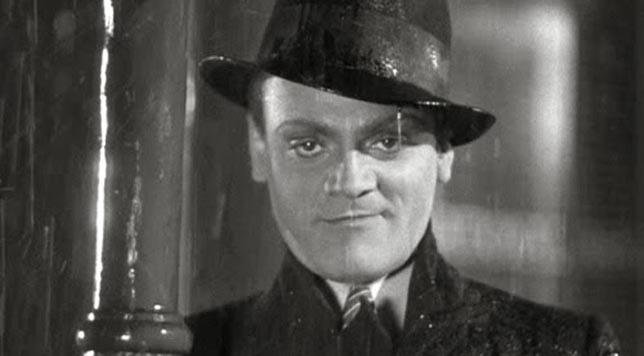
by Miguel E. Rodriguez
DIRECTOR: Willam A. Wellman
CAST: James Cagney, Jean Harlow, Edward Woods, Joan Blondell
MY RATING: 10/10
ROTTEN TOMATOMETER: 100% Fresh
PLOT: An Irish-American street punk tries to make it big in organized crime during Prohibition.
Having just finished watching Little Caesar (1931) a few days ago, I popped in The Public Enemy, expecting more of the same, if I’m being honest: a fledgling gangster picture, rough around the edges, not spectacular, but historically important. I could not have been more wrong. Where Little Caesar at times seemed to be going through the motions, The Public Enemy crackles and sizzles and pops off the screen, still capable of shocking and surprising me nearly a century after it was released. If that’s not the definition of a masterpiece, well, it damn sure oughta be.
James Cagney gives one of his most indelible performances as Tom Powers, a kid who grew up tough with his best friend, Matt Doyle. We meet them first as kids in 1909, raising a little hell, teasing Matt’s sister, disdaining Tom’s goody-two-shoes older brother Mike, and learning to treat the law and police officers as a necessary evil. They supplement their income by stealing watches and giving them to a small-time hood, Putty Nose, who gives them a pittance and treats them like Fagin treated Oliver Twist. Six years later, they’ve grown into young men (Matt is played as an adult by Edward Woods) who are still in league with Putty Nose, but when a planned theft goes awry, Putty leaves Tom and Matt dangling and wishing only for revenge.
(I enjoyed this back-story approach, as opposed to Little Caesar, which by comparison feels like it plunks us into the middle of a story already in progress and wastes no time waiting for us to catch up. I know I probably shouldn’t critique a movie by comparing it to another, but I can’t stop myself, sue me.)
It’s during this botched robbery that we get the first glimpses that this movie will pull no punches when it comes to violence, or at least as much as it could in 1931. A fleeing accomplice is shot at least twice in the back by a patrolman. He chases Tom and Matt into a dark alley. We see gunshots flare in the darkness with no clear idea of what’s happening. Tom and Matt reappear, toss their guns away, and run off…and in a poignant button to the scene, we see a close up of the patrolman’s gun hand lying lifeless under a streetlamp. We see nothing graphic, but we know exactly what’s happened. The Public Enemy will use this device many times throughout the picture, to great effect.
Time passes. Tom’s older brother, Mike, enlists in the Marines for World War I. No love is lost between the two of them when Mike learns of Tom’s criminal activities. When Prohibition is enacted, Tom and Matt get even more involved in those activities, working for a sharply dressed mobster, “Nails” Nathan. They start making more money, buying fancy new cars and clothes. (One of the funnier scenes occurs when Tom is getting fitted for a custom suit by a tailor who is so far in the closet he’s finding Christmas presents from 1889.) They meet a couple of molls, which leads to the famous “grapefruit” scene that had women’s groups up in arms…maybe it still does, I couldn’t say. And they get better at their jobs, in deeper with the mob, and suddenly…
But I’m summarizing again. That’s how this movie has gotten to me. I am so enthused about it that I want to shake people by the collar and say, “If you love gangster movies, don’t make the same mistake I did by not seeing The Public Enemy until I was [age deleted]! It’s sensational! Here, let me tell you about it…”
Director William A. Wellman (The Ox-Bow Incident, 1942) displays a directorial style that, to my untrained eye, transcends the era in which he was working. Made in 1931, it feels like it was made ten or fifteen years later, in the vein of the best films of Wilder or Hawks. Martin Scorsese even calls it “the birth of modern movie acting,” and it’s hard to argue with him when you’re watching Cagney command every single second he’s onscreen, whether he’s whispering sweet nothings into a girl’s ear or playfully chucking his mom on the chin or contemplating gruesome violence as his face twists into an evil grin.
I feel it necessary to mention once more the shocking violent acts perpetrated during the film. Again, we rarely actually see the violent acts themselves (like the infamous ear scene in Reservoir Dogs [1992]), but that just makes them land even harder. The camera either tracks off the impending scene or stays behind while gunmen march into another room, leaving us to hear the violence instead of seeing it. It’s practically Hitchcockian, and it’s perfectly executed. This method makes the film feel even MORE modern. Re-shoot this movie, shot for shot, line for line, with all of the tools available to the modern filmmaker, and it would still work, even in a world where Goodfellas and The Untouchables exist.
So, run, don’t walk, to either your friendly local streaming service or to your favorite online retailer and buy or stream The Public Enemy today. And don’t thank me. Just promise to tell YOUR friends how awesome it is. Because it really, really is.
 2 UNPAID MOVIE CRITICS!!!!