
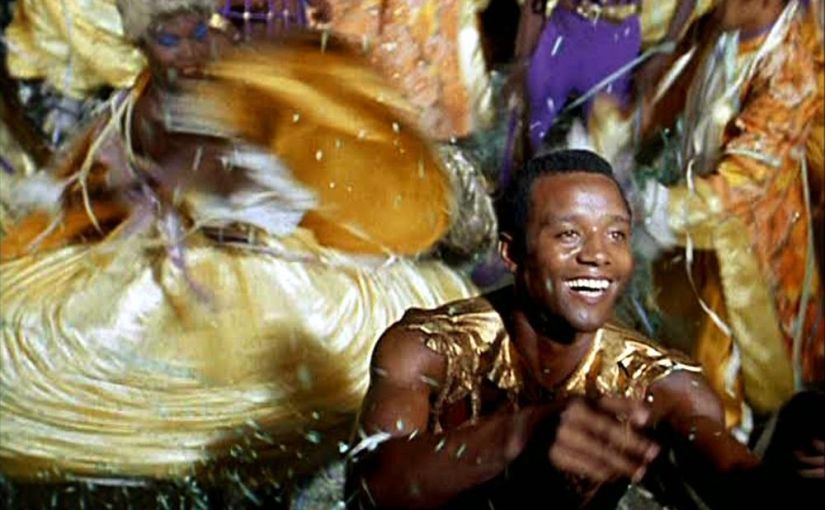
by Miguel E. Rodriguez
DIRECTOR: Marcel Camus
CAST: Breno Mello, Marpessa Dawn, Lourdes de Oliveira
MY RATING: 8/10
ROTTEN TOMATOMETER: 88% Certified Fresh
PLOT: The Greek myth of Orpheus and Euridice is translated into a modern-day story (with an all-black cast) set in during Carnaval in Rio de Janeiro.
In the first two-thirds of Black Orpheus, there are scarcely more than 2 minutes strung together at a time without some kind of music or sound effects thumping away in the background. This gives the film a subtle real-world backdrop, which is good, because Black Orpheus is a fantasy through and through. Critics, now and at the time of its release, complained that French director Marcel Camus ignored the reality of the Brazilian favelas, or slums, in favor of depicting Rio as a non-stop party. This is a valid point. However, I believe that, in this movie, reality has no place. This is a love story, a myth, a tragedy, and a travelogue all rolled into one. Reality must take a back seat in movies like this.
(And, heck, somebody must have liked it because it won both the Palme d’Or at Cannes AND the Best Foreign Film Oscar that year, a rare feat. True, there were extenuating circumstances [numerous French critics had problems with the emerging French New Wave], but let’s not turn this into a classroom, shall we?)
If you’re familiar with Greek mythology, then the plot of Black Orpheus is nothing new. Orfeu (Breno Mello, a non-professional actor) is a streetcar conductor engaged to the sexy, vivacious Mira, but he is not exactly thrilled about it. Meanwhile, Eurydice (Marpessa Dawn, who actually hailed from Pittsburgh, not Brazil) gets lost in the city on the way to visit her cousin, Serafina, who lives in a ramshackle favela neighborhood. She asks Orfeu and his boss, Hermes, for directions, and for Orfeu it’s love at first sight. The rest of the movie will involve Orfeu wooing Eurydice, who worries about a strange man who might be following her, while trying to ditch Mira, with Serafina’s help. Also assisting Orfeu, while acting as a Greek chorus in miniature, are two street urchins, Benedito and Zeca, who envy Orfeu’s lovely guitar playing, which Orfeu claims is what makes the sun rise every morning.
Apart from the story itself, the things I noticed at the outset were the presence of riotous colors in the costumes and the Brazilian countryside, and the music. Lots and LOTS of music, but not a great deal of songs. Black Orpheus is billed as a musical, but I’d have to say it’s a quasi-musical. In a standard musical, characters break out into song, and no one notices because otherwise we’d be watching a play. In Black Orpheus, every song is diegetic…someone asks Orfeu to play a song on his guitar, for example, or the Carnaval participants sing a rousing song while on parade or at a huge dance. And I want to mention again that, while Orfeu is singing a quiet song to Eurydice, the constant percussion of the Carnaval pulses behind it, completely at odds with his song. You would think it would become a cacophony, but it doesn’t. It makes his quiet song much quieter, which may sound counterintuitive, but it works.
The mythic tone of the story keeps the film from flying off into ridiculous territory amid all the revelry. Without mythology, Black Orpheus would be a soap opera. A pivotal scene occurs during a massive dance contest, as Eurydice has disguised herself as her cousin, Serafina, so Mira doesn’t recognize her. But Mira sees through the disguise and threatens to kill Eurydice. Mira chases her, and unseen by anyone else except Eurydice, a man dressed all in black wearing a skull mask follows them both. This is Death. Earlier he had nearly chased Eurydice off a cliff, but Orfeu had saved her. “I am not in a hurry,” he said, “we shall meet soon.” With that in mind, his presence during this second chase is tinged with suspense. It’s a very Hitchcockian element, the threat of danger juxtaposed with a dance or a party. Good stuff.
So, it’s fair to say I enjoyed this movie a little more than I expected to. But the bonus features on the Blu-ray brought up an interesting point. Detractors of the film pointed out that, despite taking place mostly in a slum, the actual reality of those slums (both then and now) is anything but festive, no matter how much bossa nova music you play or how many songs you sing. It’s highly unlikely these people would have had the wherewithal to create such stylized, colorful costumes while having to deal with the reality of poverty, all while looking down the mountainside at the distant concrete high rises of the higher classes.
Does Black Orpheus ignore reality? Well…yes, it does. Myths, by definition, have little to do with reality in the first place. Would it have been possible to tell this mythical story, retaining its coincidences and absurdities and supernatural elements [especially towards the end], while also keeping its feet firmly on the ground and making a socially conscious statement about the horrible living conditions in Brazil?
I don’t think so. Or, if you did, it wouldn’t be held together very well. Black Orpheus is simply re-telling a very, VERY old story and re-imagining it as if the Greek gods had lived atop Sugarloaf Mountain instead of Olympus. When you start with that kind of premise, reality goes out the window. You have to focus on the story’s emotional beats, the pleasant assault on the senses and, occasionally, logic.
This opens a whole separate argument: is it a film’s responsibility to BE authentic, or just to FEEL authentic? For example, Titanic [1997] feels authentic to me, a layman, but I’m sure historians and other experts could point to any number of things that were simply not true in the film. Fair enough, but that doesn’t affect my enjoyment of the film as it was presented to me. It FELT authentic, and that’s enough for me. The only way to make a movie like that 100% authentic would be to turn it into a documentary.
Black Orpheus FEELS emotionally authentic to me, a layman, who is not a social anthropologist. I look at the colors and vibrancy on display, visually and in the story itself, and while a small part of me acknowledges, “This isn’t real life”, another part of me says, “Well, if I wanted real life, I wouldn’t be watching a movie, would I?”
 2 UNPAID MOVIE CRITICS!!!!