
by Miguel E. Rodriguez
DIRECTOR: Richard Brooks
CAST: Burt Lancaster, Jean Simmons, Arthur Kennedy, Shirley Jones
MY RATING: 9/10
ROTTEN TOMATOMETER: 94% Fresh
PLOT: A fast-talking traveling salesman convinces a sincere evangelist that he can be an effective preacher for her cause.
Elmer Gantry pulls a double, then a triple-fake. It’s a good thing they stopped at three because you can only subvert an audience’s expectations so many times before they hold it against you. It starts as a tired (but well-executed) formula, then it turns that formula on its head, and then, just when you think you’ve gotten a stereotypical Hollywood ending, it pulls one more rabbit out of the hat. In a way, it reminded of The Blue Angel (1930) in the way it presents a clearly hypocritical man to the audience, warts and all, and gets us to feel a little sympathy for him at the end, despite his wicked ways.
The film is also the most intelligent film I’ve seen about religion and Christianity since Robert Duvall’s The Apostle (1998). It contains the best scene/exchange on the topic I’ve ever seen, between a fire-and-brimstone preacher and a non-believing newspaper reporter. Both sides score points, but in the end, neither one wins, which I believe is just as it should be. But I’m getting ahead of myself.
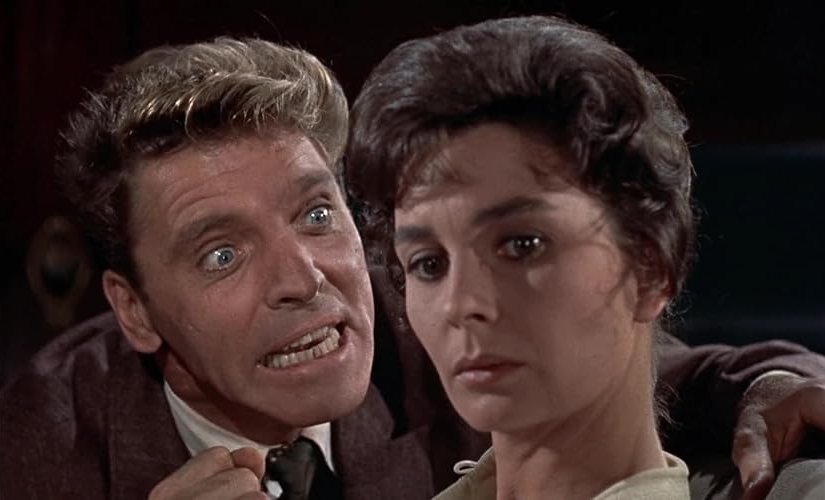
We first meet Elmer Gantry (Burt Lancaster) as he’s telling a dirty joke to some prospective clients in a bar, sometime during the Prohibition era. The impression he gives right away is that of a huckster, a fast-talking, fast-thinking heel who’ll do whatever it takes to make a sale. His conversation is interrupted by two nuns soliciting donations. As a lark, he grabs their collection plate and exhorts the bar patrons to give all they can. He’s pulling a cynical prank, but his words are surprisingly effective. And no wonder: we later learn he was expelled from a theological seminary some years ago. He knows the words, but not the music, but that’s enough for folks to turn out their pockets for him. No one is more surprised by this outcome than Elmer himself.
Later, after visiting a Negro church service and hoboing around on a train, he visits a traveling revival led by Sister Sharon Falconer (Jean Simmons). He is immediately smitten by her beauty – because, hello, it’s Jean Simmons – and realizes the only way to get to her is through her vocation. With some of his trademark fast-talking, he flirts with one of Sister Sharon’s followers and uses what he learns to get closer to Sharon. He agrees to deliver a mini-sermon at one of her very well-attended revival services to prove his good intentions, but something unexpected happens: the crowd responds to his words as if he were a bona-fide preacher. Soon he’s touring with Sister Sharon from town to town as crowds get larger and larger.
Meanwhile, we get to see the inner workings of the business side of this religious venture. We watch as various preachers and pastors debate the merits of inviting Sister Sharon and Gantry to a “big” city, Zenith. (I learn from Wikipedia this city name is fictional, created by the author of the book on which the film is based…didn’t know that.) Committee members are uncertain whether Sharon’s and Gantry’s message will increase church rolls in a metropolitan area as opposed to their previous, more rural locales. I loved this scene because it feels authentic. Whether it’s realistic or not is not for me to say. But I can easily imagine well-intentioned religious leaders (and maybe some NOT so well-intentioned) sitting around and discussing, not just the spiritual expectations of such a revival, but also the FINANCIAL expectations, as these men do in the film.
Elmer Gantry is filled with scenes and dialogue that held my attention for the film’s duration. Growing up as I did in a Christian church environment and graduating from a Christian college, I recognized virtually all of Elmer’s tactics, as well as Sister Sharon’s tactics, in using exactly the right words, gestures, and tone to play a congregation like a fiddle. The difference is, Sister Sharon genuinely believes she’s been touched or called by God to this vocation, while Gantry is expertly going through the motions as a means to an end.
(On a personal note, I should mention that Burt Lancaster’s mannerisms and speech patterns as Elmer Gantry strongly reminded me of the pastor of the Southern Baptist church I attended for many years, from his physical appearance to his, pardon the expression, shit-eating grin. But that’s another story…)
There is one scene that I must specifically mention and dissect. A Zenith newspaper reporter, Jim Lefferts (Arthur Kennedy), writes an article in which he expresses his skepticism of Gantry’s and Sister Sharon’s motives, as well as of revivals in general. He writes:
“What qualifies someone to be a revivalist? Nothing. Nothing at all. There is not one law in any state in the Union protecting the public from the hysterical onslaught of revivalists. But the law does permit them to invest in tax-free property, and collect money, without accounting for how it is used. What do you get for your money? Can you get into heaven by contributing one buck or 50? Can you get life eternal by shaking hands for Jesus with Elmer Gantry?”
(The Lefferts character is asking questions in this article that are as relevant now as they were in 1960, or 1920, or even going back to ancient times when Jesus whipped the moneylenders from the church. To put it another way, as one dissenting church elder says in the film, “Religion is not a business. And revivalism is not religion.”)
Sister Sharon and Gantry show up at the newspaper office to officially protest the article to Lefferts and his editor. Sharon objects to the article’s implications about misusing collection money. Lefferts calmly asks if Sister Sharon is ordained. She is not, in fact, sanctioned to preach by any church body. She points out that neither was Peter or Paul or any of the apostles. Lefferts retorts:
“Ah, but they said that they lived with the Son of God, were taught by Him, were sanctified by Him. What gives you the right to speak for God? …How did you get His approval? Did God speak to you personally? Did He send you a letter? Did you have a visitation from God? A burning bush, perhaps? Where in the New Testament does it say that God spoke to anyone except His Son?”
Then Lefferts quotes First Corinthians to show how the Bible says it’s shameful for women to speak aloud in church. I’m watching that scene, and I’m going, BOOM, game, set, and match to Lefferts. I remember asking these very same questions when I was younger and having normal doubts about the way church was structured. Not about women speaking in church, I knew that was archaic and outdated, but I would always hear preachers and evangelists say, “God spoke to me.” And I wanted to ask, “Well, what did His voice sound like? Did He have an accent? Did He speak English?” But we weren’t SUPPOSED to ask those kinds of questions, we just had to take their word for it because, after all, they’re up there in the pulpit, and I’m down in the pews just listening.
But here’s where Elmer Gantry shows its colors as a film that may SEEM like it’s taking sides, but it really isn’t. Lefferts finishes his takedown of Sister Sharon, but Elmer has a trick up his sleeve. He turns Lefferts’s argument against itself by asking why he quoted the Bible if he doesn’t really believe the Bible is factual. If Lefferts doesn’t believe in the six days of Creation or in the miracle of the loaves and fishes, then how can he use the scripture against Sister Sharon? It’s a rather brilliant argument that almost feels lifted from Inherit the Wind (released the same year as Elmer Gantry.)
My admiration of this scene stems from the fact that both sides make excellent points, and the scene ends in a kind of stalemate where Lefferts won’t retract the article, but the newspaper offers to run a response to the article. (Naturally, Gantry wheedles it up to a series of radio broadcasts instead.) It would be tempting in a movie that is predominantly anti-religion to portray religious proponents as Bible-thumping, spittle-spraying zealots without a brain in their heads. While Elmer certainly takes cues from that behavioral playbook, he is clearly not a moron, and that is refreshing.
Those who have seen the film before may note that I haven’t even touched on the one Oscar-winning performance from the film. Shirley Jones plays a prostitute named Lulu Baines, and she has the film’s most unforgettable line as she recounts how a young man once took advantage of her behind a church pulpit one Christmas Eve: “He rammed the fear of God into me so fast I never heard my old man’s footsteps!” What part she has to play in Elmer’s story, I will not reveal, just in case anyone’s reading this who’s never seen the movie. She reveals unexpected depths and makes unexpected choices in the last couple of reels that seal both Elmer’s and Sister Sharon’s fates.
Whew! This was another long one. Elmer Gantry by its very nature engenders discussion and debate. There’s even an opening title crawl advising patrons that, while the filmmakers believe that “certain aspects of Revivalism” demand further scrutiny, everyone is free to worship as they please, and patrons should prevent impressionable children from watching the movie. Perhaps they were afraid children would believe that all religions and evangelists proceed from secular motives, which would lead to all kinds of uncomfortable conversations with their parents, churchgoing or otherwise. In my opinion, those kinds of conversations can only benefit both the children and the parents. I believe Elmer Gantry is one of the finest treatments of religious beliefs and activities I’ve ever seen, specifically because, by the time we get to the end credits, I’m still not 100% sure whose side the movie is on. I think it’s up to us to look at the movie as a whole and make our own decisions.
 2 UNPAID MOVIE CRITICS!!!!
I just watched it a couple days ago. It’s been 50 years since I read the novel and don’t remember it, but I understand that the movie stops halfway through the novel. I didn’t care for what happened to Sister Sharon and her tabernacle — it seemed cliched to me — but maybe it was that way in the novel.
LikeLiked by 1 person
I’ve never read the novel, either, but I get why that ending feels a little cliched. However, for my part, the story point, cliched or not, was still a surprise, something I would never have guessed, especially after we got what was almost a neat-and-tidy ending just previously.
LikeLike
I love this film. It was a passion project for writer-director Richard Brooks, who had known Sinclair Lewis and had the author’s blessing for making major changes. The most important of these was making Sister Sharon a loving and sincere evangelist. Lewis’s character had been based on the notorious, half-crazed Aimee Semple McPherson. The film, as you say, is more balanced than the novel. Its crux is Gantry’s seduction of Sharon underneath the Tabernacle. She does yield to his humanity, in all its fleshy fervor, and it seems as if her doom is sealed from that point on.
Kudos to John Alton’s photography, capturing a real feeling for rural America as well as expressionistic fervor in the seduction and fire. And to Andre Previn’s vigorous score, reflecting both Gantry’s vigor and his romantic feeling.
LikeLiked by 1 person
Great info, thanks for reading!
Regarding the score, having never seen the film, when I heard the first couple minutes over the opening credits, I thought for a second it was Leonard Bernstein, and I was like, “How did I never know he did this movie??” Then I saw Andre Previn’s name, and I was even more impressed. Good stuff.
LikeLike