
By Marc S. Sanders
The first film to ever win the Oscar for Best Picture actually didn’t win Best Picture. The category was called Best Production in 1927. A year later the title was changed. Wings was the film in question, directed by actual World War I flying ace William A Wellman, only ten years after the worldwide conflict had ended.
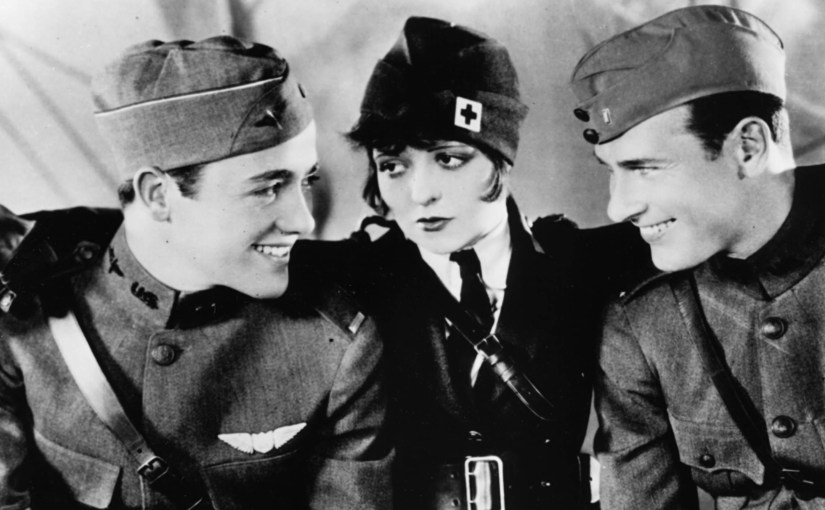
To watch this two-and-a-half-hour silent movie is an exhilarating experience. The story focuses on two young men, Jack Powell and David Armstrong (Charles “Buddy” Rogers, William Arlen), who both pine for the affections of a local girl named Sylvia (Jobyna Rolston). Their competition is put on hold as they enlist to train and serve as fighter pilots in biplanes against the German opposition. A side relationship focuses on Mary (the adoring Clara Bow), and her affections for Jack who has no interest in her.
Wellman’s film takes you through the regimen of enlistment with the calisthenics the men practice, through mentorship and then on to piloting the planes. Jack and David set aside their differences to unite against the common enemy where they routinely say just before take-off “All set?” followed by “Okay!” Reader, in a silent film with only a few frequent dialogue cards, this relationship was as effective as witnessing Maverick & Goose or Han & Luke. (“I feel the need, the need for speed.” “Okay Chewie, punch it!”)
William Wellman captures outstanding dog fight footage and enormously vast battle scenes that look even more detailed than what I found in the graphically convincing 1917 from just a few years ago.
Paramount Pictures invested in a 2012 restoration following the discovery of this film in a basement in France. I believe the restoration incorporated orange flames and sparks into the planes that get shot down, as well as from the cannons that fire from the pilots’ cockpits. Yet, unlike CGI or quick edits, Wellman holds his camera in the skies above, often following the spiral trajectories of the downed planes with numerous ground crashes. His camera is also teetered on the hull to capture engaging closeups of the pilots who are actually flying in air during the shooting of this picture.
Both Allied and German pilots get shot with blood pouring from wounds. There are direct head shots as well as to the torso and appendages. Before Hitchcock, chocolate syrup was already being used as an effective substitute. Wings is action packed and one of the best war films I’ve ever seen. These are not just random fight scenes captured on film. A story comes from the developing dog fights. Suspense stems from what becomes of David while Jack wonders if his friend is even alive.
Wellmen’s film does not just resort to the battlefield and the skies above. There’s a personal story going on for Mary, Jack and David. Mary is enlisted as a traveling nurse for the troops and the director captures emotive moments from the silent film star Clara Bow as her character reunites with an intoxicated Jack on leave in Paris. For a silent picture that must rely more on visuals, bubbles are incorporated to float away from the beverages as well as out of the actor’s mouths. It looks silly like what Chaplin or Laurel & Hardy might include. However, as Mary witnesses a drunken Jack, exhausted from the perils of war, there’s a sadness to seeing her literal despair for the one she loves. She’s even forgiving enough to accept Jack’s desperate need for immediate affections from a swinger girl.
Escapist comedy also comes into play. A character called Herman Schimpf (El Brendle) is the klutz of the regimen. He’s clumsy with the exercises and Brendle’s physical performance lives up to silliness of his character name. The drill sargeant can not even fathom a pilot named Herman Schimpf accomplishing the heroics expected of a world war flying ace. My extensive experience with late twentieth century films lent references to Goldie Hawn, John Candy and Bill Murray in an army lampoon like Private Benjamin or Stripes. Before these guys, there was Herman Schimpf.
I recommend you watch Wings like I did. As with most silent films, there is a running loop of rag time piano music. It’s terribly distracting and does not ever appropriately compliment the images on screen. I turned my sound system off and watched in silence. Oddly enough, there are so many explosive visuals to this piece with an enormous amount of artillery vehicles, planes and ammunition being fired, that I could subconsciously hear a sound system in my head as the film moved along with massive explosions, horrific crashes, rattling machine gun fire, and the screams of despair from the 5,000 American troops who were loaned by the United States military to complete the construction of the film. The U.S. hoped that Wings would serve as a recruitment piece for new enlistments.
I have no doubt Wings still serves as a seed for the future of filmmaking. I easily found elements of hit modern films from Top Gun of course, to the romantic angles found in The Dark Knight, It’s A Wonderful Life, Titanic and It Happened One Night, and furthermore on to the regrets of serving in a destructive war as covered in Born On The Fourth Of July and 1917.
Standards in practice were also not enforced at this time. Wellman had the freedom to shoot graphic violence and even nudity that includes nude shots of Clara Bow and enlisted men going through their routine of living on an army base. Wellman had no hesitancy for offering the authentic.
It is a step back in time, when this film was produced just ten years after the first war ended. William Wellman provided convincing direct oversight from his experiences as an actual fighter pilot, practically reenacting what he went through. He went so far as to relocate where he was shooting the aerial footage because the Texas skies had no clouds to offer clear composition of the acrobatically flying biplanes. The clear blue skies could not highlight the planes well enough. He believed they looked like blobs on film. So, artistically, the director refused to settle.
Wellman also went so far as the shoot the actors up in the sky, actually flying the planes. This allowed for a first-rate perspective as the hair blows in the breeze high above. Forgive me as I do this again but it’s reminiscent of when I saw Christopher Nolan’s Dunkirk. Much of this kind of footage is identically found in Nolan’s film save for the black and white photography and the absence of sound.
I also have to credit Wellman as a pioneering filmmaker with how novel his camera work is during a speakeasy sequence in Paris. Though it was not a steady cam, a camera is attached below a harness to allow a one-shot zoom over a half dozen bar tables at once with a crowd of extras occupying the spaces. Before Scorsese, Wellman had already thought of this eye-opening approach. It is a one shot moment that belongs on any highlight reel.
Simply, there is so much to appreciate technically and theatrically in Wings. There’s a lot of groundbreaking material to uncover. The aerial footage is stunning. This cast is superb. The writing is compelling. Wings has to be one of the most pleasantly surprising films I can recall in a very long time. The feats that were accomplished here are magnificent.
Wings is easily a must-see film for any film buff, and anyone who loves movies in general.
 2 UNPAID MOVIE CRITICS!!!!
nice!!
LikeLike
Thanks for reading. Hope you’ll subscribe to our site and continue to follow and comment.
LikeLike