INSIDE MAN

By Marc S. Sanders

The abundance of Spike Lee’s films offer a message as quickly as the film begins.  Then they set out to demonstrate what Lee is talking about in the scripts he writes and/or directs and what is presented on screen for the next two or three hours.  BlacKKKlansman (a favorite of mine) and especially Do The Right Thing are perfect examples.  Lee is direct and hardly ever ambiguous.  Inside Man is an exception.  

This Spike Lee Joint is having a bit of fun with the director’s own take on the staple bank robbery found in so many films.  By the time the film is over, and all the cards are on the table, you realize the audacity of this caper is as unique as Sidney Lumet’s Dog Day Afternoon or Michael Mann’s Heat.  With a screenplay by Russel Gerwitz, Spike Lee is proudly vague until he finally reaches his conclusions during the third act of the piece.  It’s unusual.  It’s out there and it’s a stretch, but the math of the heist seems to add up.  Still, knowing what I know now, I do wish there was a little more focus on some characters that lend to the film’s twist. Then again, maybe that would have implied too much.

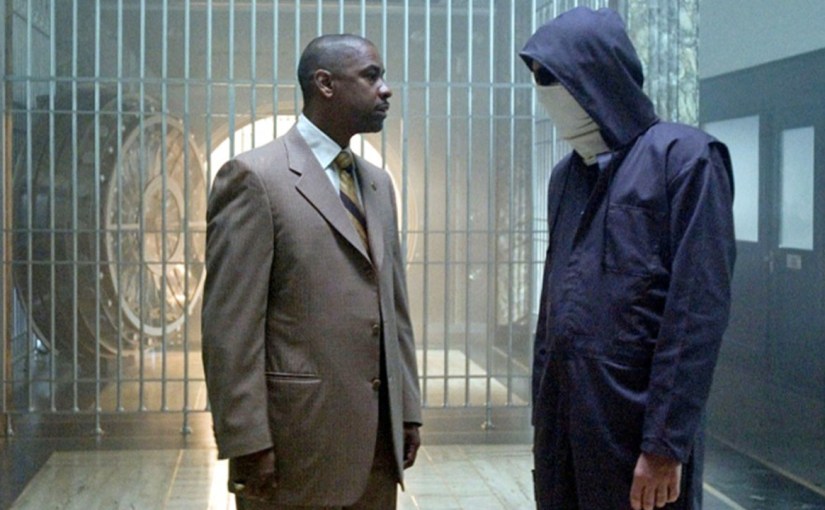
Four people wearing sunglasses, caps and painters’ uniforms take a well trafficked New York City bank branch hostage, complete with the entire staff and around thirty customers who are in the lobby.  The ringleader is played by a mostly concealed Clive Owen.  You might not see his face too often in the film, but you’ll be grateful he’s the bad guy in charge.

Denzel Washington is Detective Keith Frazier, and with his partner Bill Mitchell (Chewetel Ejiofor), they are on the scene attempting to diffuse the situation. The police captain right next to them is John Darius (Willem Dafoe).  Ejiofor and Dafoe are good as expected, though their roles are routine elements for these kinds of movies.  Washington has the kinetic pace that audiences are familiar with as he tries to outthink the bank robbers.  His character is labeled with a checkered reputation as he’s suspected of stealing drug money.  That element really goes nowhere.

Another party comes into the fold with Jodie Foster as a well-tailored and confident “fixer” hired by the bank’s president (Christopher Plummer).  To get these two actors together in a film along with Washington?  Well, that begs for repeat viewing.  Unfortunately, I didn’t see much point to the Foster character.  Upon hearing the news of the robbery, Plummer’s character clandestinely employs Foster to contain the situation so that a particular item in a safe deposit box remain untouched.  She arrives on the scene, exchanges dialogue with Washington that does not add up to much.  She surveys the hostages being held and then exits the story, until the epilogue.  As welcome as it is to see Jodie Foster, I can’t imagine what was gained from the context of her role, which does nothing to advance the story.

Inside Man always kept me interested and guessing.  The structure of Gerwitz’ script jumps ahead at times to show the detectives interrogating each hostage with suspicion after the incident is over.  So, I always wanted to know how it ever came to that shift in direction.  Plus, what happened to the bank robbers, and what precisely had Christopher Plummer so concerned about one particular branch robbery that he had to reach out for special services from Jodie Foster’s character? 

The answers arrive, and I can swallow the explanations.  Yet, the wrap up actually involves additional characters who hardly say a word or appear on screen earlier in the film.  Because they are briskly glossed over, it did not give me complete satisfaction.  I like the twist a lot.  It just needed a more solid foundation.

Inside Man is of those rare films that Spike Lee is invested simply for the fun.  The quick cuts and bustling New York atmosphere work well.  I love the opening credits to the movie; kind of his own spin on what Lumet did with Dog Day…  Lee has a good villain and appealing heroes. Other than few shortcomings, this is a solid crime drama.  

Often, Spike Lee positions himself on a platform that endorses a cause for the African American populace, or he brings attention to social wrongs in world history.  He is one of the best at what he does with his filmmaking approach.  Ironically, a message and a comeuppance arrive with Inside Man, but for a different demographic.  It might not be as hard hitting or thought provoking as other Spike Lee Joints, but it is appreciated.  

THE INCREDIBLE SHRINKING MAN (1957)

by Miguel E. Rodriguez

DIRECTOR: Jack Arnold
CAST: Grant Williams, Randy Stuart, April Kent, William Schallert
MY RATING: 8/10
ROTTEN TOMATOMETER: 83% Certified Fresh

PLOT: After being exposed to an ominous mist, Scott Carey starts to shrink in size, baffling medical science and subjecting him to unanticipated dangers.


I appreciate the seemingly endless string of 1950s sci-fi/monster movies in the same way I appreciate the short films of Georges Méliès: I acknowledge their place in movie history and their influence on the films of today, but I have no overwhelming desire to hunt them down and watch them.  If that makes me a dilettante, so be it.  I remember watching some of those ‘50s films as a boy on Saturday afternoons, although the titles elude me.  (One of them was in 3-D, requiring a trip to the local 7-11 to get a pair of those funky cardboard glasses.)  As young as I was, I could already see that these were not exactly Hollywood’s best films.  The plots were creaky and repetitive, the special effects were barely passable, the scripts were hammy and the acting even more so.  The ideas behind the stories were more compelling than the movies themselves.

Imagine my surprise, then, when I sat down to watch 1957’s The Incredible Shrinking Man, directed by Jack Arnold, the man behind a few of the most famous entries in the sci-fi/horror craze at that time: It Came from Outer Space, Creature from the Black Lagoon, This Island Earth, and Tarantula.  Even though Shrinking Man appears on the National Film Registry as well as the invaluable list of 1,001 Movies You Must See Before You Die, I was prepared to be mildly bored with cheesy effects and overwrought acting.  Instead, I was genuinely thrilled by the adventures of Scott Carey, an everyman whose body inexplicably starts to shrink and shrink, until one day a housecat poses a mortal threat and a household spider – well, a tarantula – becomes as symbolic as anything from Hemingway.

A plot summary seems mildly superfluous: while boating one day with his wife, Scott Carey unwisely remains topside as a mysterious cloud of mist passes over their boat, leaving his body coated with somehow ominous glitter.  Six months later, he starts to notice his clothes aren’t fitting as they should.  His wife, Louise, barely has to stand on her tiptoes anymore to kiss him.  Doctors are baffled, but promise to do whatever they can, spouting pseudo-scientific nonsense about phospholipids and a “deadly chemical reversal of the growth process.”  There is some unintentionally (?) suggestive dialogue as Scott expresses his concerns to Louise: “I’m getting smaller, Lou.  Every day.”  And: “You love Scott Carey.  He has a size and a shape and a way of thinking.  All that’s changing now.”  Not exactly Michael Crichton, but I rolled with it.

One of the things that sells the movie and the story is the ingenious production design that kicks in when Scott reaches about 36 inches in height.  As he walks around his living room, everything has become larger than life.  When he sits in an easy chair, his head doesn’t even reach the top of the back.  A pencil is larger than a baseball bat.  He despondently visits a diner, where a cup of coffee is as big around as a beer barrel.  This aspect of the film seemed reminiscent of, say, a Disney movie.  It seems obvious at first, but it’s done so well that I was drawn into the illusion completely.  Some clever trick photography manages to put the shrunken Scott in the same frame as the full-size Louise many times.  Even my experienced eyes couldn’t see the “splice” without a lot of searching.

Scott eventually shrinks to just a few inches tall and must resort to living inside a literal dollhouse, another triumph of production design.  This sets up the first major set piece of the movie as their housecat sees the tiny Scott as a tiny morsel and attacks the dollhouse.  Scott winds up in the cellar, Louise comes home and assumes the cat has eaten her beloved husband, and Scott, unable to climb the now-inaccessible staircase, must navigate the menacing wasteland of a dimly lit cellar in search of food and water.

This central portion of the film is what sets it apart from most other similar films of its era.  The screenplay was written by Richard Matheson, based on his book.  Matheson also wrote I Am Legend, and in both stories, there are long passages where a solitary character is alone with his thoughts and must solve life-or-death problems with no one to talk to.  The silence of Shrinking Man during Scott’s adventure in the cellar is striking.  The film started with narration, and I expected it to last throughout the cellar sequences, but the filmmakers wisely decided to keep it minimal and focus instead on Scott’s actions, allowing the audience to think along with him instead of telegraphing what he was thinking.  I was reminded of Cast Away (2000), although poor Scott never gets a Wilson.  Instead, he’s stuck with the resident tarantula that becomes his nemesis.

I should mention the subtext of the story, even though it’s not something that occurred to me while watching.  I’m told in various documentaries that Matheson wrote his novel The Shrinking Man in 1956 during a bout of depression and insecurity as a new father.  Scott’s shrinking reflected Matheson’s own sense of insignificance under the responsibilities of a father and husband in an age of accelerating technology and the fears of the Cold War.  This is something that might have been far more obvious to audiences of the time than it is to a member of Generation X, but in hindsight, it’s an intriguing added level to a story that is compelling enough on its own.  If I wanted to, I could connect this story with Michael Crichton’s Jurassic Park with its ravenous dinosaurs paired with a warning to the scientific community about the dangers of unchecked progress.  Pretty neat.

As fascinating and, at times, terrifying as the cellar sequences are, what really sets Shrinking Man apart from its contemporaries is the ending.  In virtually every other ‘50s monster film, the story ends on some kind of positive resolution where the threat is removed due to some new scientific discovery or an unexpected ally (the germs in The War of the Worlds come to mind) or, like Godzilla, it just disappears into the sunset.  This movie sidesteps that cliché by presenting the audience with an existential statement about the vastness of the universe on both a cosmic and an infinitesimal scale.  I know that sounds dry as hell, and the final monologue flirts with hokeyness, but listen to it carefully, and the ideas in it are grand and mystifying.  It mentions “God” here and there, but if you think of God, not as THE God, but as the unknowable engine of fate and/or the cosmos, the sentiments expressed have thought-provoking implications.  Scott’s last words in the film may sound simplistic, but they’re loaded with meaning, and can be applied to his own situation or to anyone struggling with the meaning of their own existence.  Pretty heady stuff for a sci-fi/special effects genre movie.

Where other films of its kind attempt and fail to ascribe grand themes to their kitschy stories and rubber-suited big-bads, The Incredible Shrinking Man actually made me think.  That’s an accomplishment.

AN OFFICER AND A GENTLEMAN

By Marc S. Sanders

You ever feel proud of a character in a movie?  Like you walk out, and you say to yourself, “Well done, Rocky!  You did it!!!”  That’s how I feel about Zack Mayo, the Navy enlisted candidate who has to survive his first 13 weeks of basic training on his way to eventually obtaining his dream of flying jets.  Just as important though, Zack has to mature as a responsible young man with a commitment to caring at least as much for others as they already care for him.  Richard Gere plays the guy who must become both An Officer And A Gentleman.

Director Taylor Hackford goes deep into the bottom of the well to show what makes Zack such a loner.  His Navy enlisted father (Robert Loggia) abandoned him and his mother, and only reenters Zack’s boyhood life once his mother commits suicide. Zack spends time growing up on the Philippine Islands Naval base where he gets bullied while remaining unloved.

Years later, after college graduation, not knowing of any other direction to take with his adult life, he opts to go down the same path of his bum of a father and join the Navy where he’ll perform basic training when he arrives at a coastal Seattle base. The enlisted men do not have a good historical reputation in this area.  Many are known for bed hopping with the local factory girls, and then they relocate to where they are going towards next in their servitude, leaving the girlfriends behind and forgotten.  Zack’s father was one of these guys. The ladies in the area also have a stained legacy.  Many of them will deliberately get pregnant or even lie about missing their period to keep these enlisted men from leaving them.

Sergeant Foley (Louis Gossett Jr, in his unforgettable Oscar winning role) oversees Mayo and his class, specifically warning all of them that these trends occur over and over again.  When he’s not cautioning them, Foley attacks the character traits that weigh Mayo and the others down.  If they had a rough childhood or checkered background, Foley will not hold back.  He has to prepare these men and women for a possible war or a position of captivity behind enemy lines.  If these young folks can endure Sgt Foley’s cruel mind games and unforgiving, hard-hearted nature, then they are more prepared for any worst-case scenario that can come while performing military service.  

Mayo is a leading candidate in his class.  He has the potential to break the record on the brutal obstacle course, and he’s secretly resourceful with selling polished boots and belt buckles to his classmates ahead of bunk inspection.  Not bad.  However, he’s not mature and he doesn’t even realize it.  The first time he completes the obstacle course he sits over on the side, proud of himself, rather than joining his teammates in cheering each other on to finish the job.

Love is also not something Mayo is experienced with. He meets Paula (Debra Winger in a superb Oscar nominated performance) who is ready to love Zack but he’s not ready to open up to her.  Perhaps he never wants to love or commit to anyone to save himself from loss or further abandonment because it’s all he’s ever known.  An Officer And A Gentleman is very good at subtly covering what makes a loner a loner.  

Contrary to Zack’s background is the best friend he makes, Sid Worley, a fellow classmate (David Keith).  Sid is a happy go lucky fellow, but eventually the film shares what motivated him to enlist and how his relationship with a local girl pans out. Perhaps there’s some sense to what Foley has been warning these people about.  

An Officer And A Gentleman is sad at some points and very uplifting as well.  Sometimes it’s hard to watch the encounters that Zack and company must endure during these first thirteen weeks of a committed six-year servitude to the Navy.  The glamour of flying jets can only arrive once you shed away the person you once were by developing maturity, respect, resilience and honor.  

I love the way Taylor Hackford’s film tests Zack.  He’s tested by Paula, by Sergeant Foley and even by his own father.  Can he let go of the drunken whore parties arranged by his dad? Raised by a guy who might have worn the officer rankings and uniform, but now beds the women he picks up in bars only to finish it off with a drunken vomit session in the morning.  

Foley puts Zach to his mental and physical limits after he catches him in violation.  The sergeant then insists on the kid’s DOR (“drop on request”).  It’s up to Zack if he wants to take this seriously or simply quit and remain a loser like his father.

Then there is Zack’s commitment to Paula.  Can he trust Paula will not trick him or let him down, again like his father, then his mother, and followed by his father all over again?  

Richard Gere is sensational at balancing two stories at once.  This remains the best role of his career.  It’s a dynamic, multi layered performance.  First, the physicality he devoted to the role is impressive.  That is Gere doing the obstacle course and cockpit test crash dives in the swimming pool.  Gere is the one doing endless pushups in the mud and running in place with a rifle above his head while Gossett’s character torments him with his abusive yelling and a dribbling water hose.  Gere is also the one riding Mayo’s motorcycle.  The actor is completely absorbed in this divided character.  Arguably, he should have been considered for an Oscar nomination.  

Zack Mayo is not always likable.  The purpose of the film is to discover what is to admire about the conflicted loner who never had anyone to care for him or anyone for him to lend sincerity towards.  If joining the Navy can pull this guy towards a meaningful life that can be purely earned and not cheated or circumvented, then it’s possible to feel proud of what this man becomes.  

An Officer And A Gentleman is now over forty years old. So, it might feel dated. Yet, the traits that make a man and a woman good, honorable, and loving people has never lost their immense value.  If you have never seen this movie, it’s time you did, and if you have seen it, it is due for a rewatch.  

The last line of the picture, depicted in one of the greatest endings ever to close out a film, is “Way to go Paula!”  Allow me to also say “Way to go Zack!”

THE BRIDGE ON THE RIVER KWAI

By Marc S. Sanders

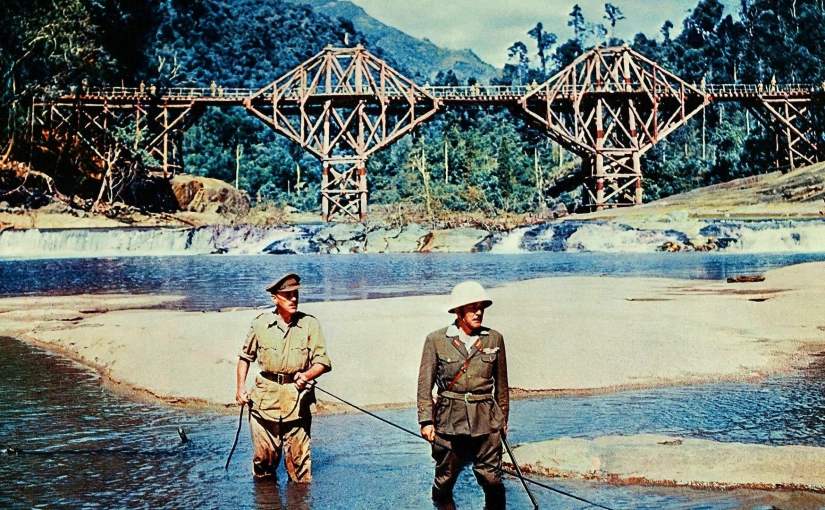
David Lean’s The Bridge On The River Kwai commits to a common theme.  The purpose of war means nothing to the pawns assigned to execute its actions.

The film primarily takes place in Japanese occupied Burma during World War II.  A prison has just acquired a British platoon of soldiers, and the Japanese have mandated this squad to construct a railway bridge that will run over the Kwai river benefiting the Axis efforts in the war.  Colonel Nicholson (Alec Guinness, in a celebrated early career role) respects the rules of war that come with his battalion being held as prisoners of the Japanese enemy, and he is prepared to have his men begin construction.  However, as his copy of the Geneva Convention Agreement dictates, his officers are not obliged to join in the assignment.  

This is a far off deserted jungle however, that does not even need to be fenced off because an attempted trek to escape is bound to fail.  Therefore, the Geneva Convention Agreement has no value of authority out here in this bug infested, stilted and sweltering heat with minimal resources of food, clothing or medicine.  The Japanese commander Colonel Saito (Sessue Hayakawa) does not hesitate to swat Nicholson’s copy in the Englishman’s face.  Now, since the politics of war are no longer a factor, the stamina of these two men are what’s at stake.

Saito forces Nicholson into a cramped, isolated hot box with next to no food or water.  He’s lucky because his remaining officers are forced to share the other box together.  Saito will force them to comply, or he may just have to kill himself.

The Bridge On The River Kwai explores how productivity, leadership and endurance thrive, but at a startling cost of madness.  Before you realize it, none of these characters are speaking of their respective war efforts or even the mandates of war.  As Nicholson persists in his stance as a defiant leader, a remarkable tide turns within this prison camp.  Soon, the question arises as to who is running this camp and overseeing this bridge project. The enforcers or the prisoners? 

A separate storyline involves an American prisoner named Shears (William Holden) – one of the last men in his platoon to survive, and now only here to bury his fallen comrades.  He’s introduced to describe the harsh reality of what Nicholson and his men can expect.  Yet once Shears escapes the camp, he is caught in a twisted irony, being forced to return to the prison camp where he must destroy the bridge under the command of a British special forces leader named Warden (Jack Hawkins).  Warden goes through his own form of madness.  A badly injured foot becomes something worse than a bloody stump and still he insists on leading his small brigade into the jungle.  

Meanwhile, as Nicholson develops more control over the camp, with Saito realizing his own pitiful ineptitude, a faction of the British are now likely to engage with Nicholson’s newfound achievement as a leader over his own squad, as well as the human Japanese resources he’s also recruited to complete this solid foundation.

David Lean had a reputation for never settling for less on his pictures and The Bridge On The River Kwai is a perfect example.  I recently watched the film, for a second time, with my fellow Cinemaniacs.  Thomas and Miguel assuredly pointed out that one less than sturdy bridge was constructed by Lean’s crew to demonstrate its weaknesses and the lack of engineering the Japanese possess, before Nicholson fully takes over.  That structure collapses on film and thus lends to the next plight in the story, when Nicholson proves to Saito that he is more capable than his enemy counterpart.

Later, the actual bridge is finished leading to a nail biting ending that elevates in suspense as an oncoming Japanese train is heard approaching with its signature whistle and chugging overheard as Colonel Nicholson proudly walks across his success, newly minted with a plaque carved with his name.  Elsewhere in the area are Stearns and Hawkins.  What began with Japanese antagonism has shifted to one side likely to do battle with itself.  

Who is fighting who?  More importantly, what are they fighting for?  War or persistent, delusional madness?

The Bridge On The River Kwai is a magnificent adventure produced with sensational filmmaking.  The investment and risk that David Lean took to assemble this picture is astounding.  It was filmed within the actual jungles.  (Miguel said somewhere around Sri Lanka.) The costumes worn by the thousands of extras are tattered dirty scraps that certainly does not invite the sex appeal you’d expect in a modern film of this kind.  Moreover, the audacity of the filmmaker at least matches the nerve of the story’s cast of characters.  

The cast is marvelous, but it is Sessue Hayakawa and Alec Guinness who serve the impact of Lean’s film.  The movie comes close to a three-hour running time.  The first half of the film has Hayakawa positioned as the leading antagonist, but the second half has Guinness filling that spot.  They almost seem to mirror one another as their character arcs move in parallel but opposite directions working to accomplish their goals, while shedding any kind of humane concern for their underlings or the countries they serve.  

I consider this film to be groundbreaking.  It’s a spectacle, but it allows much to be examined in mental acuity, military allegiance and endurance.  The Bridge On The River Kwai tests how effective war can be for any side that participates.  My Cinemaniac comrade, Thomas,  informed me that the story, adapted from a novel by Pierre Boulle, is entirely fictional.  Still, I believe it garners an important message.  Are we supposed to truly embrace “rules of war?”  This is not Risk the board game.

These men might carry the titles and rankings issued to them by their governments. However, isolate them in the middle of nowhere and who is going to uphold any semblance of regulation?  War functions on efforts of violence.  When was the last time anyone had respect for violence?