
By Marc S. Sanders
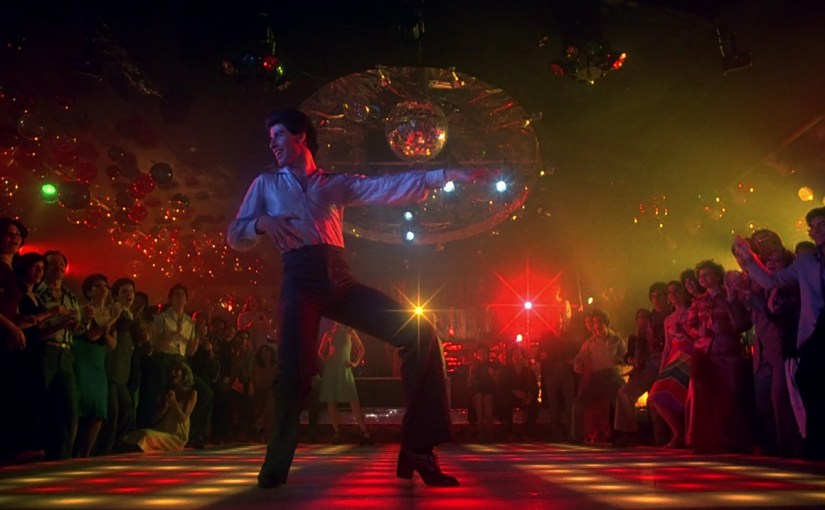
One of the biggest cinematic cultural touchstones announced itself just as the fad was withering away. John Travolta blew up movie screens in 1977 when he strutted down the streets of Brooklyn with a paint can in one hand while wearing his wide collared red shirt under his black leather jacket. The song that that got audiences grooving in their seats with the immediate superstar? Staying Alive by The Bee Gees. The movie? Saturday Night Fever which offered one of the most memorable character introductions in film history.
Disco might be dead and only designed for themed costume parties nowadays, but Saturday Night Fever remains very much alive. No one forgets the moves Travolta did on the dance floor in his polyester shirts and suits. John Badham’s film continues to be saluted with spoofs ranging from Airplane! to Saturday Night Live to Family Guy and one commercial after another. The soundtrack is an unforgettable mix played for every generation that comes along at weddings, proms and bar mitzvahs. The film was also adapted into a successful Broadway and touring musical. I loved the live stage performance by the way.
Still, there’s a sensational dramatic story to Saturday Night Fever and Tony Monero, the nineteen-year-old kid who is only a Brooklyn celebrity on the streets and especially at the local dance club 2001: Oddyssey (the extra d is included). Tony has unwanted ladies dying to sidle up to him, especially his contest dance partner Annette (Donna Pescow) who will eagerly surrender her virginity to Tony without protection. His buddies idolize him as well, as they cruise the streets at night drinking in their beat-up Ford sedan on the way to and from the club, before finishing off the evening with some risky tomfoolery on the edge of the Verrazano bridge. His boss at the paint shop even loves the kid. Tony doesn’t ask for it, but he gets a raise and by the end of the conversation, the boss has nearly doubled his first offer.
None of this is enough for Tony though. He doesn’t want to be tied down to working at the paint store for the rest his life. He’s afraid he’s losing his beautifully well coifed hair and maybe his dancing skills will not survive as the years pass him by. He also gets no love from his father. Every dinner erupts into a family argument. His mother has preferred adorations for Father Frank, Tony’s older brother who entered the priesthood. Ma calls her son Father Frank, because, after all, he’s a Father of the Catholic Church. Tony is also envious of Frank, first for their parents’ adoration. Later, it is because Frank decides to leave the seminary to be free of the parents’ expectations.
Tony also sees the talents and beauty of a dancer named Stephanie (Karen Lynn Gorney) who has no interest in his immaturity but is willing to be his partner for 2001’s upcoming dance contest. Try as he might, Tony cannot keep up with Stephanie beyond the dance floor. He’s not educated or cultured like her, and she is relocating across the bridge to Staten Island for a better life. On the other hand, Tony remains stationary and therefore he is a frustrated man about to put his teenage years behind him with no aspirations and the weight of those who he spends time with holding him down.
I’d argue many are familiar with the colorful dance sequences accompanied by The Bee Gees’ memorable numbers (How Deep Is Your Love, Night Fever, More Than A Woman) as well as KC and the Sunshine Band (Get Down Tonight) and The Tramps (Disco Inferno). Yet, Saturday Night Fever demonstrates a tough coming of age struggle for its protagonist. John Travolta is at least just as memorable as James Dean was in Rebel Without A Cause. Life goes on, but how can it when all you have to show for yourself is being the best at disco dancing? There’s a whole other world beyond Brooklyn.
Sex is even frustrating for Tony. He gives in to Annette’s desires to make love to him in the back seat, but then tosses her aside when she does not bring a condom. All of this is too easy for Tony; so easy that it’s not even pleasurable and thus he’s continuously cruel and dismissive of her. When Annette gives in to group sex with the guys, one after the other, Tony can do nothing but chastise her for allowing herself to be subjected that way.
Bobby C (Barry Miller) is the fearful, untalented, uncool and insecure buddy who is lost with what to do when he thinks he might have gotten a girl pregnant. Tony is the greatest guy he knows, but he has no interest in helping. Bobby even tries the next best thing by approaching Frank…formerly Father Frank. Everyone wants to be with Tony and stay in his social circle, yet Tony is the one who wants out.
Norman Wexler’s screenplay is tremendously insightful but never so apparent. As loud as the clothes, the disco music and the dance is, this is a script of subtly in Travolta’s performance. It’s likely why he got the film’s sole Oscar nomination for Best Actor. Despite Tony’s continued outbursts, there’s nothing so blatant in Saturday Night Fever like you would find in other coming of age films like James Dean’s, for example, or any of John Hughes’ films. Director John Badham accustoms you to Tony Manero’s anxiety.
It’s ironic, normally a protagonist will grow into self-assurance. In this film, Badham wisely shows the confident swagger of Tony Manero in the film’s unforgettable opening only to see him diminish as the character arc proceeds over the film’s next two hours. Badham includes small hints in this opening. Tony might walk with a strut, but the first attractive woman he passes on the street does not give him the gumption to approach her, and the second woman tries avoiding him being in her way. Later, Tony is outright rejected by Stephanie for anything beyond friendship and dance practice. Tony wears the local celebrity façade, but in reality he is just a nobody.
John Travolta is so effective at showing on screen how Tony internally speaks to himself as he vocalizes his frustrations at those around him. Whatever is angering Tony only looks like it’s Annette’s fault, or Stephanie’s or the guys, or Mom and Pop. There must be something better for him than just being a small time, well dressed disco dancer, and a valued worker in a paint store. He’s also outgrowing the street brawling with his buddies. All he knows is he had better find a way out of this life with no promise of a future. Otherwise, he’s destined for a destructive ending.
Saturday Night Fever has a staying power. Years after anyone has seen this film, all that might be remembered is John Travolta in the white suit on the lighted disco floor while Staying Alive is blaring through the speakers. However, it’s a deeper film than just glitzy aesthetics that arrive with the final cut. This is a coming-of-age story that does not hide the struggles nor romanticizes a path towards a better person or future.
The film’s ending is even deliberately ambiguous. It’s more realistic than you might realize because the future remains uncertain for all of us, especially when we believe we don’t have much beyond what we are envied for to send us forward. I know of the film Staying Alive directed by Sylvester Stallone which brought Travolta back into the legendary role. It is the follow up film to Saturday Night Fever; notoriously considered one of the worst sequels ever made as it attempts to bring Tony Manero into the early 1980s cheesy zeitgeist world of Cats on Broadway or a poor impersonation of Prince pop music. Norman Wexler demanded his story credit be stricken from that film.
Choosing to ignore what came with that awful sequel, Wexler’s script for Saturday Night Fever wisely offers no promises for its protagonist, because unlike what we often see in the movies, life never guarantees a new day, and that’s what truly scares Tony Manero more than anything else. It’s fair to say an uncertain future terrifies all of us. That is why Saturday Night Fever remains completely genuine. We are never meant to see what comes of Tony Manero because Tony Manero struggles with the unknown of what’s to come. Some endings are meant to have those hanging threads from a time gone by.
 2 UNPAID MOVIE CRITICS!!!!
Been a long time since I’ve seen this. You make me want to watch it again.
LikeLike
Definitely worth a rewatch.
LikeLike