
By Marc S. Sanders
The abundance of Spike Lee’s films offer a message as quickly as the film begins. Then they set out to demonstrate what Lee is talking about in the scripts he writes and/or directs and what is presented on screen for the next two or three hours. BlacKKKlansman (a favorite of mine) and especially Do The Right Thing are perfect examples. Lee is direct and hardly ever ambiguous. Inside Man is an exception.
This Spike Lee Joint is having a bit of fun with the director’s own take on the staple bank robbery found in so many films. By the time the film is over, and all the cards are on the table, you realize the audacity of this caper is as unique as Sidney Lumet’s Dog Day Afternoon or Michael Mann’s Heat. With a screenplay by Russel Gerwitz, Spike Lee is proudly vague until he finally reaches his conclusions during the third act of the piece. It’s unusual. It’s out there and it’s a stretch, but the math of the heist seems to add up. Still, knowing what I know now, I do wish there was a little more focus on some characters that lend to the film’s twist. Then again, maybe that would have implied too much.
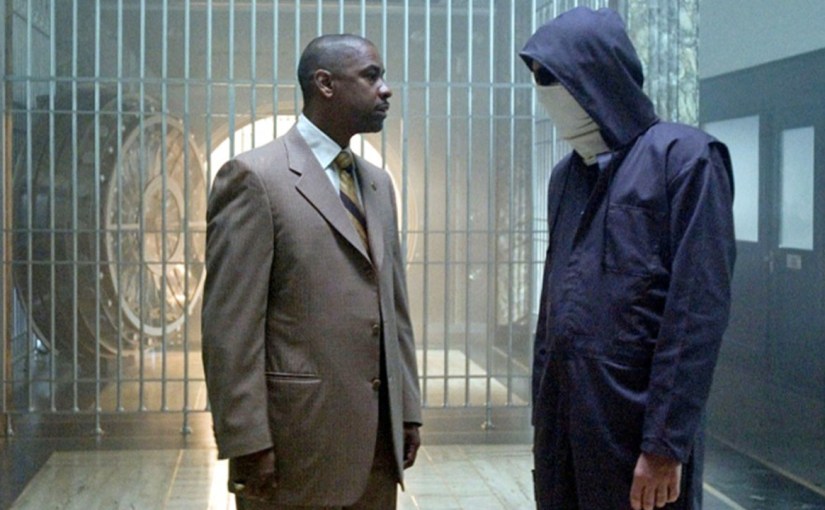
Four people wearing sunglasses, caps and painters’ uniforms take a well trafficked New York City bank branch hostage, complete with the entire staff and around thirty customers who are in the lobby. The ringleader is played by a mostly concealed Clive Owen. You might not see his face too often in the film, but you’ll be grateful he’s the bad guy in charge.
Denzel Washington is Detective Keith Frazier, and with his partner Bill Mitchell (Chewetel Ejiofor), they are on the scene attempting to diffuse the situation. The police captain right next to them is John Darius (Willem Dafoe). Ejiofor and Dafoe are good as expected, though their roles are routine elements for these kinds of movies. Washington has the kinetic pace that audiences are familiar with as he tries to outthink the bank robbers. His character is labeled with a checkered reputation as he’s suspected of stealing drug money. That element really goes nowhere.
Another party comes into the fold with Jodie Foster as a well-tailored and confident “fixer” hired by the bank’s president (Christopher Plummer). To get these two actors together in a film along with Washington? Well, that begs for repeat viewing. Unfortunately, I didn’t see much point to the Foster character. Upon hearing the news of the robbery, Plummer’s character clandestinely employs Foster to contain the situation so that a particular item in a safe deposit box remain untouched. She arrives on the scene, exchanges dialogue with Washington that does not add up to much. She surveys the hostages being held and then exits the story, until the epilogue. As welcome as it is to see Jodie Foster, I can’t imagine what was gained from the context of her role, which does nothing to advance the story.
Inside Man always kept me interested and guessing. The structure of Gerwitz’ script jumps ahead at times to show the detectives interrogating each hostage with suspicion after the incident is over. So, I always wanted to know how it ever came to that shift in direction. Plus, what happened to the bank robbers, and what precisely had Christopher Plummer so concerned about one particular branch robbery that he had to reach out for special services from Jodie Foster’s character?
The answers arrive, and I can swallow the explanations. Yet, the wrap up actually involves additional characters who hardly say a word or appear on screen earlier in the film. Because they are briskly glossed over, it did not give me complete satisfaction. I like the twist a lot. It just needed a more solid foundation.
Inside Man is of those rare films that Spike Lee is invested simply for the fun. The quick cuts and bustling New York atmosphere work well. I love the opening credits to the movie; kind of his own spin on what Lumet did with Dog Day… Lee has a good villain and appealing heroes. Other than few shortcomings, this is a solid crime drama.
Often, Spike Lee positions himself on a platform that endorses a cause for the African American populace, or he brings attention to social wrongs in world history. He is one of the best at what he does with his filmmaking approach. Ironically, a message and a comeuppance arrive with Inside Man, but for a different demographic. It might not be as hard hitting or thought provoking as other Spike Lee Joints, but it is appreciated.
 2 UNPAID MOVIE CRITICS!!!!