BLACK MASS

By Marc S. Sanders

Black Mass tells the story of an FBI agent, and his two childhood friends who are brothers.  One brother is Billy Bulger, a Massachusetts state senator.  The other is notorious Boston gangster James “Whitey” Bulger.  The script has a lot of elements to make for a great crime drama, but I wonder what Johnny Depp is doing here made up to perform like a crazed ghoul.

The FBI agent is John Connolly (Joel Edgerton) who turns to Whitey (Depp), a fearful leader of the Irish mob in South Boston during the nineteen seventies through eighties to work as an informant, providing intel on the competing Italian Mafia.  It’s no secret about Whitey Bulger’s dealings or what territory he covers.  Agent Connolly does his best to protect his friend, so long as he collects pertinent information that leads to arrests.  However, what’s the limit to Bulger’s activities, and how does this reflect on a public figure like Whitey’s politician brother, Billy (Benedict Cumberbatch)?

Much of Black Mass reenacts recorded testimonies after everything has shaken out.  Guys who survived Whitey’s violent crew (Jesse Plemmons, Rory Cochrane) offer information on the gangster’s activities and what he compelled his captains to carry out.  Mixed in with these voiceovers are how Connolly responds to the progress of his operations.  Time and again, his superiors (first played by Kevin Bacon and later by Corey Stoll) question Connolly about how beneficial Bulger can be if the crook always has his finger on the trigger, killing those that might rat him out.  Black Mass is told from an assortment of different perspectives and sometimes that muddies the water.

The most interesting storyline is how Connolly uses and protects his criminal friend, while also stepping away from getting blood on his hands.  Joel Edgerton gives the best performance of the film as an FBI guy who turns a blind eye to Whitey’s crimes. Connolly thinks he can continue his own corruption while Whitey cooperates and leads him to big, heroic indictments of the Italian mob.  As long as the arrangement upholds, the corrupt agent will always have an answer for his actions and stay ahead of the ethical lines he knows he’s crossing.  More importantly, even if his wife protests, Connolly is getting prestigious promotions and collecting substantial paychecks for his progress.  Scott Cooper directs Edgerton with conflicts of overwhelming complications.

One problem is that Whitey Bulger is a loose cannon who is never intimidated, not even by the Feds, especially not by his childhood friend.  His brother Billy looks away to maintain a clean political image.  Therefore, it is quite easy for Whitey to gun down a rat associate in broad daylight in the middle of a wide-open parking lot, shotgun and all.  The killer doesn’t even need to run away from the scene of the crime.  This is Whitey Bulger.

Johnny Depp is great in the role, but does his portrayal belong in this film?  Depp’s career is widely celebrated for the quirky, makeup clad parts he plays such as Jack Sparrow and Edward Scissorhands.  Even Ed Wood is delightfully weird.  In Black Mass, the actor dons steel grey eye contacts, white slicked back hair making him appear almost bald, and skeletal teeth beneath a near albino complexion.  He looks like Skeletor without the hood.  Throw in a brooding, deep Bostonian accent and you have the ghoul I referred to earlier.  Is this Whitey Bulger?  Online photos of the real guy do not seem consistent with the film’s appearance.  Depp’s delivery of dialogue and even his wicked Freddy Krueger laugh seem too far beyond the realm of this crime drama.  The actor is working on another plane than everyone else in the cast who wear hairpieces, three-piece cotton suits and cheesy off-the-rack polyesters and denims to populate this time period from forty years ago. 

A scene showing Bulger dining on steaks with Connolly and his FBI partner (David Harbor) was famously used in preview showings ahead of the film’s release.  Take this scene out of context like the trailer did and Depp looks scary good as he terrifies Harbor for doing something as simple as revealing a long-time secret family recipe.  Afterwards, Whitey goes upstairs to harass Connolly’s wife (Julianne Nicholson) at the bedroom door.  The dinner scene sold me on getting a ticket for the movie as soon as it was released.  However, put it back into the framework of the script and I feel like Black Mass is diverting itself from a complex crime drama to a vampire in a Member’s Only jacket.  As good as Depp is with his makeup and his vocal inflections and pace, it just doesn’t seem to belong in this particular film.  Marlon Brando as Don Corleone with the shoe polish in the hair and the cotton in the mouth? That works.  Johnny Depp as Count Dracula in Sergio Valente skinny jeans is not as effective.

Because the script changes hands from one perspective to another and then another, I found the reenactments of Connolly and Bulger’s reign of crimes to be a little inconsistent.  I found much potential for Benedict Cumberbatch’s purpose as Whitey’s brother, but there is too much diverted away from that character because the picture is trafficked with what everyone else is doing and seeing on top of giving Johnny Depp a lot of scenery to chew.

Black Mass pursued the potential for a very interesting gangster picture like Goodfellas or Donnie Brasco, but it wants to capitalize too much on the latest Johnny Depp routine.  I think James “Whitey” Bulger is an interesting twentieth century bad guy with a violently daring and checkered background.  He had associates within his family and gang to color in a movie that’ll grab you.  The tainted lawmen who were involved are also intriguing.  Scott Cooper and the screenwriters knew this, but often they opt to go in different directions.  

Now that a loose interpretation of Bulger has been played by Jack Nicholson in Martin Scorsese’s Oscar winning The Departed and again here, it’s time to tell the cold-blooded killer’s story once more.  Just go simpler without all the clownish theatrics.
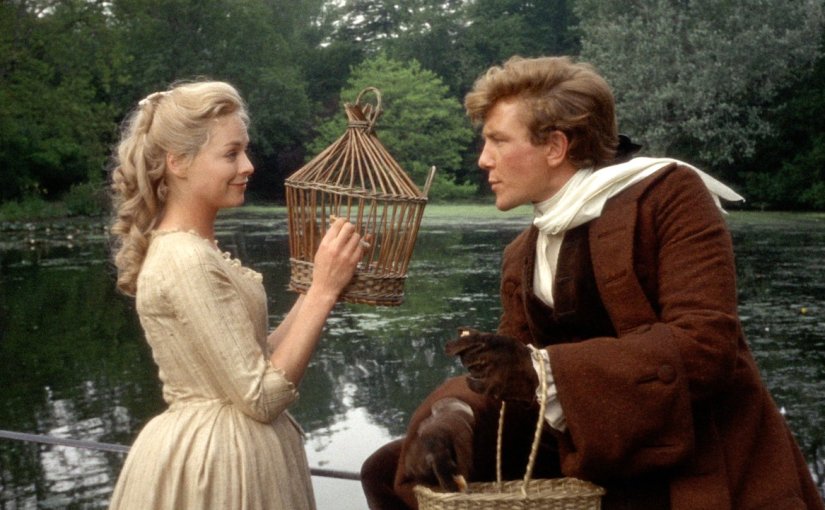
TOM JONES

By Marc S. Sanders

Watching Tom Jones I wondered if the Monty Python troupe took inspiration from producer/director Tony Richardson’s film.  It’s all quite madcap.  With Albert Finney as the lead title character, there’s a zany quality to this eighteenth century piece adapted from Henry Fielding’s novel The History Of Tom Jones, A Foundling.

The film opens like a silent movie with title cards being used to emote dialogue.  The Squire Allworthy (George Devine) returns to his estate and upon retiring for bed, he discovers newborn Tom beneath the blankets.  Allworthy decides to raise the child. 

The film transitions to a talkie picture and Tom grows up to be portrayed by Albert Finney.  The orphan man gets himself into all kinds of predicaments, notably with an assortment of women but his true affections are directed towards Sophie (Susannah York), the daughter of the neighbor Squire Western. The cad known as Blifil (David Warner, in his very first film role) convinces Allworthy that Tom is a villain and thus he’s excised from the estate with cash to seek out his own fortune.  Interactions lead to unexpected circumstances for Tom, including being robbed penniless, crossing paths with the butler who was presumed to be his father, and being sentenced to death for murder after he rescues an endangered maiden from the assault of a British red coat (Julian Glover).

Tom Jones takes unexpected turns in its narrative, and it leads to big laughs.  Upon discovering that his wallet is stolen, Albert Finney breaks the fourth wall seeking the viewers assurance that he is not making it up.  Other characters are depicted in freeze frame silliness as they eavesdrop on Allworthy.  There’s lots of running around escapades as Tom flees from being caught with a couple of mistresses.  I was waiting for the Benny Hill music to cue in, though John Addison’s score suffices well to keep it all lighthearted during such times when the film speeds up with a Keystone Kops kind of pace.

A film like Tom Jones is not what I normally gravitate towards.  Going back and forth, there’s lots of screaming banter and deep English dialects that swallow the words being uttered.  Drunken debauchery is relied upon for Hugh Griffith as Squire Western; he was one of five actors nominated for the film.  At one point, Griffith falls off his horse and the animal lands on top of him.  Apparently, this was not stunt work as Griffith notoriously showed up drunk each day on set and the horse easily overtook him.

Albert Finney, though, is a comedy gem as he innocently portrays Tom with no ill intent.  Watching him here in his youth, he’s adorable with an occasional prince and pauper romantic interpretation of his performance. A memorably hilarious scene involves Tom and a lady mistress seducing one another from both sides of the table as they gorge themselves with a bevy of food including pheasant, pears, potatoes and so on. Without Finney’s fearlessness in leading this sloppy, drooling scene, I’m not sure it would have worked as well. Richardson elongates the moment between the two to build the laughter.

I’m impressed with much of the filmmaking from Tony Richardson.  Cameras must have been mounted on horseback to get up close pursuit during a sporting hunt of a deer that also included a large number of rabid dogs.  Still, I was a little queasy in the follow up scene when the deer is slaughtered amid the canines barking for a portion. Technically speaking though, the film works on many levels.

As well, I could not help but consider that a modern filmmaker like Yorgos Lanthimos (Poor Things, The Favorite) adopted some of Richardson’s comedic approach.  Tom Jones is proudly weird and obscure just like Lanthimos’ storytelling.

Yet, I cannot comprehend the praise awarded to this movie, including Best Picture and Director as well as the nominations in cast performances by critics, Oscars and BAFTAS.  I’m convinced of the period timing and what the script and actors lend to the film, but I’ll never say any of it left me enraptured in the novelty.  It’s a cute story, but that’s all.  Kind of like Arthur with Dudley Moore, where the innocent man child happily lives within his sophomoric mentality while uncovering who he truly loves.  There is likely more to take away from Tom Jones, but I didn’t recognize it.

If anything, as I continue my trek towards watching and reviewing every Best Picture winner in Oscar history, I’m at least glad I got Tom Jones checked off my list.  At times, it’s delightful and it’s also proudly oddball in its execution.  What constitutes it as the best film of 1963? Reader, I’m just not sure.  Yet, it is at least entertaining with much praise for Albert Finney and cast.

TALK RADIO (1988)

by Miguel E. Rodriguez

DIRECTOR: Oliver Stone
CAST: Eric Bogosian, Ellen Greene, John C. McGinley, Alec Baldwin, Michael Wincott
MY RATING: 8/10
ROTTEN TOMATOMETER: 82% Certified Fresh

PLOT: A rude, contemptuous talk show host becomes overwhelmed by the hatred that surrounds his program just before it goes national.


Oliver Stone’s Talk Radio is entertaining and, at times, mesmerizing without being an altogether enjoyable experience.  I salute the craft of the film and the bravura performance by Eric Bogosian, reprising the role he created on Broadway, but despite my high score, I’m not quite sure to whom I would recommend this film.  I believe it’s an important placeholder in Stone’s filmography, coming as it does after Wall Street and before Born on the Fourth of July.  It shows immense faith in the material and portrays its characters with brutal honesty.  The closest comparison I can make is to the Safdie Brothers film Uncut Gems.  Both films are fraught with tension, featuring unlikable fast-talking main characters who tend to step on or over or around the people closest to them to achieve their goal, or sometimes just to get their own way.  They’re fascinating to watch and listen to, but I would not want to be stuck in an elevator with them.

Talk Radio centers on a Dallas radio shock jock named Barry Champlain.  Bogosian’s look and performance seems so closely modeled on Howard Stern that I’m surprised Stern didn’t sue the filmmakers for not obtaining his permission to do so.  (In fact, the Barry character is modeled after real life talk show host Alan Berg, who was gunned down by an ultra-right-wing group in 1984.)  The whole first “act” of the film takes place in and around the broadcasting booth where Barry holds court, listening to and berating callers from all walks of life on topics ranging from “I Love Lucy” to the war on drugs to Holocaust deniers to one dude who eats dinner with his cat every night.  If nothing else, this sequence boosted my respect for anyone in Barry’s line of work.  To be able to take calls from random folks with random issues, and to somehow spin their questions or problems into a mini-monologue or diatribe that manages to entertain or offend – usually both – the caller or the listening audience – usually both – is a skill I will never possess.  (Bogosian’s voice is tailor-made for the role, a nice sweet-spot baritone that sounds as if he’s been doing radio for years.)

Mixed in with the calls are the ones from clear-cut racists, warning Barry that they know where he lives, that they know “Champlain” is not his real last name, calling him Jew-boy and “f—-t”, sending him packages in the mail and claiming they’re bombs.  One loathsome item is sent to him wrapped in a Nazi flag.  Other callers don’t seem to have any affiliation at all aside from their utter hatred of Barry Champlain.  There’s a scene where Barry has been invited to a public event to introduce someone.  The moment he takes the stage, there are a few cheers that are eventually drowned out by a sea of boos and jeers in concert with a hailstorm of food and garbage thrown by the audience.  Barry has the nerve to look a little shocked.  I remember thinking, “How can you not expect this kind of reception?”

But then I remember thinking, about the audience members this time, “Well, if you hate him so much, why are you listening to his show?”  The movie is making a statement about the bizarre relationship between the general public and entertainment celebrities that they “love to hate.”  It seems to me their lives would be infinitely happier and less angry if they just switched over to NPR or smooth jazz once in a while.  No one forces them, or anyone, to engage with a TV show or movie or radio show or anything else they don’t like.  But with Barry, and presumably many other shock jocks in real life, people seem to need them, to use them as an excuse, I guess, to get riled up, to feel fueled by righteous anger.  The shock jocks are handy targets, especially because the callers can remain anonymous, much like social media.

There is a long rant from Barry himself about this phenomenon late in the film.  There was a plan for his show to go national, but it has been derailed for nebulous reasons, and so a broadcast intended for the entire country is still confined to the Dallas area.  After an ill-advised guest appearance by a stoned idiot (Michael Wincott!) and a couple of calls that go completely off the rails, Barry loses it and tells his listeners:

“You’re happiest when others are in pain.  That’s where I come in, isn’t it?  I’m here to lead you by the hands through the dark forest of your own hatred and anger and humiliation.  I’m providing a public service. … I come in here every night, I tear into you, I abuse you, I insult you, you just keep coming back for more.  What’s wrong with you, why do you keep calling?”

In another movie, that kind of rant might skew towards comedy.  Here, it serves as a painful peek into the psyche of a man who has a job that he’s good at, but there’s a part of him that despises himself for it, and that self-loathing has overflowed the boundaries of his own soul onto and over his listeners.  Even he can’t understand what his audience is thinking. I found myself wondering if any other shock jocks out there might feel this way.  I wonder if this might be one of Howard Stern’s favorite movies, or if it was one of Don Imus’s favorites.  I have never listened to either one of their shows because…well, because that’s my right as a human being.  But I wonder, nevertheless.

As I said before, I admire the craft of the film.  Stone and his collaborators (especially cinematographer Robert Richardson) do a great job with creative camera angles, lighting, and editing for those long stretches of the film where we simply sit and listen to Barry Champlain talking to that endless stream of callers.  Most of those calls end threateningly or are threatening throughout.  This has the effect of creating tension almost out of thin air, a tension that suffuses the entire film.  Are we going to get a maniac who takes Barry hostage on the air?  When Barry unwisely invites a listener to come down to the station and appear on the air, we’re thinking, “You idiot, he’s going to kill you!”  Even if none of that happens, we’re worried about it the entire time.  While this method is an effective use of cinema, as I said before, I cannot honestly say I had a “good time” watching it.  When the ending comes and the final credits roll, I will carefully say that there was a sense of relief, not at how it ended, but just relief that it ended.

Talk Radio is a well-made film featuring a stellar performance from Eric Bogosian.  If you sit down to watch it, I believe you will feel exactly what Oliver Stone meant for you to feel.  Just don’t expect it to tickle.

THE VANISHING (Netherlands, 1988)

by Miguel E. Rodriguez

DIRECTOR: George Sluizer
CAST: Bernard-Pierre Donnadieu, Gene Bervoets, Johanna ter Steege
MY RATING: 9/10
ROTTEN TOMATOMETER: 96% Fresh

PLOT: A young couple, Rex and Saskia, stop at a service station during a road trip.  Saskia vanishes without a trace, prompting a years-long search by Rex…while an unassuming family man monitors his progress.


[WARNING: This review contains unavoidable spoilers.  If you have any plans to see this movie, trust me…stop reading now.]

I went into The Vanishing absolutely cold.  I knew nothing about it aside from the name of the director, the bare outlines of the plot (a young woman vanishes while on vacation), and the fact it was a critically acclaimed foreign film, remade in America with Jeff Bridges and Kiefer Sutherland, which I never saw because it was, quote, “laughable, stupid and crude” (Roger Ebert).

With absolutely no gore, no unnecessary side plots, and no clichéd final chase between the killer and the cops where the outcome is a foregone conclusion, director George Sluizer has crafted one of the most compelling, creepiest abduction films I’ve ever seen.  By not showing the actual abduction when it happens, by focusing on the boyfriend’s frantic attempts to track her down immediately afterwards, and by abruptly shifting gears twice in the first hour, the viewer is kept constantly off balance (in a good way).  If she was abducted, how did the kidnapper accomplish his task in broad daylight?  WAS it even an abduction?  We get a good look at the person who most likely committed the crime, but his process looks almost comic…how did he pull it off?

We first meet Rex and Saskia as they’re driving to France to do some cycling.  After Saskia relates a recurring nightmare to Rex (she dreams of being trapped inside a golden egg floating through space), there is an early crisis when their car runs out of gas in the middle of a long tunnel.  We get an early, incisive look at their relationship when Rex elects to walk back for gas, while Saskia stays behind frantically looking for a flashlight she insists they will need.  Later, at a crowded service station, they kiss and make up.

This scene at the service station looks entirely mundane at first, but it is interrupted by a sequence in which we are shown the man who pretty clearly is about to commit a kidnapping.  When we cut back to Rex and Saskia, their interactions become charged with tension.  They talk and tease and kiss, while we are suddenly hyper-aware of their surroundings.  Director Sluizer fills the background with extras, and we start scrutinizing them to see if any of them might be the kidnapper.  Or perhaps there will be a clue later, a Hitchcockian callback which relies on our recall of the crowd scenes.  Rex takes a random Polaroid as a blue semi rolls past the lens, obscuring the front of the store.  Sluizer’s camera lingers on the semi, and we immediately wonder if there is any significance.  (There both is and isn’t.)

The creepy effect of these scenes cannot be overstated.  I can easily imagine some people watching this movie and immediately changing their travel habits.  Never go into a crowded store alone.  Carry mace.  If you must separate, stay in touch with your cellphone until you meet up again.  Stanley Kubrick knew what he was talking about when he told Sluizer that The Vanishing was the most terrifying movie he’d ever seen.

After Saskia’s disappearance, there are the nominal scenes of Rex searching the store and grounds for her, asking if anyone has seen her, giving her description, and so on.  Interestingly, we never get a scene of Rex being interviewed by the police as the day drags on.  Looking back on it now, I get the feeling that Sluizer perhaps thought those scenes would be way too familiar for audiences who have sat through any number of police procedurals in the movies and on TV.  Better to stay with the matter at hand and keep the story moving.

It’s at this point that the movie makes its first abrupt shift in tone and focus.  With no warning, we suddenly spend a good 20-30 minutes, not with Rex’s search, but with the apparently happy family life of the man we got a good look at earlier in the film, the man who appeared to be prepping for a crime.  These scenes are even creepier than the earlier scenes at the service station because we are pretty sure this is the kidnapper, but his home life seems stable: a wife, two daughters, a well-paying job as a chemistry teacher, and the financial wherewithal to buy a large farmhouse in the country…where we discover, in an INTENSELY creepy moment, that no neighbors will hear any screaming.

The decision to focus on this man was jarring and disturbing to me, but in that good way achieved only by the best crime thrillers.  We get more details about his life and his “preparations” that I won’t spoil here.  The film almost seems to have forgotten all about Rex and Saskia; this man is now the primary character.  (In fact, this actor gets top billing in the credits).  He has the kind of forgettable face and unimposing persona that would fly under anyone’s radar.  By showing us the fact that he has two sides to his personality, we come to the uneasy realization that evil could easily lurk behind the cheerful facades of just about anyone we meet.  This concept is far more terrifying to me than a slasher wearing a mask.

But The Vanishing has two more tricks up its sleeve.  It takes yet another dramatic shift when we abruptly jump forward three years.  Saskia is still missing.  Rex has a new girlfriend, but he still posts flyers asking for any information on Saskia.  He makes appearances on local news programs, pleading for the perpetrator to step forward, promising not to press charges; he just has to know whether Saskia is alive or dead.  He craves closure more than anything else.  It has consumed him.  And…he has received several anonymous postcards from the kidnapper asking to meet in a public place, but whenever Rex arrives, the kidnapper has never shown himself.

This creeped me out even more than I had already been.  But the screws get tighter still.  At one point, the kidnapper offers Rex a choice: turn me in, in which case you’ll never find out what happened to Saskia, or I show you what happened to her…by going through the same ordeal she did.

This has all SORTS of psychological implications that I don’t feel fully qualified to sort out.  I have to wonder about those families and friends who have suffered through the disappearance of a loved one.  (I looked up the statistics on missing persons on a whim…they are horribly depressing.)  I can only imagine what those people would do to finally get closure on what happened.  Would they accept this kidnapper’s offer?  Even if it means they might possibly die?  What price would they be willing to pay to finally get an answer after years of searching?

I hope I never have to answer that question.  Rex goes back and forth in agony before finally making his choice.  His decision leads to an ending that was probably inevitable, but which still took me by surprise.

In an interview with the actress who played Saskia (Johanna ter Steege), she states that when the movie was finally released, she was deeply disturbed.  She went to George Sluizer and asked him, “What is the point of this movie?  What do you achieve by telling this kind of disturbing story?  What are you trying to tell the audience?”  If I had to answer that question, I would say that the first motive was to make an entertaining crime thriller, which it is.  But perhaps there’s also a deeper statement about the banality of evil.  One does not have to wear a black hat and twirl his mustache to be the bad guy.  Sometimes you just have to blend into the background.  The film opens and closes with shots that include a praying mantis, a creature that relies on stealth and speed to capture its prey.  The kidnapper in The Vanishing has learned that lesson in spades.

GUNFIGHT AT THE O.K. CORRAL (1957)

by Miguel E. Rodriguez

DIRECTOR: John Sturges
CAST: Burt Lancaster, Kirk Douglas, Jo Van Fleet, John Ireland, DeForest Kelley, and a young bit player named Dennis Hopper
MY RATING: 8/10
ROTTEN TOMATOMETER: 87% Fresh

PLOT: Lawman Wyatt Earp and outlaw Doc Holliday form an unlikely alliance which culminates in their participation in the legendary Gunfight at the O.K. Corral.


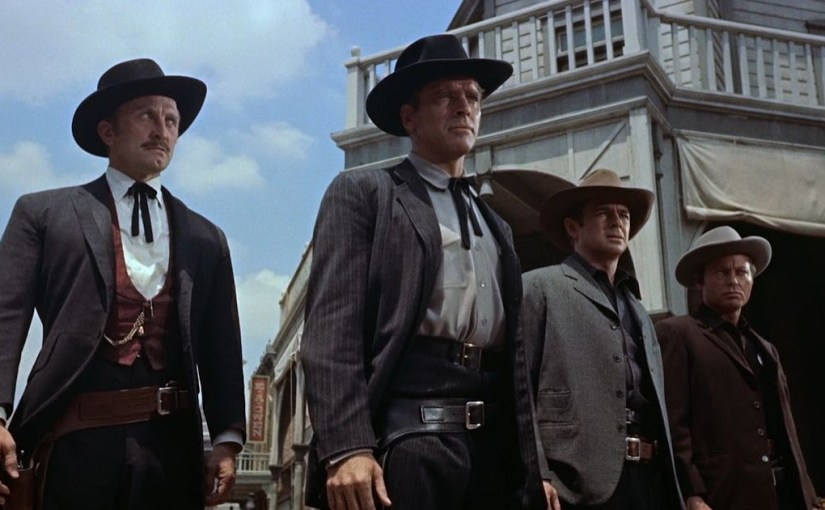
In real life, the legendary gunfight at the O.K Corral in the frontier town of Tombstone lasted thirty seconds, but what kind of movie would that be?  (Kill Bill: Vol. 2 springs to mind…)  A 1950’s Western requires a long-to-medium shot of the good guys – Wyatt Earp, his brothers, and Doc Holliday – striding down the street to meet the challenge of the dastardly Clantons, who had gunned down Wyatt’s youngest brother in cold blood.  We need a gunfight, not too long, but longer than 30 seconds.  And we need to make sure the ratio of surviving bad guys to good guys is just right: 0 to all.

John Sturges’ Gunfight at the O.K. Corral delivers the goods in a remarkably mature film for its time, free (for the most part) of cheap sentimentality and distractions from the main plot.  That’s a double-edged sword, though: we rarely leave the side of either Wyatt Earp or Doc Holliday, but the result is we get little to no information about Earp’s brothers until the final reel, nor do we get many details about Earp’s romance with the lovely Laura Denbow, a high-class gambler who knows enough about cards to beat the men at their own game.  We only find out they’re engaged as an afterthought, it seems.

As for Doc Holliday’s relationship with Kate Fisher (Oscar winner Jo Van Fleet), the word “dysfunctional” is woefully inadequate.  Loosely based on Holliday’s real mistress, referred to only as “Big Nose Kate” on Wikipedia, she seems to exist only to serve as Holliday’s psychological punching bag when required.  Her emotional yo-yoing gave me whiplash: she pledges her unending devotion in one scene, tries to stab him in another, helps him escape a lynch mob, takes up with the loathsome Johnny Ringo after yet another fight, begs to be taken back, and eventually tells him, “I’ll see you dead!”  With friends like these…

But even that kind of sordid melodrama is not enough to derail the throughline of the film, which is focused intently on establishing the rocky relationship between the morally good Wyatt Earp (Burt Lancaster) – who nevertheless wears a black hat the entire film – and the morally chaotic Doc Holliday (Kirk Douglas), a professional gambler who leaves a string of dead bodies behind him, all killed in self-defense, of course.  Earp also helps get Holliday out of town before a mob can lynch him, so Holliday decides to stick around until the debt is paid.

I think the essence of their relationship is summed up in a scene where Earp is forced to deputize Holliday when no other options are available.  Earp reluctantly walks up to Doc, tells him to raise his right hand, and says, “Do you solemnly swear to uphold…oh, this is ridiculous.  You’re deputized.”  Doc: “Wait a minute, don’t I get to wear a tin star?”  Earp: “Not on your life!”  Both men are torn between their philosophy and their sense of honor.  Holliday is no hero, but he’ll help Wyatt until his debt is paid.  Earp despises Holliday’s moral code, but he’s the best gunslinger in town.  What can you do?

All of this is handled in dialogue that seems mostly uncluttered by the hokey clichés I’ve heard in so many other films of the 1950s, even some of the great ones.  This may perhaps be due to the fact the screenplay was written by Leon Uris, a novelist who would eventually go on to write, among many others, Exodus, Topaz, and QB VII.  Listening to the characters talk, it was interesting to hear how natural they sounded, compared to the overblown melodrama of so many other westerns and dramas of that era.  The dialogue was clearly written by someone with a writer’s ear, who wants to get to the point of every scene with a minimum of fuss or flowery exposition.

As I mentioned, however, this quest for directness means we spend all our time with Earp and Holliday and almost no time at all with the Clantons or Earp’s brothers or anyone else.  By the time we hear Wyatt’s brother, Virgil, is in trouble, we’ve almost forgotten he HAS brothers.  As far as the Clantons go, we hear everything about them secondhand until we finally meet them in Tombstone.  We never even see Wyatt propose to Laura; we barely even see them courting (their courtship appears to consist of one false arrest and one kiss in the moonlight).

And I would be remiss if I did not mention…that song.  I learn from IMDb that the song, “Gunfight at the O.K. Corral,” that plays over the opening and closing credits, and which also plays over any transitional scene as Earp moves from one town to the next, was one of the inspirations for the theme song for Mel Brooks’s parody Blazing Saddles.  Brooks even got the original artist, Frankie Laine, to sing for his own movie.  It is so corny and earnest, juxtaposed against the gritty characters and scenery, that any sequence featuring that song loses all credibility.  If the filmmakers had just ditched that song, I might consider this one of the greatest Westerns of all time.  (see also Rio Bravo with Ricky Nelson’s crooning.)

But…having said all that, I must report that Gunfight at the O.K. Corral was entertaining from start to finish.  By avoiding the temptations to give in to melodrama and hokeyness, we are presented with a surprisingly solid Western drama that culminates in a decent (for the late ‘50s) gun battle.  It’s not as flashy as anything from one of Eastwood’s spaghetti westerns, and it’s not quite as thrilling as the one at the end of 1993’s Tombstone, but it’s satisfying, nevertheless.

(And for the record, when it comes to memorable lines, against Val Kilmer’s immortal “I’m your huckleberry”, I would gladly put Kirk Douglas’s venomous, “You slut!” …you have to see it in context, trust me.)

CALL ME BY YOUR NAME (Italy, 2017)

by Miguel E. Rodriguez

DIRECTOR: Luca Guadagnino
CAST: Armie Hammer, Timothée Chalamet, Michael Stuhlbarg
MY RATING: 10/10
ROTTEN TOMATOMETER: 94% Certified Fresh

PLOT: In 1980s Italy, romance blossoms between a seventeen-year-old student and the older man hired as his father’s research assistant.


Call Me by Your Name is remarkable because it tells a heartbreaking first-love story that could have easily devolved into cheap melodrama.  I mean, look at the plot description above.  It has “soap opera” written all over it.  But because director Luca Guadagnino (Bones and All, the 2018 remake of Suspiria) applies restraint, and because the screenplay by James Ivory (of Merchant Ivory fame) sticks to realism as opposed to predictable scripted nonsense, and because of the fearlessness of the film’s two leads, Call Me by Your Name becomes one of the best films about the thrill and heartbreak of first love I’ve ever seen.

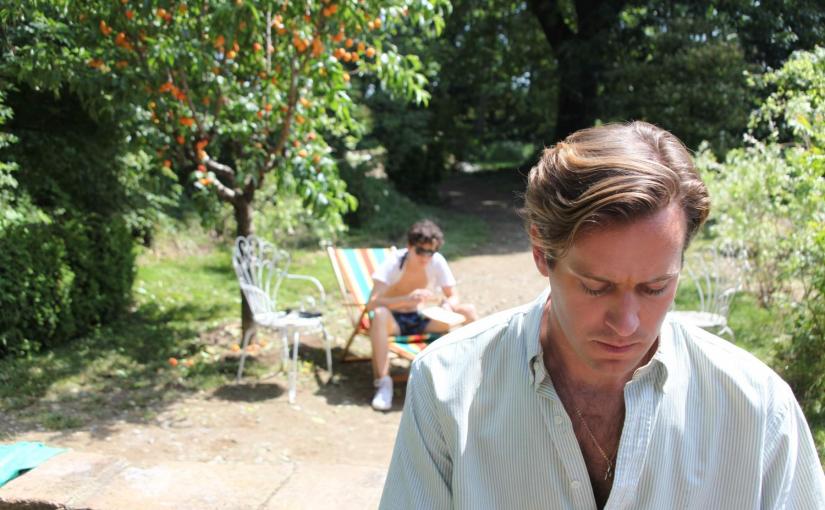
The story takes place in the summer of 1983, in Italy.  The Perlmans are on vacation at their villa in the Italian countryside.  Mr. Perlman (Michael Stuhlbarg) has hired an American, Oliver (Armie Hammer), to assist him with research over the holiday.  Elio (Timothée Chalamet), Mr. Perlman’s 17-year-old son, appears to take an instant dislike to Oliver, but we later see this is a maneuver designed to disguise his real, and scary, crush on Oliver.

…but I don’t want to write a full synopsis of the story, because I guarantee it would read like someone’s Twilight fan-fiction or something similar.  What happens is reasonably predictable and has been seen in countless movies from Douglas Sirk to Nora Ephron.  What makes this movie special is how it happens.

There is not a single scene or shot in the movie that feels routine.  Or, not “routine”, that’s not the right word.  The whole movie feels authentic.  Nobody talks in screenplay-ese (except for a sensational speech from Mr. Perlman near the end, which I will forgive because it works).  Whatever happens, whenever it happens, feels spontaneous and precisely observed.

Here is at least one moment that captures what I mean.  Elio’s crush on Oliver has gotten deeper, but he’s kept it to himself.  One night, the two of them and a bunch of Elio’s friends visit a local bar with an outdoor dance floor.  Oliver starts dancing with a pretty girl.  Elio’s friends get up to dance, but Elio stays behind, eyeing Oliver and the girl, and you can almost hear the gears turning over in Elio’s head.  He finally does get up to dance, but watch his movements carefully: he starts dancing with a girl, but surreptitiously moves closer to Oliver for a moment.  Oliver turns to Elio, and Elio abruptly turns away and pulls a little move and slide, pretending not to notice Oliver while also trying to impress him a little.  Elio turns back, sees that Oliver is no longer looking, and quickly moves back towards him.  This kind of behavior is so specific, and yet universally recognizable.  There was no dialogue, but I knew everything going through Elio’s head in every second of that scene.

I also admired the scene, done in one take, where Elio finally reveals his feelings to Oliver, but it’s all done in this marvelous code, where Elio never actually says precisely what he’s talking about, but Oliver is smart enough to decipher the code.  (“Are you saying what I think you’re saying?”)  I’ve seen so many films where the Oliver character is written as an otherwise adult person but has to be incredibly dumb in order to prolong the “idiot plot.”  How refreshing to be confronted with characters with working brains.

Guadagnino also appears to be a great fan of Japanese films, particularly those of Yasujiro Ozu.  Throughout the movie, there are many scenes that are divided, almost like chapter headings, by a series of stationary shots, held for several seconds, of ordinary items: a window, or a staircase, or the still waters of a lake, or an apricot tree.  Ozu was known for doing the same thing in his films; they were called “pillow shots,” because Japanese poetry utilizes the same device, using words instead of shots, to separate thoughts or ideas.  These “pillow shots” lend a sense of poetry or…I don’t know what, exactly, to the film.  It may look (and sound) a little pretentious, but trust me, it works.  It made the movie feel as if there were great currents of significance rumbling below the surface.

Alert readers may notice I haven’t even mentioned the sex scenes yet.  Going into this movie, I remembered that there was some hoopla about the graphic nature of those scenes, but I get the feeling they’re like the ear scene in Reservoir Dogs: everyone thinks they remember seeing the ear actually getting cut off, but we don’t.  Tarantino tactfully moves the camera up and away and leaves the dismemberment off-camera.  Same thing here.  Guadagnino leaves no doubt as to what is about to happen, but then moves the camera away, or cuts to the next scene, or expertly positions the camera so the naughtiest actions are never actually seen.

This is shrewd filmmaking.  If the film had been filled with NC-17-worthy content, the message would have been lost.  It would have become a movie about the sex instead of being about the turmoil and ecstasy of being in love with someone who loves you back, even if it’s only for a short time.

I should also mention the roles of Elio’s parents.  I can see how some people might watch the movie and imagine that his parents are far too forgiving, especially given their religious upbringing.  However, this was another welcome departure from the realms of unnecessary melodrama.  Instead of scenes where the furious parents make unreasonable demands or deliver intolerant lectures, we are given a father and mother who know enough about parenting, and about their son, to realize when it’s time to lecture and when it’s time to just let things happen.  I’m not suggesting they would ever willingly allow their son to go into harm’s way.  But they’re smart enough to know how important it is that Oliver and Elio take a little sabbatical together before Oliver’s final departure.

(They also know when a small lie is sometimes necessary at the appropriate moment.  After Mr. Perlman’s wonderful speech at the end of the film, Elio asks him, “Does mother know?”  Mr. Perlman hesitates, then delivers a very tactful answer.  To me, this was his way of protecting his son at a time when he desperately needed comfort.  I suppose it could be interpreted either way, but since Mr. Perlman knows his wife, I believe it was a perfectly timed lie.  Just a small one.  It’s a magnificent button to the scene.)

Call Me by Your Name deservedly won the Academy Award for Best Adapted Screenplay that year.  It’s a masterpiece of storytelling by osmosis, without using signal flags or hokey dialogue.  It recalls with perfect precision how it feels to be uplifted and crushed emotionally, and how one must decide how to deal with those feelings.  I was never the 17-year-old son of a professor with romantic feelings for his assistant, but I understood and identified with Elio nearly every step of the way during the movie.  I would imagine many others can, too.

PATRIOT GAMES

By Marc S. Sanders

You may remember Patriot Games as a tense thriller featuring the favorite hero Jack Ryan doing the wherewithal action that is demanding for the adaptation of Tom Clancy’s best-selling novel.  Harrison Ford (taking over the role from Alec Baldwin) plays the guy who will thwart an assassination attempt on the Royal Family or punch out a terrorist thug invading his home or on a speed boat during a dark and stormy night.  Only a small bit of the action sequences are flawed, but that doesn’t take away from what makes the picture truly special.  In the follow up to The Hunt For Red October, Jack Ryan goes back to the CIA to investigate who wants revenge against him and who was responsible for that assassination attempt.  What the picture serves as the covert halls of the Central Intelligence Agency is what is especially convincing and most fascinating.

On the surface, the Irish Republican Army appears to be the scapegoat for attempting to murder members of the Royal Family as they are pulling out of the front gates of Buckingham Palace.  Jack Ryan is in London vacationing with his wife Cathy (Anne Archer) and daughter Sally (Thora Birch) when he comes upon the incident just in time to foil the crime.  In the process, Ryan takes a bullet to the shoulder and kills the younger brother of the most dangerous squad member, Sean Miller (Sean Bean).  A quick trial puts Miller behind bars and Jack is recognized as a hero.

However, Sean Miller escapes with his surviving comrades and vows revenge on Jack and his family.  An attempt is made on the Ryans’ lives and Jack insists on getting back into the CIA to locate Miller and his team.

The revenge plot is the main thread and its pretty ho hum.  We’ve seen all that many times before.  However, what branches off are the conflicts within Irish politics and how Jack Ryan gradually uncovers who and where this small faction of terrorists may be.  Cold War commentary is delivered by an under the radar performance from one of my favorite character actors, Richard Harris.  He attempts to deny responsibility of these attacks and offer an olive branch to Ryan.  Ford and Harris have three good scenes together, two of which are minimal on dialogue but effective in sending their messages to one another. 

As well, Harrison Ford occupies another great heroic role.  I agree with a majority who believe he was too old to play the novice Jack Ryan described in Clancy’s early novels.  Many insist casting Baldwin was perfect.  It was. Yet, I am able to look past that as the character does not have the rookie appearance or regard in this picture.  With Harrison Ford, Jack Ryan is now at a point where he looks seasoned and experienced like the character eventually becomes in the book series.

Director Phillip Noyce is good at using the mysterious and quiet orchestral accompaniments of James Horner to follow Jack as he studies photographs or reflects on the day of the assassination attempt in order to piece together random clues.  In other films, this might get boring and tedious.  However, the director captures good closeups of Harrison Ford and quick flashbacks are edited to help identify what were important blink and miss it moments necessary to assemble the puzzle.  A simple visit to the restroom for Jack Ryan and a glance at a woman’s ponytail lead to a solid conclusion.

Sean Bean has the physical and quiet intensity to his role.  He’s the muscle of the terrorist group, not the leader (played by Patrick Bergen).  Bean serves the revenge element and his physique and weapon handling work well as a nice threat to the hero of the picture.

As the story progresses, the audience follows along with Ryan.  Satellite photographs are studied and zoomed in seeking some semblance of an image in a blur.  Sometimes Jack Ryan is moving in the right direction but in other times he’s unsure.  Even though we always know how the bad guys are doing and where they are, we empathize because Harrison Ford’s character does not.  Still, it’s a thrill to witness him eventually make his discoveries.

A nice approach occurs when the CIA sends in troops to what they believe is an enemy base camp.  We watch Jack Ryan and all of the government officials stare with intensity on a big screen as little black pixels drop down and move at a running pace from an overhead satellite shot.  We don’t have to endure one more machine gun battle.  This kind of intensity is much more interesting where lives are taken as a means of protection, but still a principled man like Jack Ryan does not feel good about what has to be done.

Patriot Games works well with its plays on espionage, spy activity, traitors, and government relations between America, Great Britain and Ireland.  The select action scenes are done well and hold their suspense for quite long.  However, the final sequence is challenging to sit through. 

As the enemy prepares a covert attack on the Ryans’ Virginia home where the Royal Family are guests, there is much running around upstairs and down, in the basement, and outside the roof and so on.  It’s pouring rain with the standard thunder and lightning in the middle of the night as well.  Once the villains and the hero make their way to some getaway boats, the film unravels.  The picture shakes like crazy against the waves and rain.  There’s little light on any of the shots as well and the sound goes loud due to the boat engines and the storm setting.  All of these elements make it challenging to get absorbed in the movie’s climactic ending. 

Hollywood pictures fall back on this approach often in films like Ang Lee’s Hulk and the first installment of The Hunger Games.  It’s dark and wet and shaky and rainy. So, it is hard to decipher who is hitting who and who is shooting at who and who is driving which boat and where are they now.  It’s a shame really because Patriot Games is a taut thriller that holds your attention for nearly two hours, but then you give up in the final few minutes to simply rely on your instincts for how the story is going to wrap itself up.

Jack Ryan’s second adventure is worth watching but oddly enough, maybe wait for your restroom break until the last ten minutes of the picture.

MARCEL THE SHELL WITH SHOES ON (2021)

by Miguel E. Rodriguez

DIRECTOR: Dean Fleischer Camp
CAST: Jenny Slate, Dean Fleischer Camp, Isabella Rossellini
MY RATING: 9/10
ROTTEN TOMATOMETER: 98% Fresh

PLOT: Marcel, a tiny talking seashell with big shoes and one googly eye, becomes the subject of a documentary.


Years ago, I went to see Happy Feet.  The premise was absurd – singing penguins, give me a break – but as soon as Nicole Kidman’s character sang the first words of Prince’s Kiss, I remember thinking, “Okay, this movie is only going to work if I just give in to the concept.”  I did, and it did (for the most part).  Some movies are like that.  If you’re the kind of person who brings too much logic to the movie theater, who’s always wondering, when a movie character just orders “a beer” at a bar, how does the bartender know what to bring him…if you’re that kind of person, then Marcel the Shell with Shoes On is not for you.  Trust me.  I’m trying to give a public service message here.  If you watch a James Bond movie and sit there the whole time going, “That couldn’t happen…that couldn’t happen”…then skip Marcel and go find a Werner Herzog documentary.  Cave of Forgotten Dreams is excellent.

However, if you enjoy flights of fancy, fits of whimsy, and a gently aggressive cuteness factor balanced nicely by, not one, but two potentially tear-jerking plot developments – all centered on a talking seashell – then have I got a movie for you.

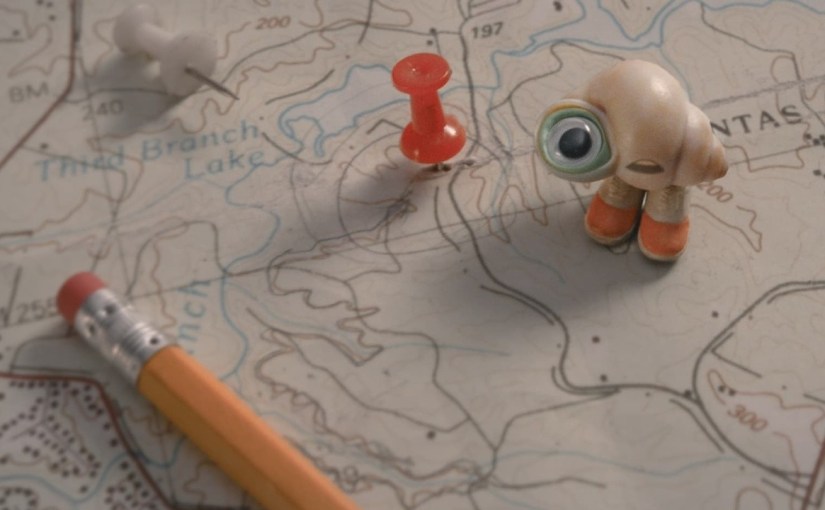
The story: A down-on-his-luck documentary filmmaker (Dean Fleischer Camp) moves into an Airbnb with his dog.  After following some odd clues around the house, he discovers his diminutive roommate: Marcel (voiced by Jenny Slate), a pebble-sized seashell with one eye – a googly eye – and tiny shoes, with a voice that sounds like your favorite childhood puppy was granted the gift of speech.  Dean discovers that Marcel has lived in this house for some time with his grandmother, Connie (voiced by Isabella Rossellini!).  There used to be an entire community, including many of Marcel’s family members, but they all vanished one traumatic night when the couple that used to live in the Airbnb got into an argument and the man stormed off with his luggage…carrying some unwitting passengers.

Now Marcel fends for himself, while Nana Connie helps in the garden.  Dean, the filmmaker, asks some excellent questions.  How does Marcel get around the house?  Why, by traveling inside a tennis ball using it like a tiny hamster ball; it’s okay as long as you don’t mind knocking some things over every once in a while.  What does he eat?  Mostly fruit from the tree growing outside.  How does Marcel get it out of the tree all by himself?  Using the mixer in the kitchen and a long length of rope, of course.  I could explain it, but it’s funnier if you find out for yourself how that works.  How does Marcel reach high places in the house?  Well, if he can’t jump it, there’s plenty of honey in the house, and honey is sticky, and that’s why there are sometimes little footprints all over the walls.  (Marcel asks Dean his own important questions: “Have you ever eaten a raspberry?  Um, and what was that like?”)

This is all unbearably cute.  I’m still not sure why I responded to it so strongly.  This is not normally my kind of material.  But the sight of this little seashell with one eye plopping down in front of the TV to watch 60 Minutes with his Nana just brought a smile to my face.  (Marcel explains, “We just call it ‘the show.’  That’s how much we love it.”)

One of the most charming elements of this movie is how it trucks along giving us one cuteness blast after another, and then it blindsides you with sentiments that are so simple and direct that they hit you in the feels before you even realize what’s happened.  As Marcel recounts the story of his family’s disappearance that fateful night, he sheds a tear or two.  Then he says:

“And then the next day, there was a really sunny day with a good breeze.  And I just remember thinking, if I was somebody else, I would really be enjoying this.”

I don’t know about you, but that statement really hits home with me, for all sorts of reasons that I won’t bore you with.  There are several moments like that in the film.  Here’s another one:

“Have you ever done that before, like, when there’s a party in your house?  Sometimes it’s easiest to rest when you go off by yourself and you can still hear the noise of the party, and you feel safe knowing that so many people are around, that you can have a rest?”

I identified with that so strongly that I can point to events in my life when I did exactly that, literally.  Hearing those words spoken in Marcel’s guileless, childlike tones almost felt…I might be overstating this a little…therapeutic.  It was a mildly bizarre experience for me.

Meanwhile, in events that uncannily mirror exactly what happened with the original Marcel shorts in real life, Dean posts his videos online and starts getting a phenomenal response.  He suggests that Marcel post a plea online to see if the online community can help track down his family.  This leads to some rather unfortunate attention-seekers, but it does provide a motivation for Marcel to take his first trip to the outside world, riding on the dashboard of Dean’s car.  If the idea of a teeny tiny seashell getting carsick and vomiting a teeny tiny little bit and apologizing every time…if you don’t find that even a little cute, I pity you.

Events progress rapidly (the movie is just over 90 minutes long).  There is an incident involving Nana Connie and some hooligans who break into the Airbnb.  The producers of 60 Minutes reach out to Dean and Marcel and ask if Lesley Stahl can come to the house and interview them.  Marcel says no, not until Nana Connie is better.  …and what happens after that I will not reveal, because it involves some of the most heartfelt passages of the film as the depth of Marcel’s relationship with his grandmother is tested, and the grandmother displays the kind of wisdom and sacrifice that would feel at home in an O. Henry story.

When so many films out there celebrate cynicism and snark, what a treat it is to find one that just wants to make you feel a little better.  I could not put it any better than Marcel himself:

“Guess why I smile a lot.  Uh, ‘cause it’s worth it.”

SUPERMAN II

By Marc S. Sanders

It’s time for the man in the red cape and blue tights to fall in love with Lois Lane, but wouldn’t you know it?  Three Krytonian criminals possessing the same powers as our hero have arrived on Earth with a means to dominate the planet and exact revenge on the son of their jailer.  Superman II picks up where Richard Donner’s original 1978 smash left off.  It remains a fantastically fun and breathless sequel.

Richard Lester (A Hard Day’s Night) gets the directing credit on this film following one of Hollywood’s most infamous behind-the-scenes stories.  While I’m a big admirer of Donner’s body of work, I think it was a blessing that Lester finished the job.  I’ve seen what Donner was intending to do on a special Blu Ray cut, and it just does not work. The characters make odd choices that seem inconsistent with how they were perceived in the first film.  That’s all I need to say about that comparison right now, though. 

In the original theatrical release, the story expands on the relationship between Superman & Lois (Christopher Reeve, Margot Kidder) as well as Clark Kent and Lois.  Eventually, both relationships intersect with one another, and Lois realizes the man she’s been admiring and the one she hardly takes notice of are one and the same.  The problem for Superman, known by his krypton name Kal-El, son of Jor-El, is if it is acceptable to be intimate with an earthling. 

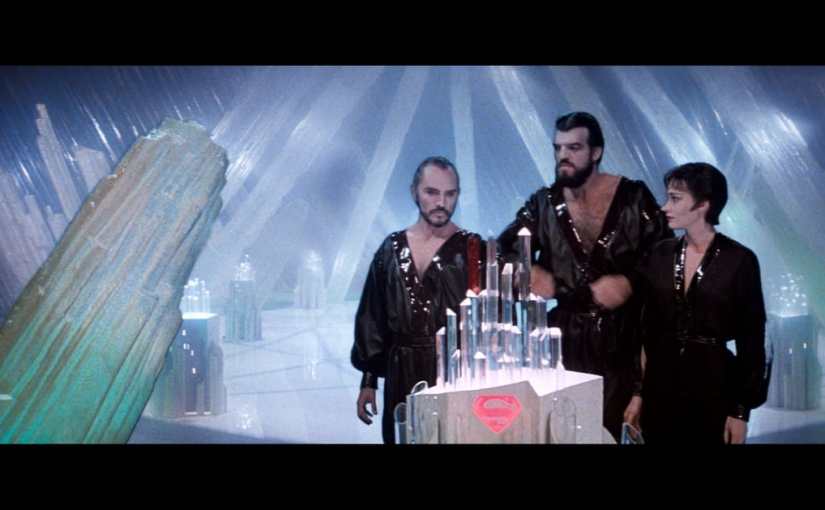
Meanwhile, Lex Luthor (Gene Hackman) has escaped prison to entice three villains from Krypton into a partnership that will allow them to take over the Earth and destroy Superman.  The trio is led by General Zod (Terence Stamp) with the wicked Ursa (Sarah Douglas) and the mindless and mute Non (Jack O’Halloran).  Following their attack on Houston, or as they call it the “Planet Huuston,” and the White House, it is on to Metropolis in search of Kal-El.

I’ve offered up quite a bit of what Superman II provides and I am not even close to sharing all it’s adventurous features and character dynamics.  This is a solid picture all the way through, and it begins with the casting.

I’ll be bold by declaring that Christopher Reeve as Clark Kent/Superman is one of the best casting decisions in film history.  Think about this for a moment.  As good as Henry Cavill was in Zach Snyder’s films, thirty years later, and how well some of the WB iterations have been, the contrary point that most people make is that none of them are Christopher Reeve.  From the smile, his handsome face, clear voice with perfect enunciation and even the signature hair curl over the forehead, no one has looked as good as a superhero come to life better than Mr. Reeve.  When he’s flying, even with outdated visual effect backgrounds, you are still convinced that Christopher Reeve knows exactly how to fly.

Following the director shake up on this picture, it is said Gene Hackman refused to shoot some scenes or do follow up edits.  You can tell when there is a double in place for him and you can hear the different vocal sound bites from Lex Luthor.  Nevertheless, what survived from Hackman’s participation is silly and twisted like you would expect from a modern-day, dastardly villain or as he declares himself to be “the greatest criminal mind of our age.” Some of these lines look hokey on paper, but Hackman invests his showmanship once again in the character.  I love it.  On all of those top ten lists, Gene Hackman as Lex Luthor is the one that everyone is regrettably forgetting about.

Margot Kidder is just as committed.  Lois Lane is best when she is the go-getter and Kidder is thoroughly convincing at not just being seen in the stunts and action but actually performing through Lois’ fears, sense of daring, and adoration for the love of her life.  Near the beginning of the film, there’s a great close up of Kidder looking up into the heights of the Eiffel Tower as Superman flies a hydrogen bomb out of danger.  No dialogue, but you can read it all over Margot Kidder’s face.  There goes my hero.  Watch him as he goes.  Few love interests in superhero films have ever matched what Margot Kidder accomplished in these pictures.

The action scenes are great set ups.  I get a chill down my spine every time I watch the showdown in Metropolis between the three baddies against the man in blue and red.  However, Richard Lester never neglects the acting throughout the whole two hours, particularly by the leads, as well as the Shakespearean maniacal performances from Stamp and Douglas.  Furthermore, the extras throughout Metropolis, Houston and even in Niagara Falls are performing very well and therefore turning the various settings into characters themselves.  Just as the fight over Metropolis is to begin, a cabbie declares “Man, this is gonna be good!”  Isn’t that guy speaking for the audience?  I remember the room applauding in the theater at that line.  When Superman rescues a child in Niagara Falls, a woman utters “What a nice man!” Clifton James, from a couple of James Bond movies, resurrects that redneck persona and it works better here as the guy who clashes with the imposing new visitors.  All of these walk on characters further shape the purpose of the visitors from space.  None of it depends on B-movie tripe like declaring “Peace!”  The personality of the folks meet the strangers from a strange land.  Sometimes it is done for means of slapstick, but it is always very entertaining.

Superman II is a perfect complement to the original film thanks especially to the cast.  Reeve gives multiple performances of Clark and Kal-El that could not be more different.  Kidder takes her character in new directions upon learning the surprises the script has in store for Lois.  Hackman is doing the same routine, but fortunately it’s welcome because I can not get enough of his antics.

This sequel really set the bar high and the next installments for Reeve came nowhere close. Though I actually have an affection for Superman III with that internal struggle depicted in the junk yard scene; one for the ages. 

The first two movies are legendary and Warner Bros/DC films realize they still have not superseded what was done over forty years ago.  The studios are not trying hard enough. However, more to the point, the filmmakers back then got it absolutely perfect, and you cannot beat Superman, nor can you beat perfection.

THE PURPLE ROSE OF CAIRO (1985)

by Miguel E. Rodriguez

DIRECTOR: Woody Allen
CAST: Mia Farrow, Jeff Daniels, Danny Aiello, Dianne Wiest, and…Jeff Daniels
MY RATING: 10/10
ROTTEN TOMATOMETER: 93% Fresh

PLOT: In 1935 New Jersey, a movie character walks off the screen and into the real-world life of a lonely, unhappily married woman.


I can imagine that it would be absurdly easy to poke holes in The Purple Rose of Cairo.  The premise is outlandish, taking place in the real world but firmly in the realm of fantasy.  It stretches the suspension of disbelief to the breaking point, then goes a little further.  It asks the audience member to forget cynicism and snark for eighty-two minutes and give in to the kind of hopeless romanticism that exists only on the movie screen.  And then, amid all that glorious make-believe, it abruptly confronts you with the knowledge that, yes, this kind of thing really does only happen in the movies, and the real world can be messy and unforgiving and sad.  Yes…but at our lowest points, we can always turn to Fred and Ginger, and Bogey and Bacall, and Luke and Leia, and Gene Kelly, and Hogwarts and the Emerald City.  The Purple Rose of Cairo reminds us that the movies allow us to escape reality for an hour or three.  Sign me up.

This movie’s plot is the embodiment of the “high-concept pitch.”  What if a movie character walked off the movie screen and tried to live in the real world?  I don’t have any statistics to support this, but I’m pretty sure there are at least 18,337 other films with variations of this fish-out-of-water scenario, most memorably Splash, Last Action Hero, and Who Framed Roger Rabbit.

In this version, Mia Farrow plays Cecilia, a semi-depressed housewife in 1935 New Jersey, living in a small town still in the grips of the Great Depression.  Her husband, Monk (Danny Aiello), claims he’s looking for work, but we only ever see him pitching pennies with his buddies or making life miserable for Cecilia at home.  Her wages from her waitressing job go directly to rent and groceries, and anything left over goes to Monk.  Amid this bleakness, Cecilia goes to see the new film opening at the local theater, The Purple Rose of Cairo, starring a dashingly handsome actor named Gil Shepherd in the supporting role of archaeologist Tom Baxter (both roles played by a young Jeff Daniels).  She is swept away by the glitter, glamour, and romance of the film.

Imagine her surprise when, during one of the many screenings she attends, Tom Baxter abruptly stops mid-sentence, breaks the fourth wall, and speaks directly to Cecilia from up on the screen.  “My God, you must really love this picture…I gotta speak to you.”  And he simply walks off the screen, much to the consternation of the movie audience, and walks out of the theater, arm in arm with Cecilia.  The wit with which Woody Allen handles the reactions of the audience AND the movie characters Tom leaves behind is priceless.  The characters and the real people react with perfect logic, so the effect is not one of slapstick (I can see an Adam Sandler version of this movie beating the joke to death), but one of a strange mixture of high and low comedy.  To relate the scenes here word for word would ruin the magic.  (An African-American maid steals every scene she’s in.)  Tom and Cecilia go off together, and the rest of the film is, from a plot perspective, fairly predictable.

What makes this movie unique is how it tells the story.  Tom knows what an amusement park is, but he has no clue what popcorn tastes like.  (“Been watching people eat it for all those performances.  When they rattle those bags, though, that’s annoying.”)  He has fallen instantly in love with Cecilia…love at first sight.  Tom hides in the city, and Cecilia lies to Monk to go back and see Tom the next night.  A nice touch comes when calls start coming in to RKO that the Tom Baxter character in prints being shown in other cities is also trying to escape his gilded silver-screen cage.  (“He almost made it in Detroit.”)  There’s the inevitable showdown between Tom and Monk.  Tom only knows the moves he uses on film, but Monk fights dirty.  However, the fight still doesn’t end quite as I expected…another nice touch.

The real crisis occurs when the studio calls in Gil Shepherd, the actor who PLAYS Tom Baxter, to New Jersey so he can try to wrangle his creation back into the movie where he belongs.  There is the expected confusion when Cecilia bumps into Gil, mistaking him for Tom.  The plot thickens even more when Gil starts falling in love with Cecilia herself, and she finds herself in a pickle.  She tells Gil, “I just met a wonderful new man.  He’s fictional, but you can’t have everything.”

The commentary being made here regarding our fascination with movie characters (and the movies themselves) as opposed to the actors who play them seems simple, but in trying to analyze it like a “real” critic, I feel helpless in the face of the ingenuity of the situation.  My words aren’t doing justice to the almost poetic elegance on display.  The more you love movies, the more you’ll appreciate what I’m desperately trying to convey.

There are two moments/sequences that elevate The Purple Rose of Cairo from a dramatic exercise into the realm of genuine movie magic.  One is when Tom wants to show Cecilia a night on the town, but they have no money (Cecilia is broke, and all of Tom’s movie money is fake).  But he remembers that, in the “fake” Purple Rose movie, the scene coming up after the one he abandoned takes all the characters to the Copacabana.  It’s here that the viewer simply must suspend what little disbelief remains and give in to the simple but grand gesture of watching Cecilia herself appear on the black-and-white screen with all of the people she’s been watching night after night.  They go to the Copa, and after watching the singer who’s supposed to be Tom Baxter’s love interest, Tom and Cecilia head out for a night on the town, as only 1930’s movies could provide.  (The maître d’ provides one of the movies biggest laughs when he suddenly realizes he can do whatever he wants…and does.)

But the greatest moment is the very ending, which I will try desperately not to spoil here.  It’s here where we get to the heart of what Woody Allen is really trying to say: The movies are here and real life is there, and never the twain shall meet.  Is this a depressing point of view?  Well, I mean…yeah, a little.  But it’s also indisputably true.  If we walked around like we were actually in a movie, we’d never lock our doors behind us when we walked into our apartment.  Everyone’s phone numbers would begin with “555”.  We’d turn on the light when answering the phone at night (who does that, really?).  But in the real world, none of that is true.  In the real world, hearts get broken, sometimes for good.  We get fired.  People die.  WE die.  Love the movies, Allen is saying, but never forget that you’re flesh and bone, and that actions have consequences.  I’m reminded of a good line from Ready Player One: “As terrifying and painful as reality can be, it’s also the only place that you can get a decent meal.”

The final shot of the movie, of Cecilia smiling through her tears, moved me like I’ve rarely been moved before.  It reminded me, perversely, of some of the worst times in my life because it was at those dark times that the movies came to my aid.  I went through a fair episode of depression in my twenties; a friend showed me Harold and Maude, and it literally changed my life.  During the Covid lockdown, I was furloughed, and the maddening Florida unemployment website sapped my will to live, figuratively speaking; my best friend, out of the blue, bought me a copy of Star Wars: The Rise of Skywalker just to cheer me up…and it did.  During that same period, several different films were in constant rotation in my movie room, all of which provided spectacular ways of escaping real life: Blade Runner 2049, Prometheus, The Martian, Interstellar, Gravity, and Sunshine [2007].  Not all laugh riots, to be sure, but they were excellent tonics against the constant worry of unemployment and disease.

And in 2017, Hurricane Irma threatened Florida.  For the first time, I was genuinely frightened that we would finally see real danger from a hurricane.  Miraculously, a local multiplex chose to stay open until almost the eleventh hour, and to get our minds off the approaching storm, I took my girlfriend to see the new remake of Stephen King’s It.  For two hours, we got scared out of our wits in the best way possible.  We escaped reality, and collectively we had our real-world fears literally exorcised.  I cannot tell you how grateful we were to have that brief respite from our troubles.

Those are the memories that came back to me in the final sequence of The Purple Rose of Cairo.  Yes, the real world is still the only place to get a decent meal, and it remains imperfect and sometimes painful.  But the movies are as close as a button click or a car ride.  They’re implausible and sometimes unrealistic and not always perfectly written.  But The Purple Rose of Cairo just wants to remind us of their power to cheer us up and transport us.