
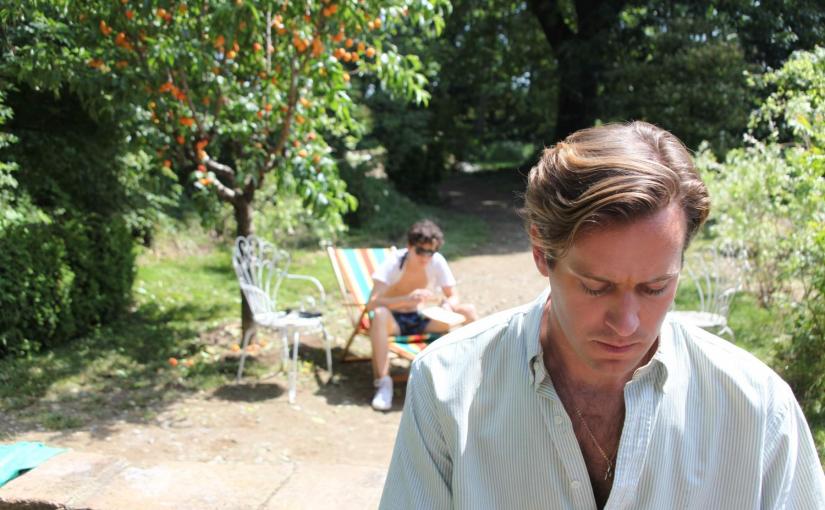
by Miguel E. Rodriguez
DIRECTOR: Luca Guadagnino
CAST: Armie Hammer, Timothée Chalamet, Michael Stuhlbarg
MY RATING: 10/10
ROTTEN TOMATOMETER: 94% Certified Fresh
PLOT: In 1980s Italy, romance blossoms between a seventeen-year-old student and the older man hired as his father’s research assistant.
Call Me by Your Name is remarkable because it tells a heartbreaking first-love story that could have easily devolved into cheap melodrama. I mean, look at the plot description above. It has “soap opera” written all over it. But because director Luca Guadagnino (Bones and All, the 2018 remake of Suspiria) applies restraint, and because the screenplay by James Ivory (of Merchant Ivory fame) sticks to realism as opposed to predictable scripted nonsense, and because of the fearlessness of the film’s two leads, Call Me by Your Name becomes one of the best films about the thrill and heartbreak of first love I’ve ever seen.
The story takes place in the summer of 1983, in Italy. The Perlmans are on vacation at their villa in the Italian countryside. Mr. Perlman (Michael Stuhlbarg) has hired an American, Oliver (Armie Hammer), to assist him with research over the holiday. Elio (Timothée Chalamet), Mr. Perlman’s 17-year-old son, appears to take an instant dislike to Oliver, but we later see this is a maneuver designed to disguise his real, and scary, crush on Oliver.
…but I don’t want to write a full synopsis of the story, because I guarantee it would read like someone’s Twilight fan-fiction or something similar. What happens is reasonably predictable and has been seen in countless movies from Douglas Sirk to Nora Ephron. What makes this movie special is how it happens.
There is not a single scene or shot in the movie that feels routine. Or, not “routine”, that’s not the right word. The whole movie feels authentic. Nobody talks in screenplay-ese (except for a sensational speech from Mr. Perlman near the end, which I will forgive because it works). Whatever happens, whenever it happens, feels spontaneous and precisely observed.
Here is at least one moment that captures what I mean. Elio’s crush on Oliver has gotten deeper, but he’s kept it to himself. One night, the two of them and a bunch of Elio’s friends visit a local bar with an outdoor dance floor. Oliver starts dancing with a pretty girl. Elio’s friends get up to dance, but Elio stays behind, eyeing Oliver and the girl, and you can almost hear the gears turning over in Elio’s head. He finally does get up to dance, but watch his movements carefully: he starts dancing with a girl, but surreptitiously moves closer to Oliver for a moment. Oliver turns to Elio, and Elio abruptly turns away and pulls a little move and slide, pretending not to notice Oliver while also trying to impress him a little. Elio turns back, sees that Oliver is no longer looking, and quickly moves back towards him. This kind of behavior is so specific, and yet universally recognizable. There was no dialogue, but I knew everything going through Elio’s head in every second of that scene.
I also admired the scene, done in one take, where Elio finally reveals his feelings to Oliver, but it’s all done in this marvelous code, where Elio never actually says precisely what he’s talking about, but Oliver is smart enough to decipher the code. (“Are you saying what I think you’re saying?”) I’ve seen so many films where the Oliver character is written as an otherwise adult person but has to be incredibly dumb in order to prolong the “idiot plot.” How refreshing to be confronted with characters with working brains.
Guadagnino also appears to be a great fan of Japanese films, particularly those of Yasujiro Ozu. Throughout the movie, there are many scenes that are divided, almost like chapter headings, by a series of stationary shots, held for several seconds, of ordinary items: a window, or a staircase, or the still waters of a lake, or an apricot tree. Ozu was known for doing the same thing in his films; they were called “pillow shots,” because Japanese poetry utilizes the same device, using words instead of shots, to separate thoughts or ideas. These “pillow shots” lend a sense of poetry or…I don’t know what, exactly, to the film. It may look (and sound) a little pretentious, but trust me, it works. It made the movie feel as if there were great currents of significance rumbling below the surface.
Alert readers may notice I haven’t even mentioned the sex scenes yet. Going into this movie, I remembered that there was some hoopla about the graphic nature of those scenes, but I get the feeling they’re like the ear scene in Reservoir Dogs: everyone thinks they remember seeing the ear actually getting cut off, but we don’t. Tarantino tactfully moves the camera up and away and leaves the dismemberment off-camera. Same thing here. Guadagnino leaves no doubt as to what is about to happen, but then moves the camera away, or cuts to the next scene, or expertly positions the camera so the naughtiest actions are never actually seen.
This is shrewd filmmaking. If the film had been filled with NC-17-worthy content, the message would have been lost. It would have become a movie about the sex instead of being about the turmoil and ecstasy of being in love with someone who loves you back, even if it’s only for a short time.
I should also mention the roles of Elio’s parents. I can see how some people might watch the movie and imagine that his parents are far too forgiving, especially given their religious upbringing. However, this was another welcome departure from the realms of unnecessary melodrama. Instead of scenes where the furious parents make unreasonable demands or deliver intolerant lectures, we are given a father and mother who know enough about parenting, and about their son, to realize when it’s time to lecture and when it’s time to just let things happen. I’m not suggesting they would ever willingly allow their son to go into harm’s way. But they’re smart enough to know how important it is that Oliver and Elio take a little sabbatical together before Oliver’s final departure.
(They also know when a small lie is sometimes necessary at the appropriate moment. After Mr. Perlman’s wonderful speech at the end of the film, Elio asks him, “Does mother know?” Mr. Perlman hesitates, then delivers a very tactful answer. To me, this was his way of protecting his son at a time when he desperately needed comfort. I suppose it could be interpreted either way, but since Mr. Perlman knows his wife, I believe it was a perfectly timed lie. Just a small one. It’s a magnificent button to the scene.)
Call Me by Your Name deservedly won the Academy Award for Best Adapted Screenplay that year. It’s a masterpiece of storytelling by osmosis, without using signal flags or hokey dialogue. It recalls with perfect precision how it feels to be uplifted and crushed emotionally, and how one must decide how to deal with those feelings. I was never the 17-year-old son of a professor with romantic feelings for his assistant, but I understood and identified with Elio nearly every step of the way during the movie. I would imagine many others can, too.
 2 UNPAID MOVIE CRITICS!!!!