GENTLEMEN PREFER BLONDES (1953)

by Miguel E. Rodriguez

DIRECTOR: Howard Hawks
CAST: Jane Russell, Marilyn Monroe, Charles Coburn
MY RATING: 7/10
ROTTEN TOMATOMETER: 88% Certified Fresh

PLOT: A couple of showgirls on a cruise to France get themselves involved in a plot involving a private detective, a diamond tiara, and the occasional musical number.


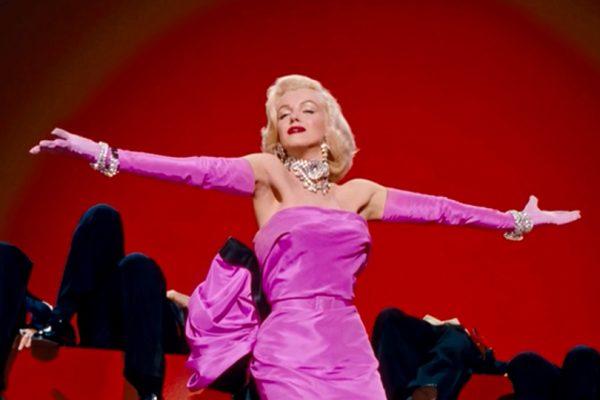
Why did I watch Gentlemen Prefer Blondes, a musical from 1953 featuring Jane Russell and Marilyn Monroe?  Well, it happens to be listed in the movie compendium 1,001 Movies You Must See Before You Die, for one thing.  And there’s the uber-famous production number “Diamonds Are a Girl’s Best Friend” performed by Marilyn Monroe in that iconic pink dress that showcased her shimmy like nothing else I can think of.  And it’s directed by Howard Hawks, one of my favorite directors from Hollywood’s golden years (His Girl Friday, The Big Sleep, Bringing Up Baby, many others).

While the song and the actors and the direction are competent, I didn’t quite get involved in the story as much as I hoped I would.  There’s no denying the wattage generated by Monroe whenever she’s on screen, and the screenplay by Charles Lederer provides some amazing little zingers, some of which I’m shocked got past the 1953 censors.  (When a man is asked which girl he would save from drowning first, Russell or Monroe, the man replies in admiration, “Those girls couldn’t drown.”)  But the plot, which I won’t even bother describing here, is merely a nail on which to hang those visuals of Jane and Marilyn strutting their stuff in exuberant Technicolor dresses and the occasional song or three.  Make no mistake, from a narrative standpoint, Gentlemen Prefer Blondes is pure farce, top to bottom.  (And no wonder, it’s based on a stage musical.)  You either give in to the formula or you don’t.  And I’ll admit, there were times when I didn’t.  There’s a song and dance number at a Parisian café which I thought was unnecessary, and the tortuous route traveled by the tiara, especially its final hiding place, stretched the logical part of my brain to the limit.

But, on the other hand…yeah, it was fun.  Set logic aside and surrender to the sights and sounds, and Gentlemen provides substantial eye and ear candy.  And there are some genuine laughs.  Like the subplot about Monroe looking through the passenger manifest looking for gentlemen traveling “with valets”, who must therefore be rich.  She finds one, Henry Spofford III, and arranges for him to be seated at her dinner table.  The revelation of Mr. Spofford’s true nature is one of the comic high points.

Or the bit towards the end where Jane Russell gets to have her cake and eat it, too.  Thanks to the machinations of the plot, Russell not only gets top billing for the movie, but she also gets to lampoon her sexy costar by impersonating Marilyn Monroe.  (In fact, if I didn’t know any better, I’d say that her appearance in a courtroom wearing a fur coat that conceals all until she crosses her fishnet-clad legs may have provided at least SOME inspiration to that one scene in Basic Instinct.  YOU know which scene I’m talking about, perv.)

But when it comes down to it, if for nothing else, you’ve got to watch Gentlemen Prefer Blondes just to see Marilyn Monroe singing “Diamonds Are a Girl’s Best Friend.”  She may play ditzy and dumb for the whole rest of the movie, but in this number, Monroe is totally and fully in command of her body, the camera, and the audience in that strapless pink dress which looks like it’s held up by sheer willpower.  For several minutes, she coos, struts, bumps, shimmies and shakes, and there’s nothing you can do but just watch in awe.  Almost as much as she did in Some Like It Hot, she simply embodies sexual…sexual…you know what, she just embodies sex.  I suppose there’s a more literary way to describe it, but I’m too tired to think of it.

Gentlemen Prefer Blondes may not feature the dancing feet of Gwen Verdon or Gene Kelly, or the vocal stylings of Debbie Reynolds or, well, Gene Kelly, or the literary complexity of West Side Story or A Star Is Born.  But when you have a song and dance number that is literally inimitable (sorry, Madonna, nice try), who cares?  I can think of plenty of worse ways to spend an evening than watching Jane Russell and Marilyn Monroe for 90 minutes.

[Side note: Penni was NOT a fan of how Monroe’s character constantly called her fiancé “daddy.”  Not sure why I’m mentioning that, but it just made it funnier to me every time Monroe said it.]

CASABLANCA

By Marc S. Sanders

I’ve always struggled with Casablanca.  It just does not have that hold on me that so many cinema lovers acquire upon viewing the celebrated film.  In the past, I’ve called it overrated, a bore, underwhelming, and plenty of other negative connotations.  Don’t worry reader.  I’ve been stabbed in the heart, back and eyes a thousand times over with the eyerolls, the verbal gasps, and the room exits from friends when I contribute to a discussion on this overall favorite.  I’ve tried.  Believe me, I’ve tried to love Casablanca.  Now, on this fifth viewing, or call it the sixth because I had to stop in the middle when my mind was wandering last week, I sincerely developed a semblance of appreciation for the picture.  Now be patient with me.

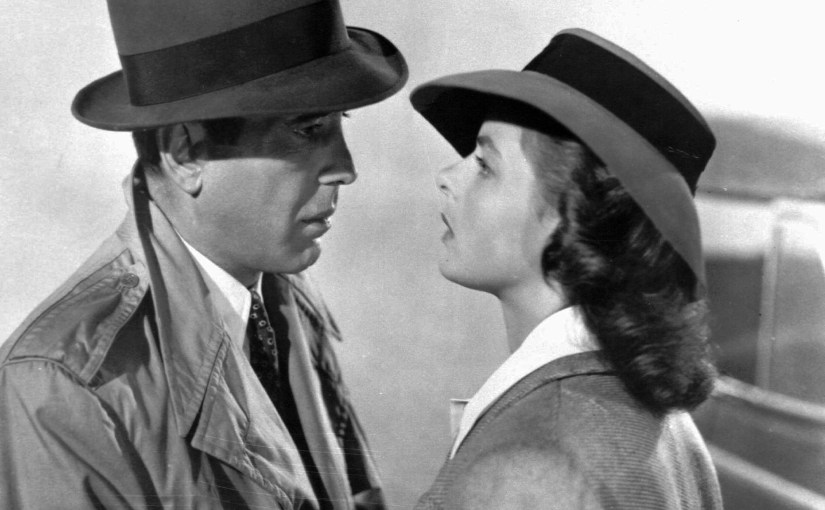
To absorb the classic film about Rick Blaine (Humphrey Bogart), the saloon keeper who keeps to himself, crossing paths with his long-lost love Ilsa Lund (Ingrid Bergman), I allowed myself to envision watching it in a movie house in 1942, when World War II was occurring on another side of the world and people were being forced to relocate or suffer captivity at the hands of the vile Nazi regime.  Casablanca, Morocco was the last hopeful exit to Lisbon, and then on to the Americas.  I had to embrace the setting and the time period in order to relate to the Oscar winning film. 

Rick runs the Café Americain near the airport of Casablanca.  All walks of life come through the doors each night to drink, gamble, smoke, flirt, and sing along with Sam the memorably charming piano player (Dooley Wilson). Most importantly, some patrons hope to score the necessary papers for passage out of this tiny desert port area that has yet to be Nazi occupied.  Rick is the expatriate who runs this gin joint and he has no interest in aiding anyone with an escape, nor with assisting the Nazis in rounding up their usual suspects they believe are enemies of the state.  He could care less about anyone’s cause or politics.  He just wants to run a respectable bar.

However, the past circles back on Rick when Ilsa arrives with a wanted Frenchman named Victor Laszlo, great name, played by Paul Henreid.  Victor has escaped the concentration camps and he is making efforts to reach the states so that he can continue his underground campaign of exposing the treachery and threats of the Nazis.  Rick has already been warned if Victor should make an appearance he must not be permitted to leave Casablanca.  The bar manager would rather not be involved.  Yet, it’s hard for him to resist thinking about his past love, Ilsa. Flashbacks soon reveal their time spent in Paris when they fell madly in love only for her to suddenly abandon him as they were trying to board a train exodus before the Nazis seized the territory.

Casablanca has a very simple plot and that lends to the strength of its finished product.  The love triangle of three good people, Rick, Ilsa and Victor, is where the complexity lies and there is no denying how memorable the main players are in their roles.  However, I can only surmise that the legendary status of the film tainted my open mindedness for an admiration of the piece.  The hype has always been too much for me, I guess.

Reader, I don’t think I am a big fan of Humphrey Bogart.  I’m very sorry.  It could be The Big Sleep or The Maltese Falcon.  Too often, I think he is quite bland in his signature, unforgettable caricature. No matter which film he’s in, Bogart is unique.  There is still no one like him with his chiseled face, dark hair and deep voice.  I’m not sure that’s even a fair description.  It’s hard to find the right adjectives for Bogie.  He was one of a kind.  However, there was little range to the star.  (I know.  I’ve seen The African Queen; great movie.) Rick is so closed off and predominantly on the same plane of emotions whether I am seeing him at the beginning of the film or at the end when he delivers his final speech to Ilsa before the plane departure.  He’s too one note for me. He’s just a boring guy and if I was at a table drinking alongside him, I would have to excuse myself very quickly.  Even to play chess with Rick would be excruciating.

Paul Henried is charming though.  He plays Victor as the adventurer or the daring swashbuckler, aware of his threat to the Nazis, but fearless in whatever he faces.  He just knows he serves a greater purpose to the world.  The loose knit, white suit and hat compliment his relaxed stature.  Even the scar over his right eye seems to tell a story.  In Casablanca, I find myself more concerned with what will happen to Victor Laszlo than anyone else.

Ingrid Berman is strikingly beautiful.  You can just recognize her exuberance through the black and white photography.  She was an actress that the camera loved and her performance is sensational as the woman caught in the middle, who mourned what she thought was the loss of a husband, only to find new love. Then the unexpected interfered with her desire for a promising new future.  Her best scene is when she stands up to Rick, no matter the stakes, to get him to help her rescue her husband Victor.  If it is not pleading, then she will use other means.  Frankly, I had forgotten what she tried next in this scene, which I will not spoil.  So, when the camera cuts back to her following another speech from Rick, my eyes went wide.  Ilsa is not just some pretty dame.  She knows she must be more than that, even more than a one night stand or some gentleman’s true love.

For so many years, I would hop on The Great Movie Ride at Disney/MGM studios and come across the famous final scene.  I heard Rick’s speech so many times, a hundred times more than I have watched Casablanca.  Take a scene like that out of context, and it waters down the power of the celebrated film.  What a difference it makes after you learn why Rick and Ilsa could not stay together following Paris, and why you learn their fates are destined for different paths perhaps.  “Here’s lookin’ at you kid!” has a deeper connotation when watching the film as a whole.  I know I’m pointing out the obvious.  Yet, I embraced Bogart’s improvised line that much more in addition to so many other well-known pieces of dialogue.  Other films have those special moments where you can isolate a scene on a work break and just take it in.  I know snippets of Casablanca are viewed that way, but there’s an emptiness to watching these scenes in that fashion.

In 1942, following the Japanese attack on Pearl Harbor, as Jews and gypsies and every other race or nationality or demographic were being bullied at the hands of an unforgiving Nazi regime, audiences must have regarded Victor, Ilsa and Rick as heroes.  True heroes!  They must have been considered the heroes who don’t amount to a hill of beans in this crazy, mixed-up world, but must therefore sacrifice what they hold so dear and personal.  It makes me wonder if Michael Curtiz’ film would have had the same kind of impact if it was released at later time in the century like the 1960s, long after the war was over and the Axis armies, particularly the Nazis, were wiped out.  In 1942, perhaps I would have had more of an appreciation for Rick and Ilsa if I watched the film then. 

My attention especially perked up during the competitive nature of the French and Moroccan patrons singing the anthem La Marseillaise against the Germans’ rendition of Die Wacht am Rhein.  It’s a scene that demonstrates promise during a very frightening and confusing period in time.  I imagine audiences applauded and cheered during this scene.  On the other hand, maybe they were afraid and apprehensive to do so during such a confusing time.  The fiction found in the Oscar winning script from twin brothers Julius and Phillip Epstein was daring enough to defy the power of Hitler’s fast rising influence.  Modern films from the likes of Spike Lee and Adam McKay attempt to circumvent their stories to present day crises and dare to footnote their films with real life news footage.  It’s admirable at times.  Sometimes their efforts are divisive.  Yet, they do not feel as meaningful as what the Epstein brothers and Curtiz accomplished.  For me, this moment near the conclusion of Casablanca is my favorite scene of the picture.  The slaphappy regulars of Rick’s Café  Americain were enthusiastic to join Sam for a rousing rendition of Knock On Wood, but when reality intrudes upon their escapism, another dimension to the people does not hesitate to stand up for a purpose.

So, it’s always been tough to win me over with Casablanca.  Still, I marvel at the picture for the absorbing settings of Rick’s Café along with the crowded Moroccan streets occupied with refugees and pickpockets under the authority of a party who threatens to stake its claim.  Sam turns the bar into a regular evening atmosphere to bond and escape while the drinkers yearn to be on the next plane to safety and freedom.  Tricks are turned where travel papers are the most sought-after commodity, and ultimately, beyond Rick Blaine, there are people who may strive for safe passage and will also unite against a tyranny if enough will take up their swords, people like Victor Laszlo. This is what I treasure from Casablanca

The cast consists of a colorful bunch including Claude Rains, Sydney Greenstreet, Peter Lorre and Conrad Veidt.  Plus, Rick and Ilsa will always have Paris, but that was always a tough relationship for me to connect with.  What is more meaningful is the harbor that Casablanca and Rick’s Café Americain offered those who were fleeing, hiding and surviving amid their desperations.

This will not be the last time I watch Casablanca.  For a film to have this much staying power after more than eighty years, there must be something else I have yet to uncover, and I cannot wait to find it.

I’ll play it again for old time’s sake. 

JOE KIDD

By Marc S. Sanders

Joe Kidd is not one of Clint Eastwood’s best westerns.  In fact, it might be his weakest of the sort.  The film arrived at the tail end of director John Sturges’ (Bad Day At Black Rock, The Magnificent Seven) career and through my research it seems that Eastwood did not get along with him.  Sturges was rumored to be an alcoholic providing limited focus on the film in question.  I’m apt to believe that theory.  Joe Kidd, which was scripted by Elmore Leonard who would go on to write Get Shorty, is full of enormous plot holes. 

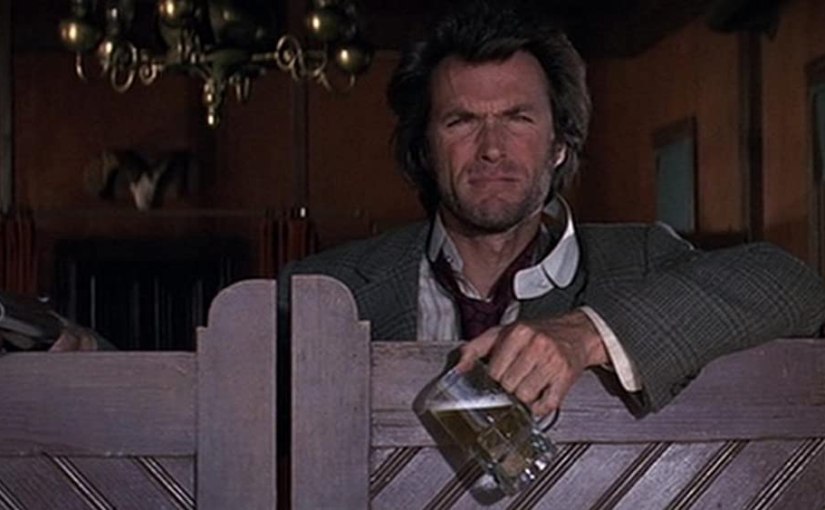
Eastwood is a welcome sight at first, handcuffed in the Sherrif’s jail until he’s unlocked to attend his court hearing.  Before leaving, in typical quiet, tough guy style, he demonstrates to an annoying cellmate that he won’t be intimidated by splashing the guy’s stew in his face and then denting the pot over his forehead.  It’s a great introduction for a title character.  I laughed.  I clapped.  After that, however, the movie fell apart.

The structure of Joe Kidd seems to start in the middle of a story that opted not to go back to the beginning.  A Mexican rebel leader named Luis Chama (John Saxon) causes some ruckus in the courtroom and around town, and then he flees into the nearby mountains.  Joe manages to shoot one gang member who enters the saloon.  Thereafter, a wealthy landsman named Frank Harlan (Robert Duvall) arrives and after paying for Kidd’s bail, he hires the ex-bounty hunter to accompany his posse and bring back Chama and his squad.  According to Harlan, Chama is occupying a large chunk of valuable land and therefore has to be taken out of the equation.  Okay.  Simple enough.

However, the narrative zig zags from that point.  First, Joe declines the offer from Harlan.  Then he discovers that Chama has tied up one of his ranch hands in barbed wire.  So, he dons his perfect tough guy cowboy duds (his hat looks great on his head) and off he goes with Harlan.  Midway on their journey through the mountains, they set up camp at a Mexican church.  Harlan announces into the wide expanse, for Chama to hear, that he will kill five people in the church if he does not surrender himself.  After a period of time, he’ll kill five more until the Rebel gives himself in and so on and so on.  Joe Kidd does not agree with this arrangement, gets fired by Harlan and eventually sidles up with Chama.  What’s going on here?  Didn’t Joe want to even a score with Chama after what he did to his ranch hand?  In a short ninety-minute running time, set ups occur only to be undone minutes later, and I’m starting to question my ability for basic comprehension. 

To date, of all I’ve seen in Robert Duvall’s illustrious career, this is hands down the weakest character he’s portrayed.  He’s not a terrible actor here.  He just has nothing to do except look like a greedy landowner with a mustache and a six shooter on his hip.  He’s not given any dimension of material to play with, and thus comes off like a bad guy of the week on an episode of The A-Team.  John Saxon actually guest starred a few times on that show as a variety of different bad guys.  The only new thing I see from him in this picture is his unconvincing Mexican accent. 

Clint Eastwood is playing his typical westerner.  He looks great with the hat and stature and the gun in his hand.  Yet, the novelty looks tired here.  As if we’ve already seen him in other classics like the Dollars trilogy, and High Plains Drifter.  There was nothing new to offer with Joe Kidd.  A diversion occurs early on where Kidd is about to take advantage of Harlan’s girl.  That goes nowhere and serves no purpose.

I imagine there was a better and more fleshed out script here that never materialized.  A friend of mine recently asked me if it would make sense to remake films with potentially good ideas that were poorly executed.  Seems logical to me, and then he asked me to name some examples.  On the spot, I could not come up with one.  Howard The Duck? Never!  Green Lantern?  Yeah, that’ll likely be done eventually anyway.  However, I think I have come across a good one to consider.  How about remaking Joe Kidd

You know what?  Wouldn’t work.  There’s a tone to the piece that seems a little prejudiced and not appropriate for present day. More importantly, on another try, it wouldn’t have the main attraction. 

Has anyone remade a Clint Eastwood picture? 

My point exactly!

JFK – DIRECTOR’S CUT

By Marc S. Sanders

Oliver Stone’s JFK is told through perspective, not necessarily history.  It’s not a biography and I do not believe Stone would ever claim it to be so.  It’s a thinking person’s picture that gives viewers entitlement to question what occurred, how it occurred and why it occurred.  It might guide you not to trust what anyone says, sees or hears, but let’s face it.  Probably the day Kennedy was shot, November 22, 1963, could we ever completely trust anyone ever again? 

(Forgive my cynicism.  I must backtrack a little.  I still trust my wife and daughter.)

Oliver Stone works through the eyes of New Orleans Prosecutor Jim Garrison (Kevin Costner, in what may have been his most challenging role to date at the time).  Garrison sees a little too easily that there are circumstances out of place, or maybe too neatly in place to satisfy the ultimate resolution that a known American defector to the Soviet Union, like Lee Harvey Oswald (Gary Oldman), acted alone in the assassination of the President.  Stone wrote the script for JFK with Jim Marrs and used Garrison’s input from his own novel. Nearly every scene builds into another possibility of how that fateful day came to be.  Stone even questions if a famous photo of Oswald on the cover of Life Magazine is real.   Too many cover ups with a building list of body count witnesses and too many coincidences keep Garrison up at night.  So, he assembles a crack team of investigators and fellow attorneys to reopen the case and question the official Earl Warren Commission.

Firstly, JFK is magnificent entertainment with a hair raising and unusual original score from famed film composer John Williams.  His notes on percussion with dings and harpsichord strings cue in at just the right moments when Stone introduces another one of many scenes that point out what seems cagy and suspect. The music of JFK works as a narrator.  This narrative keeps you alert.  Maybe you should look in each corner of the screen at times for some subtle clues.

It was also wise of Stone to go with a well-known cast of actors.  The Oscar winning editing from Joe Hutshing and Pietro Scalia moves at a breakneck pace.  Yet, because I recognize fine performers like Ed Asner, Jack Lemmon, Kevin Bacon, Tommy Lee Jones, Brian Doyle-Murray (Bill’s brother), John Candy and Joe Pesci it is easy to piece together who is playing who and what significance they lend to the many theories Garrison and Stone question next.  

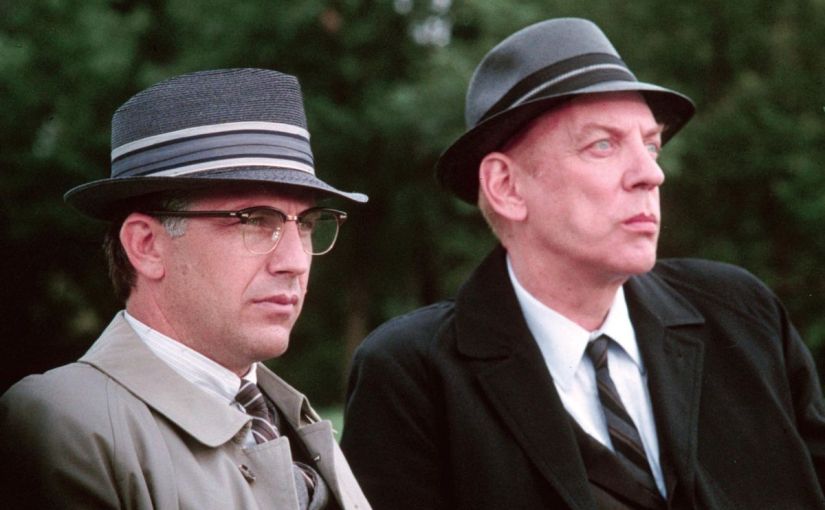
My admiration for the casting continues with the Garrison team that performs with Costner – Michael Rooker, Laurie Metcalf (especially impressive), Wayne Knight, and Jay O. Sanders.  There’s also a clandestine trench coat guy named X portrayed by Donald Sutherland.  Who even knows if this guy ever existed?  He’s more secretive than Deep Throat, but Mr. X has a hell of a lot of information to justify Jim Garrison’s suspicions.  That is an especially marvelous sequence between two men strolling through Washington D.C., eventually concluding a disturbing realization on a park bench.

Sissy Spacek brings out another dimension to the Jim Garrison character.  She’s his wife and the mother of five who suffers the loss of her husband’s attention which is entirely focused on this compounding investigation.  I like Costner’s take on the Garrison character.  Early on he politely asks one of his associates to stop cursing.  He does not like that kind of talk.  Later, it is Garrison who is dropping a number of eff bombs in front of his wife and young children.  This conundrum of a case, a very puzzling detective story, is unraveling the investigator. 

JFK was instrumental for further Congressional consideration following its release.  Files were reopened.  Additional research was executed, and soon many of those secret documents pertaining to the assassination will be revealed in 2029.  Back in 1991, of course that appeared to be a lifetime away.  It’s time we know everything, though.  Arguably, most of who were involved in this incident are dead by now.  Let us know our history.  Still, Garrison was bold enough to point skepticism at not just the adversarial relationship Kennedy may have had with Castro, the Cubans and their Communist allies, but also the people within the CIA and the FBI.  Lyndon Johnson is not even free from scrutiny after he’s sworn in.  Some on Garrison’s team went so far as to factor in culpability from the mafia.  Garrison was not so keen on that theory, actually. 

The construction of Oliver Stone’s film is unparalleled.  I think it’s his best film to date and I can find few others that even compare to how he assembled the picture.  It begins with the voiceover of Martin Sheen laying out many news cycles that were occurring ahead of Kennedy’s murder such as the Bay Of Pigs and the President’s supposed efforts to withdraw from Vietnam.  Sheen’s narrative comes at you very fast with Stone incorporating real life home movies of Kennedy along with his brother Bobby, as well as Castro, and television news footage from Vietnam and anywhere else events were happening.  By the end of the roughly five-minute opening, your head might be spinning. 

Thereafter, though, Stone goes through Garrison’s day on November 22, 1963, watching the outcome following the momentous event and the writer/director works his way into the drama beginning with Asner and Lemmon as two drunk old guys walking through the rain and getting into an argument. 

Three years pass by and so begins Jim Garrison’s motivations to follow multiple trails of breadcrumbs that lead to a lot of different places, all unlike what Earl Warren surmised. 

The scenes work quickly from that point on, and cuts of theoretical reenactments occur.  Who knows if any of these scenes are factual?  Stone and Garrison want you to at least consider their reasonable likelihood.  Moments happen where Joe Pesci and Tommy Lee Jones’ characters appear to be lying about even knowing one another while Stone will depict a sexual role play encounter between them which also includes Kevin Bacon as someone with no more reason to lie. 

Episodes are deeply focused on Lee Harvey Oswald depicted as an infamous and suspected patsy in association with others who may have a reason to want Kennedy dead.  Gary Oldman hides so well in the role.  Oliver Stone even lends focus to how different witnesses describe Oswald.  In some scenes it is Oldman, but then there are other times where a shorter, more overweight man may have been the real Oswald. Later, there’s an Oswald who is taller and more slender. 

A few years ago, I was visiting Dallas, and I was able to spend a some time walking around the crossroads where Kennedy was shot in the convertible while seated next to his wife Jackie.  Watching JFK again lent more clarity to all of the locales such as where Oswald was supposedly shooting from the top floor of the corner book depository.  Kevin Costner and Jay O. Sanders go through the motions of Oswald firing the three shots from his rifle in the short amount of time span.  The script also questions why Kennedy was taken out by Oswald after the turn off the corner of Elm and Houston. There appears to be a better wide-open clear shot long before the turn with the car only going ten miles per hour.  The men question if it was Oswald, then why didn’t he take advantage of the clearer shot.

I know.  I could go on and on.  I have to stop myself.  There’s a ton – A TON – of information in JFK.  It becomes addicting to watch.  You don’t even want to pause the long film for a bathroom break.  I watched the extended Director’s Cut by the way. 

Many common critiques of JFK lean towards how many of these scenes did not even happen.  People are happy to point out there’s no evidence to truly say any of Oliver Stone’s enactments occurred.  I agree, but that’s not the point of this director’s piece.  This is primarily told through the eyes of Jim Garrison.  Kevin Costner is great as the listener, the observer and especially at the conclusion, the describer.  Watch him physically respond to anyone he shares a scene with.  There’s a memorable twitch he offers while at the scene of the assassination that works perfectly with a jarring echo of a gunshot edited into the film.  He’s also great at turning his head down as the thinker while Mr. X lays out an enormous amount of information that comes from several different directions.  Because the film comes from Garrison’s perspective, it does not have to be true.  It only has to be what the investigating prosecutor reasonably believes, and what he absorbs from suspects, witnesses, and his devoted team. 

A final speech of Garrison’s is told at the trial of suspect Clay Bertram, aka Clay Shaw (Tommy Lee Jones), who was the only man tried by Garrison for Kennedy’s murder.  First, it’s important to note that during this fifteen-minute sequence, when Stone cuts back to Garrison in the courtroom, Costner is wearing different suits.  So, while it is assembled as an ongoing rundown, it is not meant to all be in one instance.  Garrison lays claim to an endless amount of possibilities and circumstances that at times have no correlation with each other but could possibly all merge together towards November 22, 1963.  Critics argued this speech of Garrison’s never took place.  That’s correct.  However, this is a movie and for the efficiency of information to come out, a funnel must be opened up to learn what is being pursued and what has been uncovered.  This is the strategy that the script for JFK adopts and it works, leaving you thinking and rightfully doubting what our governing bodies and history books have told us.  Most famous of all of these nonsensical happenings delivered by Garrison is the “Magic Bullet Theory” made extra famous by Jerry Seinfeld with Wayne Knight on the comedian’s sitcom.  It’s silly but it is also a response to the impact that came from JFK.

JFK has a very glossy appearance from the Oscar winning cinematography.  Reflections and natural glares come off of Jim Garrison’s glasses.  The exasperation, along with the shiny persperation of John Candy’s sleazy lawyer character is undeniably noticed as his integrity is being questioned.  Staged reenactments are shown in black and white, clear color or grainy distressed output (such as recreations of the known Zapruder Film).  Nothing is clear about what led to Kennedy’s murder.  So, Oliver Stone’s filmmaking team will ensure that nothing should look consistent.  There are no straight answers; only endless amounts of reasons to ask another question after another.

Oliver Stone does not make JFK as complex as some will have you believe.  It’s quite easy to piece together who represents what in this story.  Many theories are offered at lightning speed, but they hardly ever intersect with each other until a probability is completely laid out on the table and then the film moves on to the next one.

JFK may have a long running time and a large cast with a lot to say and ask, but it’s an exhilarating thrill to behold.  Who knows what is true?  The importance of Oliver Stone’s masterpiece demonstrates that much of what we were told as truth may not consist of the entirety of facts. 

Again, question your governing bodies and ask the hows and whys and whos.  Oliver Stone reminds us that we have that right as the citizens of America. 

What really happened to our President, and who was really responsible?

RUSTIN

By Marc S. Sanders

I’ve heard of Martin Luther King Jr.  I’ve heard of Rosa Parks.  I’ve heard of Malcom X.  I’ve heard of Medgar Evars. 

I had never heard of Bayard Rustin. 

I guess there’s just a lot of history left out of the books.

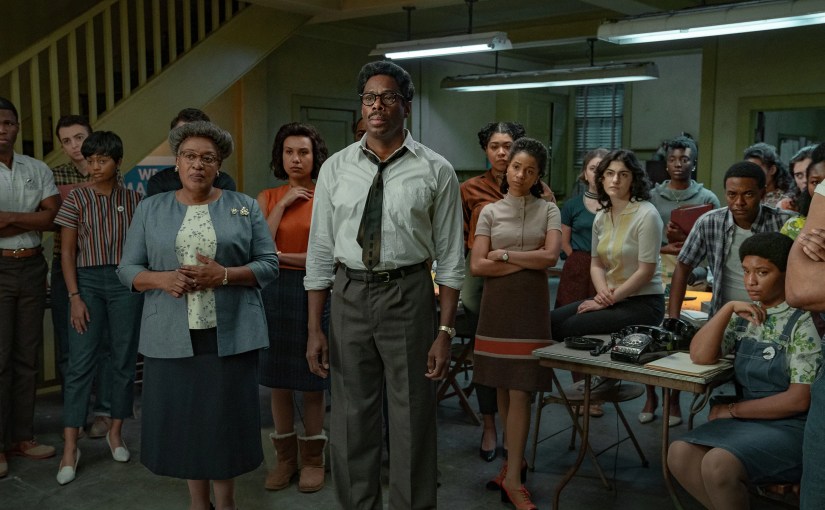
Rustin tells the story of Bayard Rustin (2023 Oscar nominee Colman Domingo) who was treated as an outcast by his friend Dr. King and the NAACP when he attempted to think of the grand possibilities of organizing the largest civil march ever to happen.  The secretly homosexual civil rights organizer eventually did see his vision come to light, however, but he had to get started with very little support or resources.  Director George C Wolfe with screenwriters Dustin Lance Black and Julian Breece use this film to depict how it all came together.

When I saw George C Wolfe’s Ma Rainey’s Black Bottom (with Oscar nominee Chadwick Boseman) my take was that it worked like a stage play on a unit set.  The sensational cast of Rustin perform in the same way, catering to what would be a live audience.  However, the unit set has been expanded to a headquarters office on the second floor, as well as Rustin’s bedroom, and the steps of the Lincoln Memorial and the National Mall in Washington D.C.  While the CGI background of the nation’s capital do not appear seamless against the cast, it is fortunate that very little of it upstages the performances from Domingo, Chris Rock, Glynn Turman, CCH Pounder, and especially Aml Ameen as Martin Luther King Jr.

Colman Domingo portrays this individual with unwavering confidence in his character.  Rustin insists on a non-violent two-day march, despite the local authorities who only grant him one day and limited resources.  One problem is that there are not enough hotels that will accommodate black guests.  Segregation might have ended in 1954, but in 1963, you would believe otherwise.  While debating with the police captain in front of Lincoln Memorial, Rustin is accused of raising his voice and yet he reminds the captain that he’s never changed the volume of his tone.  Rustin vows that this march will exceed 100,000 people from all different states.  He’s also adamant about the police authorities not carrying their service weapons to steer clear of any reason to incite violence. 

A bigger problem is bubbling within his own community of civil rights leaders.  He’s no longer associated with the NAACP which has Roy Wilkins (Chris Rock) leading the charge. Still, he needs their support. Because he does not have the respect, charm and arguably the good looks of Dr. King, Bayard’s passion falls on deaf ears and a lack of motivation from these powerful men of influence.  A large challenge comes from the arrogant Representative Adam Clayton Powell (Jeffrey Wright) who will proudly sit at the other side of the table with his long cigarette, pressed suit and pencil thin salt and pepper mustache.  With a gruff tone in Wright’s voice, this is a marvelous antagonist.

Over the radio airwaves, Senator Strom Thurmond, who was still in office at close to age 100, all the way through 2003, is building a campaign against Bayard Rustin.  Rustin has a past of suspected ties to the Communist Party, and it will also not bode well if his closeted homosexuality is revealed.  On top of that, Mr. Rustin lives with personal problems and imperfections just like anyone else.  He is trying to balance a relationship with Tom (Gus Halper) a young, white gay man and strong supporter of the cause, but Bayard is also involved with a married, closeted man as well.  None of these issues can be afforded to weigh down what Mr. Rustin and his team of youthful, optimistic volunteers are striving for.

Wolfe’s film is less than two hours, though I wish it could have been longer.  It is very engaging and certainly not difficult to follow, especially when text appears on screen to tell us who everyone is from the start.  The movie efficiently incorporates all of these dimensions into isolated episodes for Baynard Rustin to confront.  Primarily, it reflects the debates he has with the civil rights leaders and the naysayers.  There are wonderful moments shared between Colman Domingo and Aml Ameen.  Domingo also has great scenes with Gus Halper who plays Tom as someone uncompromised in the mission even if his lover is unfaithful.  Domingo is the more compelling scene partner with Chris Rock, though, who I have never considered a strong actor. A good effort is made here, but Rock is not altogether convincing as an NAACP leader. 

What I wish for, however, is some more reenacted footage of the actual historic event that famously included Martin Luther King’s “I Have A Dream” speech.  There’s a slight tease of that speech but King was so appealing in that moment that it could never be recreated so well.  It was already perfect.  What I wanted to see was some other happenings going on during this event.  We see buses arrive, chairs getting set up, people gathering, mostly black, but other races as well. What other speeches occurred on that day?  What else was said? 

I recall an episode of The Cosby Show where Theo and Cockroach had to write a school paper about the event and their parents and grandparents talked about how they drove down from New York to D.C. in buses and how hot it was that day. They described people who wore pins that said “Kiss Me I’m Black,” “Kiss Me I’m Jewish,” “Kiss Me I’m Irish,” and so on.  It might have been said to lean into Cosby’s brand of humor, but I also believe it was true.  That episode seemed much more descriptive in about ten minutes of sitcom dialogue than the film Rustin depicted. 

How was the audience on the National Mall responding?  Were people fanning themselves from the heat?  What were they saying to one another?  What songs were they singing?  Wolfe’s film only gives a tiny glimpse of this groundbreaking moment in time when 250,000 people assembled. The picture just doesn’t appear entirely painted.  Perhaps budgetary reasons were the cause of that.

Rustin is a good film and does a fine job of depicting this unsung man’s achievements despite the challenges he always faced with a smile.  Domingo is great at donning the grin with missing teeth and clumsy black framed glasses, and a loose tie with a wrinkled shirt.  He is positively absorbed in this period of time.  Still, it would have been welcome to see more of his end results. 

The picture concludes on a terrific beat before the inevitable footnote text arrives with most film biographies.  I have just observed a man who will not shut up and never tire from pursuing his seemingly impossible dream.  Baynard Rustin was likely considered a pest who would not let up.  Yet, the script closes on the fact that in spite of all I have witnessed, Bayard Rustin was likely the humblest of all of these civil rights servants.

Go learn more about our Civil Rights history and allow yourself to see one of the best performances of the 2023. 

FARGO

By Marc S. Sanders

The seeds of a crime begin in the dead of winter, in a saloon, located in Fargo, North Dakota.  A car salesman requests two thugs kidnap his wife so that they can demand an eighty-thousand-dollar ransom from his wealthy father-in-law.  The salesman will split the monies with the crooks and all will be well.  Hold on there!  It’s not as simple as it looks.

The Coen Brothers (Joel and Ethan) completed some of their most legendary work when they opted to “adapt” a supposedly true story that sheds blood over the snow-covered plains of northern Minnesota when all of the characters involved choose not to cooperate with one another.  The unpredictable is what keeps their film Fargo so engaging.  With each passing scene, you ask yourself “What next????”

Jerry Lundegaard (William H Macy, in my favorite role of many good ones from him) is the salesman who gets in over his head.  This cockamamie scheme of his stems from a need to land a get rich quick investment, but he doesn’t have the money and his father-in-law Wade Gustafson (Harve Presnell) certainly won’t lend it to him.  Steve Buscemi and Peter Stormare are the hired criminals, Carl and Gaere.  As quick as the agreement is made, Jerry wants to call off the arrangement, but things are already set in motion.  The kidnapping occurs, albeit sloppily, and a late-night pullover on a dark, snow covered back road leads to the bloody shootings of three people. 

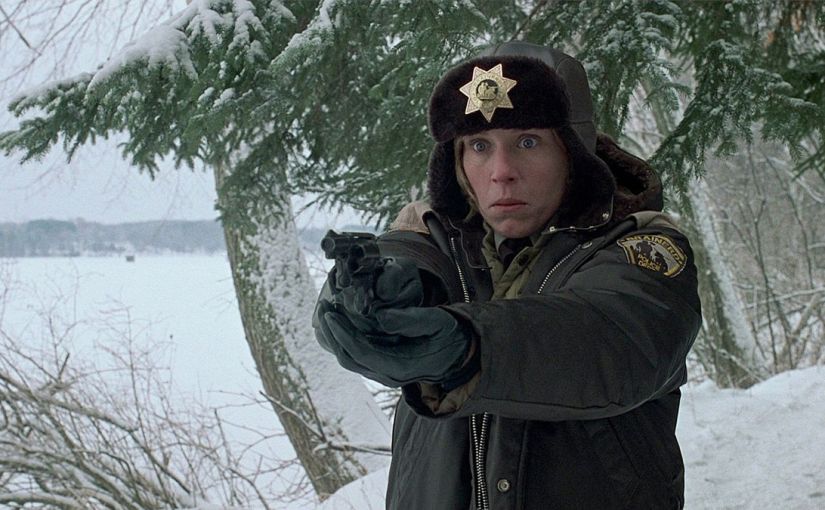
Marge Gunderson (Frances McDormand, in her first Oscar winning role) is awoken early in the morning.  Her sweet husband makes her a quick breakfast and she’s off in a jiff to inspect the crime scene of the three murders.  She is seven months pregnant, but she’s got a job to do.

Murder, kidnapping, fraud, and embezzlement piece together the Coens’ Oscar winning script.  What makes Fargo special though is how out of frame it all seems among these odd and quirky characters.  The Minnesotan dialects and vernacular (“You betcha!!” “You’re darn tootin’!” “Oh, for Pete’s sake!!!”) from Marge and Jerry do not seem standard in a story like this.  Even their names – Lundegaard and Gunderson – seem totally out of place here.  However, the pregnant, sweet natured police officer should not be underestimated, and the puppet master behind this plot should have known better.  In fact, other than Marge, no one should be doing what they’re doing, and yet that’s exactly what spins everything off the rails.

The Coens humanize the characters of their film.  Marge must stop inspecting the grisly crime scene because her morning sickness is about to overtake her.  “No, I think I’m gonna barf!” It is not the blood or the cold winter that’s holding her back.  Natural pregnancy gets in the way.  When clues lead her to Minneapolis for an overnight stay, she takes advantage of meeting with a high school friend.  Their meet-up has nothing to do with the central plot, but the writers insist on showing Marge during her off hours.  It’s a hilarious scene and Frances McDormand’s timing is naturally comedic with a guy who just has an overenthusiastic way about himself.  Marge is not just a smart cop.  She’s got a life outside of her career as a loving wife, friend and soon to be mother.

As well, Jerry insists to Wade not to contact the police and let him deal directly with the kidnappers when they call.  Wade isn’t just going to sit by for long though.  He got to the top of his powerful pyramid by taking things head on.  Jerry just doesn’t have the instinct to realize this is how the cards will fall.  Wade was not to be involved, under any circumstances.  Yet, that’s exactly what is happening.  This is not good Jerry.

Carl and Gaere (These names!!!!  I’m telling ya.), as crooked hoods, have no honor among themselves.  One might betray the other and that could lead to another gory, very gory, yet inventive moment. 

Other than Marge, either no one is particularly smart in Fargo, or they are just not seeing the possible outcomes all the way through.  Still, even the dumbest of folk can make a turn of events gone awry so fascinating.  When one tiny detail gets out of place, then the players improvise. That only twists several other expectations to go off kilter and the dominoes begin to tumble.  Very quickly, as everything has unraveled, it is any wonder how this all began in the first place. 

Fargo demonstrates that crime is hardly committed with a perfect plan.  Fortunately, the imperfections are at least as entertainingly curious as the perfections found in so many other films.  Oh, you betcha!!!!! 

JERRY MAGUIRE

By Marc S. Sanders

Writer/Director Cameron Crowe loves all of the characters he creates.  He loves them so much that I bet he’s got volumes of background histories on each one ranging from a nanny – sorry Au Pair – to a cute seven-year-old kid to a brash, hot shot professional sports agent like Jerry Maguire.  Everyone, absolutely EVERYONE, in Crowe’s films has to have a substantial amount of dialogue to bring them attention.  Often it works.  Yet, it’s also his Achille’s heel. 

Roger Ebert called Jerry Maguire a very busy picture and I could not agree more.  Do not mistake me.  I’m quite fond of the film, but yeah, Cameron Crowe unloads a lot in its over two-hour running time.  The title character, played by Tom Cruise in one of his best roles, is the superstar agent who has everything going for him.  He’s engaged to a beautiful talent scout named Avery (Kelly Preston), he has a knack for negotiating the best contracts for the greatest up and coming athletes, and he’s loved – strike that…adored by everyone.  Well…not everyone.  A hockey player’s kid tells him to eff off after his dad suffers his fourth concussion and can barely recognize his family or remember his own name.  It’s only then that he has a revelation in the middle of the night to document a multi-page memo inspiring his colleagues to sidestep the need to make more money. Less clients, and more personal attention to the ones you represent.  Call for everyone in his firm to get behind him in this mentality.  Jerry Maguire will be their martyr.

Well, that gets him fired, and ultimately he’s deemed a loser which is something that poor Jerry cannot learn to live with comfortably.  His one last hope at redemption lies in a promising wide receiver named Rod Tidwell (Cuba Gooding Jr – in a still very memorable role, likely the greatest of his career).  Rod remains committed to sticking with Jerry, but that is not going to make it easy.  He’s often uncooperative.  His pregnant wife, Marcy (Regina King) will not stand for any BS.  Rod is more concerned with obtaining the million-dollar contract, and it takes every last breath of Jerry’s to convince his client that it starts with getting back to just loving the game.

There is also another chance for Jerry to try his hand at love.  Wait, is it love, or is it that Jerry cannot handle being alone?  The test will lie in his relationship with his assistant Dorothy (Renee Zellweger in her breakthrough role), a twenty-six-year-old widow with the cutest kid (Jonathan Lipnicki, impossible not to fall in love with) for a son and a divorced sister named Laurel (Bonnie Hunt) who only has the support of her crying, pessimistic divorced wives support group.

Are you catching on yet to what Roger Ebert was trying to say?  There’s a lot of ingredients to make this stew.  Fortunately, all of it is good material with a great cast, but they are all distractions for one another as well.  At times there seems to be three movies going on at once.  Jerry the agent needs to get back on the horse.  Rod needs to humble himself and listen to his agent.  Dorothy needs to decide if this handsome guy who is the spitting image of Tom Cruise is best for her while she’s trying to be a single mother with a seven-year-old. 

The kid’s Au Pair has ten pages of dialogue.  Marcy has fifteen.  Avery has maybe five, but that’s quite a lot too.  It feels like Laurel and her divorced wives group have fifty pages.  Then there is the jerky antagonist who fired Jerry played Jay Mohr.  There’s just a lot of stuff here.

Jerry Maguire is a well-made film with a natural, feel-good comedic approach.  Cameron Crowe has feelings for all of his characters.  I think he doesn’t even want the Jay Mohr character to get hurt.  Crowe just wants to cradle everyone and kiss them goodnight and give them all a big part in the school play.  It’s a blessing the cast has terrific chemistry.  Anyone sharing a scene with Tom Cruise is doing brilliant work, especially Renee Zellweger and Cuba Gooding Jr.

Crowe’s dialogue might feel schmaltzy during the love story aspect, but it’s captivating.  Cuba Gooding Jr performs like he wrote the character, not Crowe.  He must have invented more to his Oscar winning portrayal of a cocky wanna be football star than the writer could have ever imagined.  “Show me the money!!!!” is still hailed as an all time great scene, chartered by the actor. 

As a director, Cameron Crowe is doing some of his best work.  I recently watched the movie with my Cinemaniac pals and noted to them how much lighting is pointed at the handsome faces of the cast.  It could be Cruise making a negotiation with a promising football star and his no nonsense dad (Jerry O’Connell, Beau Bridges) around a coffee table, or it could be a seductive scene between the romantic leads on a porch.  You never saw so many faces with flawless complexions and the photography of the film looks great from beginning to end.

As overstuffed as Jerry Maguire is, the film ultimately belongs to Tom Cruise, and he delivers Cameron Crowe’s character arc beautifully.  It is such a dynamic portrayal with a lot for Jerry to redeem, learn from and surmise.  The conceit I expect from Cruise is evident.  Sure!  However, it is still a well-constructed portrayal. 

This movie makes me yearn for Tom Cruise to seek out those roles that would come from nowhere and with surprise.  The roles that on the surface never seem like he should be occupying.  Think about this for a second.  This guy has played the seductive Vampire Lestat which was initially poo poo’d by Anne Rice.  He was crippled Vietnam War veteran/protestor Ron Kovic, soon after he played fighter pilot Maverick.  He played the cruelly extreme chauvinistic motivational speaker Frank TJ Mackey amid another crowded cast of exceptional talents and characters. He’s also portrayed Jerry Maguire.  The range of this actor’s talent can only be stretched further and further.  I’d rather know what wonderous role Tom Cruise has in store next, rather than what ridiculous stunt he wants to accomplish for another Mission: Impossible set up. 

Jerry Maguire is a gluttonous picture, but fortunately every entrée is served with heart, genuine emotion, and relatable caricatures.  It’s one of Cameron Crowe’s best films.

NYAD

By Marc S. Sanders

When some people go through a midlife crisis, they might buy themselves a car, get a new job or opt to not get out of bed for several days.  When Diana Nyad goes through a midlife crisis in her early sixties, she motivates herself to swim 103 miles from Cuba to Florida.  She came up short at age 28, but over thirty years later no one is going to convince her she shouldn’t try again.

Annette Bening portrays the real-life swimmer whose determination will bear the brunt of self-torture to complete arguably the maritime equivalent of climbing Everest.  Jodie Foster is Diana’s best friend and coach, Bonnie Stoll.  As acting partners and the characters they play, the leading ladies make a good pair.  

My first compliment has to go to the makeup department led by Ana María Andrickson.  The actresses received Oscar nominations, but the work done on Bening to play Nyad is astoundingly convincing. Diana makes several attempts to try to complete this challenge that’s never been accomplished before.  With each try, the dried-up complexion, blistering sunburns, chapped lips and bloodied cracks that prominently show on her body are truly painful and awfully uncomfortable to gaze upon.  At times, I was not as focused on the dialogue shared between Foster and Bening as I was on Andrickson’s masterful work.  The makeup alone tells an impactful story. A clear oversight by the Academy.

Annette Bening is particularly good in her role.  At times she’s a terrible annoyance and unlikable.  Yet, a sixty something year old woman who wants to defy all logic and the literal forces of nature will have to be a certain brand of jerk to move forward with her goals. This also comes with the natural degeneration of a body of freckled dry skin, loss of muscle mass and arthritic bones. Bening is far removed from the glamorous roles of an impressively long career past (Bugsy, American Beauty) to get to a persistent, unwavering zenith that the real Diana Nyad had to emote.

Jodie Foster is fine as Nyad’s best friend and former lover now coach.  I’m not sure all the award nominated praise she’s received for this part is merited, but she’s worthy of falling in line with other celebratory coaching mentors like Mickey from the Rocky films and Mr. Miyagi from The Karate Kid.  The film focuses so much on Diana Nyad though that there’s not much depth to Foster’s role.  She does the job, but it did not feel like it demanded much.  Frankly, Viola Davis in Air and Maura Tierny in The Iron Claw left me with more of an impression in an astounding year of great films and performances from 2023.

The unsung cast member who’s getting next to no press recognition is Rhys Ifans as John Bartlett, an oceanographer recruited by Nyad and Stoll to gauge immediate weather patterns and what the currents of the Atlantic are expected to do during the swimmer’s trek.  Ifans is a fantastic supporting character actor who is tasked with finding that suitable small window of time for Diana to start her journey. Within the context of the script, he offers the suspense needed for this sports film.  Can Diana Nyad hold up against the very real and insurmountable warnings that John describes?

Swimming is quite boring to watch.  However, this venture has cause for concerns.  Brutal storms, stinging jellyfish with undetectable approaches, and sharks.  Salt water, weakness and fatigue, the chops of the tide and mental hallucinations are also bears of contention.  A charter boat with Bonnie and John on board with a watchful, supportive crew sail alongside the swimmer, but they can only do so much if she intends to achieve her seemingly impossible goal unassisted.

Elizabeth Chai Vasarhelyi and Jimmy Chin are the directing team for Nyad with a script written by Julia Cox based on Diana Nyad’s novel account.  Most of the film is patterned like many other sports films focusing on an underdog.  I knew nothing about this person or her accomplishments.  Frankly, what I’ve learned is unbelievably impressive beyond what this picture focuses on.  Naturally, you’ll get an idea of how the story is going to conclude.

To enhance the ho hum activity of the swimming scenes, the filmmakers incorporate some of Nyad’s dreamlike delusions to get inside her head.  Falling rainbow stars onto the ocean surface as well as a yellow brick road leading to the Taj Mahal look as fantastical as they should, even if they drift into sidebar distractions.  I appreciated the handful of scenes where Rhys Ifans lays out the desperate concern shared with Jodie Foster about a lack of progress where Diana is wasting strokes against a current as well as his fear of oncoming sharks.  He builds suspense to keep the film focused. It’s pretty cool by the way how the crew responds to the shark issue.  

In addition, as good as Bening and Foster are with enormous careers of outstanding roles, much of their shared dialogue often comes off a little too hokey.  Granted, it’s a standard sports film and it’s more impressive that it’s all true, but Nyad sometimes plays off like a cheesy TV movie lacking that cinematic edge I was looking for.

An unclear element offers glimpses of Diana’s past as a beginner child swimmer who suffered personal trauma. It’s clear what happened to her, but these quick flashbacks are also mixed in with an unclear picture of her parental lineage and other ingredients.  I still don’t know why there were snippets of Diana playing Parcheesi.  Nor do I know who she was playing with to uphold its significance in the final edit of the movie.

Nyad is a biography worth seeing. The endurance the central character sustains to achieve the impossible is tremendously inspiring.  The thought that was running through my mind over the course of the film is that this woman wants to dominate over a powerful Mother Nature.  By the end, you see real life clips of Diana Nyad insisting to audiences that no matter who you are or what age you’re at in life, nothing can defeat what you want to overcome.  As well, whatever you succeed at likely deserves enormous credit for the support team that accompanied you.  Often, I’m a naysayer of Diana’s mantra because I think I’ve chalked up at least five times more failures than successes in my life.  Still, here is the person who eventually proved me wrong.  I should also note that I learn from my failures and remain hopeful that it will lead to success.

I often tell myself never to argue with a woman. Well, at least now I know never to argue with Diana Nyad.  

THE ZONE OF INTEREST

By Marc S. Sanders

Rudolph Höss, and his wife Hedwig, have five children and they seem to live in peace and serenity within a beautiful home that contains plenty of bedroom space, sunlight, a vegetable garden, a pool to splash in and a babbling brook to fish and swim in.  You might say it is The Zone Of Interest that keeps their life so fulfilling.  Yet, beyond their pleasures is the Auschwitz concentration camp conveniently located next door for Rudolph to carry out his responsibilities as a Nazi Commandant. 

Jonathan Glazer writes and directs this quietly effective piece while breathlessly showing a flawed ignorance and apathy for the countless Jewish lives lost during the Holocaust.  The tactics Glazer uses in his film work on your senses first.  Following a long series of production company names that herald from America, England and Poland, the title of the movie appears in big white thin letters against a black screen.  Slowly over a long 3-4 minutes the letters fade as faint music and sound transition.  The music gets softer, as birds chirp and then there are faint gunshots in a distance.  A picture finally appears, and we see the Höss family basking under blue sky and sun while picking flowers alongside the brook.  It’s not even possible to identify the time or setting of this story yet.  Soon after, Rudolph (Christian Friedel) is stepping out of his home in his full-dress Nazi uniform on the morning of his birthday.  Hedwig (Sandra Hüller, Oscar nominated in Anatomy Of A Fall) and the children gift him a beautiful, freshly painted kayak.  Glazer then changes the position of his camera in the opposite direction and the towering wall of the concentration camp is just beyond the pretty stone walkway and front yard that leads out from the family cottage.  Black smoke billows from the smokestacks beyond the wall, and none of this is even remotely disturbing to the family. The pops of gunfire are heard beyond.

The Zone Of Interest does not focus on the suffering of the European Jews during the Holocaust. Jonathan Glazer’s script is wise enough to know his viewers are aware of what occurred even if the mass genocide seemed to have no imaginable end.  He never shows footage of activity inside the camp because this story is told through the eyes of a family who chose not to become aware or alarmed at that massive amount of death and torture that was happening.  The Holocaust was simply a way of life.

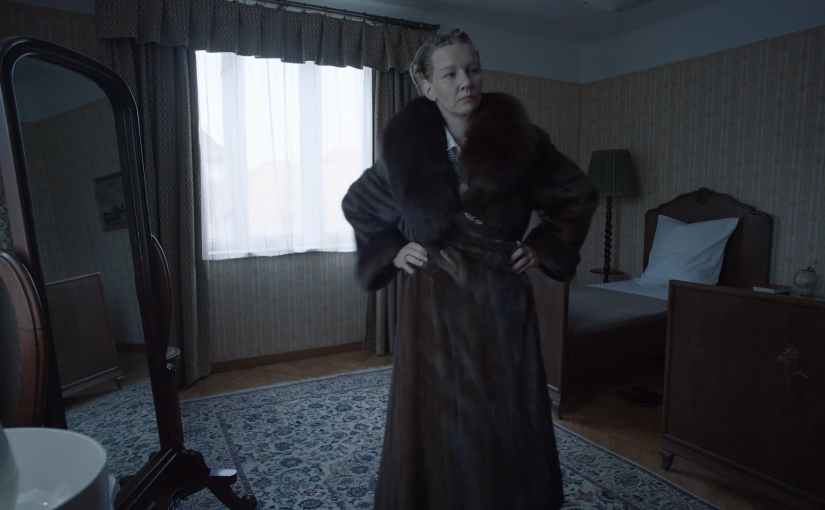
A sack is delivered to the Höss home which contains slips and nighties for Hedwig to rummage through for her use.  More interesting is a beautiful fur coat.  Hedwig tries it on for a personal fitting and looks upon herself in her bedroom mirror.  She finds a lipstick in the pocket.  Does she like the color?  She’ll have to see and draws it across her hand just like my wife and mother would do in a shopping mall.  All the while, the undisturbing (to Hedwig) next-door sounds continue on.

Miguel and I went to see this film together and had an extensive discussion afterwards.  To Miguel’s advantage, he had absolutely no idea what this film was about.  Didn’t know it was another Holocaust picture.  He didn’t know who directed it.  He didn’t know the cast.  I only knew that Jonathan Glazer wrote and directed, though I’m not as familiar with his work as Miguel is, and that it took place during the time of the Holocaust.  To observe my colleague’s surprise early on in the film gave me an interesting experience.  Miguel first witnessed the serenity and peace among the family, and then realized the sinister world that surrounds them and which they choose to be naïve towards.

The Höss family will have you believe they experience the same challenges that any ordinary family encounters.  Beyond what I have described, there are two other scenes that stay with me. 

Rudolph holds a meeting in his home. An architect/scientist is describing the effectiveness of a new model oven that will efficiently slaughter hundreds of Jews per day.  He provides well designed blueprints.  Rudolph asks for a closer estimation.  The architect says it is likely a thousand can be taken care of in one day.  Seems satisfactory.  Take a conversation like this out of the context of the picture and these men could just have easily been talking about an assembly line in a chocolate factory.

Another moment occurs between Rudolph and Hedwig.  The husband explains that because he’s been so good at his job, he’s been promoted to oversee the operations of all the concentration camps and therefore the family will have to relocate.  Hedwig is not happy about this as they have begun their new life here in their beautiful home (located next to Auschwitz).  The wife insists her husband speak to Hitler about this and request he reconsider.  Any of us would know it’s not that simple.  “Oh, excuse me Mr. Hitler…” Uh uh!  Would not work so easily. 

Jonathan Glazer demonstrates how simple dilemmas and pleasures that come with a happy home life can appear common.  Yet, in this case, should it? 

The Zone Of Interest may be a period piece.  Yet, what you witness when you watch this film is all too similar to what often occurs today.  The world has gotten smaller with information coming to us quickly by means of the internet that can update me on Middle Eastern wars or American immigration or the spread of white supremacy as quickly as developments take place.  However, I believe many still remain ignorant, often by choice, of what is presently happening.  Mass suffering and totalitarianism still runs easily and freely, but what remains important to us are the vast luxuries we treat ourselves to while hardly giving a care of what goes on outside our bedroom windows. Our toughest challenges are our inconveniences. 

I’m not chastising anyone, Reader.  We deserve our peace, our solitude, and our happiness.  The Höss family is something else altogether, though.  They live in prosperity right next to the worst way of living imaginable and the patriarch is primarily responsible for that experience.  Yet, as their comfort becomes so commonplace, the naivety only increases.  Their children grow only knowing that a train arrives on a frequent basis, with chimneys exhausting black smoke and there are distant pops on the other side of a brick wall.  It simply goes with splashing around in the garden pool or making mud pies on the edge of the brook.  The title of Glazer’s film serves the perspective of a family who are being raised not to know any better.

Miguel asked me where I would rank the picture.  At the time I gave it a middle grade.  It is a slow-moving piece.   It is not accompanied by a soundtrack of music to easily cue my emotions.  There are no big, momentous monologues.  I found the ending a little ambiguous but perhaps I was not concentrating enough, and Miguel had to explain something to me.  However, two days after watching the piece while also doing some background research on the film, it is worthy of a better grade than I originally gave it credit for while walking out of the theater.

Glazer will set up scenes where nothing happens for the longest time and then an eye opening and very uncommon discovery is made.  A particular moment happens while simply watching Rudolph waist deep in the river while fishing and wearing an SS t-shirt.  Again, out of context, this t-shirt could have been a Tampa Bay Buccaneers shirt.  There’s a disturbing comfort to moments like this before anything is revealed. 

The writer/director positions his camera like a documentarian.  There are no steady cams.  Often shots are from a far end of a hallway or outside a door frame simply to witness the commonplace activities of the family while the horrifying sounds of Auschwitz carry on in the near distance.  Miguel noticed a horizontal technique.  Glazer must have put his camera on a track to follow Hedwig as she walks off her property and marches parallel across the outside wall of the concentration camp.  She is undisturbed by anything happening on the other side of that brick structure laced with barbed wire at the top.

This is a disturbing piece that effectively shows a lack of care for suffering and horrific execution while a family attempts to live their best life and circumvent around common issues like job promotions or gardening or family time or valuing someone else’s belongings to accommodate them.  The Zone Of Interest is a haunting film and Jonathan Glazer has accomplished a tremendous feat, showing comfort just outside of a world of treachery and genocidal productivity.  This is a must watch film.

PS: My recommendation is to watch The Zone Of Interest without taking a break or taking a pause in the picture.  Watch it all the way through, unstopped.  I believe it is necessary to judge the film as a whole rather than in just parts.  As I reflect, it feels like one ongoing hour and forty minute scene.