ALL QUIET ON THE WESTERN FRONT (GERMANY, 2022)

By Marc S. Sanders

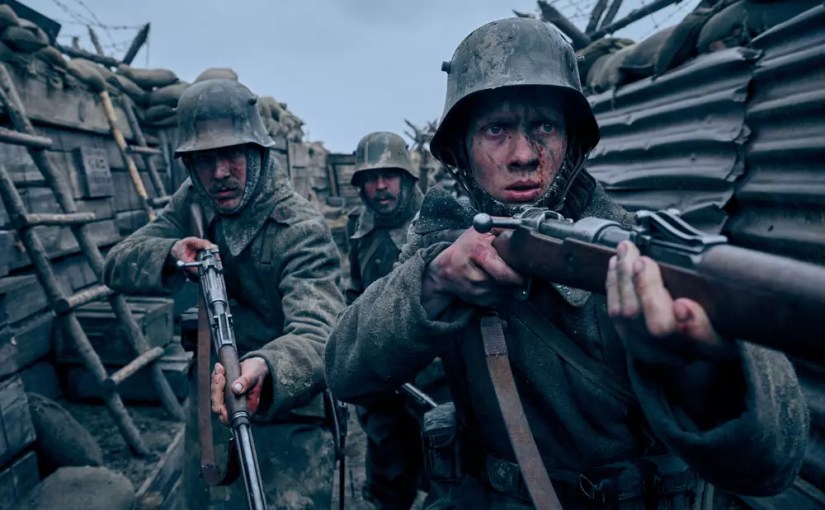
Edward Berger’s Oscar nominated interpretation of All Quiet On The Western Front is a massive success in filmmaking, storytelling, character and construction.  This 2022 adaptation of the well-known novel by Erich Maria Remarque does not only depict the ugly horrors of a mud soaked, gory and bloody conflict within deep dug out trenches, and on endless plains of wasteland battlegrounds.  It also provides perspective for the difficult peace talks occurring near the tail end of the third year (1917) of the First World War.  Another aspect covers the celebrated commander who leads a charge from the comfort of a German high castle while feasting on grand meals, far away from the front, steadfast to never surrender, and emerge victorious no matter the cost.

The main character is a youth named Paul (Felix Kammerer) who is eager to join the German brigade against the French armies.  He happily takes up with school chums to forge their parents’ signatures and enlist amid the reverie that greets them with cheer from his school superiors raging with heroic propaganda.  Shortly after, he is gifted an honorary soldier’s uniform, pressed, and laundered, that once belonged to another soldier who violently perished in battle.  Paul and his friends are rushed to front line of the fighting, into a muddy German trench and pushed on to slaughter in the name of his country. It does not take long for Paul to realize any derring-do he envisioned is nonexistent as men die by gunfire, grenades, flame thrower attacks and tank armaments.  If the men around him aren’t dead, they are at least dismembered with shredded, bloody stumps in place of limbs.

Elsewhere, the German diplomats travel in class aboard a luxury passenger train to meet up with French leaders in an effort to come to a cease fire.  Germany is greatly failing this conflict with loss of life, territory, supplies and money.  It’s a reluctant meeting to partake as the French are uncompromising with their terms.  Either Germany agrees to the demands of the French, or the war continues.  The Germans only has 72 hours to concur.  Coinciding with all of this is General Friedrichs of Germany (Devid Striesow) who lays out commands while dining and taking his butler service for granted.  He also sheds no tears for the soldiers beneath him as they are giving up their lives to fight a war that can’t be won.  Assuming a complete understanding of what constitutes a soldier based upon the generations who fought before him, he asks “What is a soldier without war?”; a dangerous philosophy for all others but him.

Of the modern war pictures to arrive in the late twentieth century and on (The Thin Red Line, Born On The Fourth Of July, Letters From Iwo Jima, 1917), the battle footage consistently offered a convincing and horrifying reality of the bloodshed that occurred during these historical conflicts.  These are not the John Wayne pictures of yesteryear.  Watching Berger’s film, which he co-wrote, I didn’t necessarily see anything that I hadn’t seen before, like sudden gun shots to the head, rapid gunfire, caked on mud, faces being blown off, or bodies being blasted to bits. Tanks are destroyed with grenades tossed into the cockpits and within their tracks. At times Paul even loses his sensory hearing amid the deafening battles, just as Tom Hanks’ character did in Saving Private Ryan.  Much of the material is identical to these other esteemed films.  What grabbed me though was how three storylines in this new film compound on each other.

Peace talks arrive. However, any kind of reconciliation will not begin until the eleventh hour of the eleventh day of the eleventh month.  That’s quite convenient for country leaders to agree on while sitting around a dining table within a luxury train compartment, but the bloodshed continues until that scheduled moment arrives.  Talk of peace also does not force battalion leaders to stand down.  If Germany is to lose the conflict to France, they will go down with one final victorious conquest in battle.  War does not play like a sporting contest where the officials ensure that everyone stops what they are doing as a clock runs out.  War unleashes a rampage in the pawns used to obtain territory and conquest. The fighting gets personal.  One on one fights resort to drowning your enemy in a brutal mud puddle or clubbing an attacker with a rock to the head.  A very personal scene occurs when Paul resorts to stabbing a French soldier multiple times in the heart.  The poor man is giving his last breaths and Paul needs to shut him up to avoid drawing any attention to their location, so he starts to shove mounds of dirt in the man’s mouth.  Soon after, Paul is apologizing to this man and begging his victim to hold on for dear life.  It’s a powerful scene never intended to make any sense, because ultimately in the field of battle, nothing makes sense.  Only frenetic chaos exists.

I have every appreciation for men and women who serve their country with the courageous will to protect against enemy threats and uphold domestic freedom and democracy.  Yet, endless war for achievement of gain does not necessarily translate to protection or honor like General Friedrichs preaches to his battalions from his balcony.  It’s easy for him to heed this policy, dressed in an unstained, decorated uniform with the pride of his fighting generations before him who were all hailed as heroes.  For an insignificant solider like Paul, though, when does he earn the recognition he has sacrificed?  When will his dead comrades gain any appreciation?  Paul’s greatest accomplishment is that he does not get shot and blown away as he runs head on towards a more powerful enemy.  Is that a celebration of the Germany he thought he stood for, though?  Paul encounters an awakening he never expected while fighting at the front line. 

Edward Berger controls a very detailed and forceful piece.  Every ditch or shredded body of a solider tells the real story of this bloody war that cost nearly 17 million lives.  The art direction of the trenches for both the German side and the French, located at the front lines, are endless mazes dug deeper than the heights of the even the tallest soldiers.  Vokel Bertelmann provides the blaring, monstrously echoing soundtrack to the film and uses his horn like chords as an omnipotence to this hellish environment.  His orchestra is so pertinent to the setting of the film.  The craft of makeup and costumes for all the extras and main players in the battle scenes is grotesque with extra thick caked on mud and different shades of blood reds, browns, and blacks.  The sounds of the tanks and the rattling explosions will make you wince with fear and shock for these boys running to their ill-fated doom with just a thin rifle to fight with. 

All Quiet On The Western Front has all of the common tropes of other more modern war pictures.  It works on its own though because the battle scenes are spliced in with the puppet masters, comfortably located elsewhere, who can control the outcomes of these bloody conflicts.  The delay of peace and agreement prolongs the horrifying carnage.  The fate of Paul, his friends, and all the other soldiers rests on what does or does not come to settlement from the people whose commands they serve.

This is a fantastic movie.  One of the best films of 2022.

THE BANSHEES OF INISHERIN (Great Britain, 2022)

by Miguel E. Rodriguez

DIRECTOR: Martin McDonagh
CAST: Colin Farrell, Brendan Gleeson, Kerry Condon, Barry Keoghan
MY RATING: 9/10
ROTTEN TOMATOMETER: 96% Certified Fresh

PLOT: Two lifelong friends find themselves at an impasse when one abruptly ends their relationship, bringing unexpected consequences for them both.


Is The Banshees of Inisherin slow?  Yes.

Is The Banshees of Inisherin sad?  Yes.

Does the movie have a sad ending or a happy one?  Yes.

These are not normally the trademarks of a movie I rush out to see.  In fact, I didn’t see The Banshees of Inisherin at a movie theater for those very reasons.  I had heard that, yes, it is well-written and extraordinarily well-acted, but that it was a bit of a slog.  I had hoped Banshees would be another film like In Bruges, one of the finest dark comedies ever made, but that did not seem to be the case.  So, I stayed away.

Well, I have just finished watching it at home, and I can confirm the film’s slowness and unavoidable moments of sadness, but they are contrasted with unexpected comic beats.  (I was going to say “unintended,” but they were surely intentional, further confirming the ingenuity of the screenplay by director Martin McDonagh.)  I can also confirm that this is one of the most unpredictable stories I’ve ever seen, and I mean literally, like ever.  At first, I was comparing it to Melville’s short story “Bartleby, the Scrivener”, but that turned out to be woefully inadequate.  The Banshees of Inisherin does have the structure of a fine short story, but there its similarities to Melville ends.  I’m not sure if Banshees has a chance of winning the Oscar for Best Picture, but it’s certainly one of the strongest contenders for Best Original Screenplay.

Pádraic (Farrell) lives on the fictional island of Inisherin, off the Irish coast, in the early spring of 1923.  He is stunned one day to learn that his best friend, Colm (Gleeson), has abruptly decided to end their lifelong friendship, cold turkey.  Colm doesn’t want to talk to Pádraic for any reason whatsoever, nor does he give a reason, at least not initially.  When Pádraic persists in speaking to Colm, Colm gives him a warning: Every time he talks to or bothers Colm in any way from here on, Colm will cut off one of his own fingers and give it to Pádraic, until he stops or until Colm has no fingers left.

It was at this point that I sat up and started really paying attention.  I’ve lived long enough to know the specific kind of grief and consternation that occurs when a long-term friend abruptly cuts off all contact for reasons that are not at all clear.  So I felt Pádraic’s pain, I saw it in his face, when he realized how serious Colm was with his threat.  At that moment, I drew mental lines: Pádraic was the protagonist, and Colm was the antagonist.

Of course, Pádraic is the good guy.  He’s nice!  His adult sister, Siobhan (Kerry Condon), confirms it!  I mean, sure, he’s a little dull, and maybe not all that smart, and maybe he has a pet miniature donkey that he lets in the house when his sister isn’t looking, and he’s never heard of Mozart, but is that a crime?  Is that reason enough to end a friendship?  Pádraic doesn’t think so.  I didn’t think so!  Pádraic is so full of righteous anger that he confronts Colm.  Colm is dumbstruck.  Their conversation ends in a bit of an impasse.  And then, the next morning, as Siobhan prepares breakfast, they hear a thunk on the front door…aaand you’ll have to watch the movie for further plot developments.

(While I watched The Banshees of Inisherin, my girlfriend wondered if I was watching some kind of slapstick comedy with the volume of laughter coming from our movie room.  My explanation of why I was laughing, and what I was laughing at, didn’t quite translate.)

What is Banshees trying to say?  In my opinion, perhaps it’s this: you can’t go through life worrying about what other people think of you.  When Colm lays down the law, Pádraic should have just sucked it up and moved on with his life, right?  I was originally comparing their situation to something that might happen on social media, when someone expresses a very negative view of your post or opinion or whatever.  What do you do?  Latch onto it and let it gnaw away at you?  Post rebuttal after rebuttal until you change their mind?  (Spoiler alert: you won’t.)

As I said, that kind of thinking made Pádraic the good guy and Colm the bad guy.  But then Pádraic starts making some very bad, very DUMB decisions.  He starts listening to the advice of the closest thing they have to a village idiot, Dominic (Barry Keoghan), who suggests that Pádraic just needs a new approach: tough love.  At that point, if he’s dumb enough to take advice from a moron, whatever happens next is on him, right?  So now the balance changes.  Now Pádraic is the bad guy/dumbass and Colm is the good guy.  Just leave him alone, dude.

(For the record, Colm does explain his decision, which may shed some light on his own state of mind.  Depression?  Despair?  The screenplay offers clues, but nothing truly definitive.)

All through the film is Pádraic’s sister, Siobhan, who functions as the audience surrogate.  “You’re all f*****g boring!  With your piddling grievances over nothin’!”  She is as dumbfounded as we are at Colm’s stubbornness.  Not to mention at her brother’s foolish attempts to reconnect with someone who clearly doesn’t want to be bothered.  There are a couple of moments when it seems as if all is forgiven, but alas, it is not to be.  Siobhan’s solution to rid herself of their bickering is as simple as it is final.

When the credits rolled, I found myself wondering what kind of review this was going to be.  I liked the movie.  But it is slow and sad.  But its massive unpredictability sucked me in as inevitably as if I were watching Kill Bill or Interstellar.  That’s the key factor to The Banshees of Inisherin.  You may think you know what’s about to happen, but just try to guess exactly how the movie ends, and see how wrong you are.

YOU PEOPLE

By Marc S. Sanders

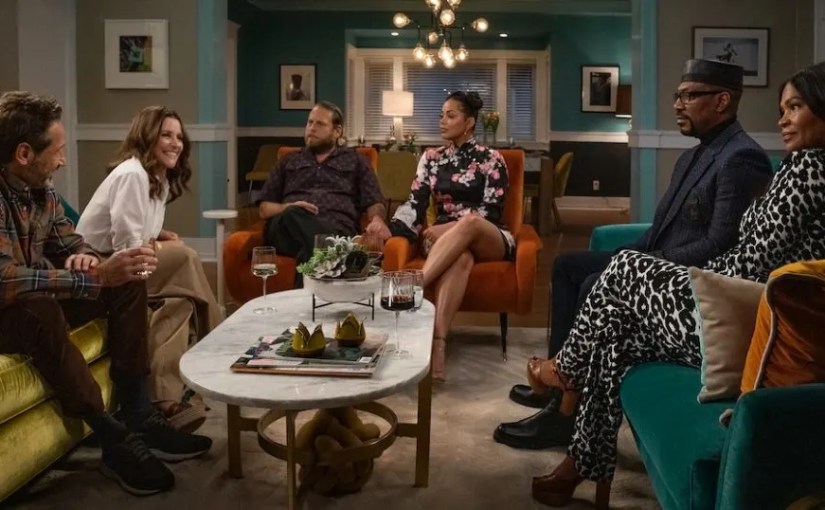
You People has me wondering how we could have stepped so mind bogglingly far back in social tolerance and understanding.  I give people far more credit than the foundations that Jonah Hill and Kenya Barris, who wrote the film together, describe in this movie.  (Barris directed, as well.) People cannot be this cruel and stupid, can they?  Someone give me hope! Give me assurances, please!!!!!

You People is a send up of the Meet The Parents formula, or more specifically Guess Who’s Coming To Dinner? In the latter example, an African-American doctor is brought to the home of his Caucasian fiancée to be introduced to her parents.  Later, the woman meets his parents.  There is an understandable sense of surprise for the characters in both scenarios.  Yet, none of the parties carry the instinct to embarrass each other or allow them an opportunity to lie just to impress and speak with moronic naivety.  The film was never catered for big laughs, but rather more towards awareness and understanding. 

With a cast that includes Jonah Hill, along with Julia Louis-Dreyfus and Eddie Murphy, all well known for huge comedic achievements, You People is designed for the laugh out loud moments.  That’s great.  It sounds very promising, and it was a movie I was looking forward to watching.  However, did the comedy have to come at the expense of stereotyping Black Muslims as angry and intimidating and freely dropping the N-word, while White Jews are dumb, ill informed, clumsy lying cocaine users?

The pattern of Barris’ film is very structured.  For every scene of father-in-law to be Eddie Murphy paired with Jonah Hill, there is also a scene on the other side of mother-in-law to be Julia Louis-Dreyfus paired with Lauren London, portraying Hill’s fiancé.  Murphy does his comedic best in expression and stature with or without dark sunglasses on, while Hill sits very uncomfortably next to him, whether it is in the car or at his bachelor party getaway in Las Vegas where his buddies ask him to call his cocaine dealer.  Cuz, you know, all Jewish guys have a go-to cocaine dealer on speed dial. 

Julia Louis-Dreyfus does her comedic best trying to impress Lauren London by acting aware of what a black person has had to endure and over-complimenting her hairstyles and appearance.  She’s ready to go all “Karen” at the front desk of a luxury spa when she suspects racial discrimination towards London’s appearance.  Later, she will commit slapstick sin by accidentally pulling off the hair weave extensions of one of London’s friends.

I refer to comedic best because the two SNL alumni are so good on camera even if their script is nothing but insulting junk, devoid of validity.  Their expressions are reminiscent of Murphy’s best stand up routines and Louis-Dreyfus’ hilarious sitcom portrayals.  However, these collection of scenes are written with an obnoxiously overabundance of cringe and discomfort.  How these characters treat one another is utterly disgraceful.

Upon an initial meeting at the dinner table, a comparison of suffrage by means of black slavery vs the Holocaust is brought up.  You know what?  Neither incident within our world history is worse than the other.  They’re both horrendous and could never merit comparison.  Yet, here they are being presented as punchlines for outrageous comedy in terms of one upmanship.  Murphy’s character, along with Nia Long as his wife, will announce their admiration for Louis Farrakhan, while Julia Louis-Dreyfus will point out the speaker’s antisemitic doctrines.  In response, she will accidentally light fire to Murphy’s prized Muslim hat gifted by the minister.  If I were to translate this mathematically, Black Muslims celebrating antisemitic gospel equates to White Jews as insensitive klutzes. 

You People is nothing but one insulting moment after another.  In every scene, someone is the punchline at the expense of the writers’ unfair and incorrect blanket approach categorization for what these two demographics must be like. What a huge misfire. 

These are some of my favorite comedic actors.  Lauren London even looks like she can hold her own in scenes with her co-stars.  The potential for talent is hard to match here.  There could have been debates as to who should officiate the wedding and what themes the reception should have, or what the bride and groom should wear. Imagine an argument over the cake topper.  Actually, as I recall there are moments like this in the film.  Nevertheless, they dwindle into conclusions that demonstrate Black Muslims should be feared while White Jews are clueless morons. 

As a conservative Caucasian Jew myself, none of what is depicted in You People could be further from the truth.  I’ve known a few Muslim people and I never caught this kind of vibe from them or who they associate with, or what they practice.  I’ve also never felt uncomfortable in their presence.

The failure of this film lies within the insensitivity of its ignorant script.  This movie could have demonstrated a clash of cultures.  Instead, it relies on moments to squirm at uncomfortably with some of the worst people any of us could ever know.

The next time Jonah Hill and Kenya Barris want to make a movie, they need to read a book and speak with who they select for their subject matter.  Even better, just turn on the camera and let Eddie Murphy and Julia Louis-Dreyfus start talking…about anything!  They are far more intelligent and creative than anything on display here.

MONTY PYTHON’S LIFE OF BRIAN (1979)

by Miguel E. Rodriguez

DIRECTOR: Terry Jones
CAST: Graham Chapman, John Cleese, Terry Gilliam, Eric Idle, Terry Jones, Michael Palin, Carol Cleveland
MY RATING: 9/10
ROTTEN TOMATOMETER: 96% Certified Fresh
Everyone’s a Critic Category: “Watch a Controversial Film”

PLOT: Born on the very first Christmas in the stable next door to Jesus Christ, Brian of Nazareth spends his life being mistaken for a messiah.

[EDITOR’S NOTE: Let the record show this was originally going to be a review of Mel Gibson’s The Passion of the Christ, but the author had just seen 2 or 3 dramatic films in a row and apparently decided it was time to switch gears a bit.  Complaints about this adjustment may be directed to the author’s colleague, Marc Sanders, who promises to reply to each and every complaint at about the same time hell freezes over. ]


Life of Brian is widely considered Monty Python’s tightest, most well-written film, even if it’s not quite as hysterically funny as Monty Python and the Holy Grail.  I agree.  I can speculate that this is due to the subject matter, and so great care needed to be taken to ensure that viewers would not mistakenly think the film was poking fun at the Jesus Christ Himself.  On the contrary, right from the very opening, it’s quite clear this movie is not about Jesus, but about the poor sod who was born in the stable next door and the deluded individuals who continually mistake HIM for a messiah as a grown man.  (“…how shall we f*** off, oh lord?”)

But that didn’t stop the mighty train of offensensitivity from rolling right along.  To wit:

  • Norway banned the film for a year.
  • Ireland banned it until 1987.
  • A town in Wales banned it until 2009, after a cast member was elected Mayor.
  • A town in Britain banned it until 2015.

However, no amount of bans and protests could prevent Life of Brian from becoming an integral part of the cinematic comedy landscape.  At the annual Venice Film Festival, the Premio Brian (Brian Award) is awarded to the most rationalist/atheist movie presented at the festival.  It was named the funniest comedy of all time by the BBC’s Channel Four, beating out Groundhog Day and The Full Monty.  In 1982, during the Falklands War, sailors aboard a severely damaged British vessel started singing “Always Look on the Bright Side of Life” while awaiting rescue.  You can’t BUY that kind of publicity.

After a brief prologue in which the Three Wise Men visit the wrong manger by mistake (“We were led by a star!”  BRIAN’S MOTHER: “Led by a bottle, more like!”), we jump ahead to when Brian is just about Graham Chapman’s age, struggling to hear the Sermon on the Mount from a distance (“Blessed are the cheesemakers?!”).  Much like Holy Grail, the film is punctuated by sketches, some of which are pauses in the action, but most of which still manage to carry the story forward.  That’s quite a feat when you consider their subsequent film, The Meaning of Life, was composed entirely of self-contained sketches, albeit with a common theme.  The fact that the Pythons were able to rein themselves in and keep things relatively lean is rather admirable.

If I kept relating plot developments and summaries of sketches and funny quotes, I would be here all day:

  • The “Biggus Dickus” scene.
  • The stoning.
  • The unexpected Latin lesson.
  • “What have the Romans ever given us?”
  • Graham Chapman’s willy.  (Hey, it’s a memorable scene, shut up.)

If I must be honest, though, I was never, and still am not, a fan of the film’s ending.  Yes, I get the supreme, absurd irony of the situation juxtaposed with that cheerful song, but…to be honest, it’s always felt like the Pythons said, “Okay, so we’re here, aaaaand…now what?  Any ideas?  No?  Okay, let’s end the movie.”  Perhaps they always meant to end it that way.  So be it.  But I’m selfish.  I wanted just a little more.  …although, now that I think about it, I’m not sure what kind of mileage you could get out of a bunch of people at a tomb waiting for someone to emerge, but never does.  There’s a joke there, somewhere, but I’m not the one to tell it.

There is one scene that I found VERY interesting.  It never stood out before, but it does now.  People are fond of saying, “Well, you could never make Blazing Saddles today.”  Perhaps, but I bet the chances are even slimmer of someone trying to make Life of Brian today, and even if someone did, the scene in question would probably not make it to the final cut.

Picture this: Four members of the People’s Front of Judea (NOT to be mistaken for the Judean People’s Front…those splitters) are trying to decide something when one of the male members, Stan, reveals he wants to be a woman and asks everyone to start calling him “Loretta.”  The others ask him why, and he says, “I want to have babies…It’s every man’s right to have babies if he wants them!”  “But you can’t HAVE babies!” retorts Reg, “you haven’t got a WOMB!  Where’s the fetus gonna gestate, you gonna keep it in a box?!”  They eventually agree that Stan/Loretta can’t actually HAVE babies, but they will fight for his RIGHT to have babies.  “It is symbolic of our struggle against oppression!”  (“…symbolic of his struggle against reality…” grumbles Reg.) [Ed. note: view the full scene here: https://www.youtube.com/watch?v=jlo7YZW8vPA ]

If you ask me, in today’s society, if that scene were to appear in a contemporary film, even in an obviously comic context like this one, it would become an even bigger controversy than “Nipplegate.”  Forget about all the religious overtones and perceived (but non-existent!) blasphemy.  All it would take is for one person to call that scene out, and Monty Python would be on the road to social cancellation faster than you can say, “Carla’s your uncle.”

ANYWAY.  As a lifelong fan of the Pythons, I consider Life of Brian their high-water mark in terms of storytelling and contextual comedy.  If it’s not quite as funny as Holy Grail, well, I ask you, what is?  Any arguments about the movie being blasphemous are easily deflated by pointing out it’s not about Jesus.  It’s about this other idiot and the group-thinking idiots who follow him.  Case closed.


QUESTION FROM EVERYONE’S A CRITIC

Best line or memorable quote:
(Talk about being spoiled for choice…it’s a little out of context, but if you know, you know:)
“He has a wife, you know.  Do you know what she’s called?  Incontinentia.  …Incontinentia Buttocks.”

After watching the film, can you see both sides of the controversy surrounding it?
I can acknowledge that two sides exist (or existed), but the anti-Brian argument is pointless because, once again for the cheap seats, the movie is not about Jesus.  It can’t be blasphemous if it barely even mentions His name.  My two cents.

APOLLO 13

By Marc S. Sanders

What’s fascinating about Ron Howard’s film Apollo 13 is that I can hardly understand what anyone is talking about.  I don’t know how they identify the problems of the doomed spacecraft.  I don’t know how any of the folks at NASA resolved the issue to get the three astronauts, Jim Lovell, Fred Haise or Jack Swigert (Tom Hanks, Bill Paxton, and Kevin Bacon), back to Earth.  What I do know is that William Broyles’ script, based upon the novel from Lovell with Jeffrey Kluger, allows for an ease of comprehension to know where one thing has started, where it leaves off and where it needs to go with each passing scene.

Forgive me, but when I watch NASA documentaries, I honestly get bored.  It’s amazing what has been accomplished during the history of our space program.  So much has been discovered but it’s only a fraction of what’s still left to be uncovered beyond our planet.  The films and literature that account for the engineering of space craft and what is required to travel in space lose me though.  Ron Howard puts everything in place with Apollo 13, however.  It’s the emotions that stem from the actors.  All I need to understand are the efforts each character serves to the ending that we all know.  It’s not about telling us what these guys are educated with or what science mandates.  Rather, it is about how these people respond to an unexpected and unfamiliar crisis.

On the ground in Houston, Texas Ed Harris portrays Gene Krantz.  He’s a pretty quiet kind of character, but upon his entry into the film, just ahead of the anticipated launch of Apollo 13, he is gifted a pure white vest.  Krantz wears this as his armor, prepared to take on any challenge including navigating a crew of three astronauts towards the moon.  He is surrounded by a school of nerdy looking engineers and scientists, in their short sleeve shirts, skinny ties and black rimmed eyeglasses.  They are all disbursed among an assortment of different departments.  I think one specified simply in human waste disposal aboard the ship.  Yeah, there’s a guy there making sure the urine is dispensed properly.  Again, I couldn’t tell what specialty each man is designed for, but they’re the experts.  Harris simply tells his men what needs to be done by drawing two circles on a chalkboard; one is the moon, the other is Earth.  When a frightening malfunction occurs aboard the rocket, Harris explains that his men now need to get the ship back to Earth by drawing a line between the solar locales.  He doesn’t know how it can be done, but like a football coach he demands his team find a way.

On board Apollo 13, the three astronauts are crammed in what is left of their ship, marooned to float through space. The interior gets extremely cold, exhaustion gradually overtakes them, and they are left with no choice but to power down whatever sources they have left as a means of preservation. 

A third angle comes from the wives and families of the three men.  More precisely, focus is drawn towards Marilyn Lovell (Kathleen Quinlan) with her family, including the children and Jim’s elderly mother watching the television with anticipation for ongoing developments while the media waits outside their doorstep.  The first act of the picture offers the anxiety that Jim’s wife has with this upcoming mission.  There is the standard nightmare scene.  Acknowledgement of the unlucky number thirteen.  Marilyn loses her wedding ring down the shower drain (something that actually happened). Ironically, the Lovells’ eldest daughter seems to carry the same kind of apathy for her dad’s upcoming trip like the rest of the country.  Jim may finally be having his dreams come true, to walk on the moon.  However, the rest of the world is more concerned with the possibility of the Beatles breaking up or what else is on TV.

A side story is delivered by Ken Mattingly (Gary Sinise).  The poor guy was originally a part of Lovell’s three man crew, only to be sidelined at the last minute because of a suspected case of measles.  When things go wrong for Apollo 13, he enters the flight simulator to diagnose the issue and find a resolution.  He’s offered a flashlight but rejects it because the guys in space don’t have that tool.  He specifically tells his men not to give him anything that they don’t have up there, and he refuses to take a break either.  If they don’t get a chance to rest, then neither does he.  This mantra carries over to the other guys working diligently to keep the astronauts alive and get them home. 

Apollo 13 is not a how to picture.  Rather, it is a film that focuses on response. 

Ron Howard offers amazing shots of the rocket and footage in space.  The launch is extremely exciting as shrapnel sheds off the craft during its fiery liftoff. Then other parts disengage after it leaves the Earth’s atmosphere.  The interior looks extremely claustrophobic, but the actors look comfortable within the floating zero gravity confines. Hanks, Paxton and Bacon have great chemistry together whether they are kidding one another about vomiting in space or bickering with each other while caught up in the problem at hand. 

The base of NASA is alive with hustle and bustle.  Not one extra looks like they are sitting around.  They all know what monitor to look at or which teammate to lean over as they desperately discuss what needs to be accounted for.  There’s a great moment that is explained to the audience as if they are a four year old.  A man in charge throws a pile of junk onto a boardroom table and says they need to build something with nothing but what’s on this table to absolve the problem the astronauts are having with carbon dioxide poisoning.  A few scenes later, we see the junky device that’s been rudimentarily assembled.  Who knows what it does?  All I need to know is that it works. 

I did take one issue with Apollo 13.  To heighten the dramatics, sound is provided as the ship comes apart. Even I know that sound does not travel through space.  I forgive it when I’m watching fantasies like Star Wars or Superman.  However, this film recaps a real-life event and during those moments, as startling as they may be, I could not help but think about the dramatic clanging and crashing penetrating my sound system.  Apollo 13 draws from a well-known case, but it still resorts to cinematic tropes to hold my attention.  I wonder if the picture would have worked had it remained faithful to basic scientific fact through and through.  It’s not a terrible offense.  It’s forgivable.  Though it got me thinking. Heck, it obviously never bothered the masses because the film was awarded the Oscar for Best Sound Design.

Ron Howard’s film is a magnificent experience, full of outstanding footage.  It relies on actors who depend on the emotions of the scenario to narrate the story.  Recently, I watched the film Tár with Cate Blanchett.  In that film, the mechanics of orchestral music and conducting are endlessly discussed.  It’s like listening to a foreign language at times while trying to keep up.  Howard’s film could have taken that approach and bored me to tears with a lot of technical jargon from engineers and scientists.  Instead, Apollo 13 succeeds by only presenting the basics of the issues at hand.  I couldn’t name one specific part on the engine of my car, but I know it powers the vehicle, allowing it to go from point A to point B.  The army of NASA folks declare this thing has never done that before or it must be crazy to consider because that has never been attempted.  I can count on the players of Apollo 13 to know what they’re doing.  They are aware of the risks that need to be taken and know what’s at stake.  I don’t need to see their diplomas to trust their concern or computations.

Like other films where known historical events are depicted, Apollo 13 maintains its suspense even if you already know the ending.  The aborted mission to the moon became known as “The Successful Failure.”  It’s refreshing to see how this proud moment all played out. For fleeting window in time America, actually most of the world, seemed to hold a unified care for three men trying to outlast a doomed, desperate and impossible situation. 

Apollo 13 is a triumph.

TÁR

By Marc S. Sanders

I’m not sure what to make of this.

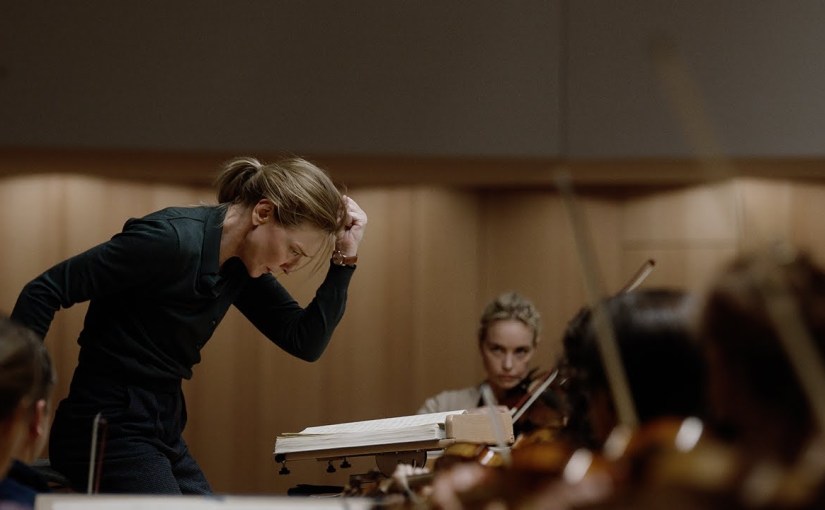
One of the very first scenes of writer/director/producer Todd Field’s Oscar nominated film Tár captures its title character Lydia Tár being interviewed for her celebrated career as one of the few widely known female conductor/composers in the world.  Cate Blanchett is Lydia, and her vocal delivery is so crisp and sharp within the wordy conversation.  I hear everything she is saying and yet I can not comprehend one thing that she is talking about.  I’m sorry.  I lack the knowledge to know the value and gifts of a skilled classical musician who expertly leads an orchestra.  However, I think I gathered the most vital element of this scene.  Lydia Tár knows she’s a celebrity as she discusses the influence she collected from Leonard Bernstein, and as she sits on this stage with this interviewer, she knows that she is one to be admired.  Lydia Tár will likely claim to be the second coming of Bernstein. She is a proud -very proud-expert at her craft.  No question about that.  Yet, in front of this classroom audience she is also wearing her best figurative mask. 

(Interestingly enough and a POSSIBLE SPOILER, the final caption of the film has the audience she performs to donning masks.)

Shortly after that interview comes another one-on-one discussion with her agent/lawyer, and a different angle to Lydia is presented at the restaurant table.  I still found it challenging to understand the breadth of the conversation.  I could uncover one thing though.  The mask has been removed.  Lydia Tár is now a proud condescending bitch. 

The most eye opening scene occurs next as Lydia attempts to shatter the confidence of a student while she teaches a class at Julliard.  Constructively speaking, this roughly ten-minute sequence is fascinating.  Todd Field captures one long take, the camera never breaks away for an edit, as the composer destroys the position of this young student’s reasoning for not being an admirer of Bach.  It consists of long, breathless monologues that travel with Cate Blanchett’s stride and Todd Field’s camera as the actress circumvents the classroom and the stage located up front. The student does not approve of Bach as a CIS, white composer whose sexual activities led to multiple children.  However, Lydia does not factor in Bach as the person he was with his ugly warts and all. Rather she only values the art he created, and therefore this student should as well.  All that is contained in the notes on the page are what Bach should be treasured for.  Lydia confidently undoes the student’s argument with logic that is hard to win against.  Todd Field will demonstrate with the rest of his film this destructive skill will also be Lydia Tár’s undoing.

It’s quite a proficiency Lydia has for tearing down the principals of anyone confronted with her.  She is also adept at ripping away the promising potential and the talented traits that others possess.  Lydia knows what she does.  She knows the hurt and pain she inflicts among the people around her.  Yet, just as she explains to the student, she should also be appreciated like Bach.  You may despise her demeanor, but Lydia Tár is an artist of varying and exceptionally high degrees, especially for a woman.  She is writing a book about herself appropriately titled Tár On Tár.  She is in the middle of writing her own symphony, and she has the esteemed honor of conducting a major German orchestra in Berlin for an anticipated live performance of Gustav Mahler’s Symphony No. 5. Therefore, who she is as a person should carry no matter.  Look only at what Lydia is capable of!!!!

Cate Blanchett is one of the few actors that can stand next to other talented peers like Meryl Streep, Jack Nicholson, Shirley MacLaine or Jimmy Stewart.  She is an uncompromising actress ready to play the unlikable characters necessary for effective storytelling.  Lydia Tár is one such sociopath.  Blanchett occupies nearly every frame of the picture, and she delivers such a frightening and obdurate drive to this person.  

It’s funny.  I often joke with a friend of mine about Faye Dunaway’s awful, over the top performance of Joan Crawford in Mommie Dearest.  It’s so ridiculously out of control and manically abusive that I don’t know where to begin with that film.  Lydia Tár has that same kind of passion, but with Cate Blanchett possessing the character, accompanied by Todd Field’s script, there are an assortment of ways this tyrant leaves her carnage strewn about when she enters and leaves a scene.  The outbursts are timed perfectly for these crescendo moments where Lydia believes she has everything under control and contained, but then a screw comes loose in her functioning that derails everything she’s built herself up to be.

However, this character lives within the modern digital age, where cell phone video footage and social media serve as a mirror and a judge and jury.  It’s not so easy to dismiss what is said about Lydia when “if it appears on the internet, then it must be true.” Underlings will surrender to Lydia’s patronizing demands.  They will cower or fidget with an involuntary bouncing knee or a clicking pen in their hand, while in her presence.  Lydia is aware of the fear she invokes because she is so good at using it for her ongoing self-empowerment.  However, she is not capable of overcoming the judgment she must endure when she becomes associated with the suicide of one of her former musicians; someone she lent the illusion of valuing only to dismiss her without so much of a care later.  She’s also unaware of how to function without the dependability of her assistant, played by Noémie Merlant, doing her mousy best under the elephant shadow cast by Blanchett’s performance.  Furthermore, the intrusion of Lydia’s self-consciousness comes into play as she gets disrupted by sounds that interrupt her sleep or silence or concentration as she kills herself trying to write her piece and live within her ego.

Tár is a film with a lot to unpack.  The other Unpaid Movie Critic, Miguel, saw it before I did and told me that.  He could not be more astute with that observation.  I read his review after watching the film and my impression is pretty consistent with what he gathered from the piece.  However, as I stared at my computer monitor wanting to write about this film, I told Miguel that I am at a loss of what to say about the picture.  It’s a long movie.  It actually feels longer.  Ironically, if I were to watch it a second time, I think it would feel like a faster pace for me.  I guess because I’d have an idea of where Todd Field was going with his film.  My problem on this first go round was that I was lost as to what was occurring, and what or who was being talked about.  Todd Field tells this story with the presumption that his audience is familiar with the art and industry of music composition.  For me, the vernacular is totally foreign.  He doesn’t offer exposition to explain the science of it all like how a crime drama will allow moments to explain police procedure for example, or a fantasy will display who/what is most valuable in its kingdom.  Don’t misconstrue what I say, please.  I’m not complaining.  Tár speaks to the musicians first. 

Only later did I accept that much of what is held within the dialogue is not a priority for me. I should be examining the act of Lydia’s cruelty, self-absorption, and the response she elicits from anyone who steps into her world.  It’s interesting that Cate Blanchett speaks fluent German (she specifically learned it, as well as orchestral conducting for this film) to her orchestra, but sometimes Todd Field opts not to provide subtitles of what she’s saying to them.  In other moments though, he will.  It doesn’t matter what she is saying.  Her body language and her – well…her OUTSTANDING – performance convey the messages.

Because my mind deviated during the film, simply because it was a challenge to understand what was going on, I kept going back and forth with the little figures on my shoulders.  I hate it.  I like it.  I hate it.  Okay, now I like it.  Reflecting back on the film, I think Tár is an enormous achievement for both Cate Blanchett and Todd Field.  This film is a very far cry from the sentimental ingredients I found in his other films (Little Children, In The Bedroom). 

For Blanchett, this role is a massive test of endurance with endless amounts of dialogue to cover in long takes, along with speaking French, German and especially the dialect of classical music while she stands at the podium with the baton held in her hand.  She uses that baton like a weapon at times, a ruler with a broad sword or an extension of her arm.  There was one moment where she holds the instrument with both hands and swings it violently like a golf club or a baseball bat.  I’ve never seen that before.  It’s shocking how she handles herself.  I noted how Margot Robbie must have exhausted herself into oblivion while performing her drug fueled rages in Babylon.  I said she must have curled up in a corner after some takes just to calm herself down.  I would not be surprised if Cate Blanchett sought some therapeutical treatment following shooting some of these scenes.  A role like Lydia Tár is so tyrannical, so cruel, so paranoid and so indulgent that it exhausts you mentally to watch her function.  For Blanchett, her strive for perfection must have taken a toll on her mentally as well as physically. Her performance is comparable to the crazed obsession found in Daniel Day-Lewis’ portrayal of the greedy oilman Daniel Plainview in There Will Be Blood or what he achieved as Abraham Lincoln.

Come later this year, Cate Blanchett will be the one taking home the trophy for Best Actress at the Oscars. It’ll be so well deserved.

I recommend you see Tár, and I urge you to stay with it.  It’ll test you.  It’ll try you. Stay with it, though, because when it is over you won’t stop thinking about it.   

TENDER MERCIES (1983)

by Miguel E. Rodriguez

DIRECTOR: Bruce Beresford
CAST: Robert Duvall, Tess Harper, Betty Buckley, Wilford Brimley, Ellen Barkin
MY RATING: 8/10
ROTTEN TOMATOMETER: 84% Fresh
Everyone’s a Critic Category: “A Movie that Won the Oscar for Best Original Screenplay”

PLOT: A broken-down, middle-aged country singer gets a new wife, reaches out to his long-lost daughter, and tries to put his troubled life back together.


Tender Mercies does not feel like a movie that was released the same year as WarGames, Octopussy, and Return of the Jedi.  It has more in common with the spare, character-driven films of the early ‘70s like Five Easy Pieces [1970] and The Last Picture Show [1971].  It’s a movie where not much seems to happen, at least on the surface.  Underneath the barren landscapes and big skies, however, great truths about life and acceptance are on display.

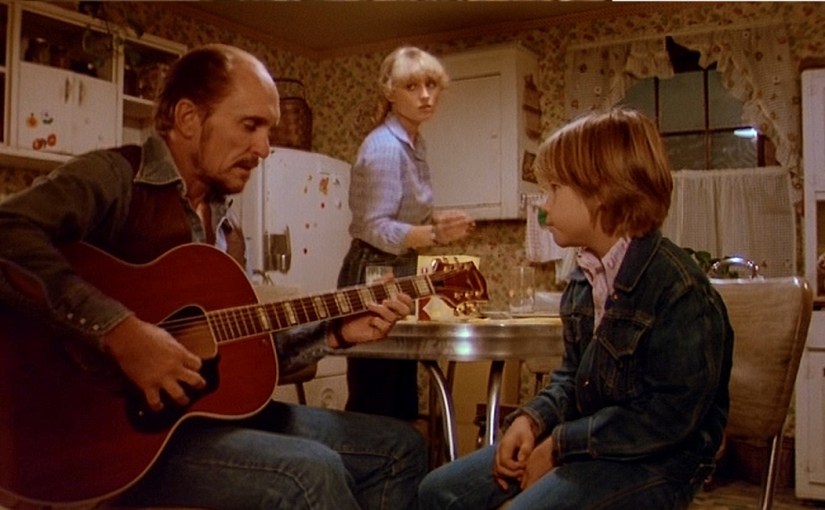
Anchored by an Oscar-winning performance from Robert Duvall, Tender Mercies tells the story of Mac Sledge (Duvall), whom we see at the opening of the film collapsing in a drunken stupor on the losing end of a fight in a rinky-dink roadside motel in rural Texas.  The next morning, broke and abashed, he makes an arrangement with the widowed motel owner, Rosa Lee (Harper): he’ll do odd jobs at the motel for room, board, and $2 an hour.  Rosa Lee’s son 10-year-old son, Sonny, watches this situation unfold impassively and asks Mac some very direct questions: “Did you used to have money?”  “How’d you lose it?”  “You think my dad would’ve liked you?”

The filmmakers (directed by Bruce Beresford, Oscar-winning screenplay by Horton Foote, who also wrote the screenplay for To Kill a Mockingbird [1962]) make some interesting choices for everything that follows.  There is a gentle scene between Mac and Rosa Lee where he shyly asks her, “You ever think about gettin’ married again?”  She says she has.  “Would you ever think about marryin’ me?”  She says she will think about it.  And in the very next scene, it’s made clear that time has passed, they got married, and have been married for several months.  In another film, that kind of “condensed storytelling” would go into the negative column in my book, but not here.  Instead, it feels…right.  We don’t need to show any further details of their courtship, their wedding, Sonny’s feelings about it one way or the other, etcetera.  Those extra scenes would have delayed the narrative structure, showing us things we don’t need to see, but which we can easily deduce.

There’s another scene (I’ll try to tread lightly here) where Mac gives a heartfelt, but still masterfully underplayed, speech to Rosa Lee about how he was in a bad drunk driving wreck years before, and how God saw fit to bring her into his life, but to do so meant her husband had to die, and so on.  “See, I don’t trust happiness.  I never did, I never will.”

When he finished, and Rosa Lee stood there taking it in, in my head, I imagined her replying with something like, “Well, Mac, you don’t have to trust happiness, you just have to trust me”, or “yourself”, or some similarly corny platitude.  Instead, in what must have been superhuman restraint on the part of the screenwriter, Rosa Lee simply stands there, processes what she just heard…and walks offscreen, leaving Mac alone with his thoughts.

That was a big moment for me.  It seemed to me to be a gesture from the filmmakers that this is not a movie about processed dialogue and ancient story arcs and the kind of emotional beats you might expect from a film.  Instead, it felt like I was looking at real people, reacting realistically to real dialogue.  Rosa Lee could have drawn the scene out, but instead she seems to realize there is nothing she can say that will make things better for Mac.  She loves him, but she knows this is something he’ll need to work out for himself, and no amount of sermonizing will help him towards that goal.  It’s a small moment, and it doesn’t occur until late in the film, but it’s this moment that convinced me Tender Mercies had a lot to say in between the pauses and transitional shots of country roads and straight horizons.

There is a lot more to the story, but the film presents very little of it with the kind of forward momentum we’ve come to expect as moviegoers.  Instead, we are treated to new developments almost as if we are intruding on these people and their lives.  Even in a scene at a crowded Opry house where we see Mac’s previous wife, Dixie (Betty Buckley!), belting some good old-fashioned, Parton-esque country tunes, the shot choices and editing still feel almost like we’re voyeurs as we watch Mac listening to one of Dixie’s ballads, then leaving, not quite in disgust, but clearly uncomfortable.  It’s in the aftermath of this concert we get the first solid information on his estranged daughter (Barkin), who would be about 18 years old by now.  Dixie screams at Mac, “She doesn’t remember you!  All she remembers is a mean drunk!”  This scene was so well-realized that I started having flashbacks to some of the fights my own parents got into before their divorce.

I don’t mean to suggest the movie does not have an arc.  It absolutely does.  But Tender Mercies does such a good job of “burying the lead” that I didn’t fully get what the movie wanted to say until the very last scenes featuring two characters tossing a football back and forth.  Mac’s life seems to be back on track.  His music career seems about to be resurrected.  Mac might still have trust issues when it comes to happiness.  Perhaps all we can do is appreciate the small moments of happiness we have while we can.  If sadness or tragedy comes, let it come.  It will hurt for a time, but it will also make those small moments all the more precious.

If that sounds clichéd, well, maybe it is.  Tender Mercies does a much better job of delivering that message than I could ever do, proving once again: a movie is not about what it’s about, it’s HOW it’s about it.


QUESTION FROM EVERYONE’S A CRITIC

Unless you read the script, you can only judge a screenplay by the movie. Based on the movie, do you feel this script deserved the award for Best Screenplay? Explain.
Great question!  For the record, the other nominees that year were the screenplays for The Big Chill, Fanny and Alexander, Silkwood, and WarGames (that last one kinda surprised me).  I am a little surprised Tender Mercies edged out The Big Chill, a movie with far more prominence than this little Texas character study from an Australian director, but I would say Tender Mercies certainly deserved the award based on the movie by itself.  Much like Lost in Translation [2003], the screenplay relies more on silences and context to deliver its message rather than on showy dialogue or melodramatic plot developments (to be fair, there is one sort-of melodramatic plot twist in Tender Mercies, but it’s handled so well it doesn’t play that way).  Sure, Tarantino and Sorkin might deliver high-quality screenplays that are flashier and certainly wordier, but to craft such a high-quality film in such a minimalist style is admirable and deserves recognition.

NOPE (2022)

by Miguel E. Rodriguez

DIRECTOR: Jordan Peele
CAST: Daniel Kaluuya, Keke Palmer, Brandon Perea, Michael Wincott, Steven Yeun, Keith David
MY RATING: 7/10
ROTTEN TOMATOMETER: 83% Certified Fresh

PLOT: Residents of a lonely gulch in inland California bear witness to an uncanny and chilling discovery.


After watching Nope, the third feature from Jordan Peele (Get Out, Us), I found myself curiously unable, or unwilling, to sit down and write a review for it.  What more can I add, I thought, to the volumes that have already been written about it?  What insights can I share that aren’t revealed in the making-of documentary on the Blu-ray?  How can I analyze a movie that can literally be boiled down to, “What if Close Encounters turned into Jaws?”  What good would it do to figuratively take this movie apart and critique its individual components?  It’s a roller-coaster, pure and simple, much like Jurassic Park III [2001].  How do you review a roller-coaster ride and try to compare it to other roller-coaster rides in terms of a review?

“I found the first hill of Rip-Ride Rocket much more intense than the slingshot approach of Hulk or Rock-N-Rollercoaster, but each has something to offer in terms of inversions, smoothness, and on and on and on…”

It just feels pointless, for reasons that are proving themselves difficult to pin down.  So, instead of a “normal” review, here are random thoughts, in no particular order:

  • The “true” nature of the UFO – oops, sorry, UAP, I had to look that up – stretched my disbelief suspension to the limit, but I will admit, it’s certainly original.  I can’t think offhand of any other movie or book I’ve watched or read that even considered that explanation for all those unexplained sightings in the books.  Once that was established, every successive appearance of the “spacecraft” became even more ominous and/or menacing.
  • I loved how the movie is littered with clues or easter eggs that either give a hint to the film or sort of comment on what we’ve seen before.  There is an early scene when OJ (Kaluuya) and Em (Palmer) are walking outside with a magnificent setting sun behind them behind the clouds, and hand to God, I remember noticing one particular cloud that looked…off.  Also, there’s another scene when a horse runs off and OJ watches it through the gaps of a wooden shed, and the visual impression is that of a zoetrope, the machine that made the opening images of the running horse possible.  Or even look at the screenshot at the top of this article…quick! What does that lampshade look like to you?
  • There was something about the design of the UAP that bugged me throughout the movie, not necessarily in a bad way, but it just seemed weird.  Why would something that is [SPOILER REDACTED] need what looks like fabric when seen up close?  Is it a sail?  That seems most likely.  In the latter stages of the movie, the “anomaly” doesn’t seem quite as mobile or speedy as it did when its “sail” was intact.  It’s an interesting design concept.
  • One of the scariest moments for me had nothing to do with the UAP itself.  It’s the scene in the exhibition area where the lights seem to be turning on by themselves.  The payoff for the scene seems predictable in hindsight, but as the scene progressed, I was BESIDE myself.  You can ask my best friend, Marc, who watched it with me.  When that shapeless mass by the light switch suddenly started to “unfold”, I echoed OJ: “Nope!  Gotta go, goodbye!”  It is a brilliantly executed scene.
  • I’ll need to watch the movie again to fully understand how that little parachute managed to scare off the UAP.  I assume it has to do with actual horse training, and with some research I could find the answer myself, but the movie does very little to explain it to the viewer.  Or maybe it does.  Like I said, I need to watch it again.
  • I loved how the flashback with the chimpanzee seems utterly incongruous at first.  And I loved how creepy and horrifying it is.  It’s a brilliant framing device (if I’m using that term right) that kept me guessing as to its real purpose right up to the end, or CLOSE to the end.  And did I mention how horrifying it is?  That moment when it’s resting…and then looks RIGHT AT THE CAMERA…chilling.
  • Someone somewhere had said that Keke Palmer was robbed of an Oscar nomination.  With all due respect to Ms. Palmer…she did an admirable job, but I didn’t see anything in the film that would have had me reaching for my Oscar ballot.  But I will give her props for her opening speech to that film crew.  The special features on the Blu-ray reveal that she delivered MANY different variations (fourteen, according to IMDb), much like you see so many other actors do in broad comedies, just to find the exact right version or take.
  • Much like Us, Nope feels like it bit off a little more than it could chew when it comes to the resolution of the film.  Everything leading up to the last 10 minutes or so is gangbusters, honestly, even the silver-helmet guy.  But as everything started to wrap up, I began to feel as if I’d seen all this before, just in different ways, in many different films.  Perhaps I’m being unfair.  Perhaps I’m criticizing the movie for what it isn’t instead of reviewing what it is.  I don’t know.  As it is, also like Us, Nope is one helluva roller-coaster ride that ends, not with a bang, but with a “pop.”
  • Allow me to shamelessly quote Roger Ebert, again: “If you have to ask what something symbolizes, it doesn’t.”

SINGIN’ IN THE RAIN

By Marc S. Sanders

Reader, I’ve been having a hard week.  My beloved puppy dog, Falcon, has not been feeling well and my family and I are so worried for him.  It’s just been a long week having to deal with reality.  Nevertheless, when I watch a classic musical like Singin’ In The Rain, it’s impossible not to smile and catch on to the energy that drives the film from the talents of Gene Kelly, Debbie Reynolds and Donald O’Connor.  This trio are not just sensational dancers and singers.  They’re adoring comedians that set a standard for facial expressions and endless entertainment variety. 

A simple, but informative story sets the spine of the picture.  Talking films like Al Jolson’s The Jazz Singer are catching on in Hollywood movie houses and the silent pictures are quickly becoming archaic.  Established talents like Don Lockwood (Kelly) and Lina Lamont (a scene stealing Jean Hagen) are being threatened with becoming extinct unless they can adapt to the use of their voices in the romantic cinematic roles they are known for.  Don will adjust.  Lina is another story.  Her alluring blond bombshell looks are recognized everywhere.  However, none of that will line up with her natural, squeaky, ear piercing vocals.  She’s a hopeless case for the best vocal coaches that money can buy.  Don and Lina are star attractions with contracts to guarantee them work, but Lina’s voice could put the movie studio out of business. 

Fortunately, Don just happens to land smack dab into the passenger seat of Kathy Selden’s (Reynolds) car.  Kathy has the voice, and soon Don and his trusty songwriting companion and pal, Cosmo Brown (O’Connor), will realize the acting talent to boot.  In the meantime, though, Kathy’s voice will dub in for Lina’s on screen.  There are great gags at Lina’s expense as she tries to work with a microphone for the first time.  This is Lucille Ball material of the finest, comedic polish.

In between all these story developments reside some of the greatest musical song and dance numbers to ever grace a screen.  Few, if any, films have matched the rubber faced hyperactive quick steps of Donald O’Connor during his rendition of “Make ‘em Laugh!” What he does with this cutaway scene looks like a superpower of marvelous agility.  Jim Carrey could never stand next to Donald O’Connor.

Gene Kelly’s accompaniment with O’Connor and their silly, tongue twisting “Moses Supposes” is magnificent to watch.  You could be on your death bed, looking at this scene, and I truly believe you’ll think nothing is so bad in life while you watch this moment.  The pair are masters with their physicality of jumping on and off desks and chairs, while they toss around a stuffy, glass eyed linguist caught in the middle of their shenanigans.  Every prop and set piece are given functionality, be it a lamp shade, office supplies or stacks of paper.  Then there are the lyrics.  How do you so fluently utter words like “Moses” and “supposes” and every other imaginable piece of vocabulary that phonetically sound like them to seem like it is as natural as saying grace? And they do it all while bouncing all over the place with two stepping in perfect sync.  It’s like nothing I’ve ever seen before.  These guys are functioning on one motor.

To add further compliment, I must emphasize that the camera pointed at these magnificent players hardly ever cuts away.  There are long sequences where the guys are literally walking up walls and back flipping over.  It’s all done in one shot.  There’s only frequent edits away for a close up or another angle.  Otherwise, Gene Kelly and Donald O’Connor are defying the impossible to show breathless choreography.  They seem to defy physics, and the props they use cooperate with every step, leap, run or jump taken.

The same goes for when Debbie Reynolds makes it a trio during another unforgettable number called “Good Morning.”  The furniture pieces are choregraphed to work with the three dancers.  All three race towards a sofa, step on to the seat cushions in unison and then walk onto the back of the sofa, allowing it to flawlessly tip over so they can continue their stride.  Just writing about this, I think about how amazing and wondrous this scene is.  Lightning in a bottle!

All of the material contained within Singin’ In The Rain is incredibly cheerful, full of color and humor and tremendously likable characters.  Yet, it does not ever teeter on being hokey or cheesy.  The musical doesn’t feel dated.  This film transcends generations like The Wizard Of Oz or Star Wars.  No matter the age, anyone should be able to like this movie. 

I love the irony of the number “Singin’ In The Rain” that lends to the title of the picture.  Just think about the word “rain.”  Often it is associated with gloominess and sorrow and mood.  However, the tempo of Singin’ In The Rain as a full length film invites happiness and glee no matter the situation.  Gene Kelly’s clownish activity with an umbrella, a large smile and a rain soaked street corner becomes one of the most delightful moments ever to grace a screen. He stomps, skips and splashes in the large puddles while taking a leap on to a streetlamp just to express all of Don Lockwood’s glorious bliss and adoration for his new love Kathy Selden.  A hat becomes its own character as gushing rain drains out of a storm pipe soaking Don’s head.  The brim of the hat seems to develop its own form of jubilation.

I’ve read that Gene Kelly was a viciously strict co-director (with Stanley Donen) and choreographer on this film.  Debbie Reynolds has testified to long sessions of endless starts and stops.  It was tortuous at times.  If just a toe or a hand was out of place in any of the choreography, Kelly would not stand for it.  It had to be perfect.  I can’t imagine Kelly in a demanding or authoritative capacity.  He is just so cheerful and lovable on screen and so is the entire company of performers.  I guess the contrast with his character lends to how impressed I am with the final product.  However, to make a picture like Singin’ In The Rain this exact and eye popping requires astute examination.  The assembled rhythm of the three dancers and the chorus behind them at least matches some of the most refined military assembly marches I’ve ever seen. 

Watch Singin’ In The Rain for a glimpse into the evolution of Hollywood and cinema.  Watch it for a simple, yet funny story.  Watch it for the characters and set pieces.  Most of all, watch Singin’ In The Rain to discover how grand and wonderful life can be.  It’s likely that none of my readers can do what Kelly, Reynolds or O’Connor accomplish in this film, but I can guarantee that you’ll feel just as joyous as they do while they are putting the show on for you.

Singin’ In The Rain is why movies are so important for our emotional lexicon of escapism.  It lends to good health to watch Singin’ In The Rain.  It’s a film we all need.

Singin’ In The Rain is a reason to live.