WEIRD SCIENCE

By Marc S. Sanders

John Hughes, as a writer, stretched his imagination far at times. Really far!!!!! You’d have to, to build up your confidence to make a ridiculous comedy like Weird Science come to life. The movie is blatantly absurd, outrageous, a little crude and outright nonsensical. It’s Frankenstein meets Pretty In Pink. It’s alive!!!!!

Double, maybe quadruple, Uber Nerds Gary and Wyatt (Anthony Michael Hall, Ilan Mitchell-Smith) spend their Friday night in front of the computer to create the hottest woman ever. With the help of a Barbie doll and some Playboy centerfolds, nothing on earth will compare to this creation for the XX chromosome community. They give her a brain as well by scanning in photographs of Albert Einstein, of course. From there, “Lisa” (Kelly LeBrock), with the toned body that SCREAMS SEX, plots out the boys’ weekend at a blues club, then the mall and later a party at Wyatt’s house where the boys’ reputations are enhanced almost as well as Lisa’s chest.

Lisa helps Gary and Wyatt overcome their insecurities with their popular girl crushes and teaches Chet, Wyatt’s idiot green beret brother, to lay off. Chet is played by Bill Paxton. Can you imagine anyone else playing Chet?

There’s a cuteness to Weird Science. However, the slapstick gags are what really wins. Either you like this silliness or you don’t. I get amused watching all the furnishings of Wyatt’s house, including the Baby Grand piano, get sucked out the chimney along with a half-naked girl. I love it when Lisa freezes the blue blood grandparents in the pantry closet or when she erases the memory of Gary’s father. I also like how Chet is reduced to a big blob of literal shit. Then there’s the nuclear missile that rises out of the floor, up through the roof.

Take off your cap of sophisticated maturity, and just appreciate silly, sophomoric comedy for a change. It’s all harmless, anyway. Lisa makes sure everything is back in its place by the end, only now it’s better and funnier than before.

NOTTING HILL

By Marc S. Sanders

Notting Hill written by Richard Curtis (Love, Actually) and directed by Roger Michell is a pleasant surprise of a romantic comedy. It’s not a perfect film but it certainly loves every one of its quirky supporting characters, as well as its two straight romantic leads played by Julia Roberts and Hugh Grant.

Grant plays Will Thacker who lives in the Notting Hill district of London where every proprietor is a charming little shop of some form or other; a quaint street where merchants appear on the sidewalks during the weekends selling their art or homemade jams or coffee products. Will owns a travel book shop located across the street from his flat that is whimsically recognized by its big blue front door. His wife left him for another man and now he’s relegated himself to living with a roommate called Spike (character actor Rhys Ifans doing a British equivalent of Cosmo Kramer, Seinfeld’s neighbor).

One day the superstar celebrity Anna Scott (Roberts) simply strolls into Will’s store. They have a quiet moment and he sells her a travel book about Turkey that he didn’t recommend she purchase. Moments later they run into each other down the street when Will spills orange juice all over Anna. From there, a meet cute relationship begins to unfold. It’s not so simple for the pair though as Anna’s enormous celebrity is hard to negotiate; hard for Anna, not hard for Will.

Anna is at ease when she can have a quiet dinner to celebrate Will’s sister’s birthday with his friends or when she can escape her turbulent life of gossip magazines and paparazzi by taking shelter at Will’s flat, even if grungy looking Spike walks in on her taking a bath.

I like Notting Hill. However, the quiet moments shared between Grant and Roberts sometimes carry on too long. Oh my gosh!!!! Will someone say something already????? Hugh Grant has made characters that trip over their words and stumble with what to say into a master craft. Julia Roberts is one actress that a camera loves especially when she’s distressed. A crying moment in any one of her films will milk the scene for every blush, or glassy eye or tear and whisper she can offer. She’s a terrifically skilled actress in almost any film she does. Eventually, we have to move on from all of this though. My patience for some scenes were just running way too long for me at times. Kiss already!!!! Make love already!!!! Scream at each other already!!!!

Fortunately, there’s much escape to be had with the supporting cast, especially Ifans as Spike who is the most absent minded, lovable, dirty underwear wearing and sloppy prig imaginable. Emma Chambers is just as fetching with her scarlet pigtailed haircut as Will’s sister, Honey. Tim McInnery, Gina McKee, James Dreyfus and Hugh Bonneville round out this madcap collection. The birthday dinner party is a great scene for this ensemble as a comedic but relaxed chemistry blends nicely during a competition to see who is suffering the most to earn the last brownie on the dessert plate. The group is unsure how to include a movie star like Anna in their simplicity but Julia Roberts pulls off a trick that even had me fooled. Simply put, for the whole cast, there’s just that much more life and vibrancy when they are all together and it’s not just relegated to only Roberts and Grant in a scene.

Another special moment occurs later when the couple have split up once again. To depict time fleeting by, Roger Michell offers up a transition of Will wearing one outfit but walking through the hustle and bustle of Notting Hill as the weather and seasons seamlessly change all around him from sunlight to rain to snow and spring sunlight again. You even get a glimpse of Honey starting a flirtatious relationship at the beginning of the sequence and by the time it’s over a minute later Honey is breaking up with the guy. It’s a wonderful moment of wordless narration to show Will’s struggle with moving on as time continues to pass by. More importantly, it allows the titled setting to be a character of its own. This is a great example of showing a lovesick character unable to move on while life has no patience to wait for him to catch up.

I like Hugh Grant and Julia Roberts whether it’s in Notting Hill or one of their many other fine movies. I can’t deny the chemistry they have in this film. It works. I only wanted a little more life to the material that was handed to them. Still, Notting Hill is charming and simply a very sweet romantic comedy.

THE BOOK OF ELI

By Marc S. Sanders

Do you believe in the word of God?

The Book Of Eli directed by The Hughes Brothers will make sure you do.

Faith carries Denzel Washington’s loner character on a journey through a grim, sunburned post apocalyptic wasteland as he protects a rare, sacred text. He has been on a sojourn to reach a final destination out west.

Me, being the religious skeptic these days, might normally find the convenient episodes of survival that Washington encounters as far fetched. However, The Hughes Brothers direct a script penned by Gary Whitta that never mocks the purpose of the film presented. As a viewer it would be rude of me to laugh at how Washington continues to walk when it seems he’s getting shot in the back. I wouldn’t dare misbehave in that manner. Watching The Book Of Eli…well…I feel like I’ve gone to church.

The Loner carries a book he faithfully reads every day as continues his long walk through treacherous, barren and motorcycle pirated lands. If the sun doesn’t blind him and kill him, the various marauders might.

The worst adversary of this bunch is Gary Oldman in yet another treasured villain role. Oldman keeps a tight authority on an “old west” inspired town, commanding from his comfortable leather chair in the upstairs level of the town’s bar (saloon, perhaps?). He’s been tirelessly dispatching men to find a particular book and perhaps it’s the one that The Loner possesses.

Post-apocalyptic wasteland, a book, a Loner, a villain. That’s the structure of this film along with some side characters like an impactful Mila Kunis and Jennifer Beals. Very simple ingredients allow for well edited moments where Washington can display his unexpected fighting techniques with a gun or a shotgun or a forearm length sword. When he exercises these moments the scenes are outstanding. Oldman is the guy who sits back letting his own horde do the dirty work and only acts when he sees that he has an upper hand. He’s oily, scary and in this dense waste of a future he likely dreams of being a prophet or a high powered evangelical might.

I was so pleasantly surprised by this film. Post apocalyptic films wear on me these days. How much is there to show that I haven’t already seen like abandoned cars, skulls, and deserted highways?

This is different however because Whitta’s script offers a reason to live through this hellish void. I had to wait for it but the ending is a very satisfying conclusion. I loved it, actually.

The Book Of Eli is a great film.

INDIANA JONES AND THE TEMPLE OF DOOM

By Marc S. Sanders

Steven Spielberg’s second installment in the Indiana Jones series of films deserves more credit than it has received, nearly forty years later. Spielberg isn’t even fond of his film, and I think he needs to reexamine his own self-criticisms.

By the time he’d make this prequel, he was already a master filmmaker (followed by Close Encounters…, Raiders Of The Lost Ark, and E.T. The Extra-Terrestrial). Temple of Doom almost seemed easy for Spielberg to construct. He just filled in the holes from one scene to the next and he’s so natural in his instincts that the thrill of adventure never wavers, and it always feels new and fresh.

Think about it!!! He accompanies a John Williams led rendition of a Busby Berkeley number while Indy tries to escape from machine gun toting baddies in a Shanghai nightclub (called “Club Obi Wan”; nice wink and nod there).

That’s followed by an unlikely jump out of an airplane with only an inflatable water raft to glide through the heights of the sky. Reader, I bought it, and only because Spielberg shot it. He just knows what looks good on film.

The main crux of the film focuses on rescuing the enslaved captured children of an Indian village from a bloodthirsty cult while also retrieving sacred stones. Over the years as we’ve approached an age of a PC climate, many take issue with racial prejudice overtones. Do Indians eat monkey brains for dessert, and rip beating hearts out of the chests of men? I don’t care, and I don’t associate these horror/comedy moments with people of a certain race. I’m not foolhardy enough to do that.

However, I do correlate this material with what inspired the Indiana Jones character in the first place, and that is the serial cliffhangers of a forgotten age. Ridiculous stunts and outrageous visuals kept the attention of the viewer and that is what Spielberg, along with creative partner George Lucas, accomplishes here.

So you are treated to thousands of icky, crawly bugs, a screeching, off the rails mine car pursuit and a “snake surprise” as a main course dinner entree.

It’s all in good fun and it’s all shown in the campy adventure thematics that Indiana Jones was always recognized for.

Just go get your jolts every time he cracks the whip. That’s all Indiana Jones And The Temple Of Doom was ever meant to be.

EVERYTHING EVERYWHERE ALL AT ONCE (2022)

by Miguel E. Rodriguez

Directors: Dan Kwan, Daniel Scheinert
Cast: Michelle Yeoh, Stephanie Hsu, Ke Huy Quan, James Hong, Jamie Lee Curtis
My Rating: 10/10
Rotten Tomatometer: 96% Certified Fresh

PLOT: A middle-aged Asian woman tries to do her family’s taxes with mind-bending results.


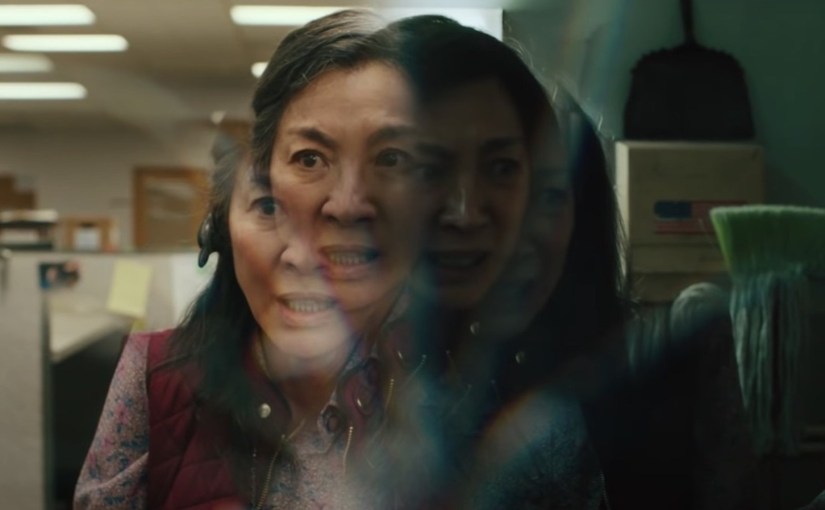
Every once in a while, a movie comes along that is so daring and original that any attempt to accurately describe it feels futile.  Scott Pilgrim vs. the World was one of them.  Being John Malkovich was another.  And now comes Everything Everywhere All at Once, a sci-fi action brainteaser that feels as if it were written by Terry Gilliam and Quentin Tarantino and directed by Stephen Chow (Kung Fu Hustle, Shaolin Soccer…two movies that also meet that “indescribable” criterion).  It feels like an episode of Black Mirror crossed with Jackie Chan and a dash of David Lynch and Terrence Malick.  If you can’t find anything to like in this movie, check your pulse.

Evelyn Wang (Michelle Yeoh) opens the film trying to do her family’s taxes.  She and her husband, Waymond (Ke Huy Quan – “Short Round” from Temple of Doom!!), carry stacks and stacks of receipts to their local IRS branch and try to explain to their case worker (a dowdy Jamie Lee Curtis) how a karaoke machine can be deducted as a business expense.  However, before that can happen, after a series of very strange events involving Waymond and a pair of Bluetooth headsets, Evelyn finds herself immersed in a trans-dimensional battle between the forces of good, led by an alternate-universe version of Waymond – the “Alpha Waymond,” if you will – and someone called Jobu Tupaki, a being or person who is hunting for Evelyn in every conceivable parallel universe.  All Evelyn has to do is use these weird headsets to access the infinite multiverse and harness the skills learned by the infinite Evelyns before Jobu Tupaki can track her down and kill her.

To access the multiverse in such a way, one must commit random acts of…randomness, which leads to bizarre scenes of individuals doing some very weird things to access special skills.  What kind of weird things, you ask?  Things involving…sticks of lip balm, putting your shoes on the wrong feet, saying “I love you” to a stranger, or wiping someone else’s nose for them and…well, use your imagination.

That’s seriously just scratching the surface.  I haven’t even mentioned Evelyn and Waymond’s daughter, Joy; their laundromat; Evelyn’s elderly grandfather, Gong Gong (veteran character actor James Hong – 450 film and TV credits and counting); or the divorce papers Waymond has on his person.

This movie is a trippy, joyous, tightrope-walking masterpiece.  There are moments where you can sense it tap-dancing on the line of self-parody, then jumping over it and daring the audience to go along with it.  If there are some people that say they were unable to follow where this movie leads, I can’t really say I’d blame them.  Not many movies would ask you to take it seriously, then include a scene involving two rocks having a conversation via, I guess, ESP.  Or where the two lead characters turn into piñatas.  Or where Jamie Lee Curtis staples a piece of paper to her own head.  Or where the fate of the world might hinge on who gets their hands (in a manner of speaking) on a trophy shaped like…a very specific kind of toy.

HOT DOG FINGERS, people.  HOT.  DOG.  FINGERS.

I’m frankly amazed this movie didn’t collapse on itself.  There are so many ways it could have gone wrong, and so much it wants to say, while trying to be simultaneously massively entertaining and heartbreakingly poignant.

From a technical standpoint, I think it’s the frontrunner for the Best Film Editing Oscar for 2022.  This movie jumps from one parallel universe to the next and the next and back again so frequently that I got whiplash, BUT it was never confusing or mystifying.  It was always crystal clear what I was watching and why I needed to see it.  I could list any number of films or TV shows that have attempted this kind of thing on a much more modest scale and failed.  This is like the Who Framed Roger Rabbit of film editing.  It has been done so well and on such a grand scale that it seems unlikely anyone will try to tell this kind of story in the same way again.

Some may quibble at the mildly melodramatic resolution of the conflict among Evelyn, the “Alpha” universe, and Jobu Tupaki.  I can understand that viewpoint, but honestly, I just rolled with it when it came around.  And so did the theater audience I was with the night I saw it.  We all laughed uproariously on cue, sometimes for something funny, sometimes in sheer disbelief at what we had just seen.  But when the wrap-up started to come together, we all hushed and waited to see what would happen.  Even when it involved a parallel universe with something called Raccacoonie.  (It’s a long story…)

I hope I’ve conveyed how crazy good this movie is while preserving some of its best surprises.  I haven’t felt this urgent about getting the word out about a great movie since I saw Roma.  To call this an entertaining night at the movies does a serious injustice to the words “entertaining” and “movies.”  It’s more than entertaining and, not to get too hyperbolic, this is more than a mere movie.  It’s a masterwork, a collision of grand ambition and even grander moviemaking.  I plan on seeing it at least once more in theaters, if only just to see what I may have missed the first time around.  (And maybe also to tune more carefully into audience reactions at key moments, like the performance trophies, or those two rocks.  Who knew two rocks could be funny?  Like REALLY funny?)

E.T. THE EXTRA TERRESTRIAL

By Marc S. Sanders

It’s easy to give credit to a magnificent script by Melissa Mathison when talking about E.T. The Extra Terrestrial.  However, director Steven Spielberg clearly invented tricks of his own off her page.  Thus, E.T. strikes a chord with me on a very personal level. 

While my parents never separated or divorced, in my adolescent years I did not have any kind of relationship with my father.  He left for work at 4:30AM and would not come home until nine at night.  He worked Saturdays as well.  I hardly saw him.  He hardly conversed with me.  One time, later on in life, he explained to me that he just never knew how to connect with a child.  It was only then that I understood why his response of “Oh wow!” amazement seemed so fake when I showed him how the wings pop off of my Star Wars TIE Fighter.

Mom was the constant in my life with regular Saturday trips to Burger King, and the comic book and toy stores, while singing along to Barry Manilow in the car.  The adults I viewed in my childhood were mom and my grandmother, Helen.  So, I understand why Steven Spielberg opts to only include Mary (Dee Wallace), the one adult in full focus through most of his picture.  Mary has recently separated from her husband leaving her to tend to their three children. Gertie (Drew Barrymore) is the youngest. Michael (Robert MacNaughton) is eldest.  Elliot (Henry Thomas) is the middle child and main character of the story.  These kids have no other important influence in their lives except their mom and maybe Michael’s buddies.  Their father is only mentioned to be vacationing in Mexico with his new girlfriend, but never seen.

After an alien ship departs Earth while looking for plant life in a California forest, one of the passengers is sadly left behind.  Through a series of suspenseful moments, Elliot welcomes the stranger from a strange world into the comfort of his room full of toys and games.  A connection is immediately made of trust and friendship, but on a science fiction level, there is also psychic bond.  Somehow, Elliot and E.T. share one another’s thoughts and can feel what the other feels.  In a humorous moment, E.T. gets drunk on beer while being left at home alone.  This leads to disruptions caused by Elliot during a frog dissection scene in science class.  Even deeper though is that E.T.’s biological make up doesn’t appear to be suitable for a long stay on Earth.  As E.T. gets more and more ill, so does Elliot.  It is up to him and his siblings to help their new friend “phone home” so he can be rescued. 

The interference in all of this are the government officials who are surveying the suburban neighborhood for clues on E.T.’s whereabouts.  Wisely, and because Mathison’s story is told primarily through the perspective of children, Spielberg shows these men from the waist down.  After all, if Elliot and the others can’t identify with these adults, why is it necessary to show their faces? (In Jaws, the townsfolk can’t identify with the man-eating instincts of a great white shark.  So, why is it necessary to show the animal?)  One adult in particular is a man who has a keychain clipped to his waist.  The film credits the character simply as “Keys” (Peter Coyote).  Only when the safety of Elliot, E.T. and the family are intruded upon in their home, does Spielberg show the faces of these scientists and G-men.  Still, most of them are displayed with intimidating radiation suits and masks on.  If they absolutely have to be shown, then they are going to look more obscure and threatening then any alien from outer space.

E.T. The Extra Terrestrial will always remain as of one Steven Spielberg’s greatest achievements.  That’s saying quite a lot considering his other films like the Indiana Jones series, Schindler’s List, Jaws and Saving Private Ryan.  What sets this picture apart from those others is the gamut of emotions it sends to the generations of audiences that continue to watch the movie over and over again.  It’s very funny at times.  It’s also very scary, and it can be very sad as well.  At one point, Elliot has to explain why a daring escape for E.T. must occur because “This is reality, Greg!”  Of course it is, no adult would ever believe what they’re involved in.  It takes a child to comprehend this wonderment.  The unknown is frightening as well.  What exactly is leaving footprints behind in the shed?  Is it a goblin?  Also, why are frightening looking figures with helmets and astronaut suits barging out of bright light into every doorway of their home?  As well, how does someone from another place adapt to a foreign environment of stuffed animals, flowers, and what’s on T.V. or in the refrigerator?  In two hours time, Spielberg answers for all of these dynamics. You develop a kinship with not just E.T., the cinematic creation, but also the kids who snap at each other and sometimes affectionately curse and tease one another. 

You also feel the sadness of a mother who is trying her best to uphold a home while hiding a sense of abandonment herself.  E.T. was left behind, but so was Mary.  Dee Wallace provides an exceptionally tear-jerking experience on Halloween night.  The following morning, she is distraught to find a missing Elliot finally return home with a high fever.  I see my mother in that scene each time I watch it.  Now that my mom is gone, it’s even more meaningful.

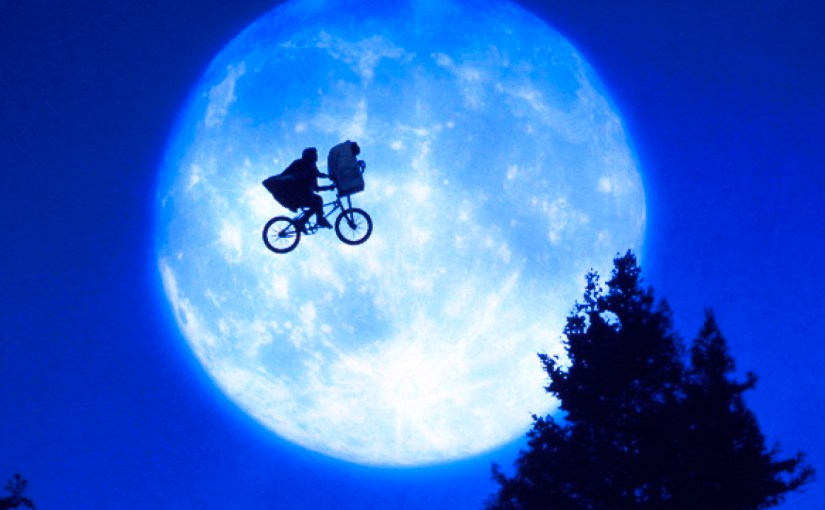
Spielberg’s film also works beautifully with an original score from John Williams.  Williams’ music speaks a language for the characters of the film.  Sometimes, his orchestration is foreboding as someone unseen lurks nearby.  Other times, it soars as the adventure kicks into gear with an outstanding bicycle escape from the government.  Williams also relaxes the pulse of the audience for the tender moments while a friendship of love and support is being built.  Watch how the score enhances the fantasy when E.T.’s fingertip glows and heals a cut on Elliot’s hand.  Williams hits a note that is in sync with Henry Thomas’ amazement.  The best sample of Spielberg’s craft blending well with Williams’ work is when Elliot’s bicycle soars into the sky with E.T. as a passenger.  As they ride across the backdrop of a full moon midnight clear, this movie provides one of the greatest shots in film history.  If there was ever a reason to prove why an original score is so necessary in film, it’s important to use E.T. as an example.

Steven Spielberg was especially sensitive when making E.T. The Extra Terrestrial.  I saw an interview with him where he decided that once E.T. departs the children of the story, the actors themselves would never see him again.  He insisted on that with young Drew Barrymore and Henry Thomas, and he warned them in advance.  Because he was steadfast in that decision, their performances were all the more genuine.  Their tears of love and sadness were kept authentic.   In one documentary, footage following the end of shooting with E.T. shows Barrymore completely distraught in the comfort of Spielberg’s arms.  Spielberg knows that everyone suffers loss.  It’s a rite of passage in life.  My first loss was my grandfather at age 9.  Imagine coming to the understanding for the very first time that someone you’ve grown close to will never be seen ever again. 

That’s the magic that Steven Spielberg possesses.  He can make anything feel real.  His fantasies and frights are true in nature.  Nothing appears ham-handed.  When watching a film from Spielberg, you’re enveloped in its environment.  What’s in front of you is what will terrify you or laugh with you or make you cry.  What you are seeing, and hearing will allow you to reminisce on a time in your life when you were scared or sad or happy or lonely.  Steven Spielberg might have used people from outer space in his films to tell us that we are not alone.  However, we are also not alone in our feelings.  Steven Spielberg reminds us that we all encounter these emotions at point or another and therefore, there’s nothing wrong with responding like any other human being would. 

PETER IBBETSON (1935)

by Miguel E. Rodriguez

Director: Henry Hathaway
Cast: Gary Cooper, Ann Harding, Ida Lupino
My Rating: 9/10
Rotten Tomatometer: No rating

PLOT: A successful architect who longs for the love of his childhood friend is delighted to discover that the Duchess who just hired him is in fact his long-lost beloved.  This being melodrama, there is of course much more to the story.


[SPOILERS FOLLOW]

Peter Ibbetson plays like a long-lost Dickens novel, full of melodramatic flourishes and convenient plot contrivances designed to play the audience like a grand piano.  Is it shameless?  Yes.  Is it maudlin?  Yes.  Do I normally like movies like this?  No.  But there is something about this film and its story that got around my defenses and into my heart and soul.  I’ll try to elaborate on that as much as I can, but I don’t know how well I’m going to do.  Good luck.

The story opens, as the title card helpfully explains, in the middle of the last century, which would make it somewhere around the 1850s.  Somewhere in a well-heeled French countryside, two children from neighboring British families play and quarrel with each other, Mimsey and Gogo.  (I am not making that up, though why parents felt the need to inflict those names on their children is utterly beyond me.)  Gogo, the boy, cruelly teases the girl, Mimsey, who nevertheless gives as good as she gets.  Unfortunately, Gogo’s mother dies after a long illness, and when a distant uncle arrives to take Gogo back to England, he realizes he doesn’t want to leave his precious Mimsey.  Together they try to run away and hide, but it’s no use.  The sight of poor Mimsey weeping in the branches of a tree as Gogo is finally taken away was one of the scenes that started to chip away at my armor of cynicism.

Time passes, and Gogo changes his name to Peter and takes his mother’s last name, Ibbetson.  He becomes a successful architect and a valuable asset for his employer.  (In a very Dickensian touch, Peter’s employer is blind…wholly unnecessary to the plot, but that specificity makes it feel even more realistic amid all the other melodrama.)  Peter is successful, yes, but he is unhappy.  He is a bachelor, and when a very pretty girl more or less hits on him at a museum back in France, he takes her for a drink as a matter of courtesy, not out of any real attraction.  His heart still belongs to the lost love of his childhood, you see.  Mimsey is the touchstone of his past, his Rosebud, his green light at the end of the pier, and she will not be easily eradicated.

Initially, I was unsympathetic to the adult Peter.  How can anyone get on with their life if they’re stuck in the past?  It didn’t work for Kane or Gatsby.  If there’s anything the last thirty or so years of my life has taught me, it’s that the past will only weigh you down if you let it.  I’m not suggesting one should literally forget history, but had I been one of Peter’s associates in the film, I would have been constantly reminding him about being grateful for the present rather than bemoaning the mistakes or regrets of the past.  That way lies madness.

Before I get into more story details, I should mention the style of the film and the acting, which is so mannered and stylized that it feels as if it were a silent film that had a soundtrack added as an afterthought.  Gary Cooper may be a legend, but in this film…let’s be blunt, he is no Cary Grant.  Every sentence feels as if it’s been dragged out of him by way of torture.  His charisma is based solely on his imposing height and his dashing good looks, NOT his speech.  (Sorry, I calls ‘em like I sees ‘em.)  The women are not much better acting-wise, though the Duchess of Towers does have some interesting moments.  However, one of the movie’s highlights are the cinematography and subtle visual effects, especially in the late stages of the film.  Look at that scene involving the peculiar qualities in the bars of the jail cell and explain to me 100% how that was accomplished.  It’s so understated and effective that it took me completely by surprise.  I believe it would raise eyebrows with TODAY’S audiences.

I mention all of this about the style and my mindset because I believe that it all contributes to the reaction I had to the film, at which I’m still perplexed.

One day, Peter is contracted to rebuild the stables of an aristocratic family, the Duke and Duchess of Towers.  When Peter first meets Mary, the Duchess, he experiences an unexplainable connection.  His contract requires him to live in the Towers house for several months.  One day they share a conversation and discover that they shared a dream.  This isn’t a case of two people dreaming about the same thing coincidentally.  They actually shared a dream, Inception style, but without the machinery.  How can this be?

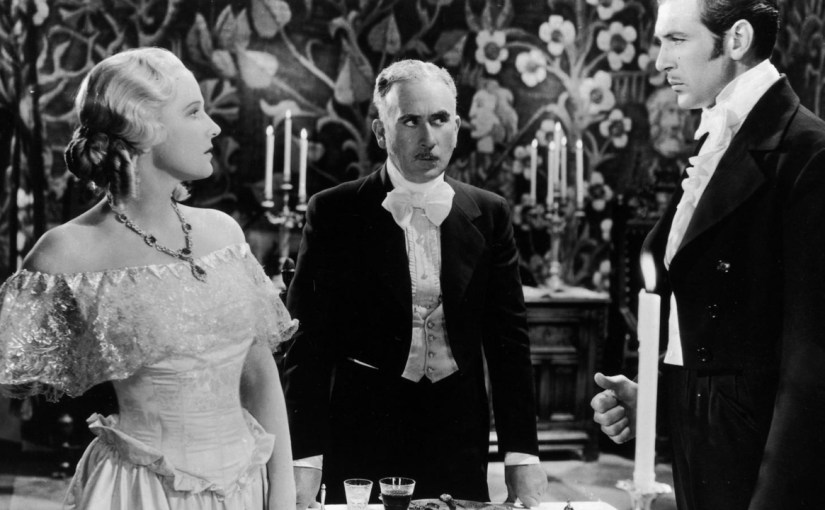
By now, any breathing audience member has already deduced that the Duchess is Mimsey and they are destined for each other.  Alas, Peter and Mary are not as quick on the uptake as we are, and their moment of recognition is delayed until after the peevish Duke confronts them at the dinner table, in a conversation laden with Hays-Code-era double-speak.  “Well, Mr. Ibbetson, are you to be congratulated again?” the Duke asks.  Later, during a second confrontation, the Duke points a gun at Peter and Mary and explains that they will not make love behind his back.  He raises his gun and says, “Get into your lover’s arms.”  Whoa.  Daring stuff for 1935.  It’s during this second confrontation that something goes horribly wrong, and Peter is sent to jail for life.

MORE melodrama?  Hasn’t this movie already had more than its fair share?  Children tearfully separated?  An equally tearful reunion?  Outrageous coincidences?  Shared dreams, for crying out loud?  Oh, you ain’t seen nothing yet.

It’s in the film’s third act, when our hero is in prison, that Peter Ibbetson really started to get to me at some primal level.  Peter and Mary, after being reunited against all odds, are now separated even more cruelly than before.  Peter is so distraught he goes on a hunger strike, chained to his “bed,” which is little more than a wide wooden beam.  (Look at it from a certain angle and he might almost appear to be on a cross, but don’t worry, it’s not that kind of movie.)  When one of his fellow prisoners makes a joke at Mary’s expense, Peter goes a little crazy and starts to throttle him.  Miles away, at the same time, Mary suddenly senses something is wrong.  In the jail, guards use force that’s a tad too excessive to restrain Peter, and at the same exact moment Mary screams.  The two are connected in a mystical way that transcends walls or distance.  They continue to share dreams in which they laugh and walk and talk as if nothing bad had ever happened.  In one dream, he points to a castle in the distance that he has built for his beloved.  I was reminded instantly of the scenes in Inception where Cobb and his wife Mal build entire cities for themselves in their own shared dream.

I’ve already given away too much, far too much than I usually care to.  As much as I want to, I can’t describe the one scene that got me to literally yell, “NO!” at the TV screen.

What fate eventually befalls Peter and Mary, I leave for you to discover.  What remains for me is to try once again to summarize how I felt after the movie was over.  Intellectually, I can see its shortcomings.  The acting is wooden, despite some pretty sharp dialogue.  The music is overwhelmingly romantic and dramatic, commenting on a lot of action unnecessarily, as was the custom back then.  There are one or two odd cuts.  But on an emotional level, the experience of watching Peter Ibbetson was like watching one of Shakespeare’s tragedies.  The only other movies that ever made feel these precise emotions, although not to the exact same degree, are The Remains of the Day and Atonement.  If you know those movies, you know what I’m talking about.

The movie’s final shot is as shamelessly manipulative as these things get.  It’s unabashed romanticism at its best AND its worst.  But you know what?  This movie earns it, and it works.

ANT-MAN

By Marc S. Sanders

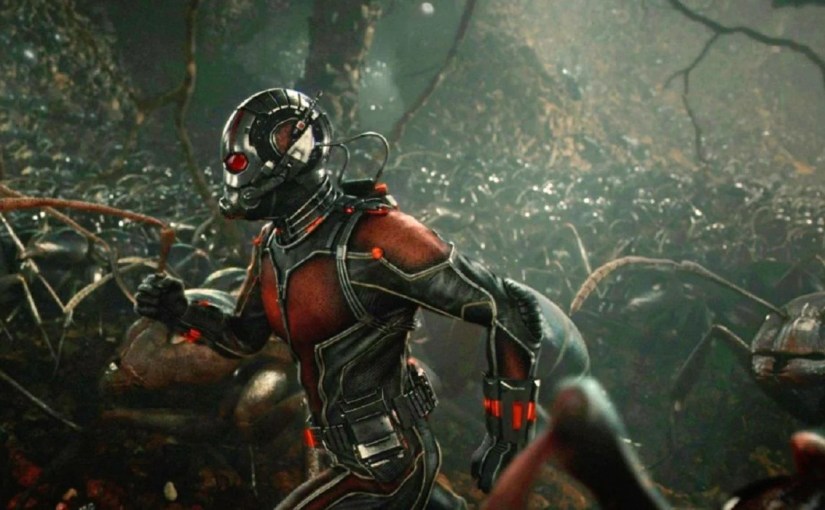
Peyton Reed not only capitalizes on Edgar Wright’s interpretation of Marvel’s Ant-Man, but also on the first chapter of the MCU, Iron Man. The similarities in the two films are so familiar that Ant-Man seems a little boring and redundant. You’ll turn to your seat mate midway through and say “We’ve seen this.”

Nevertheless, Reed’s film is saved thanks to a likable Paul Rudd, a welcome Michael Douglas and a scene stealing Michael Pena. Evangeline Lilly is here but she’s as useful as Gwenyth Paltrow has been. Corey Stoll is the bald villain, like Jeff Bridges before him, and well… LOOK!!! You just needed to find someone to be the villain; the guy interested in stealing technology to use for making a lot of money and other nefarious purposes. You’ve seen it all before.

Pena is given the best stuff to do as Reed takes advantage of visually recounting a “telephone game” story of what he and then what she said and then what he said after that. Michael Pena is a really funny guy who deserves more work. He’ll likely get a lead in an ABC family sitcom one day called Pena or Michael!, let’s say.

Rudd has fun with the stupidity of his superhero name and abilities. Let’s face it. Controlling the minds of ants is not as flashy as Batman and his gadgets or Spider-Man web slinging through the city. Rudd smirks through all of it. So, I felt okay to smirk as well.

The film suffers from a lot of exposition and a few too many characters. In a flashback 80s scene, Douglas’ character (the original Ant-Man) breaks some SHIELD agent’s nose. What’s so special or offensive about this guy? I don’t know. Also, Bobby Cannavale is a pain in the ass cop for Rudd to deal with, but more or less you’d have the same film if he was excised from the final cut.

Reed saves his movie with a really fun ending consisting of a battle involving shrinking and enlarging and shrinking again aboard a Thomas The Train Engine toy playset. It’s Rudd as Ant-Man vs Stoll as Yellowjacket (very cool looking and not used enough). As well, you can’t help but smile when you see a fifty foot high toy train crash through a house.

This is a scrappy little film in the Marvel Cinematic Universe and not much seems original, but you got a cast that’s likable and an ending to be entertained by.

Nothing special, but nothing terrible either.

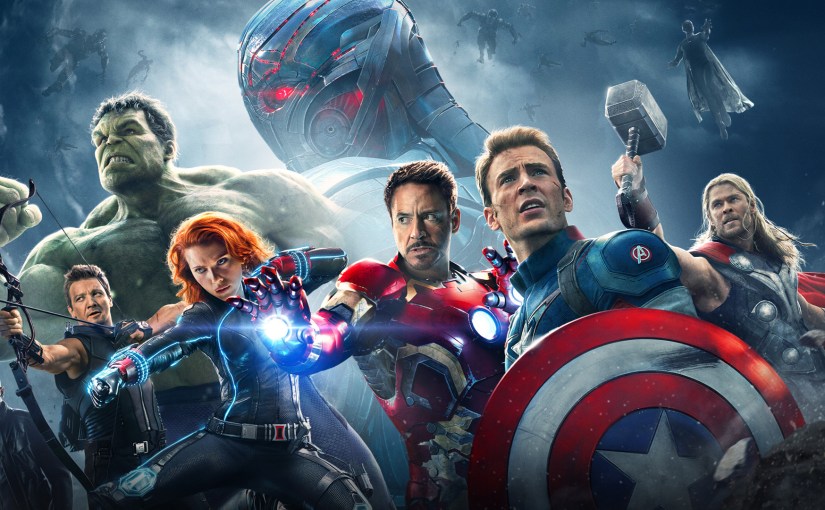
AVENGERS: AGE OF ULTRON

By Marc S. Sanders

The character of Ultron, a terrorizing cyborg, has been a favorite Marvel Comics villain of mine ever since I discovered him in 1984 during the Secret Wars 12 issue limited run. He looked sinister with a devilish face in the shape of a metallic claw. His sonic blasts appeared more destructive than anything else ever drawn on the page. Ultron was a badass!!! (“Language!”). That being said, the cinematic interpretation is quite different, yet he’s modeled on a much more grown up sculpt.

Ultron is still a terrorist bent on utter destruction, but now he has a disregard for man. He’s written quite inventively as a direct contradiction to arguably the favorite of all the Marvel cinematic characters, Iron Man aka Tony Stark. How fitting that James Spader is cast opposite his former brat pack cast mate (Less Than Zero), Robert Downey, Jr. It is really uncanny how the dialect of Spader’s limitless Ultron can sound just like Downey’s genius Stark but with a means of annihilation; “All of you against all of me.” Ultron is smart first, powerful second. He’s not just a monochromatic android. There’s a means to his end and an inventive science to his purpose; uproot a country high in the sky and then DROP IT BACK DOWN INTO THE PLANET, like an anvil flattening Wile E. Coyote. It’s actually more novel than I’m giving it credit for.

Most Marvel afficianados from the blogs, and fellow colleagues as well, do not care much for this chapter in the MCU. I have yet to understand why. Again, each character is really drawn out beautifully by Joss Whedon with a respective storyline. Finally, Jeremy Renner’s Hawkeye is given some oomph to his back story. So is Paul Bettany as the other cyborg, Vision, formerly J.A.R.V.I.S, the artificial intelligence.

Vision/J.A.R.V.I.S. outshines Data (“Star Trek: TNG,” apologies to my friend, Jim Johnson), but will never top C-3PO. I like how he’s introduced as an amalgamation of all of the film’s main characters’ abilities. Bruce Banner and Tony Stark, Thor, Ultron, Scarlet Witch, some brilliant doctor friend, and even the nation of Wakanda. They all have a piece of themselves in Vision. It’s a better story than the comics ever suggested. Maybe I’m biased having grown up on these stories, but the Vision element makes me want to clap every time I see it. So inventive and economically told for a two-hour film with a ginormous cast. Vision’s introduction is one of the best scenes in all of the Marvel Cinematic Universe.

A great device to unhinge most of the Avengers comes through by means of Elizabeth Olsen’s Scarlet Witch (identified as Wanda Maximoff) who cripples them with mind control. How else should a sorceress take out a whole lotta muscle? It works and it gives Olsen conflict to play with. The visual effects surrounding her are also pretty cool. Sure, it might be just some neon red mist, but the cinematography and CGI surrounding her look gorgeous.

This installment also serves as neat set up for what’s to come. Quick Easter Egg in Age Of Ultron: Tony Stark Name drops the term “Endgame.” Oooooooo!!!!!!

It is really admirable what Marvel and Disney have done with the MCU, and especially watching this film. It’s ironic how filmmaker James Cameron made a statement hoping for “Avengers fatigue” so the phenomenon can die down in movie houses, etc. Funny! For me, seeing all of Ultron’s toys and wit seemed to outshine quite a bit of the residuals spawned from Cameron’s Terminator franchise.

Whedon wrote and directed a film with much more intelligence, wit, at least as much action, and threat than I ever got from Cameron’s reputation of clunky dialogue and plot hole time travel storytelling. It would do Mr. Cameron well to maybe not throw stones at the glass Avengers towers. I’m skeptical that his upcoming FOUR Avatar films will carry the smirk inducing cues the MCU has used to its advantage.

FANTASTIC BEASTS AND WHERE TO FIND THEM

By Marc. S. Sanders

I really do like the Wizarding World of J.K. Rowling.   The attention to detail is marvelous.  The landscapes she has painted over eight best-selling books that follow the adventures of a boy wizard, are limitless.  A new kind of fun vocabulary was invented thanks to her colorful imagination.  Still, she needs an editor!  Even if it is not a novel, her recent screenplays that follow the escapades of another magical protagonist, Newt Scamander, and his small, distressed suitcase drift off into so many side stories, it is difficult to focus on a central plot at play.  While some might appreciate the assortment of distractions, for me it grows a little frustrating.

Fantastic Beasts And Where To Find Them (great title) is the first of what will become five new films that focus on an earlier time before the famous boy who lived was ever born.  Rowling takes the magic to New York City for the odd, but adorably likable Newt (Eddie Redmayne) to accompany his suitcase that carries the most unusual creatures that any other fantasy has likely ever introduced.  There’s a platypus duck thing that has a penchant for stealing jewelry and coin; perfect for stuffed animal merchandising at Universal Studios.  There’s a purplish-blue mosquito that twittles around.  There’s a dragon and an elephant/rhino combo thing.  There are bright green grasshoppers that hide in Newt’s jacket pocket.  It’s an encyclopedia of Rowling wildlife.

Newt arrives in Depression era New York and some of the creatures flip the buckles on the suitcase open, and before you know it, he’s chasing them through the streets.  Soon after, he gets his bag mixed up with another one belonging to a lovable baker “No Maj” (American term for “Muggle” or non-magic person) named Stanley Kowalski (Dan Fogler).  From there, a partnership is forged, and the men are pursuing the missing animals through the city bank, the zoo, tenement buildings and jewelry shops.  Romantic angles serve the men by way of magical sisters, Tina and Queenie (Katherine Waterston and Alison Sudol).

Parallel to all of this are concerns of a magic criminal known as Grindlewald who is making headlines for his various worldwide offenses.  The North American magic congress is disturbed by these events and rely on a man named Graves (Colin Farrell) to investigate.  As well, there is a No Maj woman (Samantha Morton) leading a chorus of city folk and politicians (including Jon Voight) in the hunt for what are believed to be witches and those that are committing crimes of witchcraft.  This woman serves also as a foster mother to numerous children, two of which are known as Credence and Modesty (Ezra Miller and Faith Wood-Blagrove).  These two in particular are curiously quiet with a dark way about them. 

So, yeah!  There’s a lot going on here.  There are a lot of stories to explore and a lot of characters to meet. As well, there are a lot of animals to learn about.

David Yates has become the go to director for the Harry Potter franchise and he takes up the mantle here as well.  This first film in the new series is gorgeous to look at with its period piece art design and the CGI special effects blend nicely with the human actors. 

However, the film loses itself over and over again with the different avenues it takes.  One moment we are supposed to feel the tension of Grindlewald on the loose. Then we are getting into madcap mischief with two other characters chasing down silly creatures seemingly inspired by a Jumanji theme.  We are also treated to an opportunity to literally step down into the suitcase for a whole other world of different settings where these animals are meant to be housed.  It’s wonderous for sure and Yates simply allows time for observation and nothing else.  Intermittently within the film, we also end up following these two dark children who are altogether disturbing, and we wonder why.  How and when do they come into play?  Rowling’s script is more concerned with painting broad strokes of new environments, rather than staying focused on one trajectory.  At times, I’m asking myself, where did we leave off with this storyline or that storyline.

Eddie Redmayne is adorably quirky, but maybe a little too much.  He has the “Willy Wonka” palette to his wrangler occupation. Though, his dialogue gets swallowed in his modified English accent and it is difficult to comprehend what he is saying.  He’s deliberately mumbling his words to build upon the oddities that come with Rowling’s character.  Newt has a name for each creature in the film, but there’s no way I could understand what he calls them.  I don’t even think his acting partner, Dan Fogler, understands everything being said to him.  On this latest viewing with my wife, we opted to turn the subtitles on our 4K player.

The characters are suitably atmospheric for the dark and unusual that stems from Rowling’s imagination.  Colin Farrell always plays well as the handsome, yet brooding man of mystery.  Ezra Miller seems to come from the cloth of a Tim Burton iteration.  Fogler’s character is the best though.  His expressions of stare at the amazements he’s witnessing for the first time represent the audience.  He’s not the bumbling fool that other storytellers might depict him to be.  He truly can’t believe his eyes at first, but eventually builds an affinity for the fantasy in front of him.

The ending somehow brings all of these characters together. It is engaging for sure with an action-packed encounter with a black cloud blob within the underground subway tracks. Then it is concluded with a celebrity cameo that teases of what’s to come. 

Fantastic Beasts And Where To Find Them is not unwatchable, but it requires extra attention so that you can recall where one story leaves off and then later resumes itself.  Often, I found myself asking how did I get here, and then my mind would wander and I’d get distracted from the continuing narrative. 

There’s no doubt of the kind of power and influence J.K. Rowling has.  If only someone would be brave enough to offer her a little constructive criticism, though.  The Fantastic Beasts series was originally meant to be a trilogy of films.  Then her contract with Warner Bros expanded to five films.  You know what?  With all that Rowling has to share with us, I think she might need ten or twelve films.