
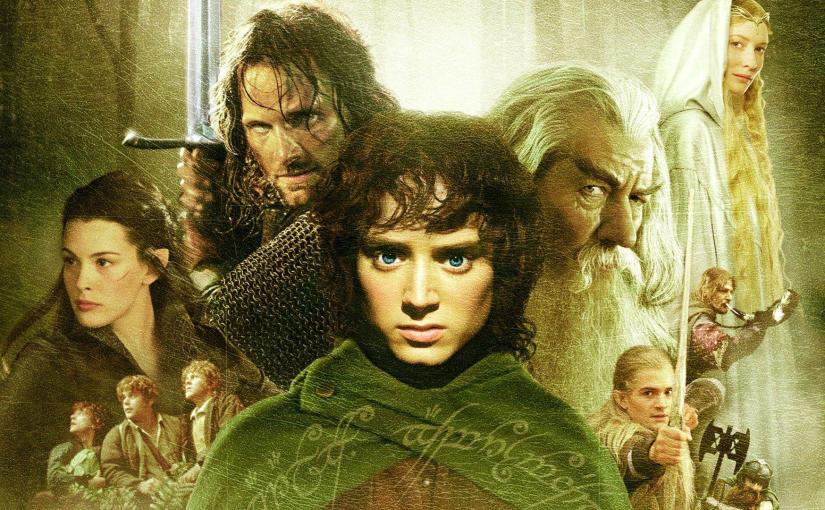
THE LORD OF THE RINGS: THE FELLOWHSHIP OF THE RING

By Marc S. Sanders

JRR Tolkien was one of the 20th Century’s greatest fantasy writers. The Lord Of The Rings series was a dense, sweeping epic inspired by the torn European climate during World War II and its conflict with the Axis nations, particularly Hitler and his organized Nazi Germany.

Peter Jackson found the opportunity to adapt Tolkien’s works. In 2001, The Fellowship Of The Ring amazed audiences with its epic landscape of Middle Earth, Isengard and Mordor where the fiery Mount Doom is located and the evil eye of Sauron waits for a resurgence of overthrow.

Much happens in each three hours plus Rings films. Tolkien’s story is not so much plot, but moreover a journey from one adventure to another. What’s special is that the main hero is a small, kind Hobbit named Frodo Baggins (Elijah Wood) who has been tasked with carrying the dangerously powerful “One Ring To Rule Them All” back to Mount Doom and destroy it. He is aided by eight fellows, three other Hobbits and four representatives of various nations and backgrounds to protect and escort him. The most significant member is the wise wizard Gandalf The Grey played by Ian McKellen in an Oscar nominated performance. The other characters’ significance become more established in later films.

This first installment is my favorite of the series because it is the most absorbing. I believe in the all but sinister and deadly value of Tolkien and Jackson’s MacGuffin, the Ring. Jackson does well of posing the threat of danger each time Frodo dons the Ring for the sake of invisibility while the Orc army of Saruman, Sauron’s Wizard henchman played by Christopher Lee, bears down on the Fellowship. The film shows one battle after another but the suspense is heightened each time as we become more familiar with Jackson’s digital world. It’s also quite dramatic to see Frodo become consumed in fear and a kind of sickness as the possession of the Ring weighs upon him. To precisely show that transition requires a three hour film, and Elijah Wood is up to the task, always appearing quite angelic and unsure of his assignment. Wood is quite the underrated actor.

There are a multitude of character descriptions in The Fellowship Of The Ring and a number of them come into play when centered around the viewpoint of the Ring. Backstories for others are really not necessary but Jackson attempts to cram as much of Tolkien’s narrative as possible. Beyond Frodo, and maybe Gandalf, the other most interesting character here is that of Boromir played by Sean Bean, often playing a variation of a hero in his films, but quite good at not being worthy of endless accolades. Boromir is a great character to show how the temptation of the Ring can cloud and poison the mind. Bean evokes that of one who might be a weak addict, needing a quick fix of the Ring’s power. There’s a complexity to his performance. Boromir is likable but Sean Bean makes the character quite shocking as well. He’s not a villain but his internal weakness presents a conflict for Frodo and his band. Sean Bean never got enough recognition for his role here.

Peter Jackson is the real hero though. This series is a massive cinematic accomplishment. Everything feels gratefully familiar. Perhaps that is from reading Tolkien’s visually descriptive books, or maybe even the animated film from the seventies. There’s something to see in every corner of the screen. It’s a world come alive in leaves, creatures on land or in the sky, sorcery and swords, flames and even saloons of overflowing drink and large platters of food. The Shire where Frodo lives with his uncle Bilbo (an excellent and jovial Ian Holm) comes off as a happy utopian village of farming and Hobbit celebrations of laziness and relaxation from any outside elements. Jackson contrasts this beautifully against the majesty of Rivendell and the hell of Mordor. It’s a nuanced universe.

Again, for me this first installment remains the best as it is cinched up tightly in its exposition and narrative. Later films are just as grand but maybe sidestep away from themselves a little.

I never got that impression with The Fellowship Of The Ring. Everything I see belongs in the film.
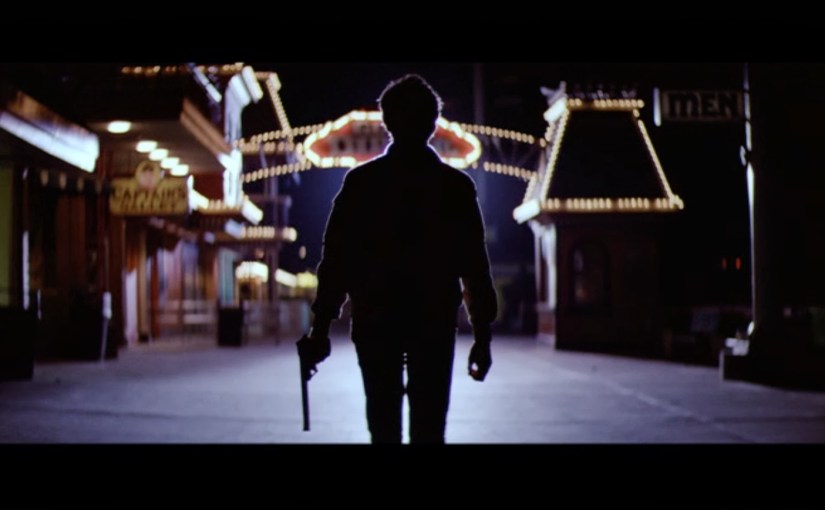
SUDDEN IMPACT

By Marc S. Sanders

The very first R rated picture I ever saw in theaters was the fourth installment of Clint Eastwood’s Dirty Harry franchise, entitled Sudden Impact.  I was eleven years old and I loved it.  My brother Brian took me with his best friend Nick.  Age 11 and I’m in a crowded theater on a Saturday night watching a brutally violent and sometimes funny crime drama with the cop who carries the .44 Magnum.  Looking back, it felt like a rite of passage.  It felt rebellious.  I’d now be the coolest kid in school as I recount for them everything I was allowed to see that their parents refused to even consider.

Brian introduced me to many of what remain my favorites this very day.  He introduced me to Jackie Gleason in The Honeymooners,and then at age 8 or 9 I must have watched the first of Eastwood’s series, Dirty Harry, on video tape.  At that age, you just want to get to the next shootout where Harry allows his bloodletting revolver do the talking while he finishes his hot dog.  I watched those first three films (Dirty Harry, Magnum Force and The Enforcer) over and over again.  As an adult, I more so appreciate the themes of the San Francisco cop, Harry Callahan.  He always had a low tolerance for the bureaucratic BS of court procedure and legal precedent.  He was always smart enough to know who the real bad guys were and that was enough to bring them in. If they didn’t cooperate, well then there were other means. 

The first two films in the series question Harry’s procedures and philosophies.  The third film, although entertaining to a degree, deviated from that.  The fourth film returns to test Harry’s beliefs in police enforcement and justice.  Only this time, it’s actually from the perspective of a gang rape victim, played by Sondra Locke.

Much of the first hour of Sudden Impact is episodic.  Scene after scene shows Harry’s encounters with various hoods that he has a connection too.  Harry disrupts a wedding to undo a vicious mobster.  Later, those guys try to take him down.  Some punk kids get off on a technicality in court.  They’ll have something to say to Harry as well, and just in case you need a little more action, there is that very memorable coffee shop robbery where Harry tempts all of us to “Go ahead.  Make my day.”  There’s also good laughs as Harry is gifted a bulldog he calls Meathead. 

Weaved within these various moments is a separate story focusing on a beautiful painter who has a knack for killing men with one bullet to the genitals and another to the head.  She has revenge on her mind following a gang rape of her and her sister ten years prior.  Eventually, Harry is assigned to investigate and he is on his way to a fictional neighborhood known as San Paulo (filmed in Santa Cruz).  Harry has to navigate around a difficult police captain (Pat Hingle) as the killings continue to happen out here.

I’ve always been fascinated with the Dirty Harry series.  Surprisingly, when I do internet searches on the films and character, I don’t find much that explores the measure of rights and law.  Yet, beyond the sometimes-comic book violence of the pictures there’s much to question and think about.  Is Harry right with his chosen actions?  After all, the films make clear that the bad guys are the bad guys.  The writing however, makes it a challenge when legality interferes and the rights of men and women are tested.  Sudden Impact does the same thing.  With Eastwood directing, he makes the viewers witnesses to what the Locke character is subjected too.  That should be enough, right?  Real life is not that clean cut though.  However, in an age of internet surfing and headline breezing, people are endlessly tried in the court of public opinion and not a court of law.

The first film in the series had Harry declare that the law is crazy.  The second film tested the protagonist when he uncovers that people supposedly on his own team were carrying out vigilante murders against the worst mobsters and pimps in the city, as a means to clean up the streets.  Now, another and more personal vigilante appears.  What makes Harry right and these others wrong?  I don’t think any of the five films in the series ever give a clear-cut answer.  That’s okay.  I’d be frightened if there were a direct response, because it remains a complex issue.  When the courts fail us, what is there left to do?

Do not mistake me.  I am not calling for violence.  I’m just questioning a system that is sometimes broken.    

Recently, a local trial wrapped up where a retired police officer shot a man in a movie theatre who became argumentative and belligerent when he wouldn’t turn off his cell phone.  Popcorn was thrown, a gun was drawn and a man was instantly killed.  The retired police officer was found not guilty by a jury of his peers.  The court of public opinion by and large have been outraged with this verdict.  The grieving widow felt as if justice was not served.  Followers of the story didn’t either.  Another story focused on a beloved teacher who was hit by a car in a school parking lot.  I actually got into a public Facebook debate with someone who said the driver should be punished to the full extent of the law.  I questioned if the driver is truly guilty of murder or manslaughter.  It could have just been an accident.  We are humans to a fault.  How do we know the teacher didn’t just step in front of the car without looking?  The opposing view insisted the driver had to be speeding.  Maybe.  Yet, at the time neither of us knew that.  A car going at 5 mph can just as easily crush a human to death as a car going at 30 mph.  I insisted to the person I was sparring with that she was riding a slippery slope of presumption without all of the facts disclosed.  A police report has yet to be publicly disclosed.  Circumstances always come into play.

I know I’m digressing.  With a Dirty Harry picture like Sudden Impact, it’s laid all out for you.  Harry will request that four robbers put down their guns before introducing his friends Smith & Wesson.  He’ll also consider the circumstances after a woman’s life has been permanently scarred with no one to side with her.  A police officer should not be judge and jury.  Yet, it’s reassuring those films like Sudden Impact or Dirty Harry will allow a comeuppance for the wrongdoers in the world. During the closing minutes of the film, Sondra Locke delivers a monologue that at least is worth consideration even if it’s not agreeable.  I don’t believe our society should turn into a wild west circus where you can get gunned down in a movie theater over thrown popcorn.  I do believe however, that evidence must be taken more seriously in many circumstances.  Suspicion must be valued more often. 

Sudden Impact might have a right-wing attraction to it.  It glorifies gun violence, for the sake of action entertainment.  Harry doesn’t just have a .44 Magnum.  Now, he also has a .44 Magnum Auto Mag!!!!  (Whatever that is!)  Ironically, this picture is primarily told from a woman’s point of view where she wants to be believed and she wants justice, much like many of the messages of the Me-Too movement that gained major traction in 2019.  It’s insisted that when a victim says they have been raped or assaulted, no matter how far back the incident occurred, it should be believed.  The argument is where’s the proof?  Like Harry Callahan though, proof is not always the end all be all.  Instinct and common sense sometimes have to prevail.  Again, it’s a slippery slope, but it’s also always worth questioning.  Harry Callahan is always worth questioning.

THE TRUMAN SHOW

By Marc S. Sanders

Perhaps The Truman Show directed by Peter Weir demonstrates that no matter what time period a person exists in, he/she/they will never be limited to life within a television set.  Life is meant for more than just stories coming from an electric box.

Jim Carrey portrays Truman Burbank who is the star of the addicting and ratings bonanza 24/7 television program known as The Truman Show.  Since his birth, Truman has been observed by the world.  His parents are actors.  His friends are too.  Co-workers and neighbors and townsfolk as well.  His wife Meryl (Laura Linney) is just an actor.  It’s all fake.  Yet, for Truman it’s all real.  He has no idea that he is a worldwide guinea pig meant for complete observation.

Now that Truman is in his thirties, though, he is becoming wise to the fact that something doesn’t feel right.  Every day, for example, is no different than the one before.  It’s all routine.  He kisses his wife on his way out the door.  He waves to his neighbors.  He always teeters on selling an insurance policy to two dweeby twin brothers.  He picks up a magazine at a local stand in the center of his harbor island town.  He responds positively to his boss and then he comes home and mows his lawn. 

It’s only when odd occurrences appear that Truman starts to think and for the television show’s creator, Christof (Ed Harris), that’s a dangerous risk for the longevity of the program.  Christof manipulates everything that happens to Truman thereby manufacturing his fear of the ocean.  An episode from long ago focused on Truman’s near fatal drowning accident with his “father” who went missing.  That fear keeps Truman contained and unable to explore beyond Christof’s inserted limits.  His program allows for sponsorships like the six pack of beer that Truman’s best friend Marlon (Noah Emmerich) always carries or the household products that Meryl uses at “home.”

Peter Weir’s film is concerned with discovery.  Efficiently speaking, he presents the script written by Andrew Niccol with a “how it works” narration as part of a fast moving first act.  When we, the viewers of the film (not the viewers of the show within the film) are accustomed to Truman’s normalcy, then we perk up when we see something out of place like a set door that reveals a backstage catering counter for cast and crew.  We find it amusing when the weather doesn’t work properly and it only rains directly over Truman, and nowhere else.  What would Truman make of a stage lamp falling out of nowhere from a clear blue sky? Christof would not even think to imagine. Even more disturbing is when one of the program’s actors does not cooperate with the illusion, like a girl named Lauren (Natasha McElhone) when she attempts to reveal the truth to Truman as they genuinely become attracted to one another.  Suddenly, “her father” whisks her over to a mysterious place called “Fiji,” and Truman becomes fixated on visiting that locale one day.

Unlike Paddy Chayefsky’s Network, I don’t consider The Truman Show to be brilliantly prophetic.  Ever since the television was invented, we’ve become addicted to the images emanating from the box in the center of our living rooms.  So, I guess I’m not as fascinated with this film as others have claimed.  The viewers depicted in the movie like regular bar patrons, old ladies who are sewing throw pillows and blankets while watching on their sofas, and parking garage security guards working out of their enclosed booth, are hooked.  They’d never even think of falling asleep or changing the channel.  We are not however, and are left with observing Jim Carrey doing another silly role sprinkled with some sensitivity and an intelligence that is slowly becoming aware.

Perhaps Weir and Niccol are toying with the idea of God, and his play toy that he calls man or in this case Truman (True-Man).  God has the will to control a person and keep him contained, but his invention will eventually develop a mind of its own.  Intelligence breeds defiance and a want for freedom.  History continues to show that.  Therefore, man will build up the gumption to sail across the treacherous seas in search of what’s out there beyond what the eye can see.  God will test and test and test.  Man will either pass or fail, again and again.

In this age of endless reality tv programs, far be it for me to say that the set up of The Truman Show is unlikely.  Yet, it still does not seem possible.  It’s ridiculously over the top.  (Watch me eat my words one day.)  So, Peter Weir’s picture is a fantasy, I guess.  However, is it a fantasy I really care about?  Unlike the viewers of the program within the film, I never cared about Truman.  I never cared about Christof, Truman’s antagonist.  I definitely don’t care about the actors in the tv show.  Sure, Niccol’s script is an idea: “What if a guy was born and raised and lived within a television show?”.  However, is this an idea that is worth running through with?  What’s to gain from the picture? I guess I missed a number of episodes or a couple of seasons to empathize or follow the ongoing story. 

Having seen all the episodes of The Sopranos or Breaking Bad or even Cheers and The Big Bang Theory, I was there from the beginning.  So, I was concerned with the outcome of Tony Soprano and Walter White and whether Sam & Diane would make it as a couple.  Truman Burbank is just another Jim Carrey caricature that I just don’t care about.  So, you’ll have to excuse me if I go check out what’s on the other channel instead.  Maybe Jeopardy is on.